



 by Tom Gurney
Tom Gurney BSc (Hons) is an art history expert with over 20 years experience
Published on June 19, 2020 / Updated on October 29, 2026
Email: tomgurney1@gmail.com / Phone: +44 7429 011000
The Representatives of Foreign Powers Coming to Greet the Republic as a Sign of Peace: Introduction
A woman in red raises a leafy branch above a gathering of solemn men. Flags crowd the roof behind them, a lion lies at their feet, and a little circle of dancers turns beside a monument across the square. Henri Rousseau gives the greeting announced in his long title an imposing public stage, then lets a quieter, more playful celebration unfold at its edge.
Painted in 1907, this oil on canvas belongs to the Musée national Picasso-Paris, which records its dimensions as 130.7 × 162.5 cm and its acquisition through the Picasso donation of 1978. It is signed and dated at the lower right.[1] The officials stand almost motionless before us; the dancers' linked arms keep them moving around one another.
At a Glance
- ArtistHenri Rousseau
- SubjectThe Representatives of Foreign Powers Coming to Greet the Republic as a Sign of Peace
- ExploreA ceremony under a canopy; The Republic and her guests
This work across Henri Rousseau’s career
Carnival Evening
1886 [2]The Merry Jesters
1906 [7]The Snake Charmer
1907 [8]Contents
- A ceremony under a canopy
- The Republic and her guests
- Branches, plants and words
- The lion and the painted shield
- A smaller world beyond the steps
- Houses, flags and an open sky
- How the arrangement took shape
- Exhibition and later history
- Annotated details
A ceremony under a canopy
The great canopy makes an immediate claim on the picture. Its reddish roof descends from the upper left towards the middle, drawing a firm boundary between the crowded ceremonial enclosure and the open sky. Thin gold bands follow that descent. Below them, a scalloped border picks out the hanging curtain, whose heavy folds form a dark backdrop for the pale faces. The whole structure seems lavishly prepared for the people assembled underneath it.
Rousseau leaves surprisingly little air around those people. Heads overlap, shoulders press together, and the figures at the back can show themselves only through the intervals between those in front. Yet each face remains distinct enough to interrupt the crowd's overall shape. White beards, dark moustaches and bald foreheads establish a succession of small changes across the line. The group rewards looking from face to face even before any names have been supplied.
Their bodies make a more continuous wall. Long black coats alternate with bright uniforms, while sashes cut across upright torsos. Much of the lower half of the assembly is occupied by narrow, almost parallel legs. The gold trim above and the red steps below hold these vertical forms between two strong sloping edges. A stage has been made for the figures, and the figures largely obey its arrangement.
The Republic and her guests
MoMA's 1985 catalogue describes an imaginary gathering containing six different French presidents, including Armand Fallières. Its identifications include Edward VII and Nicholas II, while four figures are interpreted as personifications of French colonies.[12]
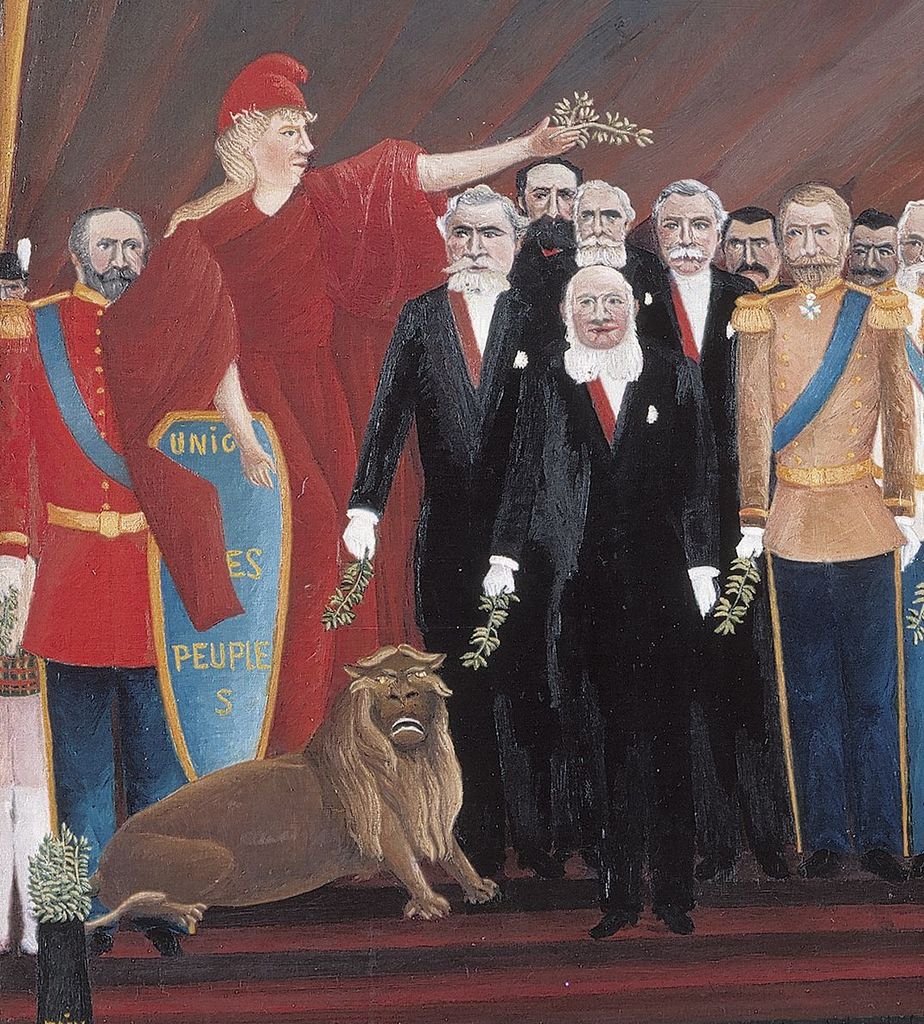
The woman in the red cap gives that gathering its point of focus. Her raised arm moves across the heads beside her, making an arch of flesh and cloth within the larger architectural shelter. Her loose red garment also breaks the sober division of the men's clothes into coats, trousers and sashes. She can appear to address the company and stand apart from it at the same time. Looking towards her, one sees why the reception requires a person to embody the Republic: a political relationship becomes a visible exchange between bodies.
Differences within the company matter as much as its apparent unity. Almost everyone stands upright, but clothing changes the silhouette from figure to figure. Near the right end, tall or spreading hats interrupt the row of rounded heads. Bare limbs contrast with heavily covered bodies. Outward appearance carries much of the burden of distinction.
That variety also invites a question about the welcome being staged. Who gets an individual public identity, and who is made to stand for a larger population? The catalogue's colonial interpretation makes that question especially pointed.[12] Within the image itself, differences of dress and placement are easy to see; equal participation is harder to read. A shared position on the steps does not make every person's role equally clear.
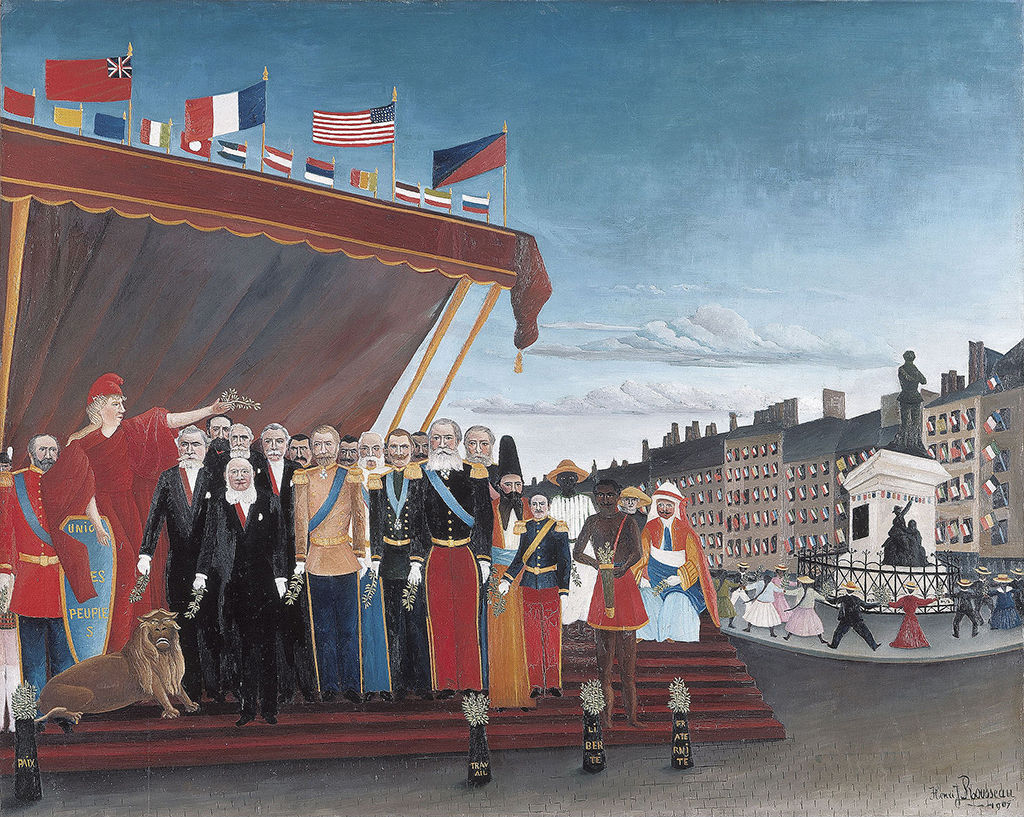
The Representatives of Foreign Powers Coming to Greet the Republic as a Sign of Peace — Henri Rousseau.
Branches, plants and words
Small sprays of leaves bring a fragile texture into the procession of uniforms. They are slight enough to disappear against a dark coat, then become legible where a hand or a pale garment supplies contrast. The raised branch has the broadest reach, but lower branches extend the gesture through the company. A ceremonial greeting becomes a repeated action, performed at different heights and with varying degrees of visibility.
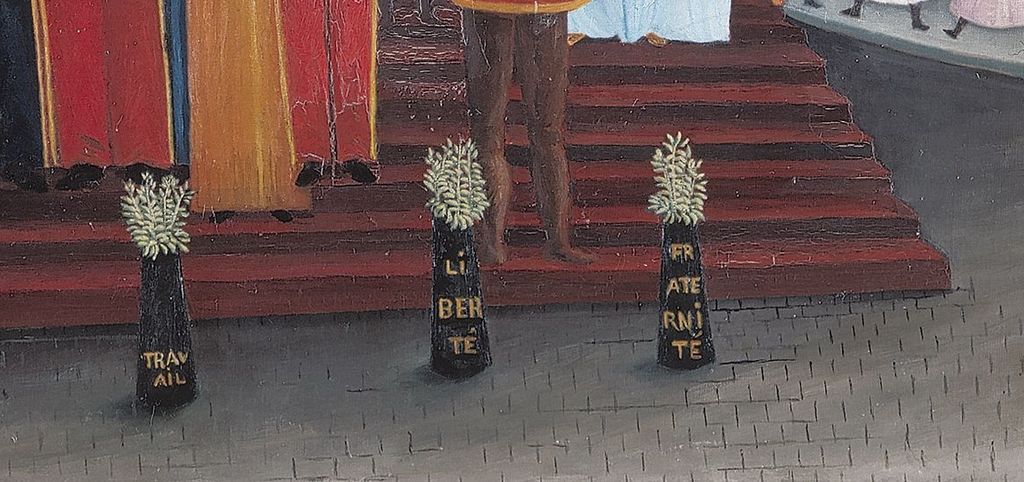
Four potted plants carry that repetition down to the front of the stage. Their thin trunks and compact foliage echo the standing bodies above them on a much smaller scale. One pot sits near the far left; the others punctuate the open ground below the central and right-hand figures. Their spacing makes the foreground feel measured, with each small plant acting as a marker along the front of the assembly.
The lettering on the pots gives the eye a second reason to pause there. The words Paix, Travail, Liberté and Fraternité divide the large political scene into short verbal declarations. Some words break over more than one line, so reading them means looking closely at objects which initially seem peripheral. The tall figures dominate the view, yet the smallest containers help articulate its meaning.
Those modest plants also change the character of the greenery. There is no luxuriant landscape to absorb the crowd. Leaves have been carried into a public square, held in hands and placed in pots. Their smallness makes the gesture of cultivation conspicuous: living things are tended, arranged and brought into the ceremony. The painted peace has objects that can be held and cared for.
Annotated Details from Representatives of Foreign Powers
The numbered points identify visible features discussed in this article. Return from each detail to the whole composition. Henri Rousseau, The Representatives of Foreign Powers Coming to Greet the Republic as a Sign of Peace, 1907. Musée national Picasso-Paris, MP2017-40. Image via Wikimedia Commons. Image source. Public domain. Numbers added to a separate resized overview. Details cropped directly from the published original without enlargement,sharpening,recolouring,cleaning or retouching.
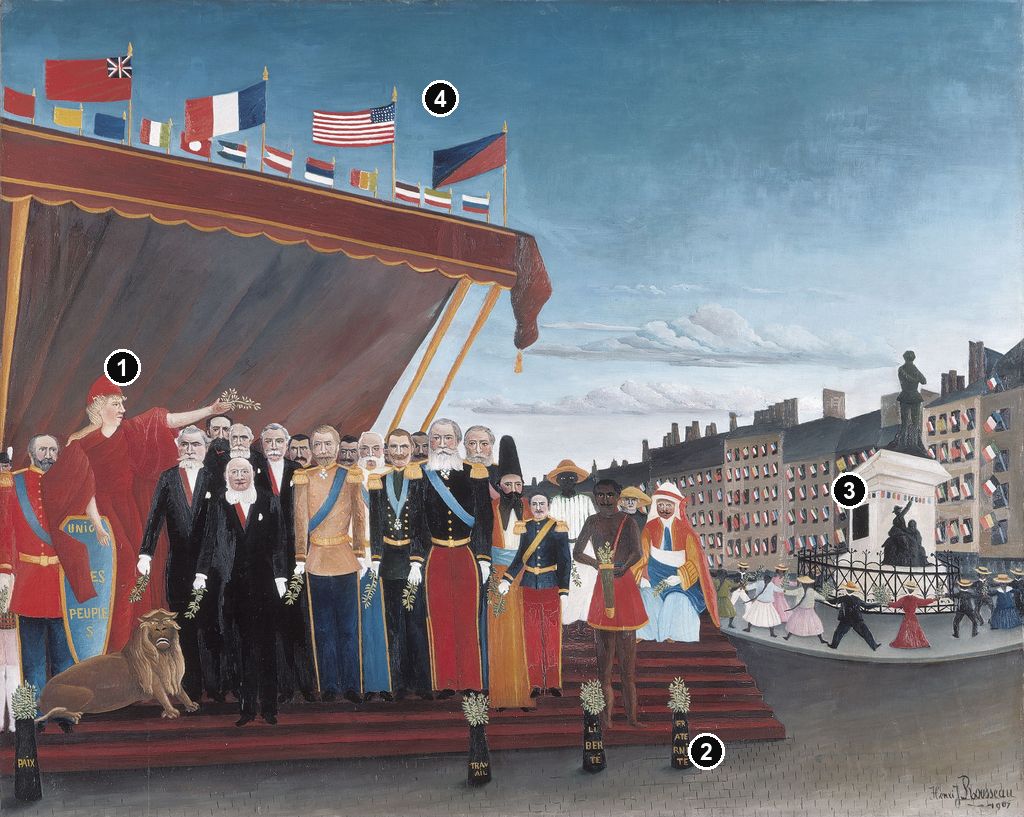
Details from REPRESENTATIVES OF FOREIGN POWERS
Follow the ceremony from the Republic and lion to the words on the pots, then compare the dancers’ circle with the flags and canopy above the official gathering.
A raised branch above a resting lion
The Republic’s red garment and outstretched arm gather the shield, leaf sprays and lion into one compact group. The lion’s level body steadies the diagonal cloth and the sloping stage.
Words placed along the steps
Three of the small foreground pots carry Travail, Liberté and Fraternité in broken lines. Their foliage rises against the red steps, repeating the upright forms of the assembled figures on a smaller scale.
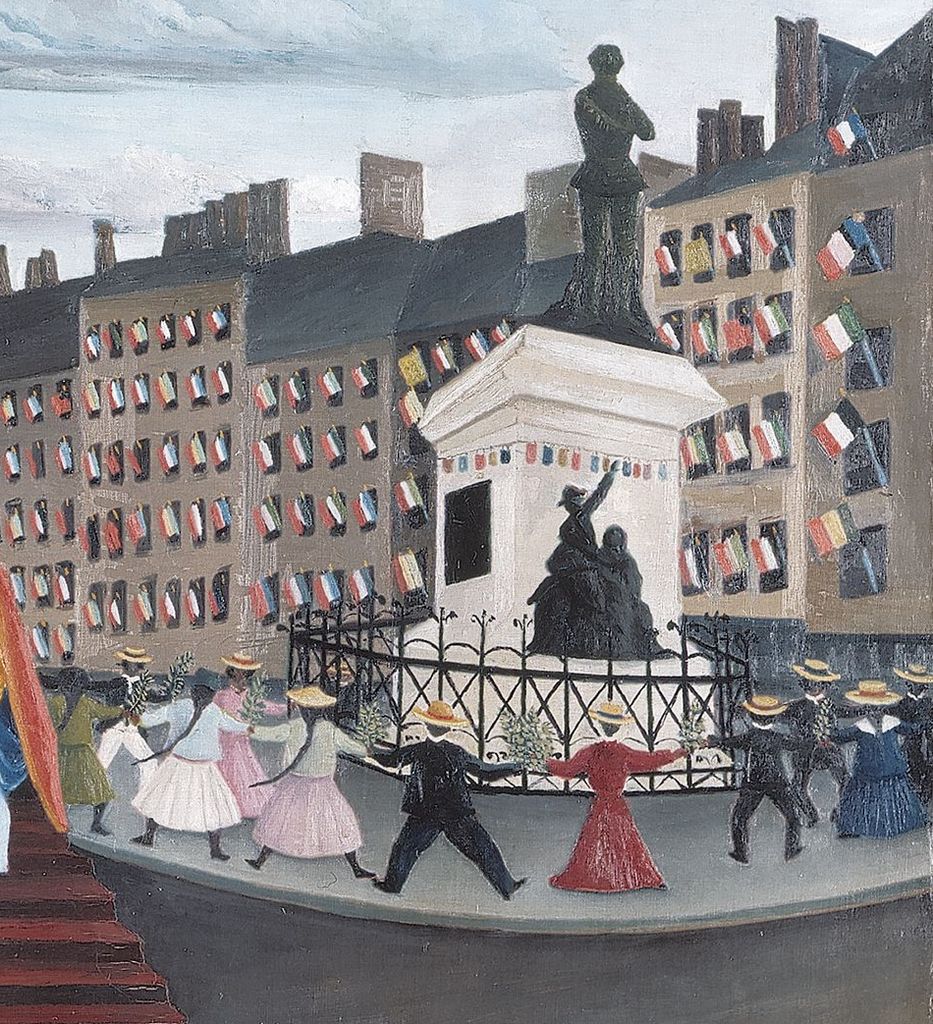
A linked circle beside the monument
Outstretched arms connect the dancers around a pale monument. Their changing postures and spreading skirts contrast with the stiff company on the platform, while the repeated windows carry the street into the distance.
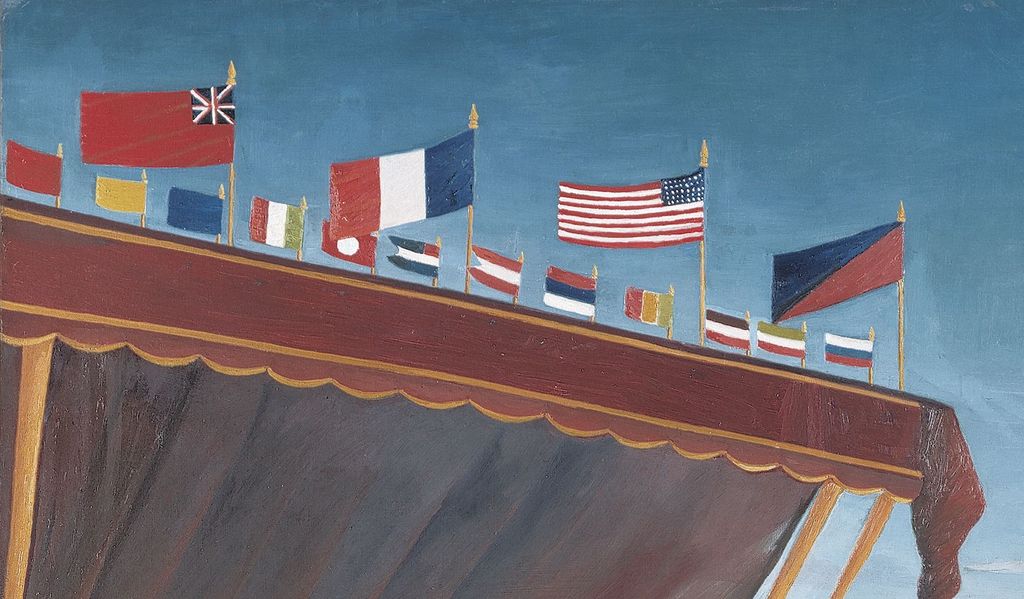
Flags above the ceremonial shelter
Large and small flags make an uneven procession above the canopy. Gold bands and scalloped trim connect the fluttering rectangles with the heavy folds below.
The lion and the painted shield
At the lower left, the lion occupies a peculiar interval between emblem and animal. Its body lies along the edge of the platform, its front legs firmly planted, its head turned out towards the viewer. The mane gives it a weight and texture unlike the smooth clothes immediately above. Although low in the picture, it has enough room around its face to command attention.
The large blue shield behind it supplies an equally decisive patch of colour. Its curved outline interrupts the upright coats, and its gold edge answers the canopy's decoration overhead. Shield, lion and red garment gather into a compact group of forms. Together they make the left side feel anchored, even as the raised arm directs attention away from that corner and towards the guests.
The lion's composure is especially striking beside all the human preparations. It does not menace the assembly or respond to the dancers. Its level body steadies an area full of diagonals: the shield tilts, the canopy slopes and the steps run away to the right. Viewers interested in Rousseau's style and technique can see here how much a sense of stability depends on the placement of a few broad shapes. The animal's quiet presence helps hold the crowded scene together.
A smaller world beyond the steps
At the right, the picture changes scale abruptly. The dancers are tiny beside the dignitaries, yet their movements are more expansive. Arms stretch sideways, bodies lean and legs separate. Skirts spread into triangles, while dark coats become angular patches among the lighter dresses. The gaps between their bodies are as lively as the bodies themselves.
Their linked circle offers another way of organising a group. On the platform, the ranks direct attention outwards, towards someone looking at them. In the dance, one person reaches towards the next. The connection passes around the ring, and no single figure has the commanding gesture of the woman in red. The contrast can be felt through posture alone: a line presents itself; a circle keeps an activity going.
A low fence and pale monument stand behind the dancers. The catalogue relays Le Pichon's proposed identification of the statue as Étienne Dolet.[12] Visually, its dark upright figure rises above the ring like a still, distant counterpart to the standing company. The pale pedestal catches the eye between the dark fence below and the dark statue above. These sharp contrasts give the small structure a presence disproportionate to its size.
Rousseau brings official reception, public monument and communal dance within one view, while allowing each its own spatial enclosure. The steps define the foreground gathering; the fence surrounds the monument; joined hands delimit the dancers' circle. Looking across them, one becomes aware of how many ways the painting draws a boundary around people.
Houses, flags and an open sky
The houses behind the monument bend through the distance in a long ochre row. Windows repeat across their façades, and chimneys rise at irregular intervals along the roofline. Small scraps of bunting hang against the masonry. That repetition gives the street a public, inhabited character without requiring a crowd of spectators in every window.
The buildings' shrinking openings lead the eye away from the dancers and towards the middle of the painting, where the street disappears behind the assembly. The row connects the two gatherings through the ground they share. Its curve is a gentle alternative to the canopy's forceful diagonal and the long straight edges of the steps.
Above the stage, flags create a denser, more jagged rhythm. Broad stripes and blocks of colour occupy almost the same narrow band, even though the poles rise to different heights. A large tricolour and a striped American flag are especially conspicuous. The smaller designs require slower attention; at this scale, their accumulation has a stronger visual effect than any attempt to identify each one.
Much of the upper right remains open blue. A few low clouds stretch across it, but nothing there rivals the dense fabric of heads, flags and curtain at the left. This clear space is part of the ceremony's effect. After the concentration of detail under the canopy, the eye can travel upwards into an area with very little to decipher. The scene feels crowded and spacious by turns.
How the arrangement took shape
The 1985 catalogue reports laboratory evidence of ruled planning lines, repeated overpainting, removed heads and added figures; the reviewing stand was painted over the sky.[12]
Those reported changes make the finished distribution of space particularly interesting. The grandstand appears inseparable from the scene because so many other forms answer it. Its supporting poles echo the legs beneath it; its gold bands recur in uniforms and shield; its descending edge points towards the falling height of the company at the right. The eventual arrangement gives different parts of the picture a shared direction.
The head row remains less mechanically even. Some faces sit above their neighbours, others emerge lower down, and a few are partly concealed. That unevenness keeps the gathering from becoming a mere pattern. Its broad outline is clear at a distance, while close attention discovers obstructions and awkward meetings within it. A face can be distinct and still look tightly wedged into place.
Colour supplies a further set of connections. Red travels from the woman's garment to the canopy, steps, trousers and dancers' clothes. Blue appears in the shield and sashes before expanding into the sky. Gold takes the form of narrow ornament in one place and a large area of uniform in another. These recurrences carry the eye across the picture without dissolving the separate identities of its objects.
Exhibition and later history
The catalogue records the painting at the 1907 Salon des Indépendants and traces it through Vollard to Picasso around 1910. It also quotes a 1910 interview in which Rousseau remembered congratulations and linked the reception to the Hague Conference; the catalogue's chronology places the Salon opening before that conference.[12]
The title's promise of peace finds its fullest expression in the peculiar stillness of the completed scene. The dignitaries seem held for a long public moment, while the dancers continue their small circuit nearby. The ceremony has no visible arrival route, handshake in progress or clear point of departure. Instead, the assembled bodies and repeated branches sustain the greeting across the whole foreground.
That suspension lets the viewer move freely between solemn and intimate details: a carefully arranged sash, a small hand carrying leaves, the lion's face, the broken lettering on a pot. The square is large enough to contain imposing public symbols and the pleasures of a dance. Rousseau gives both the same clear daylight, making an ambitious vision of collective peace tangible through cloth, masonry, foliage and human gesture.
Henri Rousseau artworks directory
This directory brings together works covered on this site and other works documented in the cited museum records and catalogues. Alternate titles share one entry; distinct versions remain separate. Historical dates for works without an article follow the cited catalogues. This is not a catalogue raisonné.
Frequently Asked Questions
It is in the Musée national Picasso-Paris, inventory MP2017-40.[1]
The catalogue identifies it as imaginary.[12] The image works as an allegory: people and emblems make an abstract political idea visible.
Follow the raised arm across the row of heads, then move down to the potted plants. Finally, compare the standing officials with the dancers at the right. Changes in scale and posture reveal much of the painting's structure.
Discussion
Look again at the images and ideas explored in The Representatives of Foreign Powers Coming to Greet the Republic as a Sign of Peace. These editorial prompts invite your observations.
Reader Insights
How does the meaning of the gathering change when you move your attention from the officials to the dancers?
Which contributes more to the painting's sense of peace: its written words, repeated branches or arrangement of bodies?
What do the different clothes allow you to recognise, and what do they leave uncertain about the people wearing them?
Join the Conversation
Share a detail, comparison or question about The Representatives of Foreign Powers Coming to Greet the Republic as a Sign of Peace below.
References
- Musée national Picasso-Paris. Les Représentants des puissances étrangères venant saluer la République en signe de paix, current collection record, MP2017-40, accessed 23 October 2026. View source. (in French).
- Philadelphia Museum of Art, Carnival Evening,1963-181-64,object59593. View source.
- Musée de l’Orangerie / Juliette Degennes, Henri Rousseau,L’ambition de la peinture: Un artiste dans son époque (in French). View source.
- National Gallery, Surprised!, NG6421. View source.
- Musée d’Orsay, La Guerre,RF19461 (in French). View source.
- MoMA, The Sleeping Gypsy. View source.
- Philadelphia Museum of Art, The Merry Jesters, 1950-134-176, object51097. View source.
- Musée d’Orsay, La Charmeuse de serpents, RF 1937 7 (in French). View source.
- Musée de l’Orangerie, La Carriole du Père Junier, RF 1960 26 (in French). View source.
- Solomon R. Guggenheim Museum / Cornelia Lauf, The Football Players,60.1583: current collection record. View source.
- MoMA, The Dream, 252.1954. View source.
- Museum of Modern Art. Henri Rousseau: Essays, 1985, catalogue entry 35, pp. 178–180; colour plate p. 179. View source.
- The Museum of Modern Art, Henri Rousseau: Essays (1985), selected catalogue entries, chronology and notes on early devotees. View source. Selected entries, chronology (pp.91–95) and early-devotee notes (pp.262–264) were consulted. Historical collection credits do not establish present ownership.
- Daniel Catton Rich, Henri Rousseau (The Museum of Modern Art, 1942), selected drawings and landscape studies; historical catalogue. View source. The dated 1942 publication is used for the two Quai d’Auteuil ink views; its Malakoff date differs from the 1985 catalogue.
- MANAS, Laval, Henri Rousseau, dit le Douanier, urban landscapes and preparatory study (in French). View source.
- National Gallery of Art, Self-Portrait (1895), pen-and-ink drawing, accession 1995.47.66. View source.
- The Museum of Modern Art, War (published January 1895), lithograph, accession 684.1943. View source.
- Barnes Foundation, Landscape and Four Young Girls, object 5521, BF855. View source.


 Henri Rousseau.jpg)


 Henri Rousseau.jpg)