


 by Tom Gurney
Tom Gurney BSc (Hons) is an art history expert with over 20 years experience
Published on June 19, 2020 / Updated on September 24, 2026
Email: tomgurney1@gmail.com / Phone: +44 7429 011000
Hiroshige’s Plum Park in Kameido
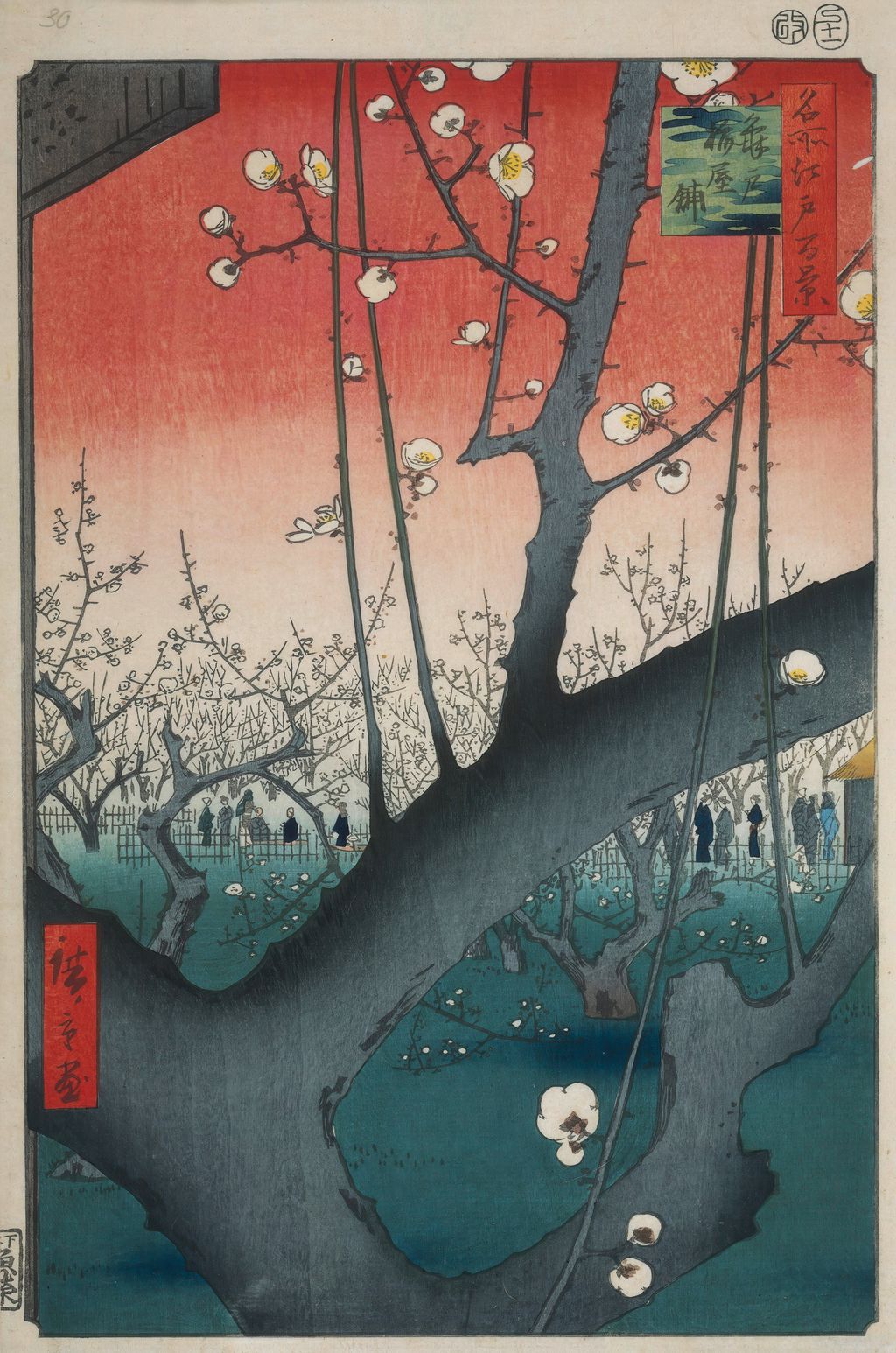
A dark plum tree fills almost the whole foreground. Its trunk rises across the sheet; branches and blossoms interrupt a red sky. Far below, small visitors walk among other trees and stop at the edge of the garden. The startling difference in scale makes the viewer seem to stand beside the enormous tree while watching a public place beyond it. This is Utagawa Hiroshige’s Plum Park in Kameido, called 亀戸梅屋舗 (Kameido Umeyashiki) in Japanese, a vertical colour woodblock print published in 1857 within One Hundred Famous Views of Edo. The image is famous partly because Vincent van Gogh transformed it into a painting thirty years later. It also deserves attention as a print that changed through repeated production and survives in visibly different states.
The sheet is a picture of a particular garden, not a generic emblem of Japanese spring. The National Diet Library’s Kameido landmark account [1] places Umeyashiki inside the villa of Iseya Kiemon and describes more than 300 plum trees. Its celebrated old tree, the Garyūbai, was likened to a dragon crawling over the ground. Hiroshige’s close, almost obstructive tree draws on that local fame. The garden in the print is also a social scene: visitors appear small but legible in the open strip behind the trunk. A later photograph of the famous tree could help us understand the place’s memory, though it cannot be mistaken for the view on an 1857 sheet.
Contents
The red-sky reproduction shown here has a red upper sky, blue-green garden ground and yellow centres in some white blossoms. Those characteristics matter when comparing print states, but a file without a confirmed museum accession should not be labelled “first state” merely because its colours look early. British Museum scientist Capucine Korenberg [3] identified four states by comparing many physical impressions. Her work shows how a familiar composition could acquire new colours and other alterations over time.
At a glance
- Artist and designUtagawa Hiroshige, Plum Park in Kameido / 亀戸梅屋舗
- SeriesOne Hundred Famous Views of Edo / 名所江戸百景
- Date and medium1857; colour woodblock print
- PlaceUmeyashiki in Kameido, Edo, now part of Tokyo
- PublisherSakanaya Eikichi, according to the British Museum exhibition guide [4]
- Key cautionDifferent surviving impressions of this design show different states and degrees of fading
- Western receptionVan Gogh owned and traced a later-state impression, then painted Flowering Plum Orchard (after Hiroshige) in 1887
Explore four details of the print
Choose a numbered point, then open its detail image below. The crops come from the retained 3286 × 4962-pixel, 300 dpi source file.
Details in THE GARDEN
Tree, visitors, colour and printed titles in one surviving reproduction.
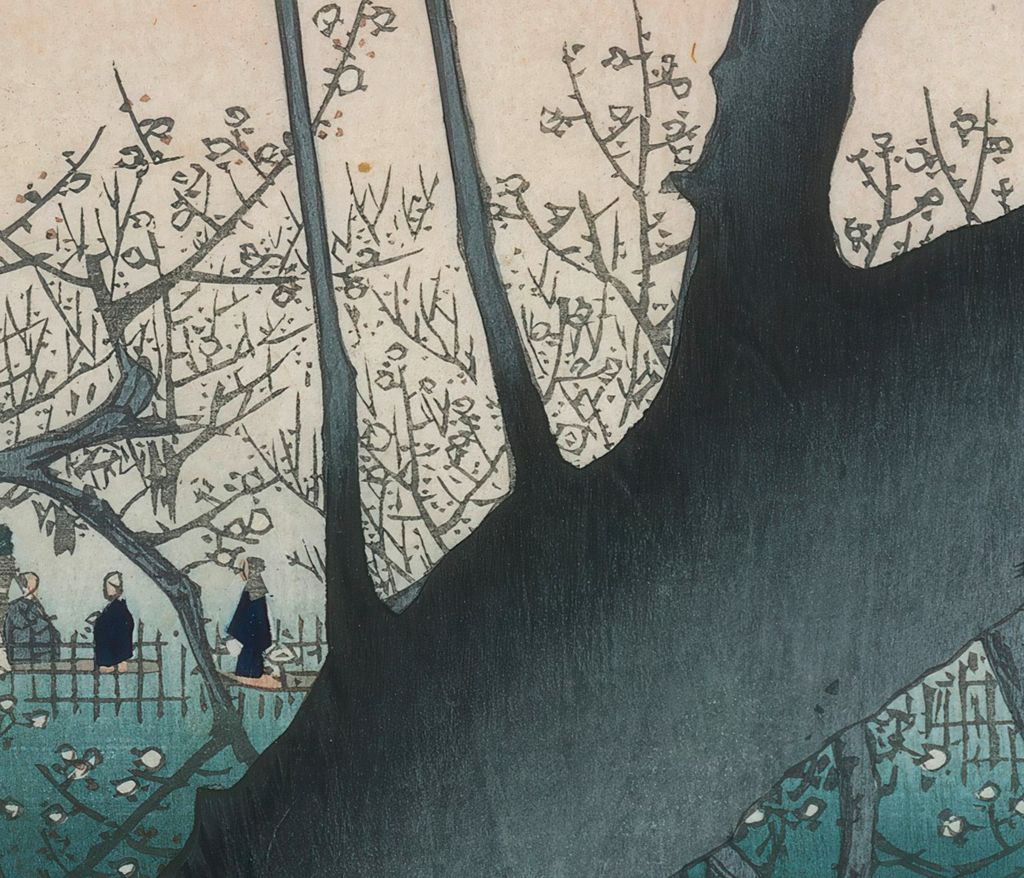
The tree in the foreground
The large limb crosses the sheet and makes the garden appear distant.
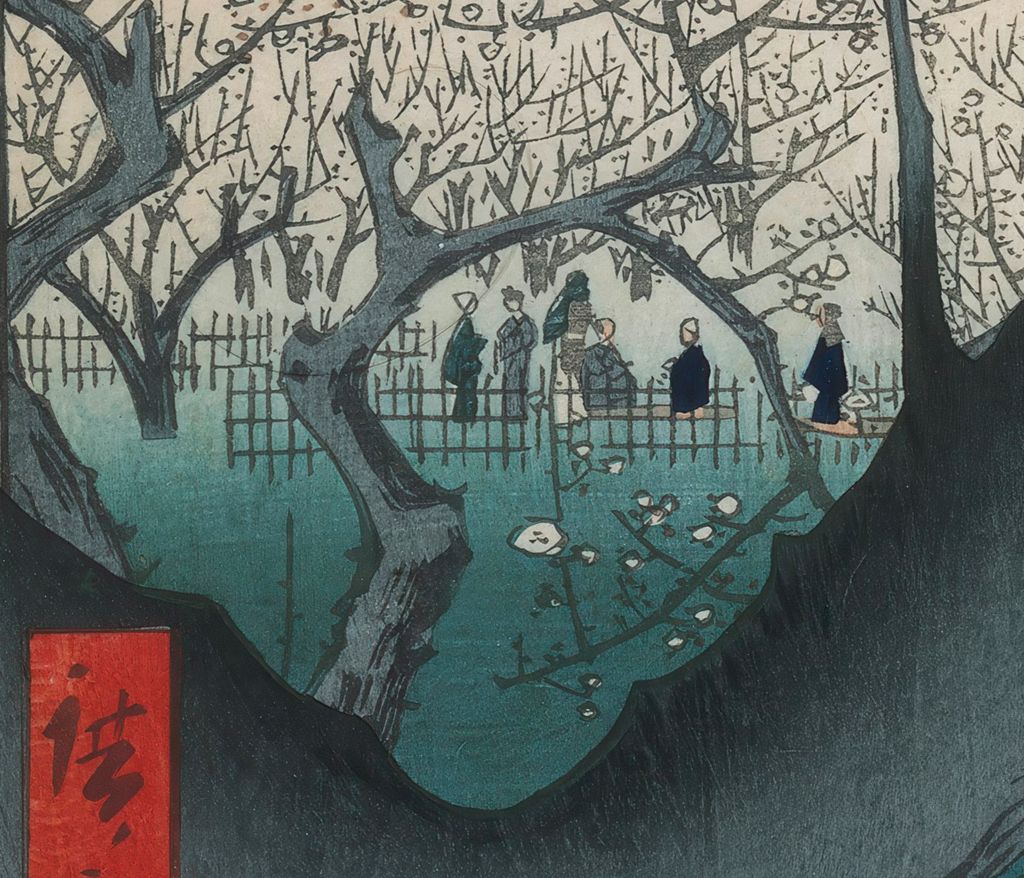
Visitors beyond the fence
Small figures make Umeyashiki a place of seasonal visits, rather than an empty landscape.
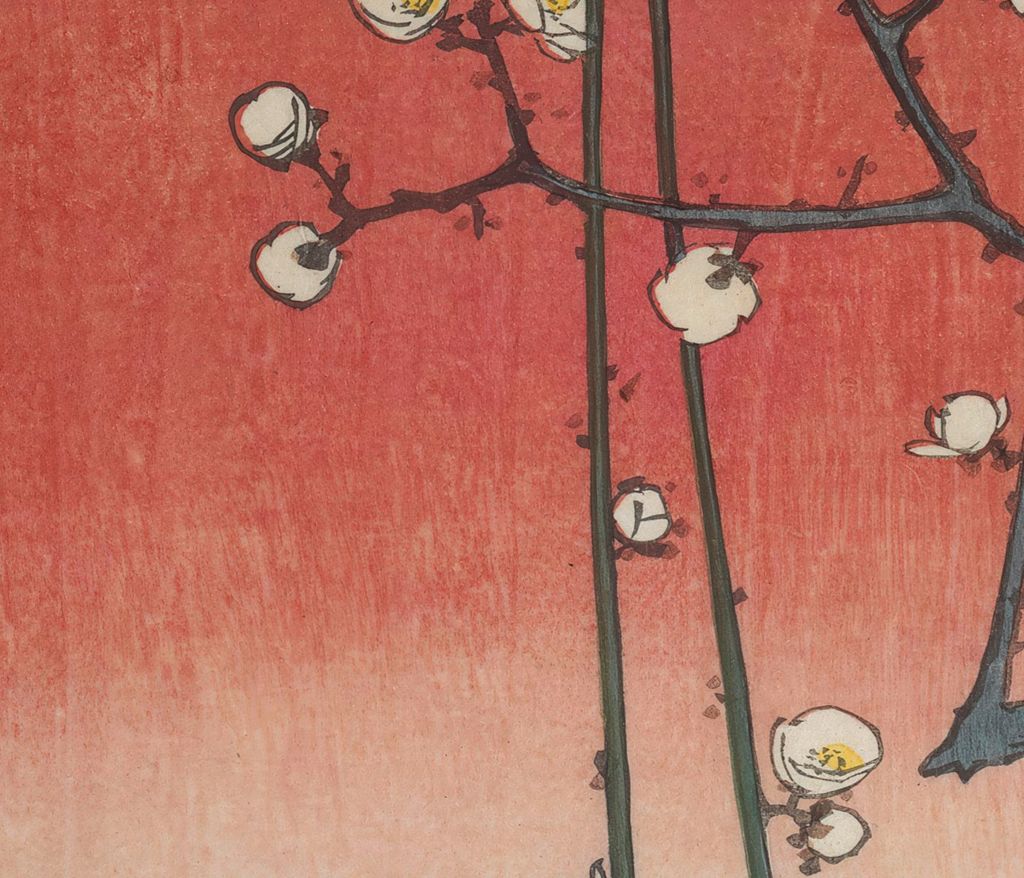
Sky and blossoms
Red grades into a paler band behind white flowers; colours differ among surviving impressions.
Names printed in the image
The red cartouche names the series; the blue-green one names Kameido Umeyashiki.
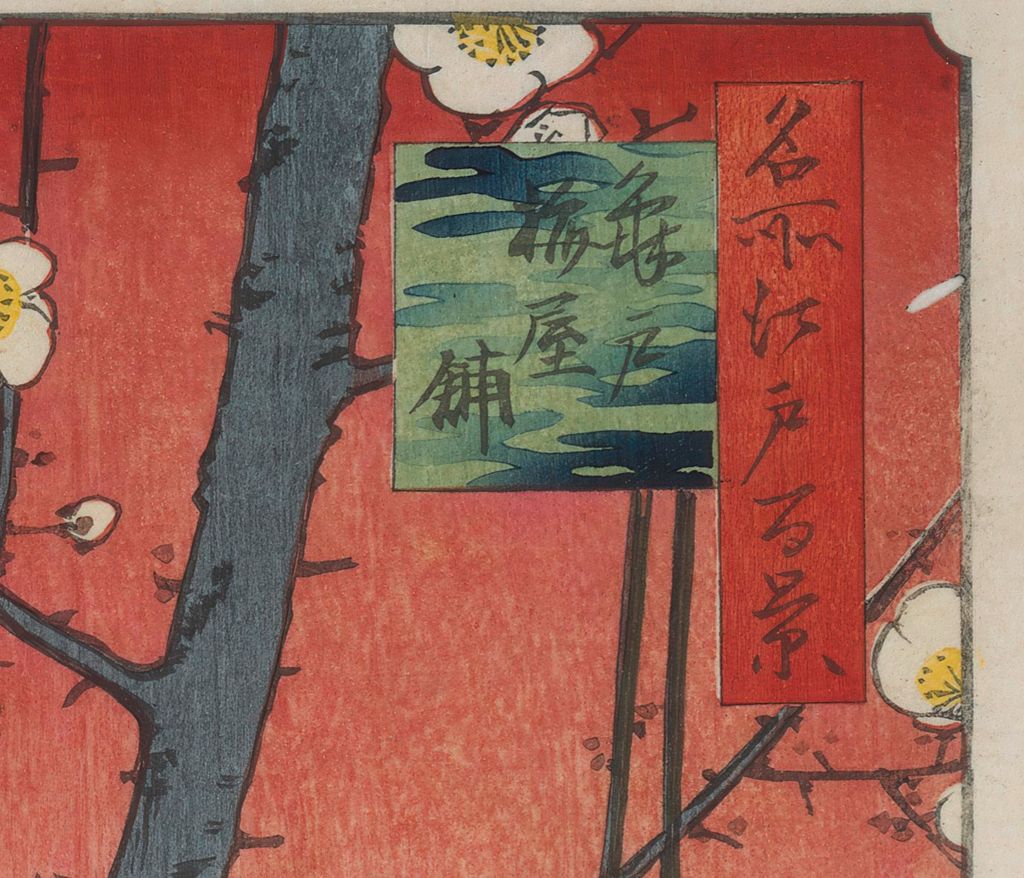
The exact physical impression and printing state of this reproduction are unidentified.
The place behind the print
Kameido was not a single attraction. The NDL’s landmark survey [1] separates Kameido Tenjin Shrine, known for its plum and wisteria, from Umeyashiki, the plum garden within Iseya Kiemon’s villa. That distinction matters when selecting a historical photograph. A photograph captioned “Kameido Tenjin bridge” shows a real place in the district, but it is not a later photograph of Hiroshige’s plum garden. The NDL separately identifies photographs titled 臥龍梅 (Garyūbai) within Umeyashiki. They are more pertinent evidence for the specific tree and site.
According to the NDL, the garden held over 300 plum trees and was popular as a meisho, or celebrated place to visit. The old Garyūbai spread low across the ground in a form compared with a crawling dragon; the library says its name was traditionally attributed to Mito Mitsukuni. Pickled plums were sold as souvenirs. These details locate the print within the culture of seasonal outings, named trees and commercial visitors. They do not prove that the particular small figures in Hiroshige’s background were buying souvenirs, nor that the colossal trunk reproduces every shape of the old tree with botanical accuracy. The print makes a famous feature of the site serve a striking pictorial design.
The NDL groups Hiroshige’s sheet with other depictions of Umeyashiki and with later photographs of the Garyūbai. A comparison between those images can show how a named place circulated across formats. The earlier and later artworks are not replacement evidence for the exact appearance of Hiroshige’s surviving impressions. A photograph made decades after 1857 records a later state of the tree and garden, possibly after changes in planting, access or surroundings. Its value is precisely that it joins the print’s imagined viewpoint to a different kind of record of place, with a clear date and source.
The photograph shown below appears in the illustrated book Tokyo Fūkei / 東京風景 [2], published in 1911 by Ogawa Kazumasa’s publishing house. The printed English caption reads “Garyobai at Kameido,” and the page shows people resting on benches under spreading branches. This is concrete evidence that the named tree remained a place of visual and social interest in the early twentieth century. The book’s publication date is secure; the date on which its particular photograph was taken is not stated in the catalogue, so it should not be called a “1911 photograph” without that qualification. The NDL Search record marks the digitised volume as public domain. The photograph is reproduced here from the specifically identified page, not from a generic Kameido Shrine album.
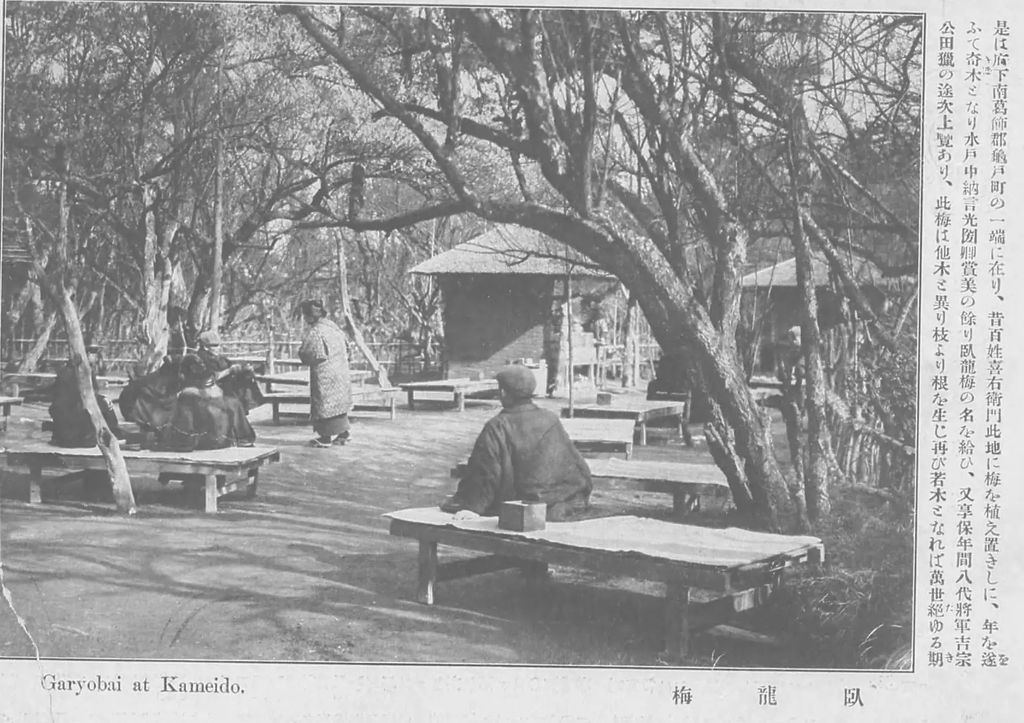
One consequence of this local fame is that the tree functions as more than foreground decoration. It makes the viewer’s position in the garden feel unusually close. Instead of opening a broad panorama and placing visitors inside it, Hiroshige lets the tree dominate our first encounter, then asks us to look past it. The garden beyond is busy, yet much of it remains hidden. That partial view suits a site known through particular sights and seasonal experience: the print gives us the feeling of peering through a living landmark rather than surveying a mapped enclosure.
How the composition works
The trunk enters from the bottom and bends across the sheet. One great branch runs nearly horizontally toward the right edge; thinner offshoots rise into the sky or hang down in front of it. The dark shape divides the image into irregular openings. Through one opening we see a band of pale blossom trees and a cluster of visitors; through another, red sky and white flowers. The tree becomes a frame that refuses to stay at the edges. Its apparent proximity pushes the garden back and makes the small human figures seem further away.
This bold scale change is supported by the print’s colour structure. The reproduction shown here has a saturated red high in the sky thinning toward a much paler area above the garden. Blue-green ground appears under the trees and around the dark trunk. The white blossoms carry small yellow centres. At the foot of the sheet the black-blue tree becomes a broad, almost abstract mass, while the figures remain tiny marks of blue and muted colour. Colour leads the eye from red and white at the top to blue-green and black below. It also makes the visitor space readable through a series of gaps in the foreground silhouette.
The viewers in the garden are not an incidental scale bar. Some stand along a fence line; others approach the opening on the right, where a roof or shelter enters the picture. Their presence confirms that this is a place to visit and look, even as the viewer remains separated from them by the oversized branch. The British Museum’s account of the design [4] calls attention to the close-up foreground against distant landscape, describing a privileged vantage that an ordinary visitor could not easily take. Hiroshige is making a picture of looking as much as a picture of blossoms.
The lettering also belongs to the composition. The red vertical series-title cartouche sits near the upper right, while the blue-green place-name cartouche partly overlaps the red sky and dark branch. Hiroshige’s signature appears lower on the left side of the trunk. These printed blocks balance natural shapes with the formal elements of a commercial colour print. They are not later labels added by a museum. Their placement helps identify the print’s series and destination. The annotated details above show them alongside the tree, visitors and blossoms.
One design, many impressions
Woodblock printing produces multiple impressions from a design, and a successful sheet may be printed again with altered blocks, colours or printing decisions. The repeated images need not be identical. Korenberg’s British Museum study [3] assembled photographs of 82 surviving impressions and distinguished four states of Plum Park in Kameido. The states are inferred by comparing physical clues such as outlines, the shape of coloured areas and printing technique. A state is not a year printed on each sheet, nor a quality ranking. It records a pattern of change in the evidence from surviving impressions.
The most obvious colour difference is high in the sky. Early impressions described by the British Museum have a brilliant pink-to-red gradation. Later ones replace the upper band with purple-blue. Other changes include the treatment of branches and the blue-green areas of grass. The museum’s exhibition guide [4] explicitly contrasts an early impression with a later one owned by Van Gogh: the latter has a purple-blue upper band, flatter branches and lacks blue-green pools in the grass. A careful comparison should identify each sheet by collection and accession before naming its state. Two reproductions with different colour balance may reflect photography, fading or restoration as well as original printing differences.
Two identified files, one design
Side-by-side impressions
The source images show different colours. Their printing states are not assigned here because the owner-supplied sheet has no identified accession and colour in a digital file can also reflect photography or fading.
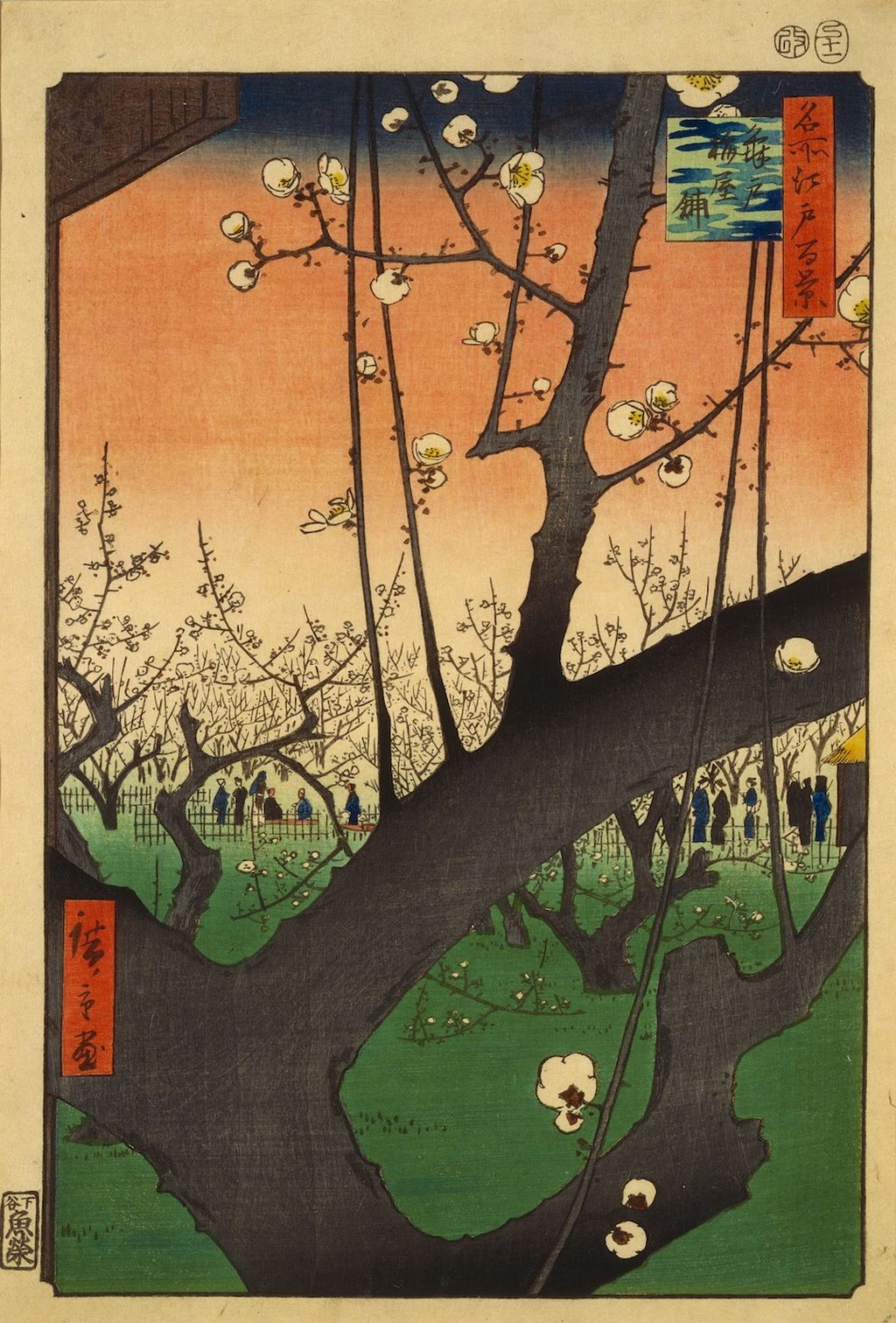
The high-resolution red-sky reproduction on this page can be set beside the Tokyo Fuji Art Museum’s Plum Garden at Kameido [6], whose downloadable image the museum marks CC0. The composition is unmistakably the same: the great dark tree forks before the little visitors; the red series cartouche and place-name cartouche sit at the upper right; the artist’s signature is low on the left. Yet the Tokyo Fuji file has a blue-black upper band, a warmer peach central sky and greener ground, while the red-sky file has stronger red above and blue-green below. The comparison is valuable without pretending that a pair of JPEGs proves exactly when either sheet was printed. Collection metadata, original surface and conservation evidence are needed for that.
The Art Institute of Chicago records another impression [5] in the Clarence Buckingham Collection, accession 1925.3752. Its catalogue gives the artist, series, 1857 date and dimensions, and its Open Access data marks the image public domain. The Museum of Fine Arts, Boston also catalogues multiple impressions [8] of this 1857 design. An image comparison can therefore grow beyond a simple red-versus-blue pair, provided every reproduced sheet retains its accession and rights statement. Variations in outer margin, colour registration, paper and wear may be just as instructive as the sky.
Even museum dates need to be read with care. The Tokyo Fuji Art Museum’s own object page [6] dates its sheet to 1857, matching the usual date for the Kameido design. A linked Cultural Heritage Online aggregation [9] displays 1856 for what appears to be that collection object. The discrepancy may be a metadata error or a difference in what was entered as series versus sheet date; neither webpage explains it. This page uses the holding museum’s 1857 date and avoids inventing a reason for the mismatch. It is a reminder that an aggregator’s short date field should be checked against the object-owning institution.
Fading complicates the question further. The British Museum notes that plant-based red and yellow colourants can be very sensitive to light. Some surviving prints have lost colour across most of a sheet while protected edges retain evidence of the older tone. That means a pale photographed sky is not automatically what the printer intended. Nor should a digitally saturated modern reproduction be treated as a restoration of a known original. A reliable comparison gives each image its object identity and marks unknown printing dates and colour history as unknown.
This material history changes how the image is read. A visitor encountering a red-sky impression may experience a strong morning glow above the dark tree. A later purple-banded impression sets a different high note. Neither is a separate Hiroshige composition; both belong to the history of one design. The variation shows that the print’s reception was shaped by the copy a reader happened to see. It also explains why a single colour thumbnail cannot stand in for every impression in the history of the work.
Van Gogh’s print, tracing and painting
Van Gogh’s response is often compressed into one sentence: he “copied Hiroshige.” Three surviving or documented stages make a richer sequence. He owned a later-state impression of Plum Park in Kameido. He made a tracing of the print on a numbered grid to enlarge its composition. In 1887 he painted Flowering Plum Orchard (after Hiroshige) in oil, retaining the close tree, distant garden and vertical design while changing medium, scale, lettering and colour. The British Museum exhibition guide [4] identifies the owned impression, the tracing and the painting as separate objects.
The colour relationship is particularly revealing. The British Museum research [3] identifies Van Gogh’s own Hiroshige print as a faded fourth-state impression. Yet the painting uses features closer to an earlier state, including a stronger red sky, yellow flower hearts and blue shading in the garden. The museum suggests he may have seen another impression in Paris, though the particular source has not been identified. The tracing documents how he carried over the structure; it does not by itself explain every colour choice in the painting. The uncertainty is part of the historical account.
Van Gogh added vertical bands of script-like characters along the edges of his painting. They are not a translation of Hiroshige’s original place and series cartouches. They reshape the format for the painting and announce a French artist’s encounter with Japanese print design. The comparison becomes most useful when both the similarities and the changes are visible: the close tree and little figures survive, but the colours, brushwork, proportions and border treatment belong to another medium and another viewing culture. The painting is evidence of a particular nineteenth-century act of artistic study, not a substitute for examining the 1857 Japanese print.
The Van Gogh Museum’s gallery text [12] places Flowering Plum Orchard (after Hiroshige) among its discussion of Van Gogh’s Japanese interests. The museum records for the print, tracing and painting let readers follow the sequence even without all three pictures beside one another. Their individual photographs carry their own image-use terms.
The print within One Hundred Famous Views of Edo
Plum Park in Kameido belongs to Hiroshige’s late series One Hundred Famous Views of Edo. It is a named view of a city and its environs, tied to an identifiable place and season, while treating that place with surprising formal freedom. The series title promises familiar sights. It does not promise a neutral survey or a geographically uniform map. The exaggerated nearness of the plum tree makes a famous attraction feel newly strange to someone who already knew its name.
The vertical format also matters. It supports a view that reads upward through trunk and branches rather than across a conventional landscape. Nearby Sudden Shower over Shin-Ōhashi Bridge uses long falling rain and a bridge crossing to make a weather event structure its sheet. Kameido uses a single tree as the dominant frame. Both are views of Edo whose pictorial devices intensify the experience of a place. Their subjects and formal solutions remain distinct; one should not be used to illustrate the other.
The Ōta Memorial Museum of Art’s series account [7] singles out Kameido Umeyashiki for the enormous near plum tree against tiny distant figures. Its exhibition notes also stress the quality of carving and printing across the series, including gradations and embossed effects in different sheets. These are useful reminders that the dramatic composition was carried into the world by a publisher, carvers and printers, not by Hiroshige’s drawing alone. Each impression bears the result of coordinated block work, inking and pressure. The museum regards many of its own well-preserved impressions as early printings, a judgment about objects rather than a blanket date for every digital image in the series.
Another Japanese source, the Tokyo Fuji Art Museum’s object commentary [6], describes the plum garden as having stood behind Kameido Tenjin Shrine and notes that people beyond the fence signal the site’s spring popularity. Its summary treats the red and green contrast as part of the visual force of the design. A reader comparing the museum’s blue-banded image with a red-sky reproduction can see why that broad description needs a specific object beside it. “The print has a red sky” can be true of one impression and misleading if presented as a universal property of all surviving copies.
Hiroshige’s biography and the series guide place the print within his career, publishers and late work. This design connects a named garden, surviving print states and the documented Van Gogh encounter. There is an earlier horizontal Hiroshige design associated with the Kameido plum estate, but it is a different artwork. Similar English place names can hide that difference. The Japanese title, series and orientation make the identity clearer.
The confusion is real even in major catalogues. The Museum of Fine Arts, Boston labels its vertical 1857 sheet [8] Plum Estate, Kameido. Another, earlier Hiroshige print shows a horizontal gathering in a garden, without the dominant foreground trunk. The words “Plum Estate” therefore cannot identify an artwork on their own. The visual design, series, orientation and institution’s record do the identifying work. This matters for readers following links and for collectors comparing impressions.
What the picture can and cannot tell us
The print is unusually informative about how a place was advertised to the eye. It names Kameido Umeyashiki and makes the great plum tree the visual event. It suggests visitors walking and looking among blossom trees. The NDL’s site history supports the garden’s popularity and the fame of the Garyūbai. The image cannot show us the whole estate, verify a count of every tree or describe an ordinary visitor’s exact position. Hiroshige chose a constructed viewpoint and a dramatic scale relationship to make a compelling print.
Likewise, a bright reproduction can show what is visibly present in that file, but not alone settle its printing state. The British Museum’s four-state framework depends on comparison among many identified impressions and technical study. At the object level, a museum accession, provenance and present condition matter. The Art Institute of Chicago catalogues one impression [5] as 1857, Clarence Buckingham Collection, 1925.3752, and public domain. Its current dimensions are 36 × 24.4 cm. Other museum copies may tell a different colour and wear story without contradicting the identity of the design.
The same care applies to place photographs. The NDL’s later photographs titled Garyūbai offer a promising way to bring historical Kameido into the page. Each must be checked at its individual digital record for date and reuse status. They should be captioned as later records of the named tree, not as the camera finding Hiroshige’s viewpoint. Used this way, a photograph adds a second historical witness rather than implying an impossible one-to-one reconstruction.
Frequently asked questions
Hiroshige’s design was published in 1857 as part of One Hundred Famous Views of Edo. A particular surviving impression may have been printed later and may show colour or block changes. The British Museum’s comparison [3] separates four states of the design.
It is a plum tree at Umeyashiki in Kameido, presented at unusually close range. The NDL [1] records the garden’s celebrated old Garyūbai, whose low form was likened to a crawling dragon. Its account explains the site’s fame; the print’s exact trunk shape remains Hiroshige’s pictorial treatment.
He traced the composition from his own later-state impression, but the British Museum’s object comparison [4] finds colour features in the 1887 painting closer to an earlier impression. The source of those colour details is not securely identified.
No. 蒲田の梅園 (Kamata no umezono) is another named view in the series. The Met’s Kamata object [13] should not be used as an illustration or source for Kameido 亀戸梅屋舗 merely because both English titles say “plum garden.”
No. Printing states, fading, photography and digital handling can all affect what a viewer sees. The British Museum’s research [3] establishes changes in the original printed sheets; a comparison of web files must also consider how each object was photographed and processed.
References
- National Diet Library, “Kameido,” Exploring Japanese Landmarks in Nishiki-e and Photographs, Japanese and English views.
- National Diet Library, Tokyo Fūkei / 東京風景 (1911), bibliographic and rights record, with identified digitised page 48 showing “Garyobai at Kameido.”
- Capucine Korenberg, “Tracking down the Plum Garden,” British Museum, 2025.
- British Museum, Hiroshige: Artist of the Open Road, large-print exhibition guide.
- Art Institute of Chicago, Plum Garden at Kameido, object 26577.
- Tokyo Fuji Art Museum, Plum Garden at Kameido, collection object 01171, including CC0 image terms.
- Ōta Memorial Museum of Art, exhibition notes on One Hundred Famous Views of Edo.
- Museum of Fine Arts, Boston, Plum Estate, Kameido, object record.
- Cultural Heritage Online, Tokyo Fuji object aggregation, consulted for a date discrepancy.
- Alfred Haft, Hiroshige: Artist of the Open Road (British Museum Press, 2025), with an essay by Capucine Korenberg; publisher announcement and ISBN 9780714137001. Listed as print scholarship for study; the specific state findings cited above come from Korenberg's accessible museum research account.
- Melanie Trede and Lorenz Bichler, Hiroshige: One Hundred Famous Views of Edo, 45th-anniversary edition (TASCHEN), publisher record, ISBN 9783754403495. Listed as a published edition of the series, not used as an object-level state authority here.
- Van Gogh Museum, gallery text for Flowering Plum Orchard (after Hiroshige).
- The Metropolitan Museum of Art, Plum Garden at Kamata, a separate design used only to clarify identification.