


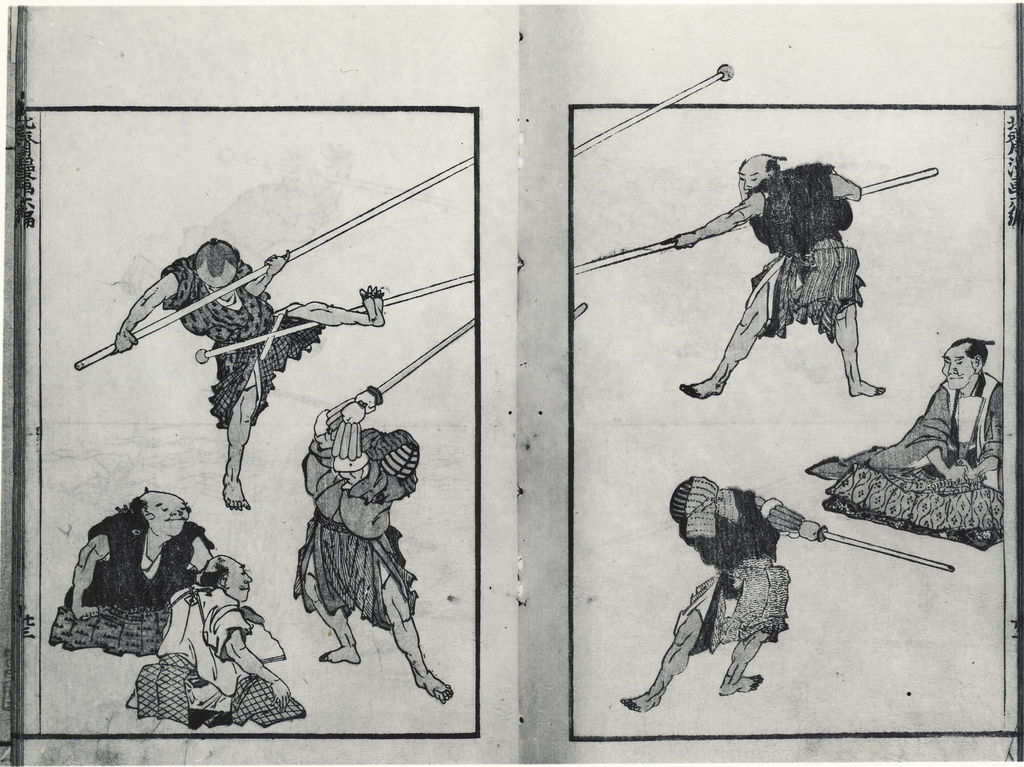
Hokusai, Hokusai Manga, volume six. The Metropolitan Museum of Art, JIB81.6; Rogers Fund, 1931. Object record · CC0. The Met does not state a date for this copy.
 by Tom Gurney
Tom Gurney BSc (Hons) is an art history expert with over 20 years experience
Published on September 24, 2026 / Updated on September 24, 2026
Email: tomgurney1@gmail.com / Phone: +44 7429 011000
Hokusai Manga: drawing the world in fifteen books
An archer draws a bow; a horse turns, rears and lowers its head; people carry loads or gather around a mechanism. These images occur in Hokusai Manga, a long-running series of small woodblock-printed books by Katsushika Hokusai. The name is familiar because of today's Japanese comics, but the objects ask to be approached as drawing manuals and collections of models. They offer ways to observe bodies, animals, objects, landscapes and imagined beings. The Sumida Hokusai Museum's account of drawing manuals [1] calls such books e-dehon, made to circulate drawing techniques among learners and admirers, not merely bound albums of finished pictures.
The first volume appeared in 1814. The fifteenth appeared in 1878, about three decades after Hokusai's death. Between those dates came new volumes, reprintings and fresh readers. The books therefore have more than one chronology. The publication history of a volume is one thing; the age of a particular surviving museum copy is another. The Metropolitan Museum of Art's first-volume copy JIB81.1 [3] is dated after 1828. It pictures designs from a work first published in 1814, but it should not be presented as an 1814 physical book. The difference is central to reading this series honestly.
Contents
- Hokusai Manga: drawing the world in fifteen books
- Annotated opening: drawing movement across two pages
- What did “manga” mean for Hokusai?
- From Nagoya drawings to the first book
- How a physical volume works
- Looking at people, work and movement
- Animals, landscape and the imagined world
- Fifteen volumes, many dates
- Drawing manuals beyond Hokusai Manga
- Hokusai Manga beyond Japan
- How to look closely at an opening
- The same page as instruction and entertainment
- Why book objects and individual leaves need separate records
- A careful way to discuss influence
The books also challenge the idea that Hokusai's reputation rests only on landscape prints. Thirty-six Views of Mount Fuji made one mountain endlessly variable across separate colour sheets. Hokusai Manga does something different: it makes the visible and imagined world available as a repertoire of forms that a reader could study, copy and recombine. The British Museum's Hokusai timeline [2] traces the first book to Hokusai's Nagoya circle; the Sumida museum's 2026 exhibition [1] follows its life through subsequent editions and influence. Those two institutions help keep the series anchored in Japanese publication and learning, even when discussing its later fame abroad.
At a glance
- Japanese title
北斎漫画(Hokusai manga), with伝神開手(Denshin kaishu) on catalogued copies - Common English nameHokusai's Sketches or Hokusai Sketchbooks
- ArtistKatsushika Hokusai, 1760–1849
- FormatIllustrated woodblock-printed books; surviving copies and printings differ
- First volumePublished in 1814; individual surviving first-volume copies may be later
- ExtentFifteen volumes, completed in 1878 after Hokusai's death
- Original purposeDrawing models within the broad field of e-dehon, or drawing manuals
- SubjectsHuman activity, animals, natural forms, landscape, historical and imagined figures
Annotated opening: drawing movement across two pages
Use the numbered points to compare figures, staffs and the book fold. Select each detail image below to enlarge it. Crops come from the retained full-resolution, 300 dpi working master.
Details from VOLUME SIX
One Met book object, JIB81.6; several movements across its photographed opening.
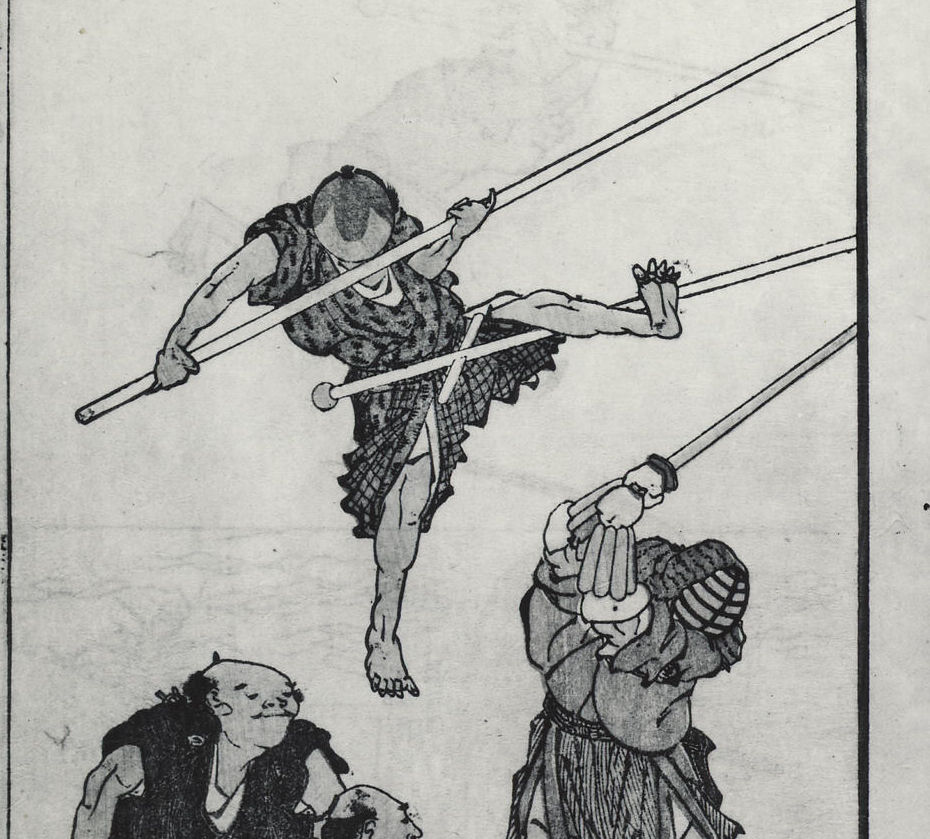
A leaning figure
A long diagonal staff crosses the figure’s bent body. The stance makes effort and balance visible.
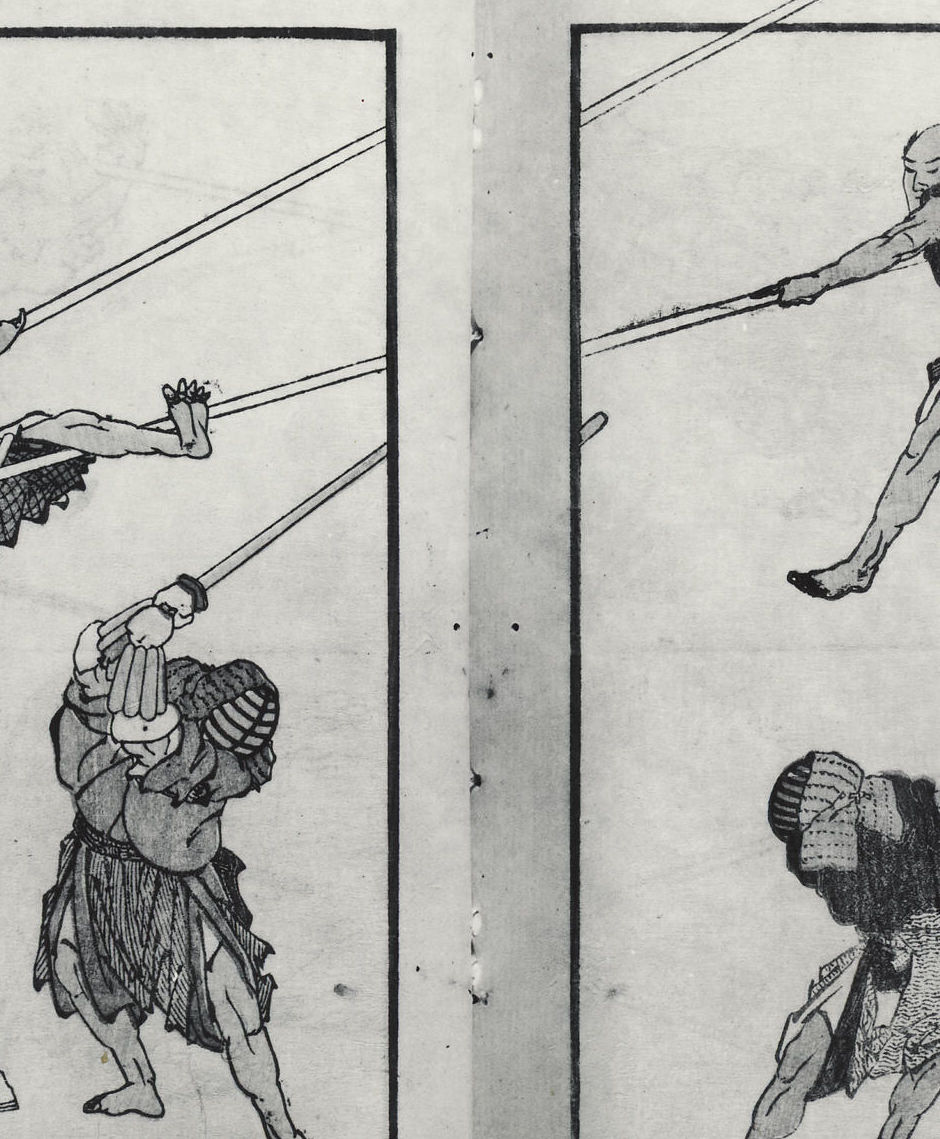
The centre fold
The gutter divides two printed pages. Lines approach the fold, but the physical binding remains part of the opening.
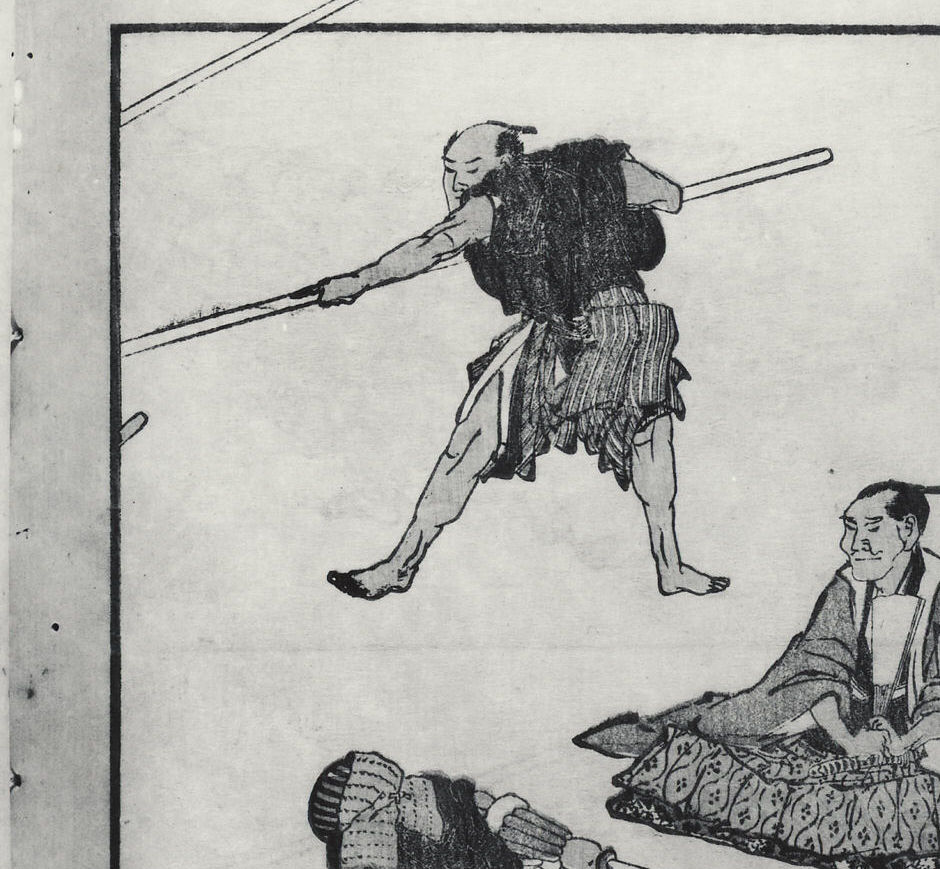
A wide stride
The large standing figure extends a staff across the right page, balancing the diagonal on the left.
Watching and practising
Smaller figures occupy the lower area, turning the opening into a comparison of action and spectatorship.
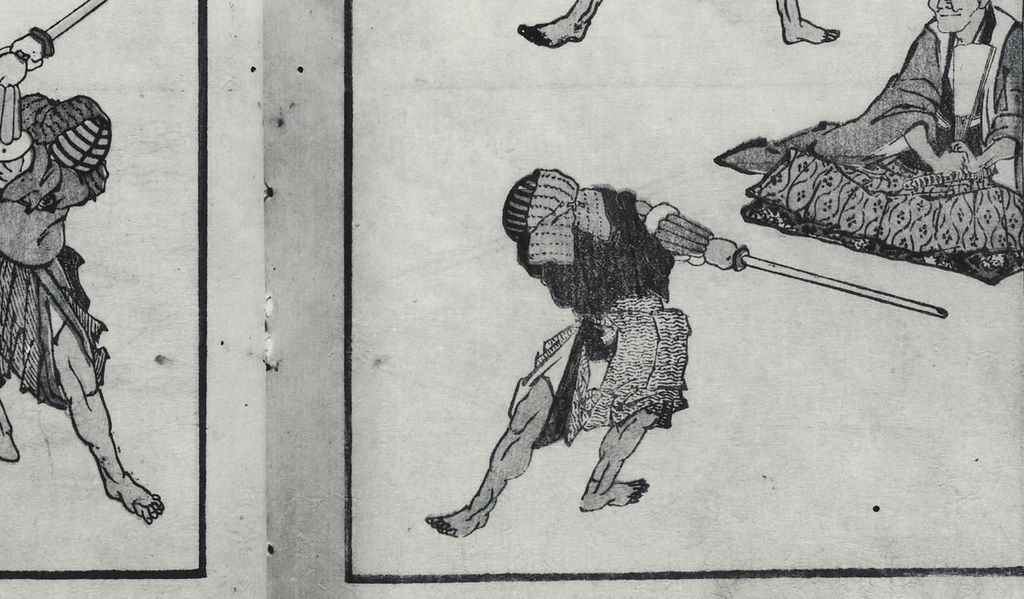
The Metropolitan Museum of Art, JIB81.6; Rogers Fund, 1931. Book object record · CC0. Detail crops from the Met scan.
What did “manga” mean for Hokusai?
The Japanese word 漫画 is now inseparable from comics, but its appearance in a book published in 1814 should not be read as proof that the book is a nineteenth-century comic strip. The British Museum's discussion of “Hokusai: the father of manga?” [2] explains that Hokusai's volumes belong to the world of picture manuals, and notes that the preface to volume one credits Hokusai with suggesting the title. The museum renders the word playfully as an unconstrained, wandering brush. The pages often gather separate observations on one sheet; they do not require a recurring cast, a fixed panel sequence or a plot running from the first volume to the fifteenth.
That does not make the modern association meaningless. The British Museum's broader history of manga [2] places Hokusai among the earlier traditions through which drawings, humorous images, narrative books and later print cultures developed. A reader today can recognize experiments with expressions, motion and juxtaposition that are interesting to comic artists. But a resemblance of visual device is different from a straight line of descent from one man to an entire modern medium. Later Japanese comics also drew on many other traditions and on changing publishing technologies. Hokusai's own title and format deserve to be understood first.
The full phrase 伝神開手 is present in several collection titles, including the Met's catalogues [3] and the Rijksmuseum's first-volume copy [4]. Translators differ on how to render it, but its place in the book signals an ambition to transmit more than an inventory of outlines. A drawing model could suggest how to capture movement, character or a sense of life. We should be wary of turning the phrase into a single tidy modern slogan, because its use is embedded in the titles and prefaces of particular printed copies. Looking at those pages gives a firmer account than using the English word “sketchbook” as if Hokusai left one private notebook behind.
From Nagoya drawings to the first book
Around 1812, Hokusai travelled to Nagoya. The British Museum's timeline [2] describes his meeting with an enthusiastic group led by Maki Bokusen, a samurai retainer and painter. At Bokusen's home, Hokusai made many rapid drawings, which his hosts helped collect into the first Manga volume. This account links the project to teaching and exchange beyond Edo. It also reminds us that a published book is not an untouched pile of spontaneous drawings. Selection, carving, printing and sale intervened between an artist's brush and the reader's copy.
Hokusai had already been issuing drawing instruction in other forms. The Sumida Hokusai Museum's 2026 exhibition [1] places Manga beside manuals that teach construction using a compass and ruler, single-stroke pictures and pictures made from written characters. Some manuals supply a procedure; others provide examples to imitate. Manga belongs especially to the latter mode. A page of different poses invites comparison and copying without printing an instruction under every figure. The museum describes copying models as an ordinary way to learn to draw in the period.
An 1814 first volume is thus both an art object and a teaching publication. Its likely audience was not limited to a modern category of “professional artists.” The Sumida museum says e-dehon were designed for anyone wanting to study drawing, and the books' broad circulation suggests that looking and copying could cross levels of skill. None of this makes every pictured activity a documentary record of Hokusai's own daily observation. Historical and mythic subjects, visual jokes and inherited motifs appear beside seemingly ordinary scenes. The books make an extraordinarily wide field of images available for use.
How a physical volume works
The Rijksmuseum's volume-one object AK-MAK-1652 [4] is a useful guide to the book as a complete object. The museum describes a blue cover with a red-and-white title slip, introductory material, numbered leaves, a preface, images of people, plants, animals and landscapes, and a list of booksellers. It names Eirakuya Tōshirō in Nagoya as publisher. The object is about 22.7 by 15.8 centimetres—something to hold and turn, not a set of independent wall-size pictures. The Rijksmuseum dates that copy broadly 1819–78; it is not evidence that the series first appeared in 1819.
The Met's JIB81.1 [3] is another first-volume object, dated after 1828. Its online record explicitly tells viewers to move through the book from right to left. Binding, margins and printed text matter alongside the illustrations. A double-page image meets at a fold; single-page motifs appear within a printed border; prefaces and publisher information frame the reader's experience. A detached web image of one figure can show Hokusai's line beautifully, but it cannot on its own reproduce the rhythm of turning leaves or the business of selling books. In a good caption, “volume one” identifies the work's place in the series and the accession identifies the particular book photographed.
Colour must also be treated carefully. Many reproduced Manga pages look largely black and grey, with delicate secondary tones; the object records describe woodblock-printed books with ink and colour on paper. The absence of brightly coloured landscape-print blue does not make these drawings unfinished. Line density, grey wash, pale printed areas and the paper itself help separate a horse from empty space or suggest weather. A scan's contrast settings can exaggerate or flatten those effects. Comparing the Met volume-six pages [3] with the Rijksmuseum's physical-book description [4] keeps attention on the thing a reader handled.
Looking at people, work and movement
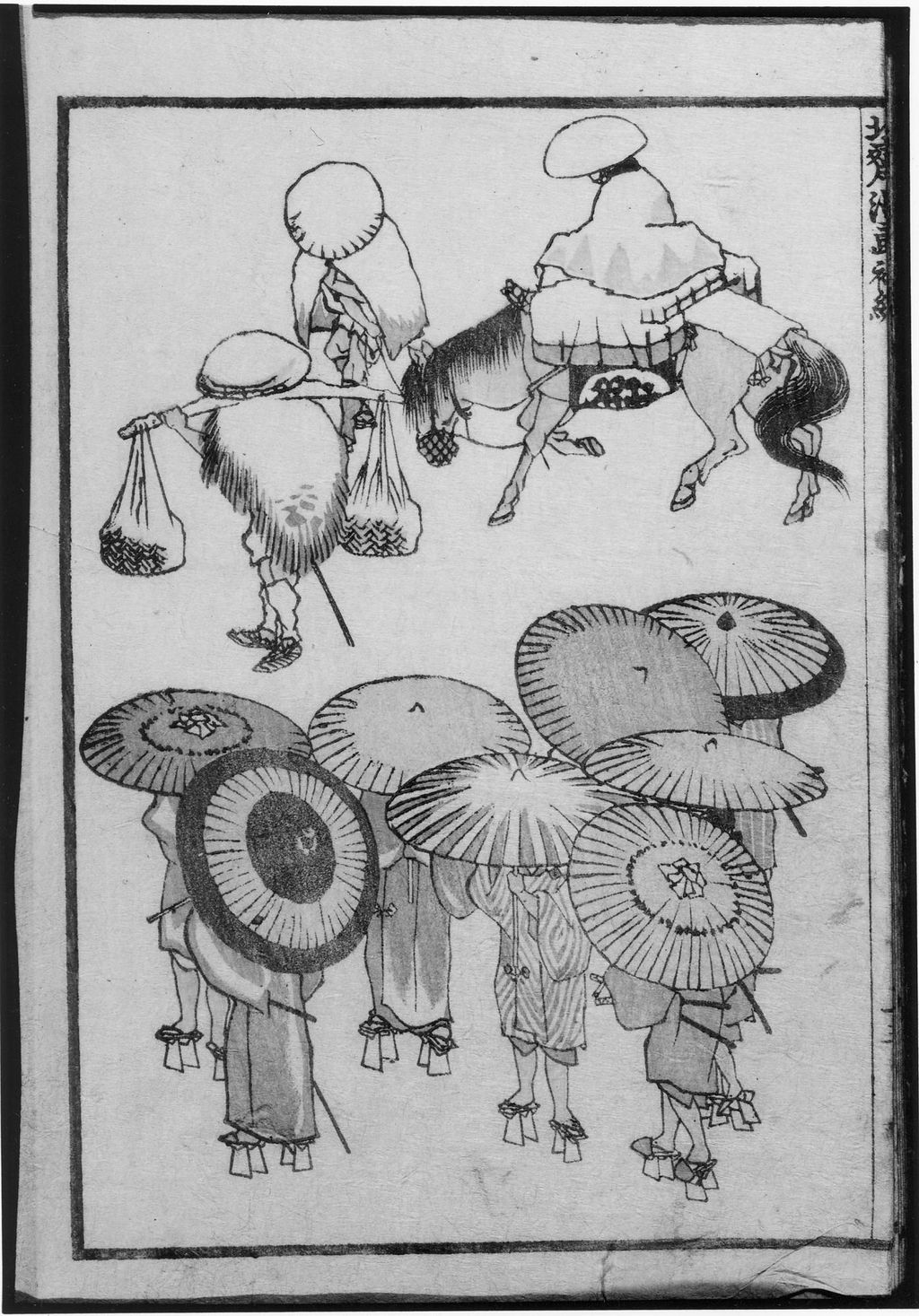
The first-volume page in the Met's JIB81.1 [3] gathers travellers and umbrellas. Rounded hat and umbrella forms repeat below figures carrying bundles; a horse and riders occupy the upper area. It is tempting to read it as a single scene on a road, but the arrangement also works as a collection of related shapes and social types. The eye moves between headgear, carrying poles, legs and the horse's body. Such a page can teach a viewer how to vary a form across people and positions without a lesson written in words.
People and work across four volumes
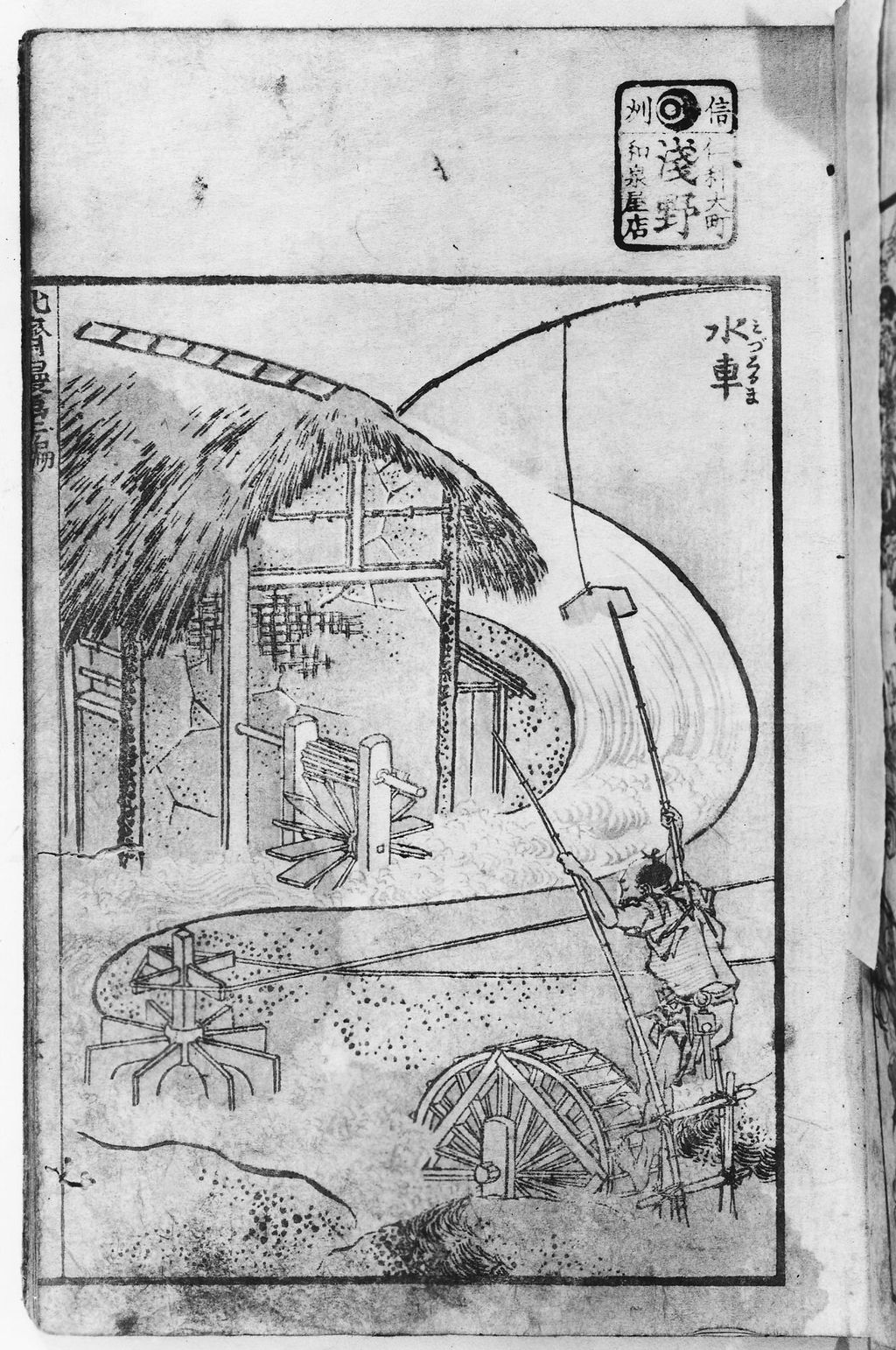
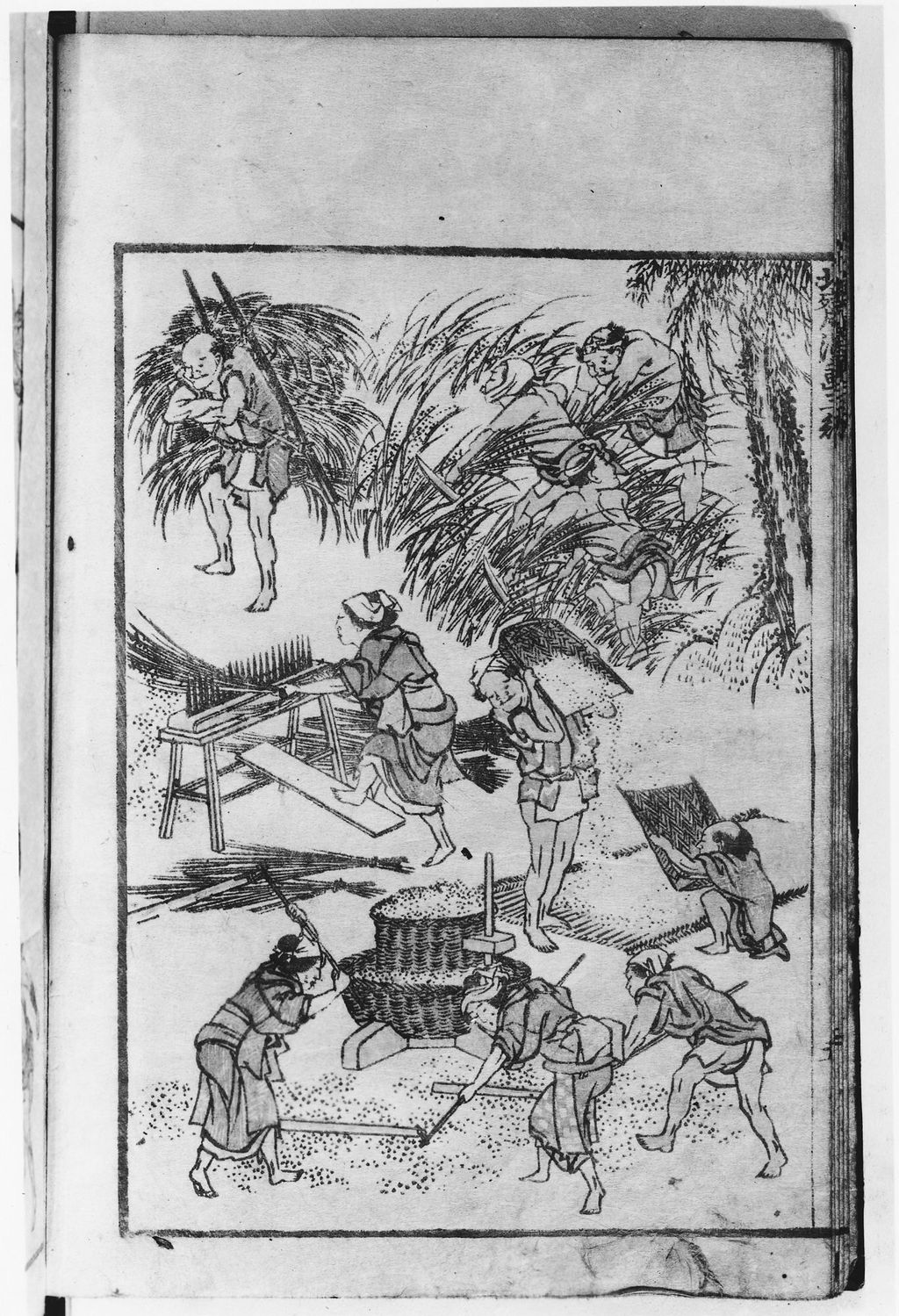
In the Met's second-volume copy JIB81.2 [3], one pictured page sets a human operator beside water and a wheel. The wheel's repeated spokes, curves of water and angled poles create a small study in engineered movement. The third-volume copy JIB81.3 [3] has a page of figures gathering and processing plants; different postures fill the scene from foreground to distance. Neither image needs to be presented as a measured survey of a named village. Their visible importance here is how work organizes bodies and how a handful of lines makes a tool, basket or patch of vegetation intelligible.
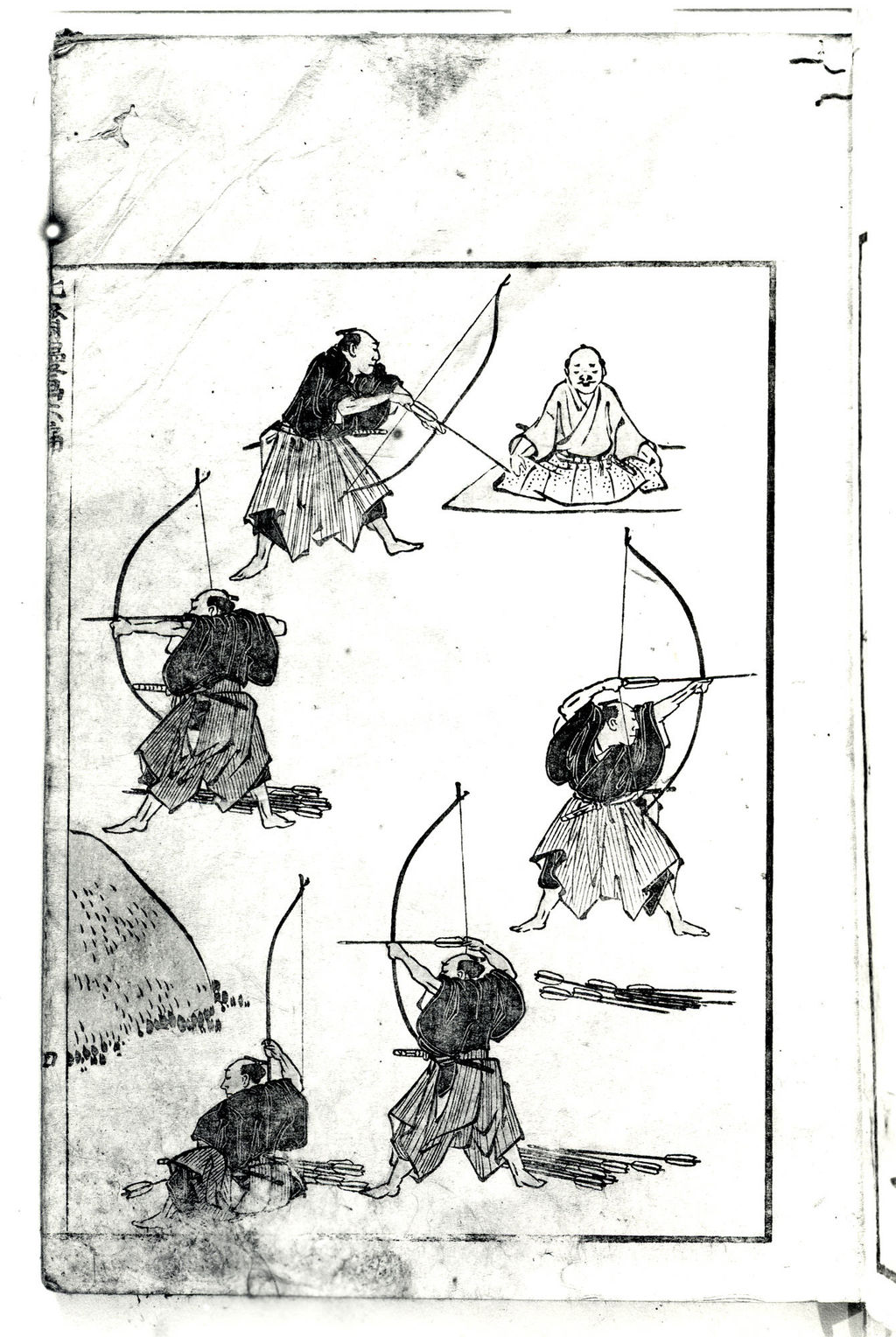
The Met's volume-six JIB81.6 [3] is particularly rich for studying action. One page shows several figures practising archery poses, each body differently angled around bow and arrow. A double-page opening brings figures with long staffs or swords into varied positions while others watch. The opening's centre fold interrupts the field without stopping the sense of repeated motion. A diagonal staff crosses one bent figure; another pose answers it on the opposite page. The fold makes the reader aware that these actions occupy a physical book. They are observed or imagined poses on a printed spread, not a captioned comic narrative with a guaranteed reading order.
The figures can be funny as well as useful. A person bends at an awkward angle; another seems to lose balance; a viewer inside the picture can appear to judge a performance. Those expressions have become a reason people see an affinity with later graphic humour. The British Museum's account [2] is a sounder guide than declaring every informal or exaggerated drawing a “first manga panel.” Hokusai lets marks do several jobs at once: describe a torso, imply its movement and invite a reaction from the reader.
Animals, landscape and the imagined world
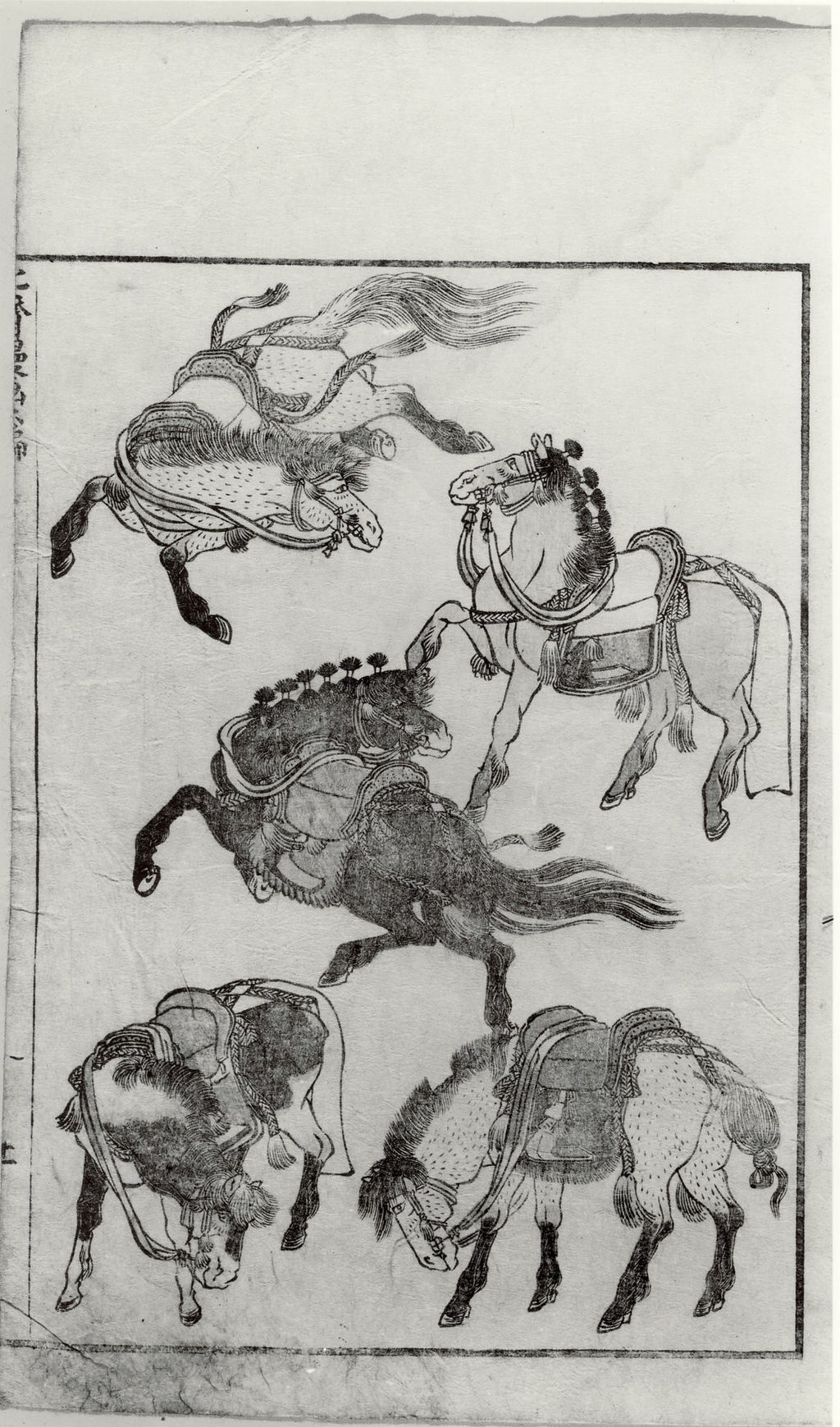
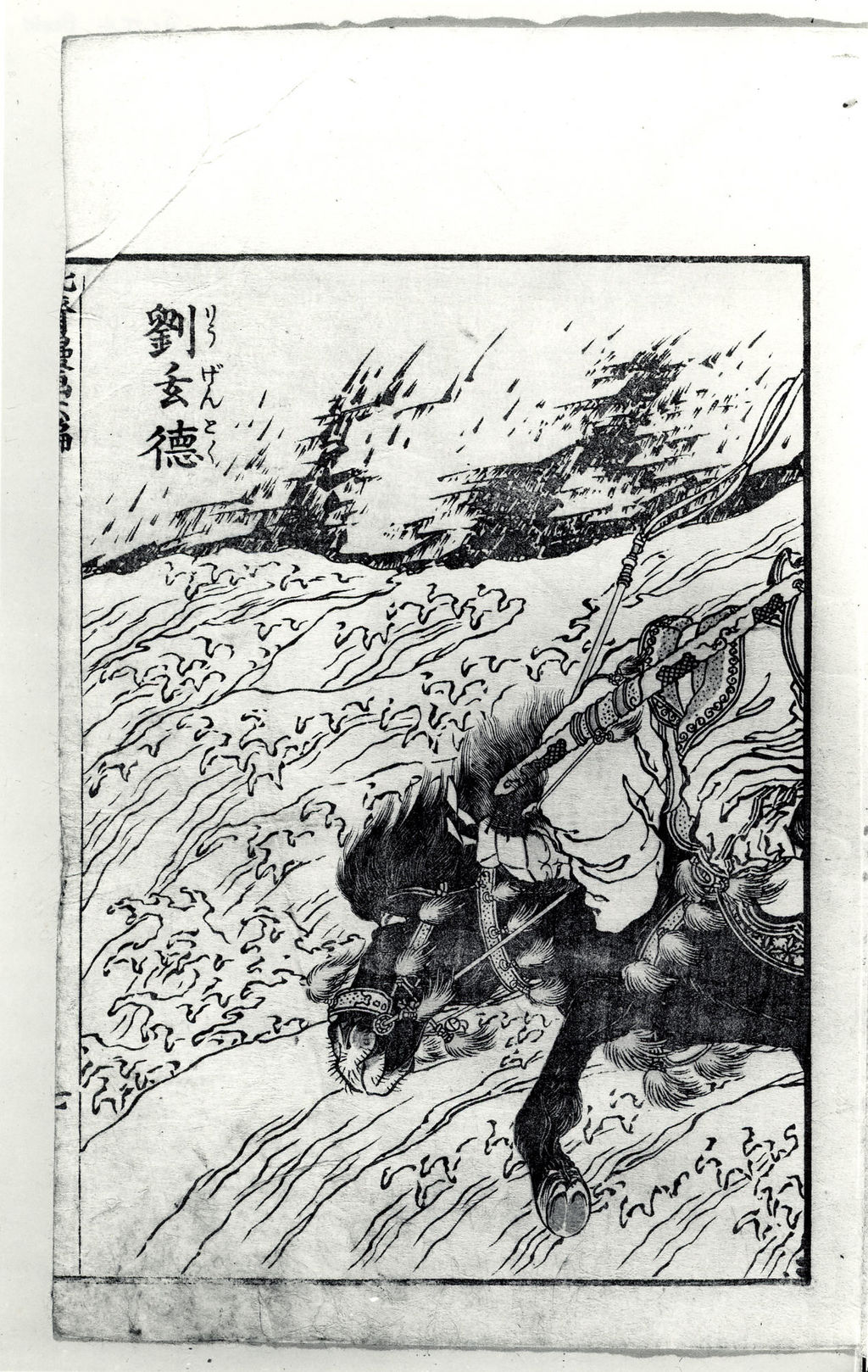
The same Met volume-six object [3] includes a sheet with several horses in different orientations. One rears or twists; others lower their heads or stand. Flowing mane and tail lines distinguish changes of speed from stillness, while gear and harness offer small contrasts in texture. Another page throws a horse and rider against forceful water. The waterfall or rapids are not a background decoration: diagonal water marks make the horse's body seem to brace against an environment. Seeing these pages close to the figure studies reveals a shared problem of drawing weight and motion across subjects.
Animals, landscape and the later books
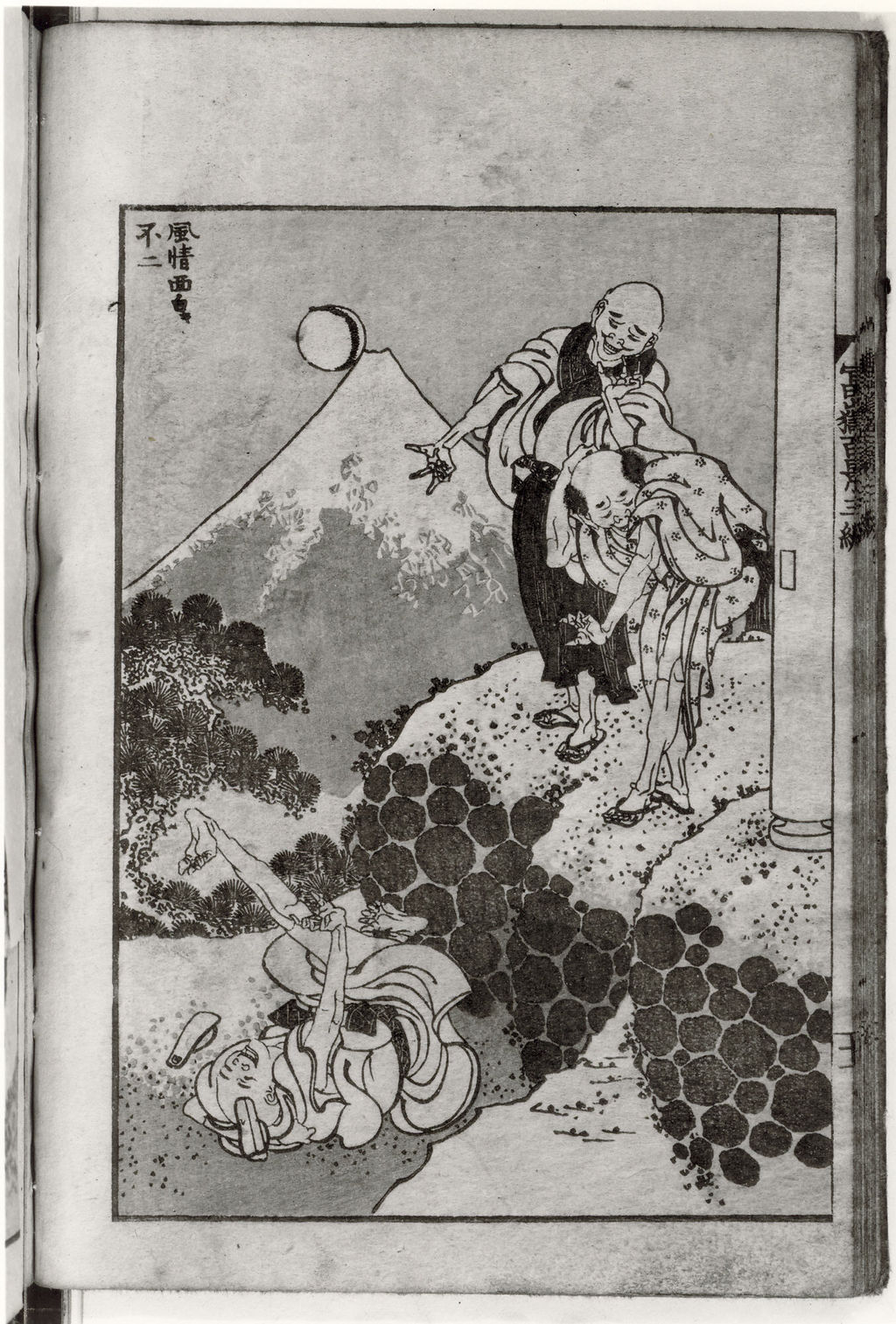
The Met's volume-seven JIB81.7 [3], dated 1819, has a pictured page with Mount Fuji and figures behaving with an almost comic lightness on the slope. Fuji here is a smaller stage for action, whereas the later Thirty-six Views makes the mountain the series' constant subject. A reader moving between the book and the colour prints sees Hokusai return to familiar forms in different publication settings. The book page belongs to its own volume and date; it should not be catalogued as a preliminary study for a particular later Fuji print without evidence.
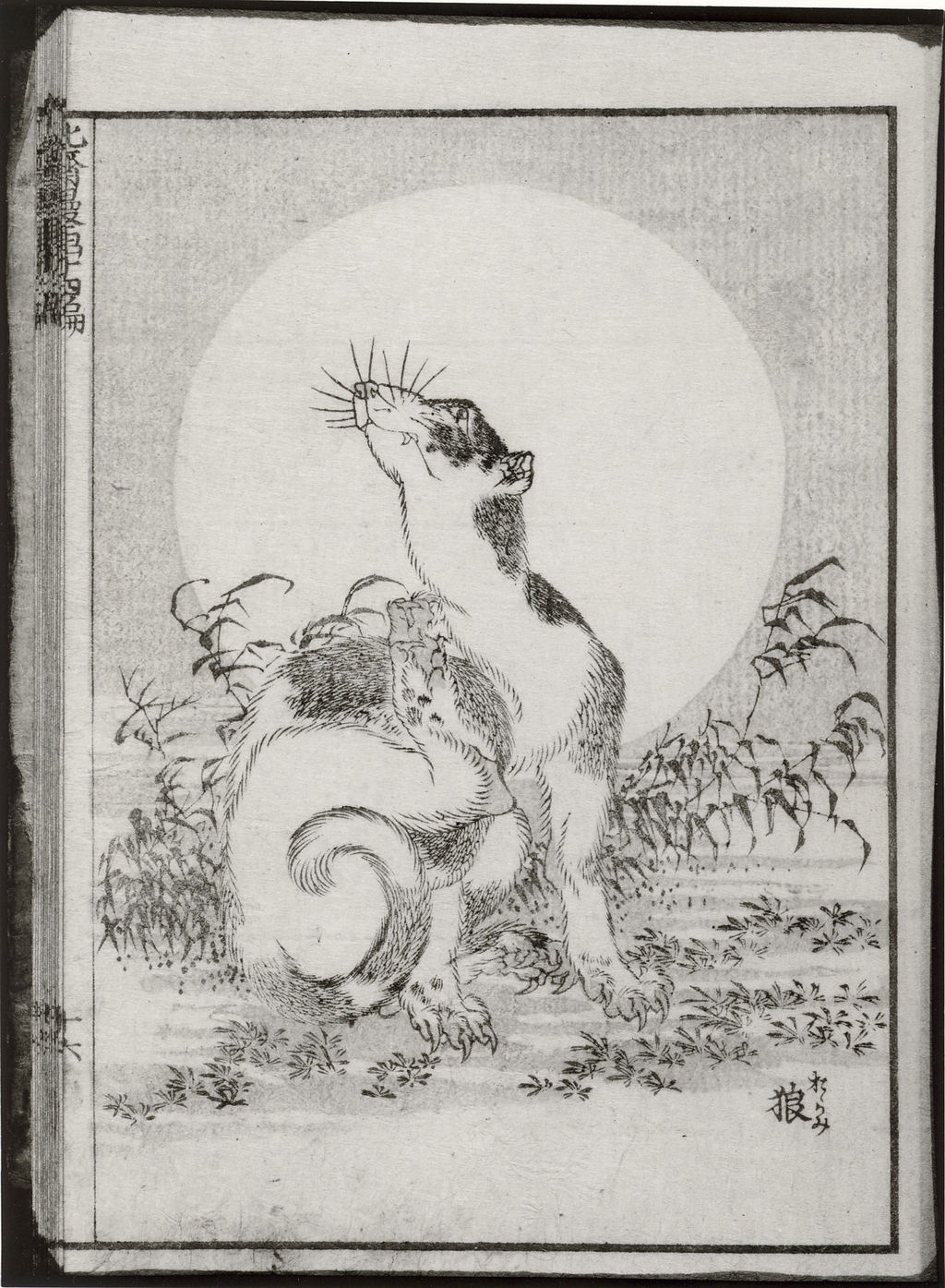
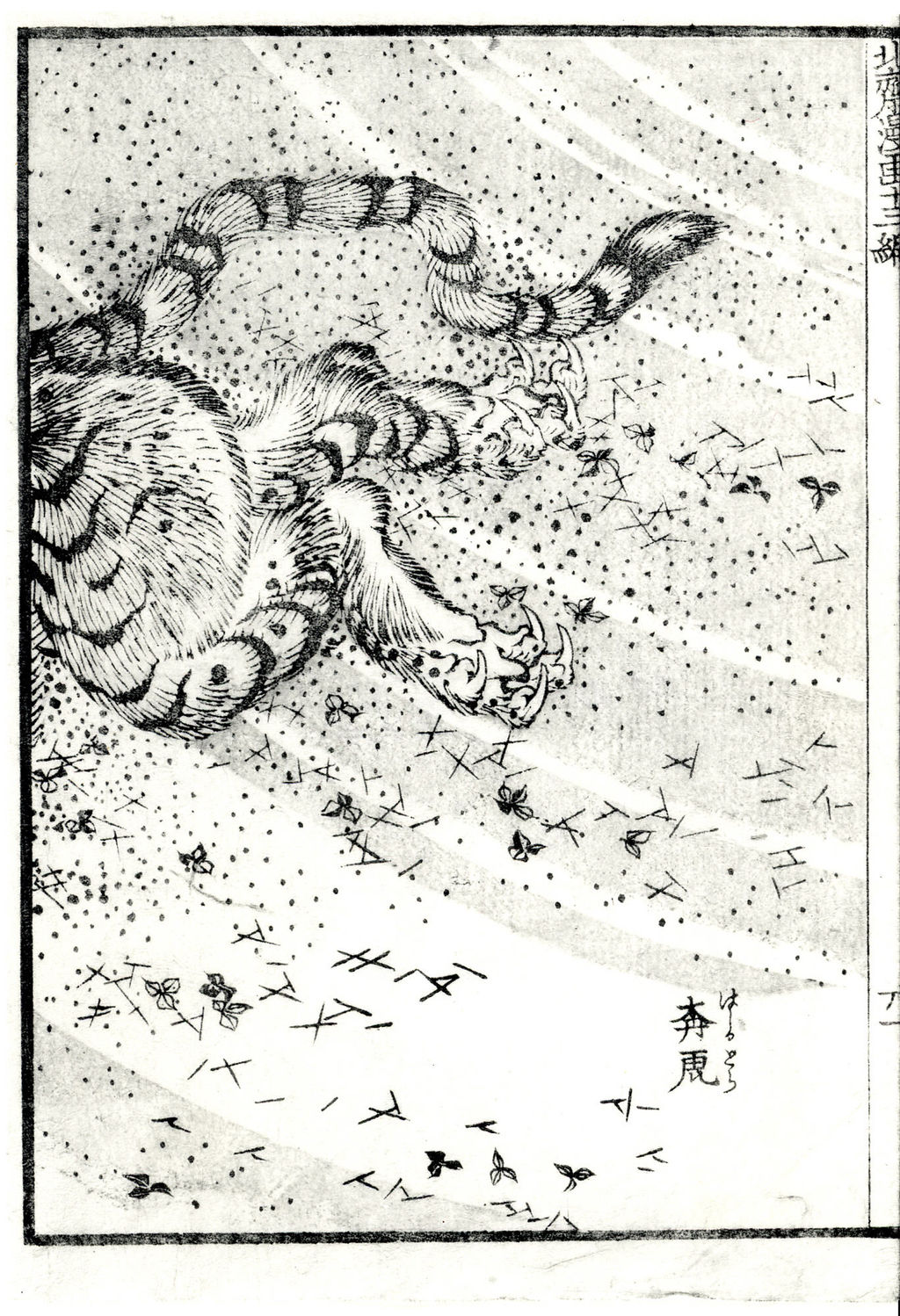
Volume fourteen gives a different kind of warning about time. The Met catalogues JIB81.14 [3] around 1875–78, well after Hokusai died in 1849. One photographed page shows an animal silhouetted before a pale circular field; another contains a tiger, its heavy body cut across by small scattered marks. The images may derive from designs associated with Hokusai, but the book copy and volume publication belong to a later phase. The Sumida museum's exhibition chronology [1] states plainly that the fifteen-volume series concluded posthumously in 1878. A caption saying only “Hokusai, 1814” beside these pages would erase sixty years of book history.
The changing subject matter gives the books an encyclopedic feel, though no one volume could be a complete inventory of Japan. The Sumida museum's second-volume account [1] describes around 3,900 images across the series—people, nature, deities and strange beings. Modern publishers sometimes give a slightly different rounded total because they count illustrations or motifs differently. The number is a scale marker, not a reason to treat every drawing as equally documented. The value of an object-based gallery is that it shows what these general labels look like in actual leaves, each with a volume and accession.
Fifteen volumes, many dates
Compare the catalogued book copies
The dates below describe the museum copies pictured here. The first volume was originally published in 1814; the whole series ended in 1878.
| Volume | Met book | Catalogue date of copy | Shown here |
|---|---|---|---|
| 1 | JIB81.1 | After 1828 | Travellers and umbrellas |
| 2 | JIB81.2 | After 1814 | Waterwheel and operator |
| 3 | JIB81.3 | Date not stated | People processing plants |
| 6 | JIB81.6 | Date not stated | Figures, staffs, horses and water |
| 7 | JIB81.7 | 1819 | Figures and Fuji |
| 14 | JIB81.14 | c. 1875–78 | Animal and tiger |
The first book did not simply stay frozen while fourteen more were added. Woodblock printing allowed renewed impressions, publishers could advertise or assemble different copies, and books survived under different conditions. The Sumida Hokusai Museum [1] describes repeated printing from Edo times into modernity, including editions printed from traditional blocks, and displays a copy notable for its colophon. Such evidence matters because a colophon can attach a book to a publisher or printing history that a cropped illustration cannot reveal.
The Met's catalogue [3] calls its first-volume JIB81.1 “after 1828,” while the museum's JIB81.2 [3] is “after 1814,” JIB81.7 [3] is dated 1819, and JIB81.14 [3] is c. 1875–78. These dates refer to catalogued objects or copies. They are not a ready-made publication list for volumes one through fifteen. The first-volume publication in 1814 and the last-volume endpoint in 1878 are separately supported by the Sumida and British Museum histories. Where an institution leaves a copy's date blank, the caption should do the same instead of filling it with the series' first year.
The comparison below groups identified museum images by volume while showing a separate date or “copy date not stated” for each physical book. These surviving copies do not all have a known place on a continuous timeline from 1814 to 1878. The series, each published volume and each surviving copy carry different kinds of dates. Keeping them separate gives a clearer account of how the books reached readers.
Drawing manuals beyond Hokusai Manga
Hokusai's book-making was not a side activity squeezed between famous single sheets. The British Museum's Hokusai resources [2] describe an artist who designed images for almost 270 books, covering many genres. The Sumida museum's drawing-manual exhibition [1] sets Manga beside Quick Guide to Drawing, pattern books and manuals made by Hokusai's students. Some teach a method directly, such as building forms with geometric tools. Others offer an abundance of examples from which the student learns by copying. Together they reveal a visual education sustained by commercial woodblock printing.
The Sumida exhibition traces a particularly concrete later reuse: designs associated with Hokusai's illustrated books were adapted onto Wedgwood pottery, and horses from Manga volume six were used as models in a later colour print. It also presents the work of Hokusai's pupil Katsushika Hoku'un, whose own picture manual shows how students could become publishers of models in their own right. The exhibition ties later objects to identifiable source designs or volumes. The Met's book images show the variety that made such borrowing possible.
Hokusai Manga beyond Japan
Copies of the books travelled and attracted readers outside Japan. The Art Institute of Chicago's conservation publication [5] notes the presence and acclaim of Manga volumes in Europe. A Met publication on Japanese woodcuts and French prints [6] discusses an account of Félix Bracquemond encountering a volume in the mid-nineteenth century. Individual stories of discovery can be compelling, but they should not stand in for the complex routes by which Japanese books, prints, collectors, dealers and reproductions circulated.
The Sumida museum's 2026 exhibition [1] provides an unusually tangible example of later adaptation through a porcelain object rather than through a sweeping assertion of Western influence. The museum also follows later impressions and editions of the books themselves, which remain part of the object's history. A modern three-volume boxed selection issued by Thames & Hudson [7] reorganizes extracts by modern themes such as daily life, nature and fantasy. That edition is useful for readers, but its three volumes are not the three original books, and the thematic divisions are editorial choices made in 2018. Keeping those levels of publication apart makes modern access more intelligible.
How to look closely at an opening
Begin with the whole spread: locate the fold and decide whether forms cross it or stay within their page borders. Then move from one pictured action to another without assuming that “next” means a plot event. On the Met's volume-six staff-practice spread [3], compare the stance of the left-hand figure with the wide stride of a figure on the right. Follow the long diagonals of their staffs across blank paper. The onlookers sit lower, giving the more active bodies a different scale. At the centre, the book fold reminds us that the design was meant to be opened and held; it is not a single unbroken sheet.
In the horse page, compare tails and lowered heads rather than counting the animals alone. On the first-volume umbrella page, let the repeated circles lead into differences in clothing and carrying. In the waterwheel page, notice how a round mechanism and curved stream hold a standing figure in place. These are practical ways to examine how Hokusai turns line into a usable stock of observations. When moving to a second museum image, check the accession and volume first. Two web files may come from different copies or reprintings; even an apparently identical design can have a different physical history.
The same page as instruction and entertainment
A pupil copying the volume-six archers could learn several things at once. The curve of the bow and the figure's extended arm make a readable silhouette; the direction of the arrow organizes the rest of the body. Repeated poses allow the learner to compare the difference made by a bent knee, a turned shoulder or the height of the hands. The page does not isolate a single “correct” pose in a diagram. Its appeal lies partly in how many lively attempts it can hold. A reader with no intention of drawing can enjoy the same variety as a study of people in motion. That double function helps explain why Manga is both an e-dehon and a book people kept buying. The Sumida Hokusai Museum [1] emphasizes that collections of pictures could teach through observation and copying, even without step-by-step instructions.
This distinction is useful beside Hokusai's more explicitly procedural manuals. Sumida describes Quick Guide to Drawing as showing how compass and ruler establish a framework from which a more detailed picture can be built. A page of Manga does not usually supply such a construction grid. It offers successful forms to watch. We should not turn that difference into a ranking of “serious” instruction and mere entertainment: both were ways of teaching the hand and eye. An amateur might copy a horse because its anatomy was challenging, a craftsman might adapt its outline, and a casual reader might simply enjoy its apparent energy. The surviving books cannot tell us which of those responses any particular buyer had.
The animal pages widen the same proposition. Five horses placed together on a page do not document five consecutive instants of a single horse's movement. They let a reader compare attitudes—rearing, lowering, standing and turning—without leaving the printed surface. The dramatic tiger in the Met's fourteenth-volume copy [3] pushes the animal's body close to the picture's edges, with small marks scattered across the surrounding space. It is a different exercise from the separated horses: one concentrated design rather than a series of studies. Both remain within the published Manga, which is why any description of the whole work as simply “a sketchbook of quick doodles” is inadequate.
Why book objects and individual leaves need separate records
A museum's illustrated-book record often covers a whole bound copy even when its website displays several photographs. The ten image selections on this page come from six catalogued Met objects. Four of the pictures belong to the same volume-six copy, JIB81.6. Counting ten files as ten separate books would inflate the evidence; captioning them all “Hokusai Manga” without volume numbers would hide it. The Met's object pages [3] provide a better unit of identification: the accession for the book and the pictured page within it. This matters especially when the viewer compares two images that look different in tone. They might be separate pages from one bound volume, not evidence of two printings of one design.
The Met's online catalogue also shows why digital records need close reading. Its first-volume JIB81.1 [3] names both the volume and a later copy date. Some photographs show prefaces or covers, while others show illustrated leaves. A selection made only from the first photograph of each book would give a distorted view of the drawings. The examples here include a full two-page opening, individual figure and animal pages, a work scene and a late-volume image. They remain a small sample; ten images cannot summarize thousands of motifs. A book viewer or a physical exhibition best conveys the rhythm and abundance of the series.
The Rijksmuseum's AK-MAK-1652 [4] adds details that a Met image gallery cannot supply by itself. Its description enumerates the cover, leaves, preface, pictured subjects and final bookseller list. The list is part of the object, pointing to a book trade that took images from Hokusai's designs into a network of retailers and readers. The named Nagoya publisher, Eirakuya Tōshirō, is not incidental decoration in this story. Without carving, printing, binding and distribution, the drawings associated with the Nagoya circle would not have become the long-lived printed series known today. Publisher information also helps distinguish this project from Eijudō's later single-sheet Fuji prints; both involved Hokusai, but their material paths were different.
A careful way to discuss influence
It is easy to call Hokusai “the father of manga” and stop there. The British Museum's essay with that phrase in its title [2] instead asks readers to look at the early book and at later graphic traditions. The question mark is doing real work. Hokusai's books supplied imagery, drawing strategies and a famous use of the word, while the modern comics form developed through further Japanese and international publishing histories. Hokusai did not draw fifteen volumes of sequential stories in the format a reader now expects from a manga series. At the same time, completely cutting the books off from later visual culture would ignore their continued copying, reprinting and adaptation.
The Sumida exhibition's Wedgwood example [1] illustrates one route with more precision than a claim of universal influence. Particular figures from Hokusai's illustrated books were adapted to a porcelain plate. The result changed scale, medium, audience and use; it did not become another edition of Manga. The museum's example of horses from volume six used in a later colour print shows a different route, this time within Japanese print culture. Both examples make borrowing traceable to images or volumes. The pictured horses show the poses available for other artists to adapt.
The modern Thames & Hudson Hokusai Manga selection [7] is another kind of afterlife. Its 2018 three-volume boxed edition sorts images into everyday life, nature and fantasy. That makes the original abundance more approachable to a new reader, but it also imposes a modern thematic map on a fifteen-volume historical publication. A reader who wants to examine the original books should keep the re-edition's helpful categories separate from the chronology and contents of Hokusai's volumes. The TASCHEN monograph by Andreas Marks [7] places illustrated-book pages within Hokusai's whole career; a smaller TASCHEN introduction by Rhiannon Paget [7] offers a more compact route. Their publisher descriptions establish scope and bibliographic details; claims about a particular original page still need a catalogue or examined book.
Frequently asked questions
No. The historic books are illustrated woodblock-printed drawing manuals and model collections rather than a continuing comic narrative. The word and some visual practices connect to later histories in complicated ways; the British Museum's historical discussion [2] is a useful starting point.
Fifteen. The first appeared in 1814 and the series ended with volume fifteen in 1878, after Hokusai's death. The Sumida Hokusai Museum [1] gives this full chronology. Modern publishers sometimes repackage selected images into a different number of volumes.
Because it is dating its surviving copy, not moving the first publication from 1814. The Met's JIB81.1 [3] gives that later date. Woodblocks and publications could have longer lives than a first edition.
He died in 1849. Volume fifteen completed the series in 1878, so its publication was posthumous. The Sumida museum's account [1] states both the endpoint and the gap after his death. Questions about the design and printing of any individual late page require object-level research.
No. The series includes historical, supernatural and imaginative subjects alongside ordinary people and nature. The term “sketches” describes the books' manner and function, not a guarantee that each page records one observed moment. The Sumida museum's description [1] emphasizes that subject range.
References
- Sumida Hokusai Museum, Open the Drawing Manual—Sketches by Hokusai or Many More; Hokusai biography; second-volume collection item.
- British Museum, Hokusai timeline; Hokusai: the father of manga?; Manga: a brief history in 12 works; Hokusai resources.
- Metropolitan Museum of Art, JIB81.1 / volume 1; JIB81.2 / volume 2; JIB81.3 / volume 3; JIB81.6 / volume 6; JIB81.7 / volume 7; JIB81.14 / volume 14; Open Access image policy.
- Rijksmuseum, Hokusai Manga volume one, AK-MAK-1652.
- Art Institute of Chicago, conservation publication; Art Institute of Chicago, acquisitions report.
- Metropolitan Museum of Art, The Great Wave: The Influence of Japanese Woodcuts on French Prints.
- Thames & Hudson, Hokusai Manga boxed selection; TASCHEN, Andreas Marks, Hokusai; TASCHEN, Rhiannon Paget, Hokusai.