


 by Tom Gurney
Tom Gurney BSc (Hons) is an art history expert with over 20 years experience. Updated September 24, 2026.
Introduction
A white rooster stands beneath a looping vine; a moon appears through a tangle of plum branches; two crabs advance across a quiet shore. Itō Jakuchū (伊藤若冲, 1716–1800) made these very different images during a long career in Kyoto. Their subjects might sound like simple nature studies, yet the Metropolitan Museum of Art's Hen and Rooster with Grapevine [7], White Plum Blossoms and Moon [6] and Crabs and Peonies [13] differ in date, medium, size and purpose. One is a coloured hanging scroll, one an earlier painting on silk, and one face of a freestanding screen. Looking at their exact objects is a better way into Jakuchū than reducing him to a painter of eccentric chickens.
His best-known undertaking, Colorful Realm of Living Beings (動植綵絵, Dōshoku sai-e), consists of thirty separate silk hanging scrolls. The Agency for Cultural Affairs' National Treasure record [1] names and measures all thirty. The Museum of the Imperial Collections [2] connects the group to the Śākyamuni triptych that Jakuchū also gave to Shōkokuji temple. The scrolls were used together with that Buddhist image in ritual settings. They should therefore be introduced as a sustained religious and pictorial project, not as thirty unrelated illustrations of things he happened to see.
Contents
- Introduction
- First look: a painter, a series and eight objects
- Explore eight exact museum objects
- Colorful Realm is a set, not an isolated painting
- Roosters and cranes beyond the famous set
- Plants as structures, symbols and brushwork
- One screen, two faces
- A river journey printed in ink
- Kyoto, the market and the monastery
- How to look without flattening the work
- Survival and renewed attention
The same artist also worked in brushed ink, designed printed books and a long printed handscroll, and gave painted forms to Buddhist figures. The eight securely identified works illustrated below offer a route through those choices. A separate biography follows the documented sequence of his life, family business, religious friendships and civic work. The thirty-scroll guide lists every Japanese title and clarifies which information belongs to the series as a whole and which can be verified for a particular scroll. This home page shows how the main kinds of Jakuchū work relate, while keeping each museum image tied to the object it depicts.
At a glance
- Who was Jakuchū?A Kyoto painter born in 1716 and deceased in 1800, formerly head of a Nishiki Market greengrocery. He handed the family business to a younger brother in 1755. Agency for Cultural Affairs [1].
- What is his central series?Thirty colour paintings on silk called Dōshoku sai-e, donated in stages to Shōkokuji and later held by the Museum of the Imperial Collections. Agency for Cultural Affairs [1]; Sannomaru Shōzōkan [2].
- When were the thirty scrolls made?Around a decade of work: begun before the earliest dated scroll of 1758, twelve complete by 1761, twenty-four donated with the Śākyamuni triptych in 1765, and all thirty complete by November 1766. These are set-level milestones, not dates for every individual image. Agency for Cultural Affairs [1].
- Did he only paint animals?No. The exact objects here include plants, Buddhist figures, ink landscape in a printed handscroll, and both faces of a freestanding screen. Met collection records [8]; Kyoto National Museum's Vegetable Nirvana [5].
- Where can the pictures on this page be checked?Eight accessioned Met Open Access files, with original image URL, dimensions, credit line and checksum retained in the production ledger. They are examples, not an exhaustive catalogue.
First look: a painter, a series and eight objects
Explore eight exact museum objects
Each card points to one accessioned object. Filter by medium, then open its museum record to check the work and image.
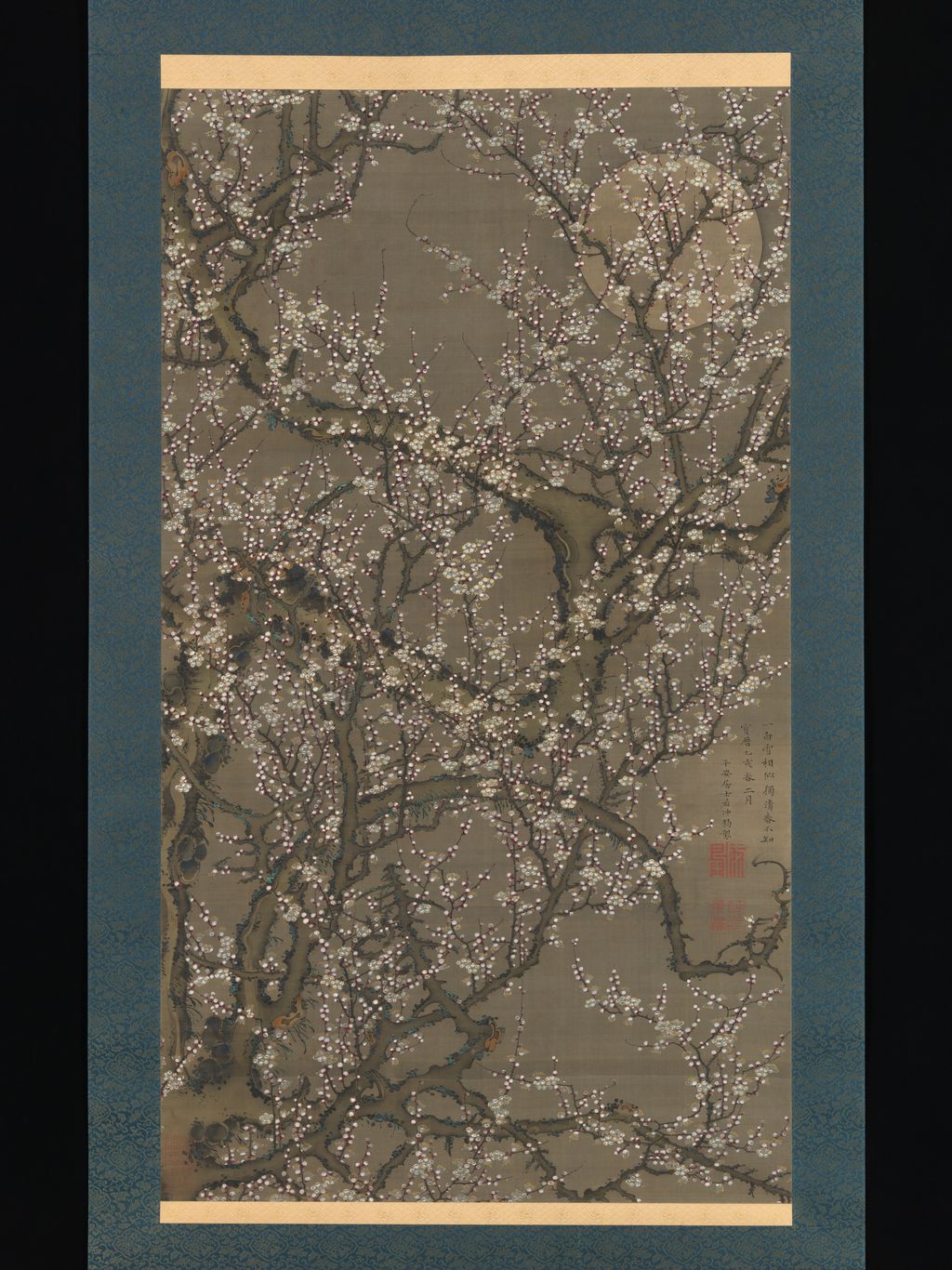
White Plum Blossoms and Moon
A network of plum branches and a pale moon in a vertical hanging scroll.
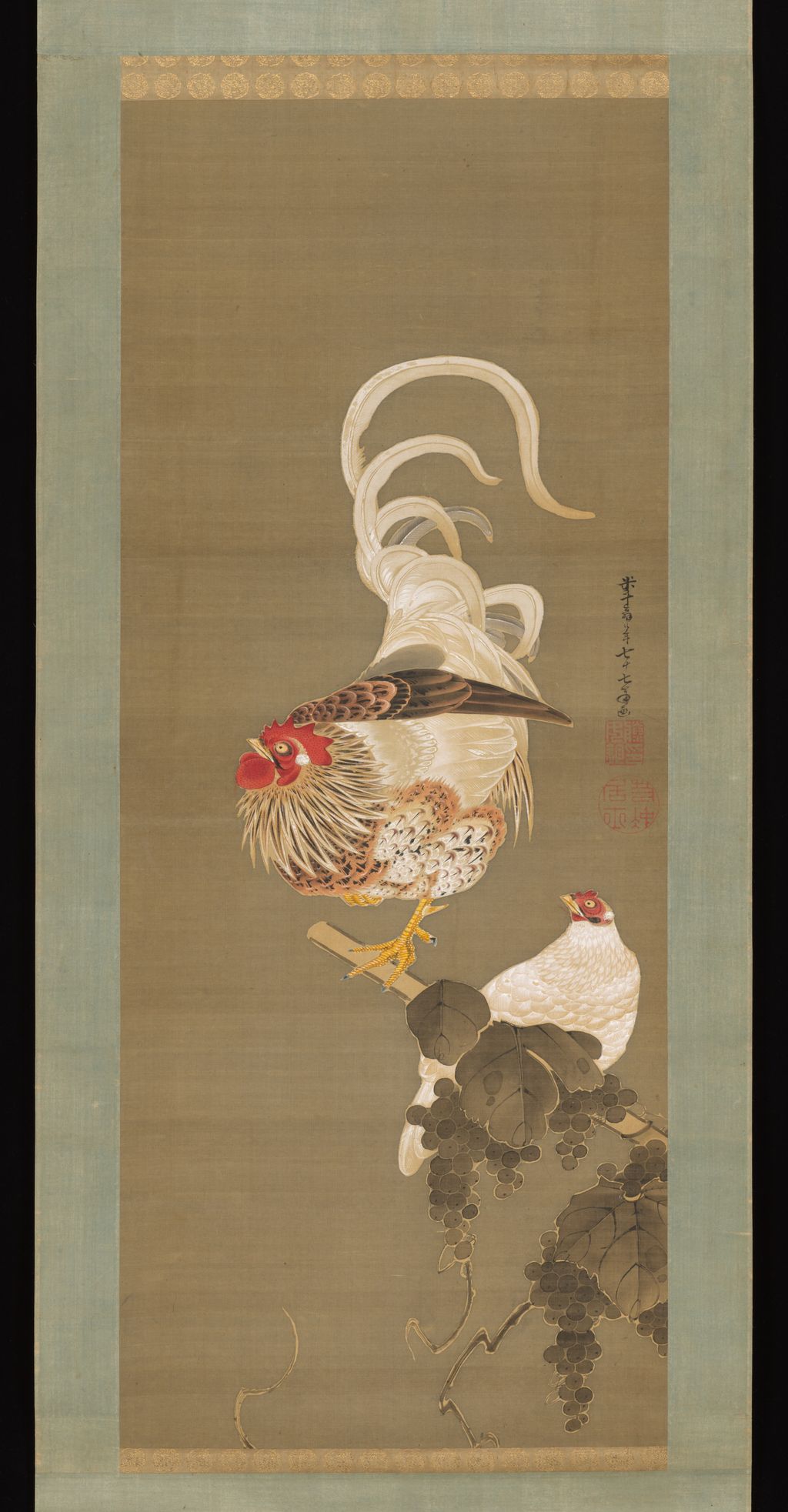
Hen and Rooster with Grapevine
Two birds and a looping vine; a later painting, not a Colorful Realm scroll.
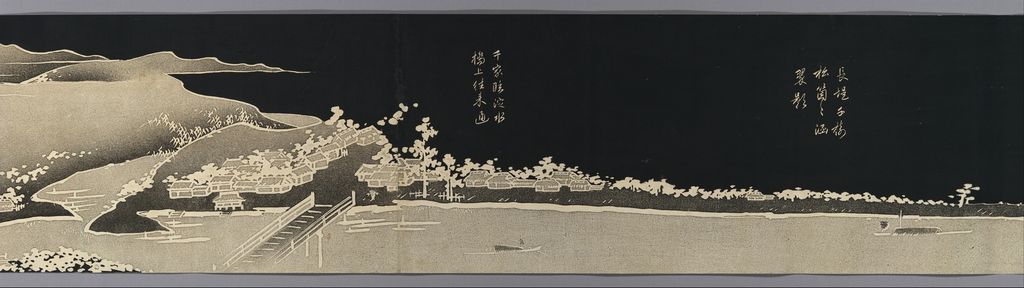
Pleasant Diversions on a Riverboat Journey
One photographed section of the long printed handscroll, not the complete work.
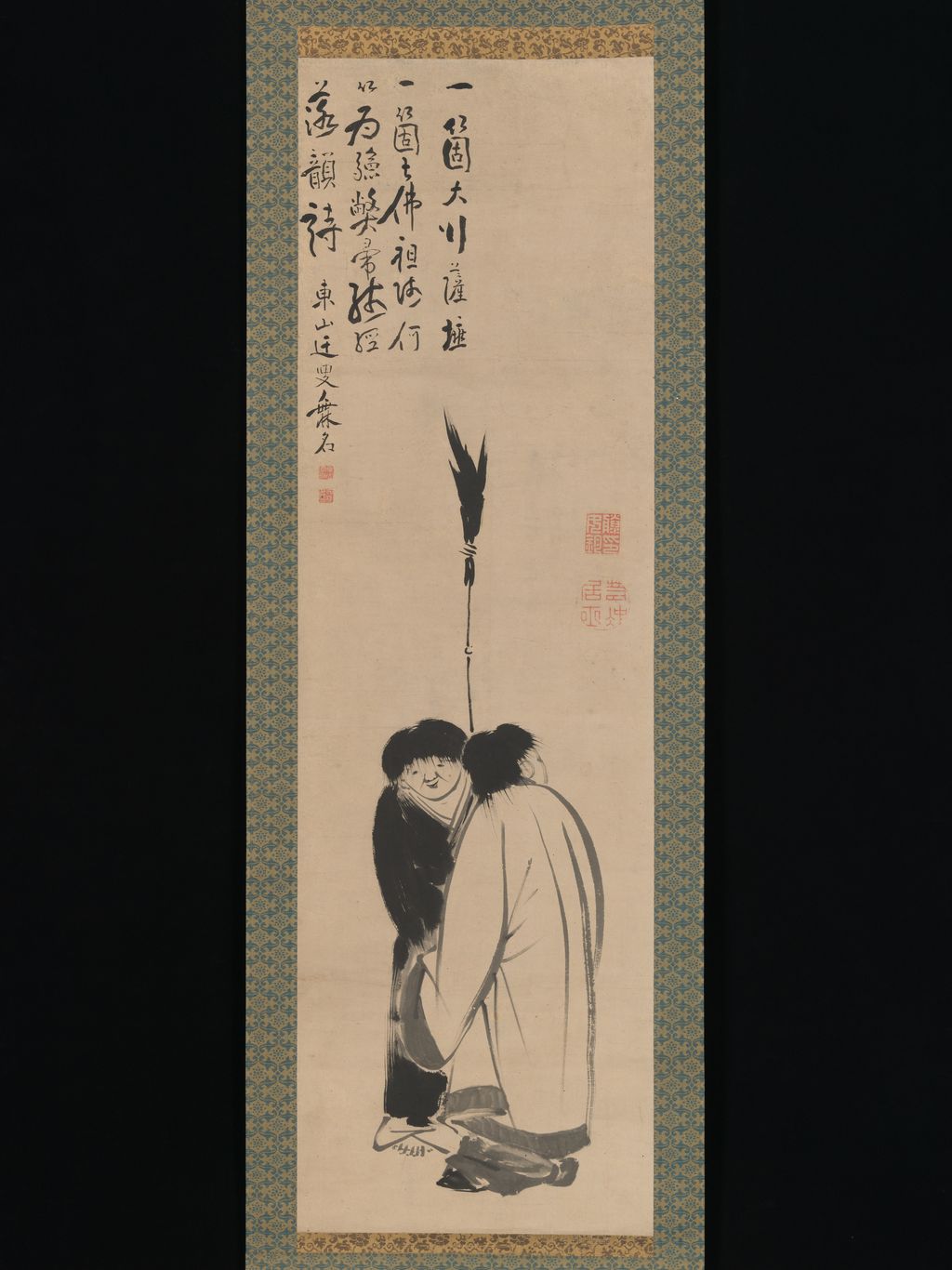
Hanshan and Shide
Buddhist figures; the inscription is attributed to Ike no Taiga.
Crabs and Peonies
Crab face of a two-sided standing screen; the peonies are on its reverse.
The opening gallery places eight Met objects in four useful groups: colour on silk, monochrome ink, a printed journey, and a painted screen. These categories are guides to looking, not schools into which the artist permanently fits. A single work may cross them: Crabs and Peonies is a screen with ink and gold on paper, whose two faces offer unlike tempos; Hen and Rooster with Grapevine is a colour painting that uses both the precise observation of birds and an emphatic arrangement of forms. The gallery's accession numbers matter. Met 2015.300.213 is the 1755 White Plum Blossoms and Moon; 1975.268.69 is the 1792 rooster painting. Replacing one photograph with another work of the same subject would change the object under discussion.
The group also makes time visible without trying to turn the home page into a second biography. The Met dates White Plum Blossoms and Moon to 1755. It dates Hen and Rooster with Grapevine to 1792 and Two Cranes to 1795. Bean Vine [11] is dated more cautiously to the late 1750s or before 1764, while Banana Leaves [12] belongs to the 1790s. Those labels do not imply an unbroken stylistic march from “simple” to “complex.” Their differences show that colourful silk, spare ink and other techniques coexisted in a life that cannot be read from a single celebrated masterpiece.
One file also needs a viewing warning. The Met's Pleasant Diversions on a Riverboat Journey, 1975.268.70 [8], is a handscroll almost twelve metres long according to its record. Our principal image shows one photographed section, not the entire work; the Met page offers additional views and instructs readers to view the scroll from right to left. Similarly, the primary file for the double-sided Crabs and Peonies, 2022.166a–c [13] cannot represent both faces at once. These limitations are part of a truthful gallery. They explain why each card has a link back to the museum rather than presenting one screen file as a complete account.
Colorful Realm is a set, not an isolated painting
The Japanese government catalogue [1] calls the thirty-scroll set silk paintings in colour and lists subjects as varied as peonies and butterflies, snowy mandarin ducks, an autumn flock of sparrows, roosters with different plants, swimming fish, shells and insects. Its ordered inventory provides a reliable starting point for browsing. The order given in an inventory is not automatically the sequence in which Jakuchū painted each sheet. Only some scrolls carry dated signatures. The catalogue uses those dates alongside documents to reconstruct phases of making and donation. A page that assigns a precise year to every pictured animal would convey more certainty than the evidence allows.
The work took shape while Jakuchū's relationship with Shōkokuji deepened. The Museum of the Imperial Collections' set record [2] explains that he donated the scrolls and his Śākyamuni Triptych to the Kyoto monastery. The National Gallery of Art's 2012 exhibition account [3] says the paintings were displayed in a large temple room during Buddhist rituals. It reunited the thirty scrolls with the triptych in Washington after conservation. The display history helps us understand why lush flora and fauna are not merely secular garden decoration. The living world could be contemplated in a Buddhist setting, in dialogue with images of the Buddha.
The government record provides an unusually precise way to handle completion. The first year written on one of the scrolls is 1758, yet work had begun before it. Twelve were complete by 1761; twenty-four were donated with the triptych in 1765; all thirty were finished by November 1766. The account suggests possible commemorative motives involving family deaths, but it does not license a simple claim that one single death “caused” the entire series. Later, the works left the temple for the imperial household in 1889 and passed to the state in 1989. They received National Treasure designation in 2021. These are changes of custody and status, not different editions of the paintings. A silk scroll is one physical work, although it can be photographed or reproduced many times.
The NGA exhibition [3] gives a close technical example in Peonies and Butterflies. Pigments of different opacity, including mineral and vegetal colour, were layered; some colour was placed on the reverse of the silk. The resulting depth does not come from outline alone. The same page records that Daiten Kenjō, Jakuchū's cultural and spiritual mentor, gave this painting the title Beautiful Mist and Fragrant Wind in 1760. Its butterflies and flowers therefore attracted both sensory attention and learned interpretation. We should not turn this study of one scroll into a universal recipe for all thirty: each is a separate object that may reward its own technical report.
An interactive thirty-scroll index can be valuable without showing thirty uncleared images. The official title matrix records all thirty Japanese names and dimensions, with links to the group source. Individual scroll photographs need their own source and commercial reuse check. The page will state when a row has a verified child-object record and when it is still a text entry. That is a feature shaped by the corpus itself: the index makes the breadth of subjects and the limits of current image access easy to see, while avoiding the false impression that an exhibition photograph is free to republish.
Roosters and cranes beyond the famous set
Jakuchū's birds did not stop with Colorful Realm. The Met's Hen and Rooster with Grapevine, 1975.268.69 [7], is dated 1792. A pale rooster's head and neck rise against a quiet field, while a hen occupies a lower, more compact part of the image. A vine arcs above and around them. The bird forms, plant and vertical hanging-scroll format produce an almost calligraphic rhythm: the gaze can move up the rooster, follow the vine, and return to the hen. These are observations of the Met's particular sheet. The image need not be described as “part of Colorful Realm” simply because it contains a rooster. Its later date and accession mark it as a different painting.
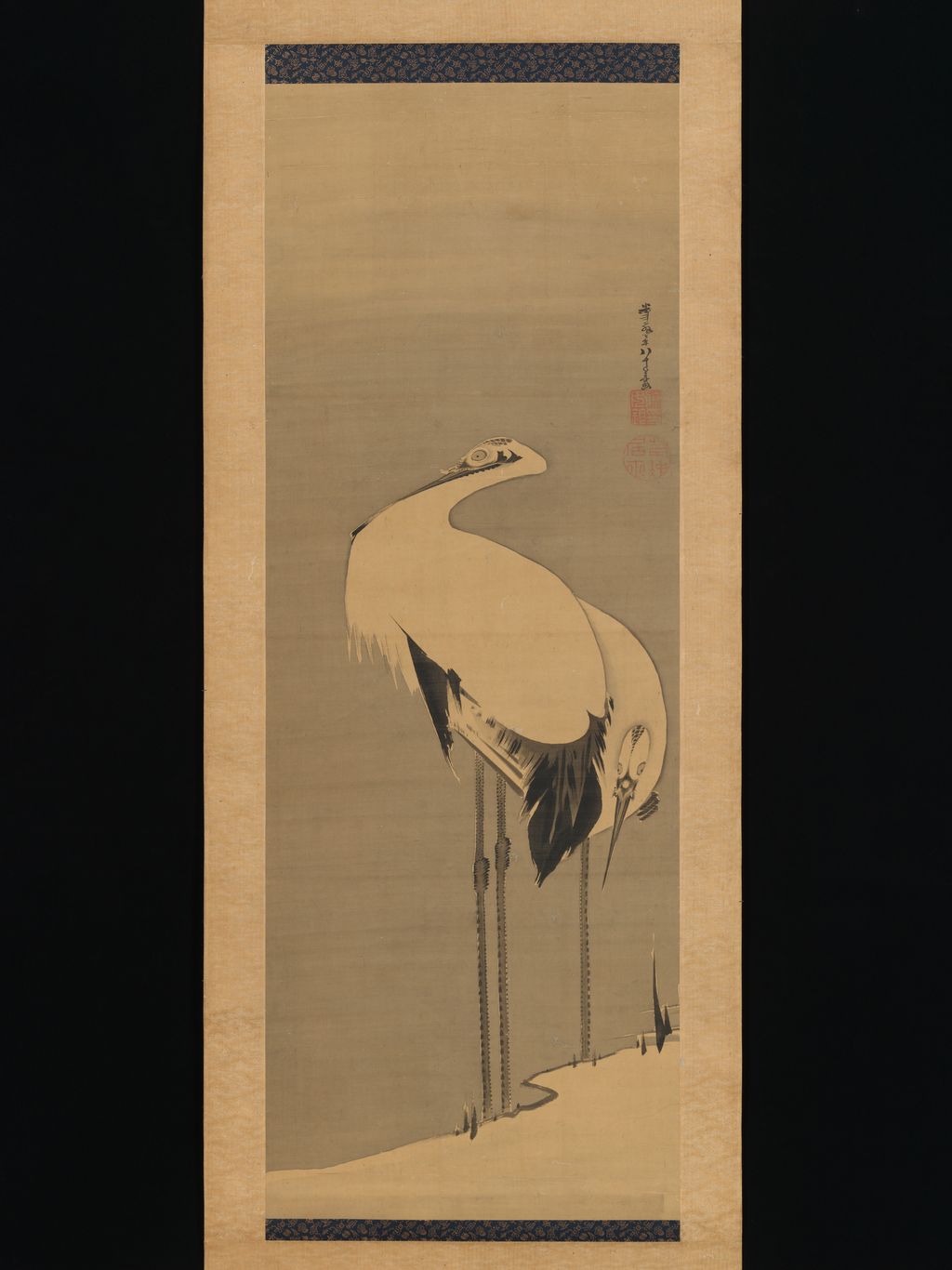
The Met's Two Cranes, 2015.300.214 [10], dates from 1795 and uses ink on silk. Its much quieter tonal range shows why “bird painter” is not synonymous with “brilliant colourist.” The two birds share a narrow vertical space. Their necks and legs are described with varied economy, while unpainted silk supplies air around the bodies. Compare the work's open ground with the denser webs of branches in White Plum Blossoms and Moon: both invite attention to living form, but their visual pace differs. The Met records a separate accession, medium and date for each. A gallery that lets visitors filter by material and subject can make that difference clearer than a single row of attractive thumbnails.
It is tempting to say that Jakuchū drew from live birds because the postures look convincing. The works demonstrate close attention to appearance; they do not by themselves prove where each bird stood, how long he observed it, or whether he also used earlier East Asian painting as a model. The Agency for Cultural Affairs' detailed explanation [1] explicitly treats observation, inherited pictorial conventions and design as forces brought together in Colorful Realm. That combination is a better guide than a choice between “realist” and “inventor.” On the page, a bird's beak, feather mass and surrounding plant pattern can be studied as image-making decisions without inventing a studio diary.
Plants as structures, symbols and brushwork
In the Met's White Plum Blossoms and Moon, 2015.300.213 [6], dated 1755, branching stems occupy much of the field, while white blossoms and a pale moon reward the visitor who slows down. The hanging-scroll format asks the eye to travel through crossing limbs rather than take in a single central animal. Its Japanese title is transcribed on the museum record. The picture belongs to the year Jakuchū handed the family business to his brother, according to the government account, but the shared year does not prove that the painting commemorated the transfer. The two facts may be placed side by side without forcing one into the cause of the other.
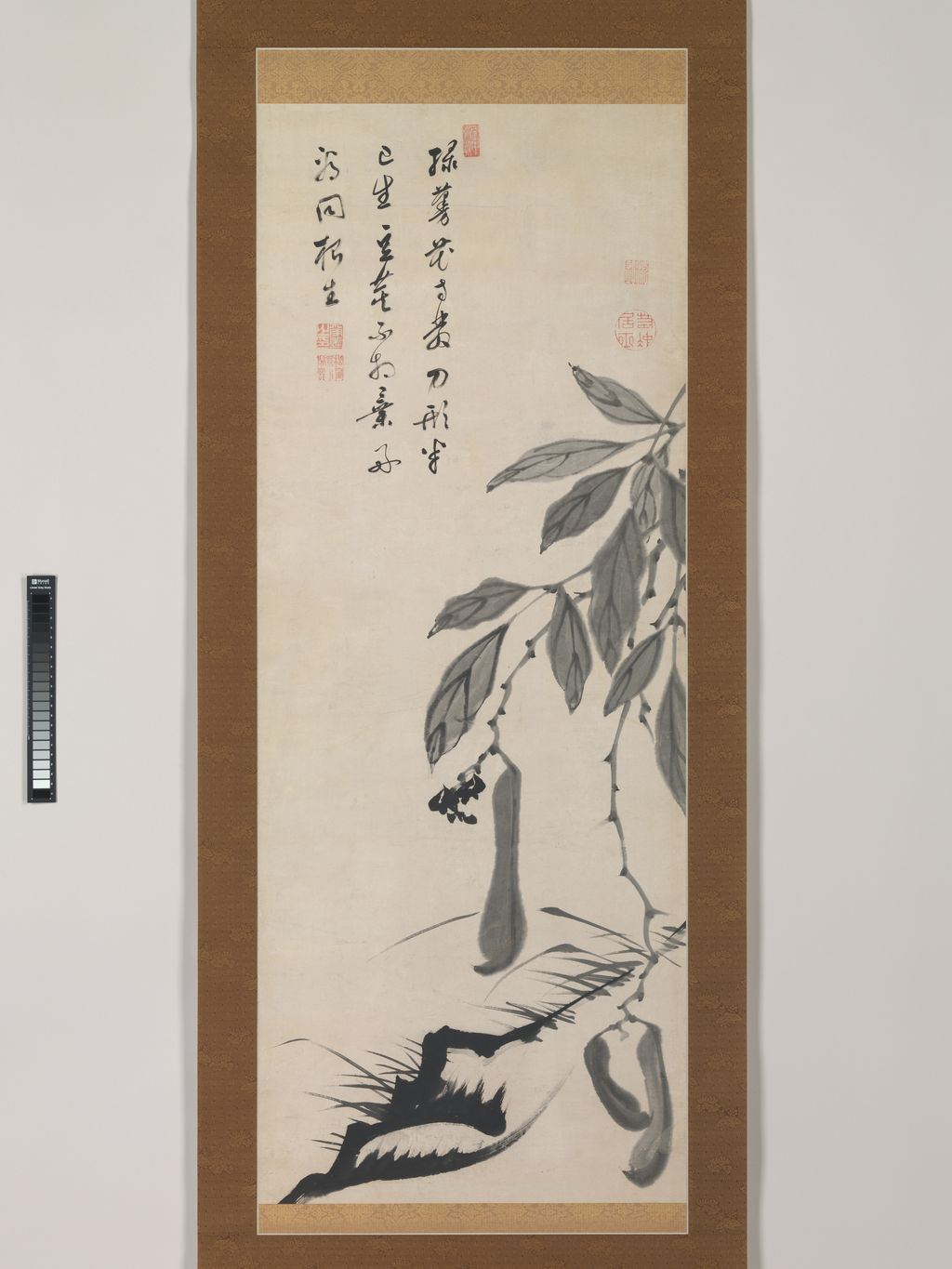
The Bean Vine, Met 1985.97 [11], is an ink-on-paper hanging scroll from the late 1750s to before 1764. The record separates Jakuchū's painting from the inscription by the monk Musen Jōzen, called Tangai. That separation matters. Calligraphy above an image is not automatically the painter's own words. The stem, leaves and pods allow the brush to vary between wet gradation and firmer marks; the poem or inscription adds a second person's response. Even a seemingly modest plant picture can therefore be a collaborative, learned object rather than a specimen illustration. The Met's catalogue discussion of the work [11] should be read alongside the visible ink forms before interpreting the verse.
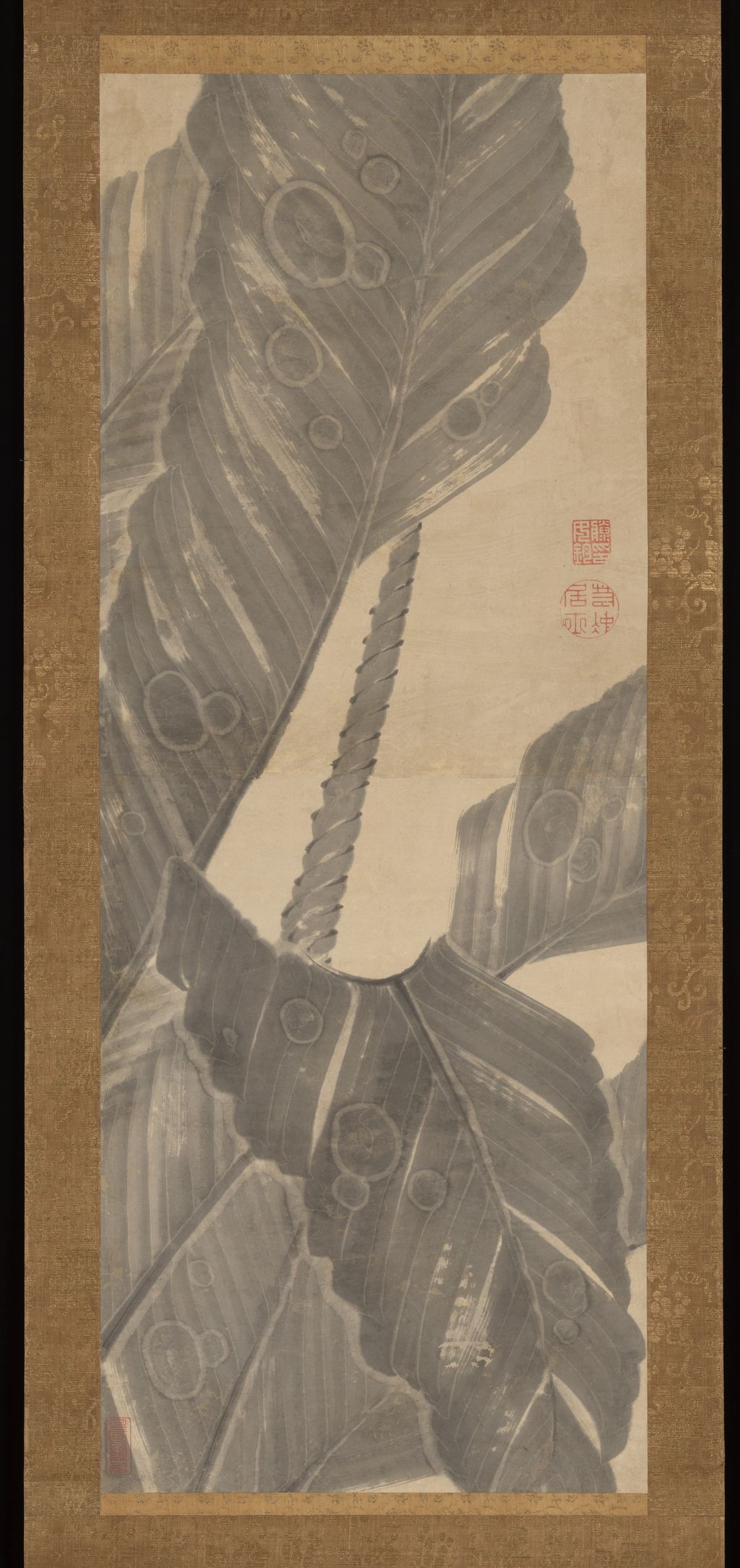
Banana Leaves, Met 2020.396.35 [12], from the 1790s, replaces small foliage with huge overlapping surfaces. The darker ribs and folds give the leaves weight while leaving the paper itself active. The Met's description discusses Jakuchū's seals, including a mark with a small break in its ring and another seal whose wording suggests treating each painting as if it might be his last. A seal can help identify a work, but its imagery should not become a confession of the artist's state of mind on a specific day. Compare the large masses of this late ink image with the network of fine plum twigs from 1755: plants served him as opportunities for very different scales of attention.
The Kyoto National Museum's Vegetable Nirvana [5] changes the role of produce again. Its object text describes a playful arrangement of vegetables and fruit after a Buddha-nirvana composition. That image is highly relevant to a painter raised in a greengrocery family, but it cannot simply be reduced to a nostalgic portrait of the shop. It draws on a religious image type as well as ordinary edible things. The Kyoto museum record is used here for its description; its photograph is not one of the eight open production images on this page. On the artist home, the work creates a route from still-life looking to Buddhist visual culture without substituting a rights-uncleared file for an accessioned image.
One screen, two faces
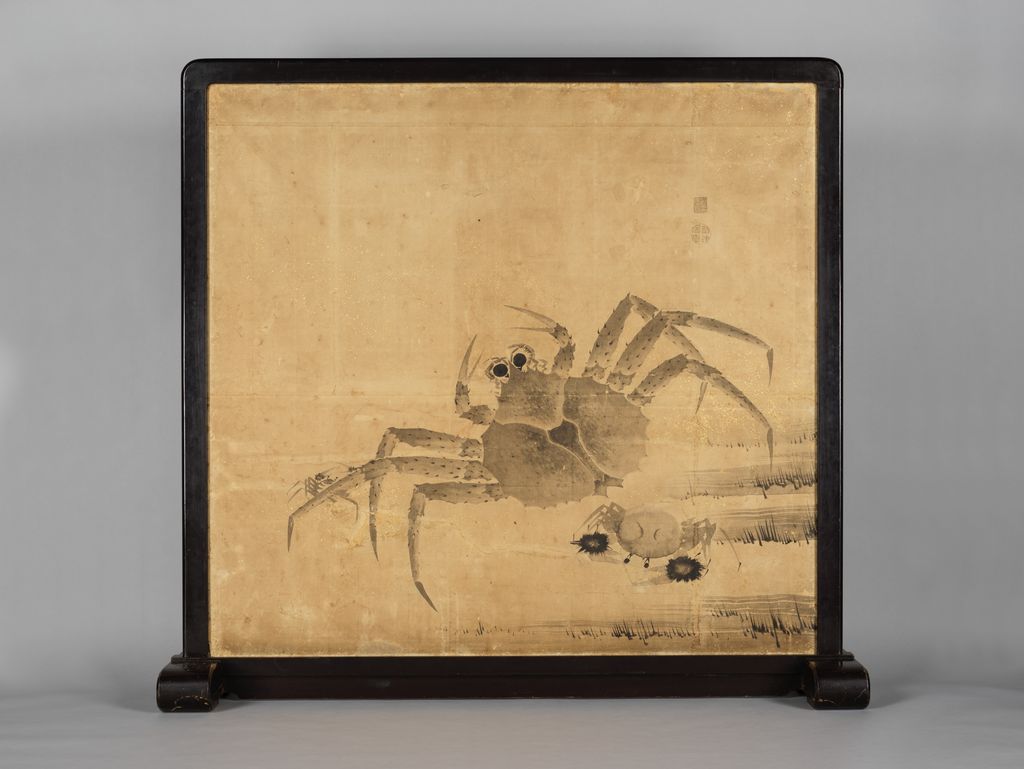
The Met's Crabs and Peonies, 2022.166a–c [13], was made before 1766 and is a freestanding, double-sided screen, or tsuitate. The museum describes one face with three crabs of different sizes moving across a grassy shore; the reverse has peonies blown across a rocky bank. An image of the crab side therefore displays only half of the designed object. The caption and gallery card must tell the viewer so, and the museum link is necessary for examining the other face. This is a good example of why physical format belongs in an art article's main explanation, not in an easily overlooked technical footnote.
According to the Met, Jakuchū defines the crabs with layered, graded ink washes instead of enclosing every form in a hard contour, a technique called mokkotsu or “boneless” painting. The large king crab and smaller mitten crabs can appear to pass in a slow procession. The reverse side changes tempo as wind presses against leaves and blossoms. Reading the two sides together makes a visitor move around the screen; a web page's single front-facing image cannot enact that bodily shift, but a clearly labelled object card can ask the right question. Why did a painter choose to place quiet movement and violent wind on opposite faces of a standing screen? The museum description supplies the physical facts; intention beyond them remains a matter for interpretation.
The screen also complicates a tidy divide between nature and imagination. Crabs are observed as different bodies and textures, yet their arrangement is theatrical; peonies obey a strong invented wind. To call this simply “realistic” would miss the designed contrast. The same caution applies to Colorful Realm: apparently identifiable species occur inside highly controlled compositions. Jakuchū's fascination with animals and plants is best understood as repeated experimentation with how to make living forms occupy surfaces, sequences and devotional spaces.
A river journey printed in ink
Pleasant Diversions on a Riverboat Journey, Met 1975.268.70 [8], shows another kind of collaboration and motion. The museum dates it about 1767 and identifies it as a woodblock-printed handscroll in ink on paper. Jakuchū and the Zen monk Daiten Kenjō travelled down the Yodo River from Kyoto toward Osaka in the spring of that year. Daiten's impromptu poems and Jakuchū's sketches register places along the journey. Jakuchū converted the drawings into prints that echo the look of Chinese stone-rubbing impressions. This is neither a conventional colour print album nor an oil-like painting on silk.
The surviving Met object is almost twelve metres long, so looking at it means moving along a sequence. The primary photograph in this page's gallery is one section with river scenery and writing. It can suggest the contrast of pale image and dark field, but it cannot convey the pace of unrolling the entire handscroll. The Met's own object page offers multiple views and instructs right-to-left viewing. We link to that richer record and do not claim our one derivative includes all of its scenes or poems. The journey is historically useful, too: it records a named friendship between painter and monk through a shared project rather than invoking a vague “Zen influence” without people or documents.
The printed handscroll gives a different answer to the question of copies. A woodblock design could produce multiple impressions, while an ink painting on silk is a single physical work. The exact Met handscroll is still a particular accession with its own mounting, condition and photographed segments. That distinction recurs across this cluster. The words “painting,” “print,” “screen” and “scroll” describe ways art was made and handled; they are not interchangeable labels for the images in a digital gallery.
Kyoto, the market and the monastery
Jakuchū's Kyoto was a working city, not simply a backdrop of temples. The Agency for Cultural Affairs [1] identifies him as the head of a Nishiki Market greengrocery before he transferred the business to a younger brother in 1755. A Kyoto Prefecture archive guide [4], referring to the Kyoto Nishikikōji vegetable-market record, challenges the story that he then retired from public affairs. It says he acted as a town elder during a dispute over the Nishiki vegetable market: a rival wholesale group petitioned for its closure in 1771, and the market reopened in 1774 after negotiations involving vegetable-growing villages. This is documentary evidence of a civic role, not a basis for painting him as a lonely hermit detached from commerce.
The monastery was another setting for work and relationships. Shōkokuji received Colorful Realm and the Śākyamuni triptych. Daiten Kenjō interpreted a scroll in 1760 and joined Jakuchū on the later river journey. The NGA exhibition account [3] supplies those links. The Met's Hanshan and Shide, 2015.300.215 [9], brings a Buddhist subject into a late eighteenth-century ink painting. Its record attributes the inscription to Ike no Taiga, rather than declaring that Jakuchū painted and wrote every element. Names on the object should be assigned their actual roles: painter, mentor, commentator, poet or attributed calligrapher.
The full chronology of household succession, friendships, market negotiations and later places belongs on the biography page. Here their importance is to prevent a misleading account of art as a sealed-off private vision. The subjects of vegetables, birds and Buddhist figures intersected with a merchant household, a working food market, educated monks and temple ritual. They also circulated through objects made for different viewing situations: hanging scrolls, printed handscrolls and screens. A reader who keeps those settings in mind can see why “eccentricity” alone explains very little.
How to look without flattening the work
Begin with subject, but ask what the object actually is. The Met rooster and the Imperial Collections' roosters do not become the same physical painting because both feature fowl. Then ask about medium: colour on silk can use layered pigments differently from ink on paper, while woodblock printing transforms a drawn journey into a repeatable sequence. Ask about format: a hanging scroll descends through vertical space, a handscroll unfolds horizontally, and a freestanding screen has two sides. These are ways a viewer encountered the image, not just cataloguing trivia.
Next ask about company. A bird may appear in a temple's thirty-scroll ensemble, in an individual hanging scroll, or beside a learned inscription. Bean Vine carries words by Tangai; Hanshan and Shide has an inscription attributed to Ike no Taiga; the river journey joins Daiten's poems to Jakuchū's printed views. Each association changes what can reasonably be said about the work. Finally ask about evidence. Museum records confirm accession, medium and certain dates; a high-resolution image allows careful visual description; an interpretation of a brushstroke or symbol should be named as an interpretation. Those layers can support one another without being collapsed.
The eight objects on this page are a route into a much larger body of work. The thirty-scroll source matrix lists every official Japanese title and its catalogued dimensions, but it is a text source index, not a claim that every scroll image can be reused here. The separate series page will give that corpus its own space. The biography will take up dates and changing circumstances in depth. The links make the artist home a navigable starting point rather than a compressed version of every article to come.
Survival and renewed attention
The thirty-scroll group remained linked to Shōkokuji before passing into imperial and then state custody; the government record [1] provides those transitions. The NGA's 2012 Washington exhibition [3] brought the complete ensemble and the Shōkokuji triptych together after six years of conservation. Its catalogue by Yukio Lippit and colleagues is a substantial book lead for deeper study. The exhibition's temporary loan does not make the NGA the owner of the thirty scrolls or make its publicity files general-use production images. Preservation, scholarship and image rights are separate questions.
The Met works have different collection histories and licences that the page records individually. Eight public-domain files make a varied illustrated introduction possible without treating a single famous rooster as a shortcut to the entire career. The home page leaves room for particular questions to be pursued elsewhere: why the thirty scrolls were made and displayed, how a Kyoto merchant negotiated art and civic duty, and how ink, colour and print each shaped his treatment of the living world. Jakuchū is most compelling when these are seen as connected forms of work by a painter with real places, collaborators and objects, not as a single unexplained visual surprise.
Reader insights and discussion
Choose one Jakuchū object and share what its medium, format and arrangement of living forms make you notice.
Reader Insights
How do space and colour change between the 1792 rooster and 1795 cranes?
What does the unseen peony side add to the way you read the crabs?
How does one Riverboat Journey segment differ from following the whole scroll?
Join the Conversation
Share the museum accession that prompted your observation.
References
- Agency for Cultural Affairs, National Treasure Dōshoku sai-e record. Thirty names and dimensions, dated stages, family business, gift history and custody.
- Museum of the Imperial Collections, Colorful Realm of Living Beings group record. Object context, Shōkokuji donation and Buddhist triptych.
- National Gallery of Art, 2012 Colorful Realm exhibition. Conservation, ritual display, Peonies and Butterflies, Daiten and catalogue by Yukio Lippit et al.
- Kyoto Prefecture Archives, source guide 24, Jakuchū and Mibuna. Household succession and documentary account of the 1771–74 Nishiki market dispute.
- Kyoto National Museum, Vegetable Nirvana. Ink work and Buddhist image type; research text only.
- Met, White Plum Blossoms and Moon, 2015.300.213. 1755 hanging scroll and open-access image.
- Met, Hen and Rooster with Grapevine, 1975.268.69. 1792 colour-on-silk hanging scroll.
- Met, Pleasant Diversions on a Riverboat Journey, 1975.268.70. Printed handscroll, Daiten and multiple views.
- Met, Hanshan and Shide, 2015.300.215. Buddhist ink image; inscription attributed to Ike no Taiga.
- Met, Two Cranes, 2015.300.214. 1795 ink-on-silk painting.
- Met, Bean Vine, 1985.97. Ink scroll with inscription by Musen Jōzen (Tangai).
- Met, Banana Leaves, 2020.396.35. 1790s ink scroll and seals.
- Met, Crabs and Peonies, 2022.166a–c. Double-sided freestanding screen and mokkotsu technique.
- Kyoto National Museum, 2016 Jakuchū exhibition checklist. Wider works and documented media.
- NGA, The Artist in Edo: Studies in the History of Art, vol. 80, edited by Yukio Lippit. Bibliographic context; volume not fully consulted.
