


 by Tom Gurney
Tom Gurney BSc (Hons) is an art history expert with over 20 years experience. Updated September 24, 2026.
Introduction
Itō Jakuchū (伊藤若冲, 1716–1800) is often introduced as a Kyoto vegetable merchant who left commerce to paint brilliant birds. The story contains real coordinates, but the verb “left” makes his life tidier than the evidence. He passed the family greengrocery at Nishiki Market to a younger brother in 1755, according to the Agency for Cultural Affairs [1]. A Kyoto Prefectural archive guide [2], drawing on a contemporary market record, describes him acting as a town elder in a dispute that began in 1771. His painting, Buddhist commitments and local obligations overlapped.
The painter's most sustained undertaking was Colorful Realm of Living Beings (Dōshoku sai-e, 動植綵絵), thirty colour paintings on silk made over roughly a decade and donated to Shōkokuji in stages. The official National Treasure record allows a more exact sequence than a vague “masterpiece of the 1760s”: twelve scrolls existed by 1761, twenty-four went to the temple with a Śākyamuni triptych in 1765, and all thirty were complete by November 1766. That same record describes careful observation together with inherited painting models and pictorial design. The series is a central achievement, but it was neither his only medium nor the whole story of his life.
Contents
- Introduction
- From the Nishiki shop to an artistic name
- Shōkokuji, Daiten and Buddhist patronage
- The Shōkokuji agreement, memorial and display
- Painted forms beyond the thirty scrolls
- The market dispute: retirement was not withdrawal
- Fire, Osaka and the late Kyoto years
- What happened to his paintings after his life
- Questions the record leaves open
This biography follows places and relationships for which there is evidence: the family shop at Nishiki, Shōkokuji and its monk Daiten Kenjō, the Yodo River journey, civic negotiations over the market, and the late setting near Sekihōji. Dated paintings and collection records provide a second line of evidence. They can show what he made at certain moments; they cannot automatically explain his private motives. The artist home compares eight exact objects, while the thirty-scroll guide handles the series as a group.
Chronology and source confidence
| Date | Event and evidence | Confidence and limit |
|---|---|---|
| 1716–1800 | Life dates in the Shizuoka Prefectural Museum artist record [3] | Secure broad dates; later accounts of his youth are less detailed. |
| Around age 23 | Head of the Nishiki greengrocery after his father's death, in the Shizuoka record [3] | Institutional historical summary; it does not date each early drawing. |
| 1755 | Family business passed to a younger brother, in the National Treasure explanation [1] | Documented turning point; not proof of withdrawal from town affairs. |
| 1758–1766 | Earliest dated Colorful Realm scroll, staged donation, completion of thirty, in the official record [1] | Set milestones; most individual scrolls lack a fixed year. |
| 1759 | Rokuonji Great Study sliding-door paintings completed, in Shōkokuji's history [4] | Institutional date for an architectural commission. |
| Around 1767 | Printed Yodo River journey with Daiten, in the Met's handscroll record [12] | Museum date is approximate; the collaboration and route are documented. |
| 1771–1774 | Nishiki market petition and reopening, in the Kyoto archive guide [2] | Based on a named market document; accounts of his exact role require that source. |
| 1788–1800 | Fire, temporary Osaka stay, later work near Sekihōji, in the Shizuoka record [3] and temple account [5] | Broad sequence supported; particular movements and dates are sometimes traditional or approximate. |
From the Nishiki shop to an artistic name
Jakuchū was born into a Kyoto family that traded vegetables around Takakura and Nishikikōji. The Shizuoka Prefectural Museum biography [3] calls the shop Masuya and says he succeeded his father at about twenty-three. Kyoto's archive guide [2] identifies “Masuya Genzaemon” in a Nishiki market document as the painter's personal name or house name. Such names are useful historical anchors: Itō Jakuchū is the artist's best-known name, while a market record may use the name under which a householder represented a business. A visitor should not mistake the different forms for two unrelated people.
The shop was more than colourful biographical scenery. Wholesale produce linked growers, urban retailers and civic authorities. It also put plants and animals close to Jakuchū's daily experience, though there is no record proving that every depicted vegetable came from a particular stall. The Kyoto National Museum's account of Vegetable Nirvana [17] shows how produce could become a playful religious composition rather than merely a memory of trade. A picture's subject and a painter's childhood can illuminate one another without a claim that one directly caused the other.
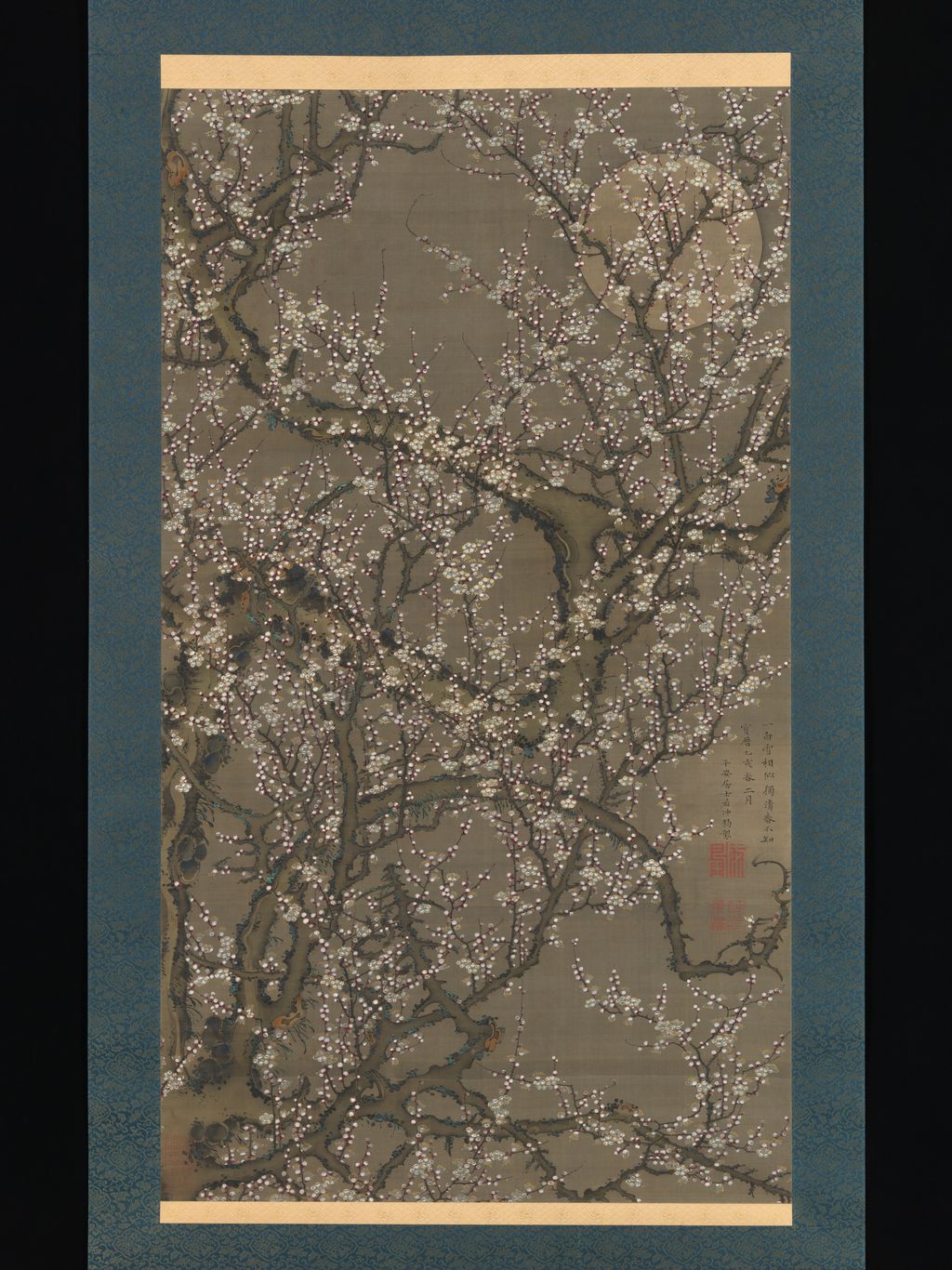
Institutional accounts say that his early learning included Kanō-school practice, copying Chinese paintings and later studying living forms. The Tokyo Fuji Art Museum's biography [16] gives that broad trajectory; the Agency for Cultural Affairs [1] stresses both inherited models and observation in Colorful Realm. These are not an inventory of surviving lesson sheets. We cannot reconstruct a dated apprenticeship or name every teacher from this evidence. His 1755 White Plum Blossoms and Moon at the Met [9] supplies a firmer object anchor: by that year he could command a complex, atmospheric silk composition.
The year 1755 also marks the transfer of the family business to a younger brother. The official Colorful Realm explanation says he then devoted himself to painting. The phrase describes a shift in primary occupation, not a legal severing of every tie to the market. This distinction matters because later evidence shows continued civic involvement. It also keeps the account from turning a painter into a modern image of a solitary artist who could work only by escaping his former social world.
Shōkokuji, Daiten and Buddhist patronage
Shōkokuji was a substantial institutional relationship, not a decorative “Zen influence.” Its historical timeline [4] dates Jakuchū's sliding-door paintings for the Great Study at Rokuonji, the Golden Pavilion precinct, to 1759. Painted doors are built into a room and seen in movement through architecture; they are a different undertaking from a hanging scroll viewed alone. A biographical account that knows only the portable Colorful Realm scrolls misses this scale of commission.
The Shōkokuji monk Daiten Kenjō became a friend and interpreter of Jakuchū's work. The National Gallery of Art's Colorful Realm exhibition [7] records Daiten naming the Peonies and Butterflies scroll Beautiful Mist and Fragrant Wind in 1760. Naming a painting is evidence of engagement with its subject and language, not proof that the monk chose the painter's every motif. Daiten also appears in a collaboration that gives the friendship a route and a medium: the Met's Pleasant Diversions on a Riverboat Journey [12], dated about 1767, joins Jakuchū's Yodo River sketches with Daiten's poems in a long printed handscroll.
The donation of Colorful Realm and the Śākyamuni triptych has a clear sequence. The Agency for Cultural Affairs [1] reports twenty-four scrolls and the triptych given in 1765, all thirty scrolls finished by November 1766, and a 1770 tablet commemorating the gift in relation to Jakuchū and his parents. Its account discusses possible memorial motivations, including family deaths. “Possible” is the right word: a set worked on for about ten years and donated in stages need not have a single private cause. The Museum of the Imperial Collections [8] and NGA [7] connect the group to Buddhist ritual use. Religious purpose and sophisticated natural observation were simultaneous aspects of this project.
The series also shows why an object chronology must be treated carefully. The earliest date inscribed on one of its seven dated scrolls is 1758, but the government catalogue says work began before that. Twelve were complete by 1761. Those numbers do not assign a year to the other twenty-three or prove the official inventory order is the order of painting. The thirty titles and dimensions are preserved in the official set record [1]; that is the evidence behind this site's text index. Photographs of individual scrolls have separate reproduction terms and are not borrowed from an exhibition page merely because the paintings themselves are old.
The Shōkokuji agreement, memorial and display
A 2021 exhibition account from Shōkokuji's Jōtenkaku Museum [19] adds unusually precise institutional dates to the broad donation story. It says Jakuchū presented the Śākyamuni triptych and Colorful Realm on 29 September 1765, entered an agreement for perpetual memorial rites that December, and had an ante-mortem memorial monument erected at the temple's Shōōan in 1766 with words composed by Daiten. The agreement and monument are evidence of a sustained, reciprocal relationship with the temple. They make the familiar description “he gave some paintings to Zen monks” inadequate: the painter arranged for remembrance while alive, and his named monastic associate supplied the text. The museum's retrospective summary, however, is not a facsimile of the contract, and should not be treated as a verbatim record of Jakuchū's private thoughts.
The dates need to be read alongside, rather than silently merged with, the Agency for Cultural Affairs' National Treasure account [1]. That account specifies twenty-four completed scrolls at the 1765 presentation, all thirty completed by November 1766, and a memorial tablet dated 1770. A separate Shōkokuji explanation of its Kannon repentance rite [20] gives October 1770 as the date of the donation of the triptych and thirty scrolls. These institutional descriptions do not use “donation” in an identical chronological way. It may refer in one account to the initial transfer and in another to the completed ensemble or its commemoration, but the evidence presented here does not prove that reconciliation. The biographical claim that survives the discrepancy is narrower and stronger: works were given and completed in stages, and a documented memorial relationship continued into 1770.
The ritual account also describes what the ensemble became in a temple room. It says the three Buddhist figures stood at the centre, while fifteen Colorful Realm scrolls hung on each side during the annual rite. Pairing animal, bird, fish and plant subjects around the Buddhist images would have made the group a changing environment for worshippers, not merely thirty separate masterpieces on a museum wall. This is the temple's account of historical use; it does not establish that the exact same selection and spacing occurred at every performance, or that the inventory order is the order of painting. The page's thirty-scroll index uses the official group order for finding objects and explicitly separates it from an unproven creation sequence.
This material gives Daiten a more precise role. The Met's river-journey handscroll [12] pairs his poems with Jakuchū's sketches; the temple attributes text for the living memorial to him; and its exhibition identifies his friendship with Jakuchū through works retained in the Shōkokuji group. None of those facts makes Daiten a co-painter of Colorful Realm, or lets us assign him every decision in the donation. They do show that poetry, painting, memorial practice and institutional patronage met in the same relationship. The chronology is more informative when those roles are kept distinct.
Painted forms beyond the thirty scrolls
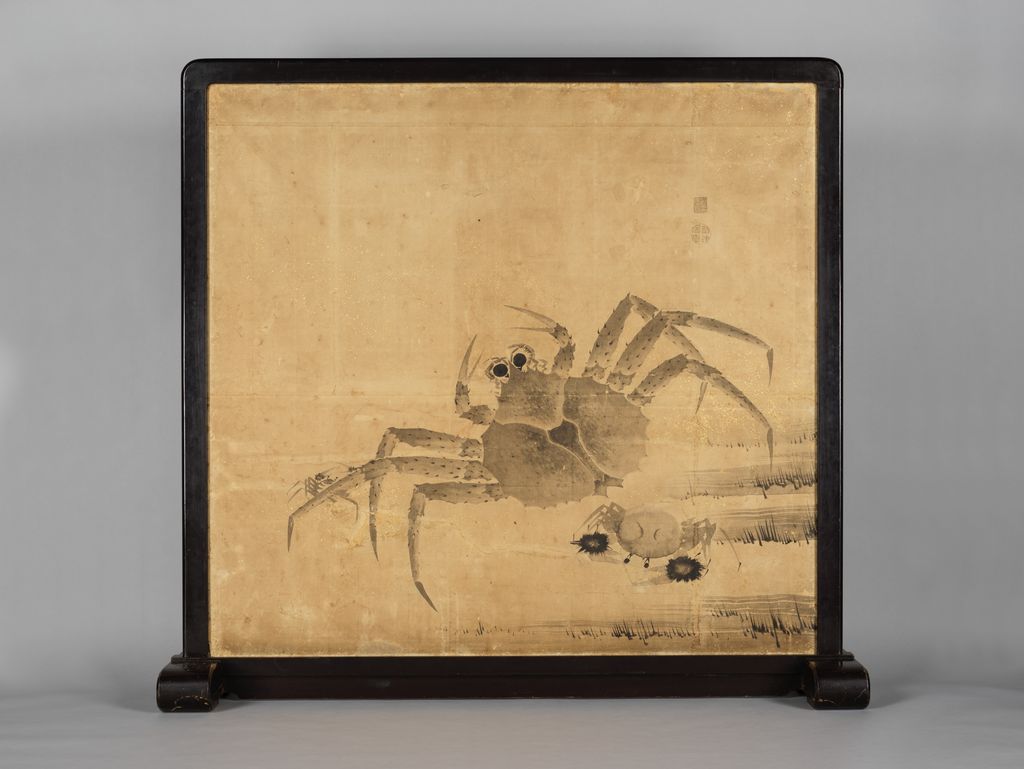
Several securely catalogued objects prevent the biography from becoming a single-series narrative. The Met dates its double-sided Crabs and Peonies screen [10] before 1766. One face depicts crabs along a bank; the other sets peonies against a stronger wind. A person must move around the standing screen to encounter both. This material form differs from a hanging silk scroll, even though animals and flowers appear in both. The museum describes graded, contour-light ink called mokkotsu on the crab face. It is one source for examining his handling of ink, not a universal label for all his painting.
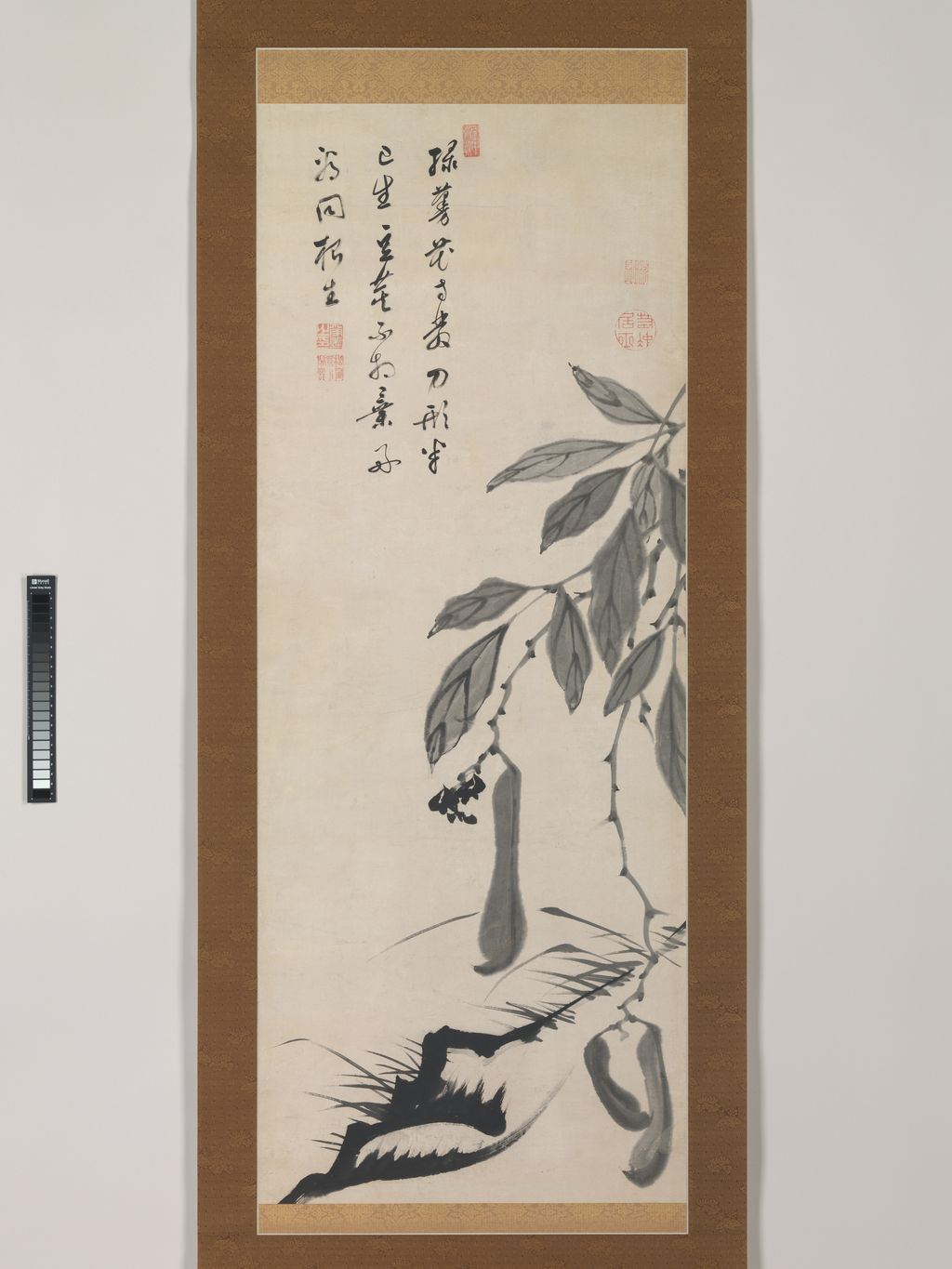
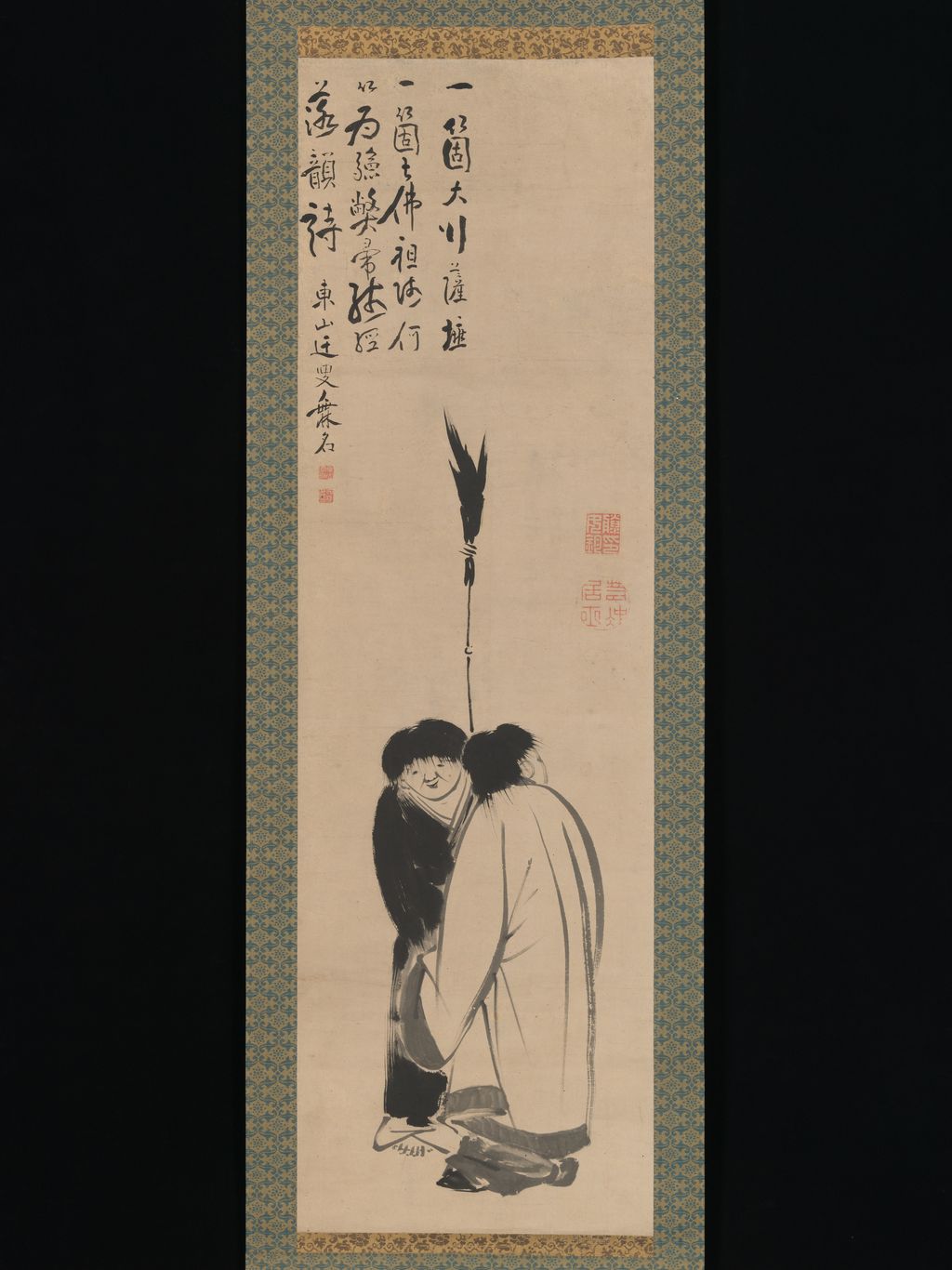
The Met's Bean Vine [11], dated from the late 1750s to before 1764, carries an inscription by the monk Musen Jōzen, called Tangai. The artwork thus records another named connection. The painting and accompanying words share a physical sheet, yet the painter and inscriber must be distinguished. Calling every piece of calligraphy on a Jakuchū painting his own would erase a collaboration. His Hanshan and Shide [18], with an inscription attributed to Ike no Taiga, also shows how images could circulate in a learned network. Attribution of the inscription is not proof that the two artists painted together on a known day.
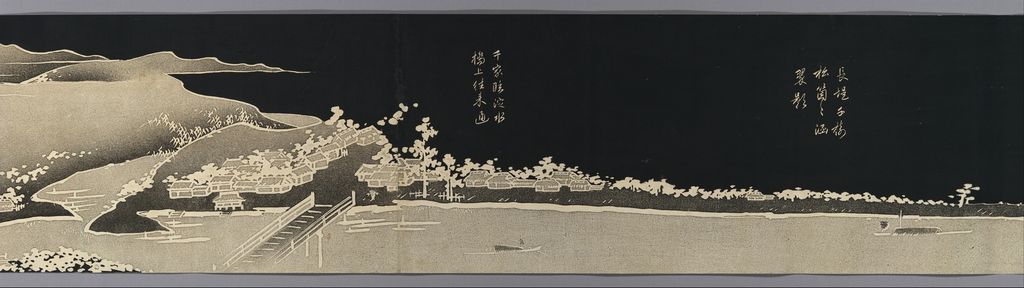
The 1767 printed Yodo journey deserves its own place in his life because it shows a planned transformation of experience into reproducible art. The Met [12] describes a trip from Kyoto towards Osaka; the sketches and poems were then turned into a handscroll that evokes Chinese stone-rubbing impressions. Its approximately twelve-metre length makes the order of viewing integral to the work. The museum's main online photograph shows only one segment. The journey supplies evidence of mobility, friendship and printmaking, while remaining silent about what Jakuchū said during the trip or who purchased each impression.
The scale of the 1759 Rokuonji work deserves more than a passing date. The Agency for Cultural Affairs' record of the Great Study paintings [21] identifies fifty panels by Jakuchū, dated by an inscription to 1759 and designated an Important Cultural Property. A Jōtenkaku Museum account [21] says the project extended through the first to fourth rooms and a narrow adjoining room. The documented set was therefore a sequence across architectural space, not a single large picture later cut into fifty. In the same period Jakuchū was making Colorful Realm on silk. Those parallel obligations complicate a neat idea that colour was an early phase and ink a late one. The date records simultaneous work in different media and settings; it does not assign every panel a separate week or establish an undocumented workshop staff.
A late work offers a second architectural comparison. Kyoto National Museum's Fowls entry [22] identifies nine surviving ink panels from Kaihōji's abbot's quarters in Fushimi, dated 1790, and says the original continuous scene with lost portions approached ten metres. The museum contrasts that uncoloured ink work with the gold-ground, coloured fowl paintings at Saifukuji, both associated with the artist's seventy-fifth year by traditional age count. These are two distinct objects and religious sites. “Late Jakuchū” cannot be reduced to a single palette, location or format. The Kaihōji work's present museum home and the Saifukuji work's original setting must remain distinct. Kyoto museum images are cited for research here; their photographs have not been copied into this site.
The market dispute: retirement was not withdrawal
Kyoto Prefecture's archive guide on Jakuchū and Mibu greens [2] challenges the common statement that after 1755 he spent all his time painting. It says that in 1771 vegetable wholesalers of Gojō Ton'yamachi petitioned the eastern magistrate's office to stop the Nishiki street market around Takakura. Jakuchū, serving as a town elder, sought support from villages that supplied Nishiki and took part in negotiations. The guide says the market reopened in 1774. Its cited Kyoto Nishikikōji Vegetable Market Record, held by Kyoto University's Faculty of Letters, is the documentary basis.
This episode changes more than a line in a timeline. It places a painter, already known for a major Buddhist donation, inside a contested urban food network. The villages mattered because the market was an outlet for growers as well as a place where Kyoto buyers saw vegetables. The archive guide uses Mibu and its greens as an example of a supplying village. It does not say Jakuchū invented the market, painted a particular stall, or single-handedly won a legal case. The documented action is collective and civic, with him among its named actors. A biography should give the dispute its due without turning him into a modern campaign hero.
The market record's “Masuya Genzaemon” also reminds us that the categories painter, merchant and town elder were not sealed compartments. The artist could give work to Shōkokuji, correspond with monks and still act where the family business had established obligations and standing. This is a stronger account of his middle years than a sequence of isolated masterpieces. It also explains why the present-day Nishiki district is historically relevant, while a modern street photograph would not by itself reveal the layout or politics of its eighteenth-century predecessor.
Fire, Osaka and the late Kyoto years
The 1788 Tenmei fire was a turning point in Kyoto. The Shizuoka Prefectural Museum's artist summary [3] says Jakuchū was burned out and stayed for a time in Osaka. It associates that period with the coloured Cactus and Fowl at Saifukuji [3]. The museum's wording is a historical summary, not a day-by-day itinerary. Shōkokuji's history [4] records the great fire's damage to the temple, but that fact alone would not prove what happened at Jakuchū's own house; the Shizuoka account supplies that separate claim.
In his later years he worked near Sekihōji in Fukakusa. The temple's account [5] describes a hermitage and the project of stone arhats, often called the “five hundred arhats,” made with the assistance of a monk. It says more than a thousand figures once existed and about five hundred remain, language that signals a traditional count rather than a surviving eighteenth-century inventory. The stones are part of his local legacy, but describing each as personally carved by Jakuchū would overstate what that account proves. The Kyoto city guide to sites associated with him [6] locates the temple and his grave.
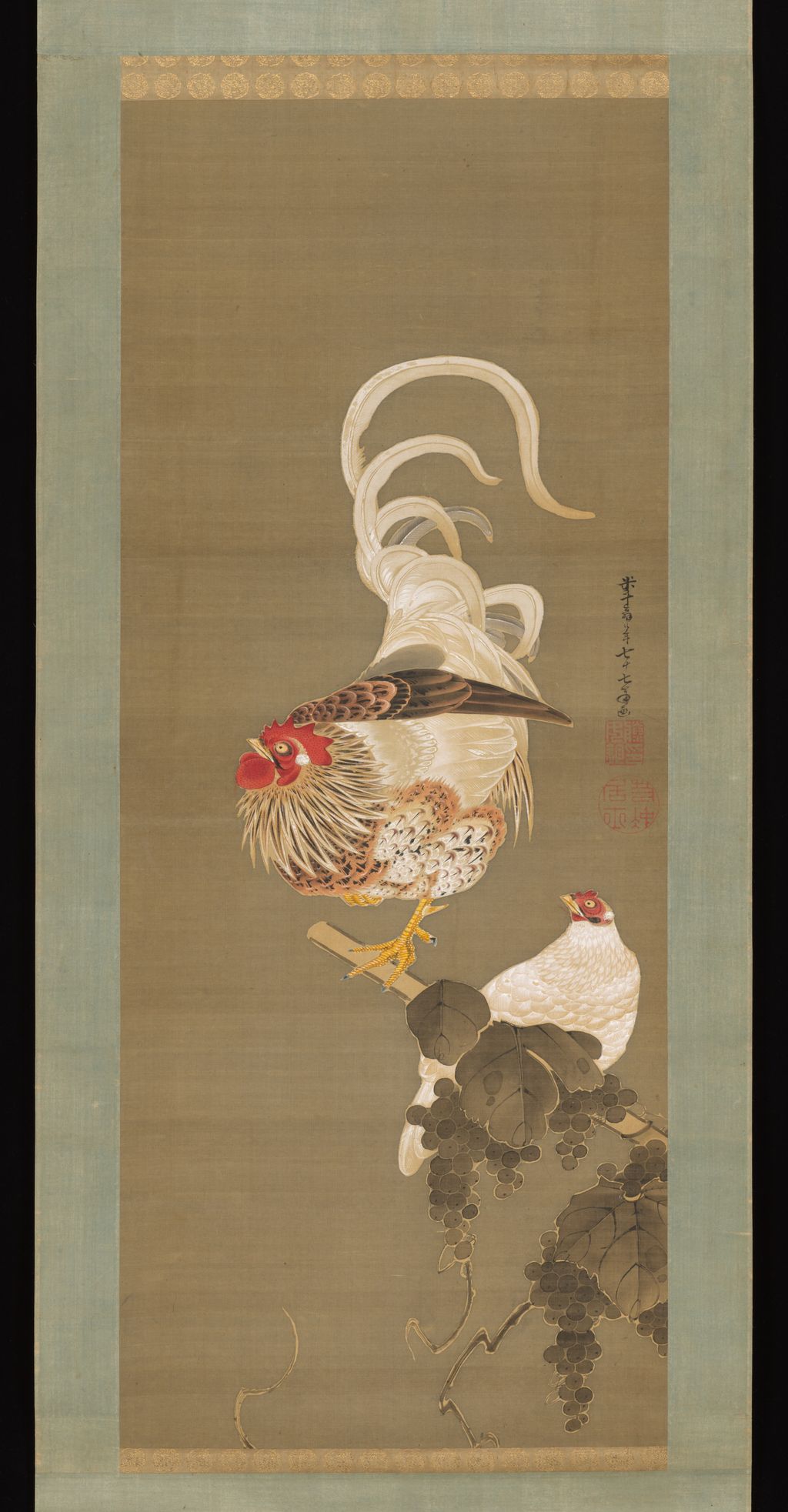
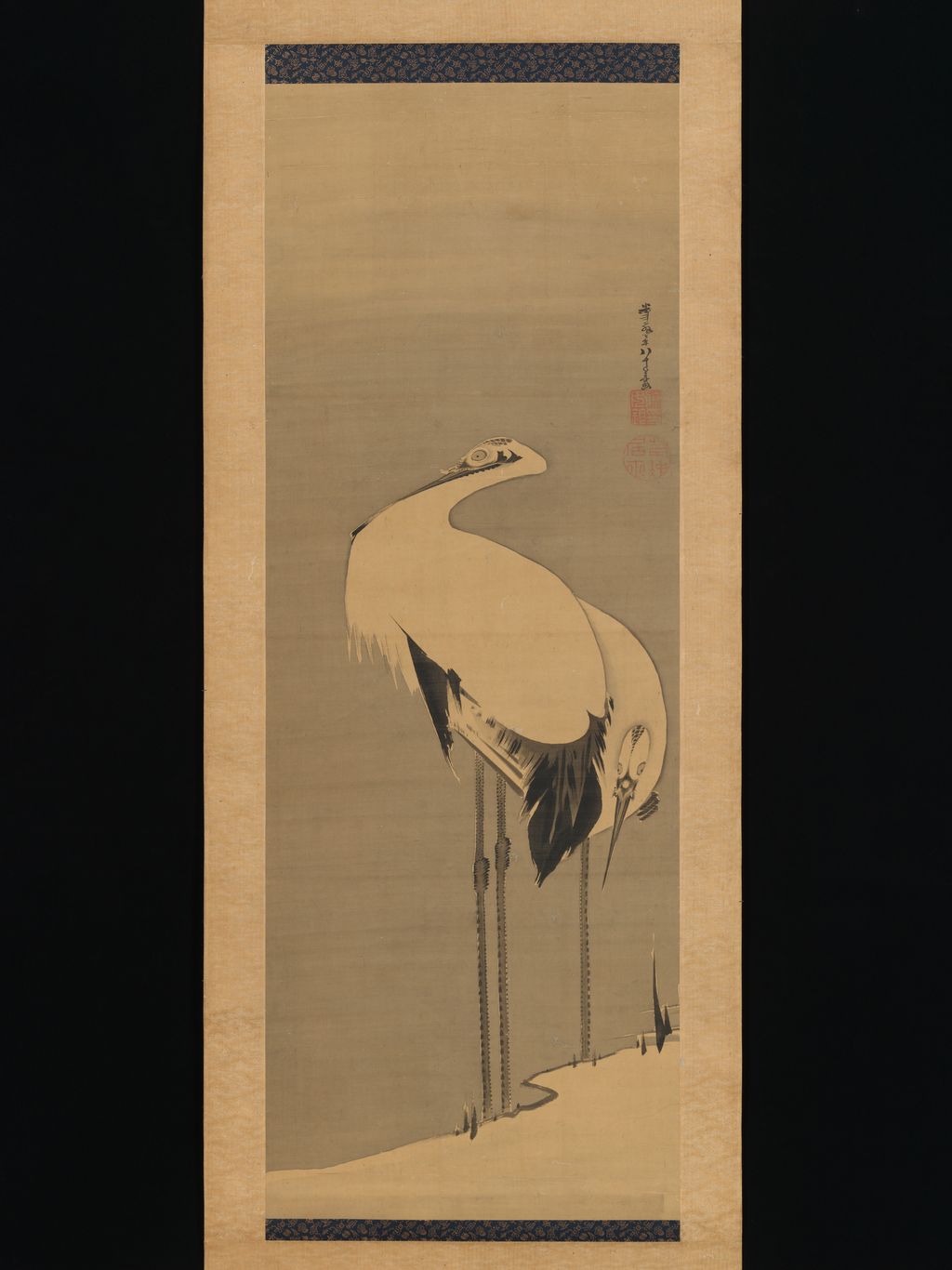
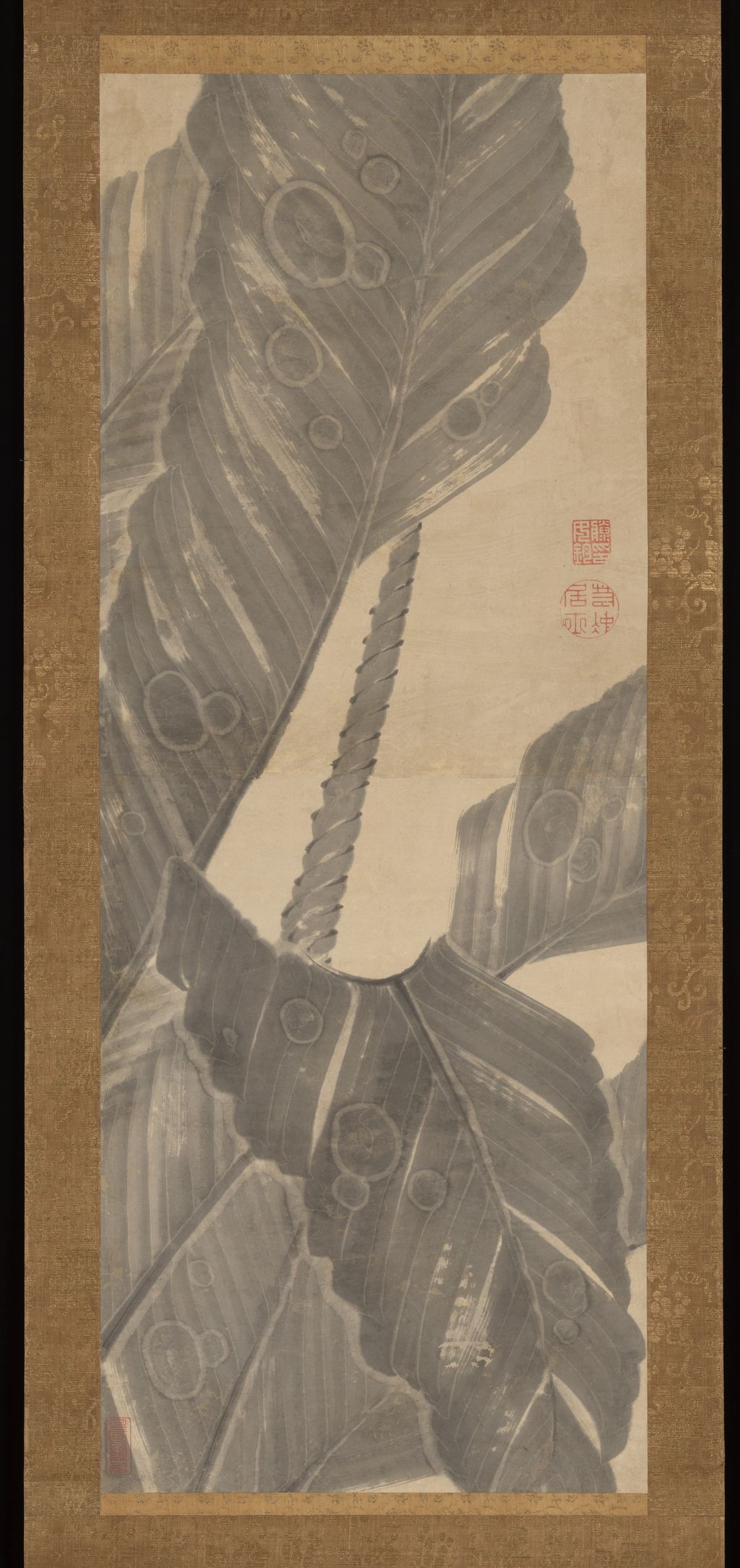
Late dated paintings help keep these years visible. The Met's Hen and Rooster with Grapevine [13] is dated 1792, its Two Cranes [14] 1795, and Banana Leaves [15] to the 1790s. These different media show continuing work rather than an abrupt stop after the fire. Tokyo Fuji Art Museum's Fowls [16] has an inscription stating that the artist was seventy-nine by traditional count, and the museum dates it to 1794. Age inscriptions are useful anchors, though a Japanese counted age should not be silently equated with a modern birthday calculation. Its object image is separately marked CC0 by the museum; the biography here uses the securely staged Met photographs and cites the Fuji object as historical evidence.
The Shizuoka museum [3] gives 1800 as his death year. The Sekihōji temple [5] associates his grave with its grounds. It is possible to end the biographical sequence there without inventing final words or a definitive last painting. There is evidence for late work, a place of commemoration and a long sequence of changing media. The order of individual late sheets is not a complete diary.
What happened to his paintings after his life
The later career of Colorful Realm belongs to its objects' history, not Jakuchū's own actions after 1800. The Agency for Cultural Affairs [1] records Shōkokuji, presentation to the imperial household in 1889 and transfer to the state in 1989. The thirty-scroll group was designated a National Treasure in 2021. The NGA's 2012 exhibition [7] reunited it with the Shōkokuji Śākyamuni triptych after a conservation campaign. These dates explain why the series appears in different institutional histories and why photographs from different exhibitions cannot be assumed to carry identical reuse terms.
Jakuchū is often labelled “eccentric,” an English shorthand for striking visual invention. The label can open a conversation, but it is not an explanation of how a shop successor, civic elder and Buddhist donor made art within Kyoto's institutions. The official National Treasure explanation [1] places close observation, other pictorial traditions and deliberate design together. His biography shows the social counterpart to that artistic mixture: trade, temple, town and travel all supplied settings in which pictures could be made, given and interpreted.
Questions the record leaves open
The surviving sources do not provide a complete account of childhood drawing, a single named master for every stage of training, the exact date of every scroll, or a transcript of Jakuchū's conversations with Daiten. They also do not prove a simple cause for his interest in every bird and vegetable, or establish how much of the Sekihōji stonework he carved with his own hands. Where a temple tradition, modern museum summary or inscription supplies a narrower fact, the page names its source and limit. That is the basis for a biography of a documented life rather than a persuasive novel.
The strongest way to continue is to move between dated objects and original records. Compare the 1755 plum at the Met [9] with its 1795 cranes, check the official thirty-scroll inventory [1], and read the Kyoto market archive guide [2] beside an account that says he simply retired. Each source answers a different question. Together they make a richer and more testable picture of Jakuchū than one spectacular rooster can provide.
Reader insights and discussion
Choose one Jakuchū object and share what its medium, format and arrangement of living forms make you notice.
Reader Insights
How do space and colour change between the 1792 rooster and 1795 cranes?
What does the unseen peony side add to the way you read the crabs?
How does one Riverboat Journey segment differ from following the whole scroll?
Join the Conversation
Share the museum accession that prompted your observation.
References
- Agency for Cultural Affairs, National Treasure record for Dōshoku sai-e. Official set description, dimensions, production and donation sequence, custody.
- Kyoto Prefectural Archives, Jakuchū and Mibu Greens, Guide No. 24. Names Kyoto Nishikikōji Vegetable Market Record and explains the 1771–74 dispute.
- Shizuoka Prefectural Museum of Art, Jakuchū artist record. Institutional biographical summary; image reuse restricted by its archive.
- Shōkokuji, institutional history timeline. Rokuonji sliding doors, temple donation and Tenmei fire.
- Sekihōji, Jakuchū and the temple. Late hermitage and arhat-stone tradition.
- Kyoto City, places associated with Jakuchū. Place and grave guide.
- National Gallery of Art, Colorful Realm exhibition. Daiten, temple use and conservation.
- Museum of the Imperial Collections, Dōshoku sai-e group record. Current institutional record.
- Metropolitan Museum of Art, White Plum Blossoms and Moon. 1755 painting, accession 2015.300.213.
- Metropolitan Museum of Art, Crabs and Peonies. Double-sided screen, accession 2022.166a–c.
- Metropolitan Museum of Art, Bean Vine. Painting and Musen Jōzen inscription, accession 1985.97.
- Metropolitan Museum of Art, Pleasant Diversions on a Riverboat Journey. Daiten collaboration and printed scroll, accession 1975.268.70.
- Metropolitan Museum of Art, Hen and Rooster with Grapevine. 1792 silk scroll, accession 1975.268.69.
- Metropolitan Museum of Art, Two Cranes. 1795 ink scroll, accession 2015.300.214.
- Metropolitan Museum of Art, Banana Leaves. 1790s ink scroll, accession 2020.396.35.
- Tokyo Fuji Art Museum, Fowls. Dated 1794 by age inscription; museum marks digital image CC0.
- Kyoto National Museum, Vegetable Nirvana. Object interpretation used for research, not image reuse.
- Metropolitan Museum of Art, Hanshan and Shide. Buddhist figures and an inscription attributed to Ike no Taiga, accession 2015.300.215.
- Shōkokuji Jōtenkaku Museum, Jakuchū and Early Modern Painting (2021 exhibition). Exact 1765 presentation, memorial agreement, 1766 monument and Daiten's role; institutional retrospective.
- Shōkokuji, origin of its Kannon repentance rite. Temple account of the 1770 donation date and ritual hanging arrangement; chronology differs from the museum and Agency accounts.
- Agency for Cultural Affairs, Rokuonji Great Study paintings; Jōtenkaku Museum, Jakuchū and Ōkyo. Fifty panels, 1759 inscription and room sequence.
- Kyoto National Museum, Fowls from Kaihōji. Nine surviving ink panels, 1790, with separate Saifukuji colour comparison. Text research only; no production image use.
