


 by Tom Gurney
Tom Gurney BSc (Hons) is an art history expert with over 20 years experience
Published on June 19, 2020 / Updated on November 5, 2026
Email: tomgurney1@gmail.com / Phone: +44 7429 011000
James Tissot Biography
James Tissot made clothes, rooms and small social gestures carry the weight of a story. A brilliantly painted dress could identify a woman's place in society; a doorway could leave a relationship suspended between welcome and rejection. His career moved from historical subjects to fashionable life in Paris and London, then towards the immense task of illustrating the Bible. Across those changes, he kept a close interest in the ways a picture could make people look, wonder and imagine. [1] [8]
Born in France and long associated with Victorian England, Tissot also worked across artistic categories. He painted portraits and scenes of everyday life, made prints and cloisonné enamels, and eventually reached readers through illustrated books. Following those different activities gives a fuller view of his life than treating the society painter and the religious illustrator as two separate people. [1]
At a Glance
Tissot and the art of his time
Contents
From Nantes to the Paris Salon
Jacques Joseph Tissot was born in Nantes on 15 October 1836. His family worked in clothing and textiles, and he adopted the English first name James while still young. The National Gallery dates that change to 1847 and connects it with his admiration for English culture. His later move across the Channel therefore followed an interest that had begun well before he became a successful painter. [1] [2]
He moved to Paris around 1856. His artistic education involved Louis Lamothe and Hippolyte Flandrin, both associated with the example of Ingres. Copying older paintings was another part of his training: the University of Glasgow's Whistler correspondence project records his registration as a Louvre copyist in January 1857. It also places the beginnings of his friendship with James McNeill Whistler in this student period. The museum was a place to learn from paintings and to meet other ambitious young artists. [2] [8]
Tissot began exhibiting at the Paris Salon in 1859. His early subjects drew on medieval history and literature, including Goethe's Faust. These paintings gave him an opportunity to construct scenes through costume, gesture and carefully chosen surroundings. They also brought official recognition: the Musée d'Orsay's account of his early career identifies the state's acquisition of The Meeting of Faust and Marguerite as an important success. The polished society paintings that followed emerged from this apprenticeship in making a pictured encounter feel consequential. [1] [3]
Painting the people of his own time
A turning point came at the Salon of 1864, where Tissot showed The Two Sisters and Portrait of Mademoiselle L.L. The latter remains a portrait without a securely identified sitter. Her brilliant red jacket, dark satin skirt and relaxed arm create an immediate impression of self-possession. The red stands against subdued green surroundings, making the clothes an active part of the painting's character. [3]
The Musée d'Orsay connects the pose and mirror with Ingres, while recalling that contemporary critics also associated Tissot's change of direction with realism and Courbet. That difference is revealing. The picture preserves the controlled drawing of formal portraiture while allowing its sitter a striking freedom of manner. Tissot could learn from established art and still make a woman in contemporary dress feel unmistakably present. [3]
His Portrait of the Marquis and Marquise de Miramon and Their Children, painted in 1865, enlarged that ambition. The family appears outdoors on the terrace of its country house. The marquis's ease, a child's turned gaze, the dog and the carefully arranged objects prevent the group from becoming a rigid ceremonial lineup. Orsay relates this setting to the English tradition of aristocratic portraits in the countryside. English art was already helping Tissot reconsider the conventions of French portraiture. [4]
The picture is also useful for understanding the apparent effortlessness of his mature work. Informality has been composed: each figure has a place, each shift of attention changes the relationship between the people. We can look at the group as a family, then notice how its comfort and possessions make a public statement about status. The museum's account emphasises precisely this combination of social portraiture and freedom from inherited formulas. [4]
Fabric, possessions and Japanese art
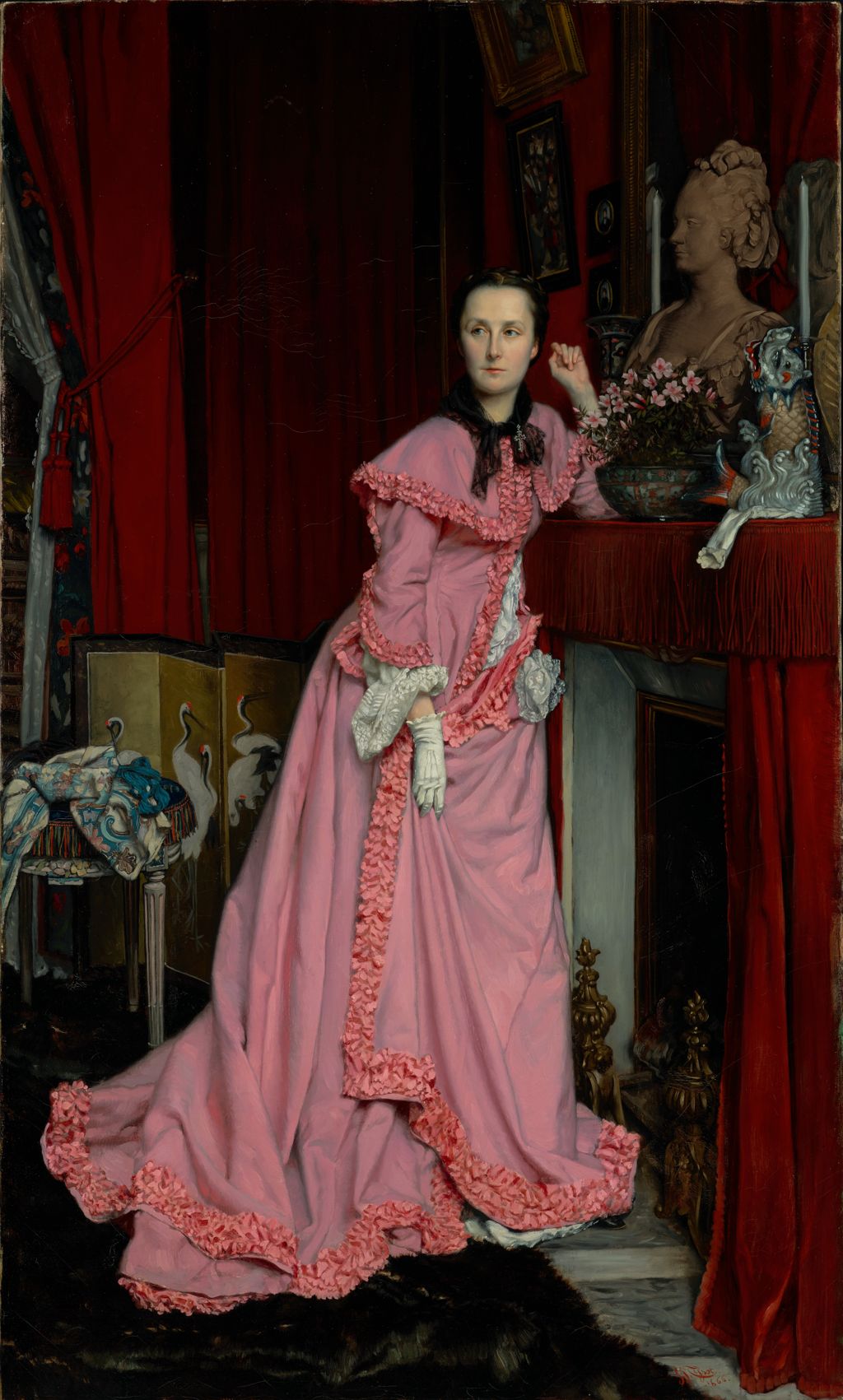
In 1866 Tissot painted the marquise again, this time alone in her husband's family château. The Getty's Portrait of the Marquise de Miramon, née Thérèse Feuillant shows her wearing a pink dressing gown, surrounded by furnishings and decorative objects. The gown's ruffles and soft surface invite close attention, but the portrait also establishes a setting of wealth and cultivated leisure. [5]
A surviving letter gives that painting an unusually tangible connection with its maker. Tissot asked permission to borrow it for the Paris world's fair. The family preserved the letter and a piece of the marquise's pink velvet gown; the Getty's teaching resource records both alongside the painting's history. The swatch brings the problem of painting fabric wonderfully close: an actual material with weight, texture and changing reflections had to become coloured marks on a flat surface. [5]
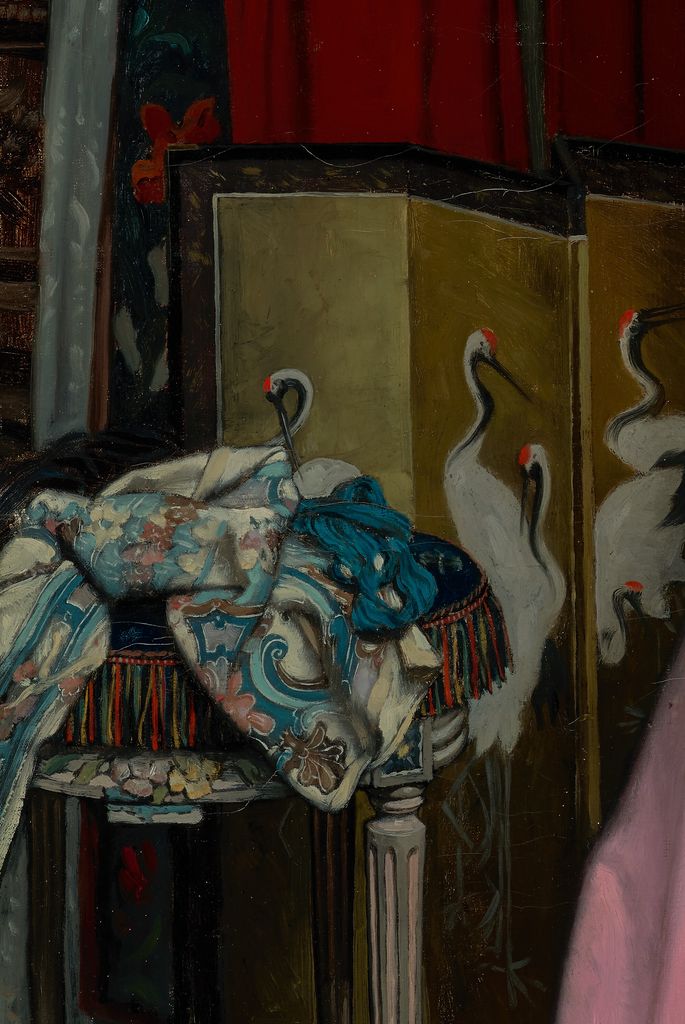
Japanese art formed another strand of that world. In the portrait, a folding screen with cranes stands near the floor. A Getty discussion identifies it as probably Japanese, while treating the origins of the mantelpiece ceramics more cautiously. Their presence reflects the European enthusiasm for Asian objects known as Japonisme. [6]
That uncertainty about individual objects matters. A fashionable nineteenth-century room could mix imports, European imitations and objects whose origins their owners only partly understood. Getty's account relates Tissot's interest to the wider collecting culture shared by artists and wealthy patrons. In his paintings, possessions help describe people, but they also expose the tastes and assumptions through which those people imagined a cultivated life. [6]
Annotated Details from Portrait of the Marquise de Miramon
Follow the painted surfaces from the neckline to the ruffled hem, then look at the small folding screen beside the dress.
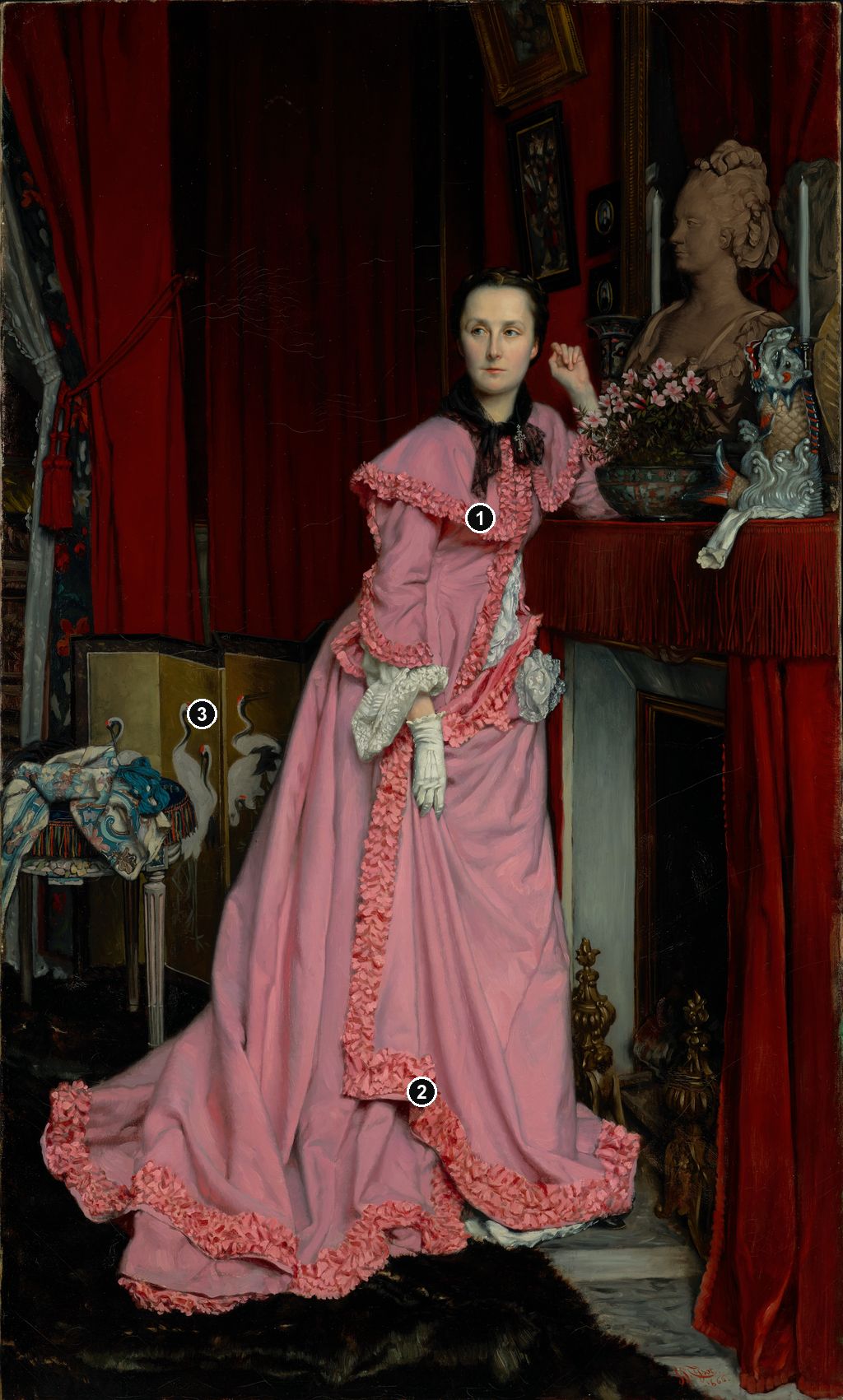
Details from PORTRAIT OF THE MARQUISE DE MIRAMON
The J. Paul Getty Museum, Los Angeles, 2007.7. CC0 Open Content image. Details resized from the unchanged museum master.
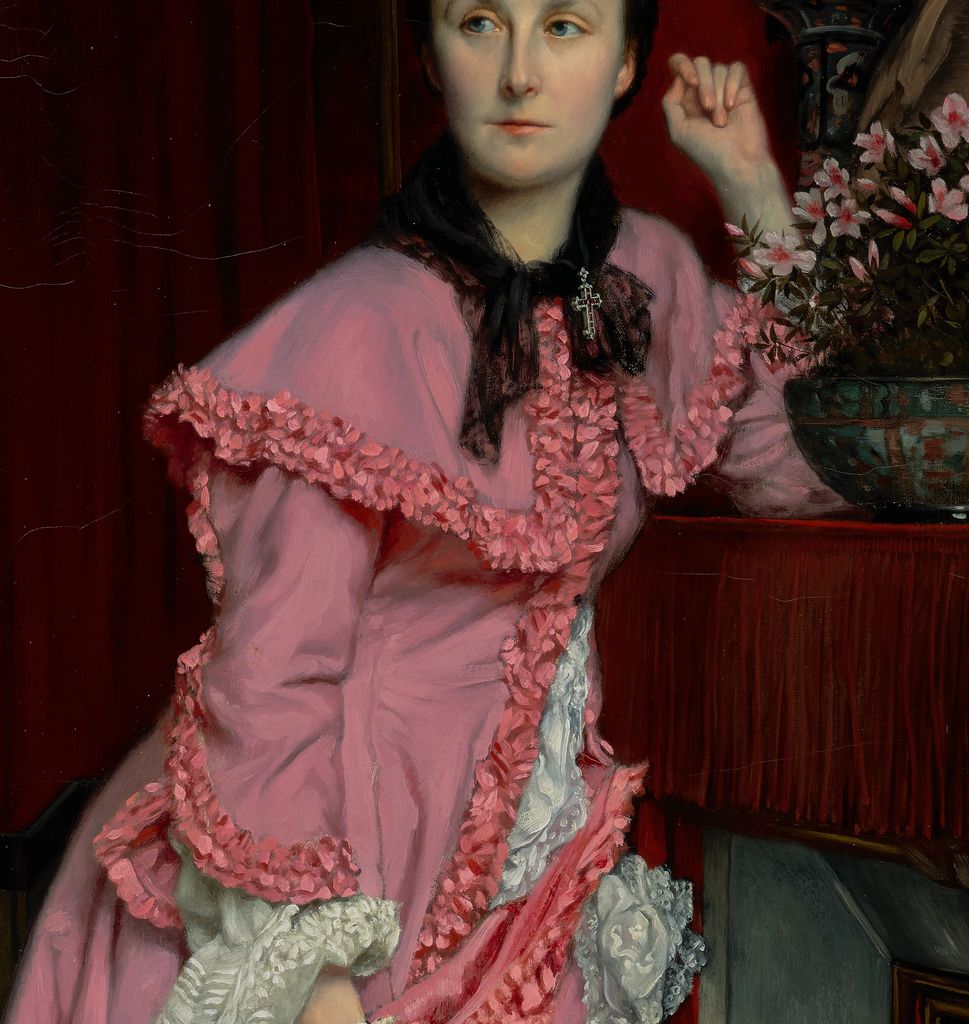
The neckline and painted fabric
Pink ruffles gather around the neckline, while the dark lace and silver cross create a small concentration of contrasting textures. [5]
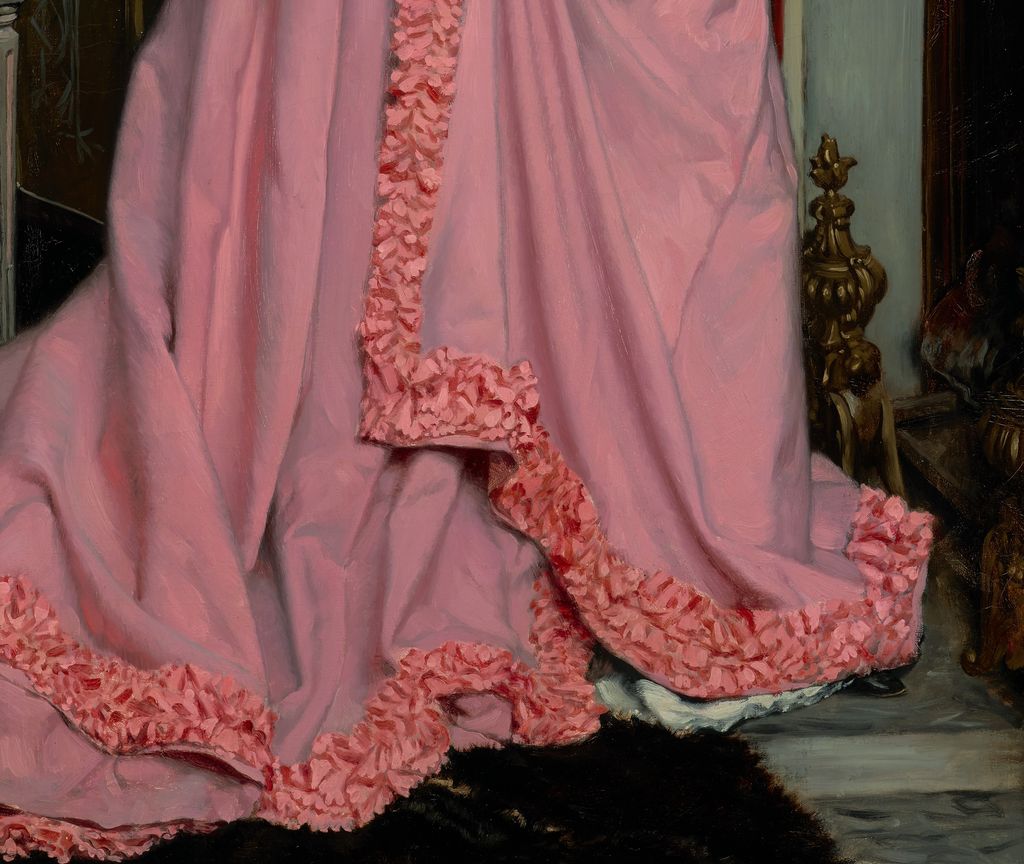
A gown spreading across the floor
The broad pink surface changes direction towards the hem. Ruffles make the lower edge more intricate, so that the fabric seems both substantial and soft.
Cranes on a folding screen
The small screen’s pale birds stand against gold. Getty identifies it as probably Japanese, while treating the ceramics elsewhere in the room more cautiously. [6]
London and the unfinished social story
War interrupted his Paris career. Tissot served in the defence of Paris during the Franco-Prussian War and moved to London in 1871. His precise involvement in the Commune remains uncertain; Orsay's retrospective cautions against a confident account. He arrived with useful connections, including Thomas Gibson Bowles of Vanity Fair, for which he had already supplied caricatures. [7]
London offered a new audience for his skill at arranging social encounters. Two Figures at a Door (The Proposal?), painted in 1872 and now in Cleveland, is particularly revealing. A man remains outside while a woman stands in the doorway, her face partly shaded and her clothes catching the light. The question in the title belongs to the experience of looking: is a marriage proposal being considered, or has something else unsettled the pair? [8]
Curator William H. Robinson explains that the title is not securely recorded in Tissot's photographic albums. He also discusses a different interpretation, prompted by an unfastened button and disturbed tassels on the woman's dress. The detail might suggest a more intimate encounter. These remain readings of an ambiguous scene, not a recovered transcript of its action. Tissot makes the material setting legible while leaving the human situation open. [8]
He was close to artists associated with Impressionism, yet chose his own exhibition path. Degas urged him to join the first Impressionist exhibition in 1874; Tissot declined. The National Gallery of Art preserves that invitation in its discussion of Hide and Seek. Shared friendships and modern subject matter did not require identical decisions about how to paint or where to show. [9]
Kathleen Newton and the London household
By about 1876 Kathleen Newton had entered Tissot's household. They lived together without marrying, and she became a recurring presence in his work. His house in St John's Wood, filled with art and decorative objects, supplied settings for paintings that brought the viewer close to domestic life. [2] [9]
Hide and Seek, about 1877, turns that interior into a space of play and partial concealment. A child occupies the foreground while other faces emerge behind furniture; Newton reads farther back. Patterned rugs, curtains and furnishings make the room visually dense. The National Gallery of Art interprets the Japanese mask near Newton as introducing unease into the scene. That is a museum reading of a particular detail, and the painting also rewards the simpler pleasure of searching through its crowded spaces. [9]
Printmaking extended the life of these subjects. Princeton's Graphic Arts Collection holds Tissot's Ten Etchings, published in 1876–77 in an edition of fifty. Six prints adapt paintings; two draw on wartime drawings. The portfolio places contemporary leisure and remembered conflict within the same working life. It also shows Tissot acting as a publisher of his own images, deciding how they would circulate beyond their first painted form. [10]
Kathleen died in 1882. The Glasgow archive identifies tuberculosis as her illness and confirms that Tissot returned to France after her death. The loss ended their shared household and changed the geographical course of his career. It does not, by itself, explain every subsequent artistic decision. [2]
Paris again: fashion, performance and belief
Back in France, Tissot continued to paint modern society. His fifteen-picture cycle La Femme à Paris was shown in Paris in 1885 and London in 1886. It explored the Parisienne through public entertainment, commerce and social display. He planned an illustrated publication with accompanying literary contributions, but the venture failed. French critics found his returned Parisian women too English. [7]
The print of The Ladies of the Chariots at the Hippodrome makes the relationship between painting and reproduction concrete. The Metropolitan Museum's impression dates to 1885 and uses etching and drypoint. A subject associated with a large painted cycle could also become an independently circulating image on paper. The distinction helps explain why Tissot's career belongs to the history of prints and publishing as well as to the history of the Salon picture. [11]
His religious work developed amid renewed Catholic belief and an interest in spiritualism. Accounts of visions form part of this history, but they cannot establish a simple, verifiable instant when one artist disappeared and another replaced him. His continued social paintings after 1882 already complicate that familiar story. [7]
The Bible as a vast visual project
The later Bible illustrations carried his interest in costumes, architecture and human behaviour into a different narrative world. He travelled in the Middle East, studying people and places as material for his work. The Jewish Museum records detailed drawings, photographs and staged models among the resources behind his biblical imagery. [14]
The Christian series followed the life of Jesus through childhood, ministry, Passion and Resurrection. It was conceived on the scale of a sustained sequence, allowing one scene to prepare for another. The Chrysler Museum's account of its Brooklyn-organised exhibition describes the pictures' theatrical detail and their dramatic reception when first shown in Paris in 1894. Their subsequent publication brought that sequence into readers' homes. [12]
Research and imagination were closely intertwined. Observing nineteenth-century landscapes and clothing could help Tissot construct a convincing setting, but could not turn a biblical event into an eyewitness record. The Jewish Museum explicitly notes exoticising elements in some of the staged scenes. His pictures need to be understood as historical and religious interpretations, shaped by his own period's ways of seeing the Middle East. [14]
The American reception gives a measure of their reach. Brooklyn Museum archivist Tara Cuthbert describes a travelling exhibition that attracted large audiences and a public fundraising campaign to acquire the works in 1900. Contemporary notices in the Brooklyn Daily Eagle recorded the subscriptions. This was a collective act of collecting, supported by people who had encountered the images as a major public spectacle. [13]
Tissot then worked on stories from the Hebrew Bible. The Jewish Museum's collection includes more than 350 paintings associated with that project, given by the heirs of Jacob Schiff. Its account distinguishes Tissot's designs from work by followers and from the posthumous publication organised by Maurice de Brunoff in 1904. The suite was unfinished when the artist died. [14]
A career that crosses familiar boundaries
The Musée d'Orsay's 2020 retrospective brought these several careers together, tracing an artist whose use of painting, prints, photography and illustration crossed the usual divisions of nineteenth-century art. [7]
Tissot died at Buillon on 8 August 1902. His career had joined the practices of painter, draughtsman, printmaker, collector and illustrator. The surviving prints, letters and illustrated books make those connections visible alongside the paintings. [1] [2] [5] [10] [13]
His reputation has also been rebuilt through the patient work of scholars and archives. The Art Institute of Chicago holds Michael Wentworth's research collection, including three albums of photographs of Tissot's work. Its finding aid explains that some photographs provide the only surviving record of lost pictures. Wentworth's print catalogue appeared in 1978, followed by his monograph in 1984. These resources preserve a career broader than any small selection of familiar paintings can suggest. The albums are especially valuable reminders that the works now visible in museums are only part of what Tissot made. [15]
Looking across the career changes the experience of an individual work. A dress in a portrait, a carefully positioned child and a biblical crowd all reveal his attention to the expressive possibilities of arrangement. The settings can be described with extraordinary precision while the people remain difficult to read. That tension gives the pictures their continuing invitation: follow the details, then consider how much of a human story they allow us to know. [3] [8] [9] [12]
Four phases of Tissot’s career
The Parisienne and public display
After returning to France, he continued modern subjects, including La Femme à Paris, exhibited in 1885 and 1886. [7]
Artworks directory
Selected paintings, figure studies, finished biblical watercolours and a print. Original works on paper are distinguished from impressions and book reproductions. The Hebrew Bible project was unfinished at Tissot’s death, and its later publication also included followers’ designs. A dash marks an undated sheet. Additional Tate entries retain the museum’s unmaintained October 2014 catalogue snapshot. This is not a complete catalogue. [19]
| Name | Date | Medium |
|---|---|---|
| Portrait of Mademoiselle L.L. | 1864 | Painting |
| The Miramon family | 1865 | Painting |
| Portrait of the Marquise de Miramon | 1866 | Painting |
| Two Figures at a Door (The Proposal?) | 1872 | Painting |
| Hide and Seek | about 1877 | Painting |
| The Ladies of the Chariots at the Hippodrome (etching and drypoint) | 1885 | |
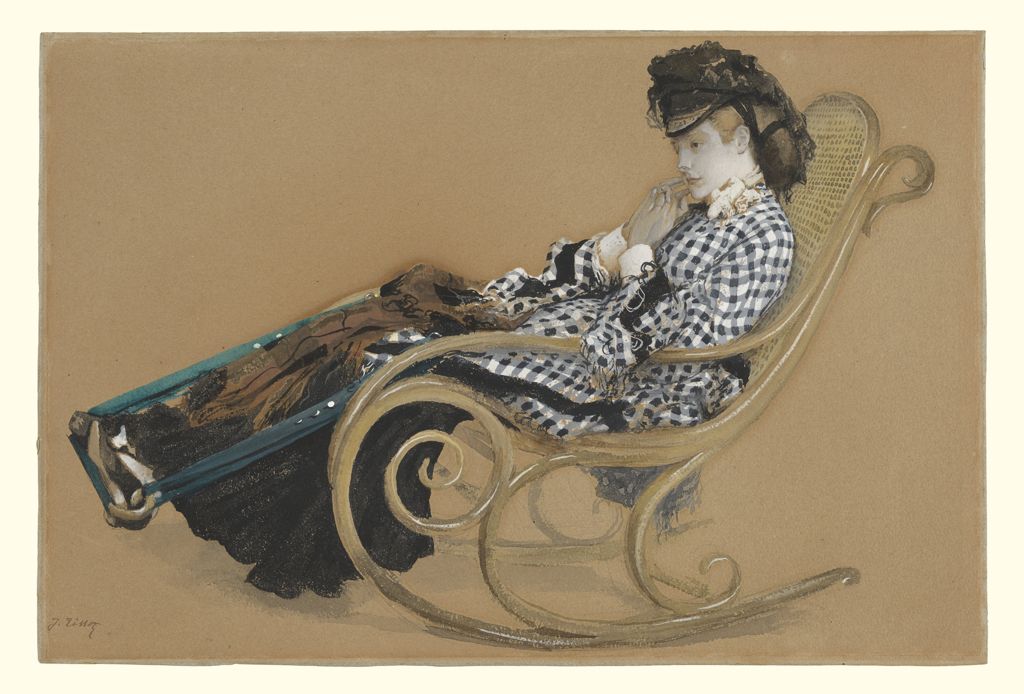
| Young Woman in a Rocking Chair | about 1873 | Drawing |
| Standing man in Renaissance costume (study) | — | Drawing |
| Study for Too Early | about 1873 | Drawing |
| Young woman seated in profile, wearing a hat | — | Drawing |
| Jesus Wept | 1886–94 | Painting |
| Abram’s Counsel to Sarai | about 1896–1902 | Painting |
| Jacob and Rachel at the Well | about 1896–1902 | Painting |
| Isaac Bears the Wood for His Sacrifice | about 1896–1902 | Painting |
| Portrait (Tate N04271) | 1876 | Painting |
| Studies of a Kneeling Woman (Tate N04292) | c.1872–3 | Drawing |
| Study of a Girl in a Mob Cap (Tate N04293) | c.1872 | Drawing |
| Study after Reynolds’ Portrait of Mrs Williams Hope (Tate N04294) | c.1872 | Drawing |
| Ramsgate (Tate N04295) | c.1876 | Drawing |
| Holyday (Tate N04413) | c.1876 | Painting |
| The Gallery of HMS Calcutta (Portsmouth) (Tate N04847) | c.1876 | Painting |
| The Ball on Shipboard (Tate N04892) | c.1874 | Painting |
| Portsmouth Dockyard (Tate N05302) | c.1877 | Painting |
Frequently Asked Questions
Degas invited him to the first exhibition in 1874, but he declined. [9]
Discussion
Look from the precise description of clothes and rooms to the uncertain human stories they contain.
Reader Insights
Which small gesture most changes a scene?
How do objects and fabric describe a social setting?
What carries across from the society pictures to the Bible illustrations?
Join the Conversation
Share a detail, comparison or question about James Tissot Biography below.
References
- National Gallery, London. “Jacques Joseph (James) Tissot, 1836–1902.” Artist biography, undated. National Gallery. English. View source.Splash image: Portrait of the Marquise de Miramon, née Thérèse Feuillant, 1866. Getty Museum, 2007.7. The J. Paul Getty Museum, Los Angeles; Open Content image, resized · CC0
- University of Glasgow, The Correspondence of James McNeill Whistler. “Jacques Joseph Tissot, 1836–1902.” Biographical record, undated; includes scholarly bibliography and Arts Club records. University of Glasgow. English. View source.
- Musée d'Orsay. “Portrait de Mademoiselle L.L.” Collection record and commentary, undated; painting dated 1864, RF 2698. In French. View source.
- Musée d'Orsay. “Portrait du marquis et de la marquise de Miramon et de leurs enfants.” Collection record and commentary, undated; painting dated 1865, RF 2006 22. In French. View source.
- J. Paul Getty Museum, Education Department. “Portrait of the Marquise de Miramon, née Thérèse Feuillant, Jacques Joseph Tissot.” Historical Witness, Social Messaging: Information and Questions for Teaching. 2009, pp. 1–2. J. Paul Getty Trust. English PDF. View source.
- Megan Lee. “What Are Japanese and Chinese Objects Doing in This French Aristocrat's Bedroom?” 31 August 2016. Getty News. English. View source.
- Musée d'Orsay. “James Tissot (1836–1902), l'ambigu moderne.” Exhibition presentation and thematic essays, 2020; exhibition held 23 June–13 September 2020. Musée d'Orsay. In French. View source.
- William H. Robinson. “James Tissot, Painter of Modern Life.” 24 February 2023. Cleveland Museum of Art. English. View source.
- National Gallery of Art, Washington. “Hide and Seek.” Collection record and interpretive text, undated; painting dated c. 1877, accession 1978.47.1. English. View source.
- Julie Mellby. “Ten Etchings by J.J. Tissot.” 19 June 2019. Graphic Arts Collection, Princeton University Library. English. View source.
- Metropolitan Museum of Art. “The Ladies of the Chariots at the Hippodrome (Ces dames des chars à l'Hippodrome).” Collection record, undated; print dated 1885, accession 1972.545.2. English. View source.
- Chrysler Museum of Art. “Chrysler Museum of Art Presents ‘The Life of Christ’ During Lent.” 1 February 2011. Exhibition announcement for the Brooklyn Museum-organised exhibition. English. View source.
- Tara Cuthbert. “Rare Tissot Resources on Display in the Libraries and Archives.” 24 November 2009. Brooklyn Museum, BKM TECH. English. View source.
- Jewish Museum. “Accumulations: Tissot and the Bible.” Gallery section text, file dated 2 June 2023, hosted in a 2025 upload directory. Jewish Museum, New York. English PDF. View source.
- Valerie Higgins, processor. Michael Wentworth (1938–2002) Collection, c.1882–2002 (bulk 1962–2002). Finding aid, 2011, accession 2007.6. Ryerson and Burnham Art and Architecture Archives, Art Institute of Chicago. Collection summary, biographical sketch, scope note and photographic-album inventory. English PDF. View source.
- National Gallery, London, Hilaire-Germain-Edgar Degas, artist biography, 1834–1917. Accessed 28 October 2026. View source.
- National Gallery of Art, James McNeill Whistler, artist authority, 1834–1903. Accessed 28 October 2026. View source.
- J. Paul Getty Museum, Young Woman in a Rocking Chair, study for The Last Evening, about 1873, 2002.30. Collection record and CC0 image; accessed 28 October 2026. View source.
- Tate, Tate Collection metadata, artwork_data.csv, October 2014 snapshot, released under CC0. Repository readme states that this dataset is no longer maintained. Downloaded and artist rows inspected 28 October 2026. View source.
 James Tissot.jpg)


