


 by Tom Gurney
Tom Gurney BSc (Hons) is an art history expert with over 20 years experience
Published on June 19, 2020 / Updated on November 5, 2026
Email: tomgurney1@gmail.com / Phone: +44 7429 011000
James Tissot Drawings
James Tissot's drawings range from concentrated studies of a single figure to biblical scenes crowded with people, buildings and incident. A pencil outline might establish a pose; touches of white could bring a sleeve or a chair into the light; colour could turn a study into something remarkably close to a finished painting. His works on paper reveal the practical decisions behind the polished surfaces for which he is famous. [1] [2]
They also demand a broad understanding of drawing. Tissot used graphite, ink, watercolour and gouache, sometimes together on the same sheet. His later Bible illustrations include finished paintings on paper and board, created for exhibition and reproduction. Looking at them alongside preparatory studies makes it possible to follow an image from an observed person or a small compositional idea towards a public narrative. [1] [3]
At a Glance
Contents
- Drawing, colour and finish
- A costumed figure before the finished picture
- A London model in a rocking chair
- Fashion as a problem of pose
- Reusing a model, changing a story
- From travel studies to biblical compositions
- A finished watercolour: Jesus Wept
- The Hebrew Bible in gouache
- Drawings, original watercolours and prints
Drawing, colour and finish
A useful starting point is the Getty's Young Woman in a Rocking Chair, made about 1873 as a study for The Last Evening. The museum classifies it as a drawing, although its materials include gouache and watercolour applied with a brush over graphite on brown paper. The category describes a work whose expressive resources extend well beyond a monochrome line. [1]
Watercolour can allow the support to show through a thin wash. Gouache, also called bodycolour, gives more opaque passages, useful for highlights and solid areas of colour. Tissot could combine these effects with the precision of graphite. A catalogue's complete medium description therefore matters: the colours in a reproduction may conceal the drawing underneath, while the word “drawing” alone may suggest a much less finished object than the one he made. [1] [4]
Coloured papers gave him another resource. A light pink or blue ground could remain visible between the marks, contributing its own tone. White heightening established the bright end of the scale, while pencil, darker washes or opaque paint supplied shadows and contours. These supports helped him work between the modelling of a body and the surface appearance of clothes. [2] [4]
Compare a figure study and a finished watercolour
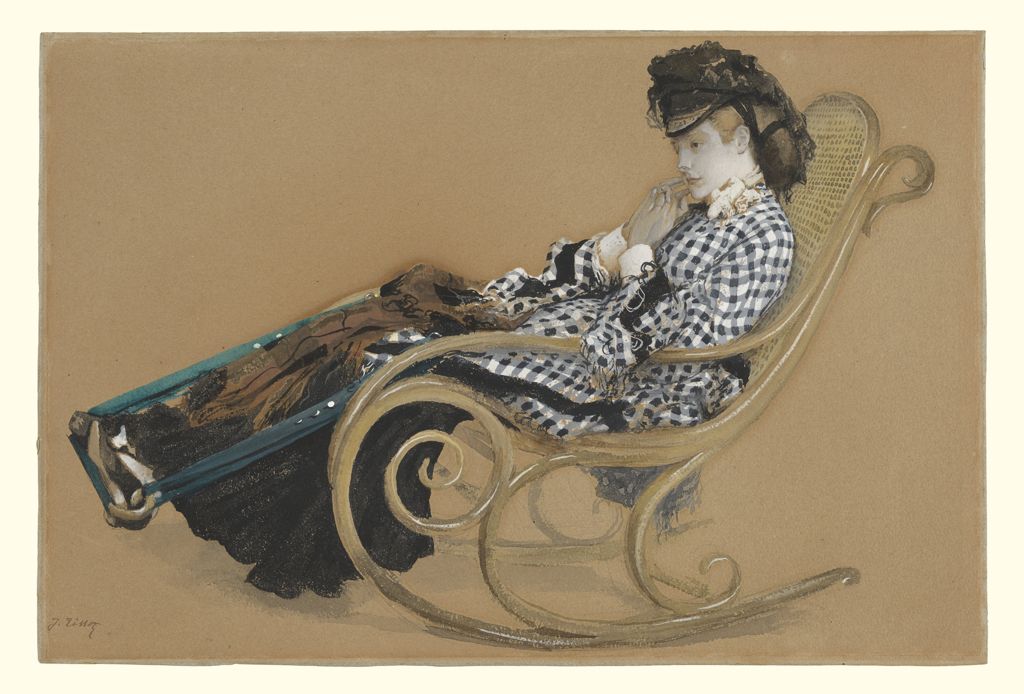
Young Woman in a Rocking Chair
About 1873; Getty 2002.30. A study for The Last Evening.
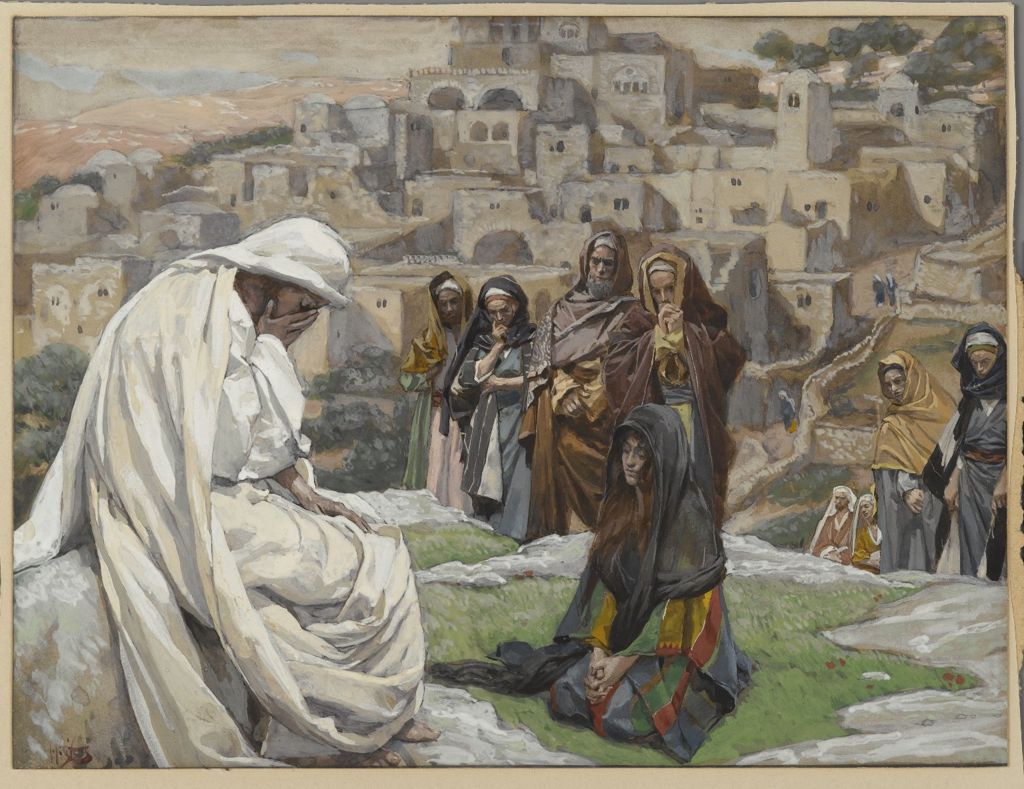
Jesus Wept
1886–94; Brooklyn Museum. A finished opaque watercolour over graphite.
A costumed figure before the finished picture
An early example is A Standing Man in Renaissance Costume, His Right Hand on His Hip. Christie's records graphite heightened with white on light pink paper and identifies the sheet as a study for The Departure of the Prodigal Son, exhibited at the Salon in 1863. The connection places the drawing within Tissot's early interest in historical subjects and Renaissance dress. [2]
The study concentrates on a figure who will belong to a larger gathering. A pose must work as a body before it can work as an actor in a story: the balance of the legs, the angle of an arm and the fall of clothing all affect how that figure occupies space. The hand-on-hip gesture already gives the man a particular bearing. The sheet's purpose is easier to understand when we imagine the practical problem of bringing separately studied people together in one composition. [2]
This attention to costume continued when Tissot turned towards contemporary life. Historical and modern clothes presented different subjects, but both required decisions about silhouette, weight and the relationship between fabric and the person wearing it. His drawings let us approach those decisions at the scale of an individual body.
A London model in a rocking chair
The Getty study offers a particularly intimate encounter with that process. Margaret Freebody, a friend of Tissot's, sits in a reclining rocking chair, her fingers resting against her cheek. Her extended legs lead towards its footrest. A checked tunic and a differently patterned skirt make the seated body a succession of changing surfaces. The museum identifies her as the model for both the study and the finished painting. [1]
The chair curls around her, its light frame contrasting with the darker clothing. Much of the brown paper remains open around this carefully developed group. That surrounding emptiness helps isolate the relationship between body, dress and furniture: the model's inward-looking pose is already persuasive before the deck and other passengers of The Last Evening supply its narrative setting. The study invites us to look at the figure as a carefully constructed arrangement of shapes as well as a person waiting. [1]
Its degree of finish is revealing. Preparation did not always mean a hurried notation. Tissot could investigate a small part of a painting through sustained attention, bringing the colours and textures of that part close to their eventual effect.
Annotated Details from Young Woman in a Rocking Chair
Look at how a few materials establish a thoughtful pose, patterned clothing and the curling structure of the chair.
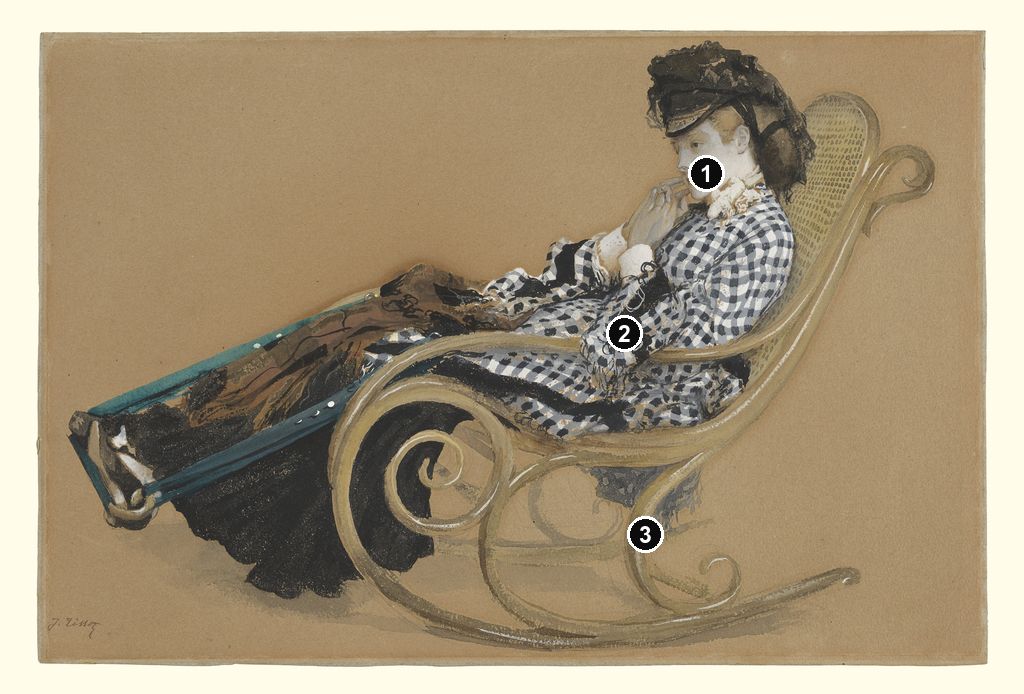
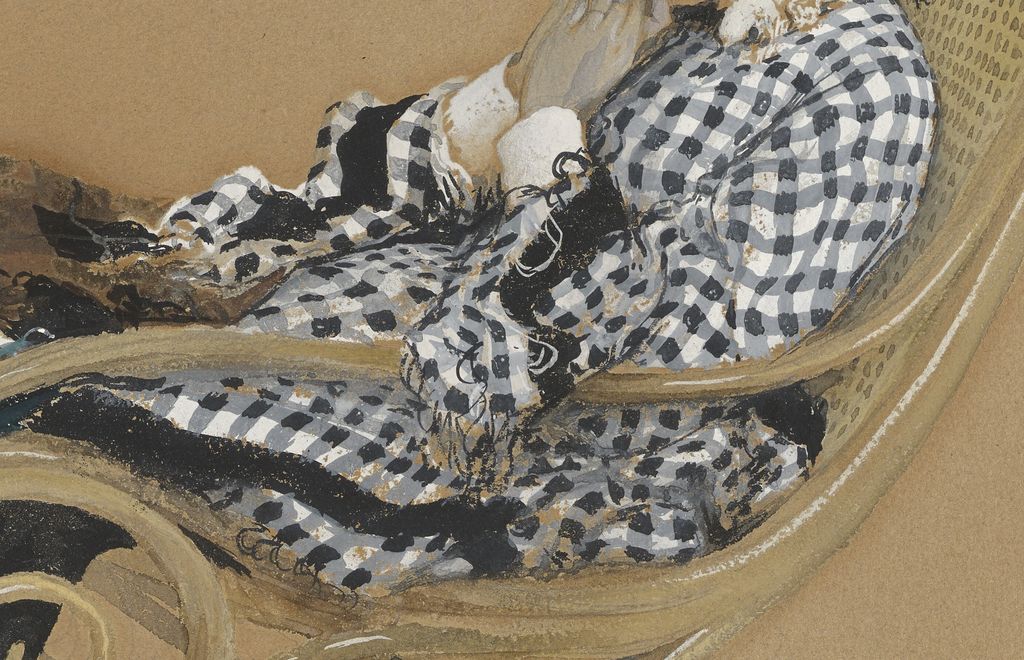
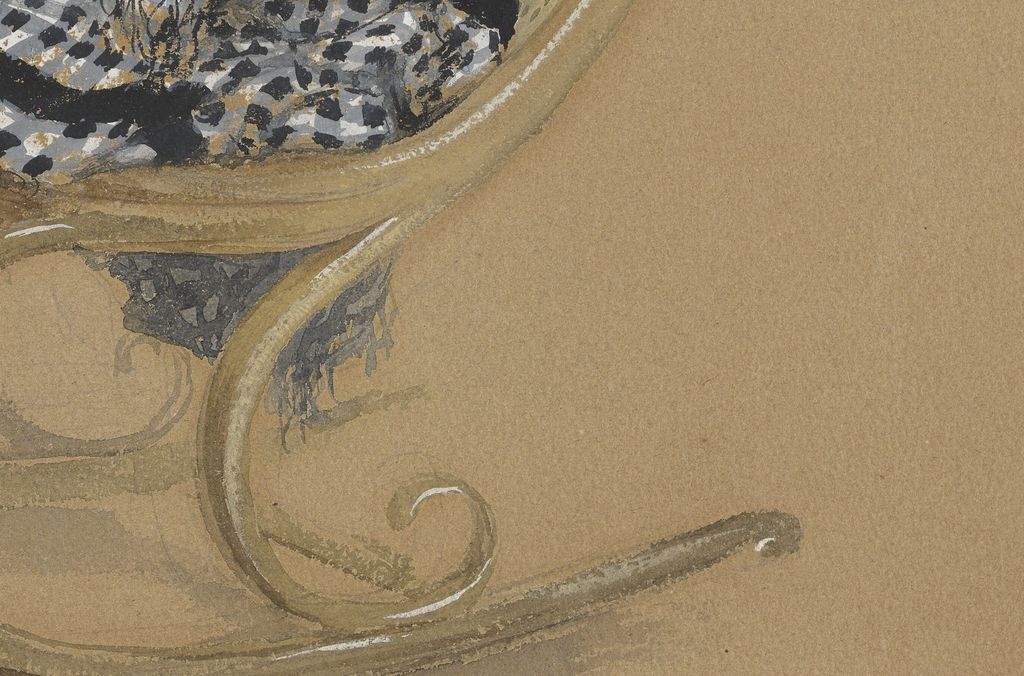
Details from YOUNG WOMAN IN A ROCKING CHAIR
The J. Paul Getty Museum, Los Angeles, 2002.30. CC0 Open Content image. Details resized from the unchanged museum master.
The hand near the face
Margaret Freebody’s fingertips rest near her cheek. The hat and the angle of the face concentrate attention within the larger reclining pose. [1]
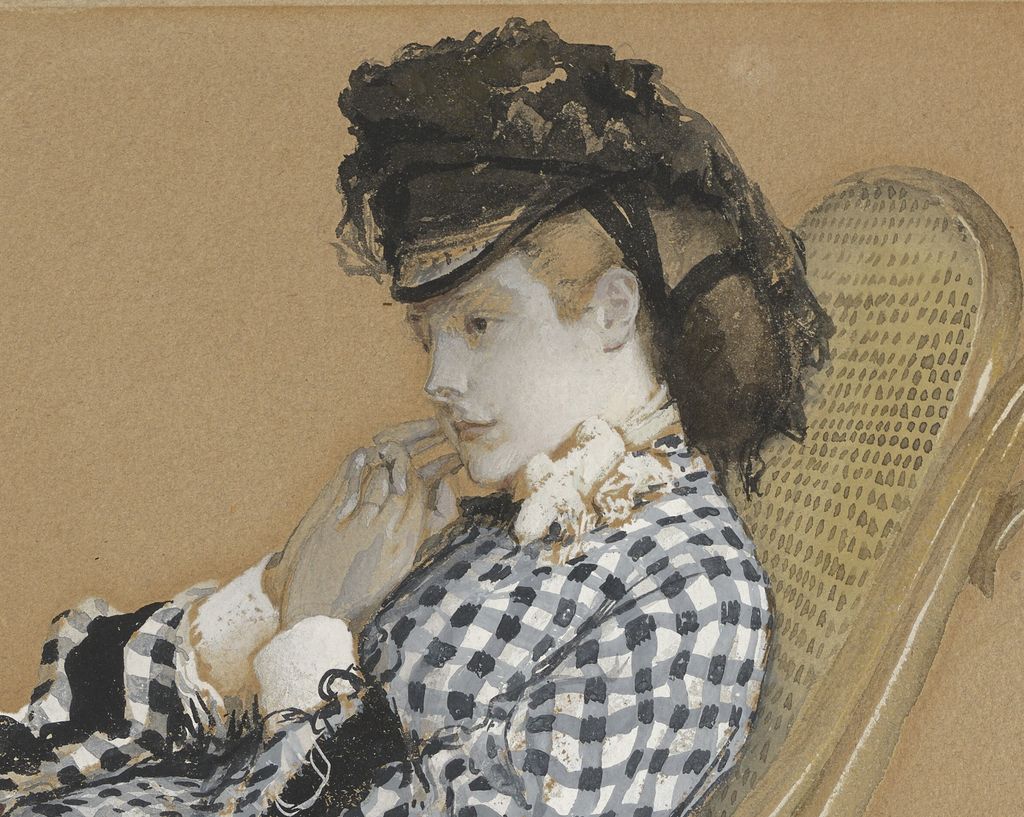
Checks across a resting body
Black-and-white checks turn across the tunic. Their changing angles make the clothing follow the reclining body rather than remain a flat pattern. [1]
The chair and the open paper
The frame curls around the figure, then turns into the rocking support below. Light marks define its edges against the brown paper that remains visible around it. [1]
Fashion as a problem of pose
The Chazen Museum of Art's Study for Too Early, dated around 1873, preserves a different kind of figure study. Its narrow sheet measures 13¾ by 6¾ inches, and the museum records graphite and watercolour. The vertical format gives the standing woman's dress room to establish a complete silhouette. [5]
The earlier auction description adds touches of bodycolour on buff paper. It connects the drawing with Too Early, the 1873 painting now in London's Guildhall Art Gallery, and describes it as one of two known studies for the picture. That relationship makes the sheet valuable for understanding how Tissot developed the individuals within his social scenes. [6]
A dress is an arrangement of volumes as well as a fashionable object. Its upper body, sleeves and widening skirt establish a rhythm around the figure; the person's stance changes the direction of its folds. In a group scene, the resulting silhouette also determines the space left for neighbouring people. A study devoted to one woman allows these questions to be worked out before the fuller interaction takes shape.
Such drawings need not tell the whole story of the eventual painting. Their concentration is part of their interest. We can study the handling of a garment without assuming that every fold has a symbolic meaning, or that a model's momentary expression reveals a fictional character's thoughts.
Reusing a model, changing a story
A further sheet, catalogued by Christie's as A Young Woman, Seated in Profile to the Left, Wearing a Hat, combines pencil, watercolour and bodycolour on blue paper. The catalogue places it among roughly a dozen early London gouaches showing single female figures studied from life. [4]
The auction essay credits Tissot specialist Krystyna Matyjaszkiewicz with recognising parallels to studies associated with The Captain and the Mate and The Return from the Boating Trip. It identifies similarities in the model, hat and hairstyle. This is a useful scholarly connection, reported through the catalogue; it does not establish a personal name for the sitter. [4]
The recurrence of a model complicates the impression that each finished scene is a casually witnessed event. The same person and accessories could contribute to different situations. Drawing offered a store of usable observations, but an individual sheet also had a specific task: to explore an angle of the head, the weight of seated clothing or the shape of a hat against the face. Tissot's apparent social ease depended on such deliberate work.
From travel studies to biblical compositions
The later Bible project gave drawing a much larger role. In her doctoral study of Tissot, art historian Melissa E. Buron distinguishes the abbreviated compositions in his surviving Holy Land sketchbook from his detailed pen-and-ink studies of people and places. The sketchbook, dated 1888–89, contains small arrangements that anticipate finished scenes; the more descriptive sheets record such things as clothes, faces and topography. [7]
These are different forms of preparation. A tiny arrangement can test where the action belongs. A carefully observed figure can supply the way a garment hangs or a load is carried. Buron identifies particular transfers, including figures in Women of Geba, Samaria that reappear in Jesus Forbids the Carrying of Loads in the Forecourt of the Temple. Her account makes a practical connection between the travel material and the later narratives. [7]
Travel did not make the illustrations direct records of biblical antiquity. Buron discusses Tissot's assumption that the region preserved the appearance of Christ's lifetime as part of a nineteenth-century Orientalist outlook. Contemporary observation could furnish convincing details without proving that those details belonged to the ancient scene being reconstructed. [7]
A finished watercolour: Jesus Wept
Jesus Wept, made between 1886 and 1894, shows what happened when such resources became a complete picture. The Brooklyn Museum's photograph and accompanying collection information, preserved through its Wikimedia Commons contribution, identify opaque watercolour over graphite on grey wove paper. The image measures only 17.1 by 22.7 centimetres, yet holds a whole hillside encounter. [8]
Christ sits at the left with his head bowed and one hand covering much of his face. His pale clothing fills a large portion of the foreground. Opposite him, a kneeling woman looks upwards; behind her, standing figures form a watchful group. The town climbs the background in tightly packed blocks, opening the immediate expression of grief onto a larger inhabited world. [8]
The white robe is especially rewarding to examine. Its shadowed folds give the body weight, while its broad, light shape separates the seated figure from the darker garments nearby. The arrangement allows an intimate gesture to remain readable within an unusually detailed setting. At this small scale, finish serves clarity: the viewer can move from the covered face to the kneeling figure and then into the architecture without losing the central action. [8]
The Hebrew Bible in gouache
Tissot carried this ambition into stories from the Hebrew Bible. The Jewish Museum holds more than 350 paintings related to that project, given by the heirs of Jacob Schiff. Its exhibition materials identify individual works as gouache on board, including Abram's Counsel to Sarai, Jacob and Rachel at the Well and Isaac Bears the Wood for His Sacrifice, dated about 1896–1902. [9]
In Abram's Counsel to Sarai, the two figures occupy a tent whose sloping fabric encloses their conversation. Abram's raised hand and Sarai's supporting arm make an exchange of attention visible. The striped ground covering and the tent's supporting lines give that encounter a material setting. Familiar interests in pose, patterned surfaces and the space between people remain active within the biblical subject. [9]
The museum's gallery text explains that the designs combined gouache with touches of graphite and ink, then passed into print through photographic techniques. It also records photographs and staged models among Tissot's resources, while drawing attention to the exoticising treatment of some scenes. The illusion of a fully furnished ancient world was constructed through several kinds of evidence and invention. [3]
There is also an authorship boundary. Tissot died in 1902 with the suite unfinished. The 1904 publication organised by Maurice de Brunoff selected from designs by Tissot and his followers. A published biblical image therefore requires attention to its individual attribution and history; association with the wider project alone does not make every design entirely his work. [3]
Drawings, original watercolours and prints
Tissot's interest in circulating images had developed well before the Bible illustrations. Princeton University Library's Ten Etchings portfolio, published in 1876–77, includes six prints adapted from paintings and two based on drawings from the wartime period. The edition comprised fifty copies. [10]
That evidence helps distinguish related objects. A drawing may stand behind a print, but the impression itself is made through a printing process. A finished gouache may later be photographed and reproduced in a book; the printed plate is another object, with its own scale, paper and publication context. The relationship between these forms is central to Tissot's practice. It should not erase their material differences. [3] [10]
The public life of the religious pictures extended through exhibitions as well as books. Brooklyn Museum archivist Tara Cuthbert describes the travelling display of Tissot's watercolours and the public fundraising campaign that secured their acquisition in 1900. Her account also points to illustrated publications and early exhibition catalogues in the museum's collections. The small original pictures could therefore participate in a very large public event. [11]
Looking across these works on paper reveals an artist attentive to both the isolated detail and the larger arrangement. A costumed man, a woman in a chair and a biblical gathering require different degrees of preparation and finish. Each becomes more interesting when its materials and purpose are kept in view: the line that locates a body, the colour that gives cloth substance, and the composition that turns observed details into a story.
Artworks directory
Selected paintings, figure studies, finished biblical watercolours and a print. Original works on paper are distinguished from impressions and book reproductions. The Hebrew Bible project was unfinished at Tissot’s death, and its later publication also included followers’ designs. A dash marks an undated sheet. Additional Tate entries retain the museum’s unmaintained October 2014 catalogue snapshot. This is not a complete catalogue. [12]
| Name | Date | Medium |
|---|---|---|
| Portrait of Mademoiselle L.L. | 1864 | Painting |
| The Miramon family | 1865 | Painting |
| Portrait of the Marquise de Miramon | 1866 | Painting |
| Two Figures at a Door (The Proposal?) | 1872 | Painting |
| Hide and Seek | about 1877 | Painting |
| The Ladies of the Chariots at the Hippodrome (etching and drypoint) | 1885 | |
| Young Woman in a Rocking Chair | about 1873 | Drawing |
| Standing man in Renaissance costume (study) | — | Drawing |
| Study for Too Early | about 1873 | Drawing |
| Young woman seated in profile, wearing a hat | — | Drawing |
| Jesus Wept | 1886–94 | Painting |
| Abram’s Counsel to Sarai | about 1896–1902 | Painting |
| Jacob and Rachel at the Well | about 1896–1902 | Painting |
| Isaac Bears the Wood for His Sacrifice | about 1896–1902 | Painting |
| Portrait (Tate N04271) | 1876 | Painting |
| Studies of a Kneeling Woman (Tate N04292) | c.1872–3 | Drawing |
| Study of a Girl in a Mob Cap (Tate N04293) | c.1872 | Drawing |
| Study after Reynolds’ Portrait of Mrs Williams Hope (Tate N04294) | c.1872 | Drawing |
| Ramsgate (Tate N04295) | c.1876 | Drawing |
| Holyday (Tate N04413) | c.1876 | Painting |
| The Gallery of HMS Calcutta (Portsmouth) (Tate N04847) | c.1876 | Painting |
| The Ball on Shipboard (Tate N04892) | c.1874 | Painting |
| Portsmouth Dockyard (Tate N05302) | c.1877 | Painting |
Frequently Asked Questions
He combined graphite, ink, watercolour and gouache. The Getty classifies the coloured rocking-chair study as a drawing. [1]
Discussion
Compare the open brown paper around the seated figure with the crowded setting of the biblical watercolour.
Reader Insights
Where does a line remain visible beneath colour?
What does the empty paper contribute to the rocking-chair study?
How does preparation differ from a finished original or its printed reproduction?
Join the Conversation
Share a detail, comparison or question about James Tissot Drawings below.
References
- J. Paul Getty Museum. “Young Woman in a Rocking Chair, study for the painting ‘The Last Evening’.” Collection record and interpretive text, undated; about 1873, object 2002.30. Getty, Los Angeles. English. View source.Splash image: Young Woman in a Rocking Chair, about 1873, study for The Last Evening. Getty Museum, 2002.30. The J. Paul Getty Museum, Los Angeles; Open Content image, resized · CC0
- Christie's. “Homme debout en costume Renaissance, sa main droite sur la hanche.” Lot 94, sale 21059, Maîtres Anciens – Dessins, Peintures, Sculptures, 2022. Object record and catalogue essay. French with English translation. View source.
- Jewish Museum. “Accumulations: Tissot and the Bible.” Gallery section text, file dated 2 June 2023, hosted in a 2025 upload directory. Jewish Museum, New York. English PDF. View source.
- Christie's. “A young woman, seated in profie to the left, wearing a hat.” Object record and catalogue essay acknowledging the expertise of Krystyna Matyjaszkiewicz, undated web record. English. View source.
- Chazen Museum of Art. “Study for Too Early.” Collection record, undated; around 1873, accession 2005.57. University of Wisconsin–Madison. English. View source.
- Christie's. “Study for ‘Too Early’.” British Art on Paper, 17 November 2005. Object record and catalogue essay. English. View source.
- Melissa E. Buron. ‘Twixt Two Worlds: The Visions of James Tissot. PhD thesis, September 2021, volume 1, pp. 145–47 and 155–59. Birkbeck College, University of London; Birkbeck Institutional Research Online. English PDF. View source.
- Brooklyn Museum. “Jesus Wept (Jésus pleura).” Collection photograph, 2007, 00.159.182_PS2.jpg; original museum contribution to Wikimedia Commons, 2010, with subsequent higher-resolution replacement. Collection metadata and public-domain artwork reproduction. English and French title. View source.
- Jewish Museum. “Tissot and the Bible.” Exhibition presentation, 21 January 2018–27 May 2024; object captions and images. Jewish Museum, New York. English. View source.
- Julie Mellby. “Ten Etchings by J.J. Tissot.” 19 June 2019. Graphic Arts Collection, Princeton University Library. English. View source.
- Tara Cuthbert. “Rare Tissot Resources on Display in the Libraries and Archives.” 24 November 2009. Brooklyn Museum, BKM TECH. English. View source.
- Tate, Tate Collection metadata, artwork_data.csv, October 2014 snapshot, released under CC0. Repository readme states that this dataset is no longer maintained. Downloaded and artist rows inspected 28 October 2026. View source.
 James Tissot.jpg)


