


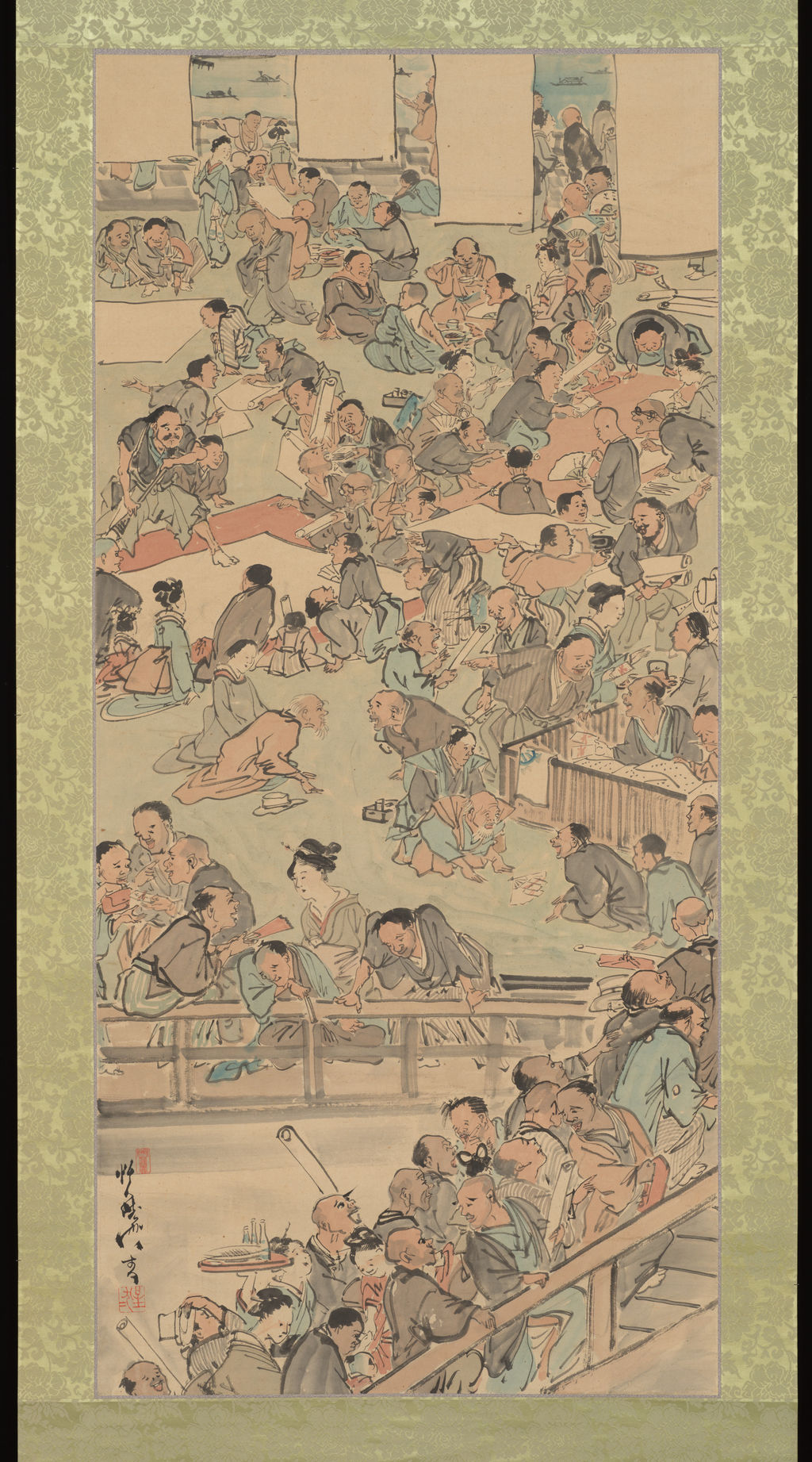
Kawanabe Kyōsai, Painting and Calligraphy Gathering at the Nakamurarō in Ryōgoku, c.1876. The Met 2023.583.34.
 by Tom Gurney
Tom Gurney BSc (Hons) is an art history expert with over 20 years experience
Published on June 19, 2020 / Updated on September 23, 2026
Email: tomgurney1@gmail.com / Phone: +44 7429 011000
A life assembled from different kinds of evidence
Kawanabe Kyōsai (河鍋暁斎) was born in Koga in the province of Shimōsa on 18 May 1831 by the modern calendar and died in Tokyo on 26 April 1889. Japan's National Diet Library and Art Platform Japan both give those dates; the latter records his birth name as Shūzaburō. A Japanese compiled chronology gives the birth as the seventh day of the fourth month of Tenpō 2, a date in the older lunar calendar. The dates describe the same birth rather than two rival biographies. This matters elsewhere in his life: the chronology expressly uses the lunar calendar until 1872 and the solar calendar afterwards. A biography that turns every earlier month and day into a modern date without conversion can quietly move an event on the calendar. [1] [2] [3]
Explore Kyōsai’s works and visual methods.
Contents
- A life assembled from different kinds of evidence
- Childhood in Koga and Edo
- The Kanō education was a continuing relationship
- A livelihood before the Meiji Restoration
- A dated tiger, a printed spectacle
- Arrest and the written change of name
- Meiji exhibitions, travel and a network of visitors
- The 1881 crow prize and Conder's lessons
- Late mastery, books and the diary
- Death, daughter and later memory
- Books on Japanese Art
Kyōsai crossed the change from Tokugawa rule to Meiji government as a working painter. His childhood learning, the professional names he acquired, the print designs of the 1850s and 1860s, the 1870 arrest, official exhibitions, foreign visitors and late publications are often joined into a single story of a rebellious genius. Those events are real subjects for investigation, but they survive in unlike sources. A dated museum object fixes one work in material form. A diary page records a scheduled visit, sometimes with a year inferred from comparison. A compiled chronology draws on later accounts. A museum exhibition proposes a reading across many objects. This biography keeps those forms of evidence visible instead of letting a colourful anecdote govern every painting. [3] [4] [5]
Kyōsai’s life at a glance
- Years1831–1889
- BirthplaceKoga, Shimōsa (today Ibaraki)
- TeachersKuniyoshi, Maemura Tōwa and Tōhaku Chinshin
- WorkScrolls, prints, illustrated books, albums and live painting
The gathering scroll is a fitting opening precisely because it does not picture an isolated person. Kyōsai made art amid teachers, other painters, publishers, guests and students. The Met's date is approximate. The compiled Japanese chronology places him at a Nakamurarō painting gathering on 21 May 1876, but the near match does not by itself prove that the pictured room documents that particular day. Look instead at what the image certainly offers: a vision of art produced and watched socially. A life described only through signed masterpieces would miss this public activity, just as a life described only through his arrest would miss decades of training and careful work. [6] [3]
Childhood in Koga and Edo
Art Platform Japan locates the birth in Koga, in what is now Ibaraki Prefecture. Suntory Museum of Art says that his family moved to Edo when he was two in the East Asian system of counting age. In that system a baby begins at one and gains a year at New Year, so “two” need not mean two full years had elapsed. The National Diet Library's short biography and the Suntory exhibition agree on the broad movement from Koga to the city where he would learn and work. The family chronology gives more detail about his father joining the Edo firefighting service, but that detail rests on a compiled account and is best presented as such. His later artistic identity was shaped in Edo, yet his place of birth remains a specific town rather than an interchangeable old name for Tokyo. [2] [4] [1] [3]
Suntory dates the beginning of his study with Utagawa Kuniyoshi to the age of seven by traditional count. The National Diet Library says six. That one-year variation illustrates the danger of presenting a childhood age as a precisely documented modern birthday. Both sources support an early apprenticeship with Kuniyoshi before training with Kanō painters. Kuniyoshi's workshop belonged to the commercial world of ukiyo-e design, a setting in which bold contours, historical and theatrical subjects, print publication and collaboration mattered. We cannot infer that every later witty drawing came solely from that first teacher: Suntory points to comic precedents associated with the Kanō Tan'yū circle too. What survives is a sequence of learning across pictorial communities, not a sealed division between a playful childhood and a disciplined adulthood. [4] [1] [5]
A later account says that, as a child, Kyōsai studied a severed head found during a flood. The episode is repeated because it sounds like a prediction of the artist's later fascination with startling subjects. The compiled Japanese chronology includes it, but its presence there is not a contemporary sketch with an unbroken provenance. Without that object or a checked near-contemporary passage, the story should remain a later biographical tradition rather than a fact on which to build his childhood psychology. There is more secure evidence for the training path and dated professional work. The anecdote's popularity is itself instructive: biographies often select the episode that best fits the artist they already expect to see. [3]
The Kanō education was a continuing relationship
Around 1840 Kyōsai entered the studio of Maemura Tōwa of the Surugadai Kanō lineage, moving the following year to Tōwa's teacher, Tōhaku Chinshin, according to the Japanese chronology and Suntory's account. The British Museum also records Kuniyoshi followed by Maemura and Tōhaku. Suntory notes that Tōwa is said to have called the boy gaki, a “painting demon,” admiring his ability; that nickname is part of the institutional retelling, not a signed contemporary examination report. More tangible is the professional standing he gained: the chronology places his receipt of the name Tōiku Noriyuki in 1849, while Suntory explains its exceptional earliness within the training system. [3] [5] [7]
Learning to copy earlier paintings was not merely a hurdle before finding an “original” style. It developed control of brush line, arrangement and established visual subjects. Later in life Kyōsai made drawings after Song and Yuan painting, Sesshū, successive Kanō painters, Tosa artists, Rinpa, Ōkyo and ukiyo-e predecessors. Suntory takes that range seriously, and the 1887 Kyōsai Gadan makes a selection of those studies public in printed form. A reader can follow the continuity from youthful training to a late work of comparison without claiming that every copied figure preserved a direct lesson from one named master. A copying tradition could be a tool for visual invention as well as inheritance. [5] [8]
The relation did not end when Kyōsai made humorous prints. Suntory says that in 1884, at the request surrounding a Surugadai Kanō succession, he formally re-entered the lineage. That later date cuts against a simple tale in which he rejected Kanō conventions once Meiji modernity began. A Met essay reads the 1885 eagle paintings as an “abandonment” of a classical Kanō aesthetic. It is an interpretation of their visual ferocity, while the Japanese curatorial and biographical record documents ongoing institutional ties. Both can be examined: one asks how a particular painting looks, the other where the painter positioned himself among teachers and colleagues. Neither should be made to erase the other. [5] [9]
A livelihood before the Meiji Restoration
The chronology gives episodes that suggest how Kyōsai made a living before 1868: a period connected with an adopted painter's household, the 1855 earthquake and satirical catfish pictures, drawing for lacquer design, book illustration and print publication. Such a list does not mean we have verified every commission and sheet. It does show why “painter” cannot mean only private hanging scrolls. A working artist might design for publication, respond to an urban event and take on decorative work while maintaining a Kanō identity. The earthquake illustrations in particular need exact print and edition records before they can be analysed in a dedicated article. In this biography, the chronology provides the route through the decade, while securely catalogued objects anchor what can be seen. [3]
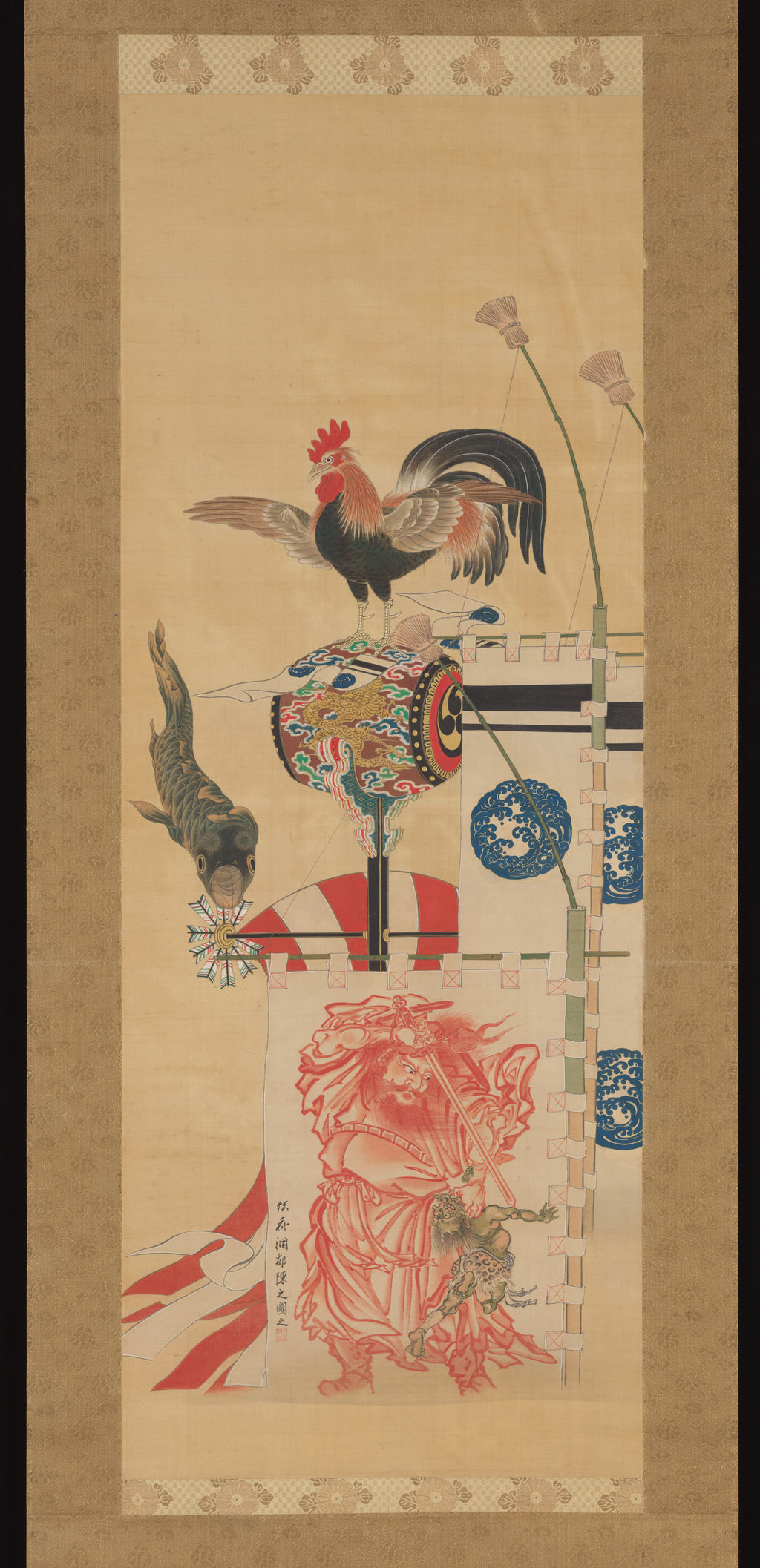
The Met's Boy's Day Carp Streamer and Shōki Banner is dated only “before 1870.” It therefore lies somewhere in this broad pre-arrest period without pinning down a year. The scroll combines a seasonal display with the demon-queller Shōki and a rooster. The museum describes it as ink and colour on silk, accession 2018.22. It is a reminder that wit and exaggeration could serve a household custom rather than an attack on authority. Seeing the work in a biography helps prevent the years before 1870 from becoming an empty waiting room for his celebrated punishment. The subject places him among inherited festivals, protective figures and clients who wanted paintings in a domestic setting. [10]
The chronology also describes family changes: marriages, bereavements and children. It records the birth of a daughter, Toyo, in the last month of 1867 by the Japanese lunar calendar. A later museum exhibition gives 1868–1935 for the painter subsequently known as Kawanabe Kyōsui; a late lunar-month birth falls in the following Gregorian year. The exhibition organised by Ichinomiya City Memorial Art Museum of Setsuko Migishi documents Kyōsui's later work and training with her father. This is an important corrective to a biography that names only male pupils or treats children as background detail. The daughter's professional life became part of the artistic inheritance, even while she developed her own subjects and studied with other teachers. Her later career belongs to a separate full page; here it establishes that teaching and image-making also happened within Kyōsai's family. [3] [11]
A dated tiger, a printed spectacle
The sixth month of 1860 gives a firm object anchor. The Met holds Kyōsai's woodblock sheet Never Seen Before: True Picture of a Live Wild Tiger, accession 2007.49.262. The spotted animal in the design and the forceful title invite questions about how unfamiliar creatures were pictured and sold as attractions. The compiled chronology connects a preface on the sheet with the writer Kanagaki Robun. Their later professional connection appears in its entries for books and satirical publications. Yet text, design, block carving and printing do not all become Kyōsai's solo work because his name appears as artist. A biography that includes the publisher and writer gives a more accurate view of how a printed image reached readers than one that imagines him alone before an easel. [12] [3]
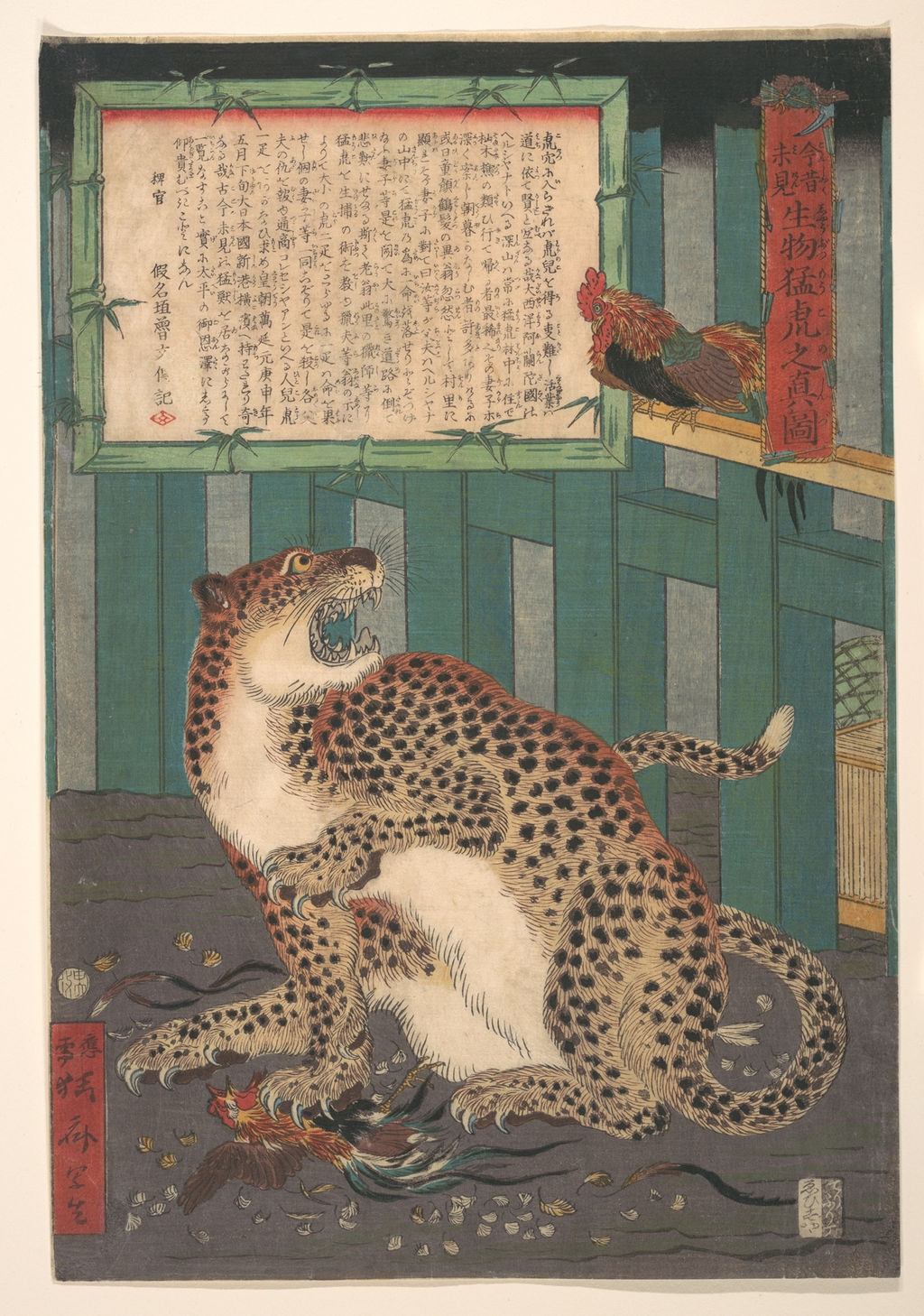
The 1860 print also challenges the artificial division of his working life at 1868. The Meiji Restoration changed the political environment, but the skills and relationships of print publication did not spring into existence afterwards. Satire, topical illustration and commercial commissions developed through older Edo channels as well as new Meiji outlets. The dated sheet gives us one piece of that continuity. It cannot establish the circulation size of every later publication, and the look of one impression cannot stand for all its printed variants. Still, it is a secure point on a long career that moved through illustrated books and periodicals as well as one-off paintings. [12] [3]
Arrest and the written change of name
The pivotal incident came in 1870. Suntory Museum of Art says Kyōsai was imprisoned after making a caricature at a gathering of painters and calligraphers; it reports that the picture was said to have offended powerful men. The Japanese chronology gives an October date by the lunar calendar and places his release in the first month of 1871. These sources justify saying that the arrest followed a picture at a gathering and that he was later released. They do not justify putting a single precise object, victim or spoken accusation into the scene without a primary record. Accounts that state he was punished for a particular insult to the emperor, with no identified document or print, go beyond what these sources directly establish. [4] [3]
He altered the first character of his art name from 狂斎 to 暁斎 while retaining the pronunciation Kyōsai. Suntory renders the first as “crazy studio” and the latter as “enlightened studio.” The chronology puts the change after release in 1871; Tsuruga City Museum likewise connects it to the arrest. Names therefore offer a dated trace of public identity rather than a simple proof that his temperament changed. He continued to make diverse and at times satirical work. The written shift may signal caution, self-presentation or a fresh beginning; its exact private motivation cannot be read from the characters alone. A separate biography must be careful when identifying works signed under different forms of the name, especially if a museum supplies a broad date range rather than an exact year. [4] [3] [13]
The arrest is often made to explain every later image as rebellion against the Meiji state. Suntory's English exhibition overview offers a more complex reading: affection for Edo culture helped fuel satire, and Kyōsai continued to see himself as a Kanō painter. The political change mattered, but it did not erase earlier loyalties or the demands of clients and publishers. A painting of Shōki, a festival print and an exhibition ink painting may have very different purposes even though the same man made them after a brush-related punishment. Keeping those differences open makes the incident meaningful without making it a universal key to his work. [4] [5]
Meiji exhibitions, travel and a network of visitors
The years following release are visible in several kinds of record. The compiled chronology says Kyōsai submitted a large banner to the 1873 Vienna World's Fair and worked at a series of painting gatherings. In 1876 it records the Nakamurarō event at Ryōgoku and a visit by Émile Guimet and Félix Régamey. These are useful waypoints, but a dated entry in a later chronology and a particular surviving object are not the same evidence. The Met's painting of Nakamurarō is dated circa 1876 and shows the gathering as a social scene; it does not prove that each person in the room can be named or that the painted moment was the chronicle's May session. The biography can place them in the same period without forcing an exact identity between text and image. [3] [6]
The visitors mattered as different kinds of participants. Guimet and Régamey came from France, while the British architect Josiah Conder later studied painting with Kyōsai. A short statement that “Westerners admired him” flattens encounter, sustained lessons, collecting and posthumous writing into one activity. It also makes Japanese pupils and patrons disappear. Suntory instead devotes a section of its exhibition to his network, using paintings transmitted in particular households and the illustrated diary to trace visitors and commissions. Each object can be an entry point into a relationship, but the relation needs a name and date when we claim to know it. [5] [14]
The gatherings also have an economic dimension. Kobe City Museum's 2026 exhibition account describes Kyōsai's skill in sekiga, pictures made before an audience, and his participation in shogakai, gatherings where guests requested painting and calligraphy. A finished scroll may therefore preserve the kind of performance in which a patron watched a brush move, rather than being the sole reason for the encounter. This makes the circa-1876 Nakamurarō image especially revealing without turning it into a photograph. Its figures speak to the social setting of production; they do not supply a contract, a guest list or the price of a particular sheet. Published prints, requested paintings and performances were overlapping ways of working. [25] [6]
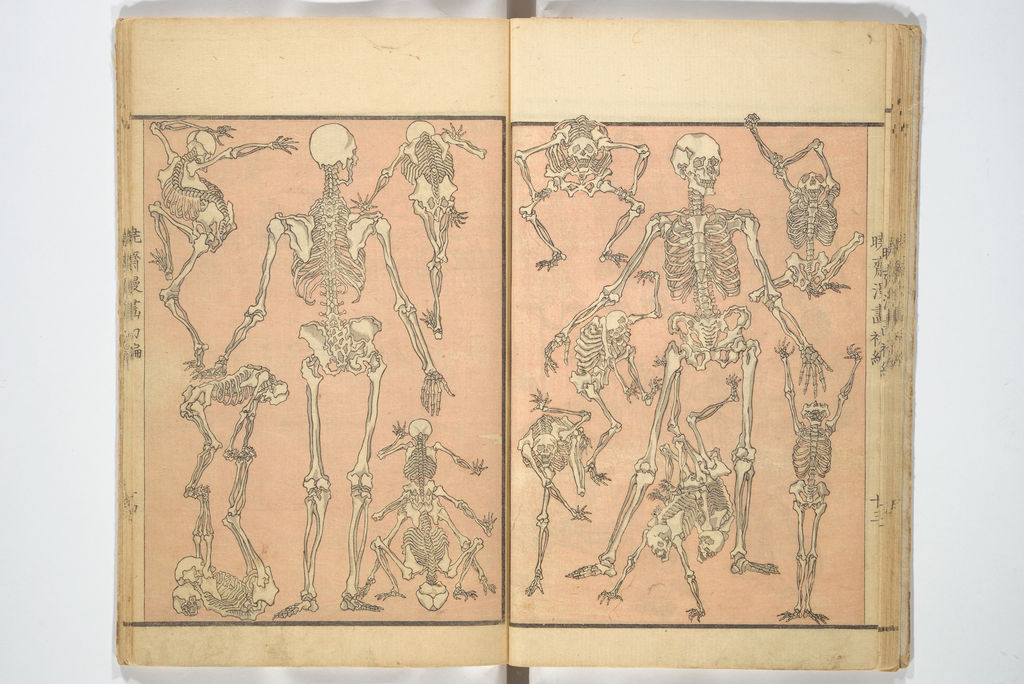
The 1881 Kyōsai Manga is an example of artistic production during these public years. The Met's copy, accession 2013.765, is a woodblock-printed book. It is not a diary of the Nakamurarō event and cannot be used to identify a guest in the scroll. It does show how designs could circulate beyond the room where a painter first demonstrated his brush. A hand-sized book invites repeated looking across pages and across copies. Its date is particularly useful because 1881 was also the year of an official prize, making the contrast between published designs and a celebrated exhibition painting visible within one period of his life. [15] [5]
The 1881 crow prize and Conder's lessons
Kyōsai's ink painting Dead Tree and Crow / 枯木寒鴉図 won a Myōgi second-class award at the Second National Industrial Exhibition in 1881. Suntory describes that rank as effectively the highest awarded in the painting section and contrasts the restrained crow with a vividly coloured flower-and-bird picture shown at the same time. The win was an official recognition of an already versatile artist, not the moment a comic draftsman discovered formal painting. The compiled chronology names a purchaser and price, but the award itself is better grounded in the museum's exhibition research. The painting must not be confused with the Met's undated woodblock print Crow Resting on Wood Trunk, JP3153. Sharing a crow and a tree does not make them the same work. [5] [3] [16]
Around this period the British architect Josiah Conder became his pupil. The chronology places Conder's entrance in 1881, and Suntory later describes their close relationship. Conder had arrived in Japan as a government-invited architect in 1877, according to Mitsubishi Ichigokan Museum, whose earlier building he designed. The pairing is not a simple tale of a Japanese artist teaching a foreign admirer how to imitate a few motifs. Conder learned through repeated meetings, collected or documented paintings, and decades later produced an English-language book on Kyōsai's work. The book was published after the teacher's death, so its descriptions belong to both eyewitness memory and early reception. Specific claims from its pages need a checked copy rather than a bibliography alone. [3] [5] [14] [17]
The Met's diary later supplies a more exact glimpse of instruction. Its curators say the February page in their album lacks a written year, but comparison with other surviving records identifies Conder lessons on 5, 12, 19 and 26 February 1888. Thus an art student's weekly visits are not inferred merely from a later admirer calling Kyōsai his teacher. They are tied to a record of appointments, albeit with the year reconstructed from related material. The distinction between the page's own marks and a curator's dating process is part of the evidence. It shows how working life can be recovered without pretending that every calendar entry is self-explanatory. [18]
Late mastery, books and the diary
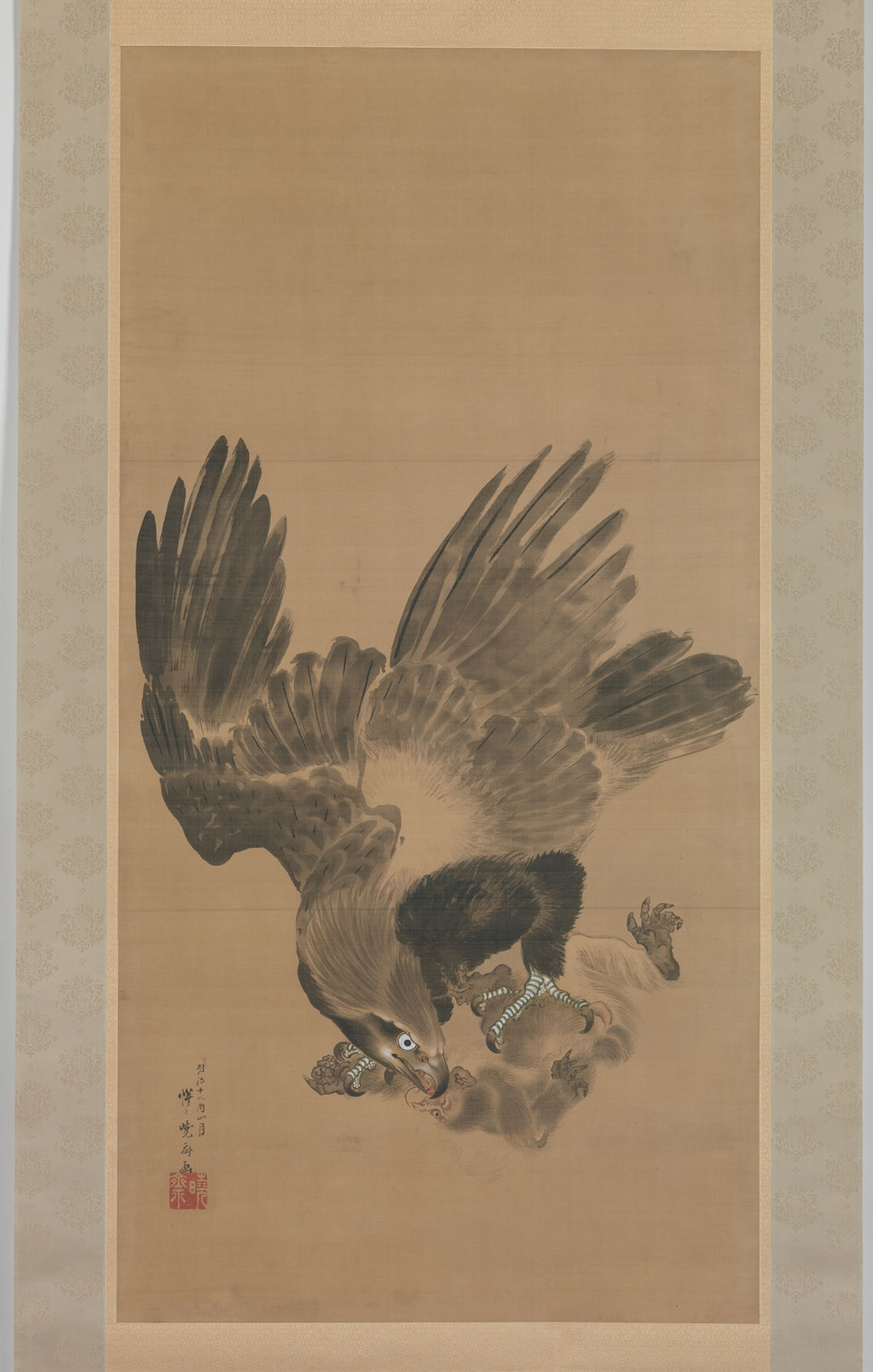
The 1885 Eagle Attacking a Monkey is one of four large eagle paintings held by the Met. In the full hanging scroll the bird plunges low against a wide upper field. The date and medium are firm: ink and colour on paper, accession 14.76.64a. The museum offers a politically charged interpretation of the raptors in the context of a changing nation. Suntory's chronology of continued Kanō affiliation keeps that interpretation open to debate. What the biography can say with confidence is that after decades of print work, painting gatherings, an arrest and an exhibition award, Kyōsai could still make an unusually large and carefully organised painted composition. The vigorous lower brushwork is not evidence of a lack of planning. [9] [5]
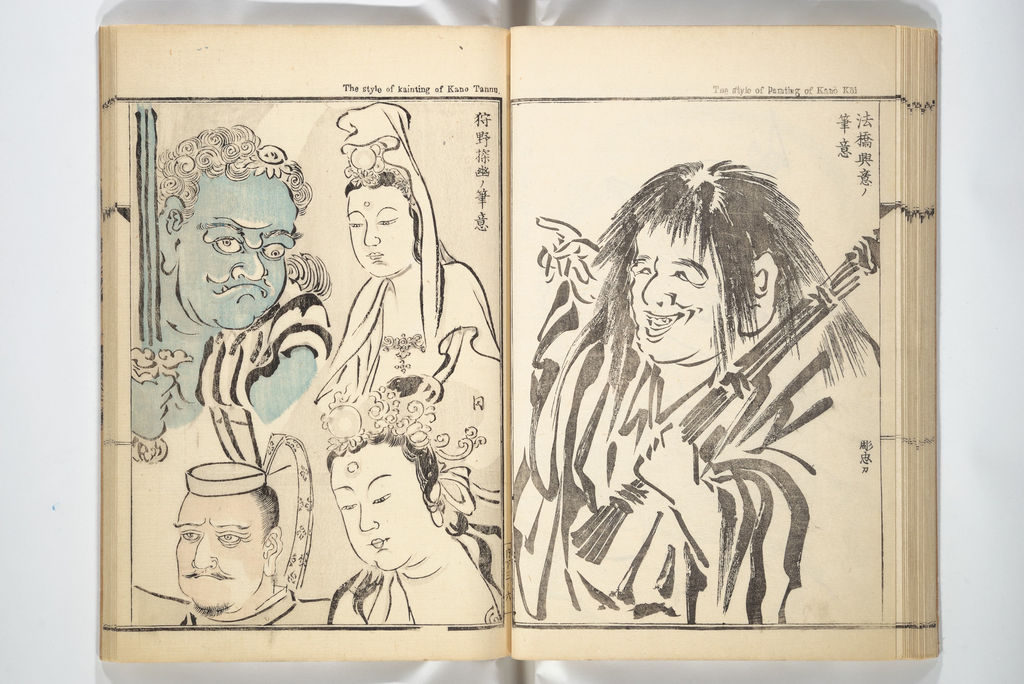
Two years later, the four-volume Kyōsai Gadan / 暁斎画談 appeared. Waseda University Library dates its edition to 1887 and identifies Kyōsai as illustrator under the Kanō name Tōiku, Uryū Masayoshi as editor or compiler and Iwamoto Shun as publisher. The British Museum describes a two-part structure, with reflections on painting and a biography by the pupil Baitei Gaso. The Met preserves a public-domain four-volume set. This was an intentionally organised publication, not an unmediated autobiography. Its inclusion of copies and comparisons with many earlier schools makes sense in light of the 1840s Kanō training and Kyōsai's continuing study. The collaborator names are necessary to understand how a life was told while the artist was still alive. [8] [19] [20]
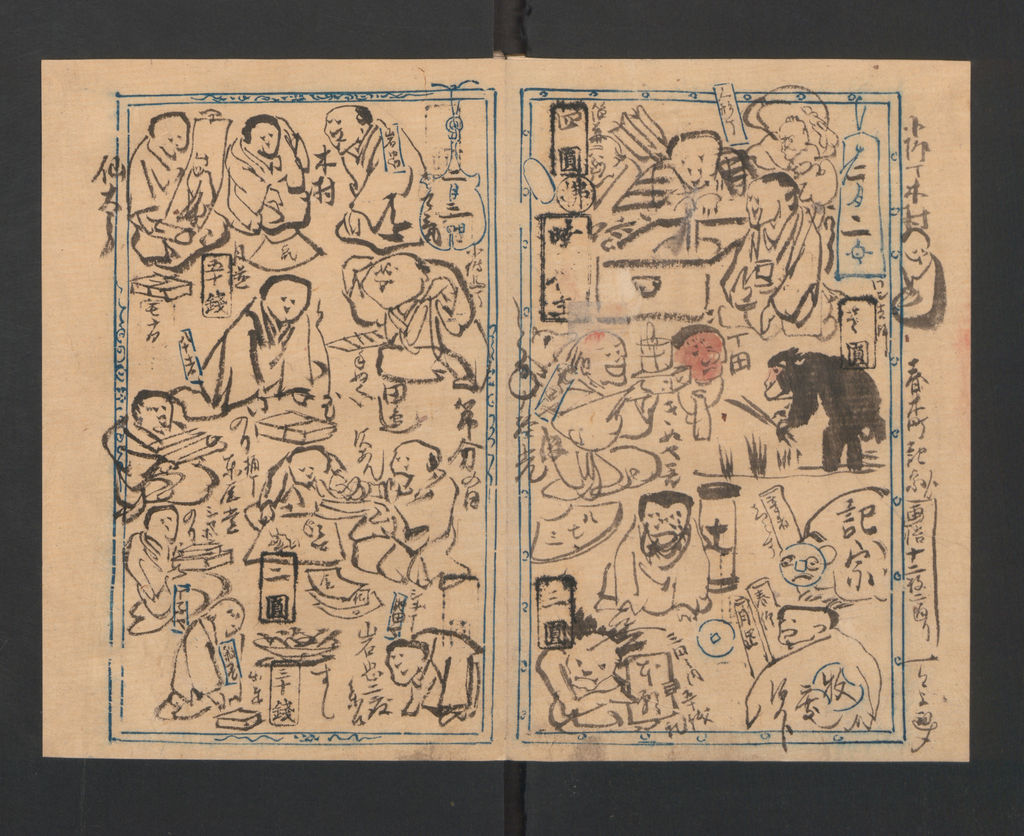
The illustrated diary is less grand but especially informative. The Met's JIB53 is an album of 29 leaves catalogued 1888. Its curators describe page frames and cartouches printed in blue by Kyōsai himself, followed by handwritten details and occasional stamps for recurring clients. The surviving page is a technology of organisation. It records meetings and work, not simply moods. A weekly Conder lesson could sit amid other obligations. Its small format also reminds us that a life may be visible through humble administrative marks as much as through a prize painting. The diary is a selection that survived; we should not presume it records every hour or commission of 1888. [18]
A silk album leaf of Monkeys bears a March 1888 date in the Met's record, accession 14.76.61.9. It belongs among many individually catalogued leaves with the parent number 14.76.61. Another leaf, Shakyamuni Subjugating Demons, circa 1888, was later mounted as a hanging scroll. Their subjects and later display histories differ, but both belong to the small-format side of the late career. Suntory highlights the care Kyōsai gave to intimate albums made for particular patrons. Counting these leaves as separate major commissions simply because a museum database gives each a line would exaggerate the scale and conceal the album's unity. Conversely, treating the whole album as a single image would hide the variety of its pages. [21] [22] [5]
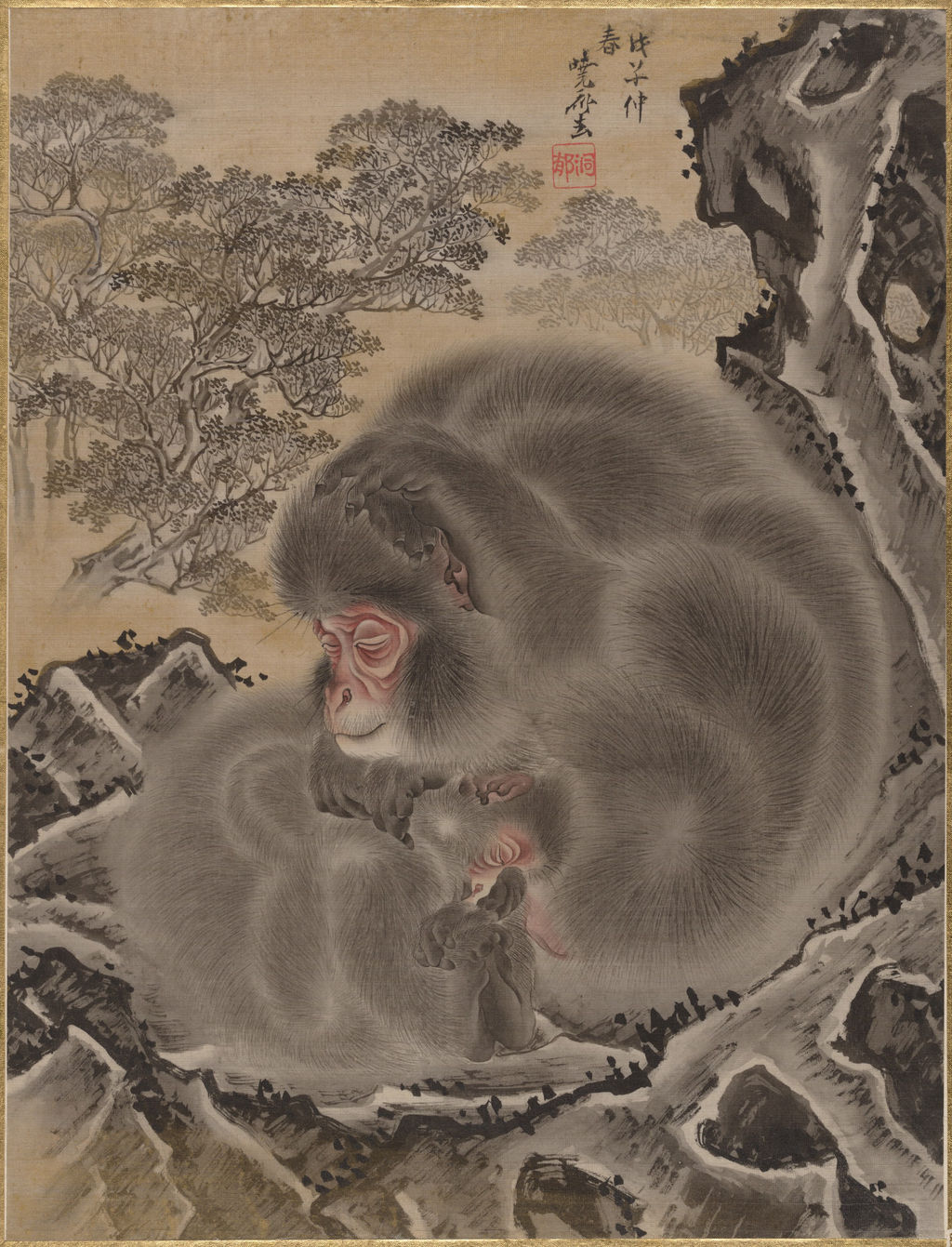
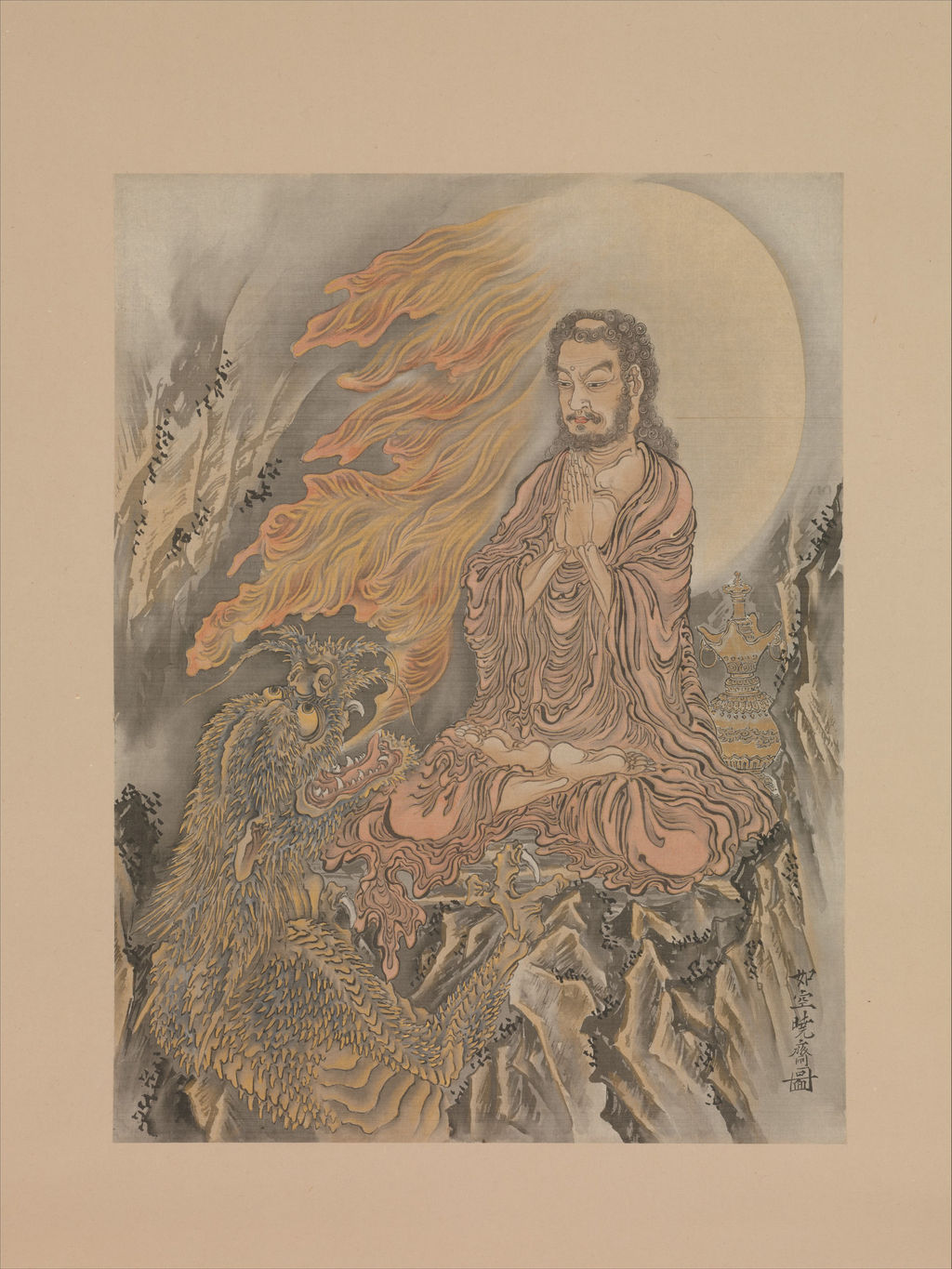
These small works and the diary belong to the same late life as the large eagles and the published Gadan. A chronological page could mistakenly imply that he moved neatly from one medium to another. In fact the dates overlap: a prize painting in 1881, printed Manga that year, large ink and colour scrolls in 1885, a four-volume book in 1887, and albums and records in 1888. The artist's work diversified through the period rather than proceeding up a ladder from commercial print to solemn painting. This pattern is clearest when exact surviving objects anchor the sequence. [15] [9] [8] [18]
Death, daughter and later memory
Kyōsai died on 26 April 1889. The date is supported by both the National Diet Library and Art Platform Japan; the compiled chronology describes his final illness and burial in Yanaka. Such details of the final days should be attributed to that later chronology rather than turned into a theatrical deathbed scene. His work continued to reach readers after death. The Met's 1890 copy of Hyakki Gadan, a book of ghostly imagery first issued posthumously, must not be dated as if Kyōsai personally drew a new picture in 1890. A publication date belongs to the book or impression; a design may have been made earlier. The distinction is essential when a nineteenth-century artist survives through printed editions. [1] [2] [3] [23]
His daughter Kyōsui continued to work as an artist. The Ichinomiya exhibition describes both training with her father and study with Yamana Tsurayoshi, through which she developed other pictorial resources. It records her later appointment as the first woman professor in the Japanese painting department of the private women's art school in 1902. That is her own professional history, not simply a footnote to her father's fame. The family memorial museum in Warabi now preserves material central to studying both artists and their circle. It is possible to follow their connection without giving Kyōsai credit for every later work made by his daughter. [11] [24]
A new view of a life also depends on what later collectors chose to keep together. Kobe City Museum presented roughly 110 works from the Israel Goldman collection in 2026, spanning paintings, handscrolls, screens, prints, printed books, preparatory drawings and diary material. The museum singles out early impressions of prints and books in fine condition as a strength of that collection. Those distinctions matter to biography: a preparatory sheet may show work before a public design, a diary can mark a meeting, and a well-preserved early impression may give more reliable evidence of a print's first appearance than a damaged or later copy. None of those objects alone discloses an inner motive, but together they widen the surviving record beyond the few famous paintings selected in older accounts. The exhibition's groupings—animals, people, demons and other subjects—also show how a career can be reorganised by themes long after the works were made. [25]
Conder's illustrated English book appeared in 1911, decades after Kyōsai died. The National Diet Library gives its descriptive title and details of photographic and colour plates, and Mitsubishi Ichigokan Museum explains its importance for an audience outside Japan. It is a valuable witness to what one close pupil chose to remember and collect, yet it is not the last word on the artist. Suntory's later exhibition returned to the Kanō training, wide study of old pictures and measured brushwork that a reputation for satire can obscure. Modern institutional catalogues also separate original paintings, print impressions, albums, copies and posthumous editions with greater precision. Reception is an ongoing series of choices about what to preserve and display. [17] [14] [5]
The Kyōsai artist homepage looks across those media rather than following the life year by year. This biography's dated anchors—Koga, Kuniyoshi, Kanō teachers, the 1860 print, the 1870 arrest, the 1881 prize, Conder, Gadan, the diary and 1889 death—show why no one episode owns the whole story. Some dates are fixed by museum objects, some come through later biographies, and some interpretations remain contested. The most useful way to read Kyōsai is to keep moving between what a painting visibly does, what an edition records and what witnesses later chose to say about its maker. [1] [5] [18]
Frequently Asked Questions
He was born in Koga, in present-day Ibaraki Prefecture. The National Diet Library and Art Platform Japan give 18 May 1831 in the modern calendar. A Japanese chronology records the equivalent lunar date, the seventh day of the fourth month of Tenpō 2. [1] [2] [3]
Following imprisonment after a drawing at a painting gathering in 1870, he changed the first character from 狂 to 暁 while retaining the pronunciation Kyōsai. Sources support the sequence; the precise private intention behind the change cannot be established from the written form alone. [4] [3]
No. The award was for the ink painting Dead Tree and Crow / 枯木寒鴉図. The Met's JP3153, Crow Resting on Wood Trunk, is an undated woodblock print. [5] [16]
Discussion
Compare the chronology, diary, prints and paintings. Which events can each object establish?
Reader Insights
Why can Kyōsui’s birth appear under two different years?
What does the Nakamurarō scroll show, and which guests remain unidentified?
Check the medium and object records before equating the prize painting with the print.
Join the Conversation
Share a documented example or a reliable source below, keeping observation separate from inference.
References
- National Diet Library, “Kawanabe Kyōsai” in Portraits of Modern Japanese Historical Figures, dates and concise biography.
- Art Platform Japan, Kawanabe Kyōsai authority record, birth name, place and life dates.
- Kawanabe Kyōsai research community, compiled chronology / 暁斎略年譜, Yamaguchi Junko; pre-1872 dates lunar; based on later biography and exhibition catalogues.
- Suntory Museum of Art, Kawanabe Kyosai: Nothing Escaped His Brush, English exhibition overview, 2019.
- Suntory Museum of Art, 河鍋暁斎 その手に描けぬものなし, exhibition sections, 2019.
- Metropolitan Museum of Art, Painting and Calligraphy Gathering at the Nakamurarō in Ryōgoku, c.1876, 2023.583.34.
- British Museum, Kawanabe Kyōsai artist authority, painters and printmaker training sequence.
- Metropolitan Museum of Art, Kyōsai Gadan / 暁斎画談, 1887, 2013.764a–d.
- Metropolitan Museum of Art, Eagle Attacking a Monkey, 1885, 14.76.64a.
- Metropolitan Museum of Art, Boy's Day Carp Streamer and Shōki Banner, before 1870, 2018.22.
- National Art Center, Tokyo / Ichinomiya City Memorial Art Museum, Kyōsui Kawanabe exhibition record, 2022.
- Metropolitan Museum of Art, Never Seen Before: True Picture of a Live Wild Tiger, sixth month 1860, 2007.49.262.
- Tsuruga City Museum, Kawanabe Kyōsai artist record, teachers and art-name change.
- Mitsubishi Ichigokan Museum, Kyōsai: Master Painter and His Student Josiah Conder, 2015 publication.
- Metropolitan Museum of Art, Kyōsai Manga / 暁斎漫画, 1881, 2013.765.
- Metropolitan Museum of Art, Crow Resting on Wood Trunk, undated woodblock print, JP3153.
- National Diet Library, Josiah Conder, Paintings and Studies by Kawanabé Kyōsai, 1911 bibliographic record.
- Metropolitan Museum of Art, Illustrated Diary / 暁斎絵日記, JIB53, album and comparative dating essay.
- Waseda University Library, Kyōsai Gadan bibliographic record, 1887, four volumes.
- British Museum, Kyōsai Gadan, volume two, 1979,0305,0.390.2; two-part contents and publication context.
- Metropolitan Museum of Art, Monkeys, March 1888, album leaf 14.76.61.9.
- Metropolitan Museum of Art, Shakyamuni Subjugating Demons, c.1888, album leaf later mounted, 14.76.61.51.
- Metropolitan Museum of Art, Kyōsai Hyakki Gadan, 1890 copy of posthumous publication.
- Warabi City, Kawanabe Kyōsai Memorial Museum and collection history.
- Kobe City Museum, The World of Kawanabe Kyōsai: The Goldman Collection / ゴールドマン コレクション 河鍋暁斎の世界, exhibition account, 2026.