


 by Tom Gurney
Tom Gurney BSc (Hons) is an art history expert with over 20 years experience
Published on June 19, 2020 / Updated on September 23, 2026
Email: tomgurney1@gmail.com / Phone: +44 7429 011000
An artist who made different kinds of pictures
Kawanabe Kyōsai (河鍋暁斎, 1831–1889) could make a bird almost disappear into a few washes of ink, crowd demons across a page, or fill a towering scroll with a violent struggle between an eagle and a monkey. He designed woodblock prints and books as well as making paintings and drawings. The range is the point. A quick description of him as a comic or “eccentric” artist can be an invitation to look, but it will not explain why a large formal painting, a provisional drawing and a printed book ask to be viewed in different ways. The British Museum identifies him as both painter and print artist, with early ukiyo-e and Kanō training. Suntory Museum of Art's 2019 exhibition deliberately brought patient ink and colour paintings into the same account as his improvisations and humour. [1] [2]
Read Kawanabe Kyōsai’s biography.
Contents
- An artist who made different kinds of pictures
- The crowded life of a single sheet
- Formal learning and familiar festivals
- A gathering made visible
- Demons first drawn, then published
- Crows, awards and the danger of a familiar title
- Kyōsai's account of painting and its readers
- Small albums and a working diary
- What a label such as “comic” can conceal
- How Kyōsai became visible beyond Japan
- How to continue looking
- Books on Japanese Art
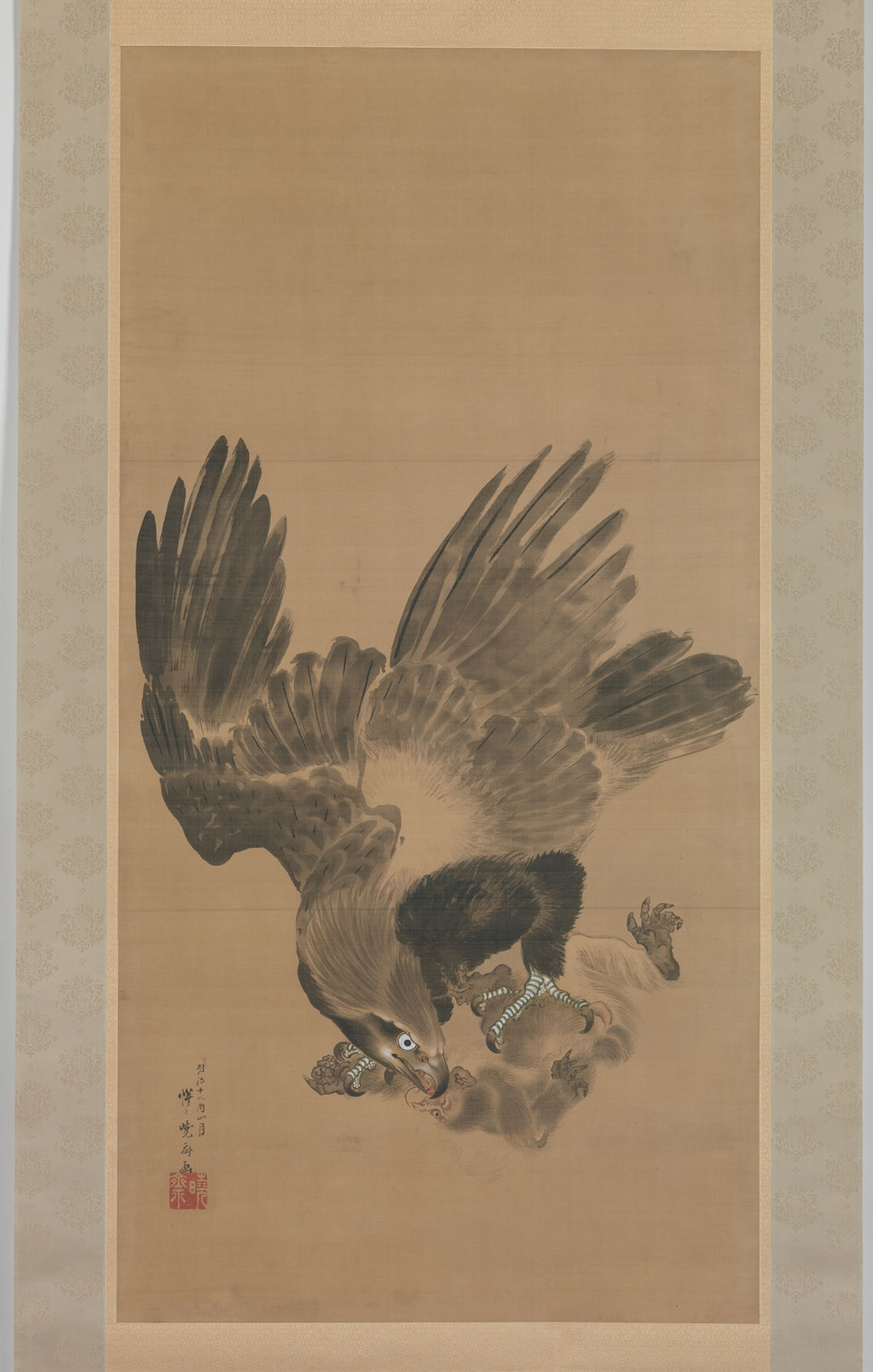
The 1885 hanging scroll Eagle Attacking a Monkey makes a forceful opening image. At the bottom of a tall field, a raptor drives down onto its prey. Its wings are extended, but an unusually broad area of pale paper remains above. That unoccupied space gives the downward rush somewhere to happen. The Metropolitan Museum of Art records this as one of four large eagle paintings, accession 14.76.64a. It is ink and colour on paper, with an image measuring 166.4 by 83.5 centimetres. Reducing it to an article column changes its physical command; cropping off the upper paper to make a wide banner would change the composition itself. [3]
Kyōsai at a glance
- Years1831–1889
- CentreEdo / Tokyo
- FormsHanging scrolls, prints, books, albums and drawings
- TrainingUtagawa Kuniyoshi and Surugadai Kanō painters
The Met reads those eagles in relation to Japan's changing national position in the 1880s and sees their energetic brushwork as a departure from a classical Kanō aesthetic. The painting certainly permits a reading of power and menace. Yet that interpretation should remain visibly the museum's interpretation rather than a fact concealed in a caption. Suntory's account notes that Kyōsai's formal Kanō relationships continued as late as 1884. A late, forceful painting can therefore carry lessons from the school even when it bends them toward another effect. The disagreement is useful for a reader: look first at the actual brush marks, scale and arrangement, then ask how far the political story follows from the object. [3] [2]
Kyōsai lived through the last decades of Edo government and the Meiji transformation, but he did not simply replace an “old” style with a “new” one. His subjects cross devotional imagery, festival custom, theatrical performance, animals, satire and classical examples. A single exhibition wall might hang these together under his name. On a website, where objects tend to appear at the same display width, their differing sizes and materials need particular care. The compact 1881 printed Kyōsai Manga and the monumental eagle are not equivalent canvases. Their reproductions may be equally sharp, yet their original handling and audience were different. [2] [4]
The crowded life of a single sheet
A dated print gives an early test of the artist's ingenuity. The Met calls its 1860 sheet Never Seen Before: True Picture of a Live Wild Tiger—Konjaku miken, ikimono mōko no shinzu—and dates it to the sixth month of that year. The animal in the picture is spotted. Rather than quietly changing the catalogue's title to a modern zoological label, the caption should allow viewers to notice how a nineteenth-century spectacle was named and pictured. The sheet is a woodblock print in ink and colour on paper, not an eyewitness oil portrait of an animal in a landscape. The Japanese Kyōsai chronology connects the design with a preface by the writer Kanagaki Robun, a reminder that such a print might reach its public through the combined work of image, text, publisher, carver and printer. The precise printed words need a legible transcription before they can be paraphrased. [5] [6]
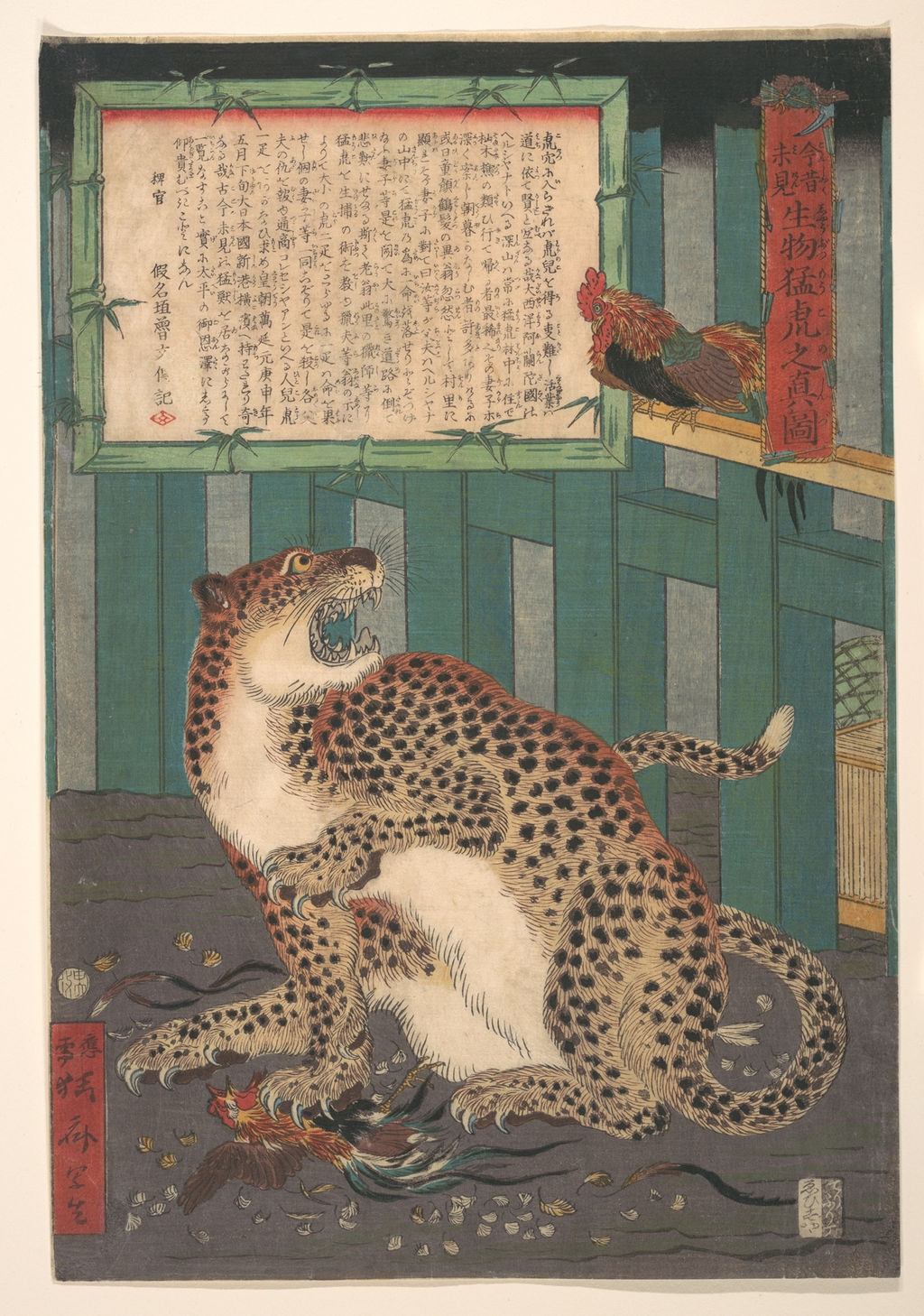
The difference between painting and print is practical, not a test of artistic seriousness. A drawn design could pass into a carved block and be printed in more than one impression; its colours, registration and paper might vary from another surviving impression. The Met's object number identifies the particular sheet shown here. If a future page compares it with a copy elsewhere, it must record the other institution, accession and any difference in printing or state. This is especially important for a claim about what “Kyōsai's tiger” looked like: a photograph of one impression is evidence for that impression, not an invisible master image shared by every print. [5]
The sheet also explains why his career cannot be held in a simple Edo-versus-Meiji frame. It was made before the 1868 regime change, yet the desire to picture a novel animal, create a striking headline and attach written commentary belongs to the lively print culture that continued to shape his later work. What changed after 1868 was the environment of exhibition, publication, patronage and public debate around him. In the artist-home page, the print works as a dated object against which to compare both earlier training and later production. The biography will take the political circumstances and his 1870 arrest in their own dated sequence, with the difference between contemporary records and later anecdotes made clear. [6]
Formal learning and familiar festivals
Kyōsai's first instruction in Kuniyoshi's ukiyo-e workshop and later work with the Kanō painters Maemura Tōwa and Tōhaku Chinshin are not competing origin stories. The British Museum records the sequence, while Suntory places special weight on the Kanō discipline of brushwork, composition and copying earlier paintings. The Japanese chronology dates the award of his professional Kanō name, Tōiku Noriyuki, to 1849. That does not mean everything he made afterwards looks like a school exercise. It does explain why a painter admired for swift invention could also structure a large scroll, carry an inherited religious subject, and return to older pictorial models late in life. [1] [2] [6]
The Met's Boy's Day Carp Streamer and Shōki Banner is a hanging scroll of ink and colour on silk, dated only “before 1870.” Its subject belongs to the fifth day of the fifth month, when families displayed carp streamers and pictures of the demon-queller Shōki. The museum interprets the red figure as a protective image against disease and identifies the rooster with honesty and fortitude. Such a work can have play and exaggeration without being detached from household ritual. Its format also differs from a festival print: the vertically mounted silk invites attention to how motifs are grouped in one hanging object. Assigning it a precise 1860s year would be more specific than the catalogue permits. [7]
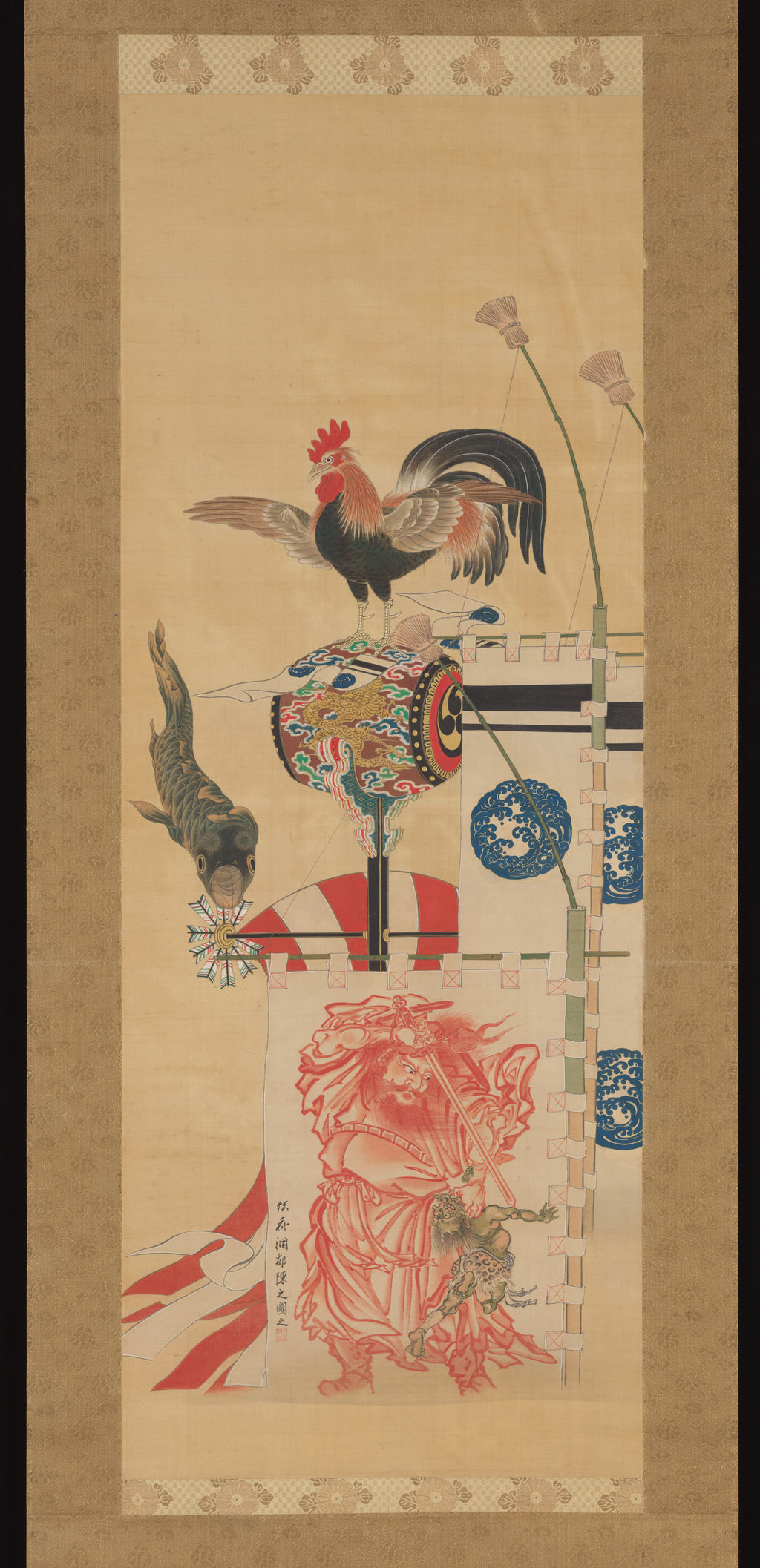
The Shōki figure also makes the range of the artist's supernatural subjects clearer. A demon is not always simply a joke, and a figure who pursues demons may be an object of protection. Kyōsai could exaggerate a face, make a frightening creature dance, or place a sacred figure in a moment of command. The subject, material and intended setting affect what kind of response an image asks of us. Suntory's curators make this a central theme in their section on boundaries between sacred and profane, beautiful and grotesque. Their exhibition examples include privately held or restricted photographs, so the page's illustrations remain tied to our separately cleared Met objects. [2] [7]
A gathering made visible
The Met's Painting and Calligraphy Gathering at the Nakamurarō in Ryōgoku offers a rare view of an event as subject. The museum dates the hanging scroll circa 1876, not to an exact day. Kyōsai's compiled chronology records that he made pictures at a Nakamurarō gathering on 21 May 1876. The two pieces of evidence belong beside one another, but the approximate object date does not alone prove that the painted scene captures precisely that session or identify every person present. In the picture, a room full of participants makes art look social and public. It gives a different sense of production from the isolated image of a brush meeting paper. [8] [6]
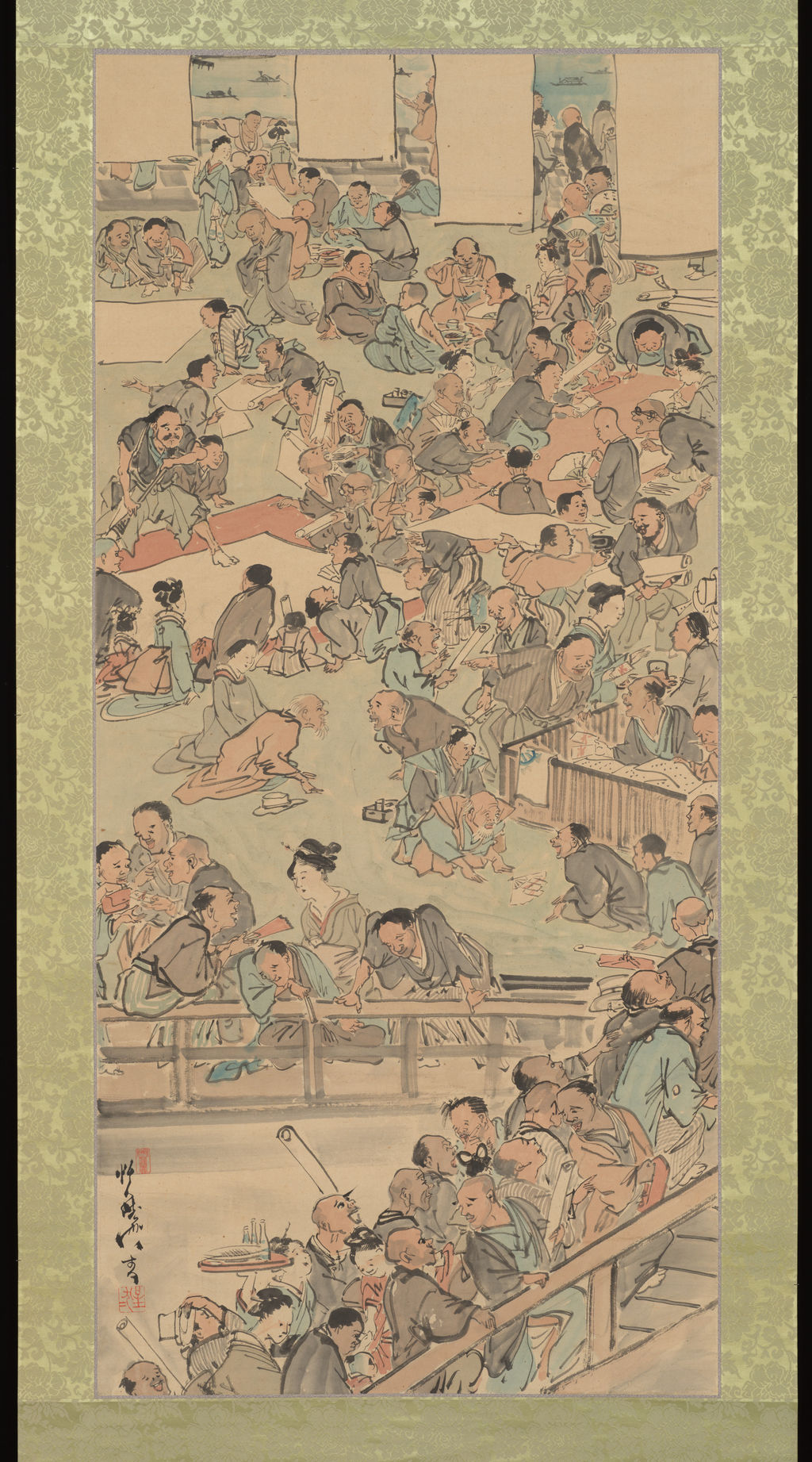
Suntory discusses Kyōsai's sekiga, improvised paintings made at banquets and similar gatherings. Their speed and apparent effortlessness contributed to the image of a master who could draw anything at once. The same exhibition warns against letting that reputation obscure works patiently planned and made with controlled ink or elaborate colour. The contrast does not make one kind of practice more authentic. A public performance could show command of line, while a large scroll required choices that a performer might make look effortless only after years of training. The gathering painting is an especially good hinge for this page because it shows the environment in which images could be produced, displayed, discussed and acquired. [2]
Ryōgoku was a place, not merely a label in a painting title. The district's river and bridges formed a recognisable part of Edo and Tokyo's urban life, while the Met painting takes us indoors to an event centred on brushwork. A later photograph of a bridge or bank would help locate the district but could not record the interior of Nakamurarō in 1876. That difference in time and viewpoint is worth keeping in mind even without a photograph beside the scroll. It prevents a view of an entire neighbourhood from standing in for one documented painting. [8]
The painting also points to people whose names are often lost when an image is reduced to “a Kyōsai.” The painter worked among writers, publishers, collectors, pupils, clients and guests. His diary later records recurring visits and commissions; its page frames and stamps give a material trace of administration as well as sociability. The biography can identify individual relationships from dated evidence, rather than treating everyone at a gathering as a generic audience. Here the image invites a simpler first question: how does a picture of a collective room change the way we imagine the creation of a supposedly solitary masterpiece? [8] [9]
Demons first drawn, then published
The Met's Preliminary Drawings of Demons, a late nineteenth-century wash drawing, gives access to a less finished stage. Its curators say the sketches appear to have been made in preparation for an illustrated book. That cautious verb matters. Without a named final publication and a matching block or plate, the sheet cannot be captioned as a proof of a particular printed page. Its former owner was Kyōsai's pupil Mano Kyōtei, which gives the drawing a documented later path from studio material into a collection. A web article can place the drawing next to a published book while preserving the difference between a possible preparatory study and an identified edition. [10]
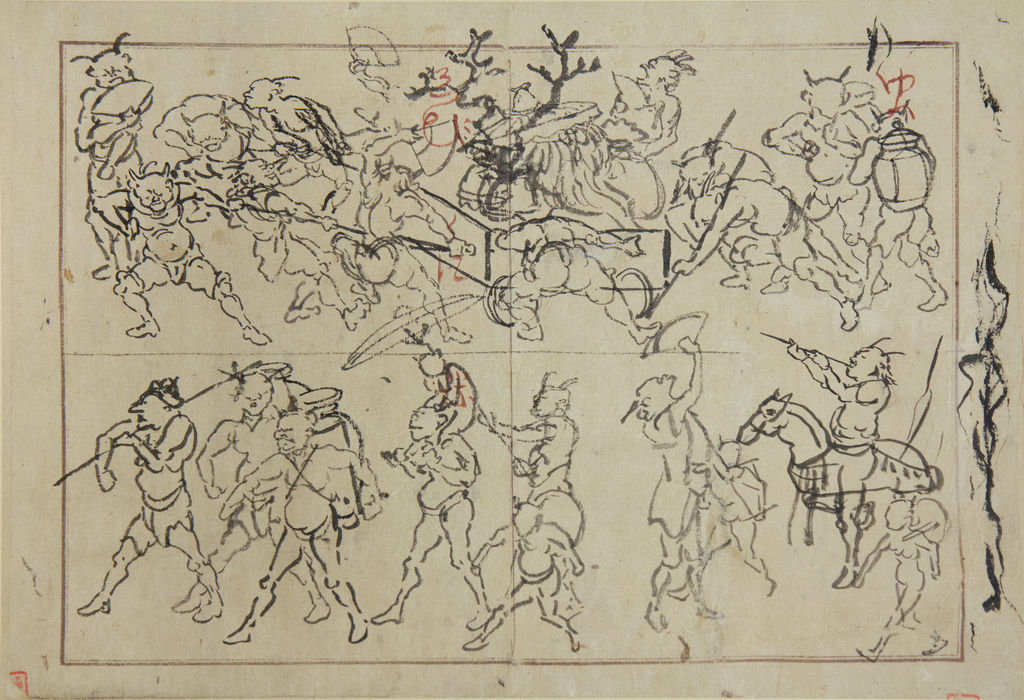
The small drawing allows a reader to look for hesitations, repetitions and instructions that a cleaned-up printed line might suppress. Its marks have different weights; bodies and faces are tested in an available field rather than installed into a completed narrative setting. Those observations are about the visible Met sheet. Whether Kyōsai intended each figure for one future book, or reused ideas across works, remains a separate historical question. A popup detail should return the enlarged part to the whole sheet and identify its position, so a magnified face does not masquerade as an independent painting. [10]
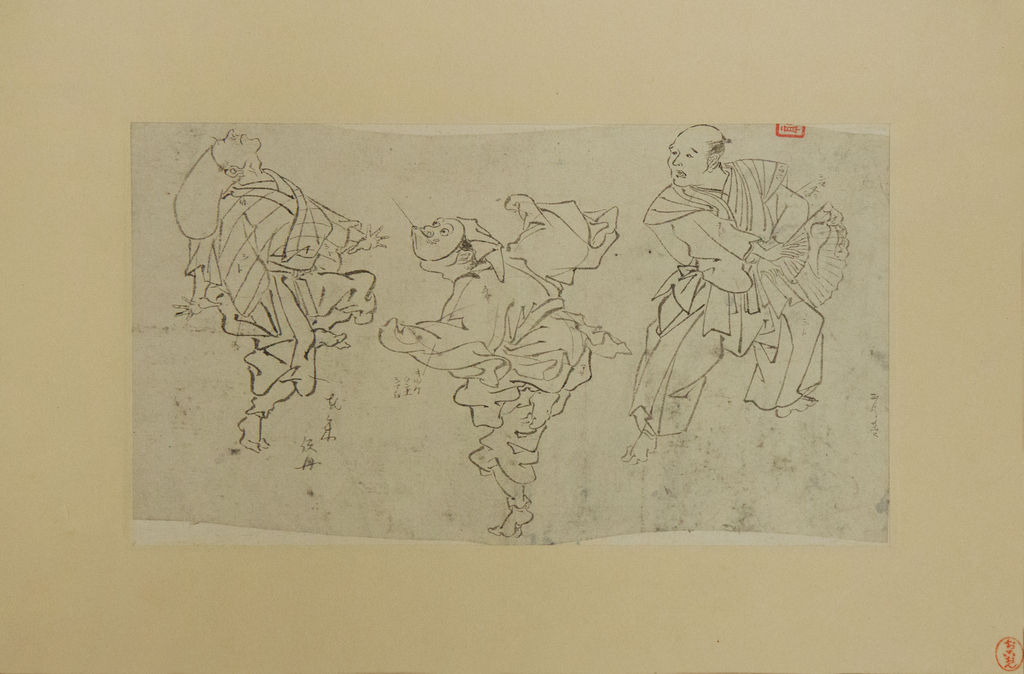
Another preliminary drawing, Three Kyōgen Dancers, makes the importance of notes even more explicit. The Met says the annotations are in Kyōsai's hand and give instructions for colouring or finishing the figures. The partial seal at the top right belongs to Mano Kyōtei. It appears to be preparation for a painting of a comic dramatic performance; the finished painting has not been identified by this object record. Kyōgen is a performed art, so the sketched gestures may invite a viewer to think about movement and rhythm, yet these are marks on a sheet, not a photograph of a stage. The sheet's modest 15.2 by 26 centimetres is worth stating if a digital enlargement makes the figures seem mural-sized. [11]
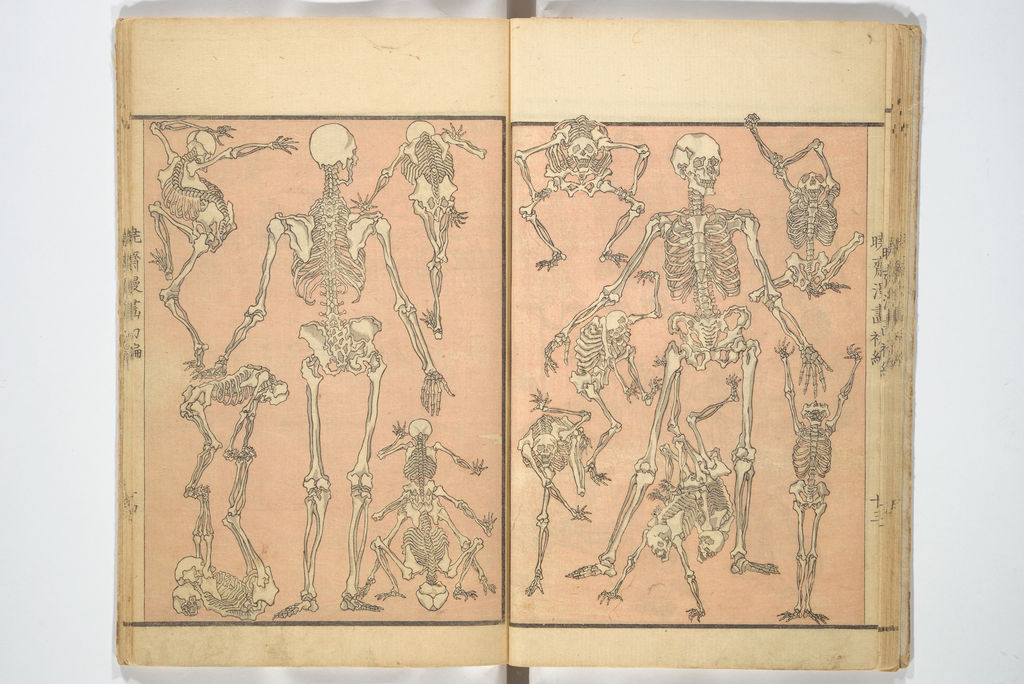
The Met's 1881 Kyōsai Manga then presents a different kind of page. It is a woodblock-printed book, accession 2013.765, about 22.3 by 15 centimetres. Its digital record offers many photographed openings, which are more informative than a single cover image. The primary photograph chosen for this article is one opening of this specific Met copy. The book title's word manga should be understood in the context of a nineteenth-century collection of sketches and picture ideas; it does not make the 1881 volume a modern serialized comic. Turning a book page into a full-width article figure also conceals the hand-sized scale and the sequence of turning leaves. The caption needs to restore both. [4]
Placing these drawings beside a book opening raises a tempting but unsupported before-and-after story. No proven one-to-one relationship has been found between the selected demon drawing and the selected opening of Kyōsai Manga. What can be compared is the difference between ink on a unique sheet and ink transferred through a carved block. A drawing may expose a trial of expression; a printed opening is designed to be encountered amid other pages. The book's sequence, the carver's work and the quality of this impression enter the experience. A matching study would be needed to connect any one demon to a particular final printed figure. [10] [4]
Crows, awards and the danger of a familiar title
One of Kyōsai's best-known paintings is Dead Tree and Crow / 枯木寒鴉図. Suntory records that it won the 妙技二等賞牌 at the Second National Industrial Exhibition in 1881 and identifies its owner as Eitarō. Its curators contrast the controlled ink work with a colourful bird-and-flower painting exhibited at the same time. The award therefore belongs to an artistic range, not to a story that an irreverent draftsman suddenly found a “serious” voice. No image of that particular painting appears here: the crow reproduced below belongs to a different object and medium. [2] [6]
The Met does hold Crow Resting on Wood Trunk, accession JP3153. Its catalogue describes a woodblock print and gives no date. A crow and a tree trunk are not enough to equate this sheet with the 1881 prize painting; neither the medium nor the accession matches. It is still a useful artwork for this home page, because it lets readers see how a related bird subject could circulate in print. The caption must use the Met's own title, medium and open-ended date, followed by a short note separating it from the award-winning painted scroll. If an object comparison is eventually made, the difference must be demonstrated through images of both exact objects and documented design histories. [12] [2]
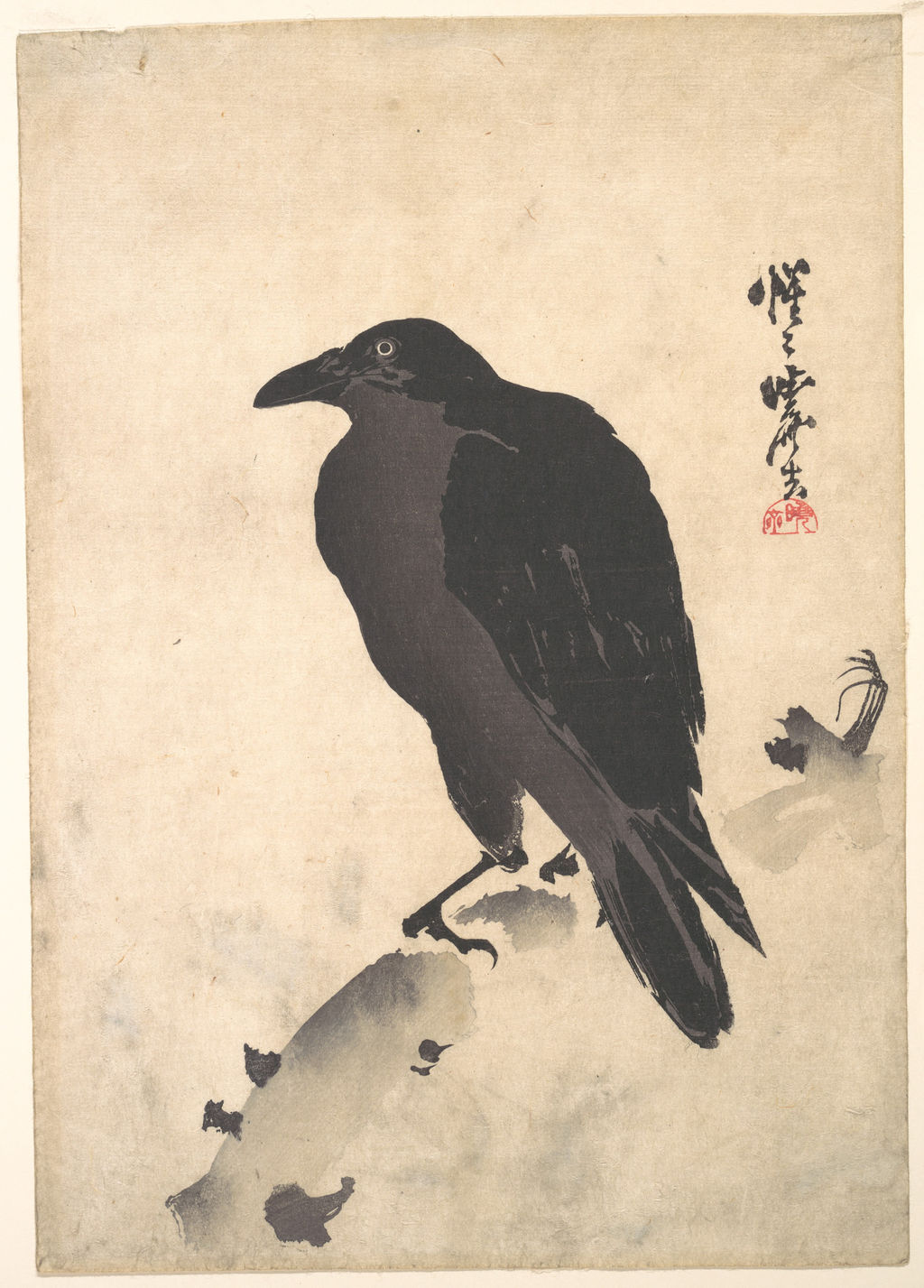
The case illustrates a wider editorial problem for Japanese print pages. Many works share birds, actors, demons, place names or a translated title. Search results can lead from a prestigious painting to a readily downloadable but different print. A website may then attach the painting's date, story and award to the print because the image looks plausible at thumbnail size. The solution is concrete rather than bureaucratic: every figure here retains the holder, accession, title, medium and date wording. Those details let a reader follow the image back to a record and see what, exactly, the caption claims. [12] [2]
Kyōsai's account of painting and its readers
The four-volume Kyōsai Gadan / 暁斎画談 appeared in 1887. The Met catalogues its set as woodblock-printed books in ink and colour, accession 2013.764a–d. Waseda University Library's bibliography names Kyōsai under his Kanō name 河鍋洞郁 for the illustrations, 瓜生政和 as editor or compiler, Iwamoto Shun as publisher and 1887 as the publication year. The British Museum describes a two-part structure: reflections on painting and a biography of the artist by his pupil Baitei Gaso. Calling it simply “Kyōsai's autobiography” would erase the people and formats through which his account was assembled. It is both a source on how he was presented late in life and a designed printed object in its own right. [13] [14] [15]
Suntory draws attention to the many earlier masters whose styles appear in Gadan: Song and Yuan painters, Sesshū, successive Kanō artists, the Tosa school, Kōrin, Ōkyo, Harunobu and Utamaro. Such a list is not evidence that Kyōsai merely collected quotations. Copying could be study, comparison and a way of demonstrating command of a brush language. The Met's retained primary photograph for its Gadan set shows an opening with English headings naming the styles of Kanō Tan'yū and Kanō Kōi. Figures on the facing pages are differentiated by line, wash and printed colour. The photographed opening is a fragment of four volumes; without an exact volume and folio identification it should not be assigned a page number or treated as the entire book's argument. [2] [13]
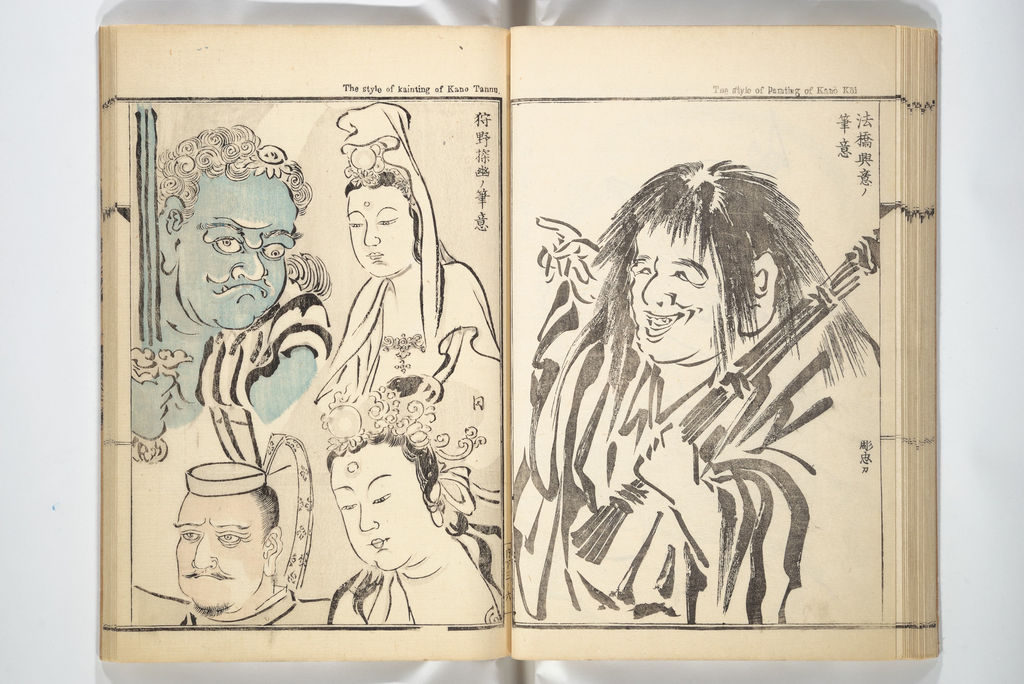
The presence of English labels is especially revealing without requiring an invented claim about exactly who read a particular copy. The book was published in a period of growing foreign engagement with Japanese art, and its design makes at least some of its comparisons accessible beyond Japanese-only readers. The British Museum notes a Japanese and English synopsis in its copy. Waseda's record confirms a Japanese publishing network and four-volume material form. Together these sources show how the book can be used responsibly: compare the words and pictures of a specific edition, distinguish artist, editor, writer, block printer and publisher, and ask how its contents positioned Kyōsai among past schools. A future Gadan page needs those folio-level checks before it can claim to explain the complete work. [15] [14]
Small albums and a working diary
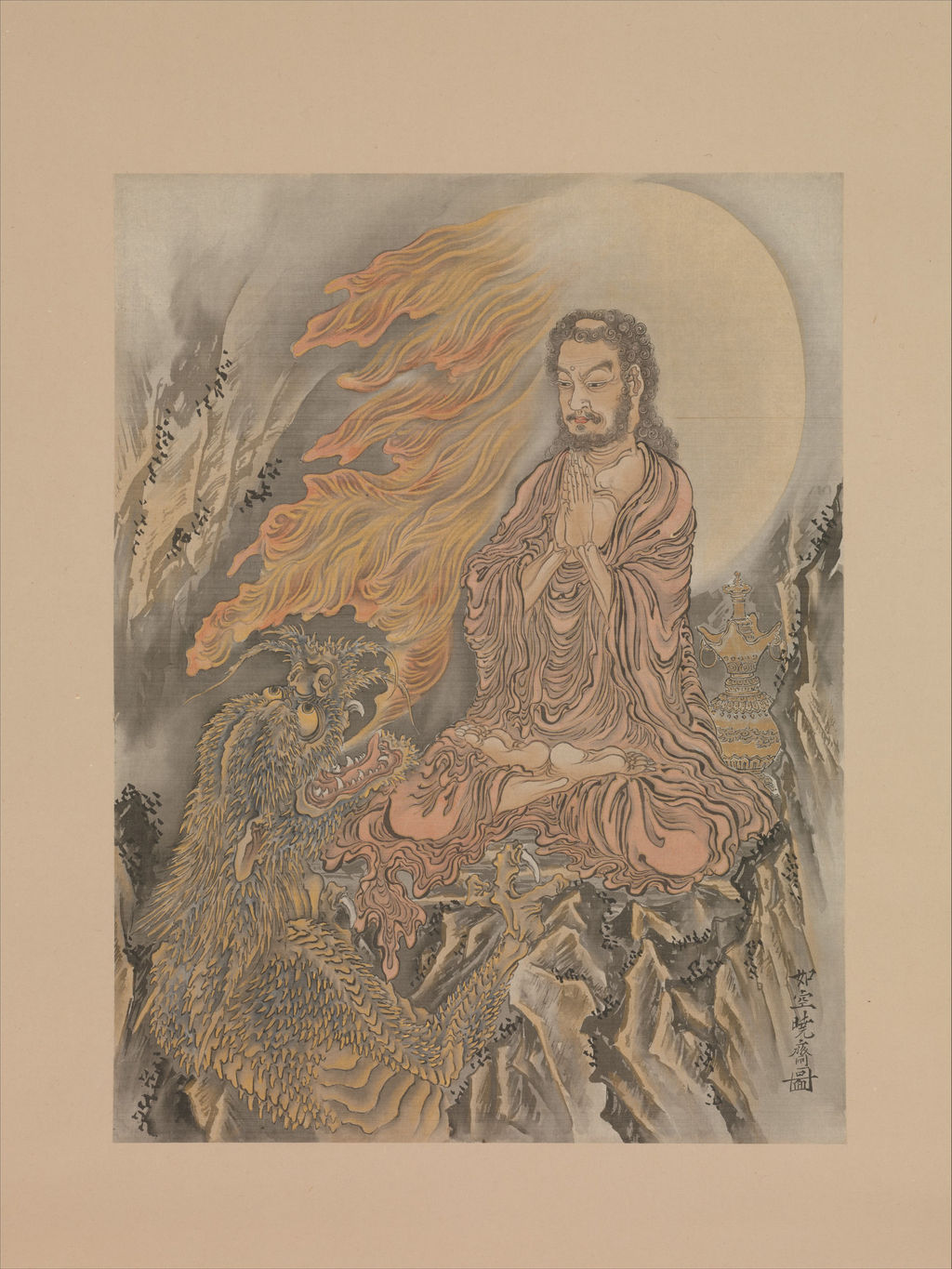
Not all late works were made for exhibition walls. The Met catalogues Shakyamuni Subjugating Demons, circa 1888, as an album leaf later mounted as a hanging scroll. The order of those formats matters. A leaf originally encountered within an album could later be shown as an isolated vertical image; the later mount changes its presentation without changing the painting's authorship. Suntory's exhibition similarly highlights small albums made for particular patrons, where careful colour and detail rewarded close handling. Such objects complicate any account that identifies Kyōsai only with large public spectacles or rapid sekiga. [16] [2]
The Met's Illustrated Diary / 暁斎絵日記, accession JIB53, is another small object: an album of 29 leaves measuring about 22.5 by 14.9 centimetres. Its curator explains that Kyōsai printed repeated page frames and a cartouche in blue, then wrote details in ink and sometimes used stamps for recurring clients. The museum dates its example to 1888, while noting that the photographed February page itself does not give a year. The identification rests on comparison with other surviving records of February 1888, including lessons given to the architect Josiah Conder. That is a stronger and more interesting account than pretending every mark on a page spells out its modern catalogue date. [9]
The diary pulls a reader out of the myth of ceaseless inspiration. Appointments, commissions and visits needed remembering and organising. In Suntory's account, the surviving diary material shows cultural figures visiting the artist repeatedly, adding detail to a network known also through pictures and later writing. Conder, a British architect working in Japan, was one of Kyōsai's pupils. He later published an English-language study of his teacher's works. The 1911 book is verified as a publication by the National Diet Library and Mitsubishi Ichigokan Museum; until specific pages are inspected, it is evidence for early international reception and a bibliographic route, not a source from which this article may invent quotations about Kyōsai's technique. [2] [9] [17] [18]
The album and diary also teach a useful visual habit: check whether a photographed page belongs to a sequence. One Met accession beginning 14.76.61 contains numerous separately catalogued album leaves. A page of monkeys dated March 1888 and the leaf of Shakyamuni are different designs within that group, not two independent large commissions. The diary has its own 29-leaf sequence. A thumbnail grid can be valuable for browsing, but it should group works by their parent album and state which leaf is reproduced. It should not make a collector's assembled album look like dozens of unrelated exhibitions. [16] [19] [9]
What a label such as “comic” can conceal
The description “comic” is often attached to a subject before anyone has described the drawing. A demon with an outsized head can make a viewer smile, yet the image may also quote a protective figure, a Buddhist story or a theatrical convention. Suntory placed playful social scenes and satire in one exhibition section, then gave another to the uncertain boundaries between sacred and profane and between attraction and fear. Those curatorial divisions are a warning against turning “funny Kyōsai” into a single artistic genre. The Boy's Day Shōki scroll has a seasonal and protective use; the Shakyamuni leaf belongs to a religious narrative; the unfinished demon sheet may have been meant for a printed book. Their similar energy does not mean they had the same audience or function. [2] [7] [10] [16]
There is also a problem of viewing distance. A giant eagle scroll can arrest a person across a room; an album leaf discloses its fine colour in the hand; a woodblock book lets the reader turn from one comparison to another. On screen, all three can be reduced to the same column width. That should make captions more precise, not less. The eagle's image is more than one and a half metres tall; the Met's printed Manga volume is about twenty-two centimetres high. A page module that shows those forms at their original relative scale would help readers grasp why an image feels abrupt in one setting and intimate in another. The standard figure should still permit enlargement of each object's full image. A scale diagram, if used, should rely on catalogued dimensions and clearly state that it is diagrammatic. [3] [4]
The difference between a subject and its execution is just as useful when comparing birds. The 1881 prize-winning crow painting is described by Suntory as an exceptionally controlled work of ink. The Met's undated crow print can help viewers ask what a carved and printed mark does differently from a wash laid directly on paper, but it cannot answer the question alone because the exact prize painting is absent from this cleared image set. Likewise, the eagle is a dated large scroll, with areas of diluted ink, dark feathers and tiny colour accents visible in the retained original. The site can invite readers to inspect its lower struggle and return to the upper empty space. That is an observation of the exact Met object. It requires no unsupported declaration that every Kyōsai bird was meant as a political symbol. [2] [12] [3]
How Kyōsai became visible beyond Japan
Foreign attention is part of the later career, but it needs names, dates and objects rather than a general claim that “the West discovered him.” The compiled Japanese chronology records a visit by Émile Guimet and Félix Régamey in 1876 and Conder's entry as a pupil in 1881. Suntory explains Conder's friendship with the artist and the role of his later illustrated book in spreading Kyōsai's name abroad. The Met diary provides a more immediate kind of evidence: its curators link a February sequence to lessons Conder took in 1888. These three sources tell different stories. A visit demonstrates an encounter; a diary entry helps establish a working routine; a 1911 publication belongs to reception after the artist's death. Their dates must not be collapsed into one moment of international fame. [6] [2] [9] [17]
Conder's position is particularly interesting because he was both a British observer and a student. A book he published in 1911 could preserve close knowledge of paintings, materials and techniques while also reflecting his own choices of what to collect and emphasise. The National Diet Library's catalogue verifies its extensive descriptive title and image plates; Mitsubishi Ichigokan Museum confirms that it became an English-language account of Kyōsai's work. Those records do not tell us what a particular page says. The manuscript therefore uses the book as a documented bridge to later readership while reserving its detailed arguments for a checked copy. This is also why the page should include Japanese curatorial voices: Suntory's account of Kanō discipline and continued study can challenge a neat foreign narrative of rebellion or singular eccentricity. [17] [18] [2]
Kyōsai's art survives in very different collections, and no one group of pictures can stand for his entire practice. Suntory's exhibition drew on the family memorial museum, temples, private collections and other museums; the British Museum records paintings, prints and books. Those holdings preserve different histories of ownership and use. A work kept at a temple may retain a devotional setting; a print in a museum can be compared with another impression; an album leaf removed from its sequence may be displayed as a single painting. Such changes belong to the history of the objects, not merely the history of their maker. The ten Met works here give a coherent route through several media while leaving ample room for other collections to complicate the picture. [2] [1]
How to continue looking
There is no single perfect first Kyōsai image. The eagle scroll shows controlled force and the importance of scale. The 1860 tiger print makes the partnership of design and publication visible. Shōki places invention within a festival custom. A drawing of demons allows the provisional mark to stay provisional; Gadan makes copying and comparison part of an artist's public identity; the diary shows a working schedule behind the virtuoso legend. Moving between them is more faithful to his practice than asking each object to prove that he was only a satirist, only a Kanō painter or only a Meiji rebel. [2] [1]
The next step for a reader is the separate biography, where the Kuniyoshi and Kanō training, the 1870 arrest, changed artist name, named pupils, public exhibitions and late publications can be placed in chronological order. A later page on the prizewinning Dead Tree and Crow would need an exact authorised image of the painting and its exhibition record. A page on Gadan would need a checked edition, folios and translation choices. These are distinct questions with distinct evidence requirements. The home page's ten objects already offer a substantial introduction: look at what each is, how it was made, and who could have encountered it, then let the differences between those objects explain the scale of Kyōsai's achievement. [2] [13]
Frequently Asked Questions
No. He made prints and witty sketches, but also religious images, formal scrolls, albums and careful studies. Suntory's exhibition deliberately set large ink and colour paintings beside more spontaneous work. [2]
No. The Met's JP3153 is an undated woodblock print titled Crow Resting on Wood Trunk. The 1881 prize belongs to a different ink painting, Dead Tree and Crow, documented by Suntory. [12] [2]
His practice drew on both traditions, and Suntory records a formal Kanō re-engagement in 1884. The Met's reading of the 1885 eagles as a break with a classical Kanō aesthetic is one interpretation of those works, not proof that his ties to the school had ended. [2] [3]
The Met records it as an 1881 woodblock-printed illustrated book. It is best examined as a nineteenth-century book and sequence of designs; the shared word manga does not make its format the same as a modern serialized comic. [4]
Discussion
Compare a drawing, a printed book and a hanging scroll. What differences disappear when a website shows them at the same width?
Reader Insights
How much of the scroll lies above the struggling animals?
What can one photographed opening of Gadan establish about the whole book?
Which object details prevent a print from becoming the 1881 prize painting?
Join the Conversation
Share a documented example or a reliable source below, keeping observation separate from inference.
References
- British Museum, Kawanabe Kyōsai artist authority, artist names, media and training.
- Suntory Museum of Art, Kawanabe Kyōsai: Nothing He Could Not Paint / 河鍋暁斎 その手に描けぬものなし, 2019 exhibition sections and object notes.
- Metropolitan Museum of Art, Eagle Attacking a Monkey / 猿を襲う鷲図, 1885, 14.76.64a.
- Metropolitan Museum of Art, Kyōsai Manga / 暁斎漫画, 1881, 2013.765.
- Metropolitan Museum of Art, Never Seen Before: True Picture of a Live Wild Tiger, sixth month 1860, 2007.49.262.
- Kawanabe Kyōsai research community, compiled chronology / 暁斎略年譜, prepared by Yamaguchi Junko from Iijima Kyoshin and exhibition catalogues; pre-1872 dates are lunar.
- Metropolitan Museum of Art, Boy's Day Carp Streamer and Shōki Banner / 五月幟図, before 1870, 2018.22.
- Metropolitan Museum of Art, Painting and Calligraphy Gathering at the Nakamurarō in Ryōgoku / 両国中村楼書画会之図, c.1876, 2023.583.34.
- Metropolitan Museum of Art, Illustrated Diary / 暁斎絵日記, catalogued 1888, JIB53; museum explanation of undated February leaf and Conder visits.
- Metropolitan Museum of Art, Preliminary Drawings of Demons, 37.119.5.
- Metropolitan Museum of Art, Three Kyōgen Dancers, 37.119.6.
- Metropolitan Museum of Art, Crow Resting on Wood Trunk, undated woodblock print, JP3153.
- Metropolitan Museum of Art, Kyōsai Gadan / 暁斎画談, four-volume set, 1887, 2013.764a–d.
- Waseda University Library, bibliographic record for Kyōsai Gadan / 暁斎画談, four volumes, Iwamoto Shun, 1887.
- British Museum, Kyōsai Gadan, volume two, 1979,0305,0.390.2; publication structure and English synopsis.
- Metropolitan Museum of Art, Shakyamuni Subjugating Demons, c.1888, 14.76.61.51.
- National Diet Library, catalogue record for Josiah Conder, Paintings and Studies by Kawanabé Kyōsai, 1911.
- Mitsubishi Ichigokan Museum, Kyōsai—Master Painter and his Student Josiah Conder, 2015 exhibition publication.
- Metropolitan Museum of Art, Monkeys, March 1888, album leaf 14.76.61.9.