


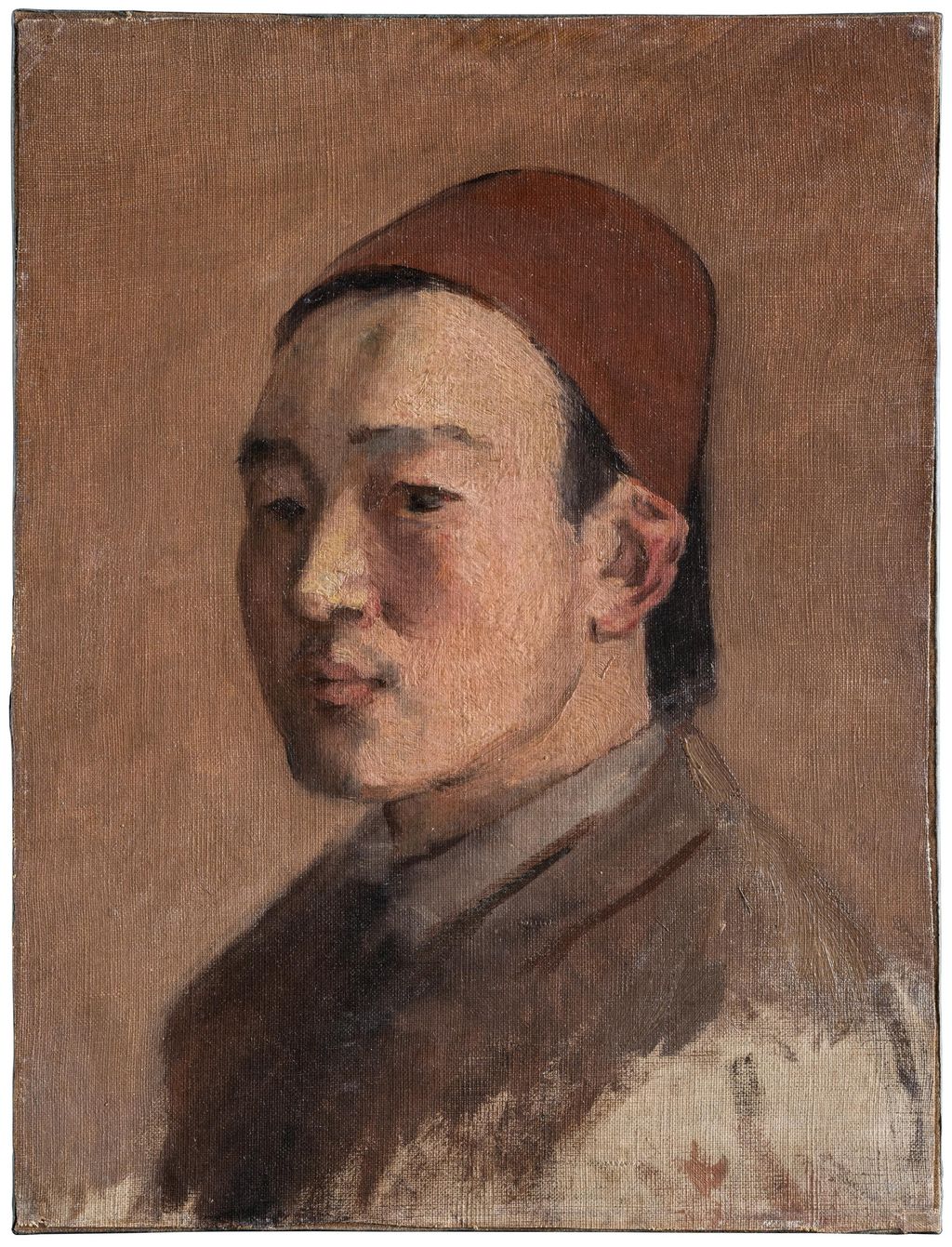
Kuroda Seiki, Self-Portrait in a Turkish Cap, 1889. Source: ColBase, Tokyo National Museum. Resized for web display. Object record
 by Tom Gurney
Tom Gurney BSc (Hons) is an art history expert with over 20 years experience
Published on September 25, 2026 / Updated on September 25, 2026
Email: tomgurney1@gmail.com / Phone: +44 7429 011000
Kuroda Seiki: a life spent changing what painting could do
Kuroda Seiki entered the world at the end of the Tokugawa era and died after he had become a viscount, a member of Japan’s upper house and president of its principal fine arts academy. Yet the route between those points was neither a simple rise through office nor a story of a painter who brought a ready-made European style home. He went to France to study law, chose painting against his adoptive father’s wishes, worked in a village whose people became his models, and returned to Japan with a training system that could be taught to others. His pictures provoked arguments about the body, nature, history and the place of oil painting in a rapidly changing country. To understand his biography is to see how the working painter and the maker of institutions kept shaping one another. [1] [2] [3]
The dates themselves offer a small lesson in reading his sources. Kuroda was born in Kagoshima on the twenty-ninth day of the sixth month of Keiō 2, a date converted by the National Diet Library to 9 August 1866 in the Gregorian calendar. Some museum chronologies print “29 June 1866” without identifying the old calendar. His name at birth was Shintarō. The later characters 清輝 can be read Kiyoteru as a personal name, while Seiki is the familiar artist name. He died in Tokyo on 15 July 1924, before his fifty-eighth Gregorian birthday. A traditional counted age of fifty-nine in an older Japanese text does not mean a different death year. [4] [5]
Contents
- Kuroda Seiki: a life spent changing what painting could do
- Kagoshima, Tokyo and an adopted heir’s expectations
- Life at a glance
- Paris: choosing a painter’s life without instantly leaving law
- Grez-sur-Loing: the household, the models and a working landscape
- A Salon nude, a return voyage and a changed set of viewers
- A school, a war assignment and the nude-painting dispute
- Hakubakai and the new Western-painting course
- A summer at Lake Ashi and a complicated personal chronology
- Paris again: success and questions carried back home
- Bunten, official duties and a painter still at work
- The sickroom, the will and the paintings left behind
- What his biography changes about the pictures
- Books on Japanese Art
Kagoshima, Tokyo and an adopted heir’s expectations
Kuroda was born to Kuroda Kiyokane, a Satsuma retainer, and Yaeko. His father’s older brother, Kiyotsuna, became his adoptive father and designated heir in 1871; the boy grew up in Tokyo in a household tied to the new Meiji state. Atsushi Tanaka’s reconstruction of the family describes a large residence and the opportunities of a prosperous official family. The point is more than colour for a childhood scene. Kuroda’s eventual decision to become a painter took place within a household in which another profession, and a public role, had already been imagined for him. His adoptive father’s expectation of law was therefore not an incidental obstacle invented to make a dramatic artist’s story. [1] [5]
Life at a glance
- Life9 August 1866–15 July 1924
- BirthplaceKagoshima
- DecisionFrance in 1884; painting from 1886
- InstitutionsHakubakai, Art School and Bunten
Art was present before France, though not yet a declared career. Kuroda learned pencil and watercolour drawing with Hosoda Sueji, a follower of Takahashi Yūichi. He also moved from English to French studies and entered a foreign-language school’s French course in 1883. The choice of language belonged to his intended legal education: French law was important to the legal reforms of the Meiji state. His later move toward painting did not emerge from a life untouched by images, but it did require choosing a different purpose for skills that had been pursued alongside law. [1] [5]
In February 1884 he travelled to France with his elder brother-in-law Hashiguchi Naouemon, attached to the Japanese legation. Tanaka records his arrival in Paris in March. Accounts sometimes compress the journey into “he was sent to study painting,” which reverses the decision that made his life distinctive. For two years his formal path still led toward law. He attended preparatory schools, studied the language, and had to explain to the family financing his stay why another profession might serve both him and Japan better. [1] [5]
Paris: choosing a painter’s life without instantly leaving law
The decisive conversations came in 1886 among Japanese residents of Paris. The painters Yamamoto Hōsui and Fuji Masazō and the art dealer Hayashi Tadamasa urged Kuroda to take his ability seriously. In February and May letters to Kiyotsuna, quoted by Tanaka, the young man worked through what it would mean to exchange one kind of service to his country for another. He argued that he might be more useful as a painter than as a lawyer, and that painting would demand a prolonged commitment rather than a fixed course ending in a qualification. The letters show a decision being reasoned out, not a romantic instant in which a law student simply threw away his books. [1] [7]
Kuroda began to study with Raphaël Collin in 1886, according to his diary, just after the May letter. Kiyotsuna opposed the change, and Kuroda continued his legal studies while painting. He finally left the law academy in 1887. This overlap matters. It makes the later painter, teacher and administrator easier to understand than a conventional tale in which the artist escapes every institution. His training, family obligations and public ambitions remained in conversation with one another. Even after law ceased to be a course of study, questions of national usefulness and formal education did not disappear from his artistic thinking. [1] [5] [7]
Collin was a successful academic painter rather than a member of the Impressionist circle. His instruction included drawing from plaster casts and the living model, learning the human figure in stages, and then arranging figures in an ambitious finished composition. That order of study would later inform Kuroda’s teaching in Tokyo. It also complicates the label “Japanese Impressionist.” Kuroda admired outdoor light and painted in it, but he carried academic drawing and the Paris Salon’s idea of a finished work alongside that interest. Helen Swift’s Harvard dissertation treats this combination as central to his cross-cultural work, not as an inconsistency to be smoothed away. [1] [8]
Kume Keiichirō arrived in Paris in the same period, joined Collin’s class, and became Kuroda’s close friend and collaborator. They learned within a larger international student environment, travelled and worked together, and later shared responsibility for a Tokyo school and an independent exhibition society. Their friendship is documented through both artists’ diaries and letters. It is tempting to make one man the leader and the other a footnote, but the later institutional history repeatedly brings them back together. [1] [9]
Grez-sur-Loing: the household, the models and a working landscape
Kuroda first visited Grez-sur-Loing in 1888 and settled there in 1890. The village, south of Paris, was already an international gathering place for artists from northern Europe, Britain and America. The river, fields and changing seasons mattered, but so did the people and the practical possibility of working with a model. The Billaut family gave Kuroda a local connection. He rented a small studio on their property; Maria Billaut appears in Knitting, Reading and other works. Grez was therefore not simply a picturesque escape from the city. It was a place in which housing, friendship, labour, weather and the making of pictures met. [1] [10]
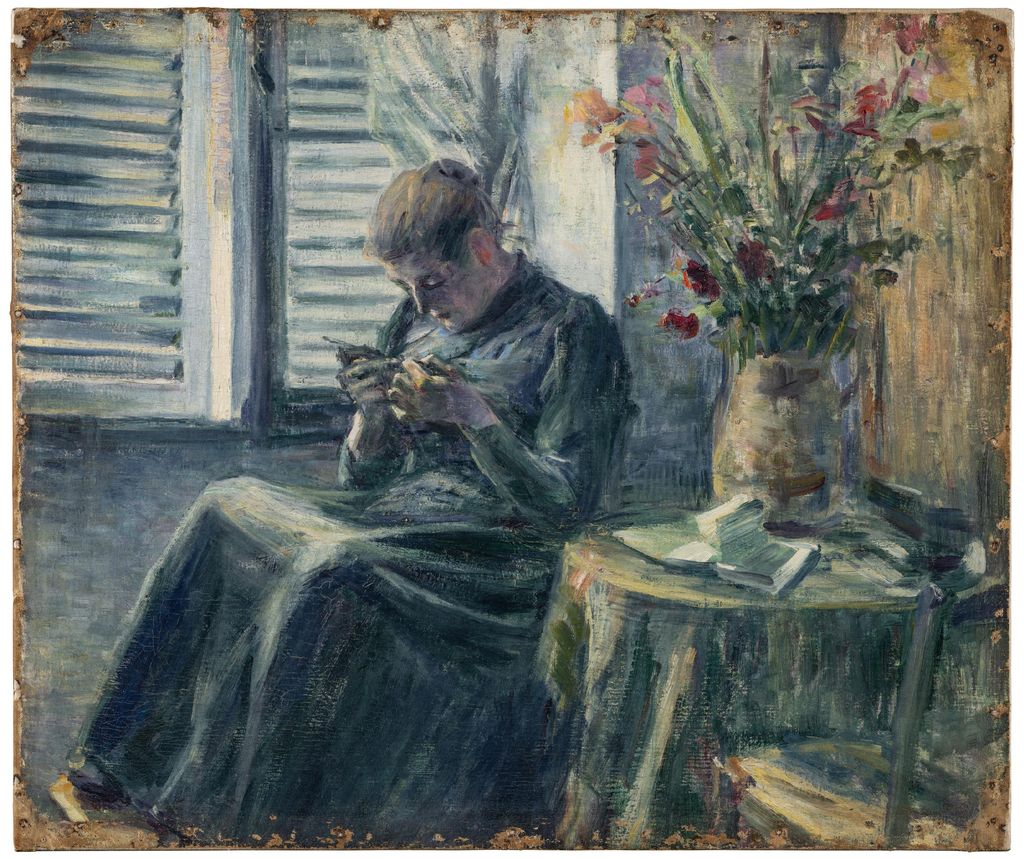
The village offered the chance to test academic skills against ordinary modern life. Kuroda could place a figure by a shuttered window, draw a worker’s body, or look across a field without needing a mythological subject. Tanaka explains that both Collin and the naturalist painter Jules Bastien-Lepage shaped the language of outdoor light available to him. Kuroda and Kume later used terms that have sometimes been translated as “pleinairism,” but the result was not identical with the independent Impressionist group’s aims or technique. A biography should therefore let the specific works describe his development. The precise relationship between carefully drawn bodies, a local household and a shifting environment says more than a single movement label. [1] [8]
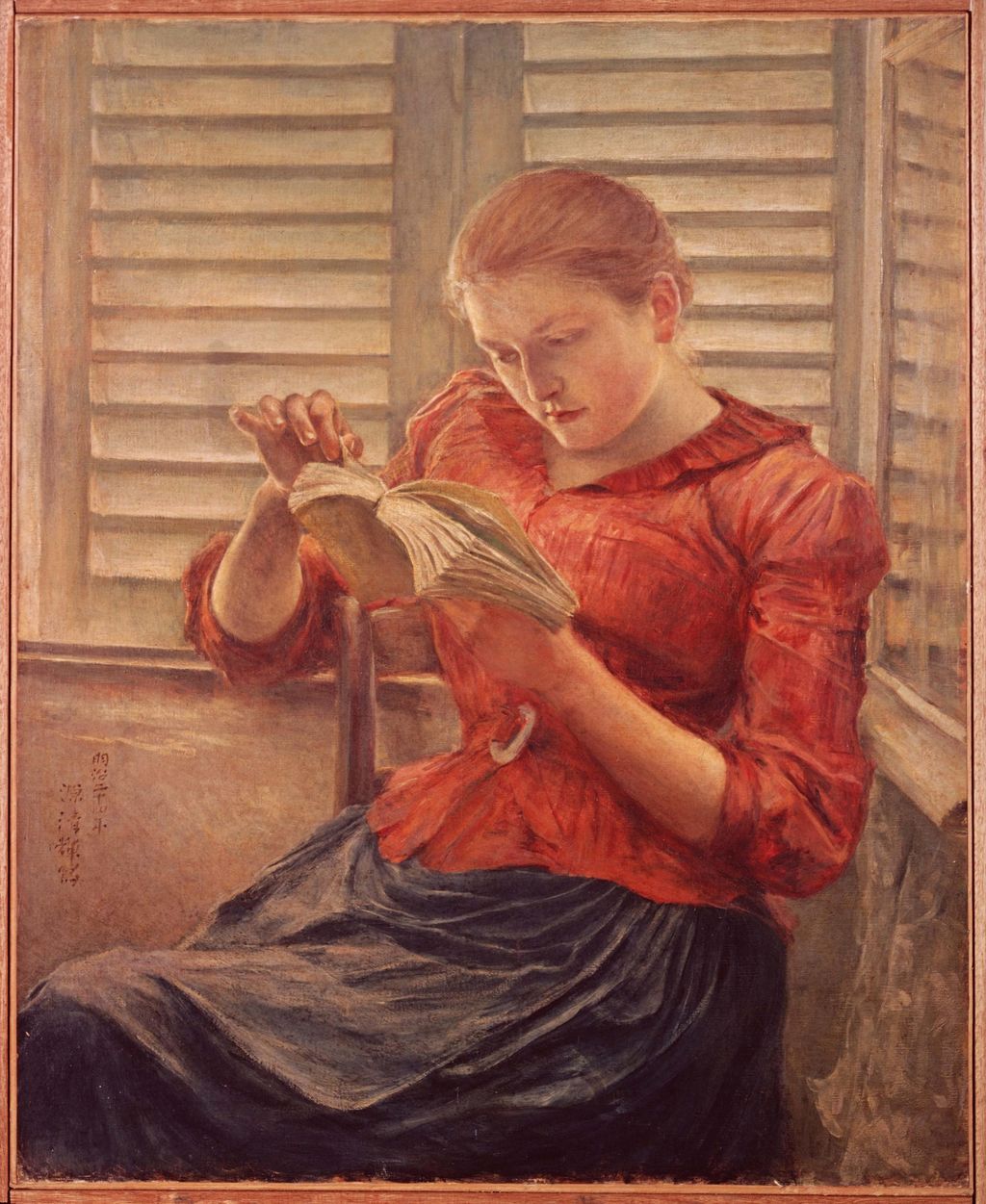
Kuroda’s own correspondence reveals that this was also a life of deadlines and costs. A letter from Grez in early 1891 discusses the price of frames, the expected Salon selection, money for the next month and the difficulty of working in cold weather. It is unusually concrete evidence against the idea that Reading simply emerged from an idyllic stay in the countryside. The figure at the window required sustained study, materials, a frame expensive enough to worry over, transport and the judgement of an exhibition jury. The famous image of quiet attention was made amid ordinary uncertainty. [12]
Reading, painted in 1891, was accepted at the Salon of the Société des Artistes Français. Maria is its model; the Institute records its Salon title as Lecture en été. The acceptance gave Kuroda recognition within the very French exhibition system for which Collin’s studio had helped prepare him. It did not settle how the work would be read in Japan. The following year it appeared at a Meiji Art Association exhibition as a reference work, and its bright, orderly interior would become part of a later argument about what Japanese oil painting might look like. [5] [13]
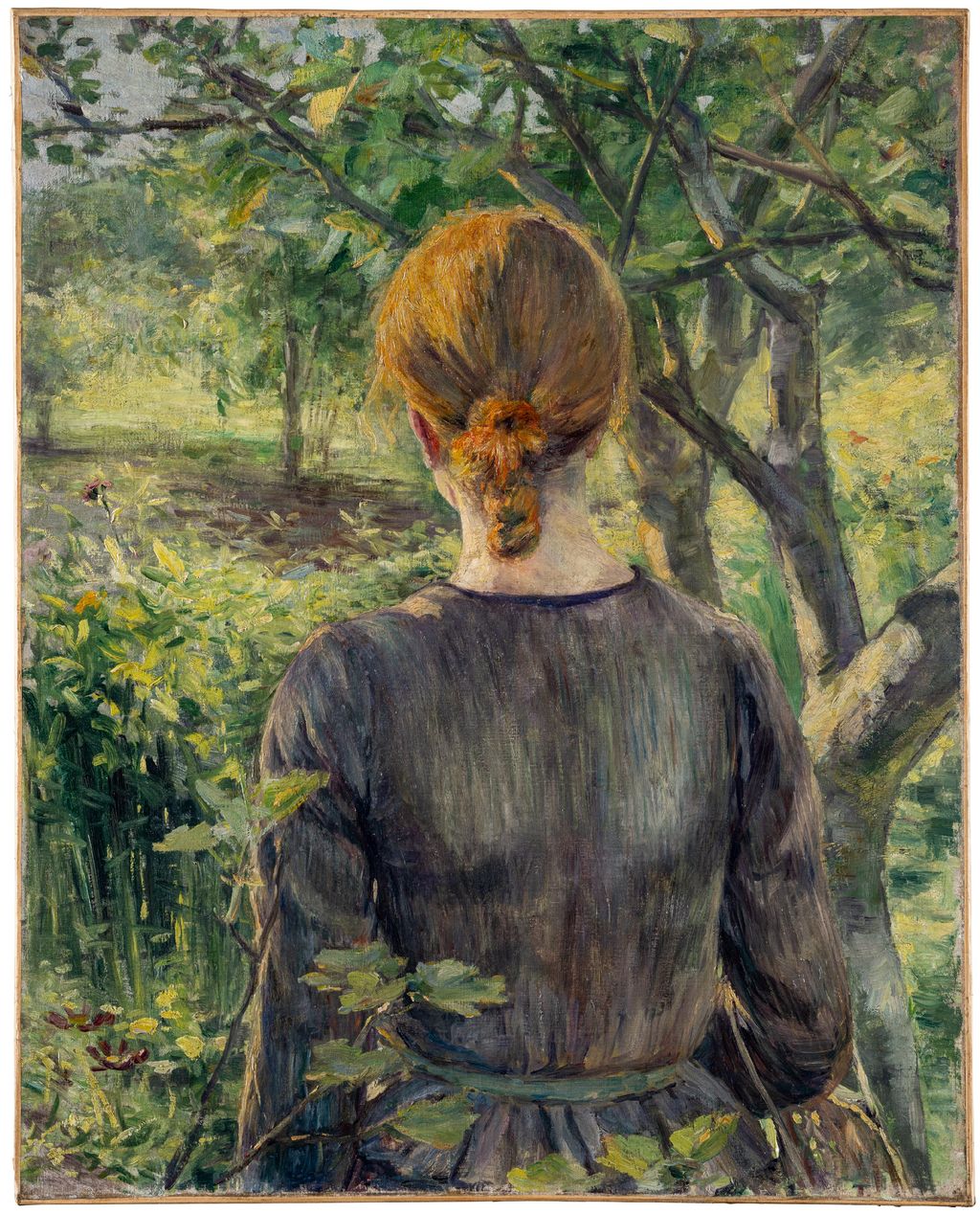
Other Grez paintings expand the story beyond one success. Girl with Red Hair uses a turned figure and a surrounding stand of trees; its interest is as much in a person’s relation to an environment as in the colour named by the later title. Kuroda’s work in the village also included landscapes and studies whose scale and purpose differ from Reading. The future teacher of academic composition was already giving small, direct observations a place alongside the more formally ambitious pictures sought by the Salon. This tension would return throughout his career. [1] [14]
A Salon nude, a return voyage and a changed set of viewers
In his final year abroad, Kuroda made the large nude Morning Toilette (《朝妝》), showing a woman before a mirror. It was accepted at the Salon of the Société Nationale des Beaux-Arts in 1893. Tanaka reports Kuroda describing the undertaking to his father as a kind of graduation test. That sense of a threshold fits the evidence: the painting called on years of figure study and on the idea that a finished, public nude could be a major artistic achievement. The work itself was later destroyed during the Second World War. Surviving studies and historical reproductions are evidence about it, but none is the missing canvas. [1] [3] [15]
Kuroda and Kume returned to Japan in 1893, travelling via the United States. Kuroda had spent nine years abroad. What had felt to him like a serious artistic accomplishment in a French Salon did not enter an identical public culture at home. This difference would become visible in the reception of Morning Toilette, but it would also shape his teaching: he needed to create conditions in which drawing from a model, painting a landscape in light and composing a figure picture could be practised and assessed. The return was not merely a change of scenery for the same paintings; it changed the audience, the institutions and the arguments around them. [5] [3]
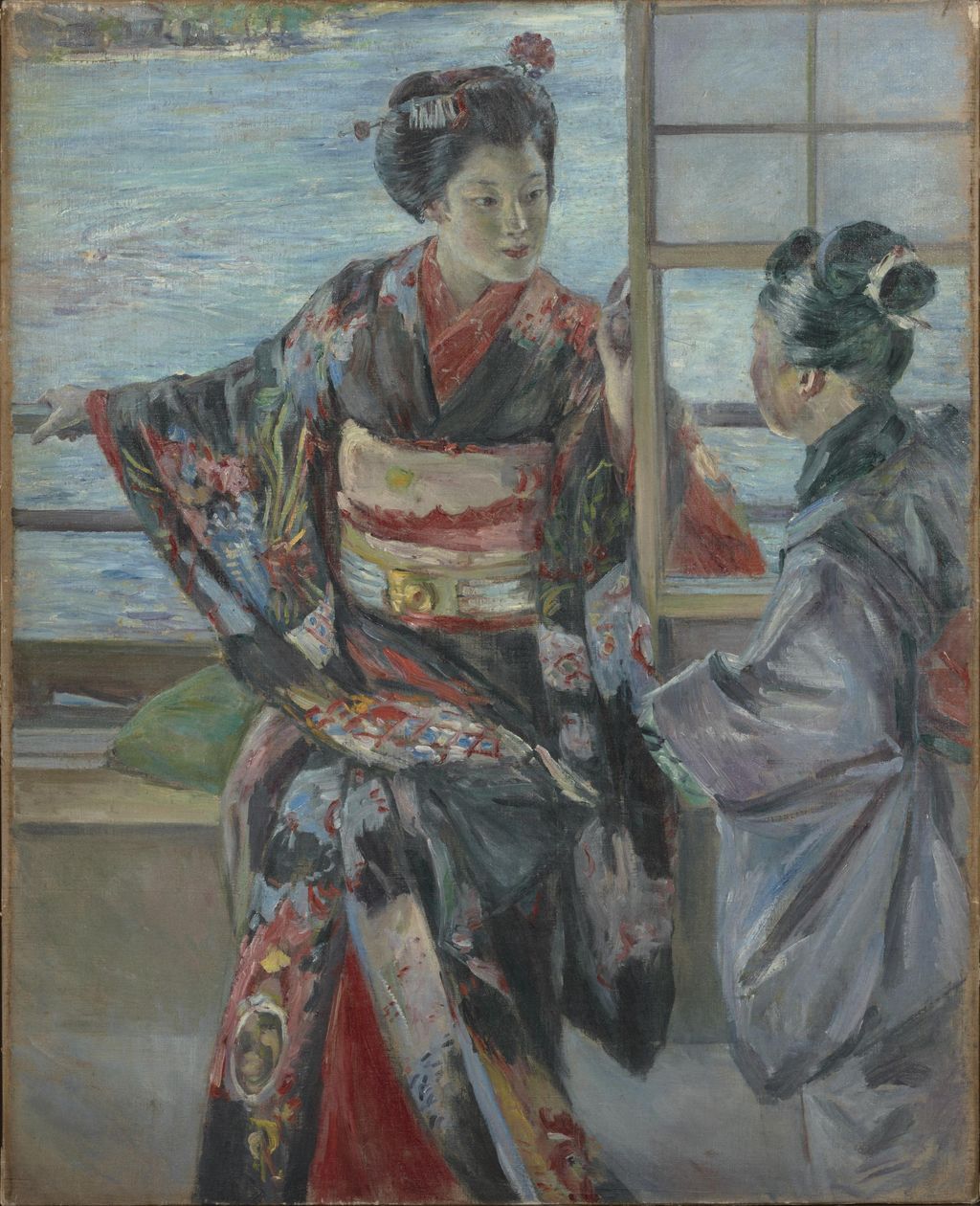
Kyoto offered an early test. Kuroda painted Maiko in 1893, after his return, with a young performer named Koen beside the Kamo River. The picture sits in the biography at a transition: its subject is local and current, while its oil medium and his training connect it to France. It should not be reduced to evidence that he “discovered Japan” after living abroad, nor should a living person be treated as an exotic costume. Swift’s study usefully reads the painting against both Kuroda’s return and the European images of Japanese women circulating in his artistic world; the object's title, date and sitter come from Japanese museum records. [8] [16]
A school, a war assignment and the nude-painting dispute
In 1894 Kuroda and Kume took over Yamamoto Hōsui’s school, renamed it Tenshin Dōjō and began teaching. Tanaka’s account of its rules is particularly revealing: students were to draw from plaster casts and living models rather than relying on copies of photographs or prints. Charcoal drawing and attention to the figure formed part of the curriculum. This was neither simply the adoption of a foreign word nor the private habit of one talented painter. It was an attempt to create a repeatable course of study for young artists in Japan. [1] [3]
From November 1894 to February 1895, Kuroda observed the Sino-Japanese War for the French illustrated paper Le Monde illustré. The institutional record confirms a correspondent’s role; it does not justify an invented account of combat experience, a specific drawing or a political position. Its relevance here is that the painter’s work and contacts already crossed between Japan and France in ways other than selling pictures. The period also interrupted a rapidly developing teaching and exhibition practice. [5] [3]
The next public controversy involved the picture he had brought from Paris. Kuroda showed Morning Toilette at the Fourth National Industrial Exposition in Kyoto in 1895, where it received recognition and drew objections to the display of a nude body. The critics’ complaints were often about public morals rather than the painting’s formal qualities. Kume wrote in defence of the nude. Kuroda’s own responses, preserved in later letters and accounts, make clear that he regarded drawing and painting the body as necessary to serious art education. The debate was not resolved by the awards the painting won; it exposed the difference between a Salon-trained artist’s assumptions and the rules and expectations of an exposition in Japan. [1] [3]
It would be misleading, however, to tell the episode as a lone modern painter facing an undifferentiated conservative nation. Artists and journalists differed among themselves. Other Western-style painters were active before Kuroda, and the Meiji Art Association already provided a platform for oil painting. What changed through the dispute and the autumn exhibition of his European works was the visibility of a particular combination of bright colour, model-based drawing and an insistence that artistic subjects could include the human body. Newspapers cast the contrast between new and old schools, sometimes using labels such as “violet” and “resin.” Those labels describe period arguments; they are not complete accounts of every painter’s technique. [1] [3]
Hakubakai and the new Western-painting course
Kuroda, Kume and colleagues formed Hakubakai in 1896 after dissatisfaction with the Meiji Art Association. Tanaka explains that they wanted an exhibition society without the existing group’s elaborate rules and officeholding structure. The white-horse name came from a favourite sake; the important consequence was a place to show work, bring students forward and test new ways of painting before viewers. The society held thirteen exhibitions before dissolving in 1911. Its membership and audience were part of Kuroda’s influence, but the story of a group should not erase the different artists who worked within it. [1] [5]
In the same year, Tokyo Art School began a Western-painting course and engaged Kuroda to teach it. He became professor in 1898. The pairing of Hakubakai with the school reveals a productive tension. One activity created a relatively free exhibition forum; the other helped establish a state-supported curriculum. Kuroda was prepared to argue against rules he thought restricted painters and, at the same time, to define what students needed to learn in sequence. The latter was not a betrayal of his earlier working practice. From the casts and models of Collin’s studio to the charcoal exercises at Tenshin Dōjō, he had seen that freedom in a finished picture depended on learned skills and shared spaces for practice. [1] [5]
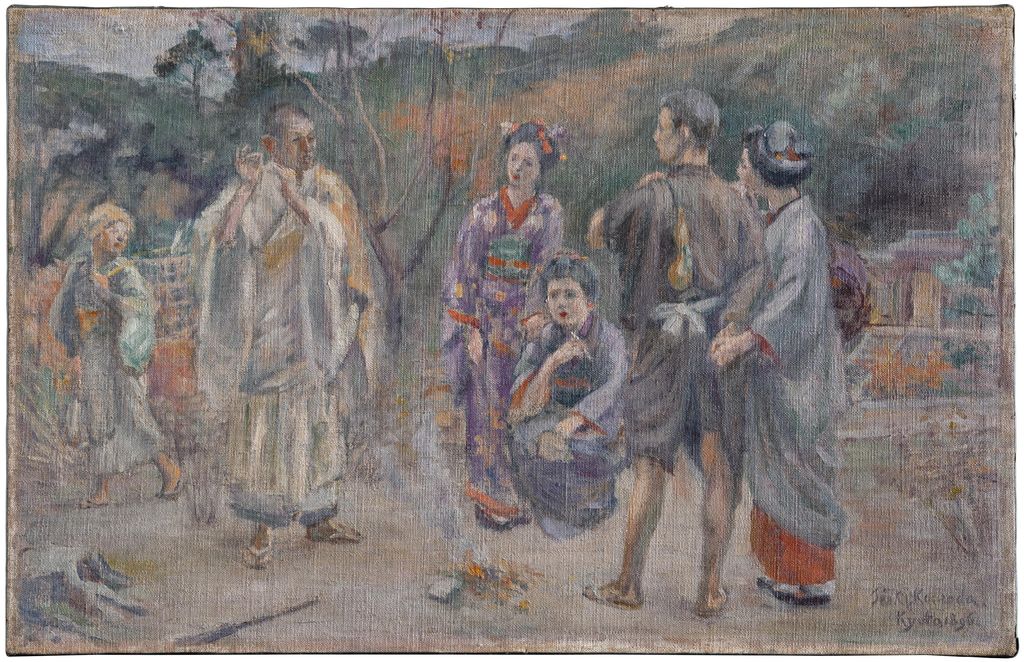
He also wanted more than fluent sketches. In an opening lecture quoted by Tanaka, Kuroda set out a path from the placement of figures and the handling of light and colour toward ambitious compositions involving history or abstract ideas. The large Talk on Ancient Romance (《昔語り》) grew from a Kyoto narrative and required models and many studies. The finished painting was shown in 1898 but was destroyed in the Second World War. What survives can show how he planned it, not exactly what the final audience saw. Wada Eisaku, a student, later recalled being struck by the labour behind a single composition. The studies therefore belong both to Kuroda’s biography as a maker and to the history of how he taught others to make. [1] [3] [8]
A summer at Lake Ashi and a complicated personal chronology
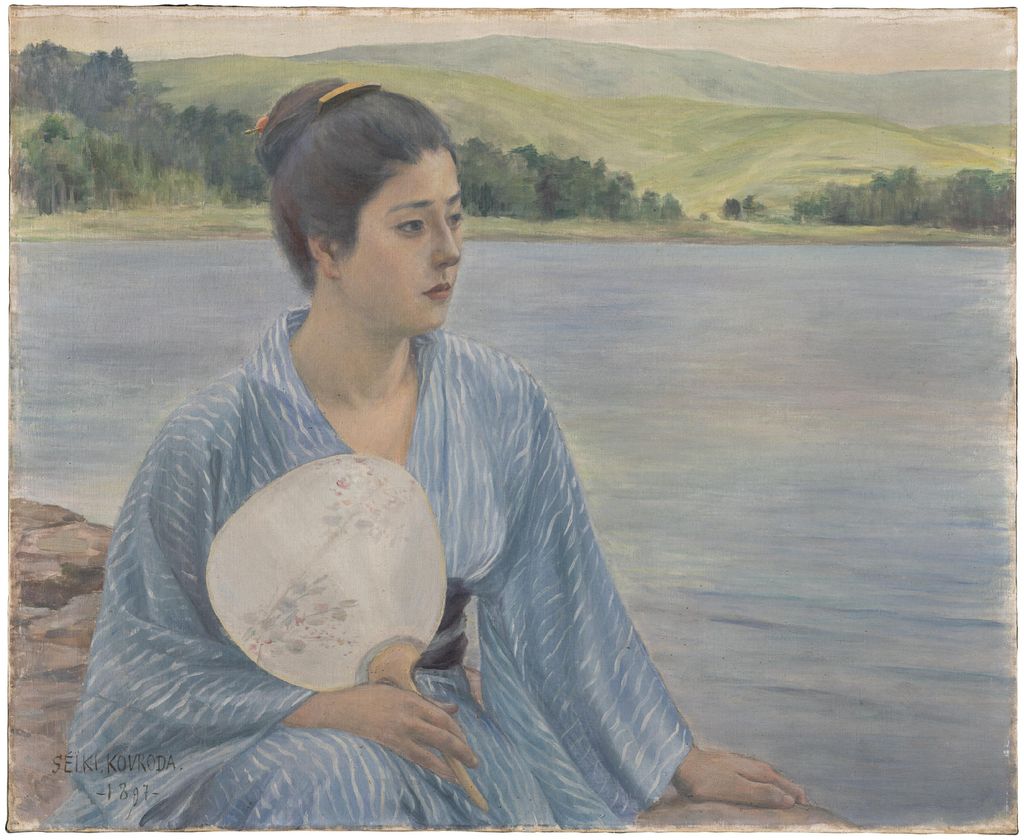
The summer of 1897 placed Kuroda at Lake Ashi in Hakone with Kaneko Tane, later called Kuroda Teruko. The Institute says he painted Lakeside over roughly a month with her as his model. It was first exhibited that autumn as Summer Retreat (《避暑》). Later accounts and catalogues used other titles before Lakeside became familiar. That title history matters within a biography: the work’s famous identity was not fixed at the moment a woman agreed to sit by the water with a fan. His artistic choices and the circumstances of showing the picture changed how it came to be remembered. [18] [8]
Personal names here can mislead when read backwards. Tane was not yet his legal wife at the time of the painting. An Institute catalogue entry says Kuroda had a brief first marriage after returning from France and formally married Teruko much later, after the death of his adoptive father. It does not supply an exact marriage-registration year in the record checked for this manuscript. Her much later recollection of posing at the lake is valuable, but it is a remembered account, not a diary entry written at the easel in 1897. Keeping those distinctions avoids turning a complex relationship into a tidy caption. [19] [18] [8]
The other major work shown at the second Hakubakai exhibition was the first version of Wisdom, Impression, Sentiment (《智・感・情》). Three nude figures occupied separate panels, each posing for a title that names an intangible faculty or feeling. The extant panels are recorded by ColBase as 1899 works, after Kuroda revised them. He had not abandoned the academic ambition of composing a large, public figure work; he had set it beside the summer picture that would become his most reproduced image. Their joint appearance makes it hard to reduce his career to a smooth change from French academic nudes to Japanese landscape and dress. Both problems were alive for him at once. [21] [8]
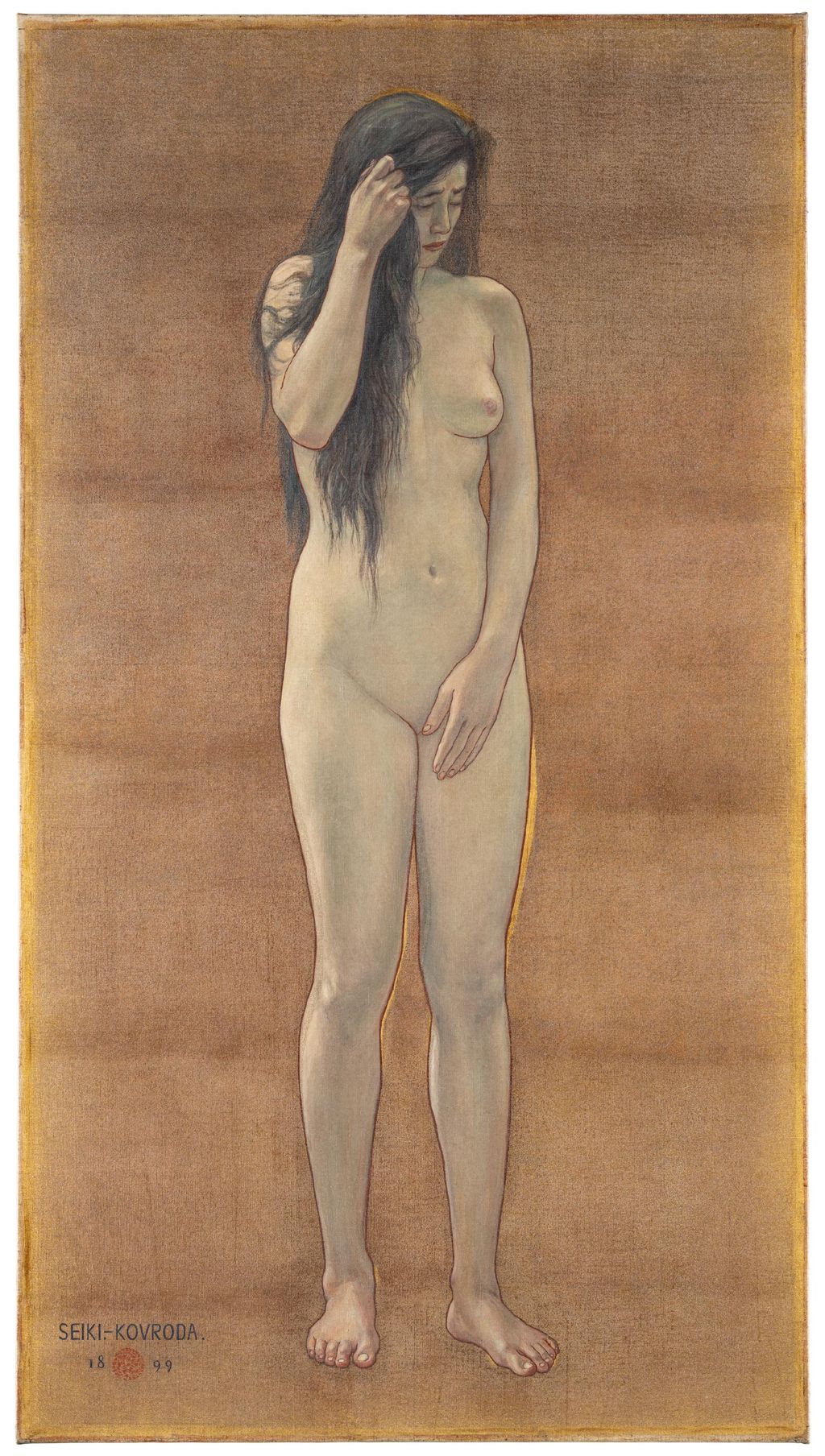
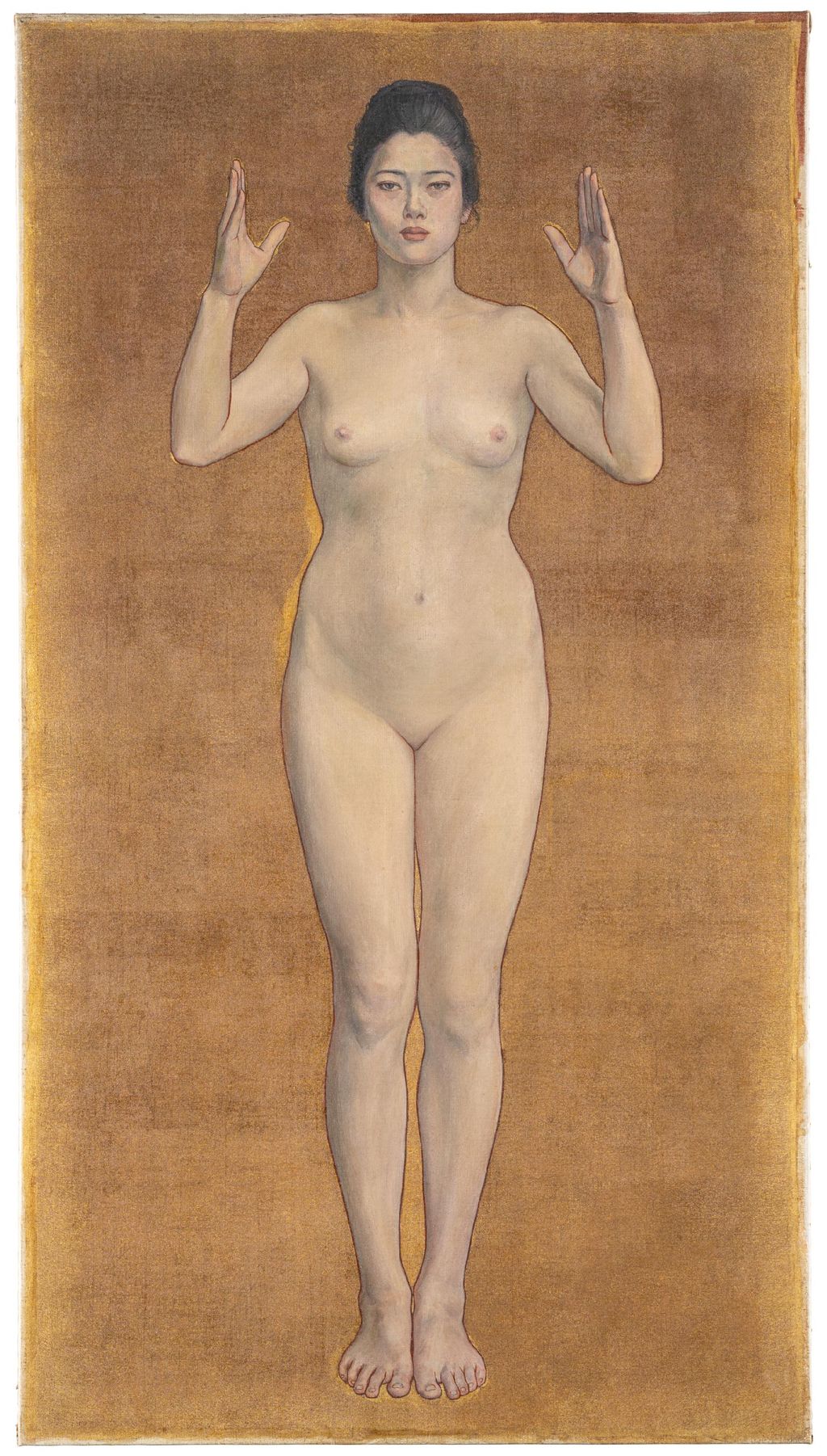
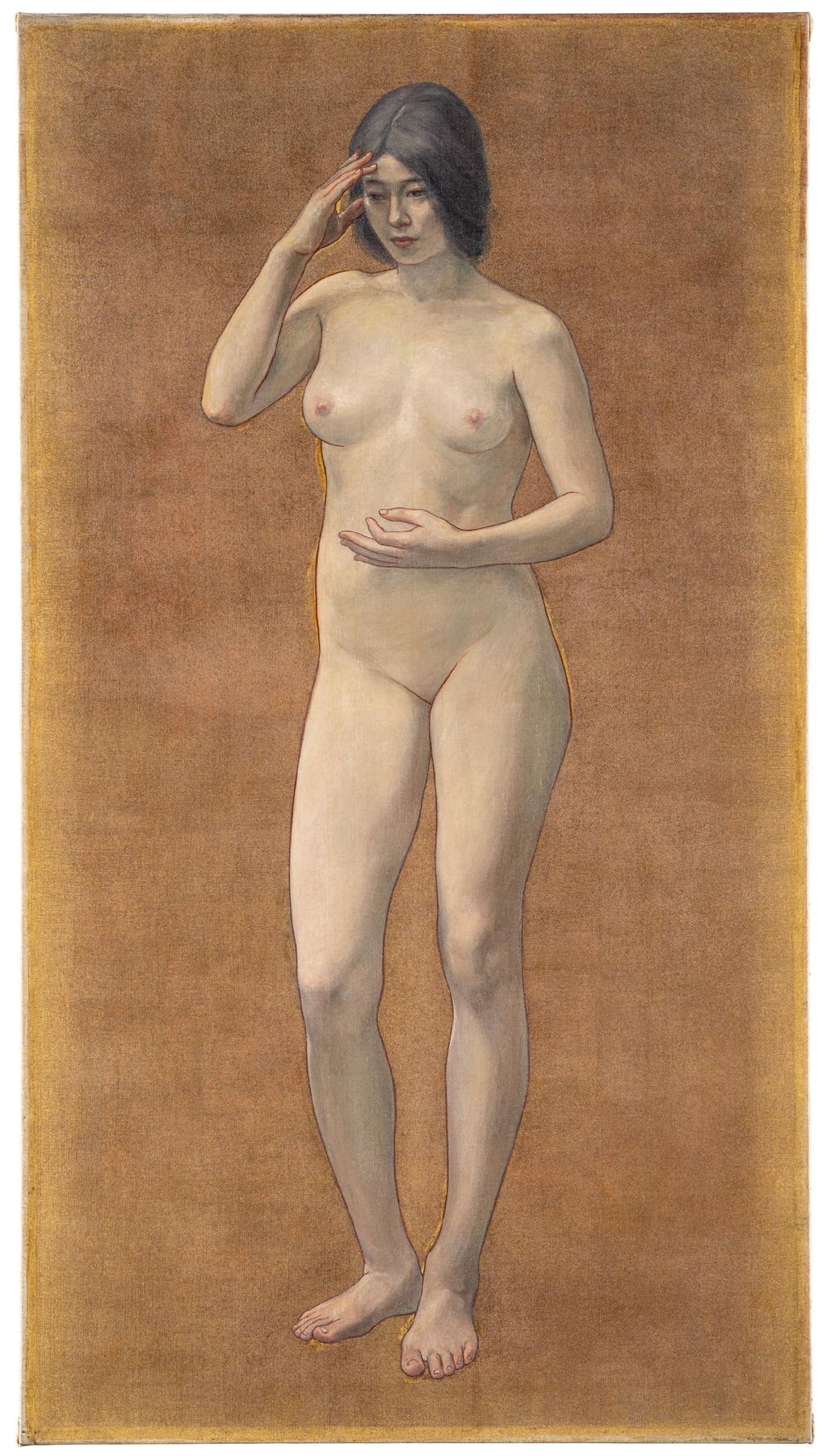
From left: Sentiment, Impression and Wisdom. Each panel is a distinct collection object, linked above.
Paris again: success and questions carried back home
Kuroda returned to Europe in 1900 with an assignment to study art administration and teaching. At the Paris Exposition, his works included Lakeside and the revised triptych, for which he received a silver award. This second journey was different from his first: he came as a painter already active in the making of Japan’s art institutions. The prize affirmed international recognition, but it did not end domestic disagreements over nude art. Art Platform Japan records a 1901 exhibition incident in which authorities required a covering over part of another nude painting. The issue was not a single 1895 scandal that quietly disappeared; it persisted as Kuroda’s teaching and public exhibitions gained authority. [5] [3]
Kuroda also saw art systems on this trip. His later advocacy of a government-sponsored exhibition in Japan drew on more than the French Salon as a venue for his own early acceptance. He wanted a place where artists outside one club could submit and be judged. That aim would feed the Bunten, first held in 1907. It could broaden access to exhibition while also installing juries and official standards. Those effects should be considered together. An artist who had helped create an independent society was now involved in building a more powerful public structure. [1] [3]
Bunten, official duties and a painter still at work
Kuroda served as a juror for the Bunten from its beginning and continued to submit work. In 1910 he became the first Western-style painter appointed an Imperial Court Artist; Hakubakai dissolved the following year. He helped form Kōfūkai in 1912 and chaired a National Art Association founded to advance artists’ standing and mutual support. Art Platform Japan also records an Imperial Household commission with photographers Ogawa Kazumasa and Maruki Riyō in 1913. His later life thus crossed teaching, exhibition administration, artist advocacy and work at the court. Listing offices alone would make this sound like an inevitable ladder. In fact, these institutions had distinct purposes and different consequences for the freedom and public standing of painters. [5] [3]
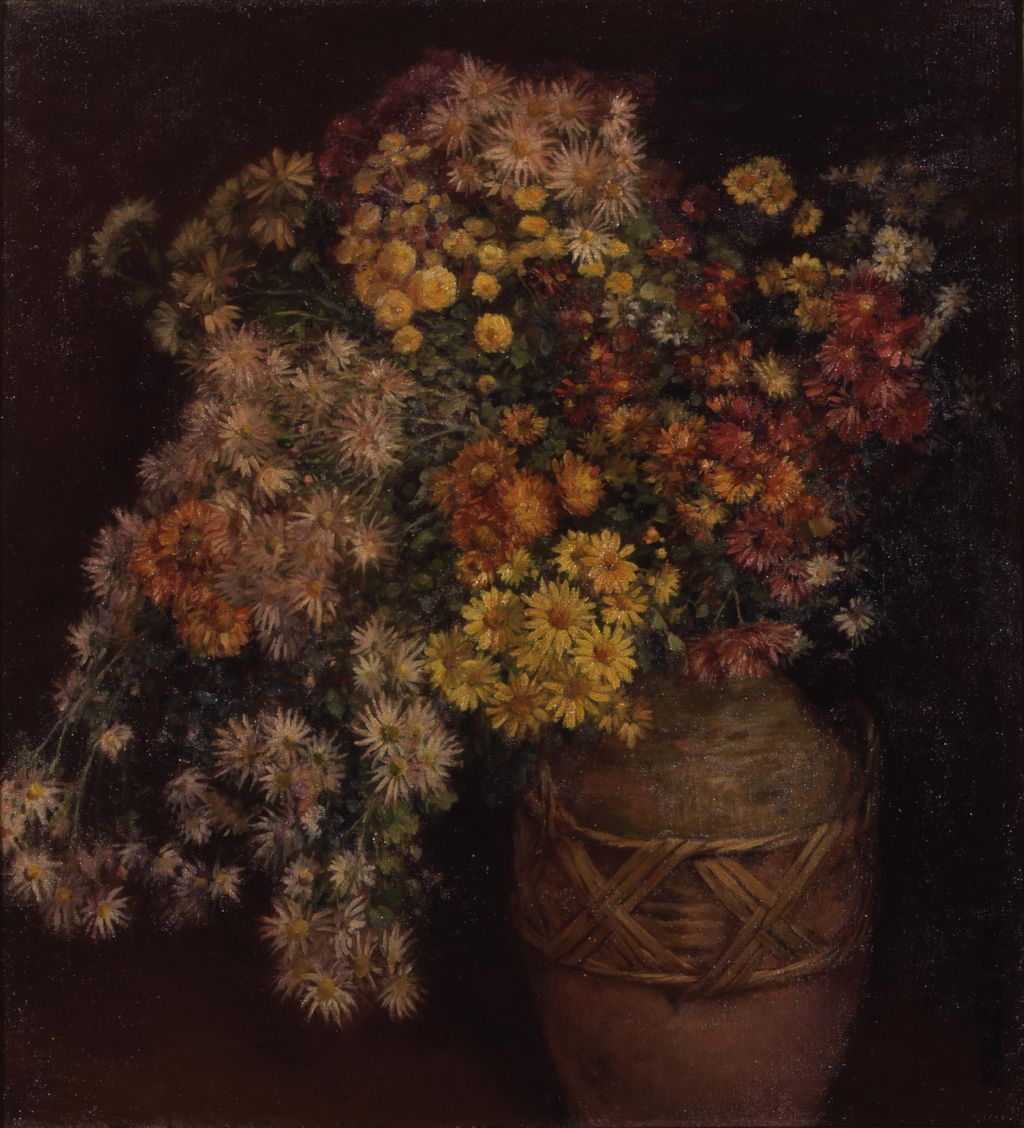
The demands of these roles affected time for painting, and contemporaries noticed. Kume later suggested that Kuroda’s most productive artistic years had passed, a judgement Tanaka discusses. Yet a friend’s retrospective view is not a measurement of every later canvas. Vase of Flowers from 1912 is a substantial observed work; late landscapes and flowers continue to ask what the painter chose to look at when a large academic composition could not be finished. Swift’s dissertation argues against treating the smaller works as mere evidence of decline. The biography should not force a vote between “administrator” and “artist.” It can show that the kind and scale of pictures changed while making remained part of his life. [1] [8] [25]
One event in the middle of these busy years brought him back to his birthplace under extraordinary conditions. The Institute's chronology records that Kuroda was in Kagoshima in January 1914 when Sakurajima erupted; it also lists a group of eruption pictures among his submissions that year. These details do not prove that disaster suddenly changed his entire late style, and they should not be used to attach a false eyewitness account to an unrelated landscape. They do show that he continued to respond visually to a place he had known since childhood while maintaining official and exhibition commitments. The episode resists a neat division between a youthful artist of observed life and an older officer of institutions. He could still encounter an urgent event, make images from it, and carry those images into public exhibition. [5]
In 1917, after Kiyotsuna’s death, Kuroda inherited the title of viscount. He joined the Imperial Academy of Fine Arts in 1919, won a seat in the House of Peers in 1920 and became the Academy’s president in 1922. These dates place the artist within the upper structures of the Taishō state, but they do not erase the law student who had argued in 1886 that painting might be his better contribution. His career had returned, through a different profession, to the question of public usefulness that had confronted him in Paris. This is an interpretation of the life’s arc; the offices and their dates are directly recorded in institutional chronologies. [5] [3]
The sickroom, the will and the paintings left behind
Kuroda suffered an attack of angina while at work in December 1923, improved for a period, and became ill again in 1924. The Institute's history of his bequest records that he made a will directing part of his real estate toward the promotion of art. He named executors including Kume, the friend with whom he had studied and taught across nearly four decades. The bequest was not a vague wish that later admirers attributed to him. It was an instruction made during illness that shaped actual research and museum institutions after his death. [26] [3]
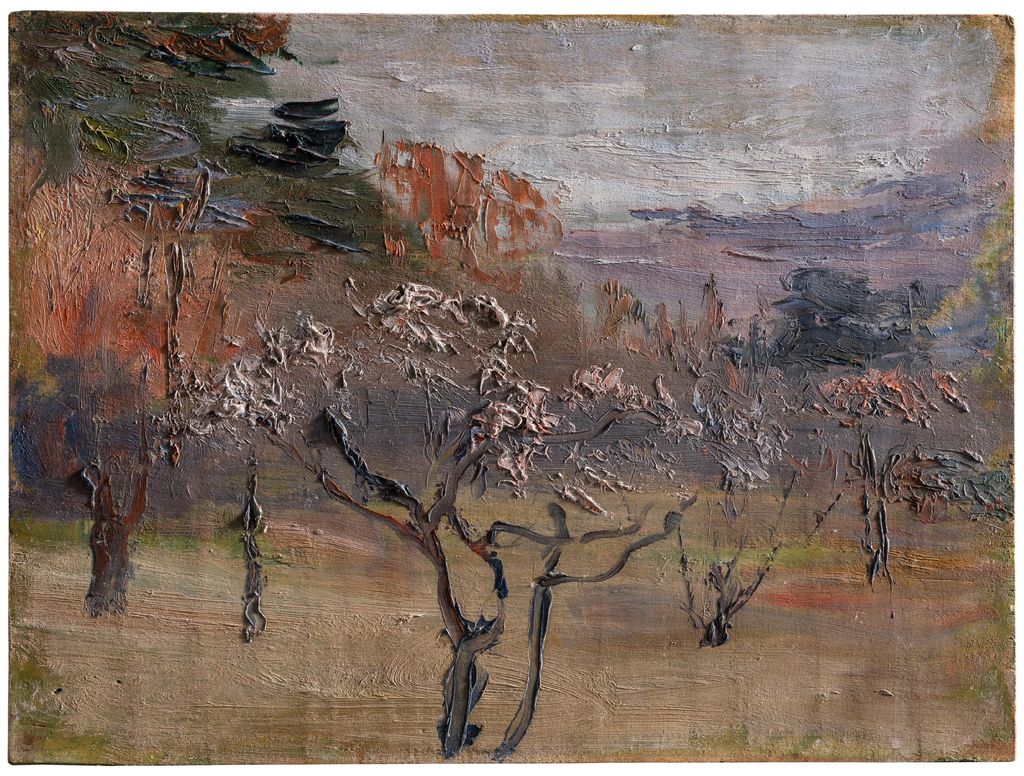
From a detached sickroom in the Azabukōgai-chō residence, he painted the small Plum Grove of 1924. ColBase identifies it as his final work and describes the garden seen from his place of convalescence. It has none of the public scale of the triptych, and that difference is part of its meaning in a life story. It is not necessary to call the painting a private confession or to claim access to his last thoughts. What can be said is precise: an ill painter still made an image from what he could see; the object record preserves its medium, size and final-work identification. [27]
Kuroda died on 15 July 1924. His relatives’ donations and the provision of his will helped bring about the Kuroda Memorial Hall, built in 1928, and the Art Research Institute established in 1930. That research institution is a predecessor of the Tokyo National Research Institute for Cultural Properties, whose archives, diaries, object studies and conservation research now make a more complex account of Kuroda possible. Tokyo National Museum later took over the Memorial Hall and collection. The public life of his work thus continued in two linked forms: paintings people can examine, and records that let them test the familiar shorthand about the man who painted them. [26] [28] [3]
What his biography changes about the pictures
The young self-portrait, the Grez interiors, the Kyoto maiko, the nude triptych, the summer lakeside and the last view of a garden do not illustrate a single unchanged idea of Japanese modernity. They record a painter’s repeated choices in different circumstances. In Paris he had to persuade a family and meet a Salon jury. In Grez he needed models, weather, money and frames. In Japan he needed students, exhibition rooms and a public willing to argue over the subject of art. Later he negotiated the demands of official office and the scale of work he could still make. His life is worth reading beside the objects precisely because neither the paintings nor the institutions tell the whole story alone. [1] [3] [8]
Frequently Asked Questions
The National Diet Library converts his birth on the twenty-ninth day of the sixth month of Keiō 2 to 9 August 1866 in the Gregorian calendar. Some institutional chronologies print 29 June without stating that it is the old-calendar date. He died on 15 July 1924. [4] [5]
He went to France in 1884 intending to study law. Japanese painters and an art dealer encouraged him in 1886; he began with Raphaël Collin that year and left his law course in 1887. [1] [5]
She was a member of the Grez-sur-Loing family with whom Kuroda lodged and worked. Museum research identifies her as the model for Reading, Knitting and other works of his French period. [1] [10]
No. The Institute identifies her as Kaneko Tane, later Kuroda Teruko, and says she became his wife after the painting was made. A separate Institute catalogue entry says the formal marriage followed the death of Kuroda’s adoptive father. [18] [19]
His offices reduced the time and circumstances for large paintings, and Kume later judged his strongest production to be earlier. Exact museum records document later paintings such as Vase of Flowers (1912) and Plum Grove (1924). Scholars differ over whether smaller scale should be read as decline. [1] [8] [25] [27]
Discussion
Compare Kuroda’s letters, later recollections and exact object records as you follow his life.
Reader Insights
What do the 1886 family letters establish about law and painting?
What different opportunities did Hakubakai and Tokyo Art School provide?
How should small paintings be read alongside the growth of public duties?
Join the Conversation
Share a documented example or reliable source below, keeping observation separate from inference.
References
- Atsushi Tanaka, “The Life and Arts of Kuroda Seiki,” Tokyo National Research Institute for Cultural Properties. Detailed institutional essay using letters, diaries, recollections and exhibition history; distinguish Tanaka's interpretation from the period voices he quotes.
- Tokyo National Museum, 2016 Kuroda retrospective overview. Period structure and object selection; a past exhibition, not a current display listing.
- Shioya Jun, “Kuroda Seiki,” Dictionary of Artists in Japan, Art Platform Japan, published online 2024. Detailed institutional biography and checked bibliography.
- National Diet Library, “Kuroda Seiki,” Japanese Portraits of Modern Japanese Historical Figures. Lists both old-calendar sixth month, twenty-ninth day and Gregorian 9 August 1866.
- Tokyo National Research Institute for Cultural Properties, Kuroda chronology. Dates from childhood through death; its “29 June” birth line uses the old-calendar day without explicit conversion.
- ColBase, Self-Portrait in a Turkish Cap, KU-a002. Exact production image and object facts.
- TOBUNKEN, introduction to the Kuroda diary. Scope of diary and letters as primary biographical material.
- Helen Swift, Cultural Crossings: Kuroda Seiki (1866–1924) and the Making of Japanese Western-Style Painting, Harvard University PhD dissertation, 2024. Complete text checked; relevant printed pages are indexed in
396-kuroda-harvard-and-object-research-digest-2026-09-25.md, especially chapters 1–4 and epilogue. No dissertation images reused. - TOBUNKEN, 2020 study of Kuroda and Kume's letters. Research on their sustained correspondence and collaboration.
- TOBUNKEN, “Kuroda Seiki and Grez-sur-Loing”. Village, artists’ community and Billaut household.
- ColBase, Knitting, KU-a029. Exact production image and object facts.
- TOBUNKEN diary database, 1891 Grez letters. First-hand letters concerning the Salon picture, winter work, frame costs and funds; paraphrased, not reproduced.
- ColBase, Reading, A-10937 and TOBUNKEN's Reading study. Exact object and Salon/model research; production image from ColBase only.
- ColBase, Girl with Red Hair, KU-a122. Exact production image and object facts.
- Tokyo National Museum, Kuroda retrospective object discussion. Morning Toilette and the context of the French training period.
- ColBase, Maiko Girl, A-11258 and TOBUNKEN Maiko research. Sitter and location checked separately from interpretation.
- ColBase, study for Talk on Ancient Romance, composition II, KU-a035. This is a surviving study, not the lost final picture.
- TOBUNKEN, Lakeside object/conservation research. Model, place, period title and later marriage wording; Institute research images are not the production file.
- TOBUNKEN, Portrait of a Woman, KU-a063 catalogue entry. The first marriage and later formal marriage with Teruko after Kiyotsuna's death; no exact registration year is used here.
- ColBase, Lakeside, KU-a117. Exact production image and object facts.
- TOBUNKEN, Wisdom, Impression, Sentiment object research. 1897 display, 1899 revised state and questions of interpretation.
- ColBase, Sentiment, KU-a055. Exact left-panel production image.
- ColBase, Impression, KU-a053. Exact centre-panel production image.
- ColBase, Wisdom, KU-a054. Exact right-panel production image.
- ColBase, Vase of Flowers, A-863. Exact later work and production image.
- TOBUNKEN, Kuroda's bequest and the Art Research Institute. Will, illness, executors and institute foundation.
- ColBase, Plum Grove, KU-a093. Exact object, dimensions, garden view and final-work identification.
- Tokyo National Museum, Kuroda Memorial Hall renewal account. Later history of the building and collection.