


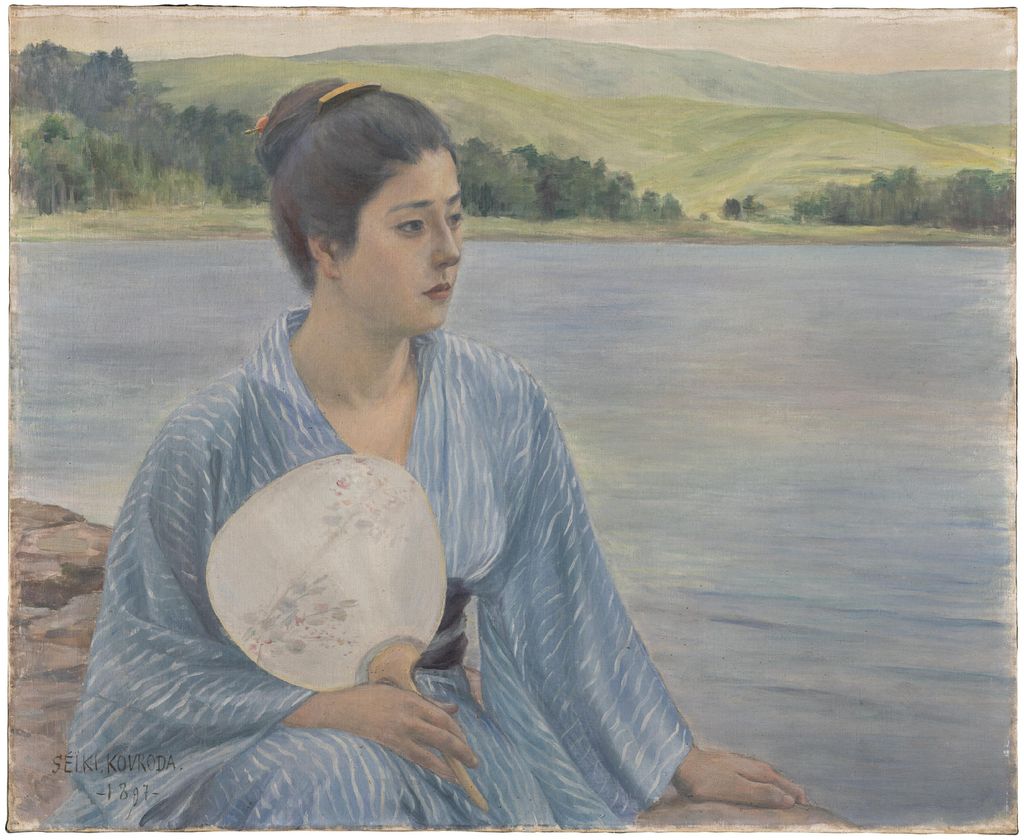
Kuroda Seiki, Lakeside, 1897. Source: ColBase, Tokyo National Museum. Resized for web display. Object record.
 by Tom Gurney
Tom Gurney BSc (Hons) is an art history expert with over 20 years experience
Published on September 25, 2026 / Updated on September 25, 2026
Email: tomgurney1@gmail.com / Phone: +44 7429 011000
Kuroda Seiki: painting the world he returned to
Kuroda Seiki (黒田清輝, 1866–1924) is often introduced as the father of modern Japanese Western-style painting. The description captures his enormous influence, but it can hide what is most interesting to look at. He learned figure drawing and oil painting in France; he made pictures of French village life; and after returning to Japan he painted a Kyoto apprentice entertainer, a woman by a Hakone lake, a symbolic triptych of nude figures, and small glimpses of gardens and flowers. These paintings do not all deliver one lesson about “Western technique.” They ask what such technique could do when the artist's subjects, viewers and institutions changed. [1] [2]
Kuroda also changed where painting could be learned and seen. With Kume Keiichirō he taught from plaster casts and living models; he helped establish the Hakubakai's exhibitions; he led the Western painting course at the Tokyo Art School and pressed for national exhibitions. These activities matter to his pictures. A student who had trained for the Paris Salon knew that a finished work was judged in public and that a painting's size, subject and treatment of the body could be as consequential as its colour. In Japan he wanted oil painting to have that standing, but he had to negotiate the expectations of Japanese viewers rather than simply replay what he had learned abroad. [1] [2] [3]
Contents
- Kuroda Seiki: painting the world he returned to
- Learning a way to see: Paris and Grez-sur-Loing
- A Japanese subject after France: Maiko
- A public argument about the painted body
- Lakeside : a summer place and a painted surface
- Look closely at Lakeside
- A picture that survives through its studies
- Smaller pictures and the weight of public work
- What changed when the light changed?
- How to look at Kuroda now
- Books on Japanese Art
The work that most visitors know is Lakeside (《湖畔》), painted in 1897 at Lake Ashi in Hakone. The woman sits with a fan, her blue-striped summer robe answered by pale water and a low bank of hills. Its apparent ease conceals a considered meeting of figure, season and place. It was first exhibited as 《避暑》, “Summering,” a title that directs us towards the experience of seeking cooler air. That title, its change in later exhibitions, the physical surface of the painting and the sitter's own later account each affect how the picture can be read. The image is a good place to begin, but it is not enough to explain all of Kuroda. [11] [12] [3]
At a glance
- Life1866–1924
- PeriodMeiji to Taishō
- PracticeOil painting, drawing and teaching
- Key worksReading, Maiko, Lakeside, Wisdom, Impression, Sentiment
Learning a way to see: Paris and Grez-sur-Loing
Kuroda travelled to France in 1884 to study law, not to launch the career for which he is now known. The Tokyo National Research Institute's detailed account dates his decision to pursue painting to 1886: Japanese painters and the art dealer Hayashi Tadamasa encouraged him, and he entered the studio of Raphaël Collin. He continued law studies for a time before giving them up in 1887. A full account of his family, adoption and education belongs in the biography; for looking at the art, the crucial change is that he took on an academic training whose demands were practical and sequential. Copying and drawing came first, then study of the live figure, then oil painting, and finally the arrangement of figures into a composed picture. [2] [1]
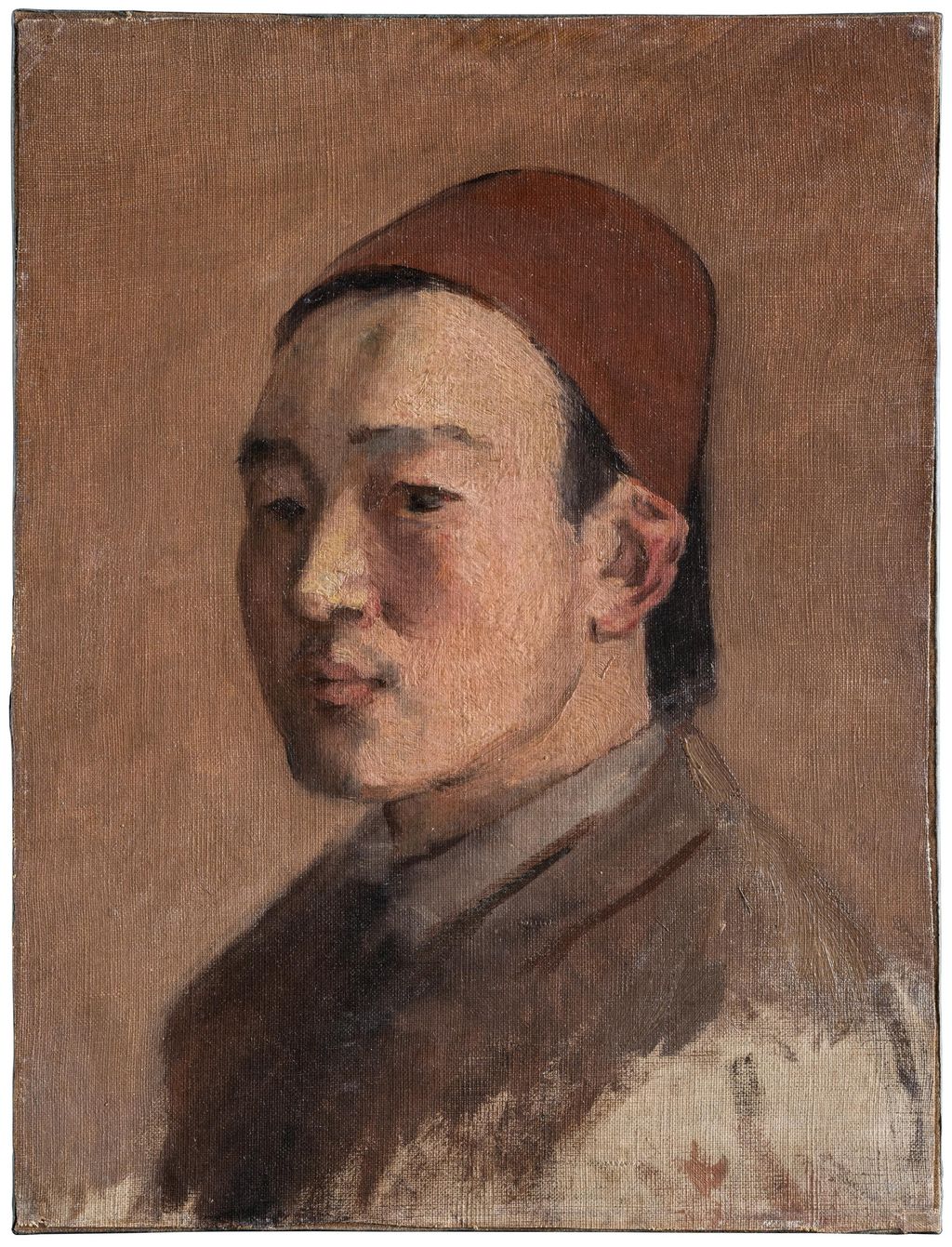
His 1889 Self-Portrait in a Turkish Cap is a small work from this training period. The sitter faces us without the grand costume of a history painting. The warm cap and closely worked face occupy a modest 40.5 × 30.7 cm canvas. It reminds us that the confident teacher of later Japanese accounts was once a young painter testing how a human head turns into a painted presence. The picture does not document a private emotion, and its cap alone cannot tell us his political or cultural allegiance. Its value here is visual: an artist attentive to a face and the tonal relation between skin, cloth and background was learning the means he would later use with other sitters. [23]
The village of Grez-sur-Loing gave Kuroda a different kind of classroom. Tokyo's research institute records a first visit in 1888 and a longer stay from around July 1890 to December 1892 in a house belonging to the Billaut sisters. American, British and Northern European artists also worked in the area. It was a network of artists and models as well as a picturesque riverside place. Kuroda could watch the fall of light through shutters, the ordinary labour of people indoors and the changes in open fields; he could try these experiences against the drawing discipline of Collin's studio. The research institute identifies Maria Billaut as a model for both Reading and Knitting. This exact identification is more useful than the familiar but vague claim that his figures were simply “French women.” [4] [2]
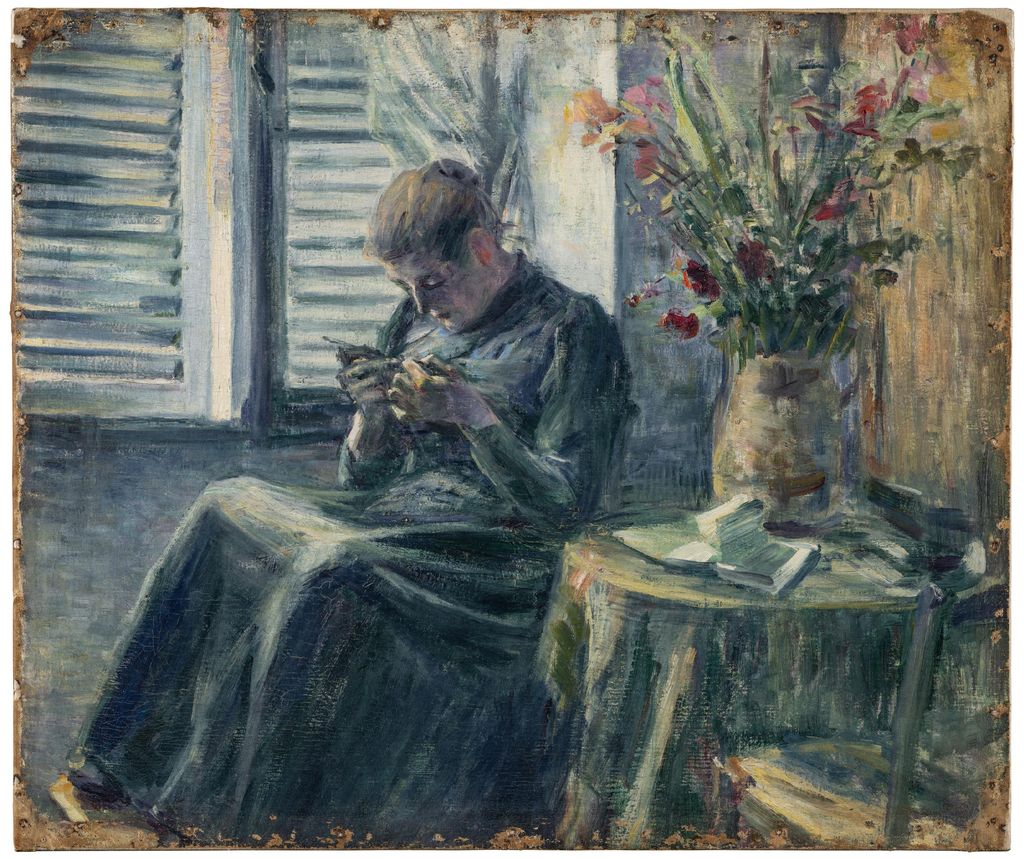
Knitting (《編物》), dated 1890 in ColBase, places a seated woman beside an open shutter. The light gathers on her lowered head, hands and work; the dark clothing and interior give those bright areas weight. A jug and flowers on the table help define the domestic room without turning the woman into a decorative accessory. The posture matters because it is occupied rather than posed for a public ceremony. We can see Kuroda working through a problem he would return to in Reading: how to keep a figure concentrated on her own action while daylight enters the painting from one side. The similarity between the works is historically grounded in the shared Grez setting, but they are distinct objects with different dates, sizes and gestures. [7] [4]
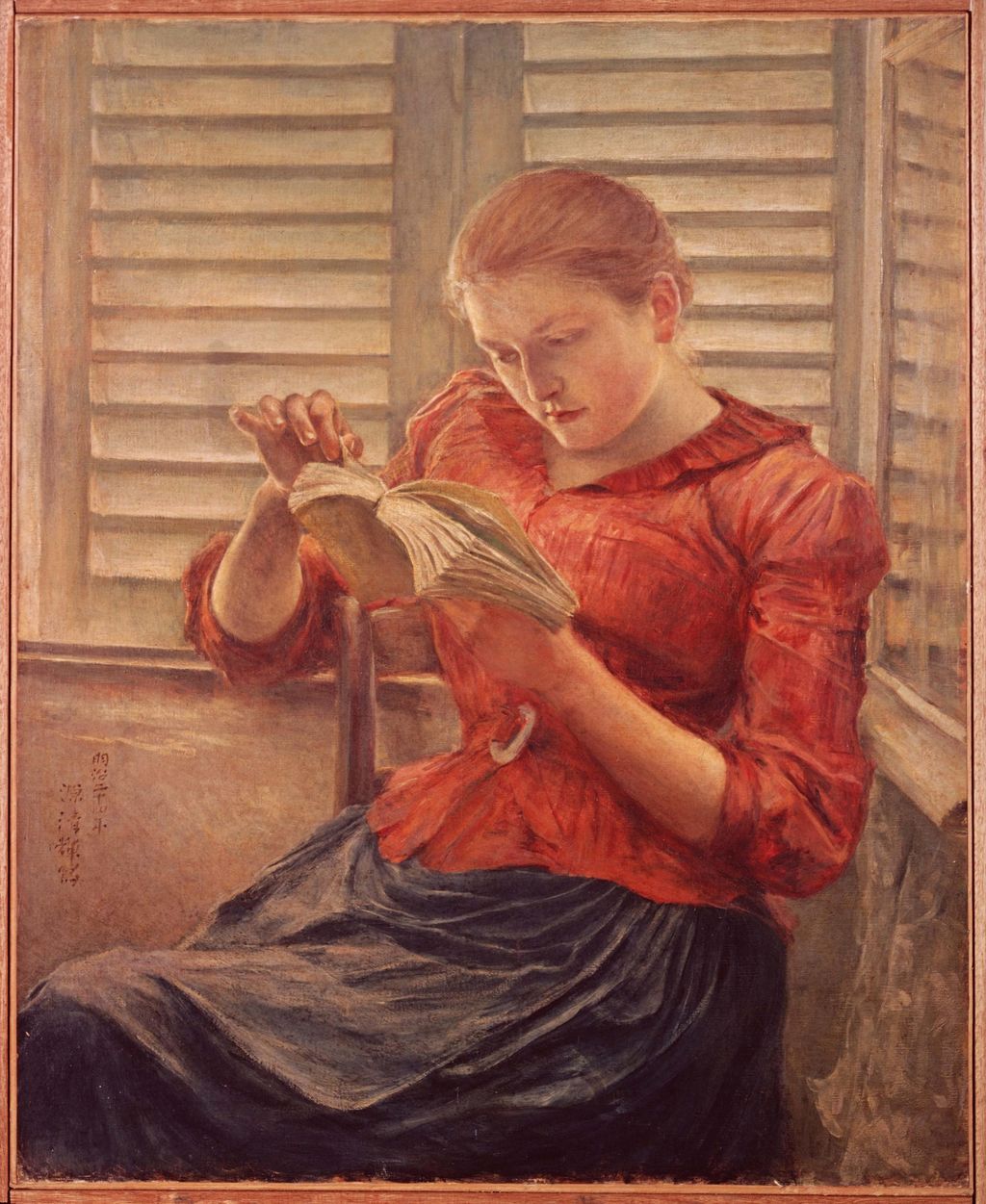
Reading (《読書》) makes that problem more exacting. The work is nearly a metre tall; Maria Billaut, in a red blouse and dark skirt, sits with her book close to the shuttered window. The page catches the light, but her gaze stays on it rather than turning out to us. The slats, her arms and the book make a series of angled lines, while the red fabric holds together the human centre of the canvas. A viewer can identify an individual at work and also follow Kuroda's controlled passage of light into the room. The Tokyo National Museum's object record dates the painting to 1891 and measures it at 98.2 × 78.8 cm. The scale is important: this intimate scene was made into a substantial exhibition painting, not a private thumbnail of village life. [5] [6]
The Institute says Kuroda submitted it to the 1891 Société des Artistes Français Salon as Lecture en été (“Reading in Summer”) and that it was accepted. It was later shown in Japan in 1892. Helen Swift's study of Kuroda's Salon years adds a useful correction to a simple success story. The Salon was not a leftover ceremony that an “Impressionist” artist would naturally ignore; for an ambitious painter from Japan, acceptance offered public recognition within a powerful international exhibition system. After Reading, Kuroda's Portrait of a Woman (Kitchen) was refused in 1892, and his later letters show how seriously he took that result. The rhythm of acceptance, rejection and renewed planning is the environment in which these paintings were made. [6] [3]
It is tempting to describe all the Grez works as the beginning of Japanese Impressionism. Kuroda did look closely at outdoor light and at painting that loosened earlier academic habits. But Collin's figure-based teaching and the naturalist example of Jules Bastien-Lepage remained important. Atsushi Tanaka distinguishes the quiet, evenly lit outdoor scenes sought by Kuroda and Kume from Monet's quite different handling of optical sensation. A work could use bright, open-air effects while retaining a carefully modelled figure and a composed Salon ambition. Those observations allow us to see Reading on its own terms rather than attach a single European movement name to the canvas. [2] [3]
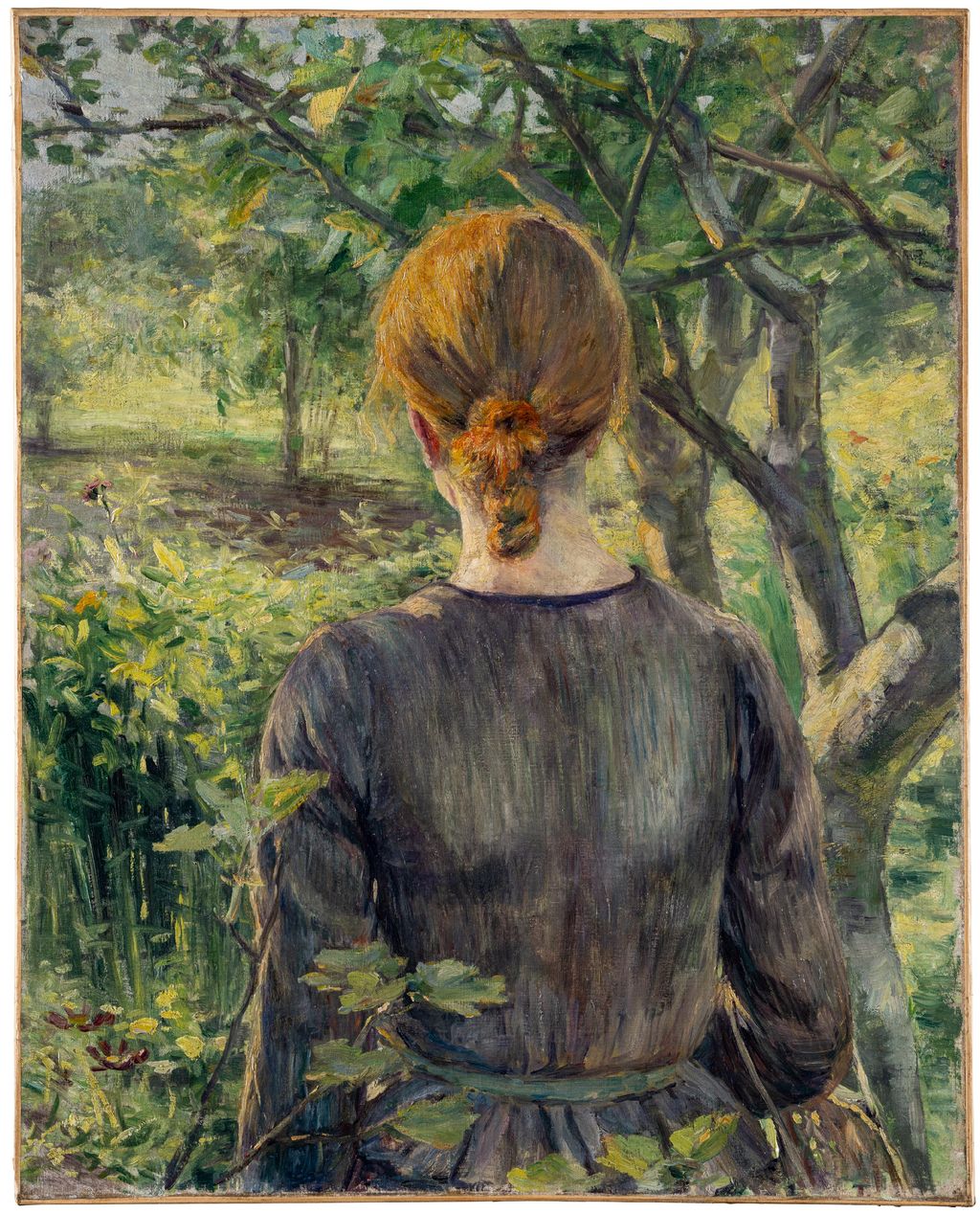
In Girl with Red Hair (《赤髪の少女》), dated 1892, the figure turns away from us among foliage. Her hair catches a warm light, while the upper body is comparatively dark and the surrounding leaves break into varied greens and yellows. ColBase describes this as particularly close to an Impressionist manner among Kuroda's French-period paintings. The picture supports that observation in its treatment of light, but it also refuses the usual portrait demand that the subject reveal her face. She belongs to the outdoor setting and yet does not become merely a colour accent. That tension between a particular human presence and the visible conditions around her will return in Lakeside. [8] [2]
A Japanese subject after France: Maiko
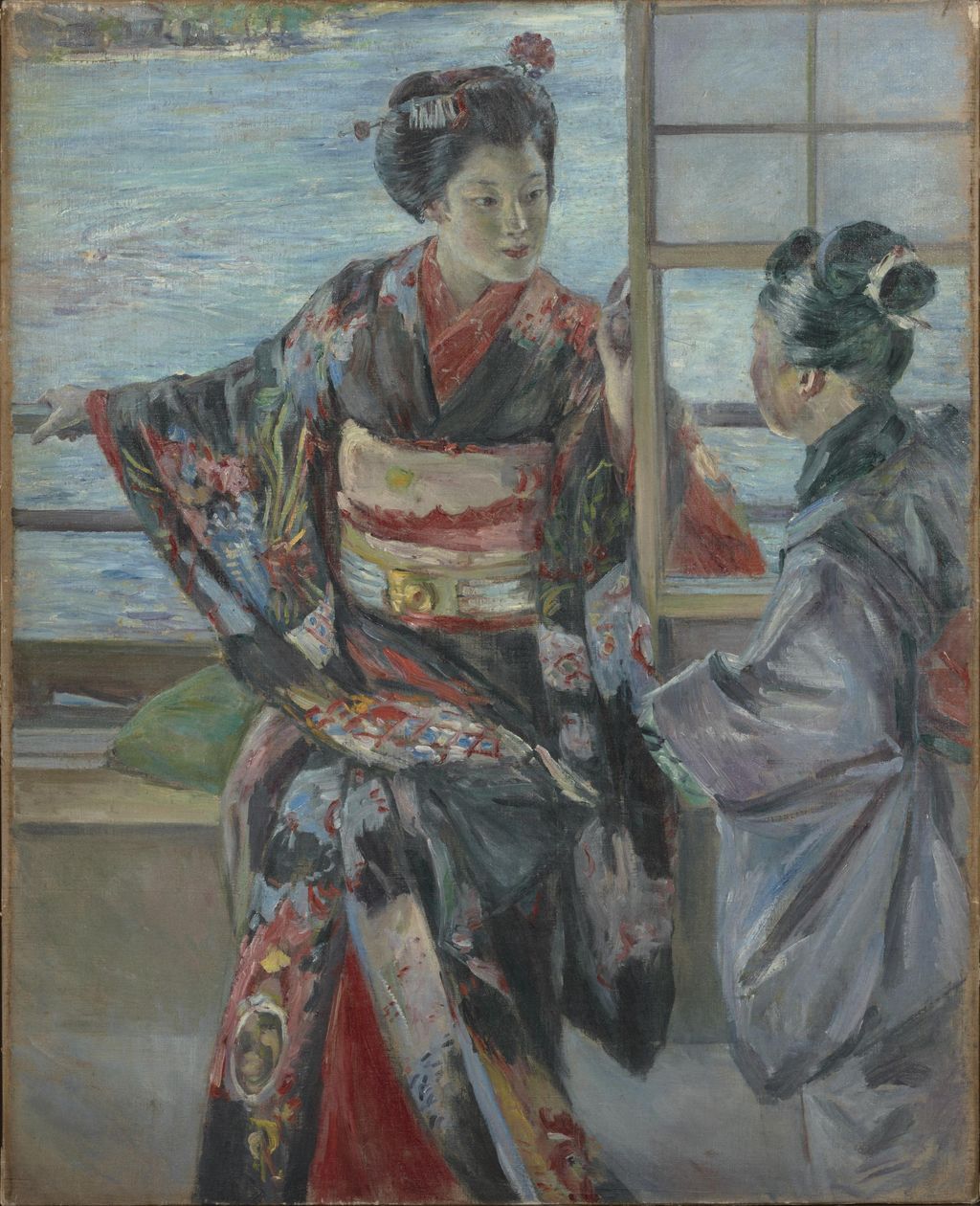
When Kuroda returned to Japan in 1893, he did not put aside the picture-making habits developed in France. His Maiko (《舞妓》) was painted that autumn in Kyoto. The Tokyo National Museum identifies the model as Koen (小ゑん), an apprentice entertainer at the Onotei, and describes the Kamo River behind the window. The painting is 80.4 × 65.3 cm. The eye moves first to the layered colours and patterns of her robe, then to the cooler water and the smaller attendant beside her. Strong light from beyond the room outlines the figures and interrupts any expectation that this is a costume portrait in a sealed interior. [9] [10]
The scene is particular, but it also carries the artist's view of its subject. Swift observes that Kuroda had encountered European pictures and performances in which the Japanese geisha had become an alluring visual type. She reads Maiko as a more complex return to such imagery: the apprentice's clothing and professional poise interested him, yet he painted her in the daylight of an actual Kyoto setting with another person present. This is a scholarly interpretation, not something an inventory field can establish. Looking at the robe's folds and the river lets us test part of it; deciding what Koen herself thought of the encounter would require evidence the painting does not give. [3] [9]
A public argument about the painted body
Another painting returned with Kuroda from France: Morning Toilette (《朝妝》), a life-sized nude begun in 1893. It was accepted by a French Salon, and Kuroda exhibited it at Kyoto's Fourth Domestic Industrial Exposition in 1895. The setting changed its reception. Critics in Japan argued about public decency, and the visibility of a female nude became a question about what an artwork could show, where it could be shown and who had authority to decide. That history should not be reduced to a story of enlightened painter versus ignorant public. A painting made within one exhibition culture was entering another with different social and institutional stakes. The finished canvas was destroyed in the Second World War; a surviving reproduction or study must be identified as such. [2] [1] [3]
Kuroda's subsequent triptych, Wisdom, Impression, Sentiment (《智・感・情》), makes the question harder. Each canvas contains a standing nude woman before a gold-toned background. The panels are not interchangeable. Seen left to right in the Institute's present display, they are Sentiment (《情》), Impression (《感》) and Wisdom (《智》); the overall title lists the concepts in a different verbal order. One figure lets long hair fall beside her body, one lifts both hands, and one touches her brow. Their height—180.6 cm each—makes them more than figure exercises to glance at from a book page. They were displayed at the second Hakubakai exhibition in 1897, revised, dated 1899 and presented in Paris in 1900 under the French title Études de Femmes. Each stage belongs to the object's history. [14] [15] [16] [17]
What precisely does each body mean? The names suggest allegory, but neither the poses nor the materials yield a single secure translation. The Tokyo research institute says interpretation of the title has remained disputed from the original showing to the present. Contemporary commentators tried to relate the figures to ideals and modes of painting; their arguments are evidence of reception, not a settled key left by Kuroda. Swift's chapter reads the work through both its Tokyo audience and its Paris presentation, where the title “Studies of Women” put a different stress on academic figure painting. The same three canvases could ask a Japanese viewer to consider an unfamiliar use of the nude and ask a Paris viewer to notice a Japanese artist's command of a familiar medium. Our page should let readers compare the three panels closely, then show where the documentary evidence stops. [17] [3]
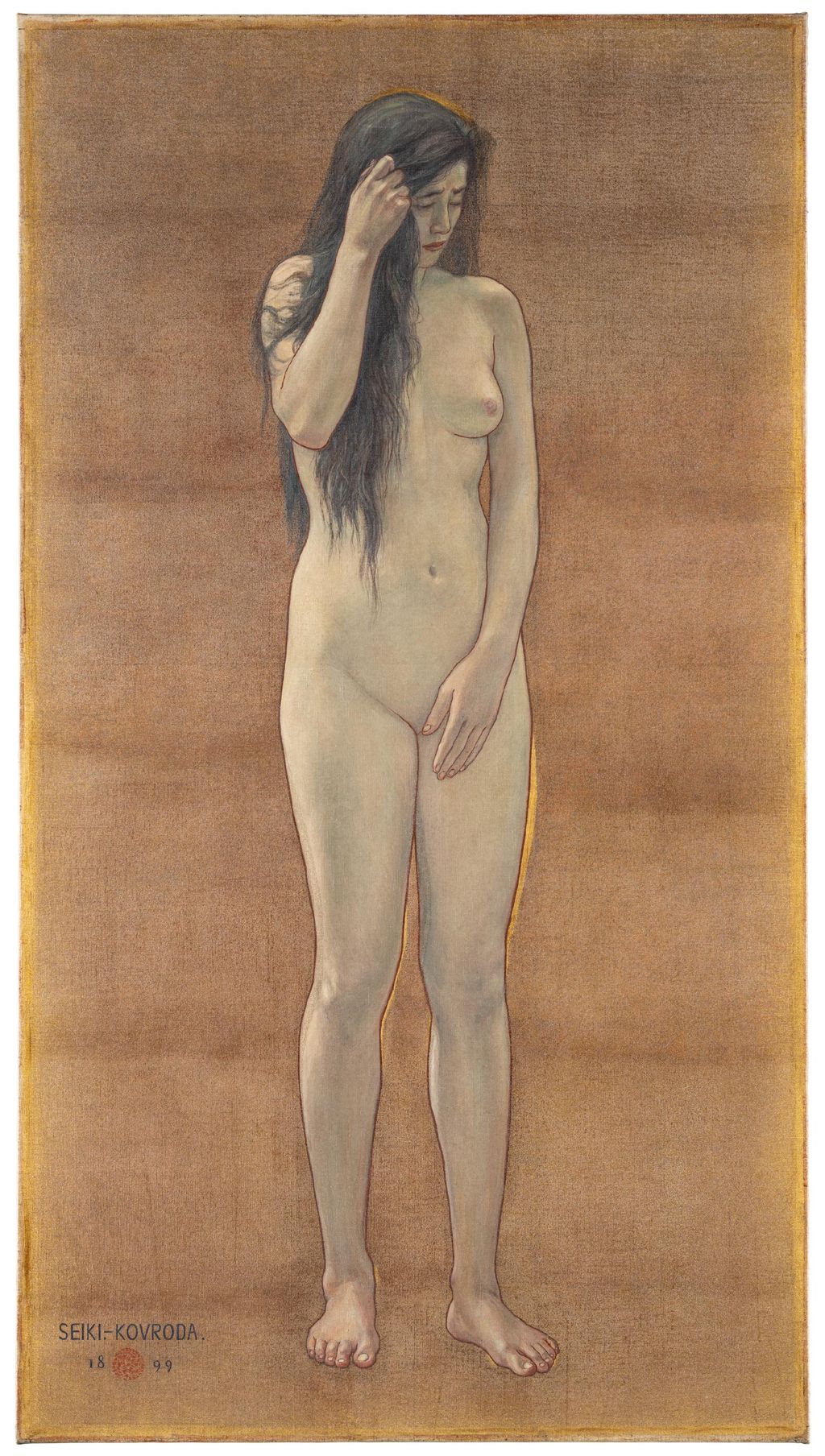
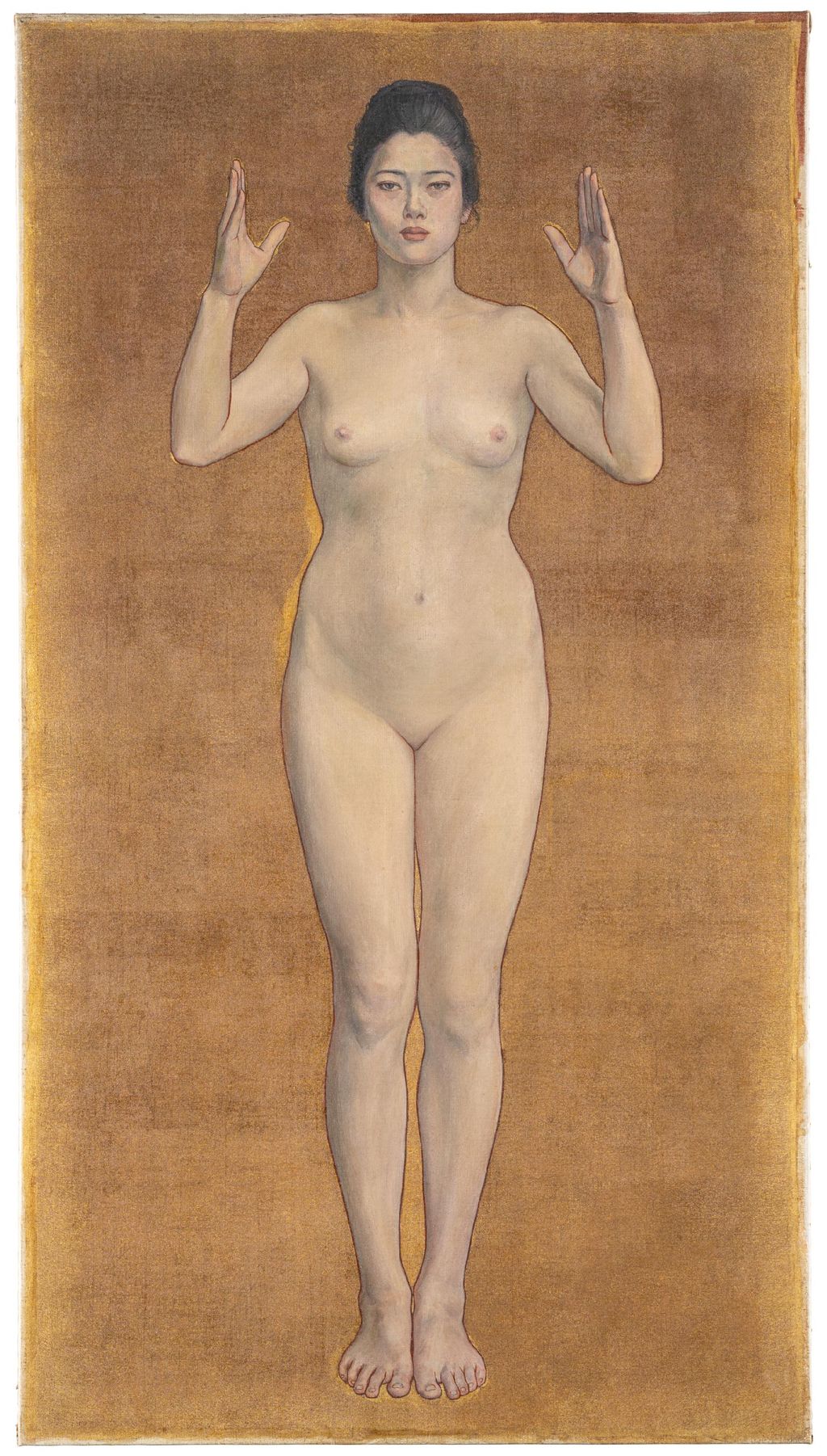
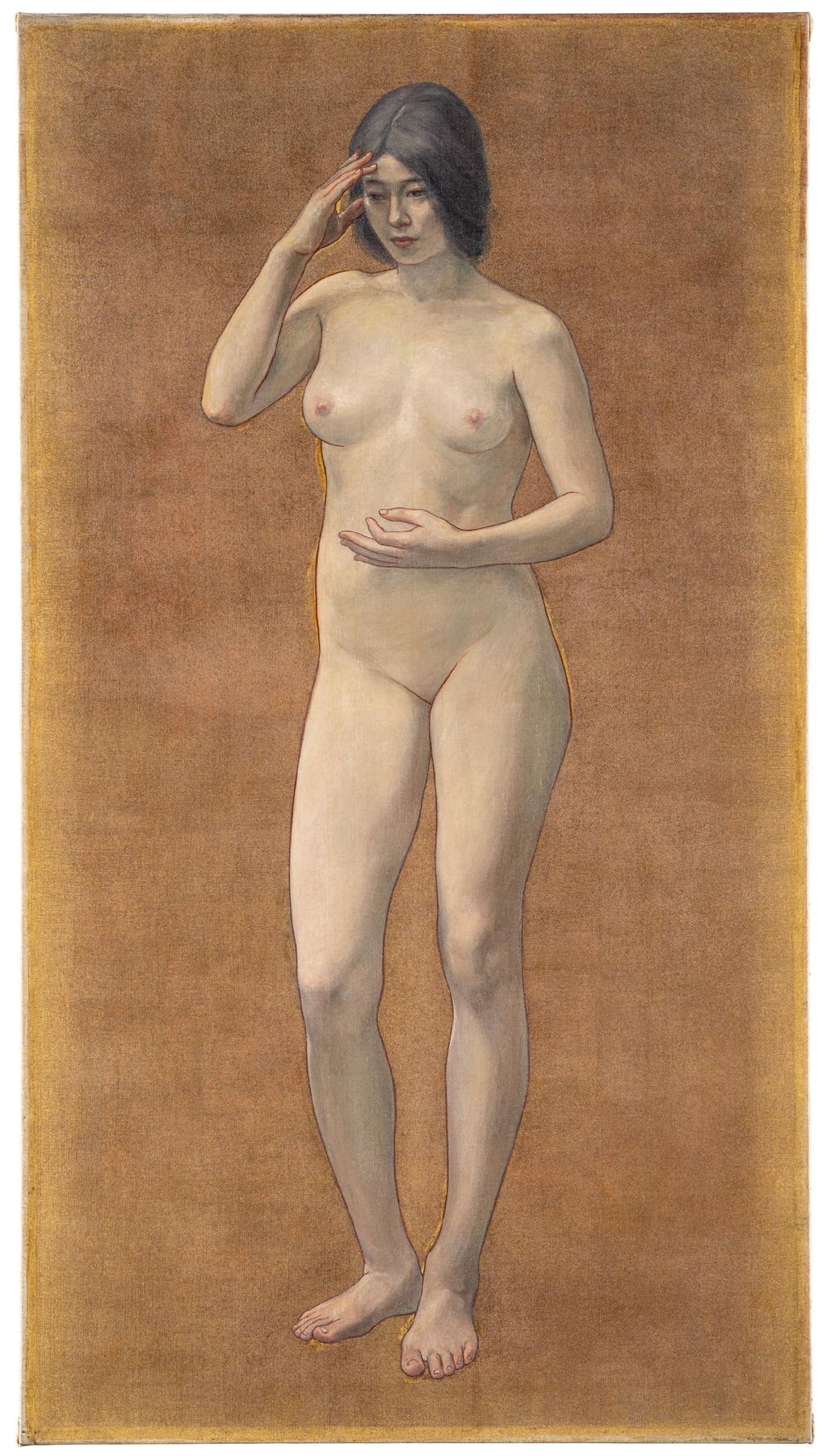
From left: Sentiment, Impression and Wisdom. Each panel is a distinct collection object, linked above.
The triptych also makes Lakeside more interesting. Both were seen at the 1897 Hakubakai exhibition. One offers named abstractions in three large nude figures; the other is a single clothed woman near a recognisable lake. It is too simple to assign “Europe” to the nudes and “Japan” to the summer scene. Kuroda built both pictures through learned decisions about bodies, surrounding fields and public meaning. Their different reception suggests how difficult it was for him to make oil painting speak across audiences. The actual questions are more concrete: how does a ground hold a body? How does a gesture become legible? When does a title make an ordinary scene into an idea? [2] [3] [17]
Lakeside: a summer place and a painted surface
Look closely at Lakeside
Choose a number to enlarge a detail from the retained ColBase original, then compare it with the whole picture and the explanation below.
Explained details
Fan and sleeve
The fan and stripes of the summer robe connect the sitter’s pose to the heat.
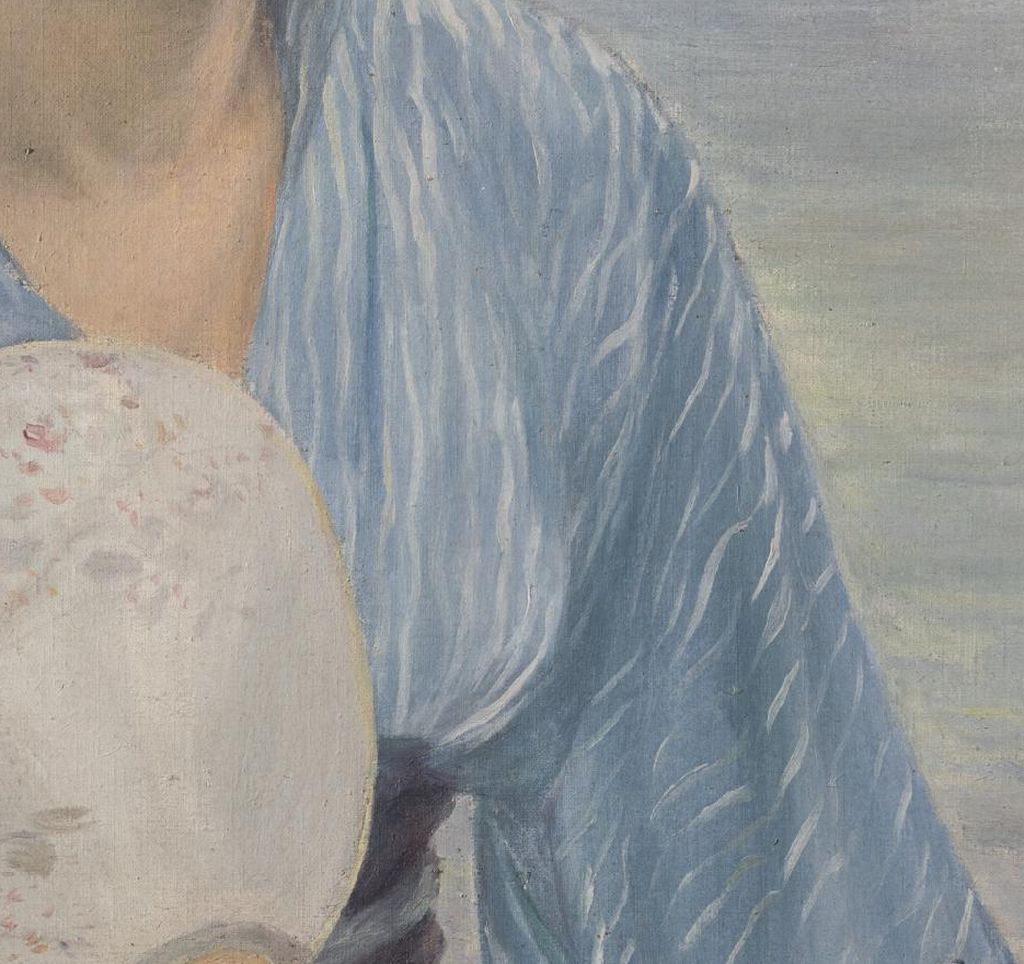
Source: ColBase, Tokyo National Museum. Object record. Editorial crop and resize.
Water and far shore
Follow colour from the water to the far shore to see the scale of the setting.
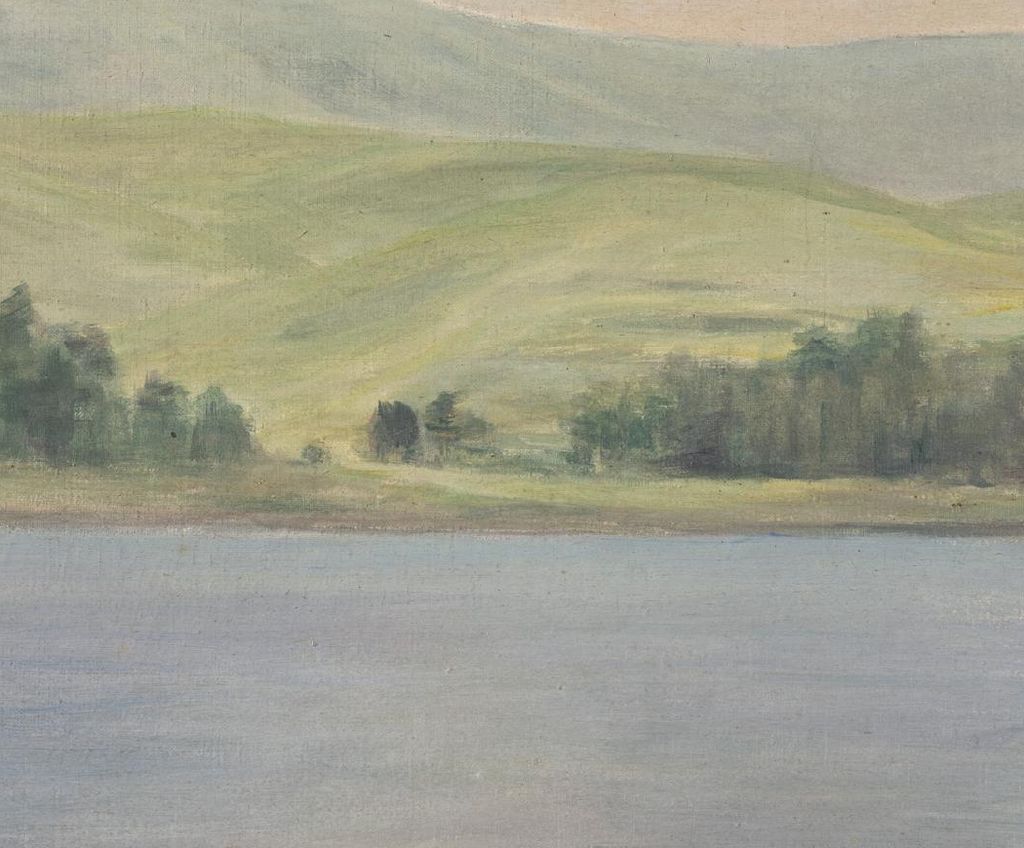
Source: ColBase, Tokyo National Museum. Object record. Editorial crop and resize.
Face and background
Read the face against its soft background without claiming pigment evidence from a JPEG.
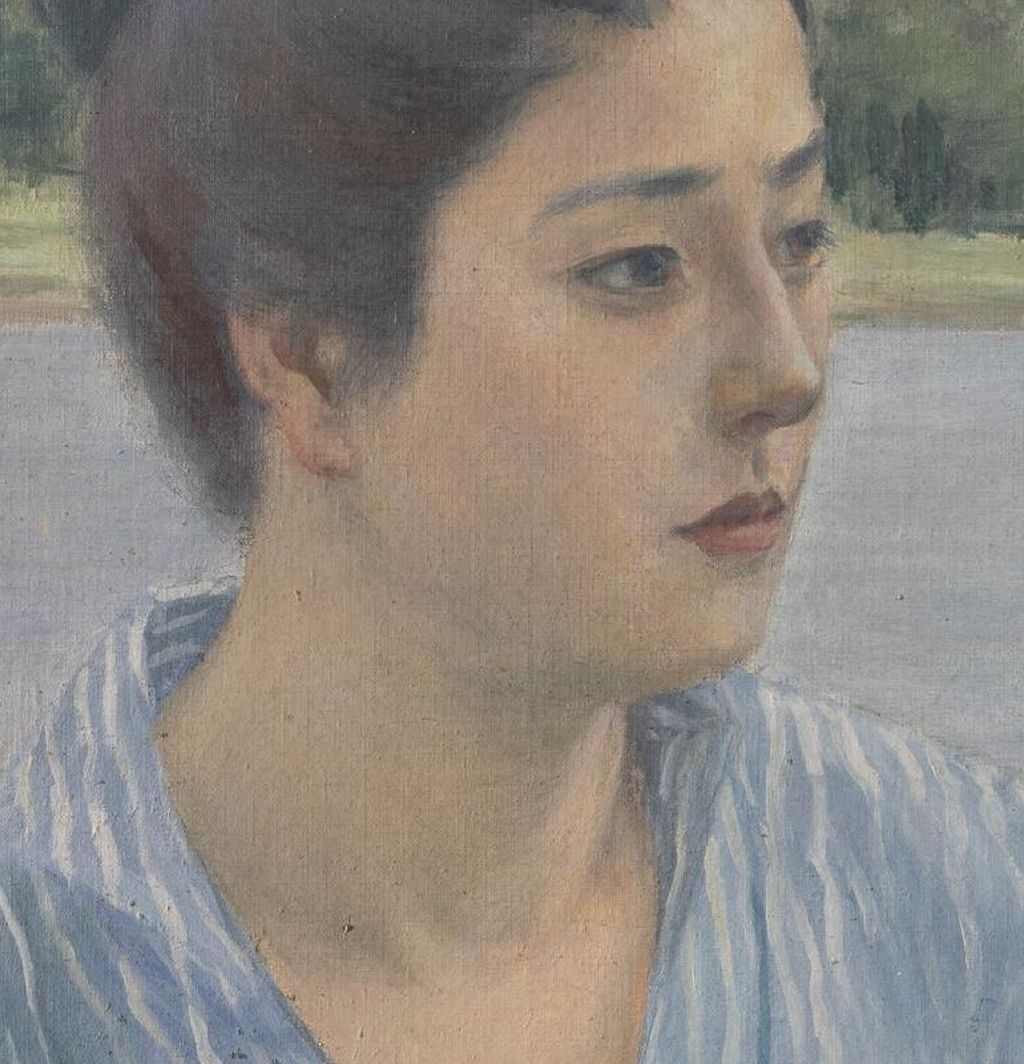
Source: ColBase, Tokyo National Museum. Object record. Editorial crop and resize.
Return now to Lakeside. The sitter was Kaneko Tane, later Kuroda Teruko. The Institute says he painted her over roughly a month at Lake Ashi during a 1897 summer stay. In her later account she recalled that Kuroda had been studying the water before asking her to sit with her fan. Such recollections bring the making of the painting closer, but they were given decades after the event. Swift cautions against treating every detail as a transcript of the working day. The securely documented facts are the 1897 date, the lake setting, the sitter identified by the institution, and the canvas itself. [11] [12] [13] [3]
The original exhibition title, 《避暑》, gives the fan and robe a function. The figure is seeking relief from heat; the still water offers a visual promise of coolness even while the air between us and the hills feels damp. The stripes of her yukata run across and down the body, while the horizontal lake stretches behind it. Her face turns away from direct contact with us, a small reserve within a composition that otherwise seems immediately accessible. These are observations a visitor can check in the ColBase reproduction. We need not claim that we know what she was privately thinking. A picture can suggest inwardness without being a record of thoughts. [11] [3]
The material facts complicate any description of Lakeside as merely a quick outdoor sketch. Swift reports conservation research finding a charcoal underdrawing beneath the painting, despite the lack of a separate surviving preparatory sheet. She also describes thin, matte paint and the absence of varnish as part of the work's pale atmospheric effect, citing the Institute's 2008 technical volume. These are technical findings drawn from conservation examination, not properties we can prove by zooming into an ordinary web image. They matter because the surface does not have to be loose by accident. Kuroda could control thickness, brightness and finish to give the landscape and figure the same humid air. A high-resolution annotated image should help readers see the fan, robe, water and distant bank while the text identifies which deeper material claims come from research. [3] [12]
Annotation direction for figure 1: prepare a separate 300dpi base from the retained 3,000 × 2,461 ColBase original. Three hotspots: (1) the fan and edge of the blue-striped sleeve, where summer activity meets pattern; (2) the painterly passage from water to far hillside; (3) the sitter's turned face against the pale background. The popup uses the shared site lightbox and names the enlarged part; a short explanation under the figure connects each detail to the paragraph above. Crop credits must state that the ColBase content was edited. The popup must never imply that its digital zoom exposes charcoal underdrawing or a pigment sample. [11] [12]
The painting travelled under different titles. The Institute documents 《避暑》 at the second Hakubakai exhibition, Au Bord du lac at the 1900 Paris exposition and the present title 《湖畔》 in later use. The shifting words changed what the picture first offered a viewer: an act of escaping summer heat, a lake-edge scene, or a concise place-name. This is not proof that Kuroda changed the paint each time. It is a reminder that the exhibited object met different languages and institutions. In 1967 the image appeared on a Japanese postage stamp, one reason the work became familiar well beyond museum visitors. A home page should distinguish the painting's original exhibition from its later national fame. [12] [3]
A picture that survives through its studies
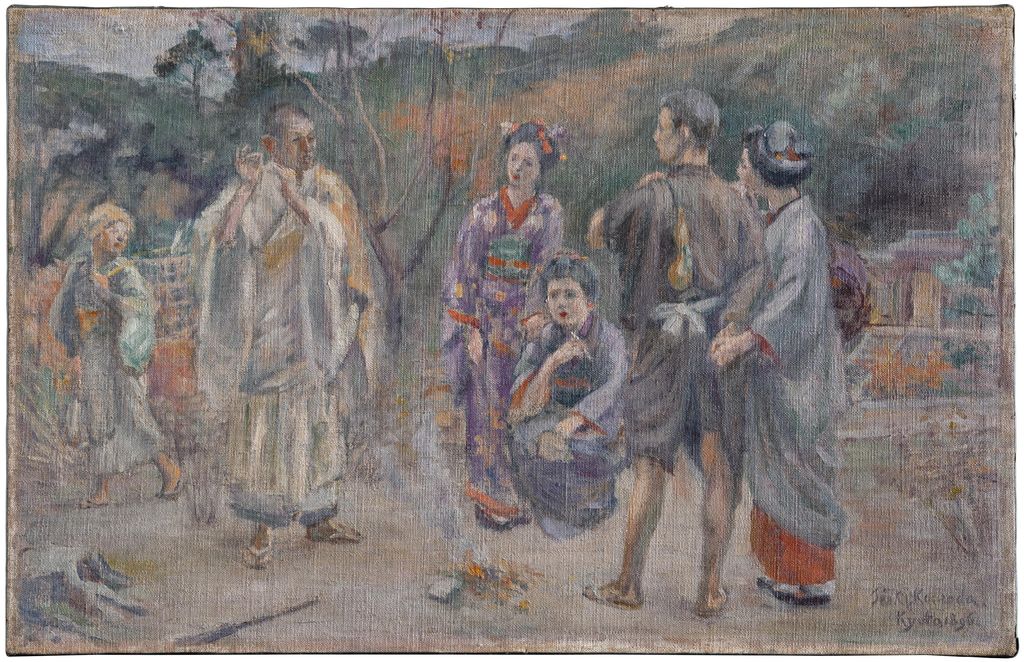
Kuroda wanted to make more than portraits and landscape studies. He argued for the ambitious composition, a planned picture in which figures and subject form a larger imagined whole. Talk on Ancient Romance (《昔語り》) grew from an episode associated with a temple visit in Kyoto and the story of Kogō. Money arranged through the Sumitomo family enabled extensive preparatory work. The Institute's account describes the charcoal drawings and painted studies through which Kuroda shaped the scene; it also records that the finished painting was lost in wartime bombing. A modern viewer can study the preparatory evidence, but not inspect the lost final surface. [2] [1]
The surviving Composition Study II (《昔語り》下絵(構図 II)), accession KU-a035, is not a convenient replacement photograph of the finished work. In its horizontal format, figures gather in a wooded scene: one stands or moves through the centre, others sit or turn beside him, and the surrounding trees leave a broken light. We can see Kuroda solving positions and relations rather than recording an instant from a literal historical event. The study itself is an oil painting, 41.1 × 63.3 cm, much smaller than the intended final picture. Comparing this sheet with the naturalness of Knitting or the apparent ease of Lakeside shows another side of his practice: planning a group subject and teaching students why such planning mattered. [18] [2]
Smaller pictures and the weight of public work
Kuroda's later responsibilities were substantial. The Tokyo Art School, Hakubakai exhibitions and the state-backed Bunten placed him in the machinery through which modern Japanese painting was taught, judged and promoted. He became a court artist in 1910; later he sat in the House of Peers and led the Imperial Academy of Fine Arts. His friend Kume remembered that these duties curtailed the time available for painting. That is an important contemporary view, but it should not become a rule that a small, late painting is merely evidence of failure to complete a grand academic work. Swift's dissertation questions this reading of late sketches as creative decline. We should look at the objects before deciding what “minor” means. [2] [3]
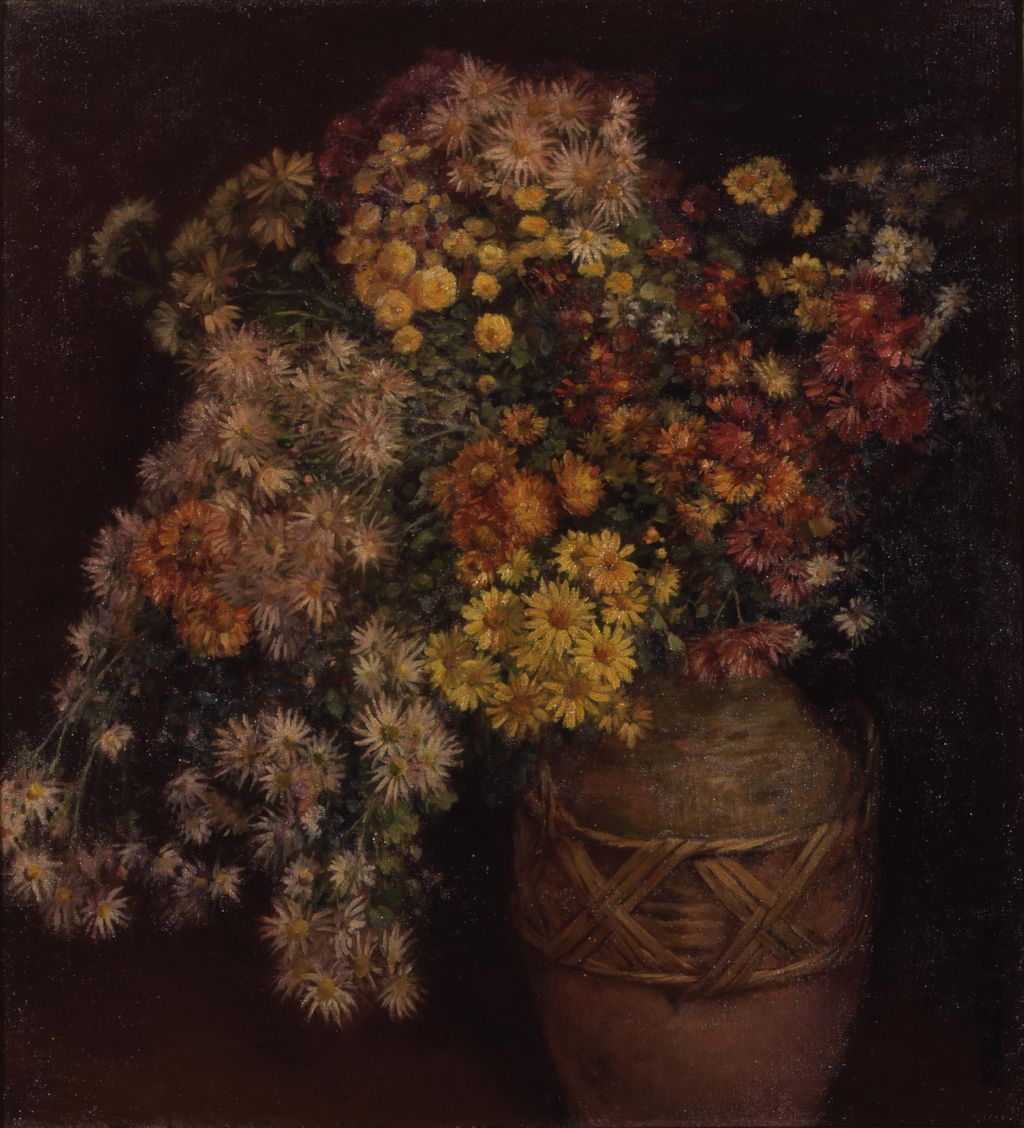
Vase of Flowers (《瓶花》), a 1912 oil on canvas in ColBase, offers one answer. Its dark field puts the crowded bouquet and ceramic vessel under close visual pressure. The individual blooms are not isolated botanical specimens; light catches pale petals and warm colours from different parts of the arrangement. The museum record contrasts its restrained construction with another Kuroda chrysanthemum painting in the Pola Museum. That comparison cannot be made fully from this image alone, so the page should say where the other work is held rather than imply both are reproduced. Vase of Flowers also demonstrates that an artist concerned with national exhibitions kept returning to a motif he could observe directly. [20]
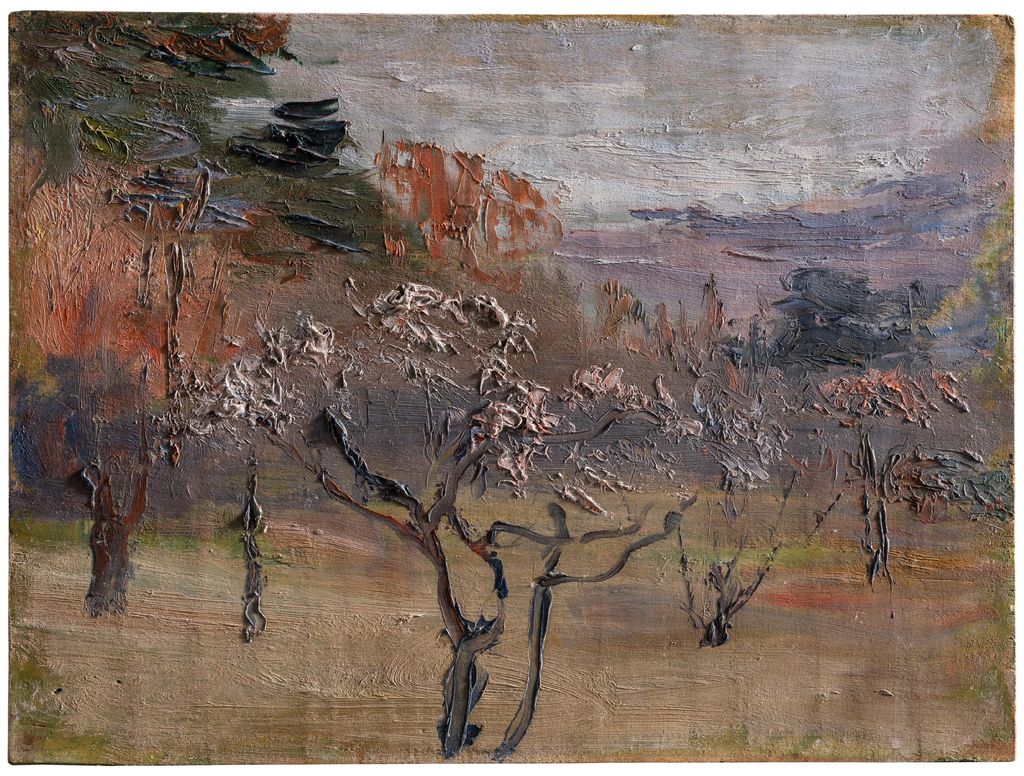
Near the end of his life, Kuroda painted Plum Grove (《梅林》) on a small board, 25.9 × 34.8 cm. ColBase dates it to 1924 and says he painted the garden from the detached part of a house being used as his sickroom; the museum calls it his last work. The modest tree and the muted space behind it invite slow attention. We cannot turn a view through the window into a full diagnosis of the artist's inner state. We can say that a painter who had promoted monumental composition also found a subject in the immediate garden. That coexistence is more revealing than judging the garden by the size of the tableau he did not paint. [19] [3]
What changed when the light changed?
The ten selected images invite a comparison more useful than attaching a single style label to the artist. In Knitting, daylight crosses a shutter and finds the hands and work of a woman seated indoors. The room still has weight: dark fabric and furniture make the window's brightness perceptible. In Reading, Kuroda narrows that encounter. The concentrated face, book and red blouse form the human centre, while the slatted light gives an everyday activity the visual seriousness of an exhibition painting. Both pictures use a model in a recognisable place; neither says simply that a painter went outdoors and began to be modern. [7] [5]
Girl with Red Hair changes the relation. We can still identify the person, but the face is withheld and the surrounding leaves claim more of our attention. There is no book to tell us what she is doing and no strong interior architecture to contain her. Kuroda lets the illuminated hair make a point of contact between figure and environment. That is why ColBase's observation about its particularly Impressionist manner is helpful, though it need not turn the whole career into an Impressionist one. The description names a specific feature of this particular work. [8]
In Maiko, the source of light lies beyond a room again, but the subject and viewer have changed. The river behind Koen identifies Kyoto; her layered clothing carries colours and patterns that make the body less immediately legible than Maria Billaut's red blouse. That difficulty is part of the picture's interest. The painting is neither a French village scene performed in Japanese costume nor an unchanged traditional portrait. It shows Kuroda adjusting what mattered in the picture: textile, human gesture and the sheen of moving water. The named sitter is a working performer, and the account should not flatten her into an abstract “Japanese beauty.” [9] [3]
Lakeside then moves the figure into the same air as her surroundings. The far hills are not a theatrical backdrop with every detail sharply stated. The water's calm surface, the pale distance and the sitter's blue robe act together. Her fan refers to heat even as its pale disc catches our eye. At a glance, the image feels easy and cooling; at length, its limited contrasts and thinly laid colour make that ease seem constructed. The record of its original 《避暑》 title makes the heat of a summer outing present even before we ask what particular light was falling at the lake that day. This is an example of how a title, physical object and visible composition should be read together. [11] [12] [3]
There is a human cost to using a painted woman as shorthand for a season or a national style. Maria Billaut can be named because institutional and diary records connect her to the Grez pictures; Koen is named in the Maiko object record; Kaneko Tane is named as the Lakeside model. Naming does not make their participation fully knowable. The pose was arranged by an artist, the picture entered an exhibition, and later viewers attached ideals to it. We can observe a sitter's gesture and cite a documented identity while refusing to invent her interior thoughts. In a cluster that also covers ukiyo-e portraits and modern nihonga, that habit will help readers compare artists without treating the pictured women as interchangeable types. [4] [9] [12]
How to look at Kuroda now
Begin with the exact object and its place in a sequence. Knitting and Reading put Maria Billaut in different indoor compositions at Grez. Girl with Red Hair draws a figure into outdoor light. Maiko sets a named apprentice entertainer by the Kamo River after Kuroda's return. The three panels of Wisdom, Impression, Sentiment let him test symbolic bodies before Japanese and Parisian audiences. Lakeside uses a figure and fan to make summer itself a subject. The study for Talk on Ancient Romance makes the planned labour visible where the final work is gone. Plum Grove brings the eye back to a small nearby place. These are changes in problem, scale and audience, not steps towards one inevitable final style. [4] [1] [3]
The word yōga identifies Western-style painting in Japan, but it should not tell a visitor in advance what each picture looks like. Kuroda worked with oil paint, academic drawing and plein-air effects; he also sought titles and subjects that would carry meaning in Japanese seasons, histories and public debates. He had European teachers and Japanese colleagues, models whose names are sometimes recoverable, and viewers who disagreed about what they saw. When we keep the work's medium, date, original title, accession and first audience visible, the large historical claim becomes easier to understand: he helped make oil painting one of the ways modern Japan could picture itself, while its possibilities remained contested. [2] [3]
The Kuroda Memorial Hall in Ueno is one place to continue that looking. Its highlighted works include Reading, Maiko, Lakeside and the triptych, though the special room has limited opening periods. The exact ColBase records linked from this article remain available for closer study at any time. A visitor should check the museum's current display schedule rather than assume a particular masterpiece is always on the wall. The separate biography can follow the man and institutions in full; dedicated artwork pages can take Lakeside and Reading beyond the overview into their dates, models, materials, exhibition histories and disagreements of interpretation. [21] [22]
Frequently Asked Questions
His paintings helped make oil painting a consequential form of modern art in Japan, while his teaching, the Hakubakai and national exhibition work changed how artists could train and show. The point is visible in exact works: a Salon painting made at Grez, a Kyoto maiko, a Hakone summer scene and a debated nude triptych demanded different things of painters and audiences. “Father of Western-style painting” is a familiar shorthand, not a claim that no Japanese painter used Western methods before him. [1] [2]
He studied outdoor light, and some works such as Girl with Red Hair look close to Impressionist handling. He also trained in academic figure drawing under Raphaël Collin, sought Salon acceptance and planned large compositions. The Japanese research institute distinguishes this blend of academic naturalism and plein-air effects from simply painting like Monet. Look at the specific work before applying the label. [2] [8]
The model was Kaneko Tane, later known as Kuroda Teruko. The Tokyo institute places the 1897 painting at Lake Ashi in Hakone and says it was first exhibited as 《避暑》, “Summering.” Her later recollection describes sitting by the water with a fan, but it should be read as a reminiscence rather than a minute-by-minute production record. [12] [11] [3]
It is a three-panel oil painting of standing female nudes, shown in 1897 and revised before its 1900 Paris display. The extant panels are catalogued separately as Sentiment KU-a055, Impression KU-a053 and Wisdom KU-a054. Their exact symbolic meanings remain debated; the title alone does not settle what each pose means. [17] [14] [15] [16]
Discussion
Compare the object record, the date of exhibition and later interpretations when reading Kuroda’s paintings.
Reader Insights
How does Lakeside change when you know its first exhibited title meant summer retreat?
How do shutter, book and hands structure the space?
What changes when you treat Wisdom, Impression and Sentiment as three distinct objects?
Join the Conversation
Share a documented example or reliable source below, keeping observation separate from inference.
References
- Tokyo National Museum, Kuroda Seiki, Master of Modern Japanese Painting: The 150th Anniversary of his Birth. 2016 retrospective overview and three-part career architecture; historical exhibition, not a current display schedule.
- Atsushi Tanaka, “The Life and Arts of Kuroda Seiki,” Tokyo National Research Institute for Cultural Properties. Detailed institutional essay, including France, teaching, 1895 controversy, Hakubakai and late public roles; original letters and memoirs are quoted there.
- Helen Swift, Cultural Crossings: Kuroda Seiki (1866–1924) and the Making of Japanese Western-Style Painting, Harvard University PhD dissertation, 2024. Relevant checked sections: chapter 1, pp. 57–85; chapter 2, pp. 121–150; chapter 3, pp. 161–212; chapter 4, pp. 216–259; epilogue, pp. 263–284. Art-historical interpretations are attributed; the thesis's embedded pictures are not site assets.
- Tokyo National Research Institute for Cultural Properties, “Kuroda Seiki and Grez-sur-Loing”. Japanese institutional account of village, international artist colony, Billaut household and exact Grez works.
- ColBase, Kuroda Seiki, Reading / 《読書》, A-10937. Tokyo National Museum object, 1891, oil on canvas, 98.2 × 78.8 cm; exact production-image source.
- Tokyo National Research Institute for Cultural Properties, Reading optical-research object page. Maria Billaut, original Salon title Lecture en été, 1891 Salon acceptance and 1892 Japanese showing. Research text only: its images carry separate terms.
- ColBase, Kuroda Seiki, Knitting / 《編物》, KU-a029. 1890, oil on canvas, 48.7 × 59.2 cm; exact production-image source.
- ColBase, Kuroda Seiki, Girl with Red Hair / 《赤髪の少女》, KU-a122. 1892, oil on canvas, 80.6 × 64.5 cm; institutional note on outdoor light and style.
- ColBase, Kuroda Seiki, Maiko Girl / 《舞妓》, A-11258. Tokyo National Museum object, 1893, oil on canvas, 80.4 × 65.3 cm; names the model Koen and Kamo River setting.
- Tokyo National Research Institute for Cultural Properties, Maiko optical-research object page. Date, dimensions and Kyoto context; its high-resolution research image is not the selected production file.
- ColBase, Kuroda Seiki, Lakeside / 《湖畔》, KU-a117. Tokyo National Museum object, 1897, oil on canvas, 69.0 × 84.7 cm; exact production-image source.
- Tokyo National Research Institute for Cultural Properties, Lakeside optical-research object page. Sitter, Lake Ashi, 《避暑》 and Au Bord du lac titles, 2008 conservation research and later stamp circulation; its optical image is not a production asset.
- Tokyo National Research Institute for Cultural Properties, Japanese Lakeside study. The model's retrospective account and the 1897/1900 exhibition history; useful for the later dedicated page.
- ColBase, Kuroda Seiki, Sentiment / 《智・感・情のうち情》, KU-a055. Left panel, 1899, oil on canvas, 180.6 × 99.8 cm.
- ColBase, Kuroda Seiki, Impression / 《智・感・情のうち感》, KU-a053. Centre panel, 1899, oil on canvas, 180.6 × 99.8 cm; its object note describes the Paris title.
- ColBase, Kuroda Seiki, Wisdom / 《智・感・情のうち智》, KU-a054. Right panel, 1899, oil on canvas, 180.6 × 99.8 cm.
- Tokyo National Research Institute for Cultural Properties, Wisdom, Impression, Sentiment optical-research object page. 1897 showing, 1899 revision, Paris title, component order and debated interpretation.
- ColBase, Kuroda Seiki, Talk on Ancient Romance, Composition Study II / 《昔語り》下絵(構図 II), KU-a035. 1896 oil study, 41.1 × 63.3 cm; not the destroyed final painting.
- ColBase, Kuroda Seiki, Plum Grove / 《梅林》, KU-a093. 1924, oil on board, 25.9 × 34.8 cm; museum record calls it his last work.
- ColBase, Kuroda Seiki, Vase of Flowers / 《瓶花》, A-863. 1912 oil on canvas, 78.8 × 71.2 cm; exact identity corrects an earlier discovery lead.
- Tokyo National Museum, Kuroda Memorial Hall Collection Highlights Gallery object list. Exact principal object accessions and historically described special-room display pattern; consult the current museum page for a visit.
- ColBase, official reuse FAQ and the Institute's Kuroda image-use procedure. ColBase files may be commercially reused with source credit and editing disclosure; other Institute image files have separate application terms.
- ColBase, Kuroda Seiki, Self-Portrait in a Turkish Cap / 《自画像(トルコ帽)》, KU-a002. 1889, oil on canvas, 40.5 × 30.7 cm.