 by Tom Gurney
Tom Gurney BSc (Hons) is an art history expert with over 20 years experience
Published on June 19, 2020 / Updated on August 2, 2026
Email: tomgurney1@gmail.com / Phone: +44 7429 011000
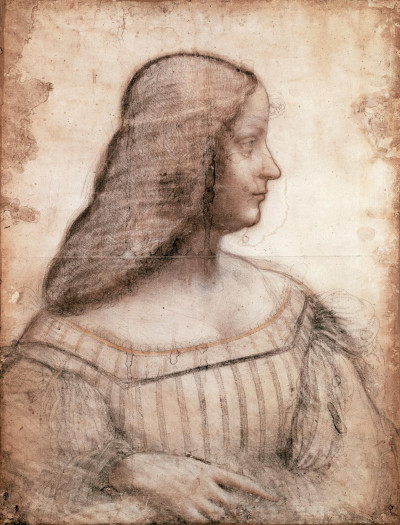
Portrait of Isabella d’Este
Portrait of Isabella d’Este is a portrait drawing rather than a finished painting. The Louvre identifies the work as Portrait d’Isabelle d’Este, dates it to around 1499/1500, assigns it to Leonardo, and records it under inventory number MI 753, Recto, in the Department of Prints and Drawings.[1] It is one of the most important surviving traces of Leonardo’s contact with Isabella d’Este, Marchioness of Mantua, but the Louvre frames it as a cartoon, or full-scale preparatory drawing, connected with a painting that Leonardo probably never began.[1]
That makes the sheet unusually revealing. It shows Leonardo responding to one of the most formidable patrons of the Italian Renaissance at a moment of political disruption, artistic transition and personal mobility. The drawing was made when Leonardo had left Milan after the French conquest of the duchy and passed through Mantua in the closing months of 1499 or the opening months of 1500 [1]. Isabella was not a passive sitter waiting to be represented. She was a cultured, ambitious and exacting patron whose court interests ranged from antiquity and poetry to painting, music and collecting [4]. Leonardo’s drawing belongs to that courtly world, yet it also resists some of its conventions.
The sheet presents Isabella in profile, a pose associated with dynastic clarity, medallic dignity and court portraiture. But the profile is not static. The Louvre’s 2019 Leonardo exhibition account describes Leonardo as turning the traditional profile into the result of movement, as if Isabella had just turned during conversation [3]. That idea gives the drawing much of its force. Leonardo accepts the courtly demand for profile likeness, then quietly makes the pose feel alive.
At a Glance
- ArtistLeonardo da Vinci
- TitlePortrait of Isabella d’Este
- DateAround 1499/1500
- Object typeDrawing / portrait cartoon
- MediumMetalpoint, charcoal, red chalk and stump, yellow ochre chalk, white highlights on prepared paper
- Dimensions61 × 46.5 cm
- CollectionMusée du Louvre, Department of Prints and Drawings
- InventoryMI 753, Recto
- Access noteView by appointment in the prints and drawings reference-room context
- Page focusIsabella d’Este, profile portraiture, transfer-pricking, absent painting and related copies
Contents
- Introduction
- At a Glance
- A Portrait Cartoon from Leonardo’s Mantua Pause
- Isabella d’Este and the Profile Tradition
- A Profile That Feels Like Movement
- Materials, Surface and Technique
- Pricking, Transfer and the Absent Painting
- Damage, Missing Edges and Related Copies
- Provenance and Present Louvre Status
- Why the Drawing Matters
A portrait cartoon from Leonardo’s Mantua pause
The historical setting is unusually precise for a Leonardo portrait project. The Louvre explains that the drawing was executed during Leonardo’s passage through Mantua after he left Milan, which had fallen to the French, between the last months of 1499 and the first months of 1500 [1]. The Louvre’s 2019 exhibition summary gives the same context: Louis XII’s army conquered Milan in September 1499, Leonardo left Lombardy in December, and during his stay in Mantua he drew a cartoon for Isabella d’Este’s portrait [3].
This background helps the page avoid a common simplification. The drawing is not simply “a portrait of a noblewoman.” It belongs to a moment when Leonardo’s Milanese career had been interrupted and when Isabella was trying to secure work from artists whose fame could enhance the cultural authority of Mantua. The National Gallery’s glossary describes Isabella as an enthusiastic and demanding patron who energetically pursued artists she admired, and notes that she hoped to obtain a work by Leonardo [4].
The word “cartoon” has a specific Renaissance meaning here: a full-scale preparatory drawing used to develop or transfer a composition. The Louvre’s catalogue commentary states that the sheet was pricked for transfer, suggesting a link with a planned painting.[1] The same notice also states that no painted version is known and that Leonardo probably never began the painting.[1] The known work is therefore Leonardo’s portrait cartoon of Isabella d’Este, associated with a projected painting that remained unrealised.
Isabella d’Este and the profile tradition
Isabella d’Este was born in 1474, educated at the court of Ferrara and married Francesco Gonzaga of Mantua in 1490 [4]. Those facts explain why a profile portrait would have been meaningful. Profile likenesses in Italian court culture could evoke medals, rulers, antiquity and dynastic presence. They turned a living sitter into a public image of rank and continuity.
The National Gallery’s account of Isabella stresses her classical education, her move from Ferrara to Mantua, and her persistent pursuit of major artists [4]. The Louvre’s Mantegna exhibition material places her studiolo within the humanist court culture of Mantua and notes that she sought the work of artists including Leonardo [6]. She was therefore not merely the subject of portraiture; she was a patron who understood how images, collections and intellectual display could shape reputation.
Leonardo’s drawing begins from that courtly expectation. Isabella is shown in profile, and the long line of forehead, nose, lips and chin gives the sitter the clarity expected from an elite portrait. But the drawing does not feel like a coin, a medal or a fixed emblem. It suggests a human presence caught in transition. That is where Leonardo’s invention enters.
A profile that feels like movement
The Louvre’s commentary is especially useful because it warns against reading the profile as a simple formula. In its 2019 exhibition account, the museum explains that Leonardo broke with tradition by making the profile seem like the result of movement rather than a chosen pose [3]. The collection record makes a similar point when it describes the profile as the endpoint of a movement, with Isabella seized in conversation as she turns [1].
This is the drawing’s central visual idea. Isabella is recognisable through profile convention, yet the profile has been animated. The head does not simply sit in a heraldic arrangement. It seems to arrive at profile through turning. The portrait therefore holds together two demands: Isabella’s need for courtly representation and Leonardo’s interest in bodily motion, perception and psychological immediacy.
That balance links the sheet to Leonardo’s larger portrait practice without forcing it into a direct sequence. The drawing is not the Mona Lisa, and it should not be made to carry the mythology of Leonardo’s later portraits. But it does show the same artist thinking about how a sitter can feel present, not merely described. Movement, attention and the implied moment matter as much as outline.
Materials, surface and technique
The Louvre records the drawing’s dimensions as 61 by 46.5 centimetres [1]. POP, the French cultural heritage database, gives the same measurements in metres as 0.610 by 0.465 [5]. The materials are complex: metalpoint, charcoal, red chalk and stump, yellow ochre chalk, white highlights and prepared paper are all part of the Louvre record [1]. POP similarly lists black chalk, red chalk, stump, white heightening, prepared white paper and ochre chalk [5].
The physical description matters because the portrait’s delicacy is not produced by one medium alone. Leonardo uses a combination of dry materials to construct the face, hair, veil, throat, clothing and hand. The Louvre notes a first black-chalk tracing visible in several areas, including the face, hair, veil, neck and garment [1]. It also records white preparation and lead-white components identifiable through X-ray fluorescence [1]. The Louvre’s Department of Prints and Drawings record repeats the same object identity within the museum’s specialist graphic-arts catalogue, which makes it a useful supporting page for later technical and catalogue checks [2].
Those facts make the sheet more specific than a generic “chalk portrait.” It is a worked portrait cartoon on prepared paper, combining line, tonal modelling and selective heightening. The sheet has the authority of a full-scale design and the vulnerability of paper: its surface records planning, correction, use and damage.
Pricking, transfer and the absent painting
The sheet was pricked with a needle. That is one of its most important object facts. Pricking could allow a design to be transferred by dusting or rubbing pigment through small holes. The Louvre says the fact that the cartoon is pricked for transfer suggests it may have been the drawing Leonardo kept in order to make a painting, although the painting was probably never begun [1].
At the same time, the pricking should not be treated too simply. The Louvre record includes Bruno Mottin’s technical interpretation that the pricking appears late, dense and mechanical, and that it was probably not done under Leonardo’s direction [1]. In other words, the holes confirm that the sheet was used in relation to transfer, but they do not prove a straightforward Leonardo-supervised transfer into a lost painting.
That distinction is important. The drawing was pricked for transfer and connected with the idea of a painted portrait, but it does not prove that Leonardo completed such a painting, or that a lost Leonardo oil portrait of Isabella certainly once existed. The known object is the Louvre drawing. Copies after the model exist, but the painted version remains absent.
Damage, missing edges and related copies
The drawing does not survive in a pristine state. The Louvre notes that the side and lower edges of the sheet are missing because of water damage and other losses [3]. The collection record also states that the lower part has been cut by a few centimetres, making the relationship of the arms and lower composition harder to understand [1].
This is where related copies become useful, but only as supporting evidence. The Louvre record says an old copy of the portrait at the Ashmolean Museum in Oxford gives an idea of the missing parts [1]. The British Museum also holds a drawing after Leonardo, described as a portrait of Isabella d’Este in profile, and its curator’s comments identify it as an idealised copy related to the Louvre drawing or to another copy after it [7].
Those related drawings should not displace the Louvre sheet as the governing object. They help explain the lost or altered lower portion and the transmission of the portrait type. They clarify why the Louvre drawing is both complete enough to define the portrait and damaged enough to require caution about the original full design.
Isabella as sitter and patron
Isabella d’Este’s role gives the drawing much of its historical interest. She was the Marchioness of Mantua, a cultivated patron and a collector whose ambitions shaped the artistic life of her court [4]. The Louvre’s Mantegna material describes her studiolo as a private intellectual space rooted in humanist court culture and notes her pursuit of leading painters for its decoration [6].
This matters because the portrait was not simply a personal likeness. It belonged to the same world in which Isabella used art to construct identity, intellect and prestige. A portrait by Leonardo would have been more than a record of appearance. It would have signalled her place among the most sophisticated patrons of her generation.
Leonardo’s response is therefore tactful and inventive. He honours the profile format associated with status, but he refuses to let it become inert. The sitter seems to turn. Her presence is formal, but not frozen. That is why the drawing is so important even without a finished painting.
Provenance and present Louvre status
The Louvre record traces the sheet through earlier owners including Bartolommeo Calderara, Vittoria Pelulso, Domenico Pino and Giuseppe Vallardi before its acquisition by the Musée Impérial in 1860 [1]. POP likewise gives the legal status as French state property, acquired by purchase for the Louvre’s Department of Prints and Drawings in 1860 [5].
The current-location note also needs careful wording. The Louvre collections record places the work in the Nouvelle réserve des pièces encadrées and states that it can be viewed by appointment in the reference room for prints and drawings [1]. This means the drawing should not be described as if it were on ordinary permanent gallery display. It is in the Louvre collection, but its access conditions are those of a works-on-paper object.
That point is practical as well as scholarly. Drawings are light-sensitive and fragile. Their display is often limited, and collection pages can change as conservation, loans or appointments change. Current location phrasing should therefore remain tied to the Louvre record rather than to a broad “on display” claim.
Relationship to Leonardo’s portrait thinking
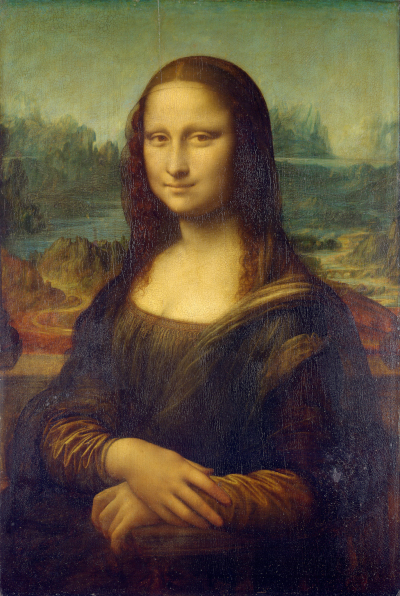
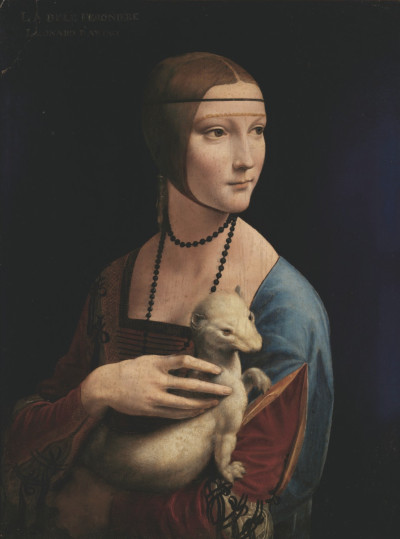
The Portrait of Isabella d’Este belongs naturally beside Leonardo’s other portrait pages, but it occupies a different category. Ginevra de’ Benci, Lady with an Ermine, La Belle Ferronnière, Portrait of a Musician and the Mona Lisa are painting-led pages with their own collection and attribution questions. Isabella is a drawing-led page, governed by paper, transfer, damage and the absence of the painting that the sheet may have anticipated.
That difference is not a weakness. It lets readers see Leonardo’s portrait intelligence at the planning stage. The sheet shows how he could take a powerful sitter and a courtly format, then turn the format into something more alive. It also shows how drawings carried ideas across media: from observation to cartoon, from cartoon to possible transfer, from transfer to copies, and from copies back into art-historical reconstruction.
Comparisons work best when they remain selective. The drawing connects naturally to Leonardo’s portraits, drawings and paintings, but those comparisons do not make Isabella’s lost painted portrait a known surviving work, and later copies cannot substitute for the Louvre sheet.
What not to overclaim
The Louvre names Leonardo as artist, dates the sheet around 1499/1500 and identifies it as a portrait of Isabella d’Este.[1] Those facts are strong. The absent painting, later pricking, missing sheet edges and related copies add caution without weakening the drawing’s central status.
The drawing is not a finished portrait painting by Leonardo. The pricking does not prove that Leonardo personally transferred the design. The surviving sheet is physically incomplete. Related works at Oxford or the British Museum help explain the image’s transmission, but they are not replacements for the missing portions. Isabella’s psychology also has to remain grounded in what the drawing and sources can support.
The evidence supports a clear reading: this is a major portrait cartoon by Leonardo in the Louvre, made during his Mantuan pause around 1499/1500, connected with Isabella d’Este’s patronage, pricked in relation to transfer, damaged at the edges, and central to understanding how Leonardo animated a courtly profile.
Why Portrait of Isabella d’Este matters
Portrait of Isabella d’Este matters because it captures a meeting between a demanding patron and an artist whose career was in motion. Isabella wanted images that matched her status, intellect and ambition. Leonardo brought to that request a mind trained to notice movement, transformation and the instability of fixed poses.
The sheet is not a finished painting, but it may be more revealing for that reason. It preserves the point at which portraiture is still becoming. The profile has been chosen, but it seems to turn. The cartoon has been prepared, but the painting never arrives. The sheet has been pricked, damaged and copied, yet the force of the design remains legible.
Within Leonardo’s work, the portrait stands as a drawing-led portrait: not a lesser substitute for a painting, but a different kind of evidence. It shows Leonardo thinking through likeness, courtly expectation and movement on paper. Source-led caution lets the drawing speak clearly.
Frequently Asked Questions
Discussion
Use this space to discuss Portrait of Isabella d’Este, its source evidence and how it fits into Leonardo da Vinci's wider cluster.
Keep comments focused on close looking, attribution language, object evidence and page-specific caveats.
Reader Insights
Which detail on this page most changes how you read the work?
How does this page connect to Leonardo's paintings, drawings, inventions or workshop context?
Where should the wording stay cautious because the source evidence is qualified?
Join the Conversation
Share your reading of Portrait of Isabella d’Este below.
References
- Musée du Louvre, Portrait d'Isabelle d'Este, collection record, MI 753, Recto. https://collections.louvre.fr/en/ark%3A/53355/cl020111146
- Musée du Louvre, Département des Arts graphiques, Portrait d'Isabelle d'Este, detailed graphics record. https://arts-graphiques.louvre.fr/detail/oeuvres/0/111146-Portrait-dIsabelle-dEste
- Musée du Louvre, Leonardo da Vinci 1452-1519, 2019 exhibition digital publication, entry for Portrait of Isabella d’Este. https://mini-site.louvre.fr/trimestriel/2019/l%C3%A9onard_de_vinciGB/82/
- National Gallery, London, Isabella d'Este, Marchioness of Mantua, glossary. https://www.nationalgallery.org.uk/paintings/glossary/isabella-d-este-marchioness-of-mantua
- Ministère de la Culture, POP/Joconde, Portrait d'Isabelle d'Este, notice 50350111146. https://pop.culture.gouv.fr/notice/joconde/50350111146
- Musée du Louvre, Le Studiolo d’Isabelle d’Este, Mantegna exhibition material. https://mini-site.louvre.fr/mantegna/acc/xmlfr/section_8_1.html
- British Museum, drawing after Leonardo, Portrait of Isabella d'Este, museum number 1940,0413.59. https://www.britishmuseum.org/collection/object/P_1940-0413-59