 by Tom Gurney
Tom Gurney BSc (Hons) is an art history expert with over 20 years experience
Published on June 19, 2020 / Updated on July 28, 2026
Email: tomgurney1@gmail.com / Phone: +44 7429 011000
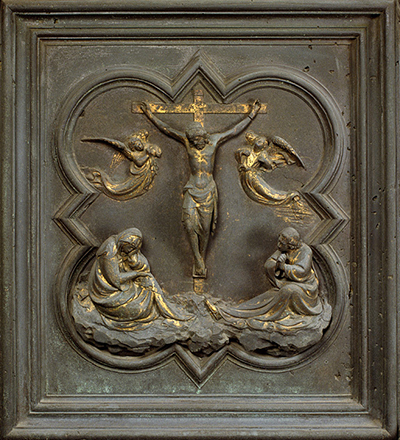
Lorenzo Ghiberti answers the crowded Way to Calvary with an unusually sparse Crucifixion. Christ hangs alone on the central cross. Mary and John sit or collapse on the rocky ground below, while two mourning angels curve inward from the upper lobes. Broad areas of exposed bronze intensify isolation and grief.
Contents
Position on the North Door
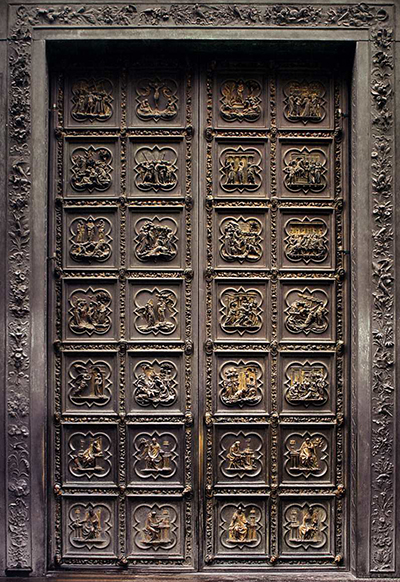
The relief occupies the uppermost narrative level of the left leaf, paired with the Way to Calvary. Opera del Duomo identifies it as the first scene from the top in the right column of that leaf.[1][2]
The North Door was made between 1403 and 1424. The original is now in the Museo dell'Opera del Duomo, while a copy occupies the Baptistery's exterior. The catalogue reports the panel within a proposed Krautheimer phase around 1407–1413/15. This is a modern stylistic reconstruction, not a documented execution date.
The isolated cross
Christ's body and the cross create a strict central axis. No crowd presses around the base, and no extensive architecture competes with the silhouette. The empty field makes the suspended body appear both exposed and remote.
Matthew 27:33–56, Mark 15:22–41, Luke 23:33–49 and John 19:17–37 establish the Crucifixion. Ghiberti selects a concentrated devotional group rather than representing the full range of people described across the Gospel accounts.[3]
Mary, John and the angels
Mary and John occupy the lower lobes on either side. Their lowered bodies answer the elevated cross, giving grief physical weight. Above them, two angels curve inward, their movement framing rather than filling the empty space.
The result is bilateral without becoming emotionally neutral. Each side responds to the same central loss, but the poses remain individual.
Emptiness after procession
The contrast with the paired Way to Calvary is essential. There, cross, weapons and bodies compete within a congested field. Here, the cross stands clear and the supporting figures are reduced to four mourners.
First trace the central vertical, then compare the two figures below and the angels above. Finally, attend to the unoccupied bronze between them. Ghiberti makes absence an active compositional element: the emptied field slows the narrative and turns public execution into concentrated lamentation.
Discussion
Ghiberti rewards slow looking: relief, gilding, narrative structure, workshop practice and conservation evidence can all change how a work is read.
Join the Conversation
Have an observation about Crucifixion, a source to add, or a comparison that sharpens the reading? Share it below.
References
- Opera del Duomo scientific catalogue, Crucifixion
- Opera del Duomo scientific catalogue, North Door
- Matthew 27:33–56; Mark 15:22–41; Luke 23:33–49; John 19:17–37.