 by Tom Gurney
Tom Gurney BSc (Hons) is an art history expert with over 20 years experience
Published on June 19, 2020 / Updated on July 28, 2026
Email: tomgurney1@gmail.com / Phone: +44 7429 011000
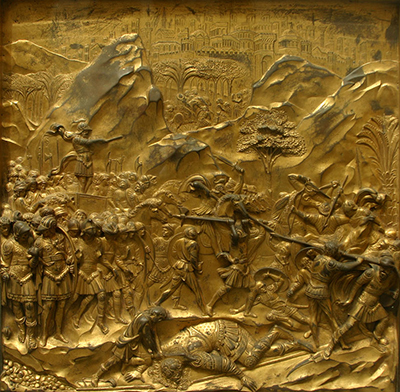
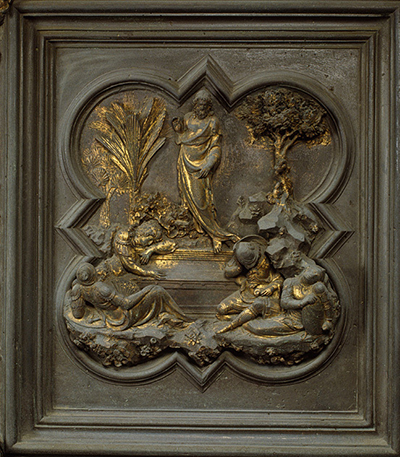
Lorenzo Ghiberti builds the Resurrection around vertical awakening. Christ rises upright above the tomb while sleeping soldiers sprawl across the foreground. A palm and leafy tree frame the apparition, and the open landscape replaces the architectural enclosure of the trial scenes below.
Contents
Position and chronology
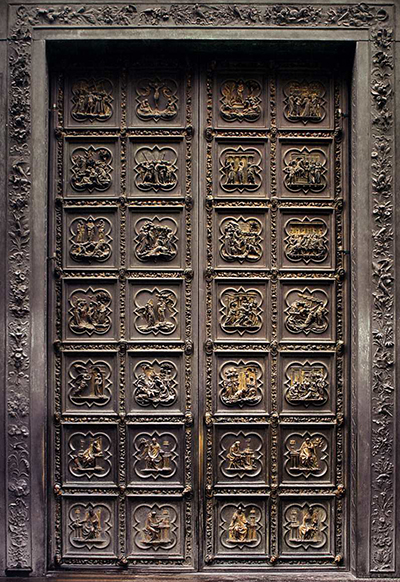
The panel occupies the uppermost narrative level of the North Door's right leaf, paired with Pentecost. Together they move from Christ's risen body to the gathered community of the Church.
The North Door was made between 1403 and 1424. The original is now in the Museo dell'Opera del Duomo; the Baptistery's exterior door is a copy. Opera del Duomo reports the Resurrection within a proposed Krautheimer phase around 1415–1420. This is a scholarly stylistic reconstruction, not a documented panel date.[1][2]
Christ above the tomb
Christ stands over the tomb at the central top of the earthly group. His upright pose is clear against relatively open bronze, giving the risen body immediate visual authority. The tomb creates a horizontal base that makes the ascent legible.
Matthew 28:1–10, Mark 16:1–8, Luke 24:1–12 and John 20:1–18 provide differing accounts of the discovery of the empty tomb. Ghiberti concentrates on triumphant emergence and the guards' failure to witness it consciously.[3]
Sleeping soldiers
The soldiers lie in varied collapsed poses on both sides. Armour gives their bodies visual weight, but sleep removes their power. Their horizontals and diagonals contrast with Christ's vertical clarity.
This opposition recalls the Agony in the Garden, where sleeping disciples remain unaware of Christ's prayer. Here, however, sleep is placed beneath the decisive reversal of death.
An open landscape
Palm and leafy tree frame the upper figure without enclosing him. Rock and vegetation create an outdoor setting markedly different from Pilate's architectural court or the Flagellation's colonnade.
Begin with the soldiers and tomb, then move upward to Christ. Compare the low, irregular bodies with his single vertical pose, and notice how the trees hold open space around him. The relief does not require a crowded audience: its meaning is carried by the contrast between bodily sleep and transformed life.
Discussion
Ghiberti rewards slow looking: relief, gilding, narrative structure, workshop practice and conservation evidence can all change how a work is read.
Join the Conversation
Have an observation about Resurrection, a source to add, or a comparison that sharpens the reading? Share it below.
References
- Opera del Duomo scientific catalogue, North Door
- Opera del Duomo, North Door
- Matthew 28:1–10; Mark 16:1–8; Luke 24:1–12; John 20:1–18.