by Tom Gurney
Tom Gurney BSc (Hons) is an art history expert with over 20 years experience
Published on August 12, 2026 / Updated on August 12, 2026
Email: tomgurney1@gmail.com / Phone: +447429011000
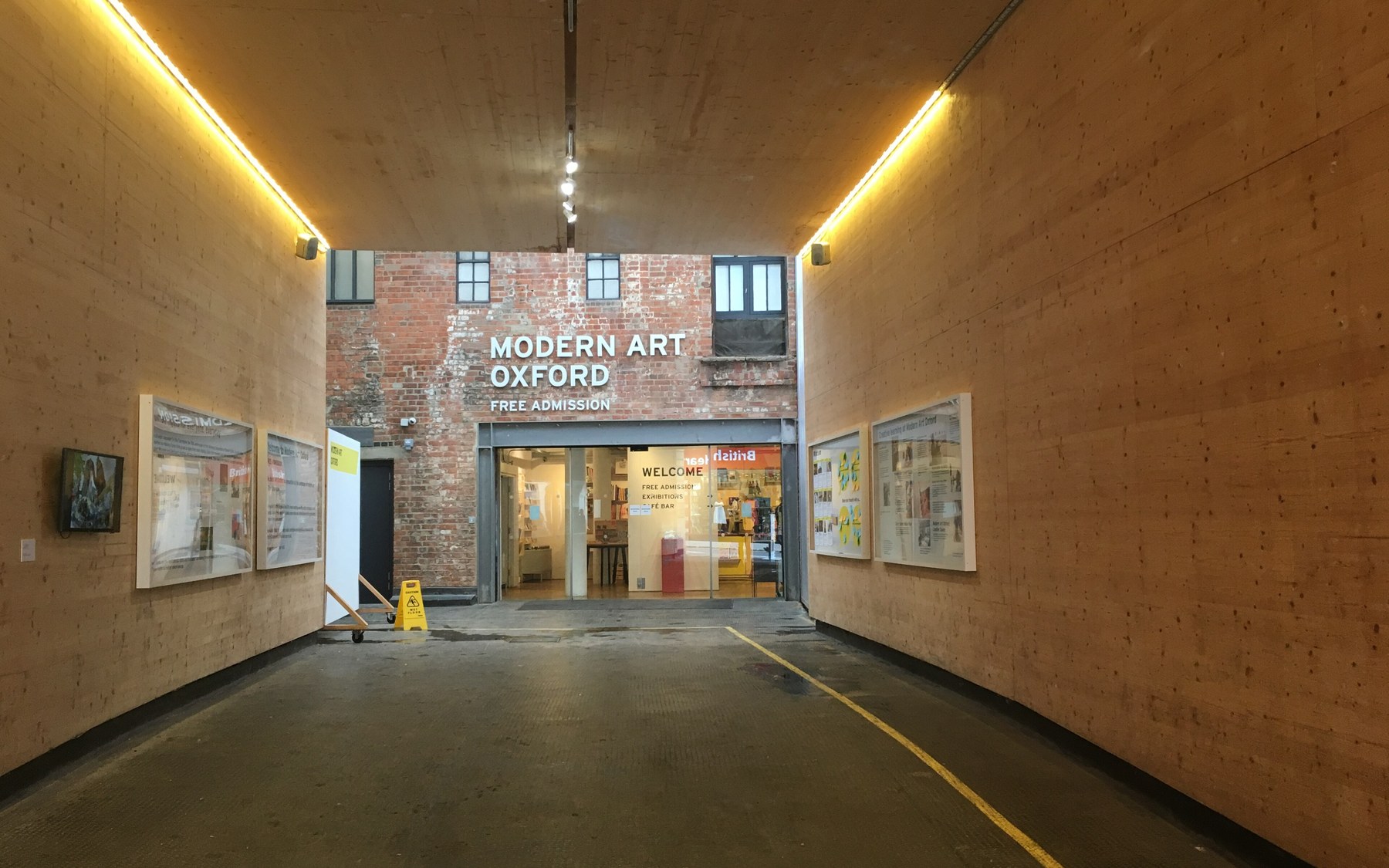
Modern Art Oxford by Christian Michelides; CC BY-SA 4.0 via Wikimedia Commons. Cropped for TheHistoryOfArt.org. · Image source
A gallery defined by change
Modern Art Oxford is one of Britain’s longest-running contemporary-art spaces, but the word “museum” in its history can easily mislead. It does not offer a conventional permanent collection route. Its public identity is built from changing exhibitions, commissions, performances, events, learning programmes and archival displays. What a visitor encounters depends on the current programme, while the institution’s six-decade history explains why that programme matters.
Trevor Green and a small group of enthusiasts founded the Museum of Modern Art Oxford in late 1965. Their stated purpose was the advancement of public education in the modern visual arts. That educational ambition has remained, although both the understanding of modern art and the ways a gallery meets its public have changed. Modern Art Oxford now describes itself as a leading contemporary-art space committed to education, internationalism and inclusion, and to dialogue between art and ideas.
The absence of a permanent collection is not a lack to be apologised for. It creates a different kind of institution. A collection museum can build continuity through objects that remain available across generations. Modern Art Oxford builds continuity through programme, relationships and memory. Artists alter the building; audiences participate in works and workshops; exhibitions introduce practices not yet familiar in Britain; archives preserve what happened after the installation has gone. The institution is therefore best approached as a place where art is repeatedly made public rather than as a storehouse of modern masterpieces.
This distinction changes the visitor’s task. There is no fixed “highlights” list to complete. The useful questions are what kind of exhibition is on, how it uses the rooms, what historical or social argument it makes, and what forms of participation accompany it. A visit during a large installation will feel different from one centred on painting, performance, a community collaboration or an archival display. That instability is part of the value.
From King Edward Street to the Pembroke Street brewery
The institution began with small exhibitions in a warehouse in King Edward Street. In September 1966 it moved to a former brewery on Pembroke Street, where it has remained. The move was decisive: it gave the new museum a central Oxford home and a building with enough variety to support installations, screenings, workshops and ambitious temporary exhibitions. The architecture was never a polished modernist museum built around a settled collection. It was an adapted industrial structure, and that practical roughness suited a programme interested in experimentation.
The founding context is worth remembering. In the mid-1960s, contemporary art did not have the dense network of public galleries, biennials and online visibility that exists now. A regional institution could materially change which artists and ideas a British audience encountered. Oxford was already internationally associated with universities, libraries and historic collections, but the Museum of Modern Art proposed a different public culture: current, provisional, sometimes participatory and open to practices that did not fit comfortably within older museum categories.
The first self-generated exhibition in the Pembroke Street building, Maurice Agis and Peter Jones’s Space Place in 1966, helps explain the ambition. Art critic Andrew Forge described the intention as creating a place where things could happen, music could be played, children could run and people could talk. The language rejects the idea of the gallery as a silent room of untouchable objects. It imagines an active environment in which the audience’s movement and behaviour are part of the work.
A year later, the Light/Sound Workshop combined slide projections, Super 8 film, kinetic sculpture and experimental sound. It was conceived as a set of workshop experiments rather than one finished installation. That distinction still feels current. Contemporary galleries often present process, research or changing events instead of a stable exhibition that is identical from opening to closing. Modern Art Oxford was testing that model near the beginning of its history.
Experiment and participation in the 1960s and 1970s
The early programme did not treat participation as an uncomplicated good. POPA at MOMA: Pioneers of Part-Art in 1971 is remembered because it opened and closed in a single evening. Organised by undergraduate members of the Oxford University Art Club, it included touchable installations and wearable capes and masks intended to heighten bodily awareness and encourage interaction. The opening-night audience interacted more enthusiastically than the artists had anticipated, and the works were withdrawn.
The episode is funny, but also instructive. Participatory art changes the distribution of control. Once visitors are invited to touch, wear or activate a work, the artist and institution cannot assume that everyone will behave according to an unspoken script. The project exposed the practical and ethical questions that still accompany interactive art: how much freedom is real, what damage is acceptable, who defines the rules, and what happens when public behaviour becomes the event.
Alongside these experiments, Modern Art Oxford developed a serious exhibition history for individual artists. Agnes Martin’s On a Clear Day in 1975 introduced her meditative grids, lines and pale colour to Oxford audiences; she returned in later programmes. Her work offers the opposite kind of encounter from a noisy participatory environment. It asks for duration, subtle perception and attention to small differences. The fact that both modes could belong to the institution is important. Experiment did not mean one visual style.
The Young in Art in 1976 took over all three floors with more than 900 exhibits from Oxfordshire schools and colleges. Its scale demonstrates that public education was not restricted to lectures about established artists. Young people’s work could occupy the building and become visible as part of the programme. That approach anticipates the present institution’s emphasis on early-years activity, young creatives and community co-production, although the methods and language have evolved.
These early decades established several recurring ideas: the gallery as an event rather than a container; education as making as well as interpretation; international artists seen in Oxford at significant moments; and a willingness to let the audience’s presence complicate the work. Later programmes did not simply repeat the 1960s, but they inherited a building and institutional memory already shaped by those experiments.
Internationalism in the 1980s
Modern Art Oxford’s internationalism became especially visible in programmes that challenged a narrow British or Western-European account of contemporary art. India: Myth and Reality in 1982 was a season devoted to contemporary India. Its central exhibition, Aspects of Modern Indian Art, coincided with the official Festival of India in London but emerged from a different collaboration involving the gallery’s director David Elliott, theatre director Ebrahim Alkazi and dealer Victor Musgrave. The distinction matters because cultural diplomacy and curatorial inquiry do not necessarily ask the same questions.
The season brought modern Indian art into an Oxford programme at a time when British institutions often treated it as peripheral to a supposedly universal modernism centred on Europe and North America. A present-day account should not romanticise one exhibition as solving that imbalance. Its importance lies in making a sustained institutional space for work and contexts that many British audiences had little opportunity to see.
Robert Mapplethorpe’s 1984 exhibition surveyed photographs made from 1970 to 1983, including portraiture, nudes, self-portraiture and still life. Photography at this level tests how a contemporary-art gallery handles beauty, sexuality, formal control and public controversy. It also demonstrates the programme’s ability to move between media: photographs could command the galleries as art rather than serve only as documents of other work.
Yayoi Kusama’s Soul Burning Flashes in 1989 filled the Upper Gallery with large sculptures and paintings organised around repetition and the artist’s distinctive pattern language. Kusama is now a globally recognised figure whose installations attract enormous audiences, but a 1989 Oxford exhibition belongs to a different point in her British reception. Looking back through the archive can reveal how institutional choices appear before an artist’s current reputation feels inevitable.
These examples also warn against reading history only through famous names. A gallery’s international role includes lesser-known projects, collaborations, publications and audience work, not just artists who later became canonical. The official history selects highlights; the archive is valuable precisely because it can preserve a broader and less tidy record.
New art and global exchange in the 1990s
New Art from China Part 1: Silent Energy in 1993 was part of a series presenting contemporary Chinese art. Modern Art Oxford describes it as the first time contemporary Chinese art was shown in the United Kingdom. The exhibition included eight artists connected to the Chinese avant-garde of the previous decade, among them Cai Guo-Qiang, Chen Zhen, Gu Wenda and Huang Yong Ping. Whatever later fame attached to individual artists, the institutional importance lay in presenting a field rather than an isolated exotic example.
The programme’s internationalism did not mean geography alone. Marina Abramovic’s 1995 exhibition joined sculpture, film on multiple monitors, photography and performance. The body, duration and the conditions of spectatorship became central. A visitor could not approach every element as a static object. Performance changes the meaning of presence: whether the artist is there, whether an action is live or recorded, and how an audience understands its own looking all become part of the work.
Yoko Ono’s 1997 exhibition brought together 38 years of photographs, films, performances, paintings and sound. Her instruction works are especially relevant to Modern Art Oxford’s history because they can be enacted physically or imaginatively. A concise typed direction may make the visitor responsible for completing the work. That returns to the participatory problem of the early years, but with a different tone: participation can occur in thought as much as through touching an object.
Mona Hatoum’s 1998 exhibition used installations to explore dislocation, domestic space, bodily unease and systems of power. Her work often begins with recognisable materials and then makes them threatening, unstable or estranged. In a programme already shaped by participation and international exchange, Hatoum’s installations could show that the visitor’s bodily relation to a room may carry political meaning without becoming a literal illustration.
Taken together, the decade demonstrates why the institution’s history cannot be reduced to a collection narrative. Performance disappears, installations are dismantled, and technology becomes obsolete. Their afterlives depend on photographs, catalogues, correspondence, reviews, oral memory and later reconstruction. The archive is not secondary evidence; for many kinds of contemporary art it is the principal means by which an exhibition remains available to history.
The 2002 name change and the twenty-first-century programme
In 2002 the Museum of Modern Art Oxford became Modern Art Oxford. The institution explains the change as a better reflection of its dynamic programme of temporary exhibitions. Dropping “museum” reduced the risk that visitors would expect a permanent collection and clarified that the organisation’s central activity was the production and presentation of contemporary culture.
Tracey Emin’s This is Another Place marked the change. It brought together neon, drawings, etchings, film and a large structure made from reclaimed timber. The range of media mattered as much as the artist’s public profile. The exhibition demonstrated that Modern Art Oxford could give a contemporary British artist room to build an environment rather than offer only a survey of portable objects.
Mike Nelson’s Triple Bluff Canyon in 2004 turned installation into a sequence of constructed spaces carrying literary and cinematic associations. Work of this kind depends on the visitor moving through it. It cannot be understood from one frontal photograph. The gallery becomes a route, and uncertainty about what is real, staged or remembered becomes part of the experience.
Jenny Saville’s 2012 exhibition traced her work from the early 1990s and included new paintings made for Modern Art Oxford. The institution describes it as her first solo exhibition in a British public gallery. Saville’s large painted bodies brought the programme back to painting while testing what figure painting could do after decades in which new media and installation had expanded the field.
Jeremy Deller’s Love is Enough in 2014 placed William Morris and Andy Warhol together through Deller’s own account of influence. The pairing shows another strength of the temporary exhibition: it can make an argument no permanent collection display would naturally sustain. Rather than claiming that Morris and Warhol belong to one movement, the project used juxtaposition to ask how art, labour, reproduction, celebrity and social imagination might cross periods.
Lubaina Himid’s Invisible Strategies in 2017 was the first major survey of her work, bringing together painting, sculpture, ceramics and works on paper from the 1980s onwards. Its timing is significant because Himid received the Turner Prize later that year. The exhibition gave institutional space to a long practice concerned with Black histories, representation and the politics of display before the award intensified national attention.
More recent programmes, including exhibitions by Anish Kapoor and Jesse Darling, continue the pattern of using temporary space to examine material, body, institution and power. No short list can represent the whole history, and contemporary reputations will continue to change. The useful point is that Modern Art Oxford repeatedly creates conditions in which a practice can be seen at scale and in context.
Education, participation and public value
Modern Art Oxford’s mission places education, internationalism and inclusion at the centre of the programme. It describes creative expression and cultural participation as human rights and contemporary art as a means of learning, reflection, belonging and communal exchange. Those are institutional commitments rather than neutral facts, but they help explain why the gallery devotes substantial space and staffing to participation.
For early-years visitors, Make Play uses the materials and themes of exhibitions to create sensory sessions for children and carers. Free activity sheets, sensory backpacks and the Studio offer ways to respond without requiring a child to behave like a miniature adult art historian. The emphasis is on curiosity and making, not on proving that a single interpretation has been learned.
The Young Creatives programmes give teenagers routes into collaborative projects, skills, portfolios and professional experience. Social sessions and residencies recognise that access to the arts involves confidence, networks and practical knowledge as well as admission to exhibitions. A public gallery can lower some of those barriers by letting young people work with artists and staff rather than only observe the finished result.
Adult and community programmes include making sessions, book discussions, volunteering and professional-development activity. The 2024 ground-floor gallery was designed to support exhibitions co-created by artists and local people. This changes where participation sits in the building. Community work is not hidden in a classroom while the “serious” art occupies all public gallery space; it has a visible exhibition route of its own.
Participation should still be assessed critically. Co-creation can be meaningful only when communities have real time, support and influence. The gallery’s programme offers evidence of sustained formats, but each project needs to be understood on its own terms. The broader significance is that Modern Art Oxford treats public engagement as one of the ways contemporary art is produced and understood, not simply as audience development around a separate curatorial core.
The archive as a record of exhibitions and people
A non-collecting gallery still accumulates material. Modern Art Oxford’s archive includes photographs, letters, documents and records of exhibitions, community work, practice and participation across sixty years. Ground-floor displays now make parts of that history visible. They allow a visitor to encounter earlier programmes without pretending that an archive photograph recreates the original installation.
The archive is especially important for performance, sound, film, temporary architecture and participatory projects. A painting may survive independently after an exhibition closes; a room-sized installation or one-night event survives differently. Installation photographs record viewpoints but not duration or bodily experience. Correspondence can reveal curatorial negotiation. Flyers and catalogues show how a project described itself. Audience recollections may preserve reactions absent from official documentation. Each kind of evidence is partial, and their combination is the history.
Modern Art Oxford also points to a large catalogue collection at Oxford Brookes University. Around 16,000 international exhibition catalogues were assembled through an exchange programme with galleries worldwide, with particular depth in the 1980s and 1990s. The material moved to Oxford Brookes after the 2002 institutional change, where it remains available for research. That collection gives a wider picture of international contemporary-art activity than Modern Art Oxford’s own exhibitions alone.
For visitors, the archive adds continuity to a changing programme. If the current artist is unfamiliar, archival displays can show that experimentation and uncertainty have always been part of the institution. For researchers, the records can trace how exhibitions were organised, which artists circulated through networks, how participation changed, and how the language of public galleries evolved.
The 2024 public spaces
Modern Art Oxford reopened in November 2024 after a five-month, £2 million refurbishment of its ground and lower-ground areas. The project created a new ground-floor gallery, a Studio, a redesigned welcome area and shop, archive display points and a café conceived as an installation by Emma Hart. These changes did not turn the organisation into a collection museum. They made the relationship between exhibition, participation, social space and institutional memory more legible on arrival.
The upper galleries remain the principal route for major exhibitions. The ground-floor gallery places artists and local communities at the centre of co-created changing displays. The Studio supports sensory play, workshops, classes and informal making. Archive cases and digital displays bring fragments of the institution’s history into the welcome area. The café introduces another artwork-like environment into an everyday activity, complicating the line between viewing and using a space.
This layered visit is useful because contemporary-art institutions can feel forbidding when the only choice appears to be entering a large unfamiliar exhibition. A visitor can begin with a free ground-floor display, spend time in the Studio or archive area, and decide whether to continue to a ticketed upper-gallery exhibition. That does not diminish the major programme; it creates several thresholds into it.
How to plan a visit
Check the official “What’s On” and visit pages before travelling. Modern Art Oxford’s ground floor is generally presented as free to enter, while major exhibitions in the upper galleries may be ticketed. Prices, concessions and the division between free and paid programming can change with the season, so this guide does not preserve a current figure as though it were permanent.
The gallery is at 30 Pembroke Street in central Oxford, close to Carfax, Oxford Town Hall and The Story Museum. A focused visit can work well within a city-centre day, but contemporary installations often require more time than their object count suggests. Film, sound and performance documentation should not be rushed simply because there is no long sequence of rooms.
Use the visual story and sensory map if you need a clearer account of arrival, lighting, sound and movement through the building. Families can ask about current activity materials, while groups should check booking requirements. The official site remains the authority for opening hours, access, closures between installations and whether a particular exhibition permits photography.
Most importantly, arrive without expecting the same experience on every visit. Modern Art Oxford’s history is a history of temporary propositions: spaces to enter, images to question, actions to witness, ideas to argue with and creative processes to try. Its value lies not in guaranteeing a familiar masterpiece but in repeatedly making room for work that can change what a public gallery is for.
Sources and further reading
Use these official museum pages, object records and exhibition sources to check details and keep exploring.
- About Us
Institution identity and participation - Our History
Chronological institutional source - Our Mission and Values
Mission and public-value source - Visit
Current visitor model - City of Archives: Take on the Trail
Archive and city context - Our New Spaces
2024 building update - Early Years and Families
Family learning source - Young People
Young-person participation source