 by Tom Gurney
Tom Gurney BSc (Hons) is an art history expert with over 20 years experience
Published on June 19, 2020 / Updated on September 29, 2026
Email: tomgurney1@gmail.com / Phone: +44 7429 011000
About the painting
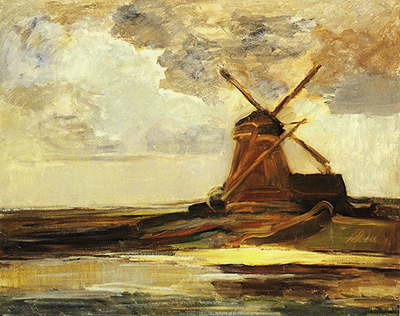
The Oostzijdse Mill rises from a low dark bank under a luminous, broken sky. In the foreground, water catches pale yellow and warmer colour, while the mill's form is held together by deep browns. Piet Mondrian's Oostzijdse Mill with Panoramic Sunset and Brightly Reflected Colours belongs to his repeated Gein mill studies of 1907–08. RKD catalogues this particular image as A418 and lists it in a private collection. The long title helps distinguish it from the Hague museum's A411 evening sky, the Hague museum's A420 moonlight, and the Kreeger Museum's A416 sunset with the mill at centre.[1]
At a glance
- ArtistPiet Mondrian (Piet Mondriaan, 1872–1944)
- TitleOostzijdse Mill with Panoramic Sunset and Brightly Reflected Colours; RKD uses the American spelling “colors”
- Date1907–08 in the RKD catalogue
- Catalogue numberRKD A418
- MediumOil on canvas, as catalogued in the work's public-domain Commons record
- CollectionPrivate collection in RKD's current listing
- Location and public displayNo current public gallery placement is given by RKD[1][2]
Four views of the Oostzijdse Mill
Moonlit Gein (A411b)
c. 1903Moonlight (A420)
c. 1907Extended sky (A411)
1907–08Panoramic sunset (A418)
1907–08Contents
- What does the panoramic sunset show?
- Why did Mondrian return to the same mill?
- How does A418 differ from A411 and A420?
- What can be known about the original?
- Why does the painting matter in Mondrian's development?
What does the panoramic sunset show?
The mill occupies the central part of a broad landscape. Its body and sails form a strong, dark shape between a glowing sky and an equally luminous surface of water. The clouds are not a smooth backdrop: broken golden, yellow-grey and cooler passages give the upper part of the composition movement. A low bank and adjoining structures make a near-horizontal strip across the middle. The foreground water has wide light areas, not a detailed mirror image of every cloud or wing.
 The Red Tree Piet Mondrian.jpg)
The mill stands close enough to be an unmistakable subject, but Mondrian does not describe every mechanical detail. The visual interest rests in the contrast between dark land and windmill, bright sky, and unexpectedly bright reflection. The term “brightly reflected colours” in the catalogue title is apt: the water is active in the composition rather than an empty foreground.[1]
“Panoramic” describes the experience of open space and a low horizon. It should not be read as a technical claim that this canvas is the widest of all Mondrian's mill views. RKD identifies several panoramic sunsets in this group, with the mill placed differently in each. A416 puts the mill at centre and is recorded at the Kreeger Museum in Washington; A417 puts it at right and is privately held; A418 is the separate sunset and brightly reflected-colour work on this page.[1]
Why did Mondrian return to the same mill?
The Oostzijdse Mill stood along the River Gein near Abcoude. From Amsterdam, the Gein landscape offered water, flat banks, low buildings and a broad sky. The mill gave Mondrian a recognisable upright landmark that could be placed within many different arrangements of light and horizon. The Rijksmuseum's account of another Oostzijdse painting notes that the mill remains within cycling distance of Amsterdam today, while treating Mondrian's exact journey to it cautiously.[3]
RKD's sequence shows how varied those arrangements became. It lists views from downstream, skies streaked pink or blue, shallow evening scenes, sunsets and moonlit versions. The entries are separate works with different owners and dates. Together they show a painter using one location as a visual laboratory. Changing the viewpoint or conditions shifts the whole picture: the vertical mill may be a distant accent, a heavy silhouette or a near-central mass.[1]
In A418, the mill's dark body anchors two bright regions. The sky has a changing, almost turbulent light; the water below returns it in broader, calmer patches. The landscape is still readable, but the colour structure matters as much as the topographic subject. This is one reason the early Gein paintings are useful for understanding Mondrian before his later abstract grids. They show him simplifying and strengthening relationships within observed nature without yet abandoning the mill or river.[1][4]
Watch: Piet Mondrian
See his studio, the move toward geometric abstraction and the rhythms of his New York paintings.
Piet Mondrian: Abstract Painting as We Know It
Curator Michael White explores the paintings and Mondrian’s studio as an abstract space.
Watch on YouTubeHow does A418 differ from A411 and A420?
A411, in Kunstmuseum Den Haag, is the extended blue-yellow-purple-sky painting, object 0334233. The museum currently titles it Oostzijdse molen bij avond and describes its sharply silhouetted mill, yellow-green evening sky and blue-purple cloud. Its long, shallow canvas gives an unusually large share of space to the sky. A418 instead balances a more prominent mill with a strong foreground reflection. The English titles sound alike because both describe colour at evening; their catalogue numbers and images keep them distinct.[1][4]
A420, also in the Hague museum, is Oostzijdse Mill in Moonlight, object 0332363. It uses a dark night setting and a warm, prominent moon rather than this A418 sunset. Conservators found an orange ground beneath A420, but there is no cited technical examination establishing the same ground for A418. One should not move a conservation finding from one canvas to another simply because Mondrian painted the same mill.[1][5][6]
The earlier A411b, in the Rijksmuseum, is dated about 1903. It centres a smaller mill within a curve of the Gein under a small moon. The later A418 image compresses land and mill into a darker middle zone and gives colour in sky and water a more forceful role. A411b's appended catalogue letter is not a sign that it is the same painting as A411 or a preparatory version of A418.[1][7]
What can be known about the original?
The RKD catalogue gives A418, 1907–08, and private collection. That is sufficient to identify the work and place it in the Oostzijdse Mill sequence. It does not give a publicly accessible institutional accession number or promise public display. This article therefore avoids claiming that A418 hangs at a named museum. A Commons record for the matching image describes the painting as oil on canvas and gives a measurement, but without an accessible museum object record to reconcile that metadata, the principal facts here follow RKD and the dimensions are not asserted in the quick facts.[1][2]
The site already had a reproduction of this sunset view. It has been retained because the mill, broken gold sky and bright foreground water agree with the A418 image crosswalk. Commons hosts public-domain reproductions, but replacing the existing local file is unnecessary for a sound article. The image's small size does limit examination of brushwork and subtle colour, so formal observations here focus on the visible large-scale arrangement.[2]
The collection line is also time-sensitive. RKD's public catalogue records a private collection at the time its entry was checked. Because private works can change hands without a newly published museum page, that statement should be read as a documented catalogue listing rather than a claim about a named current owner. The article's durable identity is its A418 catalogue number and its visible composition.[1]
Why does the painting matter in Mondrian's development?
It is tempting to read the black mill and horizontal bank as early versions of Mondrian's later straight-line abstraction. A418 supports a narrower, more persuasive point. Mondrian is already giving large colour zones and structural contrasts unusual force, yet the atmospheric sky, water and mill are still central to the painting. The work shows a painter asking how a Dutch landscape can be reorganised for visual intensity, not a painter who has already solved the problems of the 1920s grid.
Kunstmuseum Den Haag's discussion of the related A411 describes the period as one in which Mondrian reduced familiar landscape elements to broad, summarising forms and used increasingly individual colour. A418 shares that broad exploration while presenting its own balance of dark mill, sunset and reflection. Looking across the series allows viewers to see that “development” consisted of several choices about colour, light, scale and viewpoint, not one uniform style applied to every canvas.[4][1]
Mondrian artworks directory
Frequently asked questions
When was A418 painted?
RKD dates it 1907–08.[1]
Where is the painting?
RKD lists A418 in a private collection. It does not identify a current public gallery display.[1]
Is it the Kunstmuseum's evening mill?
Does the title use “colors” or “colours”?
RKD uses “colors”. This site's established route uses British “colours” for the same A418 painting; the catalogue number resolves the spelling variation.[1]
Discussion
Which sky colours return in the water?
Reader Insights
How does the dark mill connect those bright regions?
What differs from the extended-sky A411 and moonlit A420?
What differs from the extended-sky A411 and moonlit A420?
Join the Conversation
Share what you notice in this painting below.
References
- RKD – Netherlands Institute for Art History, Mondrian catalogue of Gein landscapes, entries A416–A420, including A418's title, 1907–08 date and private collection. View source.
- Wikimedia Commons, A418 category and matching public-domain image record, used for image cross-check and medium only. View source.
- Rijksmuseum, “Then and now” story locating the Oostzijdse Mill by the Gein. View source.
- Kunstmuseum Den Haag, record and interpretation for the separate A411 Oostzijdse molen bij avond, 0334233. View source.
- Kunstmuseum Den Haag, record for the separate A420 moonlit canvas, 0332363. View source.
- Kunstmuseum Den Haag, conservation publication documenting the orange ground of A420. View source.
- Rijksmuseum, record for the separate c. 1903 moonlit Gein painting A411b, SK-A-4987. View source.
- Lead image credit. Piet Mondrian, Oostzijdse Mill with Panoramic Sunset and Brightly Reflected Colours, 1907–08, RKD A418; private collection in the RKD catalogue.