 by Tom Gurney
Tom Gurney BSc (Hons) is an art history expert with over 20 years experience
Published on June 19, 2020 / Updated on August 21, 2026
Email: tomgurney1@gmail.com / Phone: +44 7429 011000
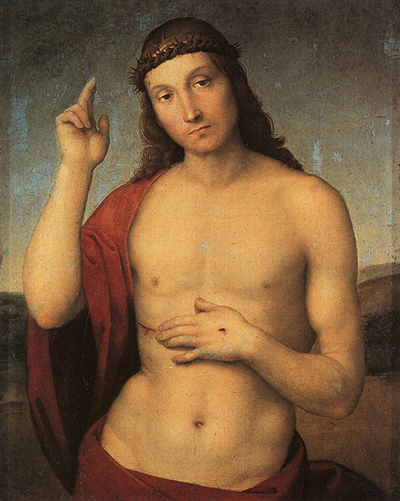
Raphael's Christ the Redeemer Blessing brings the risen Christ extraordinarily close. His nude torso fills a panel little more than thirty centimetres high. A red cloth crosses his lower body and one shoulder. His right hand rises in blessing; the other rests beside the wound in his side. The crown of thorns remains upon his head, and the marks of Crucifixion remain visible even as clear daylight and a quiet landscape announce life beyond death.[1][2]
The Italian title, Cristo Redentore benedicente, unites two ideas that the image holds together: Christ as Redeemer and Christ as one who blesses. This is not a generic, untouched ruler of the world. It is a wounded body returned to the viewer, exercising sacred authority through a hand gesture that is also an intimate act of address.
Fondazione Brescia Musei dates the painting to about 1505–06. It belongs to Raphael's early maturity, when the young artist was moving among central Italian court, church and private patrons and refining small pictures for close devotion.[1][2] Its compact size concentrates that development in a single figure.
At a Glance
- ArtistRaphael
- Italian titleCristo Redentore benedicente
- English titleChrist the Redeemer Blessing or Christ Blessing
- Dateabout 1505–06 in current Brescia museum materials
- Mediumoil on panel
- Dimensions31.7 × 25.3 cm
- Subjectthe risen, wounded Christ giving a blessing
- Identifying detailscrown of thorns, side wound, blessing hand and red cloth
- Probable original functionprivate devotion
- Early modern provenancenot securely known
- Acquired by Paolo Tosioearly 1820s
- Present collectionPinacoteca Tosio Martinengo, Brescia
- Inventory number150
Contents
- A risen Christ who still bears the Passion
- The blessing hand
- Annotated Details
- The hand at the side
- Crown of thorns and calm gaze
- The royal red cloth
- Light across the body
- A panel made for nearness
- Classicism and bodily presence
- Why the date is not entirely settled
- Not a fragment of the Baronci Altarpiece
A risen Christ who still bears the Passion
The painting depends on an apparent contradiction. Christ has overcome death, yet Raphael does not erase the body that suffered. The crown of thorns remains. The wound in the side is indicated by Christ's left hand, and the marks in his blessing hand recall the nails.[2]
These signs move the figure beyond an ordinary half-length blessing Christ. They connect the frontal sacred image with the Passion and Resurrection. Redemption is not abstract power; it is made credible through the injured flesh before the viewer.
The painting also avoids narrative setting. There are no soldiers at the tomb, grieving disciples or astonished witnesses. A lightly indicated landscape opens behind the body, but Christ alone determines the encounter.[1][2]
That reduction suits personal prayer. A beholder could move between wound and blessing without following a sequence of action. The panel offers the completed theological claim in one presence: the one who was wounded now lives and blesses.
The blessing hand
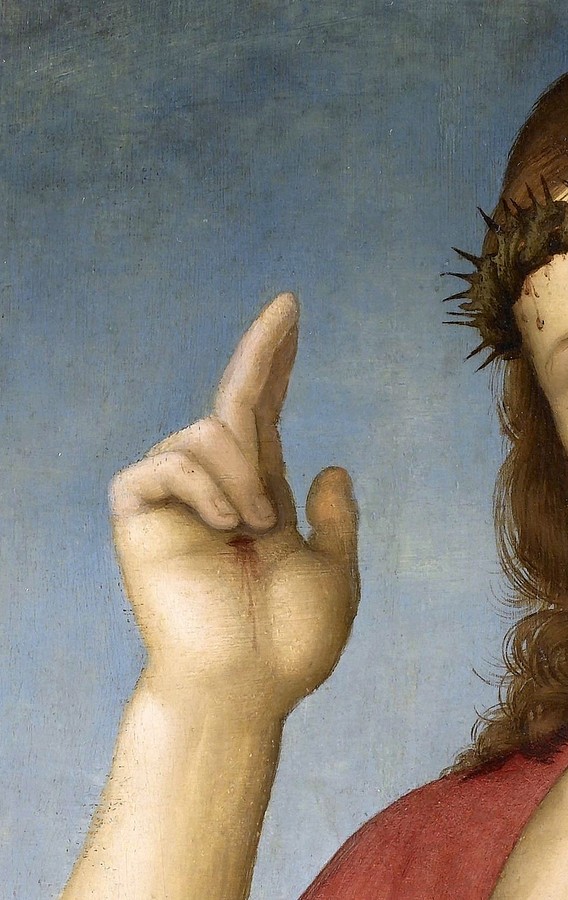
Christ raises his right hand with fingers organised into a conventional sign of blessing. The gesture had a long history in Christian art. It could mark teaching, sacred speech and divine favour, and it made a still image feel directed toward someone beyond its surface.
In Raphael's panel, the hand is large enough to command attention but not isolated as an emblem. It grows naturally from the turned shoulder and bent arm. Light models the palm and fingers, converting a familiar sign into a bodily movement.
The gesture is frontal in purpose even though the torso is subtly mobile. Christ does not bless another painted person. He blesses into the viewer's space.
That directness distinguishes the panel from a multi-figure altarpiece, where gestures circulate within a sacred gathering. Here the beholder completes the relation. The small scale permits physical nearness, while the blessing preserves distance of rank.
Annotated Details from Christ Blessing
The annotated view keeps the whole work in sight while isolating six details that reward close looking: expression, gesture, fabric, setting and the way Raphael moves attention through the image.
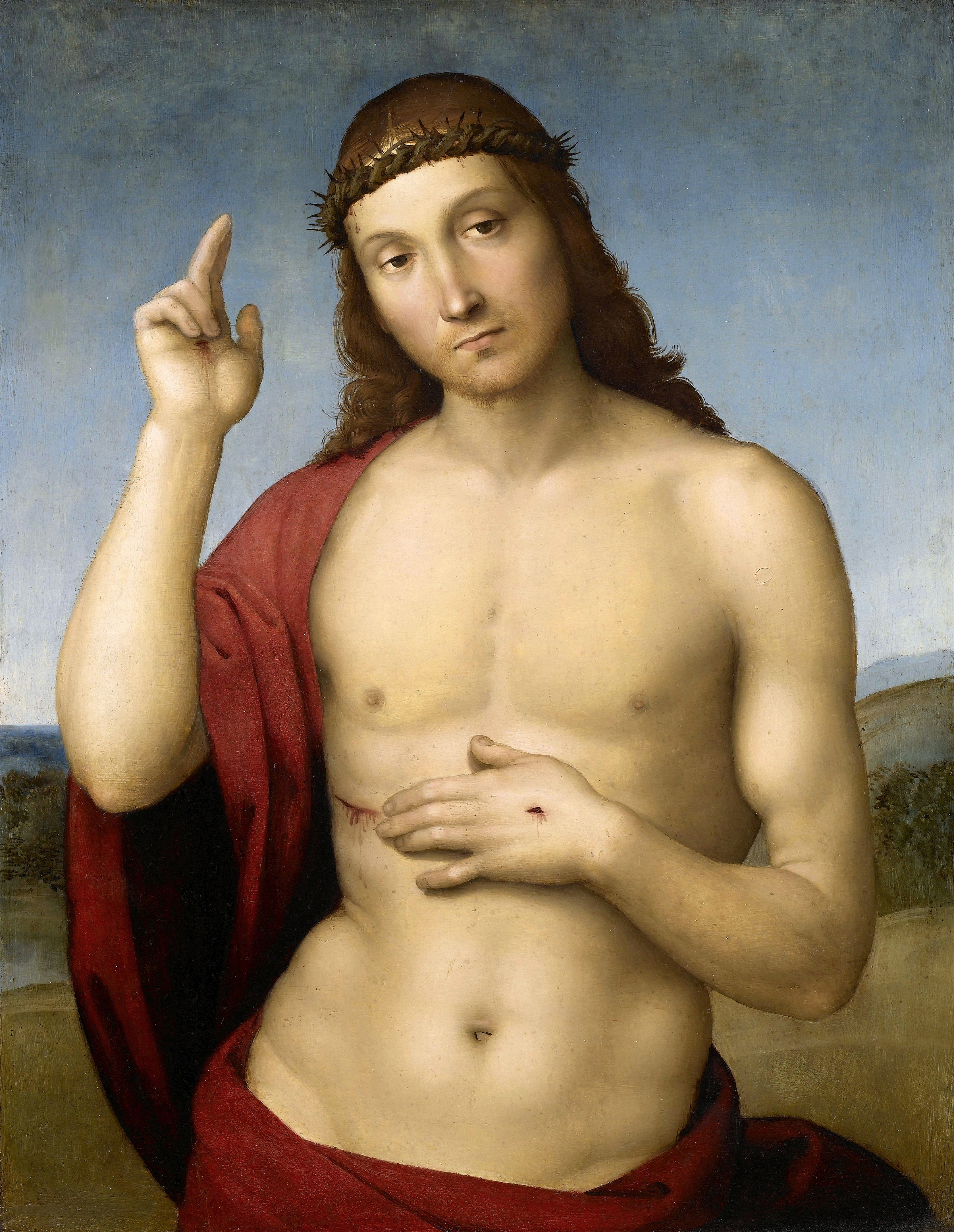
Details from CHRIST BLESSING
Close looking highlights visible details in the work while keeping image-source and rights notes with the page evidence.
Blessing hand
Christ's raised hand gives the small devotional image its most direct address to the viewer.
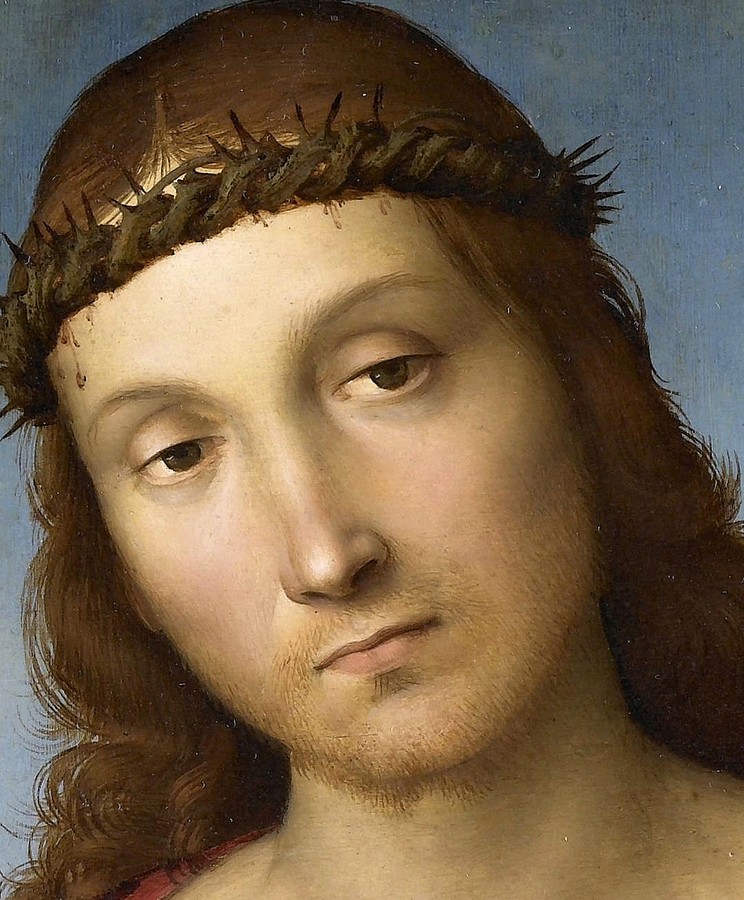
Crown and calm face
The crown of thorns remains visible even as the face is calm and frontal.
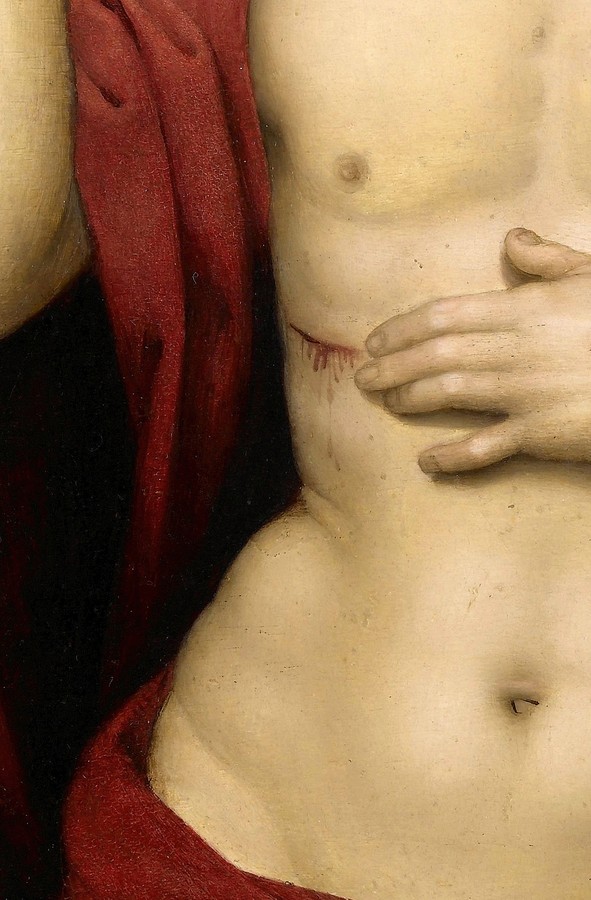
Side wound and hand
The lowered hand draws attention to the wound, keeping Resurrection and Passion together.
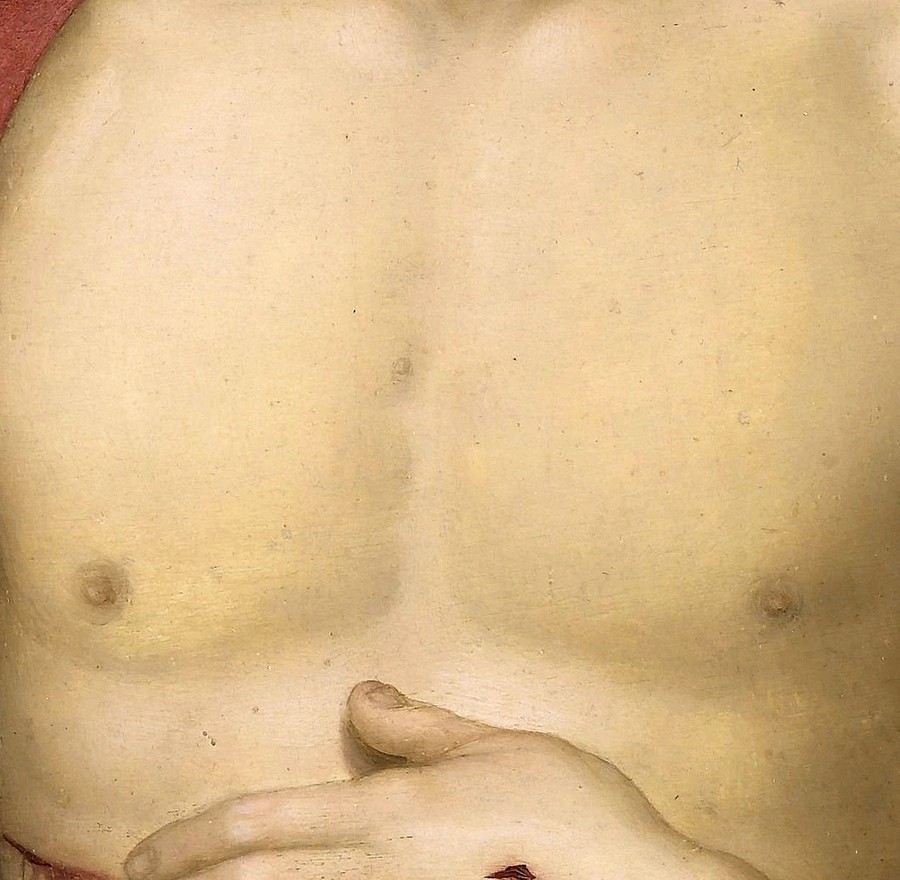
Bare torso
The softly lit torso makes the sacred presence bodily rather than abstract.
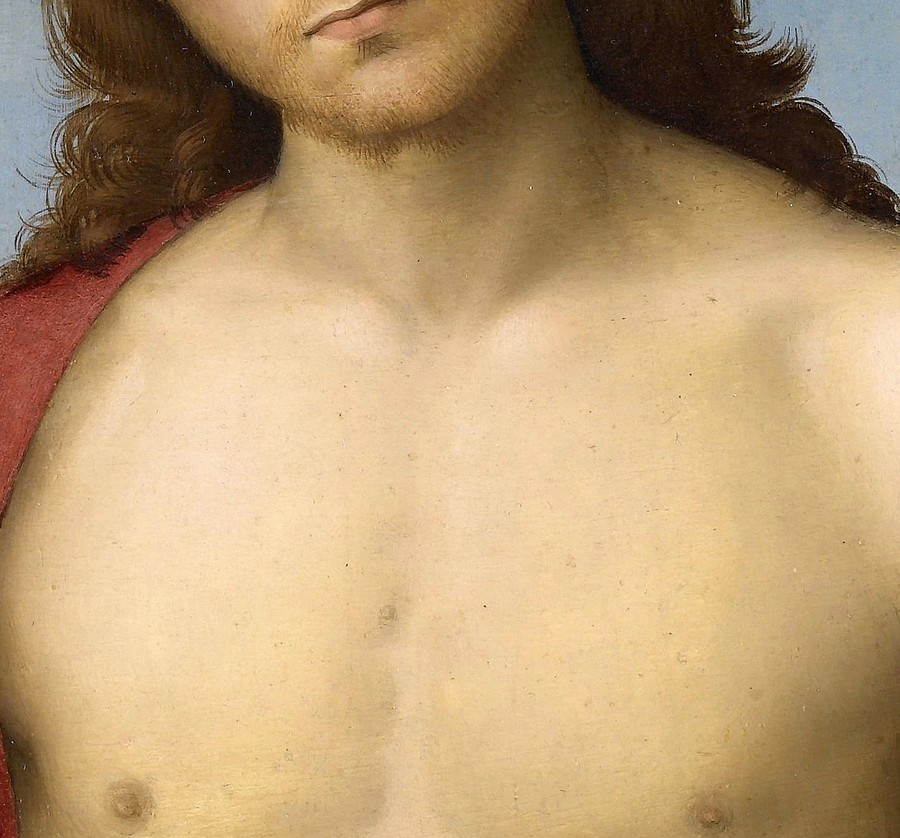
Red mantle
The red mantle encloses the figure and supplies a strong devotional colour accent.
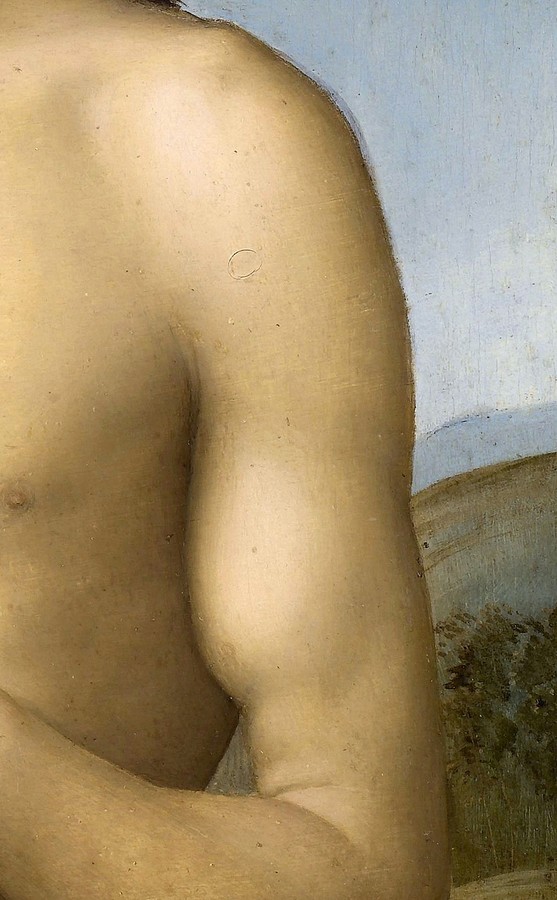
Distant landscape
The low landscape gives the figure air and daylight without becoming a narrative scene.
The hand at the side
Christ's left hand draws attention to the wound in his side. This detail recalls the Gospel account in which the risen Christ invites Thomas to see and touch his wounds. Raphael does not paint Thomas, yet the gesture makes sight itself a form of testimony.
The fingers do not theatricalise pain. They rest against the body, presenting rather than probing. The wound's smallness forces close observation.
Two hands thus offer complementary meanings. One turns outward with benediction; the other turns inward toward the evidence of sacrifice. Authority and vulnerability occupy the same body.
The composition could have become diagrammatic, with each hand assigned a symbol. Raphael prevents that by making shoulders, chest and arms continuous. The torso carries the movement between the two gestures.
Crown of thorns and calm gaze
The crown identifies the suffering Christ even before the wounds are located. Its sharp, irregular line contrasts with the smoother curves of hair and face.[2]
Christ's expression is grave rather than triumphant in a worldly sense. His head inclines slightly, and his gaze meets or nearly meets the viewer. He appears fully aware of what the body records.
The effect relies on restraint. A broad smile would separate Resurrection from Passion; extreme anguish would return the image to the moment of torment. Raphael holds the expression between them.
The face has the idealised symmetry expected of a devotional image, yet it is not immobile. Small changes around eyes and mouth give the address psychological pressure. The Redeemer sees the person who looks.
Hair and beard soften the transition from the thorny crown to the illuminated chest. Darker framing around the face increases its visibility against the blue sky.
The royal red cloth
A saturated red cloth crosses Christ's lower body and rises over his shoulder. Brescia's museum-linked account describes it as regal, associating colour and drapery with his sacred status.[2]
The fabric also has a practical compositional role. It gives the pale torso a strong base, carries colour across the lower half and balances the raised arm. Its folds imply a body extending beyond the crop.
Red can evoke blood, kingship and sacrifice in Christian art, but no single gloss is needed to make the picture work. The cloth already binds royal presentation to wounded flesh.
Against the distant landscape, its warmth moves toward the viewer. Raphael uses colour to reinforce proximity: the most intense material belongs to the figure who stands nearest.
The mantle neither hides the Passion signs nor exposes the body as a study detached from religion. It frames the torso as an image of sacred corporeality.
Light across the body
Fondazione Brescia Musei emphasises the clear light that reflects from the sky and surrounds the Redeemer's body.[1] The illumination gives the torso both volume and clarity.
Shadow collects under the chest, arm and drapery folds, while exposed surfaces receive a cooler brightness. The body seems present before an open atmosphere rather than cut from a gold field.
That choice alters devotional address. Natural light makes sacred flesh intelligible through observation, but the frontal figure exceeds ordinary portraiture through halo-like authority, wounds and gesture.
The landscape contributes to this naturalising effect without competing for attention. Hills, vegetation and blue distance are only lightly stated. They provide air around a figure who otherwise nearly fills the support.
The clear setting can suggest a world renewed after Resurrection, although the museum sources do not assign a precise location or hour. Its strongest function is visual: it lets dark hair, red cloth and pale torso remain distinct.
A panel made for nearness
At 31.7 by 25.3 centimetres, the painting is close to the dimensions of a modern sheet of paper.[3] It could be held, placed on furniture or installed in a small domestic or courtly prayer setting much more readily than a church altarpiece.
Brescia's account associates Raphael's small works in this phase with private devotion and with the refined culture of the Urbino court.[2] That provides a likely function, not a documented original owner or room.
Scale structures attention. A large public image establishes itself across architectural distance. This panel rewards a viewer who approaches until the crown, side wound and finger positions are clear.
The format is portrait-like without being a portrait. Christ's cropped body and direct address borrow the intimacy of a human likeness, but his signs place the encounter outside ordinary social exchange.
Repeated private use could make every detail familiar. The painting would not need to narrate the entire Passion because the beholder brought that memory to it.
Classicism and bodily presence
The museum-linked text places the work among small, highly refined pictures rich in classical reference, aligned with Urbino's humanist court culture.[2] The torso's ideal proportions and calm self-possession support that connection.
Classical reference does not mean the figure copies a known statue. It describes an approach to bodily dignity: clear structure, measured turn, controlled expression and a belief that the ideal human form can carry elevated meaning.
Raphael's sacred image transforms that visual inheritance. The body is perfected but wounded; its balance supports a narrative of sacrifice rather than pagan heroism.
The turn of the torso keeps the pose from becoming an icon laid flat against space. Shoulders respond differently, arms move in opposing directions and the red fabric winds across the body. Calm is constructed through managed movement.
This balance helps explain why the picture has been dated by style rather than documentation. Its forms seem to stand between the poised early manner associated with Perugia and the increasing corporeal sophistication Raphael developed through wider study.
Why the date is not entirely settled
The Comune di Brescia's official exhibition checklist and current museum-linked accounts date the picture about 1505–06.[2][3] Fondazione Federico Zeri gives 1506.[4]
Accademia Carrara, however, displayed it as about 1502–04 and grouped it with works painted between 1502 and 1505.[5] Older scholarship has also placed it near other early projects.
This variation does not threaten the identity of the object. It reflects the difficulty of dating an undocumented small panel whose chronology depends heavily on comparison of style, technique and Raphael's rapid development.
The governing date here is about 1505–06 because that is the current Brescia formulation. The alternative deserves notice because it prevents false precision.
Nor should a date be made to prove a tidy travel story. Raphael worked across Urbino, Umbria and Florence during these years. The panel's combination of courtly refinement, landscape and bodily presence is more secure than an exact statement about where he stood when each brushstroke was made.
Not a fragment of the Baronci Altarpiece
The Pinacoteca Tosio Martinengo also owns Raphael's Angel, a surviving fragment of the shattered Baronci Altarpiece. Because the two small works share an artist, collection and early acquisition by Paolo Tosio, their histories are sometimes compressed.
They are different objects. The angel was cut from a larger altarpiece painted for Città di Castello. Christ the Redeemer Blessing is presented by the museum as a complete small devotional panel.[1][2][5]
No surviving edge or historical record cited by the collection requires the Redeemer to be reconstructed inside a lost ensemble. Its concentrated half-length design makes sense as an independent image.
The distinction matters for looking as well as cataloguing. The angel's turned head originally answered figures outside its present fragment. Christ's blessing is directed through the panel toward the viewer and is compositionally sufficient within its small field.
Keeping their histories separate allows the Brescia collection to reveal two different kinds of survival: a fragment detached from public church art and a private devotional object preserved whole.
Paolo Tosio and the painting's modern history
The Redeemer was one of Paolo Tosio's earliest important purchases as he formed the collection that would become a foundation of Brescia's civic gallery.[1][2]
A detailed account based on Brescia scholarship reports that negotiations began in 1819, with collector Teodoro Lechi acting as intermediary, and that Tosio acquired the panel in Milan from the Mosca family of Pesaro in 1821.[6] The transaction placed Raphael at the heart of Tosio's ambitions.
Tosio was not collecting one school alone. His holdings brought together Renaissance models, contemporary sculpture and later Italian painting. Raphael's measured design could serve nineteenth-century admirers as an emblem of classical balance.
The work was reproduced in an engraving by Ludwig Grüner and entered wider knowledge through Francesco Longhena's 1829 life and works of Raphael.[6] Reproduction extended the small panel far beyond the private room in which Tosio kept it.
Tosio's collection passed to the city, and the Redeemer became part of the Pinacoteca Tosio Martinengo. Its present inventory number, 150, distinguishes the physical panel from prints, copies and similarly titled blessing Christs.[3]
A Raphael among Brescian painting
The Pinacoteca presents the Redeemer and the Baronci angel near the beginning of a collection that develops into the distinctive Renaissance painting of Brescia, including Foppa, Savoldo, Romanino and Moretto.[1]
That setting creates a productive encounter. Raphael's clear central Italian body can be seen before artists renowned for their own approaches to light, colour, cloth and human presence.
The museum's history also makes the painting part of civic identity. What began as a small image for unknown private use entered a collector's house and then a public institution shaped by citizen gifts.
Its fame does not depend on scale. In a gallery containing large altarpieces and portraits, viewers must approach closely. The object quietly reproduces its likely first mode of attention.
How to look at Christ the Redeemer Blessing
Begin with the two hands. One offers blessing; the other presents the wound. Their different directions organise the entire figure.
Move to the crown of thorns and ask how a sign of humiliation remains part of the risen Christ's identity.
Follow the red cloth across the body. It supplies royal colour, physical covering and a strong compositional diagonal.
Then look beyond the shoulders to the restrained landscape. Its open light makes the body feel near without turning the scene into a historical episode.
Finally, step back far enough to register the panel's size. Its intimacy is not a reduced version of an altarpiece; it is the condition under which the blessing reaches its viewer.
Why the painting matters
The Redeemer condenses an immense Christian sequence into a quiet encounter. Crown, wounds and exposed torso remember suffering. Open landscape and living gaze imply Resurrection. The raised hand turns both into a present blessing.
It also shows how Raphael could give a traditional type new bodily conviction. Clear light, controlled turn and close cropping make the sacred figure plausible without making him ordinary.
The uncertain date is part of that value. Whether placed a little earlier or around 1505–06, the panel belongs to a period when Raphael developed with unusual speed across several artistic centres. Its small surface records a young painter thinking ambitiously about body, authority and direct address.
Artist Up Close
Find the wound at Christ's side and compare its quiet presentation with the outward force of the blessing.
Notice where the red cloth touches bare skin. Colour and flesh divide the picture into sacred covering and exposed evidence.
Look at the crown against the sky. Its sharp points remain readable without overwhelming the calm face.
Then examine the distant ground. The landscape is small, but its light changes Christ from an emblem on a flat field into a body present in the world.
Frequently Asked Questions
Discussion
What detail most changes how you read Christ the Redeemer Blessing?
Reader Insights
Which source detail gives the page its strongest anchor?
Which visual or historical distinction should readers keep in mind?
How does this page change the wider picture of Raphael's career?
Join the Conversation
Share your reading below.
References
- Fondazione Brescia Musei, “Pinacoteca Tosio Martinengo,” collection overview. View source.
- Fondazione Brescia Musei, “Brescia: Il Rinascimento nell'Italia settentrionale,” Google Arts & Culture presentation, including Cristo redentore benedicente. View source.
- Comune di Brescia and Fondazione Brescia Musei, Brescia: The Renaissance in Northern Italy, official exhibition checklist, 2016. View source.
- Fondazione Federico Zeri, “Sanzio Raffaello, Cristo Redentore benedicente,” catalogue record 27261. View source.
- Accademia Carrara, “Raffaello. Anteprima,” exhibition record. View source.
- The Ark of Grace, “Cristo Redentore benedicente (c. 1505–1506),” summary drawing on Brescia collection literature. View source.