 by Tom Gurney
Tom Gurney BSc (Hons) is an art history expert with over 20 years experience
Published on June 19, 2020 / Updated on August 21, 2026
Email: tomgurney1@gmail.com / Phone: +44 7429 011000
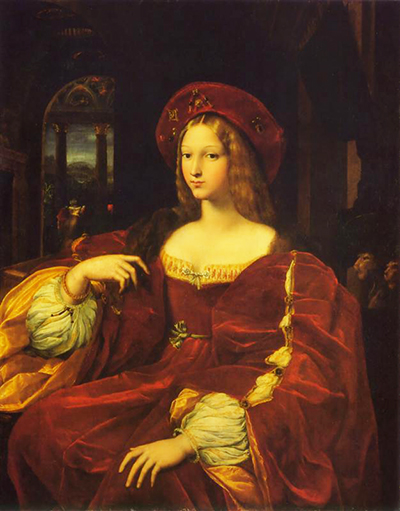
For centuries, the woman in this magnificent red portrait was called Joanna of Aragon. The name entered books, prints and memory so thoroughly that it survives in the page address. The Louvre now identifies her as Doña Isabel de Requesens, vice-queen of Naples, and credits both Raphael and Giulio Romano.[1]
Correcting the name does more than update a label. It restores Isabel to her own political and dynastic world. Correcting the authorship does something equally important: it reveals a late Raphael commission produced through a powerful studio partnership rather than pretending that one famous hand painted every passage.
Isabel sits in deep red velvet, touching the fur at her shoulders while another hand rests lower. Her jeweled headdress, open sleeves and commanding scale make beauty look like a form of court diplomacy. The picture travelled to Francis I of France in 1518, carrying an absent woman's presence from Naples into the French royal collection.[1]
At a Glance
- ArtistsRaphael and Giulio Romano; the exact division of work remains debated
- Current titlePortrait of Doña Isabel de Requesens, Vice-Queen of Naples
- Former titlePortrait of Joanna of Aragon
- Date1518
- CollectionMusée du Louvre, Paris
- InventoryINV 612; MR 434
- Mediumoil originally on wood, later transferred to canvas
- Dimensions120 × 95 cm
- SitterDoña Isabel de Requesens y Enríquez de Cardona-Anglesola
- Positionwife of the viceroy of Naples, therefore conventionally vice-queen
- Commission contextmade for Francis I of France through Cardinal Bernardo Dovizi da Bibbiena
- French provenanceoffered in 1518 and part of the Crown collection ever since
- Workshop questionPrado catalogued it as Giulio Romano, perhaps with Raphael's intervention
- Key visual featuresred velvet dress and headdress, fur, gold-trimmed slashed sleeves, direct gaze and three-quarter-length seated format
Contents
- Who was Doña Isabel de Requesens?
- Why was she called Joanna of Aragon?
- Why names matter
- A portrait made across distance
- Francis I and portraits of celebrated women
- The seated three-quarter figure
- The turn
- The gaze
- The red velvet headdress
- Red as material presence
Who was Doña Isabel de Requesens?
Isabel belonged to the interconnected noble world of the Crown of Aragon, Catalonia and the kingdom of Naples. Her marriage to Ramón Folc de Cardona placed her beside the viceroy who governed Naples from 1509 to 1522 on behalf of the Spanish monarchy.[2][3]
“Vice-queen” describes rank through marriage rather than an independent sovereign office. Even so, a viceroy's wife could carry formidable court visibility, dynastic connections and ceremonial responsibility.
The portrait presents that public standing through material splendour. Isabel has no need for a written title inside the painting; scale, setting and dress make her courtly position visible.
Why was she called Joanna of Aragon?
Older writers interpreted Vasari's reference to a portrait of the wife of the viceroy of Naples as Giovanna—or Joanna—d'Aragona. The title then passed through reproductions and museum histories.[3]
The problem is that several women in related dynastic circles bore similar Aragonese names and titles. Once a prestigious identification became attached, the image helped confirm the label that had been placed upon it.
Research published by the Louvre in 1997 established Isabel de Requesens as the sitter. The museum now makes the old name visible only as a former identification.[1]
Why names matter
A wrong title can seem harmless when the sitter remains an aristocratic Renaissance woman either way. It is not harmless.
Joanna and Isabel had different families, marriages and historical positions. Substituting one for the other turns individual biography into a generic idea of Neapolitan beauty.
Restoring Isabel's name also changes interpretation of the commission. The painting concerns the household of the serving viceroy and a living diplomatic network in 1518.
A portrait made across distance
The finished picture was intended for Francis I of France, not for Isabel's Neapolitan home. Cardinal Bibbiena, a diplomat and close figure in Raphael's circle, facilitated the gift.[1]
This required presence to travel. A likeness had to be obtained in Naples, translated into a large finished image and sent to a king who may never have met the sitter.
Portraiture became a diplomatic technology. It allowed beauty, rank and political connection to circulate when bodies could not.
Francis I and portraits of celebrated women
Francis I cultivated Italian art and court culture on an ambitious scale. A portrait of the vice-queen of Naples joined that interest with the collecting of renowned female beauty.
The commission can appear objectifying, because Isabel's appearance was made available to a distant male ruler. Yet the image does not reduce her to passive prettiness.
Her outward gaze, volume and control of gesture establish a presence capable of answering the court that looks at her.
The seated three-quarter figure
Isabel is shown well below the waist, a larger field than the bust and half-length formats of many earlier portraits. The composition gives room to knees, sleeves and the expanse of dress.
This scale makes clothing architectural. The red garment constructs a broad base from which face and hands emerge.
The sitter does not appear behind a protective parapet. She occupies the room directly, close enough that the velvet seems to enter the viewer's space.
The turn
Her body angles to one side while the head returns toward us. The pose keeps courtly composure from becoming rigid.
The turning structure also displays the dress: one sleeve advances, the fur moves diagonally and the headdress forms a broad tilted crown.
Raphael and Giulio could thus unite likeness with costume presentation without making the sitter resemble a mannequin.
The gaze
Isabel looks outward with calm directness. Because the portrait was made for a distant recipient, this gaze creates the fiction of an encounter the commission itself could not provide.
The expression has often been folded into the Renaissance language of ideal beauty. It should not be treated as evidence of flirtation or private invitation.
Direct eye contact can be diplomatic and sovereign in effect. Isabel appears conscious of being seen and fully capable of returning the act.
The red velvet headdress
A broad red head covering, often described as a balzo, frames the hair. Jewels line its edge and catch light above the face.[3]
Its round form can resemble a halo in reproduction, giving secular splendour an almost iconic boundary.
The headdress also balances the enormous sleeves below. Red occupies top and base, enclosing skin and hair within one sustained court colour.
Red as material presence
The dress is not a flat sign of passion or status. Velvet changes with nap, direction and light, so one hue can contain deep shadow, warm reflection and brilliant ridge.
Large red areas dominate the panel without erasing bodily structure. Gold trim divides them, while cream fabric pushes through slashed openings.
Any symbolic association with love or majesty remains secondary to the secure fact of expense. Saturated velvet on this scale announces elite access to material and labour.
Slashed sleeves
The sleeves open in repeated cuts to reveal pale underfabric. Gold edging marks the boundaries and turns construction into ornament.
Slashing makes clothing appear both massive and permeable. The red exterior is interrupted by flashes of softness beneath.
It also allows the painter to demonstrate control over several surfaces at once. Court fashion becomes a test of colour, rhythm and tactile illusion.
The fur at her shoulders
One hand rises to touch or gather the fur draped around Isabel's upper body.[3]
Fur adds warmth, wealth and a dense brown counterpoint to red velvet. Its irregular edge softens the geometry of dress and connects the active hand to the torso.
The gesture is deliberately easy. Rather than formally presenting a jewel, Isabel appears to manage her own clothing.
The lower hand
Her other hand rests nearer the knee, helping the eye understand how far the body extends. It stabilises the diagonal action above.
The separation of the hands differs from the folded-hand barrier familiar in many female portraits. One belongs to touch and display; the other anchors bodily scale.
This openness contributes to the sitter's unusual command of space. She is contained by costume, not closed away by gesture.
Jewellery as a network of light
Gems on the headdress, gold along sleeves and ornaments at wrist and dress distribute small highlights across the red field.
No single stone needs to carry an elaborate code. Together, the ornaments articulate rank and prevent the costume from reading as one undifferentiated mass.
They also direct looking from face to hand and back again. Wealth becomes compositional movement.
The interior
Unlike portraits set before a plain field, Isabel appears within a spacious architectural environment. A secondary woman is visible at a balcony or loggia in the distance, opening another human scale behind the sitter.
The setting makes the foreground body seem even larger. It also turns the portrait into a court scene rather than an isolated head study.
Architecture supplies ordered splendour without identifying a literal Neapolitan chamber. The room is a stage of status, not necessarily topographical evidence.
The distant attendant
The smaller woman beyond Isabel creates a striking hierarchy. Both are female presences in the same space, but scale, dress and placement distinguish vice-regal sitter from attendant.
Her turned body also prevents the background from becoming empty decoration. Court life continues behind the formal encounter.
No secure identity is required. Her role is relational: she helps define what it means for Isabel to occupy the foreground.
Raphael, Giulio Romano and the commission
The Louvre names both Raphael and Giulio Romano as artists.[1] The Prado's Late Raphael catalogue placed primary execution with Giulio, perhaps with an intervention by Raphael.[2]
The distinction is important. Calling the picture simply “a Raphael” hides a late studio in which designs, preparatory likenesses and painting could be distributed among highly capable collaborators.
At the same time, removing Raphael entirely would ignore the commission's organisation and the possibility of his work on crucial passages.
Vasari's account
According to the report transmitted by Vasari, Giulio was involved in obtaining or executing the likeness, and Raphael worked on the face while Giulio completed the rest. The British Museum repeats this tradition in its record for a print after the portrait.[3]
Vasari provides invaluable proximity to Raphael's world, but his wording has been interpreted in different ways. Modern technical judgement does not divide every square centimetre with certainty.
The account supports collaboration more securely than it supports a perfectly mapped separation of hands.
Was Raphael ever in Naples for the sitting?
The late workshop could solve a remote commission through travel by an assistant, a preparatory study or a painted model sent back to Rome. The surviving public records do not prove that Raphael personally met Isabel.
That uncertainty affects the idea of likeness. A celebrated face might pass through drawing, cartoon and colleague before reaching the final panel.
Raphael's authorship could reside in conception, correction and selected passages rather than continuous presence before the sitter.
Giulio Romano as more than an assistant
By 1518 Giulio was capable of carrying major pictorial responsibility. The Prado's attribution recognises a developing artistic identity, not merely a pair of borrowed hands.[2]
His later work in Mantua would show bold architecture, dramatic scale and sensuous surface. In Isabel's portrait, those capacities operate within Raphael's courtly system.
Giving Giulio credit makes the painting richer. It exposes the achievement of collaboration at the point where one master's reputation has often absorbed another's labour.
Why the face receives special attention
If Raphael intervened primarily in the face, he concentrated on the portion most essential to recognisable identity and royal reception.
The possibility fits a studio economy in which the master could refine crucial passages while a trusted colleague managed costume and setting.
Yet the body is not subordinate filler. Dress, hands and architecture create the political scale through which the face becomes vice-regal.
From wooden panel to canvas
The Louvre records oil on canvas with an explicit qualification: the painting was transferred from wood.[1]
During such a treatment, the original panel support was removed and the painted layers attached to fabric. The intervention altered the object's structure while aiming to preserve its visible surface.
Modern viewers encounter the historic image, but not the support Raphael and Giulio prepared. Condition and texture must be understood through that major change.
Arrival in France in 1518
Cardinal Bibbiena offered the portrait to Francis I in 1518, the same year the Louvre assigns to its creation.[1]
The rapid passage suggests that diplomatic destination shaped the project from the start. This was not a private likeness later chosen from a Neapolitan collection.
Its entry into French ownership is exceptionally early and clear, even though the exact working process in Italy remains debated.
A continuous royal provenance
From Francis I's collection, the portrait remained part of the French Crown holdings and eventually the Louvre.[1]
That continuity helped preserve the painting and amplify the old Joanna title. Royal display, copies and prints distributed both image and misidentification.
The same long visibility later made correction especially consequential. A museum label had to overcome centuries of repetition.
Prints and the persistence of the wrong name
Reproductive prints often carried “Joanna of Aragon” or its equivalents. The British Museum's nineteenth-century lithograph still bears that object title while its current record corrects the sitter to Isabel.[3]
This layered cataloguing is useful. It shows how false names travel through inscriptions and markets even after scholarship changes.
Historical titles should not be erased from records, because they help trace reception. They should no longer lead the identification.
Beauty and political usefulness
The portrait's celebrated beauty was not separate from politics. Courts exchanged images to cultivate curiosity, admiration and alliance.
Isabel's red splendour could honour Francis I's taste, Pope Leo X's cultural diplomacy and Naples's elite world simultaneously.
The sitter's own intentions are less visible. Recognising this asymmetry keeps admiration from pretending that the commission was simply a personal act of self-expression.
A woman represented for an absent king
The circumstances raise an ethical question familiar in court portraiture: who controls an image made for someone far away?
Isabel's appearance became part of a male diplomatic exchange. Yet the final picture gives her unusual spatial and visual authority.
Those truths can coexist. A work may arise from unequal structures and still present its sitter with force that exceeds the purposes of patrons.
Artist Up Close
The portrait's authorship debate becomes clearest when the work is understood as an integrated system. Raphael's courtly conception may govern the turn, scale and gaze; Giulio's execution may drive the sensuous breadth of velvet, sleeve and room; intervention in the face may concentrate likeness. The public sources do not permit a complete brush-by-brush map.
What they do permit is a more accurate idea of late Raphael. His studio could create a diplomatic presence across geographic distance by coordinating design, travel, observation and paint.
Isabel is not diminished by that process. Her restored name now anchors the whole achievement to the historical woman whose identity the famous image once lost.
Frequently Asked Questions
Discussion
What detail most changes how you read Raphael and Giulio Romano's Portrait of Doña Isabel de Requesens?
Reader Insights
Which source detail gives the page its strongest anchor?
Which visual or historical distinction should readers keep in mind?
How does this page change the wider picture of Raphael's career?
Join the Conversation
Share your reading below.
References
- Musée du Louvre, “Portrait de Dona Isabel de Requesens, vice-reine de Naples, dit longtemps Portrait de Jeanne d'Aragon,” collection record, INV 612 View source.
- Museo Nacional del Prado, “Late Raphael,” exhibition research and catalogue list, 2012 View source.
- British Museum, “Joanna of Aragon,” lithograph after Raphael and Giulio Romano, current sitter record for Doña Isabel de Requesens, 1871,1209.2124 View source.