 by Tom Gurney
Tom Gurney BSc (Hons) is an art history expert with over 20 years experience
Published on June 19, 2020 / Updated on August 21, 2026
Email: tomgurney1@gmail.com / Phone: +44 7429 011000
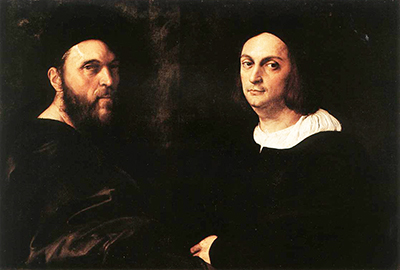
Raphael's Portrait of Andrea Navagero and Agostino Beazzano is not simply two likenesses fitted onto one canvas. The men turn in different ways, occupy different depths and possess sharply distinguished faces, yet their attention converges. They appear to have interrupted a conversation because someone else has entered it.
That absent presence may be Pietro Bembo, the humanist who owned the painting and whose correspondence connects its sitters with Raphael. In April 1516, Bembo wrote of a planned excursion to Tivoli with Navagero, Beazzano, Baldassare Castiglione and the artist. They intended to look at ancient and modern things and at what was beautiful in the district. The portrait belongs to this extraordinary crossing of friendship, poetry, diplomacy, antiquarian study and art.[1]
The exact commission is not known. Bembo's ownership is documented; the idea that he ordered the picture to preserve his friends is persuasive but remains an inference. Raphael's double portrait is powerful because it allows friendship to be seen without converting it into a sentimental anecdote.
At a Glance
- ArtistRaphael, with possible influence or participation by Sebastiano del Piombo proposed by the museum
- TitleDouble Portrait, commonly identified as Andrea Navagero and Agostino Beazzano
- Dateabout 1516
- CollectionGalleria Doria Pamphilj, Rome
- InventoryFC 130
- Mediumoil on canvas
- Dimensions77 × 111 cm
- Bearded sitter placed slightly behindAndrea Navagero (1483–1529)
- Fuller-faced sitter nearer the parapetAgostino Beazzano (died 1549)
- Early ownerPietro Bembo
- Documentary anchorsMarcantonio Michiel's notice in Bembo's house and Bembo's 1538 letter recording the gift to Beazzano
- Former identificationsBartolo and Baldo, and Luther and Calvin
- Former attributionGiorgione was sometimes proposed because of the work's Venetian character
Contents
- Two men, one event
- How to recognise the sitters
- Andrea Navagero
- Navagero the diplomat
- Agostino Beazzano
- Beazzano and poetry
- Pietro Bembo as the connecting figure
- The Tivoli letter of 3 April 1516
- Was the portrait painted for Bembo?
- Portraits of friendship
Two men, one event
Many paired portraits divide a surface into parallel likenesses. Raphael instead creates an event.
Navagero is set slightly farther back, his head turned sharply. Beazzano occupies the front and rests an arm along the parapet. The positions are complementary rather than mirrored.[1]
Their eyes look outward. Because both seem to respond at once, the viewer becomes the cause of their turn. The canvas stages the instant in which a private exchange opens to include a third participant.
How to recognise the sitters
The Doria Pamphilj's detailed account identifies Navagero as the man with a moustache and long beard, wearing a broad dark velvet garment and cap. His eyes are deeply set and his head is placed behind his companion.[1]
Beazzano is fuller faced, with prominent eyes, a pointed and dimpled chin, longer straight hair emerging beneath his cap and a pale pleated shirt under a dark woollen jacket.[1]
These descriptions are safer than saying only “left” or “right.” Reversed reproductions and different verbal viewpoints can make directional labels surprisingly confusing.
Andrea Navagero
Andrea Navagero was born in Venice in 1483. He became a humanist, classical scholar, poet, orator, librarian, historian and diplomat.[2]
His career joined books with government. He worked on Latin texts in the Aldine world and became associated with the care of the collection given to Venice by Cardinal Bessarion. That collection would form the intellectual foundation of the Biblioteca Marciana.
Navagero also served as an official historian of the Venetian Republic. His learning was therefore civic as well as personal: classical literature could furnish the language through which Venice understood and presented itself.
Navagero the diplomat
After the portrait was painted, Navagero represented Venice in major European negotiations. He became ambassador to Spain and later was appointed to France.
His assignments placed him within the contest among Venice, the Habsburg monarchy and Francis I. A scholar who edited ancient texts also had to report on courts, cities, alliances and danger.
Navagero died at Blois in 1529, during his French mission. The Doria portrait shows him before those extended embassies, but the concentrated face readily accommodates later knowledge of a life spent reading political situations.[1][2]
Agostino Beazzano
Agostino Beazzano was born at Treviso, probably in the last decade of the fifteenth century. The precise year is not known. He pursued an ecclesiastical path and received benefits and honours under Pope Leo X.[3]
Pietro Bembo brought him into Roman and papal affairs. In 1515, Beazzano was sent to Venice to request arms for Ancona's defence and to seek Greek books for the papal collection.[3]
He wrote in Latin and Italian, moved among leading Roman humanists and maintained a particularly strong attachment to Bembo. His importance in the portrait is not borrowed solely from his more famous companions; he was an active participant in their world.
Beazzano and poetry
Beazzano's surviving reputation rests especially on vernacular poetry. His later collection brought together Italian and Latin works, including verses addressed to prominent political and cultural figures.[3]
He wrote about Navagero in both friendship and remembrance. Their relationship was not permanently harmonious: Treccani records a later breach, followed by elegiac praise after Navagero's death.[3]
That later complexity is useful. The painting preserves friendship at one moment; it does not promise that human relations remain unchanged.
Pietro Bembo as the connecting figure
Pietro Bembo linked both sitters to Raphael and to one another. A Venetian patrician, writer and later cardinal, he was central to the promotion of Petrarchan literary style and to debates about the Italian language.
The portrait belonged to him. That ownership is not a minor detail added after visual analysis; it helps explain why two Venetian men appear together in a painting made within Raphael's Roman circle.[1]
Bembo's house later held the canvas as an object of memory. It could maintain the presence of absent friends while also displaying the owner's association with Raphael.
The Tivoli letter of 3 April 1516
Bembo wrote to Cardinal Bibbiena on 3 April 1516 about going to Tivoli with Navagero, Beazzano, Castiglione and Raphael. The company intended to examine ancient remains, newer works and the beauty of the place.[1]
The letter gives unusual substance to the social world behind the picture. These were not names grouped retrospectively because they all seem “Renaissance.” They planned to travel and look together.
Ancient architecture, poetry and painting met through shared observation. Raphael's art existed inside conversation rather than apart from it.
Was the portrait painted for Bembo?
The Doria Pamphilj suggests that Bembo probably commissioned the portrait to preserve his dialogue with the two sitters.[1]
This is plausible. He owned the picture, corresponded with the men and belonged to the group. The outward turn even allows an imaginative reading in which the owner occupies the viewers' position.
No surviving contract quoted by the museum proves the original order. The distinction is straightforward: Bembo's early possession is documented; his role as commissioner remains a well-grounded proposal.
Portraits of friendship
The work is often described within a tradition of friendship portraits.[1] Such images can do more than place companions side by side.
A double likeness may preserve social connection, celebrate shared learning or give one owner access to absent people. It can also display the cultural rank of belonging to an eminent circle.
Raphael avoids a symbolic token of friendship. No joined hands, inscription or exchanged object defines the bond. Coordination of attention carries the idea.
A dark field
The background is almost entirely dark. It supplies no landscape and no recognisable room.
The figures therefore emerge through illuminated faces, shirt, hair and the subtle behaviour of black fabrics. Darkness compresses the space and makes their sudden outward attention more intense.
The setting also contributes to the painting's Venetian reputation. Strong tonal contrasts and saturated, warm colour differed from a portrait built primarily through firm contours and bright local hues.
Complementary turns
Navagero's head makes the sharper turn. Beazzano's body occupies the foreground more firmly, with his arm establishing a horizontal base.
If both men had adopted the same pose, the result could resemble a repeated formula. Raphael instead uses difference to bind them. One turn answers the other; one depth makes the other legible.
Their contrasting positions suggest that shared response does not require visual sameness.
The parapet
A low parapet coincides with the bottom of the painting. Beazzano's forearm rests along it, bringing his body toward the threshold between pictorial space and the viewer.[1]
The ledge stabilises the group, but it is not an impermeable barrier. The arm crossing it creates ease and access.
In portrait traditions, parapets could carry inscriptions or separate living spectator from represented sitter. Here the empty boundary becomes part of an interrupted social exchange.
Three-quarter presentation
Both men are seen in three-quarter relation rather than strict profile. This permits Raphael to show facial structure and bodily turn simultaneously.
The format had become a powerful vehicle for lifelike presence. Raphael presses two such presentations into one wide field without allowing either head to disappear.
The result is asymmetrical but balanced. Beazzano's greater foreground mass is answered by Navagero's beard, dark robe and vigorous rotation.
Beards, hair and age
Navagero's long beard and deeply set eyes create an appearance different from Beazzano's rounded cheeks, straight hair and small pointed chin.[1]
These contrasts help secure identity after centuries in which the names were lost. They also prevent friendship from becoming a picture of idealised twins.
Raphael describes two bodies with different histories. Age and feature are given enough specificity to resist absorption into a single type of “humanist.”
Black garments as varied materials
Both sitters wear dark clothes, but their fabrics react differently to light. Navagero's broad velvet garment has depth and subdued lustre; Beazzano's woollen jacket reads as firmer and drier.[1]
This discrimination is central to the painting. Darkness becomes a field of material knowledge rather than an empty zone.
Social status is present in cut, cloth and finish, but the likenesses do not become fashion plates. Texture supports the contrast between people.
Beazzano's white shirt
The pale pleated shirt is the strongest light in the lower half. Its folds emerge between dark jacket and face, drawing Beazzano forward.
The fabric registers care and fashionable dress. It also breaks the wide expanse of black that might otherwise merge the two bodies.
The shirt's rhythm has a conversational function: multiple folds collect into one luminous passage, much as two different sitters form one social unit.
The viewer as a third friend
The painting's outward gazes have encouraged the thought that Bembo is imaginatively present before it.[1]
This cannot be proven as a literal scenario. The sitters may not have turned toward a specific person during one decisive second. Raphael arranged the effect.
Nevertheless, the interpretation clarifies what the composition accomplishes. Whoever stands before the canvas temporarily takes the open position in a triangular relationship.
No conversation can be heard
The men appear interrupted, but the subject of their exchange remains unknown. Raphael does not give them books, ruins, maps or letters.
That refusal keeps the picture from becoming a narrow illustration of scholarship or diplomacy. Conversation is conveyed as readiness rather than content.
The silent pause also suits portraiture's temporal paradox. Painted people cannot speak, yet their attention makes speech feel about to resume.
Raphael and Venetian painting
The Doria Pamphilj describes the work's style as Venetian, citing its vibrant palette and strongly contrasted illumination.[4]
Raphael had long absorbed ideas from multiple Italian centres. In Rome, contact with Venetian painters and patrons made exchange especially active.
Calling the portrait Venetian in character identifies colouristic and atmospheric affinities. It does not mean Raphael abandoned his own compositional clarity or that the canvas was necessarily made in Venice.
The Sebastiano del Piombo question
Because of the work's colour and forceful lighting, scholars have proposed influence or even participation by Sebastiano del Piombo.[4]
Sebastiano was a Venetian painter active in Rome and a major alternative to Raphael's visual language. Collaboration would be historically possible, but the museum presents it as a possibility.
The safest account keeps both parts in view: Raphael remains the named artist, while the surface has prompted a serious question about Sebastiano's role.
What Marcantonio Michiel saw
The Venetian connoisseur Marcantonio Michiel recorded the portrait in Pietro Bembo's house in Padua. The Doria Pamphilj's long account places his observation around 1526 and reports his identification of Navagero and Beazzano with Raphael as painter.[1]
The museum's shorter entry gives 1521, demonstrating that even institutional summaries can vary in dating the notice.[4]
The essential point is secure: an early witness saw the double likeness in Bembo's possession and named both sitters and Raphael.
Bembo's gift to Beazzano
A letter dated 29 July 1538 records Bembo's pleasure that the painting of the two heads by Raphael had been given to Beazzano.[1]
This transfer is unusually fitting. One of the represented friends became owner of the image that joined him to the other.
The letter also strengthens identification across time. It is not merely a later collector guessing at two anonymous faces.
Into the Aldobrandini collection
The painting reappeared in the inventory of Cardinal Pietro Aldobrandini's collection in 1603.[1]
Its path between Beazzano and that inventory is not described with equal completeness. The change from a humanist's friendship object to a cardinal's art collection may have contributed to loss of personal memory.
Through Olimpia Aldobrandini's marriage to Camillo Pamphilj in 1647, Aldobrandini holdings entered the dynastic formation behind the Doria Pamphilj collection.[1]
When the names were forgotten
By the seventeenth century, the sitters were no longer consistently recognised. They were called the jurists Bartolo da Sassoferrato and Baldo degli Ubaldi.[1]
Another reading made them Martin Luther and John Calvin. These identifications radically changed the painting's imagined relationship, turning Venetian friends into legal authorities or Protestant reformers.
The errors show that lifelike features do not preserve names by themselves. Identity depends on records as well as resemblance.
Why Giorgione entered the story
The painting's Venetian colour encouraged attribution to Giorgione during parts of the seventeenth and eighteenth centuries.[1]
That history is understandable even though the work is now assigned to Raphael. Attributions respond to expectations about how artists use light, colour and atmosphere.
The Giorgione episode also reveals the strength of the canvas's Venetian voice. What can now be discussed as Raphael's adaptation once seemed evidence of a different hand.
Rediscovery in the nineteenth century
Marco Minghetti, a politician and scholar, played a major role in restoring the sitters' identities. In 1883 he asked permission to photograph the painting and connected it with Bembo's letters concerning Navagero and Beazzano.[1]
His work joined visual recognition to documentary inquiry. The older Bartolo and Baldo names could be tested against an early description with a known owner and artist.
Rediscovery was therefore not a flash of intuition. It was an argument built across picture, correspondence and collection history.
Copies at the Prado
The Museo del Prado holds separate portraits of Navagero and Beazzano that its records describe as copies after Raphael's 1516 double portrait. The two copied canvases were originally joined.[5]
Their existence shows how a paired composition could be divided into individual likenesses. Separation changes the social logic: each face survives, but the mutual event weakens.
Copies can therefore preserve appearance while revealing what the original alone achieves through adjacency.
Artist Up Close
Raphael's Roman career depended on his ability to work across different communities. He could serve popes and bankers, design monumental religious spaces and maintain friendships with writers whose authority did not come from hereditary rule alone.
This portrait shows his sensitivity to plurality. Navagero and Beazzano are not reduced to matching examples of learned men. Their faces, clothing, depths and turns remain separate. Unity emerges from response.
The work also demonstrates Raphael's openness to Venetian colour without sacrificing structural control. Dark atmosphere, fabric and abrupt illumination intensify a composition whose underlying relations are precisely organised.
Most importantly, Raphael makes sociability visible. The picture has no handshake and no inscribed declaration of loyalty. Friendship exists as a space kept open for another person. Five centuries later, viewers continue to enter it.
Frequently Asked Questions
Discussion
What detail most changes how you read Portrait of Andrea Navagero and Agostino Beazzano?
Reader Insights
Which source detail gives the page its strongest anchor?
Which visual or historical distinction should readers keep in mind?
How does this page change the wider picture of Raphael's career?
Join the Conversation
Share your reading below.
References
- Galleria Doria Pamphilj, “Raffaello 500: Raphael Sanzio, Double Portrait,” 18 March 2020 View source.
- German National Library, “Andrea Navagero,” Integrated Authority File record 115571248 View source.
- Francesco Tateo, “Beaziano, Agostino,” Dizionario Biografico degli Italiani, vol. 7, Treccani, 1970 View source.
- Galleria Doria Pamphilj, “Raphael — Double Portrait,” collection record, FC 130 View source.
- Museo Nacional del Prado, “Andrea Navagero,” collection record P304, describing the paired Prado copies after Raphael's double portrait View source.