 by Tom Gurney
Tom Gurney BSc (Hons) is an art history expert with over 20 years experience
Published on June 19, 2020 / Updated on August 21, 2026
Email: tomgurney1@gmail.com / Phone: +44 7429 011000
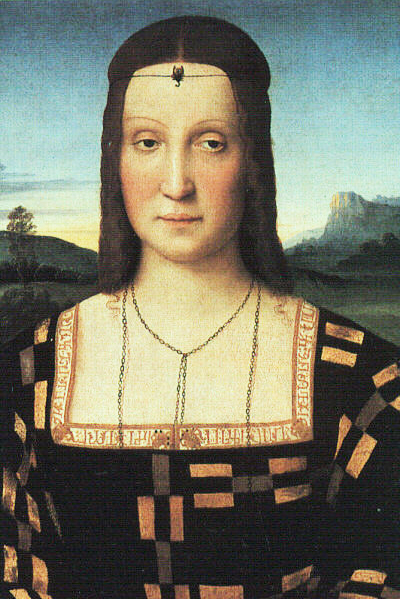
Raphael's Portrait of Elisabetta Gonzaga meets the viewer with complete frontality. The Duchess of Urbino neither turns into the scene nor extends a hand toward us. Her pale face is set above an almost black dress patterned with gold and silver, while a bright, finely wooded landscape opens behind her shoulders. At the centre of her forehead, a scorpion-shaped jewel interrupts the strict symmetry.
Elisabetta—Elizabeth in its anglicised form—was no passive ornament of the Urbino court. She was a politically tested duchess, a patron and a central figure in the cultural world later idealised by Baldassare Castiglione in The Book of the Courtier. The likeness nevertheless resists being converted into an illustrated biography. Its reserve is constructed from pose, costume and spacing; it is not a window through which every private feeling can be read.[1]
Painted about 1502, the panel shows the young Raphael already able to make formality psychologically compelling. Elisabetta's authority comes from stillness, but stillness never becomes emptiness.
At a Glance
- ArtistRaphael
- TitlePortrait of Elisabetta Gonzaga, Duchess of Urbino
- Dateabout 1502
- CollectionPalatine Gallery, Pitti Palace, Uffizi Galleries, Florence
- Inventory1890 no.1441
- Mediumoil on panel
- Dimensions52.9 × 37.4 cm
- SitterElisabetta Gonzaga (1471–1526)
- PositionDuchess of Urbino through marriage to Guidobaldo da Montefeltro
- Formatfrontal bust ending below the chest, without visible hands
- Clothingblack
gamurraorcamurrawith asymmetric gold-and-silver rectangles - Distinctive jewelscorpion-shaped forehead ornament set with a precious stone
- Literary afterlifepresiding duchess in Castiglione's Book of the Courtier
- CompanionRaphael's portrait of Guidobaldo da Montefeltro in the same collection
- Interpretive cautionthe jewel has several competing explanations; none is definitive
Contents
- Who was Elisabetta Gonzaga?
- A court under pressure
- Why the frontal pose matters
- A portrait without hands
- The gaze
- Youth and office
- The black gamurra
- Montefeltro colours
- The white neckline
- Two gold chains
Who was Elisabetta Gonzaga?
Elisabetta was born in 1471 into the ruling Gonzaga family of Mantua. Her marriage to Guidobaldo da Montefeltro made her Duchess of Urbino and placed her within a court celebrated for learning, art and refined social conduct.
Court culture was not separate from government. Marriage joined dynasties; hospitality could become diplomacy; cultivated conversation displayed the quality of a regime. Elisabetta's position required political judgement as well as ceremonial grace.
The Uffizi describes her as one of the important cultural figures of her age, deeply engaged with literature and art.[1] That standing makes the portrait an image of authority, even though Raphael includes no crown, document or architectural throne.
A court under pressure
The approximate date, 1502, was not a tranquil point in Urbino's history. Cesare Borgia's military expansion forced Guidobaldo from the duchy that year. He returned after Julius II, his brother-in-law, became pope and political circumstances changed.[2]
It is uncertain whether the portrait was completed before, during or after a particular stage of this upheaval. “About 1502” cannot be made to document a single day.
The political setting nevertheless prevents us from imagining Urbino's elegance as sheltered from force. The culture later remembered for polished conversation existed alongside exile, papal alliances and dynastic contingency.
Why the frontal pose matters
Elisabetta's shoulders and face align almost squarely with the picture surface. This is more demanding than it first appears.
In a three-quarter portrait, a turn can create animation. Here Raphael must produce life through minute inequalities: the shape of the eyes, fall of light, line of the mouth and slight changes across the cheeks.
Frontality can suggest icon, ceremony or official record. Raphael accepts those associations while preventing the sitter from becoming an impersonal sign. Her gaze is formal, yet it belongs to a particular face.
A portrait without hands
The panel ends below the chest and excludes arms and hands. There is no gesture to explain mood or occupation.
This omission intensifies the encounter. All motion is concentrated in the small variations of features and in the rhythmic dress pattern below them.
It also distinguishes Elisabetta from Raphael's apple-holder and later Florentine sitters, whose hands organise the lower field. Her authority is not performed through possession. She simply occupies the centre.
The gaze
Elisabetta looks outward without theatrical confrontation. The Uffizi calls the expression reserved and noble, while also emphasising Raphael's concern with authentic emotional presence.[1]
Those terms are useful if they remain descriptions rather than diagnoses. Reserve can be a pictorial effect of closed lips, frontal symmetry and controlled eyes. It does not prove sadness, anxiety or detachment.
The portrait's power lies in how little it gives away. Viewers receive sustained attention but no narrative key for possessing the person behind it.
Youth and office
Elisabetta was about thirty-one in 1502. Raphael represents smooth skin, a composed mouth and carefully arranged hair without turning youth into informality.
Her ducal role and individual appearance reinforce one another. Rank gives the direct pose public weight; observed features stop office from becoming a mask.
This balance is central to Raphael's portraiture. Ideal order does not erase bodily difference. Instead, order makes difference easier to see.
The black gamurra
The duchess wears a dark fitted dress known as a gamurra or camurra. Across it, rectangles of gold and silver form an asymmetric arrangement.[1]
Black creates a broad, quiet mass around the pale face. It can indicate costly sobriety: producing deep, stable dark fabrics and pairing them with precious ornament was itself a form of luxury.
Raphael lets the dress approach abstraction. At first it reads as darkness; only then do pattern and construction emerge. The sequence makes the face appear luminous without separating it from court dress.
Montefeltro colours
The Uffizi connects the gold-and-dark palette with the heraldic colours of the Montefeltro family.[1] Guidobaldo's companion portrait uses a similarly sober black garment with gold edging.[2]
Elisabetta was born a Gonzaga, but marriage made her duchess within the Montefeltro dynasty. Clothing can therefore present affiliation without requiring a large coat of arms.
The asymmetric rectangles keep heraldic colour from hardening into uniform. Family identity is worn as designed material, adapted to a living body.
The white neckline
A narrow band of white separates face from dress. Gold characters run across it in a script described by the Uffizi as Kufic.[1]
European Renaissance textiles and paintings often incorporated ornamental forms derived from Arabic script. Such marks need not constitute a legible sentence. Their prestige could depend on visual association with imported luxury and distant manufacture.
It is safest to call the border script-like or pseudo-Kufic unless the characters are demonstrably readable. Raphael paints cultural exchange into clothing without giving us a translation.
Two gold chains
Two simple chains descend over the dark dress. They are far less assertive than the patterned fabric or forehead ornament.
Their thin lines connect neckline to torso, preventing the black area from becoming visually closed. Gold repeats at different scales: script, chains, rectangles and jewel setting.
The restraint is important. Elisabetta's status does not depend on the quantity of gems. Selection and placement carry more force than accumulation.
The scorpion jewel
The scorpion at the centre of the forehead is the portrait's most discussed detail. It sits where symmetry makes even a small object impossible to ignore.
Its shape is clear; its meaning is not. The main Uffizi record notes interpretations involving an amorous letter S and a fertility charm associated with Scorpio.[1] A separate Uffizi study of jewels rejects a zodiac reading because Elisabetta was born under Aquarius and proposes another conjunction: the hard diamond signifies strength and intellect, while the scorpion can signify dialectical eloquence.[3]
The disagreement is valuable. It shows that museum interpretation can remain open when one object belongs to several symbolic traditions.
Fertility and the limits of interpretation
Elisabetta and Guidobaldo had no biological children. The Uffizi attributes this to the duke's sterility and notes that a protective or fertility reading has been applied to the jewel.[1]
That biographical fact should not license a story of concealed grief in Elisabetta's expression. Nor should every ornament she wears be reduced to reproduction.
If the jewel carried protective force, it could still also proclaim intelligence, splendour or courtly identity. Renaissance objects accumulated associations; a modern viewer should resist choosing the one that makes a woman's body the whole subject.
Diamond, strength and eloquence
The Uffizi jewellery essay pairs the diamond's hardness with fortitude and intellectual sharpness. It also links the scorpion to dialectic and Elisabetta's gifts as a speaker.[3]
This interpretation is particularly apt for the duchess remembered as presiding over courtly conversation. Yet aptness is not documentary proof of commission intent.
The portrait supports a measured conclusion: the jewel marks Elisabetta as exceptional and learned, but Raphael left no surviving explanation that fixes its code.
The luminous landscape
Behind the dark figure, hills dotted with fine trees recede toward a high mountain. The Uffizi characterises the landscape as light, peaceful and Umbrian.[1]
It supplies more than local atmosphere. Pale distance makes the frontal body advance and gives air around the head. Trees offer irregular, organic counterpoints to the dress pattern.
The contrast between still sitter and open land does not isolate Elisabetta from nature. Dark shoulders become the threshold through which the distant scene is seen.
Is the landscape Urbino?
The museum does not identify a precise topographical view. Calling it the duchy itself would turn a general landscape language into a map.
Raphael had absorbed the clear horizons and measured recession of Umbrian painting. At Urbino he also knew court art in which landscape and architecture expanded a sitter's world.
The background can evoke place without recording a named location. Its role is both cultural and compositional.
Flemish art at the Urbino court
The Uffizi relates Raphael's fine handling, intense light-dark contrast and attention to detail to northern paintings he could study in Urbino, including works by Justus of Ghent and Pedro Berruguete.[1]
Urbino's collections offered a young painter access to different visual traditions. Northern oil technique, dynastic portraiture and minute material description existed alongside Central Italian design.
Raphael did not merely imitate a foreign model. He absorbed precision into a portrait whose broad symmetry and landscape remain his own problem.
A companion to Guidobaldo
Raphael's Portrait of Guidobaldo da Montefeltro, also in the Pitti Palace, is treated as Elisabetta's pendant. The two share black and gold family colours and a language of solemn presentation.[2]
They are not identical in dimensions or setting. Guidobaldo appears in a larger panel with an interior and wide window; Elisabetta is more tightly framed against open landscape. The companion relation therefore depends on correspondence, not mechanical duplication.
The museum dates Guidobaldo about 1503–04 and Elisabetta about 1502. These approximate dates warn against asserting that the couple sat on the same occasion.[1][2]
Guidobaldo's likeness
Guidobaldo was the son of Federico da Montefeltro and Battista Sforza. His identification in Raphael's portrait is supported by comparison with a reliable image preserved in the Vatican Library.[2]
Where Elisabetta's face is fully frontal, Guidobaldo's body occupies a more articulated chamber. Both paintings make pale skin emerge from dark clothes, but they distribute attention differently.
As a pair they present rule through complementary pictorial structures. This need not mean that every contrast encodes gender; it may reflect format, date and the availability of separate models.
Exile and return
Guidobaldo fled Urbino during Cesare Borgia's 1502 invasion. The election of Julius II—Elisabetta's brother-in-law—helped make a return possible in 1504.[2]
The couple's court was therefore rebuilt after displacement. Cultural prestige could help restore continuity by presenting Urbino as an enduring centre of civility despite political rupture.
Raphael's portrait participates in that larger visual memory, even if its exact circumstances are not recorded. Elisabetta's stillness gains historical resonance from a life repeatedly required to preserve dynastic composure.
Adoption and succession
Because the marriage produced no heir, Guidobaldo and Elisabetta adopted Francesco Maria della Rovere. He was named successor in 1504 and inherited the duchy after Guidobaldo's death in 1508.[2]
This arrangement tied Montefeltro continuity to the della Rovere family and to Pope Julius II. It was a political and familial solution, not merely a private matter.
The young man holding an apple in another Uffizi portrait has been proposed as Francesco Maria, partly because the fruit might allude to this new status. That identity remains uncertain and should not be used to turn the three pictures into a documented family group.
Elisabetta in The Book of the Courtier
Baldassare Castiglione set The Book of the Courtier at Urbino and made Elisabetta the presiding presence before whom its conversations unfold. The Uffizi notes that she is praised there as a personification of grace.[1]
The work transformed memories of court discussion into a highly shaped literary ideal. It tells us how Elisabetta's cultural role was represented, not everything she said on particular evenings.
Portrait and book have reinforced one another. Raphael gives the duchess a visual reserve suitable for retrospective ideals of grace; Castiglione gives viewers a language through which that reserve can be admired.
Grace without passivity
Renaissance praise of feminine grace can sound like a demand for effortless compliance. Elisabetta's historical position complicates that reading.
Presiding over a court required attentiveness, mediation and control of tone. Grace could be political technique: authority exercised without coarse display.
Raphael's image is compatible with that understanding because it makes restraint active. The frontality does not wait for someone else to animate it. It holds the viewer in place.
A face and a literary ideal
It is tempting to use Castiglione's praise as a caption for every feature. The jewel becomes wit, the mouth becomes discretion and the gaze becomes perfect grace.
Such correspondence is satisfying but circular. The book was composed through later recollection and literary craft; the painting has its own material and visual history.
Their relation is strongest when neither is reduced to proof of the other. Together they show how a historical woman could become central to two distinct forms of Renaissance memory.
From Urbino to Florence
Elisabetta's portrait belongs to the group of Urbino dynastic works that ultimately entered Medici collections through Vittoria della Rovere. The same movement brought other Raphael portraits from the ducal inheritance into Florence.
The transfer preserved a remarkable visual archive but also changed its setting. Images once tied to relationships within an active court became works arranged in a grand-ducal collection.
Today the portrait hangs within the Palatine Gallery, where its pendant relation with Guidobaldo can again be made visible. Exact room placement may change; the collection identity is stable.
Artist Up Close
This early panel reveals Raphael learning how little a portrait needs when its internal order is exact. He removes hands, furniture and narrative action. He then varies surfaces with extraordinary care: flesh is pale and softly modelled; dress is dark but patterned; chains are linear; the jewel is compact; the landscape dissolves into air.
The face does not float above costume. Gold and white at the neckline mediate between skin and black cloth, while the central jewel fixes the vertical axis from forehead downward. Landscape opens the silhouette without weakening frontality.
Raphael's achievement is not that he uncovers Elisabetta's private soul. It is that he makes public form feel inhabited. A duchess can be ceremonial and individual in the same instant.
Frequently Asked Questions
Discussion
What detail most changes how you read Portrait of Elisabetta Gonzaga?
Reader Insights
Which source detail gives the page its strongest anchor?
Which visual or historical distinction should readers keep in mind?
How does this page change the wider picture of Raphael's career?
Join the Conversation
Share your reading below.
References
- Uffizi Galleries, “Portrait of Elisabetta Gonzaga, Duchess of Urbino,” object record by Anna Bisceglia View source.
- Uffizi Galleries, “Portrait of Guidobaldo da Montefeltro,” object record by Anna Bisceglia View source.
- Uffizi Galleries, “Jewels in the Uffizi,” online exhibition, section on the Portrait of Elisabetta Gonzaga View source.