 by Tom Gurney
Tom Gurney BSc (Hons) is an art history expert with over 20 years experience
Published on June 19, 2020 / Updated on August 21, 2026
Email: tomgurney1@gmail.com / Phone: +44 7429 011000
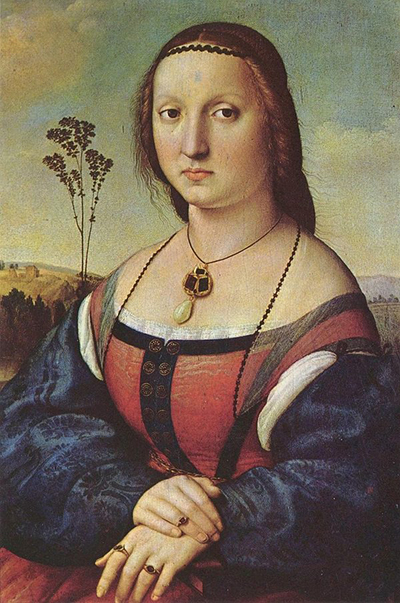
Maddalena Strozzi Doni sits before a distant landscape with her hands folded, her shoulders widened by sumptuous sleeves and her jewellery arranged against a dark bodice. The pose inevitably recalls Leonardo's Mona Lisa. Raphael does not hide the encounter. He uses it to discover how clarity, colour and exact material description can make a Florentine bride command a half-length portrait.
This panel is one side of a larger conception. Raphael's portrait of Maddalena was paired with his likeness of her husband, Agnolo Doni, and the two paintings originally formed a hinged diptych. Their reverse faces carry successive scenes from Ovid, painted by another artist: the Flood behind Agnolo and the rebirth of humankind through Deucalion and Pyrrha behind Maddalena.[1]
The portrait is therefore both intimate and dynastic. It records one young woman's appearance, while its clothes, precious objects, companion panel and hidden myth place her inside a marriage negotiated between money, lineage and hope for continuity.
At a Glance
- Artist of the frontRaphael
- TitlePortrait of Maddalena Doni
- Approximate date1504–07
- Present collectionthe Uffizi Galleries in Florence
- Inventory1912 no.59[2]
- Support and techniqueoils applied to a lime or basswood panel
- Size63.5 × 45 cm
- SitterMaddalena Strozzi Doni (1489–1540)
- MarriageAgnolo Doni, 31 January 1504
- Companion paintingRaphael's Portrait of Agnolo Doni
- Original arrangementhinged, double-sided marital diptych
- Reverse imageDeucalion and Pyrrha, in monochrome, by the painter called the Maestro di Serumido
- Technical discoveryradiography shows that Raphael revised the first background before coordinating it with Agnolo's landscape
- Principal jewelgold unicorn mount with ruby, emerald, sapphire and pearl
- Family ownershipretained by Doni descendants until sale to Grand Duke Leopold II in 1826
Contents
- Who was Maddalena Strozzi Doni?
- A young bride represented as an adult presence
- A likeness made for a pair
- The half-length format
- The three-quarter turn
- Looking at the viewer
- The folded hands
- Sleeves and social scale
- Clear colour rather than atmospheric fusion
- The pendant jewel
Who was Maddalena Strozzi Doni?
Maddalena was born in 1489 into the Strozzi, one of Florence's most prominent families. She married the wealthy cloth merchant Agnolo Doni on 31 January 1504.[1]
The union joined aristocratic lineage to mercantile resources. Such categories were not simple opposites in Florence: elite families, commerce, public standing and marriage strategy were tightly connected.
Maddalena was about fifteen at the wedding. That fact belongs to the social history of the commission, but it does not let modern viewers recover her private response to the marriage from a controlled painted expression.
A young bride represented as an adult presence
Maddalena's age can surprise modern viewers because the portrait grants her such physical and ceremonial weight. Raphael does not visualise adolescence as informality. Marriage altered legal, familial and social expectations, and the likeness presents her within that adult public role.
This should not be mistaken for evidence that age carried no vulnerability. It means only that the image's purpose was not to expose it. Broad sleeves, measured hands and concentrated gaze build the kind of presence the new Doni household wished to preserve.
Raphael's achievement is to make that public construction specific. Maddalena is neither a generic bride nor merely the matching half of Agnolo's display.
A likeness made for a pair
Maddalena's portrait matches Agnolo's in support, dimensions and broad spatial structure. The landscapes communicate, and the double-sided panels once closed or opened together.[1]
Pairing asks the viewer to compare without treating the spouses as interchangeable. Maddalena's colourful fabric and elaborate jewel receive more emphasis; Agnolo's darker dress produces another kind of sobriety.
The object makes marriage visible as relation. Neither portrait was a decorative supplement to the other, because the cycle requires both faces and both backs.
The half-length format
Maddalena is shown to about the waist, near enough for face, hands, cloth and gems to remain legible. The format offers more bodily information than an early profile portrait while preserving ceremonial control.
Her shoulders create a broad pyramid. Folded hands close that geometry below, and the head completes it above.
The construction is calm, but not static in the sense of lifelessness. Small turns in wrists, eyes and mouth animate an otherwise stable design.
The three-quarter turn
Her torso faces slightly away while her head returns toward the viewer. Both sides of the face remain visible, though one recedes into softer light.
This angle makes the sitter available as a person in space rather than an emblematic profile. It also permits the landscape to flow behind her without breaking the central mass.
Raphael would use the three-quarter pose repeatedly, but here its very familiarity is being formed through close engagement with Leonardo's example.
Looking at the viewer
Maddalena's eyes meet us steadily. The mouth is closed and the expression controlled.
It may be tempting to read passivity, contentment or apprehension into this restraint. None can be established from the face alone. Formal portraiture required composure, and composure can contain many inner states.
Raphael makes the gaze strong by surrounding it with clear contours. We see Maddalena looking, yet the painting refuses to translate that look into confession.
The folded hands
One hand lies over the other near the foreground edge. Their arrangement unmistakably recalls the Mona Lisa, where hands help transform a seated body into a continuous pyramidal form.[1]
Raphael makes the motif more explicit and materially crisp. Fingers, sleeves and jewellery occupy distinct zones rather than melting into an atmospheric whole.
The hands communicate self-possession. They do not hold a book, flower or devotional object. Gesture becomes an ordering of the body itself.
Sleeves and social scale
Maddalena's sleeves expand on both sides, giving her a presence larger than the visible torso. Rich red and blue surfaces alternate with the darker central garment.
Clothes in elite portraiture were not superficial wrapping. Fabric carried cost, family presentation, urban industry and knowledge of fashion.
For the wife of a cloth merchant, Raphael's attention to textile difference has an additional aptness. He does not turn the painting into a shop display; he lets mastery of material become social language.
Clear colour rather than atmospheric fusion
The Uffizi contrasts Raphael's clear forms and colours with Leonardo's sfumato, the soft modulation that makes boundaries appear to breathe and dissolve.[1]
Maddalena's red, blue, dark fabric, pale skin and gold ornaments remain legibly separate. This does not mean Raphael rejected subtle light. He simply made distinction central to the image.
Clarity allows status to be read at a glance while detailed looking continues to reveal texture.
The pendant jewel
At Maddalena's chest hangs a complex ornament: a gold mount shaped like a unicorn, set with ruby, emerald and sapphire, and finished with a pearl.[1]
The object gathers colour from across the portrait into a compact centre. Its gold structure stands out against dark fabric, while the pearl extends toward the folded hands.
Jewellery makes wealth portable and bodily. It also links precious material to family presentation, turning the torso into a carefully ordered field.
The unicorn
The unicorn had associations with chastity and purity, especially in relation to young women and marriage. The Uffizi identifies the mount's form but does not reduce the complete jewel to one code.[1]
Its presence can be both ornamental and emblematic. A recognisable creature might invite moral association while displaying virtuoso goldwork.
The best reading keeps these purposes together. The jewel participates in the ideals expected of a bride, and it remains an expensive, beautifully made possession.
Ruby, emerald and sapphire
Three coloured stones create a small sequence of red, green and blue. Their differences are visible even at the portrait's compact scale.
Gem traditions supplied many meanings for such stones, from virtue and protection to love and heavenly value. Without a specific contemporary explanation for Maddalena's ornament, assigning one fixed sentence to each would create false precision.
What Raphael demonstrates securely is rarity and colour intelligence. The stones concentrate the palette and reward proximity.
The pearl
The large pendant pearl forms the jewel's lowest point. The Uffizi connects it with virginal purity and marital fidelity.[1]
Its pale, rounded surface also speaks directly to the portrait's forms. It echoes highlights on flesh and interrupts the vertical fall of gold.
Symbol and design reinforce one another. The pearl carries an appropriate bridal association because Raphael has made it impossible to overlook.
Jewellery and agency
Marriage portraits often display objects involved in family wealth, dowry and expectation. That history can make a sitter appear merely as the bearer of possessions selected by others.
Maddalena's image is more active than that. Her gaze and hands organise how the precious materials are encountered. Jewellery belongs to a composed person rather than replacing her.
The portrait can expose the structures surrounding marriage while still acknowledging the sitter's visual authority.
The first background
Radiographic examination has shown that Raphael initially placed Maddalena against an interior with a landscape opening to one side.[1]
This earlier idea would have made architecture frame the figure and limited the view beyond. Raphael changed it, opening the background more fully.
Technical evidence is unusually revealing here because it records design as decision. The landscape was not simply copied from an established pattern; it emerged through reconsideration.
Coordinating the two landscapes
The museum states that Maddalena's portrait was begun first. After revising her setting, Raphael inserted Agnolo directly into a landscape that creates continuity with hers.[1]
This sequence makes the pair's unity a product of work. Raphael did not execute two self-contained likenesses and later discover they matched.
Landscape becomes marital structure. Its hills and horizon connect separate bodies across the gap between panels.
The low horizon
Behind Maddalena, the land falls low enough that her upper body rises clearly against sky. The scale gives her solidity and brings her forward.[1]
Leonardo's landscape can feel geologically vast and atmospherically strange. Raphael's is more lucidly staged, its recession measured in steps.
The difference is not lesser ambition. Raphael seeks a spatial world in which person and distance remain mutually legible.
Learning from the Mona Lisa
The three-quarter pose, folded hands and landscape make comparison with the Mona Lisa unavoidable. The Uffizi suggests that Raphael had access to Leonardo's work in Florence by late 1504.[1]
Learning appears as transformation. Raphael borrows a powerful syntax, then changes its pressure: outline firms, colour separates, fabrics become explicit and horizon drops.
The Doni portrait is valuable precisely because influence remains visible without exhausting invention.
Other Florentine precedents
The Uffizi also situates Raphael after Verrocchio's Woman with Flowers and within dialogue with Perugino and northern portraitists such as Hans Memling.[1]
Half-length bodies, expressive hands, fine surfaces and distant landscapes did not belong to one artist alone. Florence allowed Raphael to compare solutions at unusually high intensity.
Maddalena's portrait condenses that education into a commission whose social purpose remained specific.
Behind the portrait: Deucalion and Pyrrha
The rear face shows Deucalion and Pyrrha after the Flood. Acting on divine instruction, they throw stones over their shoulders; the stones become men and women, repopulating the world.[1]
The scene was painted by the Maestro di Serumido, an anonymous artist identified through a group of stylistically related works. Raphael should not be credited with its execution.
Its placement behind Maddalena links her panel with regeneration while Agnolo's reverse carries the preceding destruction.
Why the ancient story suited marriage
The Ovidian pair joins survival, partnership and the creation of descendants. The Uffizi reads it as wishing fertility to the newly married Doni couple.[1]
This language is larger than ordinary family planning: a husband and wife restore humanity after catastrophe. Myth magnifies household continuity into a universal event.
The allegory does not make Maddalena's painted body visibly pregnant. Its hope resides on the reverse and in the pair as a whole.
A monochrome back and coloured front
The subdued rear imitates the effect of sculptural relief, whereas the front displays flesh, textiles, gems and atmosphere. Turning the panel changed not only subject but sensory mode.
The Uffizi relates such monochrome backs to northern European diptych and triptych practices admired in Florence.[1]
The object joined contemporary Italian portraiture, classical poetry and Flemish-inflected format inside one domestic structure.
Maddalena and La gravida
Raphael's Portrait of a Woman, traditionally called La gravida, also uses a half-length figure and expressive hands. Its sitter is unknown, and its title arises from the apparent prominence of her abdomen.[3]
Maddalena's reverse carries a fertility wish, but her front should not be interpreted through the later title of a separate painting. Marriage imagery and visible pregnancy are different evidentiary questions.
Keeping the works apart prevents a general story about women, bodies and motherhood from replacing object history.
Family ownership and early viewing
Vasari saw or knew the portraits in the possession of the couple's son Giovan Battista, in the Doni house on Corso de' Tintori. Raffaello Borghini and Giovanni Cinelli also recorded them there.[1]
The domestic setting is crucial. These were not made first for a public gallery. Their hinges, reverses and paired address belonged to family use.
Long retention by descendants preserved the connection between image and name unusually well.
Acquisition and current display
Grand Duke Leopold II bought the two panels from Doni heirs in 1826 and added them to his Palatine Gallery collection.[1]
In 2018 they were placed in the Uffizi near Michelangelo's Doni Tondo on mounts that reveal the rear scenes. Visitors can now understand the fronts, backs and related patronage together.[1]
This setting does not reconstruct the marriage chamber, but it restores relationships that conventional wall hanging had hidden.
Artist Up Close
Raphael began with a bold borrowed proposition: a seated woman, turned three-quarters, folds her hands before an expansive landscape. He then made every component answer the Doni commission. Rich cloth fills the broad silhouette, a bridal jewel fixes its centre, and the horizon coordinates a second panel.
Radiography lets us see that this resolution was achieved through revision. The initial interior gave way to openness, and Agnolo's setting followed. Unity was made, not assumed.
Maddalena's portrait therefore captures Raphael at his most intelligently receptive. Leonardo's example expanded what portraiture could do, but Raphael's clarity, colour and double-sided design transformed that example into a Florentine household object with its own force.
Frequently Asked Questions
Discussion
What detail most changes how you read Portrait of Maddalena Doni?
Reader Insights
Which source detail gives the page its strongest anchor?
Which visual or historical distinction should readers keep in mind?
How does this page change the wider picture of Raphael's career?
Join the Conversation
Share your reading below.
References
- Uffizi Galleries, “Portraits of Agnolo and Maddalena Doni (front); the Flood and Deucalion and Pyrrha (back),” object record View source.
- Italian Ministry of Culture, Catalogo generale dei Beni Culturali, “Ritratto di Maddalena Doni,” national collection record View source.
- Uffizi Galleries, “Portrait of a Woman (‘La Gravida’),” object record View source.