 by Tom Gurney
Tom Gurney BSc (Hons) is an art history expert with over 20 years experience
Published on June 19, 2020 / Updated on August 21, 2026
Email: tomgurney1@gmail.com / Phone: +44 7429 011000
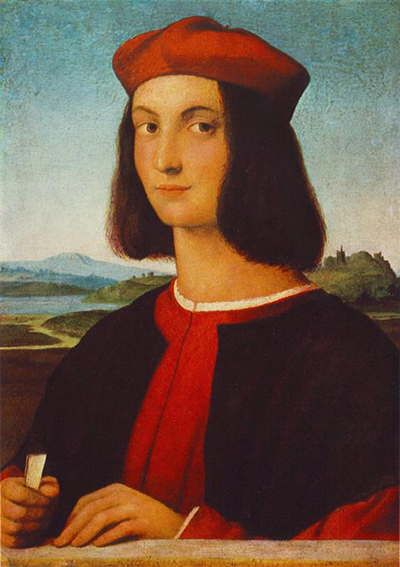
Raphael's Budapest portrait presents a young man at extremely close range. A parapet holds his hands near the surface, a red cap punctuates the dark costume, and a direct gaze turns the small panel into an encounter. The sitter seems accessible; his name is not.
For many years the work has been called Portrait of the Young Pietro Bembo. That title connects it with an early record of a Bembo portrait by Raphael, but the identification has never become secure. A Museum of Fine Arts, Budapest-linked record now titles the painting Portrait of the Young Cardinal Ippolito I d'Este. The Royal Collection describes the sitter as unclear, and older scholars also proposed Francesco Maria della Rovere.[1][2]
The most accurate title therefore carries its uncertainty: Portrait of a Young Man, Traditionally Called Pietro Bembo. The point is not to make the picture less knowable. It is to distinguish the person Raphael painted so vividly from the names later attached to him.
At a Glance
- Artistgenerally attributed to Raphael
- Title used herePortrait of a Young Man, Traditionally Called Pietro Bembo
- Current alternative title in a Museum of Fine Arts-linked record: Portrait of the Young Cardinal Ippolito I d'Este
- Dateabout 1503–06
- CollectionMuseum of Fine Arts, Budapest
- Inventory72
- Mediumoil on walnut, reinforced on pine
- Dimensions54 × 39 cm
- Familiar sitter traditionPietro Bembo (1470–1547)
- Other proposed sitterFrancesco Maria della Rovere
- Present identity positionunresolved
- Stylistic contextRaphael's early career, before or around his move from Umbria toward Florence
- Key featuresclose crop, parapet, red cap, dark clothing, pale pleated shirt and prominently placed hands
Contents
- A clear face and an uncertain name
- Why the title needs a qualification
- The exact object in Budapest
- When did Raphael paint it?
- Raphael before Florence and Rome
- The documented Bembo portrait
- Who was Pietro Bembo?
- Why Bembo seemed persuasive
- The resemblance problem
- Ippolito I d'Este
A clear face and an uncertain name
Portrait identity can fail even when a face is carefully observed. Features survive; the document that once joined those features to a name may not.
This panel demonstrates the difference. It gives the young man's eyes, nose, mouth, jaw, hair, clothes and hands enough specificity to imply a living sitter. Nothing in the painted field spells his name.
Later viewers tried to reconnect image and biography through early descriptions, collection history, costume and resemblance. Several solutions remain possible, but none has ended the discussion.[1][2][3]
Why the title needs a qualification
“Traditionally called” is not decorative caution. It tells the reader that Pietro Bembo is a historical identification rather than an established fact.
Removing his name altogether would conceal the long tradition through which the panel became famous. Keeping it without qualification would turn a hypothesis into certainty.
The expanded title preserves both truths: the painting has a substantial Bembo history, and its sitter remains disputed.
The exact object in Budapest
The panel belongs to the Museum of Fine Arts in Budapest and carries inventory number 72. Its recorded dimensions are 54 by 39 centimetres.[1]
The museum-linked entry gives a particularly exact material description: oil on walnut, with the walnut support reinforced on pine.[1] This is more informative than the generic phrase “oil on wood.”
Fondazione Zeri catalogues the same object as a portrait of a young man, with Portrait of Pietro Bembo as its title and a date of 1504–06.[3]
When did Raphael paint it?
The Budapest-linked record dates the work to 1503–05 while its accompanying account places it in Urbino between 1504 and 1506.[1] The Royal Collection gives about 1503 and relates it to Raphael's Umbrian period.[2]
A broad date of about 1503–06 accommodates these differences. The work belongs near the beginning of Raphael's independent career, not to the mature Roman phase of Castiglione, Leo X or Bindo Altoviti.
That early position is visible in both the panel's strengths and its awkward passages.
Raphael before Florence and Rome
Raphael was born in Urbino in 1483 and learned first within the world of his father, Giovanni Santi. His early development was also closely related to Perugino and the artistic culture of Umbria.[4]
By late 1504 he was moving toward Florence, where Leonardo and other artists offered new solutions for portraiture, figure grouping and atmospheric modelling.[4]
The Budapest panel sits near this transition. It shows an ambitious young painter handling a demanding close portrait before the seamless ease of his later works.
The documented Bembo portrait
The Venetian connoisseur Marcantonio Michiel noted in 1530 that he had seen a portrait by Raphael of the young Pietro Bembo in Bembo's house in Padua.[1]
This is strong evidence that such a portrait existed. It is not automatically proof that Budapest inventory 72 is the same picture.
The difficulty is one of identification across objects. A description without measurements, an unbroken history or unmistakable feature can be connected plausibly to a surviving work while still leaving room for another lost or unidentified portrait.
Who was Pietro Bembo?
Pietro Bembo was born into a Venetian patrician family in 1470. He became a poet, humanist, theorist of language and later a cardinal.
His career took him through Ferrara, Urbino and Rome. He wrote the dialogue on love known as Gli Asolani, promoted Petrarch as a model for lyric poetry and helped establish influential standards for literary Italian through the Prose della volgar lingua.[1][5]
Bembo also collected art and maintained close relationships with artists and writers. Raphael's double portrait of Navagero and Beazzano later belonged to him.[5]
Why Bembo seemed persuasive
An early written notice names a young Bembo portrait by Raphael. The Budapest panel is an early Raphael likeness of an evidently cultivated young man. A connection is therefore reasonable.
Its Urbino date can also be made to fit Bembo's contact with that courtly world. The sitter's self-possession suits what later viewers expect of a major humanist.
These points form an argument, not an identification label painted into the panel. Compatibility must not be mistaken for demonstration.
The resemblance problem
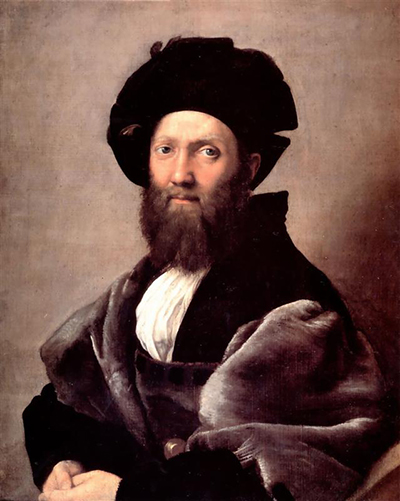
Scholars have compared the young man with later images of Bembo and found differences, especially in facial structure. Such comparison is useful but difficult.
Age, beard, angle, artistic style and the purpose of each portrait can alter appearance. A later cardinal's likeness need not resemble an early court portrait in every respect.
At the same time, resemblance cannot be invoked only when it supports a preferred name. Persistent visual disagreement is one reason the Bembo tradition remains qualified.
Ippolito I d'Este
The Museum of Fine Arts-linked digital record titles the picture Portrait of the Young Cardinal Ippolito I d'Este.[1]
That title gives the Este identification important present-day institutional weight. It should be reported clearly rather than hidden beneath the more familiar Bembo name.
Yet the accompanying museum text still begins from Michiel's record of a portrait of Pietro Bembo and discusses Bembo's achievements.[1] This unusual combination exposes the work's changing catalogue history rather than resolving it silently.
A title is evidence, not proof
Museum titles summarise current judgement. They can change when new research, conservation findings or comparison makes another identity more persuasive.
The Ippolito d'Este title is therefore not equivalent to an original inscription. It represents an attribution of identity made after the sitter's lifetime.
Acknowledging its authority while retaining uncertainty is not indecision. It is the correct response when different institutional records preserve different conclusions.
Francesco Maria della Rovere
Another proposed sitter is Francesco Maria della Rovere. Carl Ruland used that identification in the nineteenth century when cataloguing material related to Raphael.[2]
The Royal Collection's record now mentions the proposal as part of the work's history but states that the sitter remains unclear.[2]
This distinction matters. A name can be historically significant because it shaped catalogues and reproductions even after it ceased to command general agreement.
Attribution to Raphael
The Royal Collection describes the painting's attribution as still debated but now generally given to Raphael.[2] Fondazione Zeri catalogues it under Raphael, with bibliographic support for the attribution.[3]
That question is not identical to the sitter problem. One may accept Raphael as painter while remaining uncertain whom he represented.
Earlier connoisseurs assigned the panel elsewhere before nineteenth-century scholars increasingly connected it with Raphael. The attribution developed through comparison with his early works rather than through a surviving signature.
The close crop
The young man's head and upper body fill most of the vertical panel. There is little room around him, and the parapet presses close to his hands.
The Budapest account describes this as a tight space characteristic of the early work.[1] Compression gives immediacy but leaves the pose less relaxed than Raphael's mature seated portraits.
The sitter does not inhabit a world of landscape or architecture. He confronts the narrow conditions of the picture itself.
The parapet tradition
A parapet runs across the lower edge. Such ledges were common in Netherlandish and Italian portraiture, where they could separate viewer and sitter, carry an inscription or provide a place for hands.[1]
Here it performs all but the inscription. It establishes depth, yet the hands reaching it partly overcome the boundary.
The museum connects the motif with Netherlandish models and Perugino's influence.[1] Raphael is learning from a portable tradition of half-length likenesses.
The hands
The hands rest on the parapet in a position the Budapest account calls somewhat unnatural.[1]
That awkwardness is valuable evidence of artistic development. Raphael understands that hands can bring a sitter toward the viewer, but their relationship to wrist, ledge and body has not yet achieved the effortless logic of his later portraiture.
They should not be dismissed as failure. Their prominence makes the encounter physically immediate and shows the young painter testing a demanding convention.
Why hands matter in portraiture
A head alone records features. Hands can suggest action, education, possession and social bearing.
Raphael gives this sitter no book, flower, weapon or letter. The hands themselves become the attribute: pale, controlled and displayed at the threshold.
Their slight stiffness may also reflect the challenge of maintaining a pose. Portraits convert temporary bodily arrangements into permanent signs, and that conversion is sometimes visible.
The red cap
The cap provides the painting's strongest colour accent. Its warm red stands against dark hair, garment and background.
Headwear contributes to fashion, status and silhouette, but colour alone cannot identify the sitter as a cardinal. Different red garments circulated in courtly and ecclesiastical settings, and a painted hue may change with age and conservation.
The cap's secure function is pictorial: it crowns the face and prevents the upper field from becoming uniformly dark.
Dark clothing and pale linen
The sitter wears a dark outer garment over a light, finely gathered shirt. The contrast draws the eye from hands to face.
Pleats introduce small rhythms into a compact composition. They suggest care and quality without the broad material splendour of Raphael's later portraits.
The clothing presents the man as socially polished, but no emblem fixes a specific profession or office.
The direct gaze
The young man's eyes meet the viewer. His expression is composed without the softened intimacy of Castiglione or the overt turn of the Navagero–Beazzano pair.
Close cropping makes the look unusually immediate. The face has nowhere to retreat, while the parapet prevents the body from moving further forward.
This balance of contact and boundary gives the small panel a psychological scale larger than its dimensions.
Individuality and type
The sitter is specific enough to invite naming, yet his presentation also belongs to a type: a cultivated young man at court, fashionably dressed and self-possessed.
That combination explains why multiple historical figures can seem plausible. A portrait can preserve individual features while using a social vocabulary shared among peers.
Identifying a type narrows context, but it does not supply a civil identity.
Netherlandish influence
The tight field, parapet and careful surface have been connected with Netherlandish portrait models.[1]
Northern paintings circulated in Italian collections and offered compelling examples of close likeness, material detail and figures positioned behind ledges. Italian artists adapted these devices to local expectations.
Raphael's panel demonstrates exchange rather than a simple division between “northern realism” and “Italian ideal.” Observation and arrangement work together.
Perugino's orbit
The museum also notes the influence of Perugino.[1] Raphael's early relationship to that master involved shared figure types, compositional habits and workshop practice.
In portraiture, Perugino's clarity and measured presentation offered a foundation that Raphael could test against other models.
The Budapest youth is compelling because it has not yet absorbed every influence into the smooth synthesis familiar from the Roman years.
The walnut panel
The original support is described as walnut, later or structurally reinforced on pine.[1]
Wood species affect how a panel behaves, how it is prepared and how conservators understand its condition. The reinforcement is part of the object's physical history, not the original pictorial design.
Precision also prevents a common catalogue error: the panel is 39 centimetres wide, not 69.
From object to photograph
The Royal Collection record concerns a nineteenth-century albumen photograph after the Budapest painting, not the painting itself. That photograph entered Prince Albert's Raphael Collection between about 1853 and 1876.[2]
The distinction is essential. Its measurements and medium belong to the photograph, while the commentary refers to the original panel.
Such reproductions made Raphael study possible across Europe. They also carried changing titles and attributions into new catalogues.
Carl Ruland and classification
Carl Ruland catalogued Prince Albert's Raphael Collection and interpreted the Budapest sitter as Francesco Maria della Rovere.[2]
His entry demonstrates how reproduction, scholarship and naming interacted. A photograph detached from colour and scale still became evidence for identity and authorship.
Modern digital records inherit some of this structure. Each image arrives with words, and those words strongly influence what viewers think they see.
Fondazione Zeri's record
Fondazione Zeri catalogues the object as Raphael's Portrait of a Young Man, with Portrait of Pietro Bembo as its title, dated 1504–06 and formerly in the Esterházy collection.[3]
This record usefully separates a generic subject description from a named title. It acknowledges that “young man” is what the image securely shows while “Pietro Bembo” belongs to identification history.
Comparing catalogues reveals disagreement that a single label can hide.
The Esterházy connection
Before entering the Budapest museum, the painting belonged to the Esterházy collection.[3] That princely collection became a major foundation of the Museum of Fine Arts holdings.
Earlier ownership explains how an Italian Renaissance panel came to Budapest, but it does not restore its sitter's name automatically.
Collection histories preserve objects with one hand and sometimes attach unstable attributions with the other. Both preservation and uncertainty are part of the panel's life.
Why uncertainty enriches the portrait
An unresolved name does not turn the sitter into an abstract face. On the contrary, it makes viewers notice how strongly a living presence can survive after biography is detached.
The painting invites two forms of looking. One asks who this was. The other asks how red cap, ledge, hands, darkness and gaze make him present.
Art history needs both. Identity research can continue without postponing visual understanding until a final name appears.
What can be said securely
The object is inventory 72 in Budapest, measures 54 by 39 centimetres and is painted in oil on walnut reinforced on pine.[1]
It belongs to Raphael's early period and is generally attributed to him.[1][2][3] A record from 1530 confirms that Raphael painted a young Pietro Bembo, although the match with this panel is not proven.[1]
The current museum-linked title proposes Ippolito I d'Este; other respected records retain Bembo or leave the sitter unnamed. Those facts define the honest boundary of present knowledge.
Artist Up Close
The Budapest youth offers an uncommon view of Raphael before complete mastery became his reputation. Its narrow space and hands reveal a painter working through inherited portrait forms rather than producing effortless perfection from the beginning.
This does not make the panel minor. The gaze is firm, the tonal design controlled and the contact across the parapet memorable. The very friction between ambition and solution gives the picture historical depth.
Raphael would soon study Florentine portraiture and develop increasingly fluid relations among head, torso, hands and setting. Later works can make their construction nearly disappear. Here, the mechanics remain available for study.
The uncertain sitter also corrects a common distortion in Raphael's fame. Not every vivid face can be matched to a famous biography. His art's power does not depend on our ability to complete every name.
Frequently Asked Questions
Discussion
What detail most changes how you read Portrait of a Young Man, Traditionally Called Pietro Bembo?
Reader Insights
Which source detail gives the page its strongest anchor?
Which visual or historical distinction should readers keep in mind?
How does this page change the wider picture of Raphael's career?
Join the Conversation
Share your reading below.
References
- Museum of Fine Arts, Budapest, “Portrait of the Young Cardinal Ippolito I d'Este,” Google Arts & Culture object record, inventory 72 View source.
- Royal Collection Trust, “Portrait of a Man,” photograph after the painting in the Museum of Fine Arts, Budapest, RCIN 852012 View source.
- Fondazione Federico Zeri, “Sanzio Raffaello, Ritratto di giovane uomo,” catalogue record 27214 View source.
- National Gallery of Art, Washington, “Raphael,” artist biography View source.
- National Gallery of Art, Washington, “Cardinal Pietro Bembo, 1539/1540,” systematic collection catalogue entry View source.