 by Tom Gurney
Tom Gurney BSc (Hons) is an art history expert with over 20 years experience
Published on June 19, 2020 / Updated on August 21, 2026
Email: tomgurney1@gmail.com / Phone: +44 7429 011000
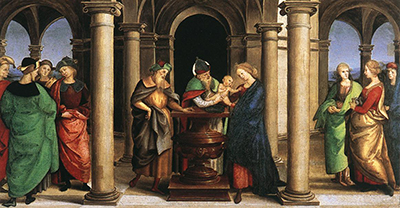
Raphael's Presentation in the Temple brings the infancy sequence of the Oddi Altarpiece to a poised architectural conclusion. Mary and Joseph have carried Jesus into the Temple at Jerusalem. At the centre, the aged Simeon receives the child across an altar while attendants gather on either side. Stone columns, a patterned pavement and a succession of arches turn the meeting into an ordered public rite.[1][2]
The scene is often reproduced as a small rectangular picture, but it is not an independently commissioned panel. It occupies the right end of a continuous predella whose other episodes are the Annunciation and the Adoration of the Magi. Raphael painted the three scenes across one poplar support, approximately 38 by 190 centimetres, for the base of the Oddi family's Crowning of the Virgin.[1][3]
Its scale is modest; its implications are not. Luke's Gospel joins purification, dedication, sacrifice, prophecy and recognition in one Temple episode. Raphael answers that density with clarity. The altar separates and connects Mary and Simeon. The central building encloses the sacred exchange while the pavement gives every participant a place. The result is both intimate and ceremonial: an encounter with a six-week-old child staged as a revelation within measured space.
At a Glance
- ArtistRaphael
- TitlePresentation of Jesus in the Temple, right-hand scene of the Oddi Altarpiece predella
- Dateapproximately 1502–05
- Mediumtempera grassa on poplar panel
- Dimensionsthe complete three-scene predella is approximately 38 × 190 cm
- PatronAlessandra degli Oddi
- Original locationOddi family chapel, San Francesco al Prato, Perugia
- Main figuresthe Christ Child, the Virgin Mary, Joseph and Simeon, with Temple attendants
- Related episodes on the same supportAnnunciation and Adoration of the Magi
- Removed to Paris1797
- Returned to Rome1816
- Current locationPinacoteca Vaticana, Vatican Museums, Room VIII
- Catalogue numberMV.40335.0.0
Contents
- The right-hand end of one painted base
- What happens in Luke's account
- The altar at the centre
- Mary, Joseph and the offered child
- Simeon and the recognition of age
- Where is Anna?
- A temple built from perspective
- Piero della Francesca and measured vision
- Learning from Perugino
- Colour across the predella
The right-hand end of one painted base
A predella is the low horizontal section beneath the main field of an altarpiece. Its smaller scenes could expand a sacred subject through narrative episodes seen at close range. In the Oddi ensemble, three events from the early lives of Mary and Christ once supported a much taller vision of the Virgin being crowned in heaven.[2][3]
The sequence begins with Gabriel's announcement to Mary, continues with the Magi recognising the newborn king and ends with the child brought into the Temple. Movement therefore runs from private interior, through outdoor journey and homage, to a public sacred building. The Presentation supplies closure by placing promise and birth within worship, law and prophecy.
Raphael did not divide the episodes into three separate boards. The Vatican catalogue records a single poplar panel with all three subjects.[1] Painted architectural boundaries make each story legible, but the common support and continuous format encourage the eye to travel along the base.
That material fact changes interpretation. The Presentation is not simply a miniature version of a familiar theme. Its compressed figures and carefully bounded architecture answer the needs of the predella's right end. The temple gives the sequence a firm visual stop, just as Simeon's recognition gives the Gospel story a prophetic culmination.
Above the predella, the apostles in the principal field discover Mary's empty, flower-filled tomb while Christ crowns her in heaven. Below, the infancy scenes proceed toward the first public declaration of the child's destiny. Beginning and fulfilment were visible together at the Oddi altar.
What happens in Luke's account
Luke 2:22–40 provides the narrative foundation. After the period prescribed for purification, Mary and Joseph take Jesus to Jerusalem to present him to the Lord. They bring the sacrifice allowed to a family unable to provide a lamb: a pair of turtledoves or two young pigeons.[4]
At the Temple they encounter Simeon, described as righteous and devout. He has been promised that he will not die before seeing the Messiah. Taking Jesus in his arms, Simeon praises God and calls the child salvation, light for the Gentiles and glory for Israel. He then warns Mary that the child will occasion both fall and rise, and that a sword will pierce her.[4]
The prophetess Anna also arrives. An elderly widow devoted to fasting and prayer, she gives thanks and speaks about the child to those awaiting Jerusalem's redemption.[4]
Several rites and meetings are thus condensed into one passage. The family observes Mosaic law; the firstborn is consecrated; an offering indicates modest economic means; two aged witnesses recognise a future concealed within infancy. The episode looks backward to Israel's religious obligations and forward to Christ's public mission and Passion.
Raphael's narrow field cannot illustrate every sentence equally. Instead, it organises the central transfer of the child across an altar. The action makes presentation visible in the most direct possible form: Mary extends Jesus toward Simeon, and the elder receives him.
The altar at the centre
The altar is the compositional hinge. Its block-like form marks the centre of the pavement and provides a stable interval between the two principal adults. Mary and Simeon do not merge into one group; their arms cross a sacred threshold.
The child bridges that separation. His small body occupies the charged space above the altar, making him both the object of ritual presentation and the person whose identity the rite reveals. He is physically dependent yet visually central.
An altar normally receives an offering. Luke's account mentions birds, but Raphael's arrangement places Jesus himself over the stone block. The painting does not confuse the legal sacrifice with a literal sacrifice of the child. It uses visual proximity to make consecration and future destiny resonate together.
The architecture reinforces the moment. Vertical supports rise around the exchange, while the pavement leads toward it. Figures at the sides become witnesses rather than competitors for attention. Even at predella scale, the centre is unmistakable.
Raphael creates ceremony without stiffness. Mary bends through the offering gesture; Simeon answers with hands and body; the child introduces a small, living irregularity above the hard geometry of stone. The scene's meaning is carried by contact about to occur.
Mary, Joseph and the offered child
Mary approaches from one side with the child. Her movement is purposeful but restrained. She is not enthroned, and there is no domestic tenderness isolated from the rite. Motherhood appears here as participation in a religious obligation.
Joseph stands within the accompanying group rather than taking the central action from her. In Luke, both parents bring Jesus to Jerusalem and marvel at Simeon's words. Raphael preserves the family's presence while giving Mary's extended arms the clearest narrative task.
The offering of birds, when visible in presentations of this subject, identifies the family's compliance with the provision for those unable to afford a lamb. The detail matters because it situates sacred history within social circumstance. The parents do not arrive with courtly wealth.[4]
Jesus is small enough to be held but placed high enough to command the encounter. Renaissance painters faced a recurring challenge in infancy narratives: theological importance must inhabit an infant body without making that body implausibly grand. Raphael answers through position, gesture and surrounding attention.
The family's movement into the Temple also advances the predella's larger story. In the Annunciation, Mary receives a divine message. In the Adoration, foreign visitors come to the child. In the Presentation, Mary actively brings him into a communal and legal setting. Her role changes from recipient, to mother receiving homage, to participant in consecration.
Simeon and the recognition of age
Simeon gives the episode its emotional centre. He has waited for a promised sight, and the child entering the Temple completes that waiting. His age makes recognition an encounter between the beginning and end of life.
Raphael distinguishes him through bearing and placement. He stands across the altar from Mary, ready to receive Jesus. The spatial symmetry is not equality of role: Mary brings the child; Simeon recognises what others cannot yet fully see.
His Gospel speech contains both consolation and warning. The song traditionally called the Nunc dimittis accepts death in peace because salvation has been seen. The subsequent prophecy introduces contradiction and Mary's future sorrow.[4] A serene painted exchange therefore holds knowledge of suffering beyond the frame.
Raphael does not need to stage that future dramatically. The Presentation's calm is made more serious by the viewer's knowledge of it. Simeon's hands can be read as tender, ritual and prophetic at once.
The elder also alters the direction of sacred authority. He is not seated on a throne above the family. Mary and Simeon meet across a shared centre, and the child is positioned between them. Wisdom recognises infancy rather than dominating it.
Where is Anna?
Luke explicitly includes Anna, but identifying every secondary figure in a small Renaissance Presentation can be difficult. An elderly woman among the attendants may evoke the prophetess, while the overall gathering can carry the idea of Temple witness.[4]
Caution is useful here. A painted figure does not become securely identifiable merely because the Gospel names someone who might be represented. Clothing, age and placement can support a reading without providing the equivalent of an inscription.
Anna's narrative function remains important whether or not one accepts a precise identification. Simeon's recognition is not entirely solitary. She gives thanks and carries news outward to a waiting community. The episode therefore widens from private revelation to shared testimony.
Raphael's attendants make that widening visible. They fill the edges of the ritual group and turn toward the child. The action is concentrated at the altar, but recognition has an audience.
The small format encourages such economy. One figure may carry more than a single narrative function: individual witness, compositional balance and sign of a broader Temple population. Raphael's clarity comes from concentrating roles, not from illustrating the text word by word.
A temple built from perspective
The Vatican's account emphasises the scene's temple interior, with columns and pilasters bearing Ionic capitals, and relates Raphael's architectural interest to the perspective culture associated with Piero della Francesca.[2] Architecture is not a neutral container. It transforms a narrow strip into a convincing ceremonial space.
Pavement lines establish depth from the lower edge. Repeated verticals give scale, while openings and arches lead the eye farther into the building. The figures occupy a shallow foreground zone, yet the temple seems to continue beyond them.
The altar stabilises this recession. Without it, the eye might travel too quickly into the depth and leave the human action behind. Its horizontal top interrupts the pavement's movement and makes the transfer of the child the place where spatial construction becomes sacred meaning.
Ionic capitals introduce a classicising vocabulary. For a young Umbrian painter who had not yet made Roman antiquity the centre of his practice, such details display an emerging desire to give sacred history an architecturally reasoned world.[2][5]
The scene is less monumental than the great buildings Raphael would later invent in Rome. That difference is revealing. Here architecture is fine-scaled, regular and closely fitted to the predella. Later, in works such as the School of Athens, enormous vaults would command a much larger field. The underlying habit—using proportion to coordinate bodies and building—is already visible.[5]
Piero della Francesca and measured vision
Piero della Francesca's importance lies not in a claim that Raphael copied one specific building. It lies in a regional culture where perspective could be understood as a disciplined construction, capable of giving painted space mathematical coherence.[2]
Raphael had grown up in Urbino, a court associated with Piero's work and with intellectual interest in architecture and geometry. The young artist's Umbrian paintings repeatedly test how tiled floors, converging lines and centrally placed structures can make sacred narratives legible.
In the Presentation, measured depth serves attention. Lines do not demonstrate perspective for its own sake. They direct sight toward a human encounter and create room for a ritual gathering.
This union of calculation and ease would become central to Raphael's reputation. The finished scene does not ask viewers to admire a diagram. Its geometry is absorbed into a calm experience of place.
The small scale makes the achievement sharper. Minute errors in a predella interior could make columns buckle or pavement patterns become confused. Raphael keeps enough regularity to suggest a coherent temple while avoiding fussy detail that would overwhelm the figures.
Learning from Perugino
The Vatican Museums notes Perugino's influence across the Oddi predella while also stressing the young Raphael's movement toward new Renaissance solutions.[3] The Presentation belongs within that productive closeness.
Perugino offered models for balanced groups, lucid architecture, gentle figure types and landscapes governed by calm intervals. These were not limitations to be escaped as quickly as possible. They were powerful tools for altarpieces that had to communicate across chapels.
Raphael's distinction emerges in coordination. The altar, child, adult gestures, pavement and architectural frame work together as one event. No single elegant figure is allowed to detach itself from the encounter.
His relation to Perugino is therefore better understood as assimilation and revision than as a sudden contest between pupil and master. The Oddi project demonstrates command of a shared workshop language. It also shows how rapidly Raphael could make that language answer the exact shape and narrative function of a commission.
The right-hand compartment is particularly revealing because endings are difficult. It must conclude a horizontal sequence without becoming visually inert. Raphael lets architecture provide firmness while the extended child keeps the centre alive.
Colour across the predella
The predella's three scenes share a small scale and a bright, precious surface. Strong garment colours help figures remain distinct amid architecture, animals and landscape. Blue, red and warm earth tones recur without making each episode identical.
The Presentation's interior changes the conditions of colour. The Annunciation opens a measured domestic space; the Adoration spreads into an outdoor crowd; the Temple places coloured bodies against pale structural forms. Garments therefore become especially important for separating participants.
Tempera grassa permits precise contours with richer modulation than a strictly lean tempera technique. The Vatican catalogue identifies the predella's material as tempera grassa on poplar.[1] Fine handling suits the narrow format, where faces, hands and architectural accents must remain readable at reduced scale.
Conservation in 2022 recovered greater brilliance in the colours before the predella travelled to an exhibition in Milan.[3][6] That treatment concerned the continuous object, not merely this final scene.
Colour also links the base to the principal field. Mary's familiar garments and the repeated celestial blues would have helped worshippers connect infancy below with coronation above, even before every small episode could be examined.
A chapel, a family and a Franciscan church
Alessandra degli Oddi commissioned the altarpiece for the family's chapel in San Francesco al Prato, Perugia.[1][3] The location made the work part of worship, family memory and civic presence.
A chapel predella operated differently from a picture hung at eye level in a museum. It sat below a monumental sacred image, near the altar and within a frame. Viewers approached it under particular conditions of distance, lighting and devotion.
The Presentation's subject was apt for that setting. A family brings an offering to a sacred place; an altar mediates the encounter; faithful witnesses recognise divine purpose. Painted ritual and actual ritual occupied related spaces.
Franciscan surroundings may also have sharpened attention to humility and poverty. Luke's paired-bird offering signals modest means, while the grandeur of the temple comes from order rather than luxury.[4] The scene can therefore hold both material simplicity and sacred dignity.
The Oddi name now identifies the work across museum catalogues, but the commission should not be reduced to family branding. Its programme connected the donors' chapel to a broad Marian and Christological sequence intended for communal religious use.
From Perugia to Paris and Rome
The predella remained connected to the Oddi commission until French forces removed the altarpiece under the Treaty of Tolentino in 1797. It was taken to Paris with many other Italian works.[1]
After Napoleon's defeat, the painted components returned to Rome in 1816. They entered the papal collection rather than resuming their original position in San Francesco al Prato.[1]
This history changed the object's meaning and conditions. A chapel ensemble became a museum possession. The three predella subjects could increasingly circulate as individual reproductions even though their common wooden support survived.
The principal field underwent a more radical material transformation: its paint was transferred from wood to canvas in Paris. The predella remained on poplar.[2] The two parts of the original altar thus carry different physical histories.
Current Vatican display and cataloguing preserve awareness of the predella as one item. The inventory number MV.40335.0.0 covers Annunciation, Adoration and Presentation together.[1] That record is a useful defence against the fragmenting habits of reproduction.
The 2022 conservation
Before the predella travelled to the Museo Diocesano Carlo Maria Martini in Milan in late 2022, the Vatican Museums' Laboratory for Paintings and Wooden Materials undertook a delicate conservation treatment.[3][6]
The intervention restored greater brilliance to Raphael's colours, according to the Vatican's exhibition account.[3] It also created an unusual opportunity to encounter the nearly two-metre base away from the much larger principal field.
Conservation draws attention to the support shared by all three narratives. Changes in wood, ground, paint and later coatings do not respect the conceptual boundaries between scenes. Care must address a long, continuous object.
The event also encouraged close reconsideration of Raphael's early practice. A famous artist's small narrative work can be overshadowed by monumental frescoes and Madonnas. Treatment and focused display made precision, colour and pacing visible on their own terms.
Yet temporary separation should not erase original function. The predella was designed as the foundation of an altar ensemble. Its Presentation remains both a compelling miniature and the final sentence of a larger painted argument.
A later copy and the spread of the composition
The Louvre preserves a small pen drawing that copies part of Raphael's Presentation. Its present catalogue identifies it as a partial copy, probably made by a Florentine artist around 1560–70, after the right compartment of the Oddi predella.[7]
The distinction matters. The sheet is not secure evidence for Raphael planning the original scene. It shows instead that the composition was studied and repeated decades later.
Copying could isolate a scene already bound to a larger work. On paper, the Presentation became portable: a later artist could examine its figures, architecture or arrangement without possessing the altarpiece.
The drawing therefore belongs to reception history. It records attention paid to a youthful Raphael after his fame had transformed European artistic education. Even a small early compartment could become a model.
Its crossed-out old description, which once referred more directly to Raphael's picture, also reminds us that collection catalogues change. Attribution and object relation must be stated with the precision of current records rather than inherited labels.[7]
How to look at the Presentation
Begin with the altar. Notice how it fixes the centre before you identify anyone.
Follow the child across the stone block from Mary's arms toward Simeon. Their gesture is the narrative in its most concentrated form.
Then read the floor. Its receding pattern turns a thin strip of wood into a temple with measurable depth.
Look outward to the attendants and ask how many kinds of witness Raphael can suggest without crowding the centre.
Finally, imagine the scene at the far right of the Annunciation and Adoration. Its building and prophecy close a journey that began with Gabriel's arrival.
Why the scene matters
Raphael's Presentation in the Temple demonstrates how scale can intensify rather than diminish invention. Within a narrow compartment, the young painter coordinates scripture, ritual, architecture and human exchange.
The scene also corrects a common museum-era illusion. What appears in reproduction as one little picture is part of a long wooden base and a much taller Marian altar. Its fullest meanings arise from those relationships.
Most of all, the work turns perspective into recognition. Pavement and columns do not merely prove technical knowledge; they organise a place in which an old man can see salvation in a child.
Artist Up Close
Find the point where the child's body crosses the altar's central axis.
Compare the hard, horizontal stone with the curved arms reaching above it.
Then let your eye move through the columns into the temple depth. Raphael makes space continue, but he never lets it draw attention away from the encounter.
Frequently Asked Questions
Discussion
What detail most changes how you read Presentation in the Temple: The Oddi Predella's Final Scene?
Reader Insights
Which source detail gives the page its strongest anchor?
Which visual or historical distinction should readers keep in mind?
How does this page change the wider picture of Raphael's career?
Join the Conversation
Share your reading below.
References
- Vatican Museums, “Predella della Pala Oddi: Annunciazione; Adorazione dei Magi; Presentazione di Gesù al Tempio,” online catalogue, MV.40335.0.0. View source.
- Vatican Museums, Raphael: The Predella of the Oddi Altarpiece, object dossier, 2022. View source.
- Vatican Museums, “Raffaello. Annunciazione, Adorazione dei Magi, Presentazione al Tempio,” exhibition notice, 2022. View source.
- United States Conference of Catholic Bishops, “Luke, Chapter 2,” especially 2:22–40. View source.
- Metropolitan Museum of Art, “Raphael and Antiquity,” 2026. View source.
- Vatican Museums, “Department of Fifteenth- and Sixteenth-Century Art: Activities and Projects 2022.” View source.
- Musée du Louvre, “La Présentation au Temple,” INV 4104, Recto. View source.