 by Tom Gurney
Tom Gurney BSc (Hons) is an art history expert with over 20 years experience
Published on June 19, 2020 / Updated on August 21, 2026
Email: tomgurney1@gmail.com / Phone: +44 7429 011000
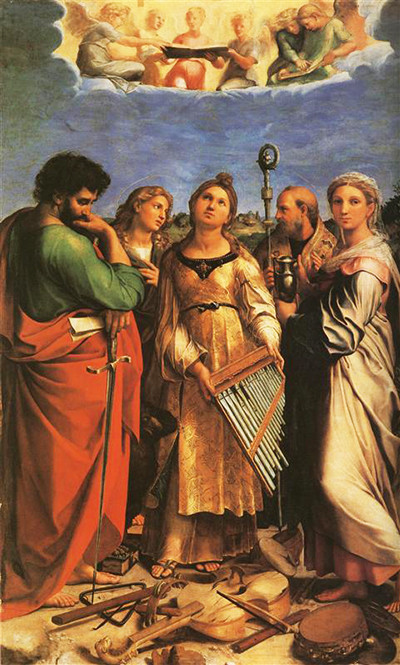
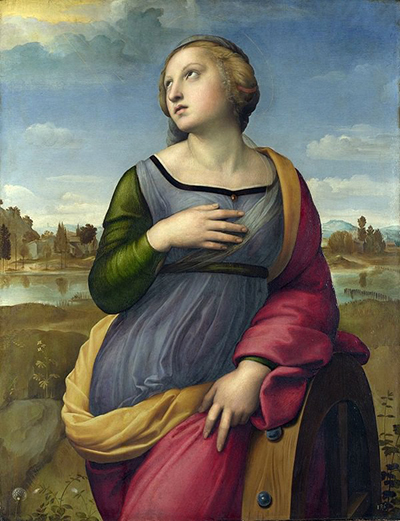
Raphael's Saint Catherine of Alexandria turns a martyr's violent story into an image of inward revelation. Catherine rests against the spiked wheel intended for her torture, yet Raphael omits the sword and palm that often accompany her. Her right hand presses to her heart. Her lips part and her head rises toward a golden opening in the clouds. The body spirals; the mind seems fixed beyond the visible world.[1]
Painted about 1507, the panel belongs to Raphael's Florentine years and to the period of the Baglioni Deposition. It combines a pose of extraordinary physical complexity with a devotional effect of calm. The National Gallery relates that synthesis to three sources Raphael transformed: the raised eyes and graceful saints of Perugino, the curving figure of Leonardo's lost Leda, and the monumental turn of Michelangelo's unfinished Saint Matthew.[1]
The picture is also unusually well documented as a creative process. Sketches at the Ashmolean Museum show Raphael considering a full-length Catherine and then a three-quarter-length solution. A pricked full-size cartoon survives at the Louvre. Infrared examination reveals the dots used to transfer it to the panel, as well as changes Raphael made after that transfer.[2][3] The finished saint is therefore not simply an effortless inspiration. She is the result of repeated thought on paper and wood.
At a Glance
- ArtistRaphael
- TitleSaint Catherine of Alexandria
- Dateabout 1507
- Medium and supportoil on wood, probably poplar
- Dimensions72.2 × 55.7 cm
- SubjectCatherine in visionary ecstasy beside the wheel associated with her martyrdom
- Present attributesspiked wheel
- Usually omitted heremartyr's palm and sword
- Preparatory sheetstwo at the Ashmolean Museum, Oxford
- Surviving full-size cartoonMusée du Louvre, Paris
- Transfer evidencepounced dots visible through infrared examination
- Acquired by the National Gallery1839
- Present collectionNational Gallery, London
- Inventory numberNG168
Contents
- Catherine's story and the picture's limits
- The spiked wheel
- Annotated Details
- Hand, heart, lips and gaze
- A body built from turning
- Perugino transformed
- Leonardo's Leda
- Michelangelo's Saint Matthew
- The small plants and dandelion clock
- From first sketch to three-quarter-length figure
- The surviving Louvre cartoon
Catherine's story and the picture's limits
According to Christian tradition, Catherine was a learned fourth-century princess of Alexandria who converted to Christianity and experienced a mystic marriage with Christ. When she refused the demands of Emperor Maxentius, she was condemned to die upon a spiked wheel. Divine intervention shattered the instrument, and Catherine was then beheaded.[1]
This is hagiography: a sacred story developed and transmitted through Christian culture, not a modern documentary biography. Raphael relied on its recognisable elements while selecting only a few.
The wheel places the saint within the martyr legend. Her upward gaze redirects the scene from physical punishment to visionary faith. The viewer encounters neither the emperor nor the executioners, and the threatened violence remains outside the depicted moment.
That selection gives the image concentration. Catherine's identity depends upon the relation between body, wheel and heaven rather than a crowded sequence of events. The painting asks how suffering can be remembered without being restaged.
The spiked wheel
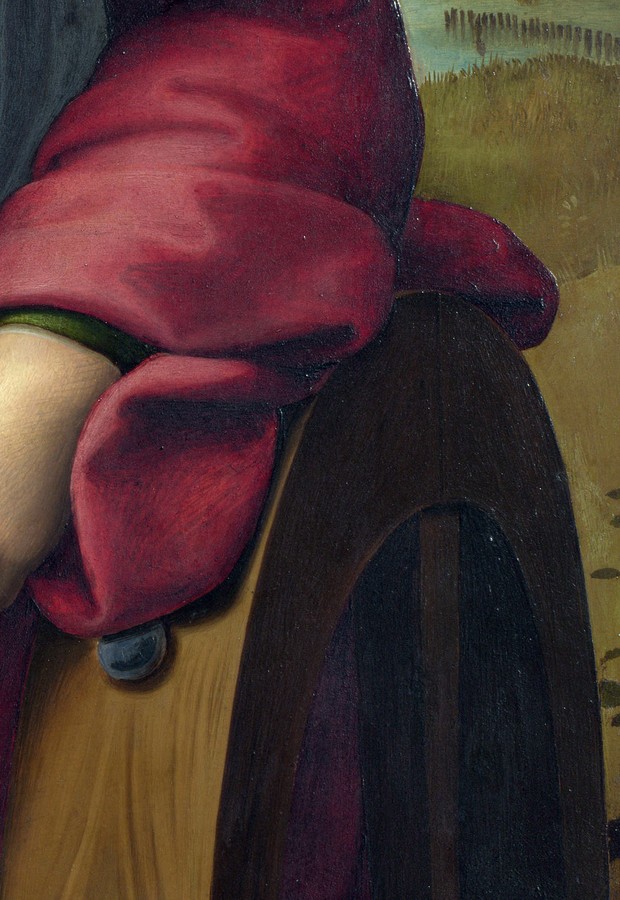
The wheel rises beside Catherine and supports the lower turn of her body. It is both an object in space and an instrument heavy with narrative memory.[1]
Raphael does not show it breaking. Its spikes remain visible, so danger has not been softened into an abstract emblem. Yet Catherine leans against it without apparent fear. The device that was meant to destroy her becomes a stable edge within her pose.
The wheel also creates a circular answer to the body's spiral. Catherine's hips, torso, shoulders and head turn through different directions, while the rim keeps that movement legible.
Because the palm and sword are absent, the wheel carries exceptional identifying weight. It tells viewers which Catherine they see while leaving the moment itself open: contemplation, mystic vision and remembered martyrdom overlap.
Its placement near the picture edge prevents the attribute from becoming a second protagonist. Raphael lets it hold the story while Catherine holds attention.
Annotated Details from Saint Catherine of Alexandria
The annotated view keeps the whole work in sight while isolating six details that reward close looking: expression, gesture, fabric, setting and the way Raphael moves attention through the image.
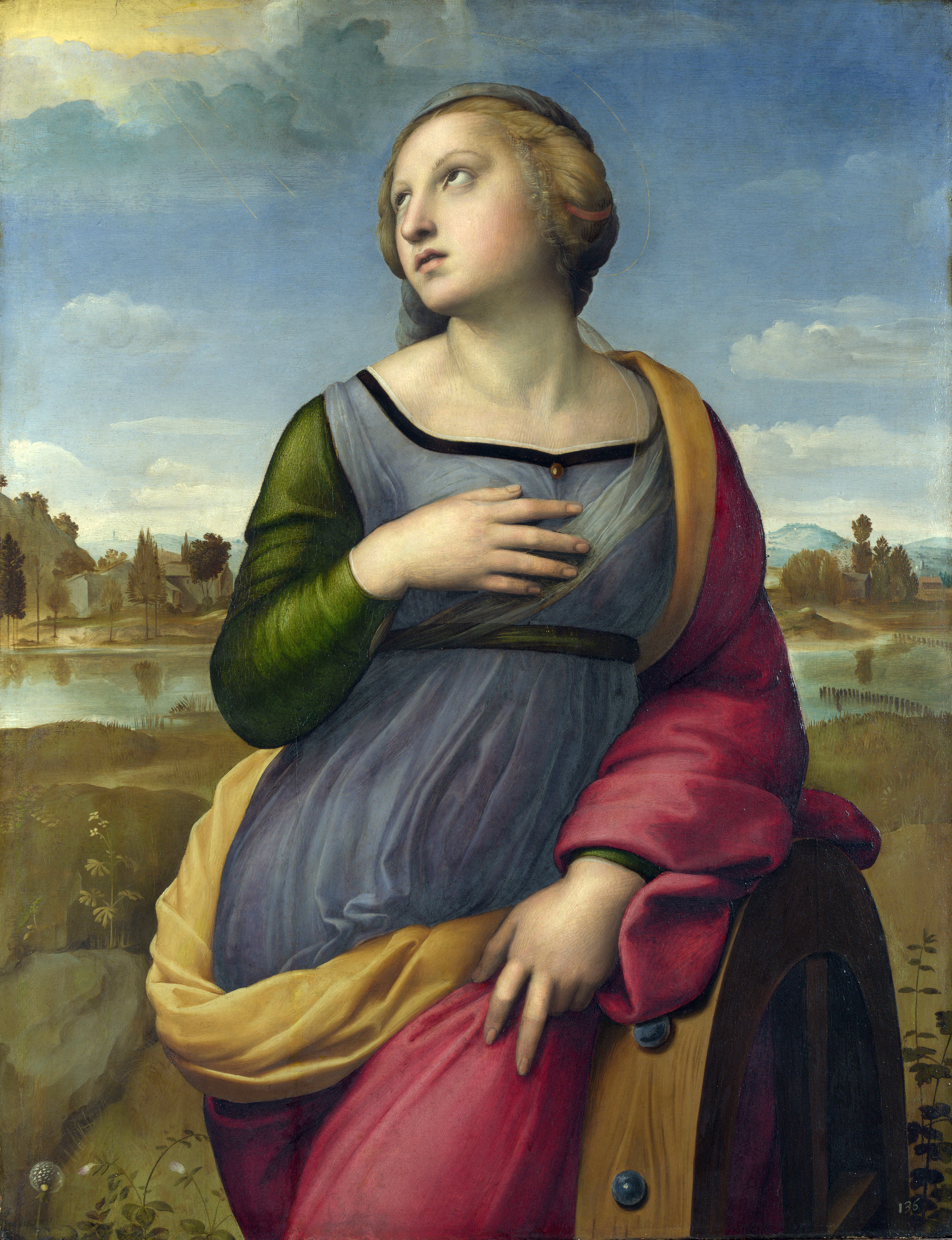
Details from SAINT CATHERINE OF ALEXANDRIA
Close looking highlights visible details in the work while keeping image-source and rights notes with the page evidence.
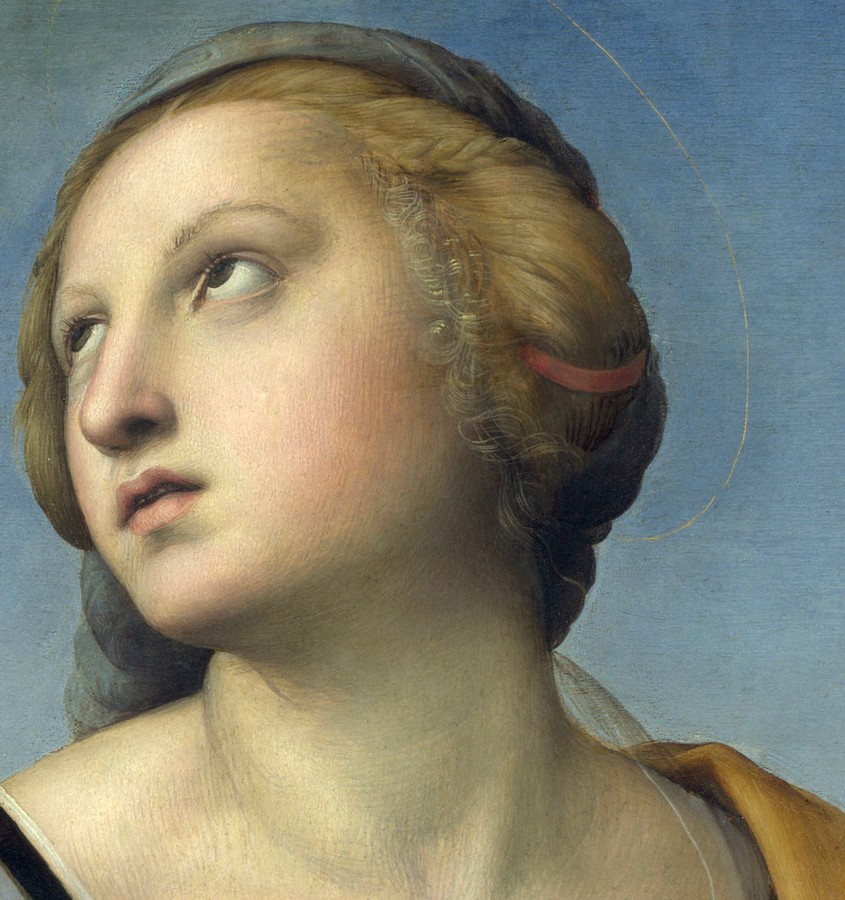
Upturned face
Catherine's lifted face makes the painting's spiritual movement visible without adding narrative action.
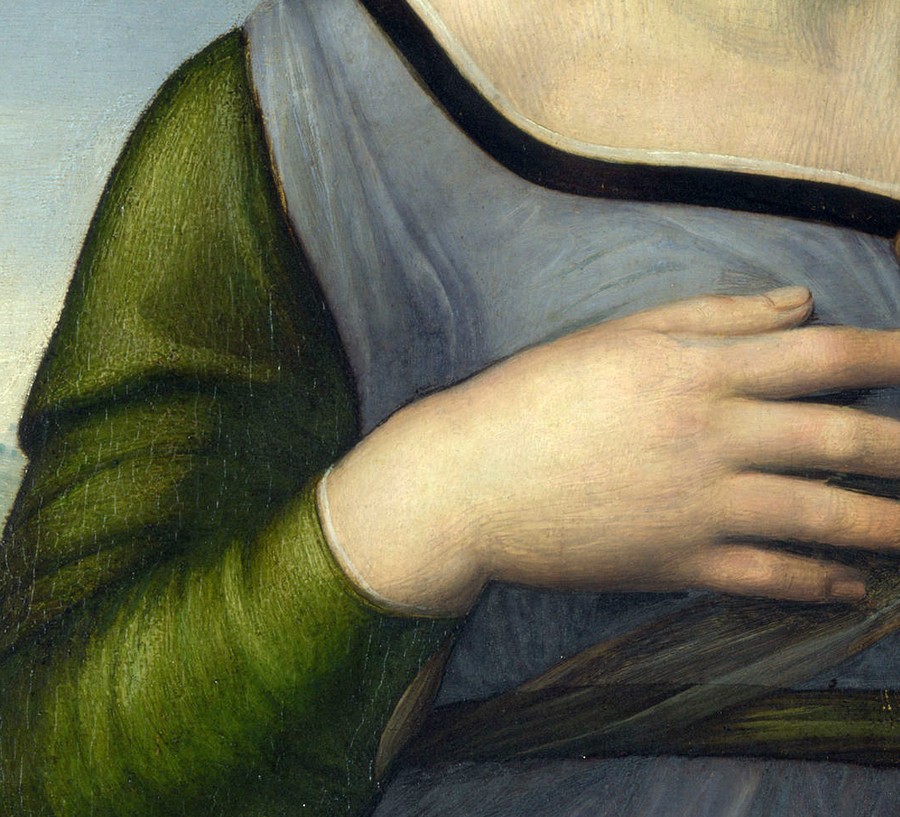
Hand over heart
The hand over the heart turns the pose inward while the head turns upward.
Wheel of martyrdom
The spiked wheel identifies Catherine's story but remains visually secondary to her upward turn.
Crossing drapery
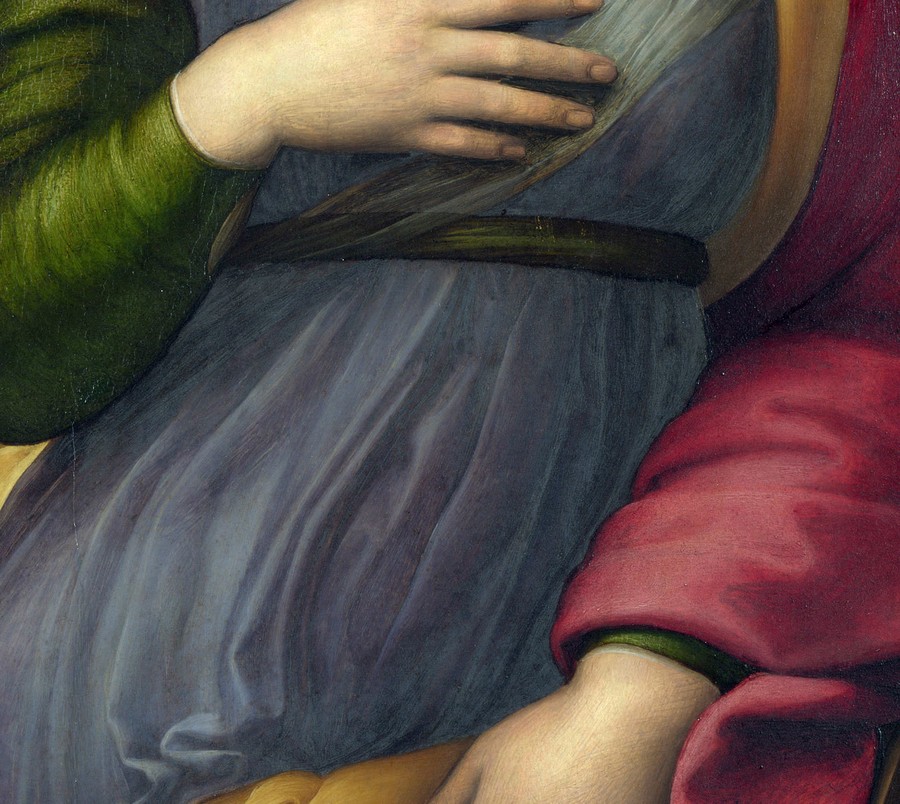
Blue, green, yellow and red fabrics bind the twisting body into one continuous rhythm.
Landscape and water
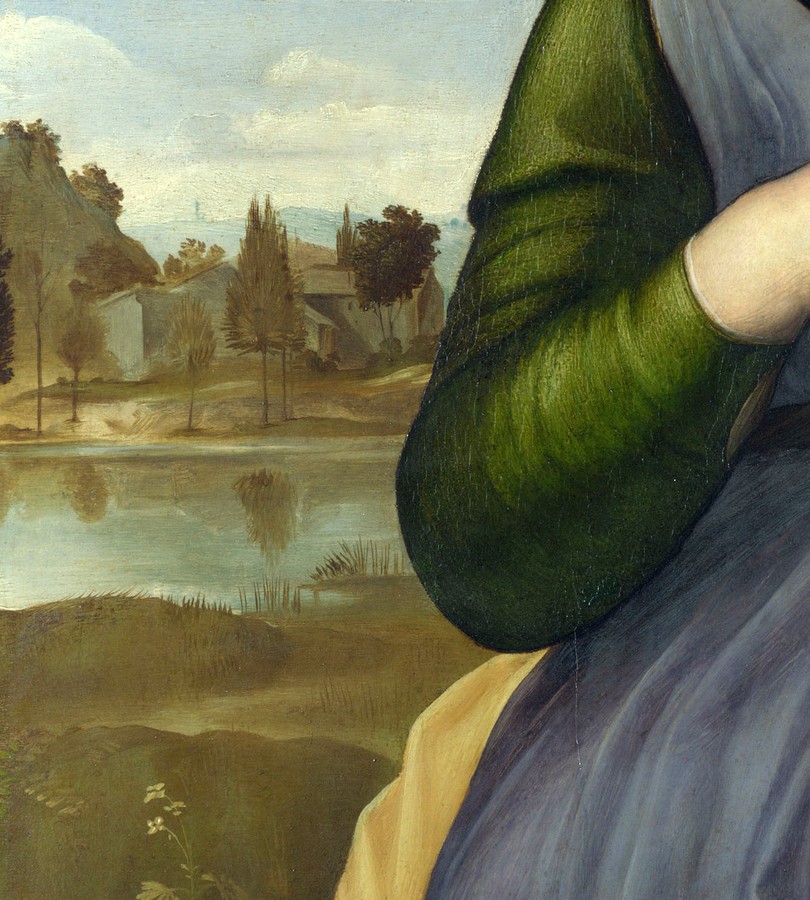
The distant town and water open the devotional figure into a wider natural world.
Cloud opening
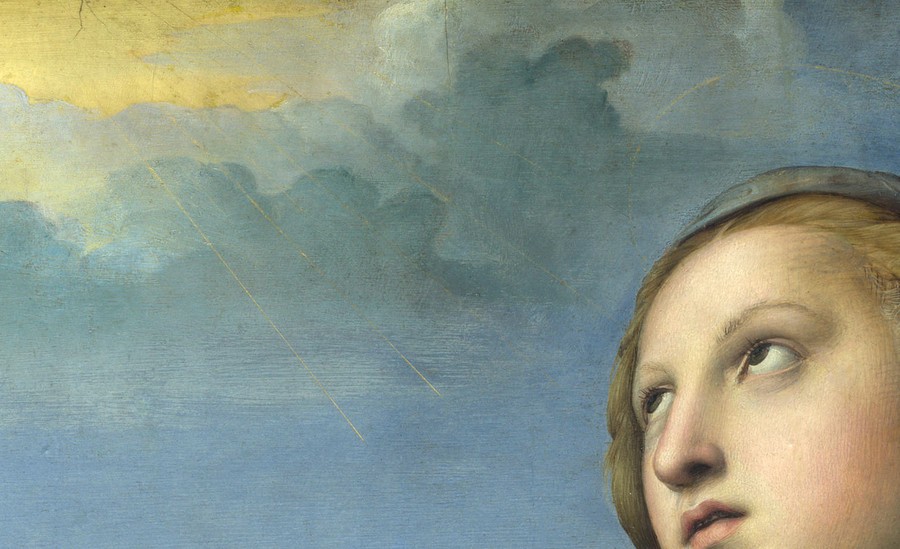
The bright opening above Catherine helps direct the gaze beyond the ground-level scene.
Hand, heart, lips and gaze
Catherine's right hand rests on her breast. The gesture locates faith and feeling within the body, but it also steadies a figure whose pose might otherwise seem entirely in motion.[1]
Her lips are slightly open. The National Gallery describes her as caught in divine ecstasy, a state that exceeds ordinary speech without turning the face into theatrical anguish.[1]
The raised head is strongly foreshortened. Chin, throat and jaw lead toward eyes directed above the viewer's horizon. Raphael makes the act of looking upward physically demanding.
Clouds part in the direction of that gaze, revealing golden light. The break gives Catherine an object of vision while withholding a depicted divine figure. Viewers see the illumination, not what she knows through it.
These details create a chain: hand declares inward response, mouth suggests breath or prayer, eyes rise, and cloud opens. The movement is devotional and anatomical at once.
A body built from turning
Catherine's pose is often described as contrapposto, the balancing of weight and relaxation across a standing body. Raphael makes it more complex by twisting upper and lower zones in different directions.[1]
The saint does not stand squarely before the viewer. Her drapery sweeps around her, the shoulder line shifts, and the head returns upward across the turn. The body resembles a helix contained within a stable silhouette.
This movement is not display for its own sake. It converts ecstasy into visible form. Catherine seems drawn toward a realm above while remaining materially anchored by wheel, dress and ground.
The three-quarter-length format intensifies the twist. Cropping removes the need to explain the feet and concentrates attention on torso, hands and head. The body can appear monumental even though the panel is only 72.2 centimetres high.[1]
Raphael's achievement lies in making a difficult pose look continuous. No joint becomes a puzzle isolated from the whole. Drapery carries force from hip to shoulder, and the upward head completes the curve.
Perugino transformed
The National Gallery traces Catherine's visionary presentation to conventions for single saints in polyptychs. Perugino, with whom Raphael probably worked, often placed graceful religious figures before distant landscapes and gave them raised eyes praised for an angelic quality.[1]
Raphael retains that clarity. Catherine stands alone against a calm countryside, her identity conveyed through attribute and devotional bearing.
Yet her posture is far more dynamic than Perugino's typical saints. Instead of gentle inclination within a stable vertical, her whole body turns through space.[1]
The relation is therefore one of development, not simple rejection. Raphael took an established type that viewers could recognise and subjected it to new anatomical and emotional pressure.
The landscape keeps the older devotional intelligibility intact. The figure's movement can be daring because her setting and saintly signs remain lucid.
Leonardo's Leda
Raphael had copied Leonardo's design for Leda and the Swan shortly before painting Catherine. Although Leonardo's painting is lost, drawings and copies preserve a standing woman whose body bends in a sinuous turn.[1]
The National Gallery sees that curving pose behind Catherine's contrapposto. It also associates her spiralling hair and the yellow lining of her mantle with Leonardo's approach.[1]
Raphael did not carry over the mythological subject. He extracted a way of organising a female body and redirected it toward Christian ecstasy.
That transformation matters. The bodily beauty of a classical story becomes the means through which a saint's spiritual intensity is made visible. Sacred and secular sources need not remain sealed from one another in Renaissance invention.
Catherine's turn is also less self-contained than Leda's. Wheel, hand and upward opening give every curve a narrative destination.
Michelangelo's Saint Matthew
Michelangelo's unfinished marble Saint Matthew, begun in 1505 for Florence Cathedral, offered Raphael another model of a body responding to a force beyond itself. The National Gallery connects its monumentality and foreshortened head to Catherine.[1]
Raphael studied the sculpture in a drawing and used related knowledge for the bearers in the Baglioni Deposition. This links Catherine's pose to the same period of concentrated study that transformed a large narrative altarpiece.[1]
From Michelangelo, Raphael could learn that inward or divine pressure might be expressed through muscular turn. Yet Catherine is not made massive in the same manner as marble. Her fabrics, hair and delicate face soften the sculptural structure.
Leonardo's fluid curve and Michelangelo's resistant weight meet without cancelling each other. Raphael's harmony lies in coordinating unlike energies.
The result should not be reduced to a list of influences. Catherine matters because neither source survives unchanged inside her.
The small plants and dandelion clock
Among the foreground rocks Raphael painted delicate plants, including a dandelion seed head. The National Gallery notes that dandelions appear in Netherlandish and German Crucifixion paintings as signs of Christian grief and Christ's Passion.[1]
The plant creates a quiet parallel between Catherine's suffering and Christ's. Unlike the wheel, it does not identify her. It enlarges the devotional field through a detail easy to miss.
Raphael used a dandelion clock in the slightly earlier Holy Family with a Palm Tree and in the Baglioni Deposition of 1507.[1] Its recurrence shows that natural observation and symbolic association could travel among subjects.
The seed head also belongs convincingly to the rocky ground. Meaning does not require it to detach from nature. Its fragility contrasts with the wheel's hard spokes and Catherine's monumental body.
Looking closely at the plant changes the pace of viewing. The eye descends from golden sky to earth, from ecstasy to a small sign of loss and renewal.
From first sketch to three-quarter-length figure
Two sheets at the Ashmolean Museum preserve Raphael's early thinking. A rapid study first considers Catherine at full length. Another sheet explores the three-quarter-length composition closer to the final panel; its reverse studies the saint's head in greater detail.[2]
This sequence shows scale and crop becoming active decisions. A full-length figure would have stressed stance and the wheel's complete form. The closer solution enlarges expression, hand and torso.
Raphael did not begin with the finished answer hidden in his mind. He tested alternatives through drawing, moving between a quick whole and concentrated parts.
The head study is especially important because Catherine's foreshortened face carries the climax. Its difficult angle required preparation independent of the draped body.
The sheets also remind us that drawings could serve different purposes: invention, variation, anatomical clarification and preparation for transfer.
The surviving Louvre cartoon
A full-size pricked cartoon for the painting survives in the Louvre.[2] A cartoon was a working drawing used to carry a composition onto another surface at the scale of execution.
Pouncing involved pricking small holes along important outlines, placing the paper against the prepared panel and dusting charcoal or another powder through the holes. The dots could then be joined or reinforced.[2]
Infrared examination of the National Gallery painting reveals pounced dots beneath the paint along several contours, confirming that Raphael used the surviving cartoon for transfer.[2][3]
This correspondence is unusually powerful evidence. Similarity between a drawing and painting can suggest a relationship; matching transfer traces show the drawing's physical role in production.
The cartoon was not a mechanical endpoint. It fixed a developed design while leaving Raphael free to revise as he drew and painted on the panel.
What Raphael changed on the panel
Raphael followed much of the cartoon but altered Catherine's head position and facial features. He also omitted a knot of drapery on her right shoulder. The knot was faintly drawn and pricked on the cartoon, and infrared imaging shows it in the panel's underdrawing although it disappeared from the visible paint.[2]
These changes demonstrate a hierarchy of commitment. Transfer secured proportions and major contours; head, expression and fabric remained open to refinement.
The removed knot simplified the shoulder and prevented a small accent from interrupting the ascent toward the face. The head change affected the emotional centre more fundamentally.
Technical study also records extensive freehand adjustments to contours and drapery folds, including in the face.[3] Raphael treated transferred structure as a platform for further thought.
The finished surface conceals that process because its transitions feel resolved. Infrared restores the interval between plan and appearance.
Axes, compass and incised light
The National Gallery's technical study found very fine incised vertical and horizontal axes beneath the painting. The horizontal construction was set out with compasses.[3]
Such geometry helped locate and coordinate a complicated body. Catherine's apparent spontaneity rests on measured organisation.
Straight rays from the heavenly light were also incised, as was the saint's elliptical halo.[3] Lines associated with divine radiance were therefore built physically into the prepared surface before or during painting.
The combination of ruled construction, pounced transfer and freehand adjustment resists a false choice between calculation and inspiration. Raphael used each where it was useful.
Geometry did not determine the emotional result by itself. It gave the artist a stable field within which minute changes of head, face and drapery could carry expressive force.
Panel, ground and painted body
The National Gallery lists the support as wood, probably poplar. Technical examination identifies a panel made from two boards with vertical grain, covered by a gesso ground.[1][3]
Over the gesso lies a thin preparatory layer containing lead white, powdered glass and a small amount of lead-tin yellow.[3] This priming created a light, responsive base for drawing and colour.
The technical details matter because they explain how the image was built. Incisions entered the ground; pounced dots and black reinforcement established design; thin layers of oil paint turned that preparation into flesh, cloth, sky and landscape.
They should not be mistaken for a complete recipe. A list of materials cannot explain why Catherine's upward turn feels coherent. Material study is most illuminating when joined to the drawing evidence and visible decisions.
The painting was cleaned and restored at the National Gallery in 1967.[3] Its present appearance is thus also part of a conservation history, though the object remains a sixteenth-century panel rather than a timeless untouched surface.
An unknown commission
No secure document identifies the patron. The National Gallery suggests that the panel may have been intended for private devotion, perhaps for someone named Catherine or especially devoted to the saint. A Perugian or Florentine patron has also been proposed.[1]
Its size and concentrated subject fit private use, but fit is not proof. The work could address a single beholder closely without revealing who paid for it.
Pietro Aretino recorded in 1550 that he possessed an image of Saint Catherine by Raphael and considered giving it to Catherine de' Medici. It is impossible to know whether he meant this panel.[1]
The coincidence is tempting because artist and subject agree. The absence of measurements, detailed description and a continuous ownership chain prevents identification.
Uncertainty here protects the painting from an attractive but unsupported biography. Its first destination remains open.
Borghese, British collectors and the National Gallery
The earliest ownership is probable rather than certain: the picture may have belonged to Cardinal Pier Paolo Crescenzi. By 1633 it was in the Borghese collection and later descended to Prince Marcantonio IV Borghese.[1]
Around 1798–99, dealer Alexander Day acquired it in partnership with restorer Pietro Camuccini and banker Giovanni Torlonia. It was offered in London and later came into the possession of John Rushout, second Baron Northwick, who obtained full title in 1824.[1]
William Beckford bought the painting that year for £2,615 and five shillings. The National Gallery purchased it from him in 1839.[1]
This history places the panel within the great movement of Italian pictures from Roman aristocratic collections into Britain around the Napoleonic period and after. Sacred private image became a prized old-master painting and then public property.
Inventory number NG168 preserves its identity in the Main Collection. Location within the building can change, so the Gallery's live record remains the best guide for visitors.
How to look at Saint Catherine
Begin with the wheel and decide how much of the martyr story Raphael expects one object to carry.
Follow the body upward from hip to torso, shoulder, throat and eyes. The spiral converts physical balance into visionary ascent.
Look for the dandelion clock among the rocks, then compare its fragility with the wheel's spikes.
Study the right shoulder and imagine the knot of cloth transferred beneath the paint but removed from the final appearance.
Finally, move between the head and the golden clouds. Raphael gives Catherine a visible direction of thought without painting what she sees.
Why the painting matters
Saint Catherine of Alexandria demonstrates that Raphael's celebrated harmony was made through experiment. He joined Perugino's devotional clarity, Leonardo's sinuous invention and Michelangelo's monumentality, but the result belongs to none of them separately.
The surviving sketches, cartoon and underdrawing make that transformation exceptionally legible. A full-length idea became a closer figure. A transferred design was altered in the face, head and drapery. Measured axes supported a body that appears carried by emotion.
Raphael also found a way to represent martyrdom without spectacle. Wheel, plant, woundless body and open heaven hold violence in memory while directing attention toward faith. The painting's stillness is not the absence of drama; it is drama concentrated inside one turning figure.
Artist Up Close
Look at the pained object first: the spiked wheel. Then notice how gently Catherine uses it as a support.
Trace the drapery's yellow lining as it reinforces the body's curve, a feature the National Gallery relates to Leonardo's influence.[1]
Find the small dandelion seed head low in the landscape. Its meaning depends on attention at a different scale from the saint's monumental pose.
End with the head. It is the place Raphael revised after transferring the cartoon, and it carries the passage from bodily turn to inward vision.[2]
Frequently Asked Questions
Discussion
What detail most changes how you read Saint Catherine of Alexandria?
Reader Insights
Which source detail gives the page its strongest anchor?
Which visual or historical distinction should readers keep in mind?
How does this page change the wider picture of Raphael's career?
Join the Conversation
Share your reading below.
References
- National Gallery, London, “Saint Catherine of Alexandria,” NG168, including the 2022 catalogue provenance. View source.
- National Gallery, London, “Studying Raphael: Drawings and Cartoons.” View source.
- Ashok Roy, Marika Spring and Carol Plazzotta, “Raphael's Early Work in the National Gallery: Paintings before Rome,” National Gallery Technical Bulletin 25, 2004, pp. 4–35. View source.