 by Tom Gurney
Tom Gurney BSc (Hons) is an art history expert with over 20 years experience
Published on June 19, 2020 / Updated on August 21, 2026
Email: tomgurney1@gmail.com / Phone: +44 7429 011000
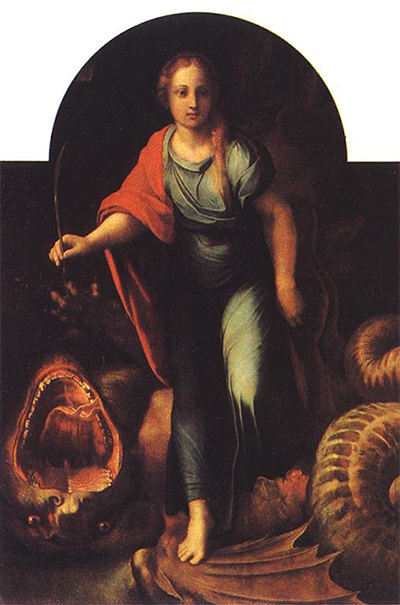
Raphael's Vienna Saint Margaret places a young woman inside the coils of a monster and gives her no weapon except a cross. The dragon's open jaws rise beside her; its tail circles across the ground. Margaret turns toward the threat without collapsing into fear. Her blue garment follows the movement of her body, red cloth crosses one arm, and a fine halo identifies the apparent courtly beauty as a Christian martyr.[1]
The Kunsthistorisches Museum dates the poplar panel to about 1518 and catalogues it under Raphael's name. At more than 1.9 metres high, it is a life-sized confrontation rather than a small devotional emblem.[1]
This is one of two late Raphael compositions of Margaret and the dragon. The Louvre version shows the saint holding a martyr's palm and stepping frontally over the creature's wing. Vienna's painting instead makes the cross and the sideways encounter decisive. The two works belong to different collections, supports and early histories; they should be compared, not blended.
At a Glance
- ArtistRaphael
- Museum titleSt. Margaret
- Dateabout 1518
- Medium/supportpaint on poplar panel
- Dimensions191.3 × 123 cm; panel depth 3.5 cm
- SubjectSaint Margaret of Antioch confronting the dragon
- Principal attributea small cross
- Visual model named by the museumthe Roman figure of Victory
- Attribution questionRaphael's design and present museum attribution, with long debate about assistant execution
- First destinationpainted for the abbot of San Benedetto in Venice
- Recorded owner by 1528Zuanantonio Venier, Venice
- Later collectionsPriuli, Hamilton and Archduke Leopold Wilhelm
- Present collectionKunsthistorisches Museum, Vienna
- InventoryGemäldegalerie 171
- Display when checkedRoom I
Contents
- The legend of Margaret of Antioch
- The cross as instrument of victory
- Between mouth and tail
- A sideways exchange of sight
- Blue cloth and red movement
- A halo almost too fine to see
- Rock, forest and a narrow opening
- Margaret as a Roman Victory
- A life-sized sacred heroine
- Raphael and the question of assistants
The legend of Margaret of Antioch
Margaret was revered as an early Christian virgin martyr, traditionally placed in Antioch during the persecutions associated with the emperor Diocletian. Her story is hagiography, not securely documented biography.
In the Golden Legend, the pagan prefect Olybrius desires her and demands that she renounce Christianity. Margaret refuses, is tortured and imprisoned, and prays to see the enemy who has fought her.[2]
A horrible dragon appears. In one version, she makes the sign of the cross and it vanishes. In another, the beast swallows her; the cross causes its belly to burst, and she emerges unharmed. The medieval compiler himself labels the swallowing episode apocryphal.[2]
The devil then appears in human form. Margaret seizes him, throws him down and places her foot upon his neck. Eventually she is beheaded and receives the martyr's crown.[2]
Raphael condenses these episodes into a single confrontation. Dragon, cross, encircling tail and victorious stance allow viewers to recognise prison, temptation and spiritual triumph at once.
The cross as instrument of victory
Margaret holds a small cruciform object in her left hand. It appears almost delicate beside the dragon's enormous mouth, yet within the legend it is the strongest force present.
The disproportion is meaningful. The beast owns teeth, wings, scales and coils; Margaret owns faith made visible through a simple sign.
She does not thrust the cross like a spear. Its power does not depend upon physical impact. Her possession and display of it are enough to frame the monster as already defeated.
This detail distinguishes the Vienna version immediately from the Louvre painting, where Margaret carries a long palm of martyrdom. Cross and palm belong to the same saint but tell different parts of her story.
Vienna stresses the means by which she overcomes demonic assault. Paris stresses the martyr's triumph after suffering.
Between mouth and tail
The dragon's body structures the lower half of the picture. Its jaws open near Margaret, while its tail travels across the foreground and encloses her feet.
Raphael makes the monster an environment as well as an opponent. Margaret does not simply stand above a compact heraldic creature. She occupies the dangerous space produced by its body.
The curve of the tail helps describe depth. It moves from one side of the panel toward the saint and then away, turning the ground into a shallow arena.
The open mouth supplies the legend's central possibility: swallowing. Whether viewers imagine the moment before ingestion, after miraculous escape or a timeless triumph, the jaws retain narrative force.
Margaret's calmness becomes intelligible only because the threat remains so near. Courage is not the absence of the beast but steadiness inside its reach.
A sideways exchange of sight
Unlike the Louvre Margaret, who faces more directly outward, the Vienna saint turns her head toward the dragon. Her gaze binds the two bodies into an encounter.
This does not make them equal. The monster opens its mouth in appetite; Margaret looks with alert control.
Her body moves one way while her attention returns toward danger. That opposition creates a spiral, continued by red cloth and the dragon's coil.
The pose allows Raphael to show spiritual certainty as active perception. Margaret does not defeat an enemy she ignores. She recognises it and remains composed.
For the viewer, her gaze gives an instruction. We look where she looks, moving from idealised human face toward monstrous jaws and then back along the surrounding tail.
Blue cloth and red movement
Margaret wears a close blue garment whose folds describe the legs and turning torso. A red textile gathers over or around her left arm and introduces a warmer band across the figure.
The colours separate her from the brown rocky setting. They also give the saint a dignity closer to a courtly heroine than to a prisoner stripped by torture.
Raphael does not attempt to reconstruct late antique dress. Clothing belongs to an ideal present in which sacred history can appear beautiful and immediate.
The blue fabric stabilises the upright body, while the red cloth records turning movement. Colour performs distinct compositional tasks.
Against the creature's broken surfaces, the garment also preserves bodily wholeness. The dragon divides into jaws, wing and tail; Margaret remains one continuous, intelligible figure.
A halo almost too fine to see
A slender golden halo hovers above Margaret's head. Its delicacy prevents it from becoming a heavy disk or separating her from the surrounding space.
The saint can first register as a young woman confronting terror. Only then does the halo confirm sacred identity.
That sequence suits the legend. Margaret's sanctity becomes visible through action rather than through an overwhelming supernatural display.
The halo also provides a quiet circular answer to the dragon's larger coil. One curve encloses holy identity; the other attempts to enclose the body.
Raphael's compositional intelligence often operates through such differences of scale. Similar shapes can carry opposite meanings without requiring explicit explanation.
Rock, forest and a narrow opening
The scene occupies a dark, constricted landscape. Rock and shadow make the prison legend present without defining a literal cell.
Vegetation and a glimpse of sky prevent the setting from becoming sealed. The natural world continues beyond the monster's domain.
Strong contrasts of brightness and darkness are among the features the Kunsthistorisches Museum notes when discussing the picture's execution.[1] Light catches Margaret more decisively than the surrounding terrain.
The contrast establishes moral visibility: the saint can be understood as a complete person, while the monster emerges in fragments from obscurity.
Yet darkness is not merely empty background. It makes mouth, tail and rocky enclosure feel as if they belong to one threatening subterranean space.
Margaret as a Roman Victory
The Kunsthistorisches Museum compares the figure to a Roman Victoria, the winged or advancing personification of victory in ancient art.[1]
Margaret herself has no wings, but her stride, turning drapery and effortless ascendancy transform a martyr into a triumphal figure.
This classicising form changes the emotional key of the legend. Torture and imprisonment recede; beauty and command occupy the centre.
Raphael had spent his Roman years studying sculpture, reliefs and the expressive possibilities of antique bodies. Here he does not simply attach a Christian attribute to a pagan statue. He uses ancient victory to give new force to a Christian woman's conquest of temptation.
The transformation is particularly apt because Margaret wins without military strength. The visual language is imperial; the cause of victory is faith.
A life-sized sacred heroine
At 191.3 centimetres high, the panel approaches the scale of an adult standing before the viewer.[1]
That size changes the dragon's effect. Its mouth is not a miniature symbol beneath a saint's shoe but an opening large enough to recall the legend's impossible act of swallowing.
Margaret's body, meanwhile, can command an architectural interior. The painting creates presence rather than inviting only intimate inspection.
The narrow width intensifies her upward movement. Little spare space remains beside body, jaws and tail, so the heroine appears to break through confinement.
Scale also supports the comparison with ancient statuary. Margaret can be encountered as a living, coloured counterpart to a monumental figure of Victory.
Raphael and the question of assistants
The Vienna surface has often been called coarse, especially in its emphatic light-dark contrasts. Some scholars have used those qualities to argue that assistants carried out much of the painting.[1]
The museum does not conceal the problem, but it also offers another possibility: Raphael may have supplied differently priced versions of a composition, with levels of finish shaped partly by cost.[1]
That suggestion moves beyond a simple quality test in which every rough passage must belong to a pupil. Workshops served patrons with varying budgets and expectations.
The Kunsthistorisches Museum nevertheless catalogues the picture as Raphael.[1] That name encompasses the invention and the work's issue from his studio while leaving exact execution open to discussion.
It would be equally misleading to declare every brushstroke personal or to replace the current museum attribution with a confident assistant's name. The evidence supports tension, not a neat verdict.
A late studio under pressure
Around 1518 Raphael supervised one of Rome's busiest artistic enterprises. Papal decoration, architecture, portraits, altarpieces and designs for objects in other media all competed for attention.
The studio was not an emergency substitute for personal work. It was the system through which Raphael could develop and disseminate complex inventions at an unprecedented scale.
Assistants such as Giulio Romano and Giovan Francesco Penni learned to elaborate his figure types and compositional structures. Their skill makes modern separation difficult.
The Vienna Margaret illustrates that difficulty clearly. The governing idea—the classical heroine calm amid a circular monster—is exceptionally strong. Parts of its execution have seemed less refined to later eyes.
Rather than choosing between genius and collaboration, the painting permits a fuller question: how did Raphael turn design, supervision, labour and price into a single object carrying his name?
Painted for San Benedetto in Venice
The Kunsthistorisches Museum says the panel was painted for the abbot of San Benedetto in Venice.[1] This first destination is crucial because it separates Vienna's picture from the French history of the Louvre version.
Venice offered a setting where Raphael's Roman classicism could encounter a culture celebrated for colour and rich collections.
The exact original placement is not stated in the live record, so the work should not be assigned to a particular altar or room without further documentation.
Its scale could suit an important interior, but scale alone does not prove liturgical function.
What is secure is a Venetian recipient, followed quickly by ownership in a major Venetian collection. The painting's first history is ecclesiastical and local, not a duplicate of Leo X's gift to France.
Zuanantonio Venier and the Priuli
By 1528 the painting belonged to Zuanantonio Venier in Venice.[1] A date only a decade after creation gives the provenance unusual early precision.
It later passed to the Priuli family. Both names place the work within Venice's elite collecting culture.
The shift from an abbot to private owners may reflect sale, gift or inheritance, but the museum's concise chain does not specify the mechanism. It is better to preserve the known succession than invent a story between names.
Early collection history also supports the work's distinct identity. A painting securely in Venice cannot simply be the French royal panel under another title.
Its movement through households prepared the way for a much larger transfer: from Venetian possession into one of the most famous princely collections of the seventeenth century.
Hamilton and Archduke Leopold Wilhelm
The Vienna panel entered the Hamilton collection between 1638 and 1649.[1] It was then recorded in the collection of Archduke Leopold Wilhelm in Brussels by 1659.[1]
Leopold Wilhelm assembled a renowned gallery of Italian paintings while serving as governor of the Spanish Netherlands. David Teniers the Younger represented the collection in painted gallery interiors and helped make its works known through reproduction.
Raphael's tall Margaret suited such a display of canonical Italian art. Her striking silhouette remained recognisable even within densely hung rooms.
The archduke's collection formed a major foundation of the imperial picture gallery in Vienna. The painting's present home therefore descends from a seventeenth-century act of connoisseurial and dynastic collecting.
Its Habsburg path differs sharply from the Louvre work's continuous French Crown identity.
The Louvre version: a necessary comparison
The Louvre Saint Margaret also dates from 1518, but it is a separate painting. The museum catalogues that work jointly to Raphael and Giulio Romano.
Paris Margaret carries a palm and steps frontally upon the dragon's opened wing. The creature's gaping head turns upside down at one side while its tail coils at the other.
Vienna Margaret holds a cross, turns toward the mouth and occupies the encircling tail. Her relationship with the beast is more visibly conversational and enclosed.
The supports differ too. Vienna remains on a thick poplar panel. The Louvre image was transferred from wood to canvas.
Finally, the first histories diverge. Vienna begins with the abbot of San Benedetto and Venetian collectors. Paris reached François I from Leo X and entered the French Crown collection.
Cross versus palm
The exchange of attributes is not a minor variation. It changes how time operates in each image.
The cross belongs to Margaret's confrontation with the demon. It is the sign through which the dragon vanishes or breaks apart in the medieval story.[2]
The palm belongs to her eventual martyrdom. It anticipates or celebrates the beheading that follows the prison temptation.
Vienna therefore concentrates on spiritual defence in the dangerous present. Paris folds the later crown of martyrdom into the victory over the creature.
Both symbols lead beyond the painted instant, but in different directions. The cross looks toward Christ's saving power; the palm looks toward Margaret's completed witness and heavenly reward.
How to look at the Vienna Saint Margaret
Begin with the small cross and compare its scale with the open mouth. The visual imbalance is the theological point.
Follow the tail around the saint's feet and notice how the beast makes a circular stage for her upright body.
Move from her torso to her turned head. Body and gaze travel in different directions, keeping the encounter active.
Look for the fine halo only after reading the figure as human. Sanctity is understated rather than spectacular.
Finally, compare the coherent blue-red silhouette with the monster's separated jaws, wing and tail. Wholeness confronts fragmentation.
Why the painting matters
The Vienna Saint Margaret turns a fantastic medieval legend into a monumental image of interior courage.
Its antique model does not secularise the saint. Roman Victory gives physical authority to a woman whose triumph comes from a Christian sign rather than a weapon.
The work also exposes the realities of Raphael's late practice. A powerful composition could pass through assistants, price structures and different levels of finish while remaining part of the master's artistic enterprise.
Its provenance carries the painting from a Venetian abbot through local patricians, Hamilton and Leopold Wilhelm into the imperial collection.
Most importantly, comparison with the Louvre version shows how Raphael could rethink one subject through attribute, gaze, movement and patron. The dragon may be shared; the encounter is not.
Artist Up Close
Find the cross first. It is the smallest decisive object in the panel.
Trace the dragon from mouth to tail instead of trying to understand it as one compact body. Its fragmentation makes Margaret's form feel calmer.
Watch how the red cloth carries the turn of her arm while blue holds the longer figure together.
Then step back until she approaches human scale. The legendary scene becomes a physical meeting rather than a distant symbol.
Frequently Asked Questions
Discussion
What detail most changes how you read Saint Margaret and the Dragon: The Vienna Version?
Reader Insights
Which source detail gives the page its strongest anchor?
Which visual or historical distinction should readers keep in mind?
How does this page change the wider picture of Raphael's career?
Join the Conversation
Share your reading below.
References
- Kunsthistorisches Museum Wien, “St. Margaret,” Gemäldegalerie 171. View source.
- Jacobus de Voragine, “The Life of St. Margaret,” The Golden Legend, translated by William Caxton and edited by F. S. Ellis, Fordham University Internet Medieval Sourcebook. View source.