 by Tom Gurney
Tom Gurney BSc (Hons) is an art history expert with over 20 years experience
Published on June 19, 2020 / Updated on August 21, 2026
Email: tomgurney1@gmail.com / Phone: +44 7429 011000
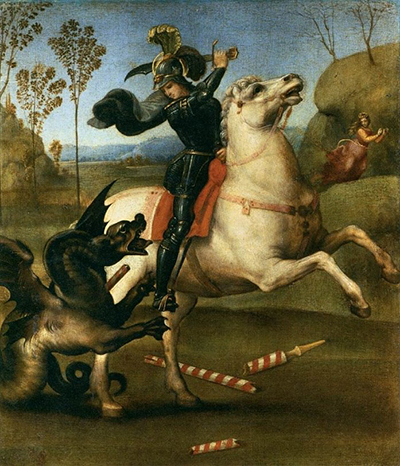
Raphael's Louvre Saint George captures the instant before a decisive sword stroke. George's lance has already broken in the struggle, leaving part of it embedded in the dragon. His white horse rears and twists away from the creature at its flank. The armoured saint turns in the saddle and raises his blade, while the princess retreats through the landscape behind them.[1][2]
Everything happens on a panel only 29.4 centimetres high. Raphael compresses horse, rider, monster, weapon, fleeing woman and distant country into a field scarcely larger than a book page. The picture's scale belongs to private and courtly viewing; its energy belongs to epic narrative.
The Louvre dates it about 1503–05 and records it as oil on poplar.[1] It is the earlier of Raphael's two surviving painted treatments of Saint George. The other, now in Washington, shows the saint driving an intact lance downward and prominently wearing the English Order of the Garter. The Louvre panel instead owns the broken-lance and raised-sword climax, as well as a long association with Raphael's small Saint Michael.
At a Glance
- ArtistRaphael
- Louvre titleSaint Georges luttant avec le dragon
- English titleSaint George Fighting the Dragon
- Dateabout 1503–05
- Medium/supportoil on poplar panel
- Dimensions29.4 × 25.5 cm
- Narrative momentGeorge prepares the final sword stroke after his lance has broken
- Other figuresa rearing white horse, dragon and retreating princess
- Closely associated workRaphael's Small Saint Michael, Louvre INV 608
- Possible first contextthe court of Urbino and its chivalric honours
- French royal acquisitionbought from Cardinal Mazarin's heirs for Louis XIV in 1665
- Present collectionMusée du Louvre, Department of Paintings
- Inventory numbersINV 609; MR 440
Contents
- Saint George's legend
- A lance already broken
- The sword above the action
- Horse, rider and centrifugal movement
- Armour, helmet and cape
- The dragon at the horse's flank
- The princess in motion
- A landscape of hills and shrubs
- Diagonals and immediate comprehension
- The Small Saint Michael as companion
Saint George's legend
The legend made George a Roman soldier and Christian saint who came upon a city terrorised by a dragon. The creature demanded human victims, and the king's daughter was chosen. George confronted it, wounded or subdued it and enabled the princess to lead it back toward the city, whose people converted after the saint's victory.[2]
Medieval versions varied in their details. Raphael needed only the most recognisable elements: armed horseman, dragon, princess and rescue. He stages the story as a moment of controlled peril rather than a sequence of miracles.
The dragon embodies a threat to the community, but the painting also belonged to a culture in which Saint George served as an exemplar and patron of knighthood. Sacred courage and aristocratic identity could reinforce one another.
The tale should therefore be read as legend rather than documentary history. Its power lay in repeatable moral form: danger confronted, vulnerable life protected and faith confirmed through action.
A lance already broken
The broken lance tells viewers that the fight began before the painted instant. Part of its shaft lies or projects near the combat, and its point has already pierced the beast.[2]
Raphael uses this damage to intensify the turn toward the sword. George has lost his first weapon but not command of the action. He adapts while horse and dragon collide below.
The fragment also gives the picture a before and after. Before: the mounted charge and impact. Now: the weapon fails. Next: the sword descends.
Because the panel is still, the broken shaft performs the work of time. It is visual evidence of an earlier force and a reason for the saint's present gesture.
This detail is the easiest way to distinguish the Louvre version from Raphael's Washington panel. In Washington, the lance remains long and whole as George drives it into the dragon. In Paris, the weapon's failure produces a second phase of combat.
The sword above the action
George raises his sword in his right hand, preparing a blow from above. His torso turns to create space for the arm, and the blade extends the body's movement beyond the saddle.[2]
The gesture must remain legible inside a crowded small panel. Raphael solves that problem by setting weapon and arm against open sky. The silhouette can be understood immediately.
The blade also creates one of the composition's principal diagonals. It answers the dragon's last offensive motion and the horse's rising body. The princess's movement in the background carries the same directional agitation farther into space.[2]
George's violence is framed as protective rather than aggressive. The princess and the legend's threatened city give the blow its moral context.
Yet Raphael does not reduce the action to a static emblem of good over evil. The horse's fear, the monster's resistance and the rider's physical effort keep struggle real.
Horse, rider and centrifugal movement
The white horse rears upon its hind legs. Its body turns three-quarters toward the viewer while its head responds to the dragon's attack at the flank.[2]
This orientation allows Raphael to show mass and instability together. The chest of the horse occupies the picture's centre; raised forelegs and twisting neck make that centre volatile.
George must control the animal while striking. His seat, legs and torso pull in different directions, creating a rotating unit rather than a rider placed stiffly on a mount.
The red saddle and harness provide points of intense colour among white hide, armour and green landscape. The saint's cape swells behind him, turning unseen air into visible motion.[2]
Horse and hero are not interchangeable signs. The animal's reactive movement gives the saint's composure meaning. Courage appears through mastery of a living body under threat.
Armour, helmet and cape
George wears shining armour and a helmet with a tall crest. Protective metal encloses him from head to foot, while fabric and plume remain free to respond to speed.[2]
Armour gives the ancient Christian soldier the appearance of a Renaissance knight. Raphael's viewers did not require archaeological reconstruction; contemporary chivalric equipment made the saint present to courtly culture.
Reflections across the metal clarify limbs without turning the tiny picture into a detailed armour catalogue. Bright edges separate George from horse and landscape.
The high crest enlarges his figure and keeps the helmet readable above the raised sword arm. The cape prevents the armoured silhouette from becoming rigid.
Together these materials produce a contrast central to the scene: hard defence and mobile air, disciplined equipment and bodily improvisation.
The dragon at the horse's flank
The dragon is low in the foreground, close enough to threaten the horse rather than merely await execution. Its body bends through a compact, irregular shape beneath the larger animal.[2]
Raphael does not need a huge beast. Scale supports the moral hierarchy: George and the horse dominate the panel, but the dragon remains dangerous because it attacks from below at close quarters.
Its opened mouth and active limbs prevent it from becoming a decorative footstool. The embedded lance shows injury; its movement shows that injury has not yet ended resistance.
The creature belongs partly to nature and partly to fantasy. Its earthbound form connects cave, rocks and scrub, while its monstrosity visualises a threat outside ordinary animal order.
George's downward strike will close the vertical gap between saint and beast. Until then, the panel sustains suspense.
The princess in motion
The princess appears small in the background, moving away while turning her attention toward the fight. Her diagonal posture continues the turbulence of the foreground.[2]
She is not a passive label. Without her, viewers might see a knight hunting a monster. Her danger gives the combat its rescue structure.
Distance marks different kinds of action. George occupies the immediate physical contest; the princess registers fear, escape and witness farther back.
Raphael makes the size difference narratively useful. Her small figure deepens the landscape and measures how close the knight has placed himself to danger on her behalf.
Unlike the Washington version, where the princess kneels in prayer, the Louvre woman is described by the museum as fleeing or withdrawing. The two gestures create different emotional rhythms around the same legend.
A landscape of hills and shrubs
The Louvre guide calls the setting characteristically Umbrian: clear hills, small trees and open atmosphere.[2] Its brightness differs sharply from the darker underworld of the associated Small Saint Michael.
Landscape does more than fill unused space. Slopes and tree lines stage the princess's escape, separate the cave from distant country and make the combat occur within a threatened inhabited world.
The high horizon leaves enough sky for sword, helmet and cape to read clearly. Near rocks support the dragon; far hills make the tiny panel feel expansive.
Raphael's clarity is economical. He supplies only as many landmarks as the story needs, then uses aerial distance to prevent the crowded foreground from feeling sealed.
The landscape also moderates violence. Beyond the crisis, the world remains ordered, sunlit and potentially recoverable.
Diagonals and immediate comprehension
The Louvre's Department of Paintings emphasises the panel's diagonal organisation. The dragon's last attack, the rearing horse and the princess's flight all direct movement across the field.[2]
These diagonals cross the stronger vertical of horse and rider. The result feels rotational without losing a centre.
Raphael's design allows viewers to grasp the scene quickly: threat below, protector above, victim beyond, final stroke imminent.[2] That speed was valuable in a miniature picture whose details might be enjoyed only after the narrative registered.
The composition can therefore work at two distances. At first sight, a brilliant armoured rider defeats a monster. At closer range, the broken lance, horse's reaction, flowing textiles and background princess reconstruct the story's phases.
Conciseness is not simplicity. It is the coordination of several pieces so that none requires explanatory clutter.
The Small Saint Michael as companion
Raphael's Small Saint Michael, Louvre INV 608, has remained closely associated with Saint George. The two were described together in Cardinal Mazarin's collection and entered the French royal collection as a linked pair.[1][2]
Both show an armoured champion at the instant before a fatal blow. Their movements mirror one another: Michael shows his left profile, while George seems to surge toward the opposite side.[2]
Their worlds differ. George acts in a bright earthly landscape and protects a princess and city. Michael descends into a dark field populated by punished figures and fantastic creatures derived partly from Dante.[2]
The contrast gives pairing a purpose. One victory belongs to chivalric legend on earth; the other belongs to cosmic warfare against rebellious evil.
Whether every aspect of their first physical arrangement can be recovered is less certain. What is secure is their early courtly scale, close date, complementary subjects and long shared collection history.
Urbino and chivalric honours
The Louvre suggests the panel may have been made for Duke Guidobaldo da Montefeltro of Urbino around 1503–05.[1][2] The court valued learning and art alongside military identity, making a small Saint George an apt possession.
The National Gallery's 2022 Raphael catalogue develops the chivalric context. Francesco Maria Della Rovere entered the French Order of Saint Michael in 1503, while Guidobaldo was invested in the English Order of the Garter, whose patron was Saint George, in 1504.[3]
That study regards the Louvre Saint Michael and Saint George as almost certainly connected with those events.[3] No surviving contract names the panels' exact recipients, so the association should remain a historically grounded reconstruction rather than a documented commission formula.
Small scale suits diplomatic exchange. A portable painting could memorialise honour as privately as a medal or precious book, while Raphael's narrative invention demonstrated the sophistication of the giver's court.
George's subject also translates institutional honour into moral image. Membership in an order of knighthood becomes a claim about courage, defence and Christian conduct.
How this version differs from Washington
Raphael's Washington Saint George and the Dragon is close in size but different in action and purpose. There, George leans forward to drive an intact lance into the dragon. The princess kneels in prayer. A blue garter inscribed HONI makes the Order of the Garter connection explicit.[3]
The Louvre version shows a later narrative instant: lance broken, sword raised, princess withdrawing. It has no comparable inscribed garter as its governing detail.
The horse also turns differently. Paris emphasises a swirling, three-quarter rearing pose and the threat at its side; Washington builds a more forceful downward line from rider through lance to beast.
Their provenance diverges early. The Louvre panel became associated with Mazarin and Louis XIV. Washington entered the English royal collection, passed through Crozat and Catherine II, and eventually reached Andrew Mellon.
Calling one merely a copy or duplicate of the other would erase these differences. Raphael used the same legend to solve two distinct problems of movement, commemoration and address.
Mazarin and Louis XIV
The Louvre records possible early ownership by Guidobaldo, a possible Milanese presence around 1520–23 and ownership by Ascanio Sforza at Piacenza. Each early step carries a question mark.[1]
The secure French sequence begins with Cardinal Jules Mazarin after 1653. His 1661 inventory recorded the Saint George together with the associated small panel.[1]
Louis XIV acquired the paintings from Mazarin's heirs in 1665.[1] The transfer placed Raphael's youthful courtly image inside the French royal collection, where authorship and dynastic prestige shaped its reception.
The object later entered the Louvre as part of the former Crown collection. Inventory number INV 609 identifies it separately from INV 608, the Small Saint Michael.
Its history demonstrates how private scale does not imply private obscurity. A panel designed for intimate handling became an object of royal display and national patrimony.
Present location and object identity
The Louvre's live record lists the painting within its Department of Paintings and, at the time checked, gives the Musée Bonnat-Helleu in Bayonne as its current location.[1] Loans and gallery placements can change, so visitors should confirm before travelling.
The support is poplar, and the painted field measures 29.4 by 25.5 centimetres. Frame-inclusive dimensions are much larger and should not be mistaken for the panel itself.[1]
The alternate museum number MR 440 reflects historical inventory systems. Neither number belongs to the Washington picture.
Clear object identification matters especially here because English titles often shorten both paintings to Saint George and the Dragon. Collection, inventory, dimensions and action are the reliable anchors.
How to look at the Louvre Saint George
Start with the broken lance and reconstruct the charge that preceded the shown moment.
Follow the horse upward through its rearing chest, then turn with George's torso toward the raised sword.
Look beneath the horse for the dragon's response. It is wounded but still active.
Move backward to the princess and compare her retreat with George's advance.
Then imagine the Small Saint Michael beside this bright landscape. The pairing turns two battles into complementary forms of Christian and chivalric victory.
Why the painting matters
The Louvre Saint George shows Raphael mastering narrative compression while still very young. A broken weapon, a turn in the saddle and a raised blade give the painted instant a past and future.
Its courtly setting enlarges the legend. The saint was not only a religious protector but a model through which Urbino's rulers could understand chivalric honour.
The long relationship with the Small Saint Michael reveals how paired images could create meaning through contrast: earthly landscape against infernal terrain, mounted knight against archangel, rescued princess against cosmic punishment.
Above all, the panel proves that monumentality need not depend on physical size. Raphael makes a hand-sized surface feel capacious by controlling movement, distance and time.
Artist Up Close
Find the snapped lance before looking at the sword. The two weapons identify the exact stage of combat.
Notice how the horse's white body creates a bright platform for armour, red saddle and flying cape.
Trace three diagonals: dragon's resistance, horse's rise and princess's retreat.
Finally, look at the open country beyond the fight. Its calm distance makes the foreground crisis feel both urgent and containable.
Frequently Asked Questions
Discussion
What detail most changes how you read Saint George Fighting the Dragon: The Louvre Version?
Reader Insights
Which source detail gives the page its strongest anchor?
Which visual or historical distinction should readers keep in mind?
How does this page change the wider picture of Raphael's career?
Join the Conversation
Share your reading below.
References
- Musée du Louvre, “Saint Georges luttant avec le dragon,” INV 609. View source.
- Département des Peintures, Musée du Louvre, Premiers feux au musée, entry on Saint Georges luttant avec le dragon, 2017, pp. 8–9. View source.
- Carol Plazzotta and Tom Henry, “The Dream of a Knight,” National Gallery Catalogues: The Sixteenth Century Italian Paintings, Volume 4: Raphael, 2022, especially the Urbino court and chivalric-order context. View source.