 by Tom Gurney
Tom Gurney BSc (Hons) is an art history expert with over 20 years experience
Published on June 19, 2020 / Updated on August 21, 2026
Email: tomgurney1@gmail.com / Phone: +44 7429 011000
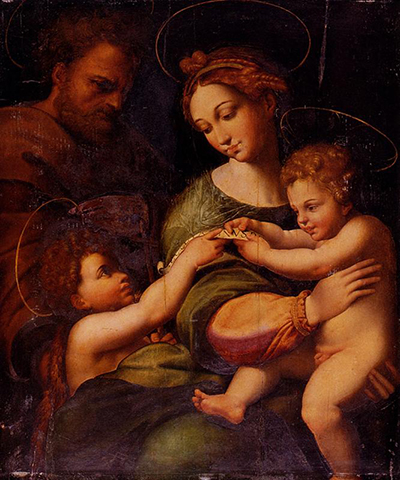
Raphael's Virgin of the Rose is famous for a flower he never painted. The rose rests on a lower strip added when the picture was transferred from its original wooden panel to canvas, probably during the first half of the nineteenth century. That intervention altered the dimensions and supplied the popular title by which the Holy Family is now known.[1]
The original composition, painted around 1517, draws Mary, Christ, the young John the Baptist and Joseph into a close, curtain-backed space. Mary holds the slightly unbalanced Christ while John offers a scroll identifying him as the Lamb of God. Mary and Joseph respond with melancholy; the children remain lively within a prophecy of death.[1]
The Museo del Prado currently attributes the intimate panel to Raphael without doubt. Earlier scholars often divided late works into puzzles of master and workshop hands, but current study describes a more sophisticated collaboration controlled by Raphael and concentrated especially in large commissions. The careful, small-scale Virgin of the Rose does not require a categorical assistant attribution.[1]
At a Glance
- ArtistRaphael
- Full titleThe Holy Family with the Infant Saint John the Baptist
- Common titleThe Virgin of the Rose
- Dateabout 1517
- Original mediumoil on panel
- Present supportcanvas after transfer
- Present dimensions103 × 84 cm
- FiguresMary, Christ, young John the Baptist and Saint Joseph
- Central textJohn's
Ecce Agnus Deiscroll - Present roseon a lower band added in the nineteenth century
- Original commissionunknown
- First secure notice in Spain1657
- Earlier possible ownerEarl of Arundel, based on Hollar's 1642 engraving; not certain
- Current collectionMuseo Nacional del Prado, Madrid
- Object record
efb3dfa3-c993-4f29-9db4-1c49373b275b
Contents
- A title created by alteration
- Mary supports an unbalanced Christ
- John presents the scroll
- Joseph in melancholy shadow
- The curtain and private sacred space
- A limited but carefully built palette
- Delicate light and transparent shadow
- A late echo of earlier Madonnas
- Raphael, Leonardo and Fra Bartolomeo
- How the Prado now states attribution
A title created by alteration
The name Virgin of the Rose appears to identify a meaningful original attribute. Material history tells a different story.
The lower band supporting the flower was added during or around the transfer from panel to canvas.[1]
Before that extension, Raphael's composition had no rose in its present position. The popular title therefore depends upon a nineteenth-century change.
This does not make the name unusable. It has become a stable part of reception and helps distinguish the painting from many other Holy Families.
It does mean that the flower should not be assigned an elaborate Marian or Passion symbolism as though Raphael placed it there.
The title records what later viewers saw after the object's shape changed. It is evidence of afterlife, not original iconography.
Few names demonstrate so clearly how conservation and alteration can rewrite the identity of an artwork.
Mary supports an unbalanced Christ
Mary holds Christ as his body shifts toward John. The child appears slightly off balance, making her support visibly necessary.[1]
The pose introduces energy into a tightly framed group. Christ does not sit passively; his movement carries the scene toward the scroll.
Mary's hands respond to weight and direction. Her care becomes a compositional force, keeping the body within the narrow field.
The child's instability also has emotional resonance. The future Passion is announced at the moment when he remains physically dependent on his mother.
Mary's expression is melancholy rather than alarmed. She understands the prophetic meaning without interrupting the children's exchange.
Raphael balances movement and control. The child can lean because the adult hold is secure.
That bodily credibility prevents the sacred group from becoming a static arrangement of symbols.
John presents the scroll
The young John the Baptist offers a scroll bearing the words Ecce Agnus Dei, “Behold the Lamb of God.”
The phrase identifies Christ through sacrificial imagery. It anticipates John's adult preaching and Christ's Passion.
In the painting, text passes between children. John's small body carries a declaration whose significance belongs to future history.
Christ responds with movement rather than reading in an ordinary manner. The scroll attracts hand, gaze and torso.
The white band also creates a strong directional accent against flesh and dark setting.
John appears lively and close, not as a miniature adult or distant prophet. Raphael lets childhood behaviour convey adult destiny.
The scroll, unlike the later rose, belongs to the composition's original theological structure.
Joseph in melancholy shadow
Joseph stands behind the primary exchange. His face appears in reduced light, and his attitude is contemplative or melancholy.[1]
The shadow separates his role from the children's brightness. He watches what he cannot prevent.
Mary and Joseph share knowledge across different positions. She holds Christ physically; Joseph responds from behind.
The two adults create an emotional frame around the lively boys.
Raphael uses limited illumination to keep the composition intimate. Joseph does not need equal brightness to remain psychologically important.
His presence also turns a Madonna-and-children group into a complete Holy Family.
The quiet guardian brings future sorrow into the background while the scroll brings prophecy into the foreground.
The curtain and private sacred space
A curtain closes much of the background.[1]
Unlike the wide landscapes of Raphael's Florentine Madonnas, this textile field compresses the figures toward the viewer.
Curtains can suggest domestic rooms, ceremonial revelation and the act of setting sacred persons apart.
Here the limited space strengthens intimacy. Bodies overlap closely, and light moves across them without a distant horizon offering escape.
The fabric also helps explain why the work may have served a private devotional chapel.[1]
Its scale is substantial but not a public multi-saint altarpiece. A curtain-backed Holy Family could meet close, controlled viewing.
The setting makes the children's encounter feel immediate while preserving a solemn boundary around it.
A limited but carefully built palette
The Prado describes a restricted range of colour executed with great care.[1]
Blue passages were laid over a pinkish underlayer. The interaction between layers affects warmth and depth.
Flesh paint is extremely thin. Shadows and hair approach transparency, recalling similar effects in Raphael's late Pearl.[1]
Thinness can produce extraordinary delicacy, but it also makes the surface vulnerable to wear and aggressive cleaning.
The close curtain and limited palette focus attention on tonal relations rather than landscape variety.
Mary's clothing, children's flesh and Joseph's shadow form a controlled hierarchy.
Raphael's late colour is not simply brighter or darker than his Florentine work. It depends on subtle layering and the visibility of undercolour.
Delicate light and transparent shadow
Light enters the compact group without becoming theatrical spotlight.
It models Christ and John more fully while allowing Joseph to recede.
The Prado notes that shadows and hair are treated with near transparency.[1] Such handling keeps contours from becoming hard boundaries.
Mary's melancholy expression emerges through fine transitions rather than exaggerated features.
Transparent shadow also connects figures to the surrounding atmosphere. Even in a closed interior, flesh does not appear cut from darkness.
The technique demands control because thin paint leaves little room for heavy correction.
Its subtlety supports attribution to Raphael within the museum's current account.[1]
A late echo of earlier Madonnas
The composition partly returns to types Raphael explored at the beginning of the 1510s.[1]
Mother, child and Baptist form a compact devotional group with Joseph behind, recalling earlier Florentine concerns with bodily relation.
Yet colour and light connect the work to The Pearl around 1518 and to Raphael's continuing study of Leonardo and Fra Bartolomeo.[1]
The result is neither a simple revival nor a wholly new type. Raphael reuses learned models under late Roman conditions.
Figures are placed with confidence, as though familiar relationships can be established rapidly and securely.
That fluency may explain the panel's apparent simplicity. The artist no longer needs to advertise every act of construction.
Late style here means compressed mastery rather than increasing complexity for its own sake.
Raphael, Leonardo and Fra Bartolomeo
Leonardo remained important to Raphael beyond the Florentine years. Close bodily exchange, softened shadow and psychological continuity continue to inform the panel.[1]
Fra Bartolomeo offered monumental simplicity and broad sacred grouping.
Raphael's Virgin of the Rose turns those lessons toward a comparatively intimate panel.
Christ's movement across Mary's body produces a Leonardesque chain of action, while the group retains a clear, stable mass.
The curtain suppresses atmospheric landscape, so influence appears through figures and light rather than distant scenery.
Raphael's synthesis is recognisable in the ease with which formal security contains emotional unease.
The children play; adults foresee suffering; every body remains legible.
How the Prado now states attribution
The current Prado record says there is no doubt that the painting is by Raphael.[1]
That statement matters because late works have often been divided among assistants passage by passage.
Older scholarship imagined Raphael's Roman production as a puzzle in which workshop members painted separate parts. The museum describes late collaboration as more sophisticated and consistently controlled by the master.[1]
It also notes that substantial delegation was concentrated in works of large scale.
This image is intimate and carefully finished. Some scholars have proposed workshop help in incidental areas, but the Prado does not use that possibility to displace Raphael's authorship.[1]
Responsible language can preserve debate without contradicting the institution's present conclusion.
The page therefore identifies Raphael as artist and treats assistant participation as a historical proposal, not an equal current attribution.
Speed, confidence and careful finish
The Prado suggests that the formal simplicity and secure spatial arrangement indicate rapid painting from well-learned models.[1]
Rapid does not mean careless. The limited palette, thin flesh and transparent hair are meticulously controlled.
Raphael could work quickly because the compositional language was deeply internalised.
The distinction is useful. Visible complexity is not the only measure of labour or mastery.
A close group can emerge fluently while requiring exact decisions about balance, overlap and light.
The panel's damaged support history makes surviving delicacy especially valuable.
Its refined speed belongs to a workshop master managing many projects but still capable of concentrated small-scale painting.
No known commission
The Prado has no information about the original commission.[1]
The intimate subject and curtain-backed setting suggest private devotion, perhaps for a chapel, but no patron can be named.
The first owner should not be invented from later Spanish history or from the painting's popular title.
The added rose certainly cannot identify an original Marian dedication.
Function can be inferred cautiously from scale and format; provenance requires documentary evidence.
The unknown commission leaves attention on what the panel itself provides: a close Holy Family, Lamb-of-God prophecy and melancholy foreknowledge.
Copies in sixteenth-century Spain
Although the first secure Spanish notice of this physical painting dates to 1657, copies of the composition were already present in Spain during the sixteenth century.[1]
The 1589 testament of the Florentine painter Benedetto Rabuyate in Valladolid recorded six versions.[1]
Other early copies include one associated with the Count of Monterrey and a 1588 version by Gabriel de Cárdenas.[1]
This circulation shows that Raphael's design reached Spain long before the original panel's secure documentation.
Copies complicate provenance because a written “Raphael Holy Family” may identify a version rather than this exact object.
They also demonstrate fame. The composition proved transferable across workshops and devotional settings.
Arundel, Hollar and Carducho: possible clues
Wenceslaus Hollar engraved the composition in 1642 after a painting belonging to Thomas Howard, Earl of Arundel.[1]
That picture may have been the Prado original, but the link remains hypothetical.
In 1633 Vicente Carducho mentioned a damaged Raphael in his workshop that might also have been this work, suggesting an earlier Castilian presence.[1]
Again, identification is possible rather than certain.
These clues show why provenance must distinguish secure notices from plausible matches. A famous composition can generate several candidates.
The first definite evidence in Spain comes in 1657.[1]
Careful chronology keeps attractive connections available without turning them into fact.
Transfer from panel to canvas
Raphael painted the picture on wood. The present support is canvas because the paint layer was transferred, probably in the first half of the nineteenth century.[1]
Panel transfer involved removing the original wood and attaching the ground and paint to fabric.
The procedure permanently changed the object's material structure. Raphael did not choose canvas for this work.
The Prado believes the transfer also altered the dimensions.[1]
Surface wear and the absence of the first support complicate technical interpretation and dating.
The intervention must therefore be stated in the medium line, not hidden in a conservation footnote.
What survives is a Raphael painting carried by a later support and changed outline.
The added lower band and rose
The bottom strip with the rose was added when or around the time the work was transferred.[1]
The extension gave the composition more space below and placed a flower on the new ledge.
That small change had an enormous afterlife: it created the title Virgin of the Rose.
Later viewers could reasonably assume the flower had symbolic significance because it looked integrated into a Renaissance sacred panel.
Technical and historical study correct that assumption. The rose belongs to nineteenth-century transformation.
The episode illustrates why iconography must begin with material chronology. A symbol cannot express Raphael's intention if it was painted centuries after him.
The flower remains part of the current object, but it tells a story about restoration culture and reception.
How to look at the Virgin of the Rose
Begin with Christ's shifting body and the exact support of Mary's hands.
Move to John's scroll and separate its original prophecy from the later flower below.
Find Joseph in the dark and compare adult melancholy with the children's liveliness.
Study the thin flesh tones, transparent shadows and blues built over pink.
Then locate the lower band. Imagine the composition ending before the rose was added.
Finally, remember the lost wooden support beneath the present canvas structure.
Why the painting matters
The Virgin of the Rose is a late Raphael image of remarkable emotional economy. Close bodies, a scroll, a curtain and subdued light hold play and foreknowledge together.
Its current attribution also helps correct a simplistic picture of Raphael's workshop. Collaboration was controlled and varied by scale; this intimate panel remains Raphael's work in the Prado's judgment.[1]
The material history is equally important. Transfer erased the original wood, changed the dimensions and added the very rose that renamed the painting.
The page matters because it teaches two kinds of looking at once: toward Raphael's delicate family drama and toward the later object that now carries it.
Artist Up Close
Look at Mary's grip and the slight imbalance of Christ's body.
Notice how Joseph's face emerges from the curtain-darkened space.
Then study the rose. It is visually present and historically late—the key to a title Raphael never knew.
Frequently Asked Questions
Ecce Agnus Dei identifies Christ as the Lamb of God and anticipates his sacrifice.Discussion
What detail most changes how you read Virgin of the Rose?
Reader Insights
Which source detail gives the page its strongest anchor?
Which visual or historical distinction should readers keep in mind?
How does this page change the wider picture of Raphael's career?
Join the Conversation
Share your reading below.
References
- Museo Nacional del Prado, “La Sagrada Familia con san Juanito, o Virgen de la Rosa,” current collection record. View source.