 by Tom Gurney
Tom Gurney BSc (Hons) is an art history expert with over 20 years experience
Published on June 19, 2020 / Updated on August 21, 2026
Email: tomgurney1@gmail.com / Phone: +44 7429 011000
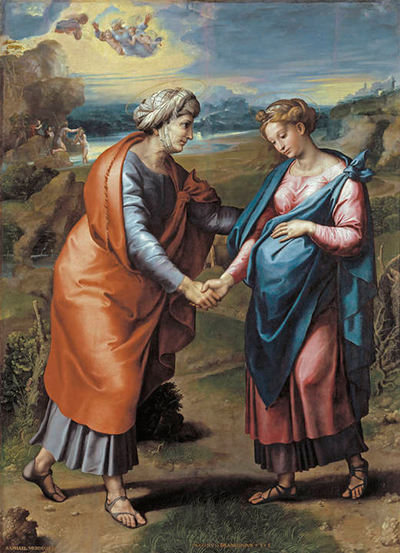
Raphael's Visitation makes a quiet greeting carry the weight of sacred history. Mary has travelled to the hill country to see her older relative Elizabeth. Both women are pregnant through extraordinary circumstances. As they meet, Elizabeth recognises that Mary's unborn child is her Lord, while the child in her own womb will become the prophet who prepares his way.[1][3]
The painting gives this intimate recognition an expansive setting. Mary and Elizabeth occupy the foreground, joined by hands, glances and the sweep of their clothing. Far behind them, beside a river, John baptises the adult Christ. The distant episode has not yet happened, but Raphael places it within sight. Promise and fulfilment therefore coexist in one landscape.
Made for the Branconio family chapel in L'Aquila, the altarpiece joined the names and devotions of a particular household to a universal Christian story. The Prado identifies Raphael as its designer and records the participation of Giulio Romano and Giovan Francesco Penni, while leaving the exact division of execution open.[1]
At a Glance
- Artist and studioRaphael, with Giulio Romano and Giovan Francesco Penni named in the Prado record
- TitleThe Visitation
- Dateabout 1517; the Prado also gives the range 1517–19
- Medium/supportoil originally on panel, transferred to canvas
- Dimensions200 × 145 cm
- Subjectthe pregnant Virgin Mary greeting the pregnant Elizabeth
- Secondary episodethe future Baptism of Christ in the background
- Patronagecommissioned by Giovanni Branconio at the behest of his father, Marino
- Original destinationthe Branconio family chapel in San Silvestro, L'Aquila
- Recorded payment300 scudi to Raphael
- Inscription naming the artist
RAPHAEL VRBINAS F - Inscription naming the patronal family
MARINVS BRANCONIVS F F - Present collectionMuseo Nacional del Prado, Madrid
- InventoryP000300
Contents
- The biblical encounter
- Youth and age
- The language of hands
- A landscape that holds more than one time
- The Baptism in the distance
- Movement and stillness
- Colour and separation
- The Branconio family commission
- Giovanni Branconio and Raphael
- Two inscriptions
The biblical encounter
Luke's Gospel tells that Mary travelled in haste to a town in the hill country of Judah after the Annunciation. She entered the house of Zechariah and greeted Elizabeth.[3]
Elizabeth's pregnancy was already miraculous. She and Zechariah were advanced in age and had been childless. Their son would be John the Baptist.
At Mary's greeting, John leapt in Elizabeth's womb. Filled with the Holy Spirit, Elizabeth blessed Mary and the fruit of her womb. She also called Mary the mother of her Lord.[3]
The meeting thus involves four persons even though only two bodies dominate the foreground. The women see and touch one another; the unborn children establish the encounter's prophetic meaning.
Raphael translates recognition into physical relation. No written scroll explains Elizabeth's words. Her inclined body, intent face and contact with Mary allow the greeting to become visible.
Youth and age
Mary appears youthful, composed and strong after her journey. Elizabeth is visibly older. Her covered head, lined face and more cautious movement express age without caricature.
The contrast is theological as well as naturalistic. Mary's conception is virginal; Elizabeth's has occurred beyond the expected years of childbearing. Their different bodies make two forms of divine intervention legible.
Elizabeth bends toward Mary with reverence. Mary does not retreat into remote majesty. She returns the greeting through her gaze and hands.
Their meeting avoids any sense of rivalry between mothers or sons. John will proclaim one who is greater than himself. Elizabeth's posture anticipates that relation while honouring Mary's condition.
Raphael uses difference to produce concord. Youth and age, arrival and welcome, future Baptist and future Christ all meet at the same foreground centre.
The language of hands
The women's hands form the painting's emotional knot. Contact begins at the centre and is reinforced by the movement of arms, sleeves and mantles.
Touch makes the sacred event humanly immediate. These are relatives greeting after a difficult journey, not abstract symbols positioned beside one another.
Yet the gesture is more measured than an impulsive embrace. Elizabeth's approach conveys recognition, and Mary's response carries quiet authority.
The joined hands also stabilise bodies moving from opposite directions. Mary advances from the right; Elizabeth receives her from the left. Their meeting arrests those currents without making the figures rigid.
Because the unborn children cannot be shown in the main group, the women's contact becomes an outward sign of an invisible exchange already taking place.
A landscape that holds more than one time
Behind the figures, land opens toward water, trees, buildings and distant heights. The breadth gives the foreground encounter room to resonate.
Raphael does not use landscape only as a plausible setting for Mary's journey. It becomes a structure of sacred time.
In the distance John baptises Christ in the Jordan.[1][4] The infant forerunner still hidden within Elizabeth is shown again as an adult prophet. Mary's unborn child reappears as the adult Christ.
The device does not imply that the Baptism occurs simultaneously in ordinary chronology. It allows the viewer to see what the Visitation contains in promise.
Distance becomes futurity. The nearer event is the recognition of identity; the farther event is the public manifestation of that identity beside the river.
The Baptism in the distance
The background figures are small, but the episode is not decorative. John stands beside Christ at the water, carrying forward the relationship announced during the Visitation.[1][4]
At the Jordan, the forerunner's vocation reaches its defining act. He identifies and baptises the one whose coming he has prepared.
By including this scene, Raphael answers a visual problem. Pregnancy conceals both children, yet their future roles are central to the Gospel passage. The Baptism renders those roles visible without disrupting the foreground meeting.
The river also extends the painting's spiritual geography. Mary's road through the hill country leads the eye toward the water where Christ's public life will begin.
A viewer can move between the two episodes repeatedly: from the women's inward knowledge to the distant public revelation, then back to the first moment of recognition.
Movement and stillness
Mary's journey is implied by her advancing pose and the landscape behind her. Elizabeth's body moves outward in welcome.
The composition turns that double movement into a stable meeting. Their faces, arms and hands create a compact exchange against the broad horizontal world.
Fabric records motion more visibly than the faces. Drapery curves around legs and shoulders, giving the meeting an energy that remains controlled.
This balance is characteristic of Raphael's mature sacred narratives. An action can be immediately understood while retaining enough stillness for prolonged contemplation.
The painting was intended for an altar, where viewers would encounter it repeatedly. Its clarity serves recognition at a distance; its smaller background event rewards sustained looking.
Colour and separation
Mary's clothing gives her a strong chromatic presence while maintaining the traditional association of red and blue with the Virgin.
Elizabeth's more muted and earthbound tones support the contrast between the two women without diminishing her dignity.
Colour separates overlapping bodies, particularly where hands and sleeves meet. It makes the greeting readable before the viewer has identified every gesture.
The broader landscape cools and softens as it recedes. That atmospheric transition distinguishes the immediate encounter from the future episode.
Raphael thus coordinates colour with time: saturated foreground bodies belong to the present of the Visitation, while the Baptism appears within a more distant world.
The Branconio family commission
The altarpiece was made for the Branconio family chapel in the church of San Silvestro at L'Aquila.[1][2]
Giovanni Battista Branconio, a papal protonotary and prominent figure at Leo X's court, commissioned it at the request of his father Marino.[1][2]
The choice of subject spoke closely to the family. Marino's wife was named Elizabeth, and their son Giovanni bore the Italian form of John's name.[1][2]
Such connections did not reduce the sacred scene to a family rebus. They allowed patrons to bind personal names, intercession and remembrance to an established biblical encounter.
The chapel setting gave those associations a liturgical life. Family members and other worshippers could see the heavenly promise reflected through names already present in the household.
Giovanni Branconio and Raphael
Giovanni Branconio moved within the papal world in which Raphael had become architect, painter and organiser of a large studio.
He was sufficiently close to Raphael for the artist to design a celebrated Roman palace for him, later demolished. Their relationship joined social access, architectural ambition and religious patronage.[2]
The Prado records that Raphael received 300 scudi for the altarpiece.[1] The sum confirms the commission's significance and the value attached to the master's invention.
Raphael's increasing responsibilities made collaboration essential. A patron purchased not only the isolated labour of one hand but access to a highly organised artistic enterprise led by the most sought-after painter in Rome.
The Visitation belongs to that late system: Raphael's authority shapes the whole even where assistants participated in carrying the design into paint.
Two inscriptions
The painting bears an inscription naming Raphael: RAPHAEL VRBINAS F, identifying Raphael of Urbino as maker.[1]
Another reads MARINVS BRANCONIVS F F, preserving Marino Branconio's role in causing the work to be made.[1]
Together they make authorship and patronage part of the physical object. The names do not sit outside its history in later documents; they were built into the altarpiece.
The formulation also clarifies the family structure behind the commission. Giovanni acted at the behest of Marino, whose name remained attached to the chapel's picture.
Inscriptions can seem secondary beside faces and landscape, but here they secure the link between a Roman master, an Aquilan family and a precisely intended sacred place.
Raphael, Giulio Romano and Penni
The Prado's current record names Raphael together with Giulio Romano and Giovan Francesco Penni.[1]
It explains that Raphael designed the composition and delegated execution, while the identity of the principal executing assistant remains uncertain. Some accounts favour Giulio; Penni has also been proposed.[1]
That uncertainty should remain visible. It is possible to recognise workshop participation without forcing every passage into a named hand.
Raphael's authorship resides especially in the invention: the monumental pair, the landscape's temporal design and the integration of the distant Baptism.
Studio execution does not make the work impersonal. It reveals how Raphael converted individual conception into a coordinated practice capable of serving patrons across Italy.
From L'Aquila to Philip IV
The altarpiece remained in San Silvestro from about 1517 until 1655.[1]
In that year Philip IV of Spain acquired it. Its removal placed a local family commission within one of Europe's greatest royal collections.
The painting was installed at El Escorial, where its Marian subject and Raphael's fame suited the monastery-palace's devotional and dynastic environment.[1]
The move changed the conditions of viewing. An Aquilan chapel picture with intimate Branconio associations became a royal Raphael studied as part of a larger canon.
It entered the Prado in 1837.[1] The Madrid museum is now another chapter in an object history that began with a particular altar and family.
From wooden panel to canvas
Raphael's studio painted the work on a wooden panel. The Prado now records oil on panel transferred to canvas.[1]
An 1857 inventory states that the transfer took place in Paris.[1] In such an operation, the painted layers were removed from their original wooden support and attached to fabric.
The procedure was intended to preserve a vulnerable image, but it radically changed the object's material body.
The visible surface therefore comes from the sixteenth-century work, while the support behind it does not. Calling it simply an original canvas would erase that history.
The work's large dimensions make the transformation especially consequential. Conservation history and sacred meaning meet in the same object.
The painting's devotional intelligence
The Visitation does not rely on spectacle. Its deepest claim is that recognition can precede public evidence.
Elizabeth knows something not yet visible in Mary's body to an ordinary observer. The unborn John responds before he can speak. The distant Baptism confirms what the foreground already understands.
Raphael gives this chain of knowledge a lucid form. Touch, gaze, age and distance replace lengthy explanation.
The painting also values human relationship as the means through which revelation is received. Mary does not stand alone after the Annunciation; she carries news and presence to another woman.
The altar image could therefore support both doctrinal reflection and ordinary sympathy: travel, welcome, pregnancy, family recognition and hope all participate in sacred history.
A meeting centred on women
The principal sacred action belongs to two women speaking through presence, touch and recognition. Male authority does not need to supervise the foreground encounter. Zechariah and Joseph are absent, while John and Christ remain hidden within their mothers.
That concentration follows Luke's narrative and gives the altarpiece unusual emotional intimacy. Elizabeth interprets Mary's arrival; Mary receives the blessing and will answer with the Magnificat.[3]
Raphael does not confuse intimacy with smallness. The women stand at monumental scale, and the whole landscape is organised around their greeting.
For the Branconio chapel, this emphasis could connect the universal story to Elizabeth Branconio's name without turning her into a depicted portrait. Sacred analogy allowed family identity to enter devotion while the biblical women retained their own bodies and histories.
The distant Baptism eventually shifts the story into a public male ministry, but the foreground preserves what comes first: knowledge shared between Mary and Elizabeth before either son has been born.
Artist Up Close
Raphael was working at the centre of papal Rome when the Branconio commission arrived. He directed major decorative projects, designed architecture and supplied paintings for patrons far beyond the city.
The Visitation shows how his mature practice could make complexity immediately intelligible. Two episodes, separated by decades within the biblical story, coexist without confusion. Scale and distance tell the viewer how to read them.
It also demonstrates the importance of his studio. Giulio Romano and Penni were not anonymous labourers at the edge of the enterprise; they were talented painters learning, extending and eventually carrying Raphael's language into new settings.
The exact division of hands remains debated, but the governing intelligence is coherent. The close greeting and wide landscape belong to one conception of recognition unfolding through time.
Raphael died in 1520, only a few years after the work was made. The painting therefore belongs to a late period in which his personal fame and collaborative organisation had become inseparable.
Frequently Asked Questions
Discussion
What detail most changes how you read Visitation?
Reader Insights
Which source detail gives the page its strongest anchor?
Which visual or historical distinction should readers keep in mind?
How does this page change the wider picture of Raphael's career?
Join the Conversation
Share your reading below.
References
- Museo Nacional del Prado, “The Visitation,” collection record View source.
- Museo Nacional del Prado, “Raphael's Visitation altarpiece and the Branconios' commission,” Boletín del Museo del Prado View source.
- United States Conference of Catholic Bishops, “Luke, Chapter 1,” verses 39–56 View source.
- The British Museum, “The Visitation,” collection record 1842,0806.200 View source.