 by Tom Gurney
Tom Gurney BSc (Hons) is an art history expert with over 20 years experience
Published on June 19, 2020 / Updated on July 30, 2026
Email: tomgurney1@gmail.com / Phone: +44 7429 011000
Beaune Altarpiece / Last Judgement Polyptych: Introduction
The Beaune Altarpiece, often called the Last Judgement Polyptych, is one of Rogier van der Weyden's most powerful surviving works because it keeps painting, charity, fear and hope in the same field of vision. It was not made simply to decorate a chapel. It was made for the Hotel-Dieu at Beaune, the hospital founded by Nicolas Rolin and Guigone de Salins, and it spoke to people who could see the chapel from a place of sickness, poverty and approaching death. [1] [2]
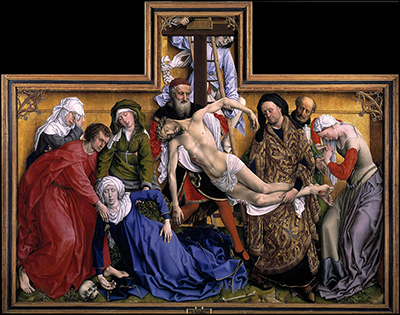
That setting matters. In Rogier's Descent from the Cross, grief becomes a compressed drama of bodies and hands. At Beaune, judgement becomes a public and institutional image. The work addresses individual souls, but it also belongs to a hospital built around Christian charity. The dying patient, the wealthy founder, the religious community and the painted saints all meet under one question: what becomes of the human soul?
At a Glance
- ArtistRogier van der Weyden
- TitleBeaune Altarpiece / Last Judgement Polyptych
- DateUsually placed in the 1440s or early 1450s
- MediumOil on panel, with later structural interventions
- Original settingHotel-Dieu, Beaune
- Patron contextNicolas Rolin and Guigone de Salins
- SubjectThe Last Judgement
- Current locationHospices de Beaune / Hotel-Dieu, Beaune
Contents
- Introduction
- At a Glance
- A Hospital Altarpiece
- Annotated Details
- Open And Closed
- Saint Michael And The Weighing Of Souls
- Heaven, Hell And The Human Body
- The Donors
- Painted Sculpture And Grisaille
- Beaune And The Burgundian World
- Why The Beaune Altarpiece Matters
- FAQs
- Discussion
A Hospital Altarpiece
The Hotel-Dieu at Beaune was founded in the fifteenth century by Nicolas Rolin, chancellor to Philip the Good, Duke of Burgundy, and his wife Guigone de Salins. The building was not a neutral container for the painting. It was a charitable institution, a public act of piety and status, and a place where the care of bodies and the care of souls were tightly connected. [1]
The polyptych originally belonged to the chapel area of the hospital. French descriptions of the site emphasize that the work was associated with the chapel of the "povres" sick, where the altarpiece could be connected with the spiritual life of the ward. [1] The setting gives the imagery its urgency. The Last Judgement is never abstract in a hospital. It speaks to a viewer who may be measuring time by suffering, confession, ritual and hope.
For readers coming from Rogier's biography, the work also shows how his art reached beyond Brussels and Leuven. The commission belongs to the Burgundian political world, yet its physical and devotional life remained in Beaune.
Annotated Details from the Beaune Altarpiece
These details trace Rogier's Last Judgement from Christ's verdict and Saint Michael's scales to the sharply divided destinations of the saved and damned.
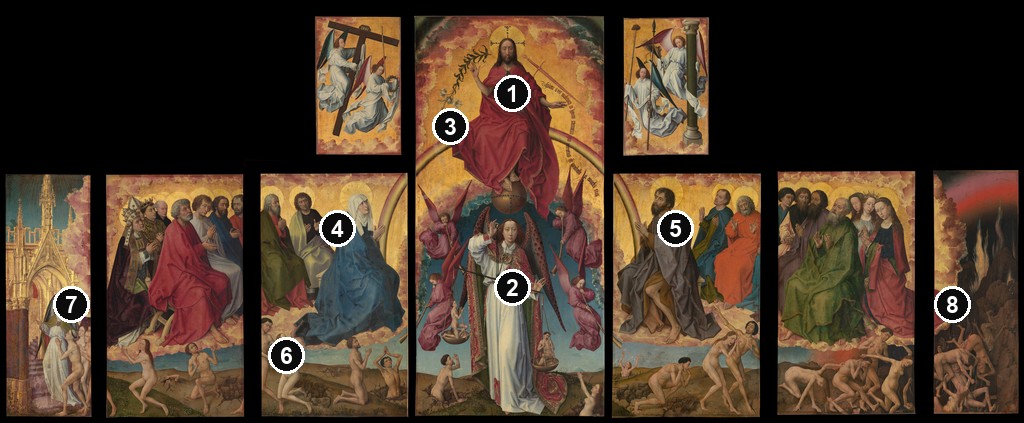
Details from BEAUNE ALTARPIECE
Close looking reveals a judgment organised through symmetry, colour, gesture and destination.
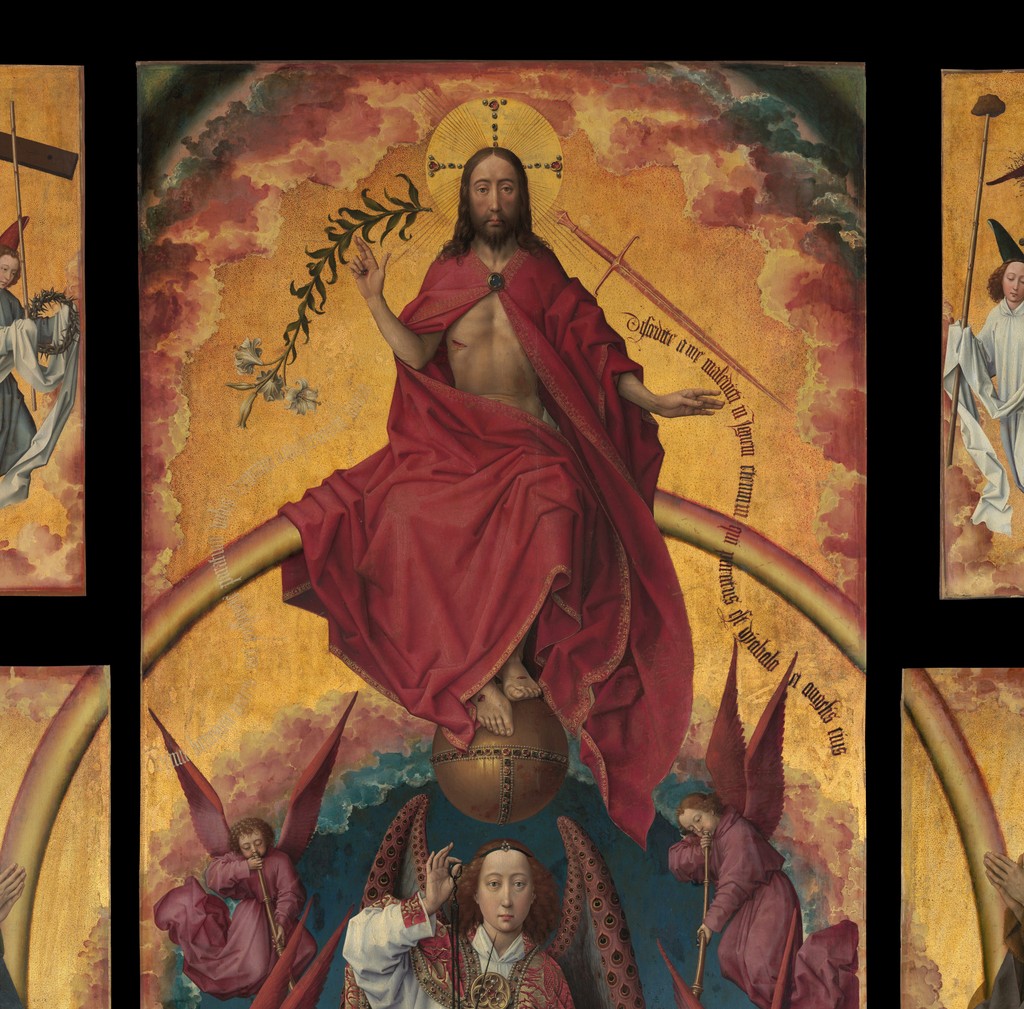
Christ the Judge
Christ sits on the rainbow above the world, raising one hand in blessing and lowering the other in judgment.
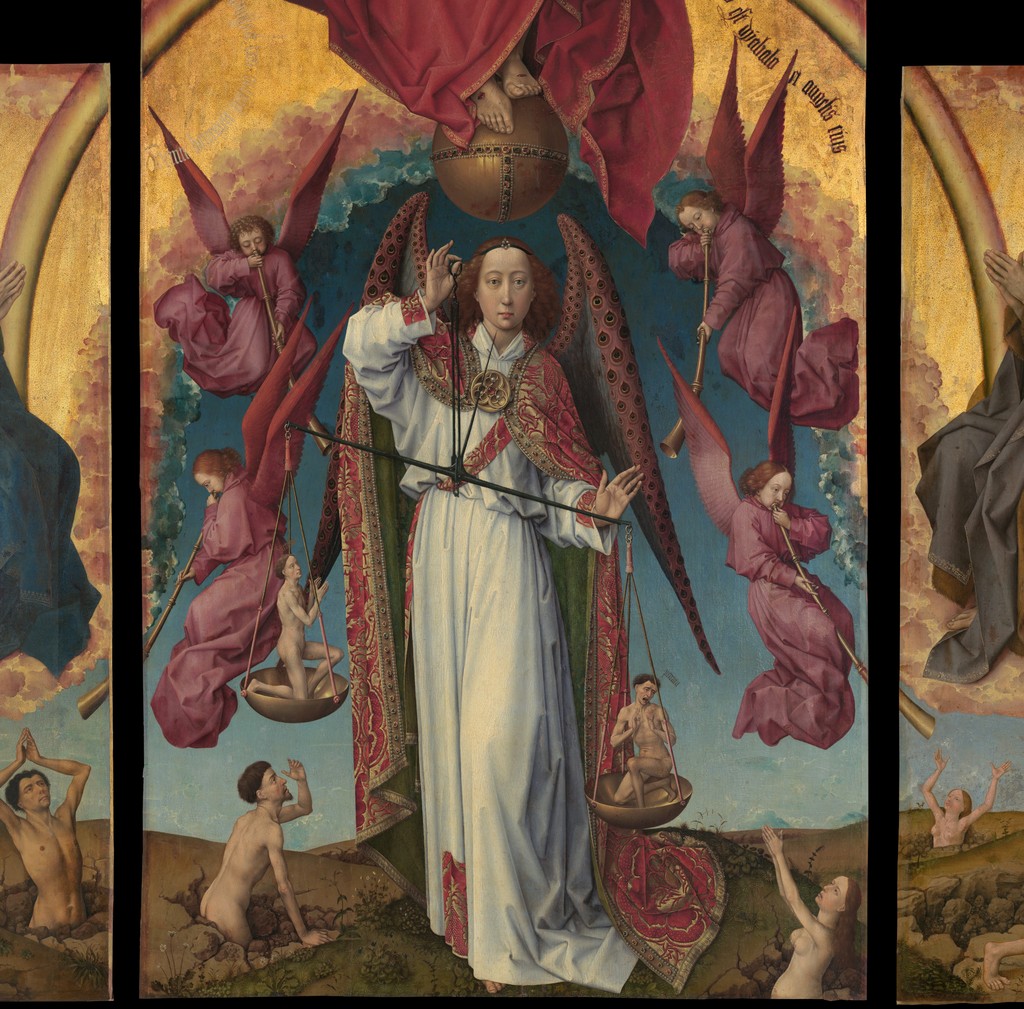
Saint Michael weighing souls
Michael's poised scales translate divine judgment into a precise visual balance.
Lily and sword of judgment
The lily and sword distinguish mercy from condemnation beside Christ's head.
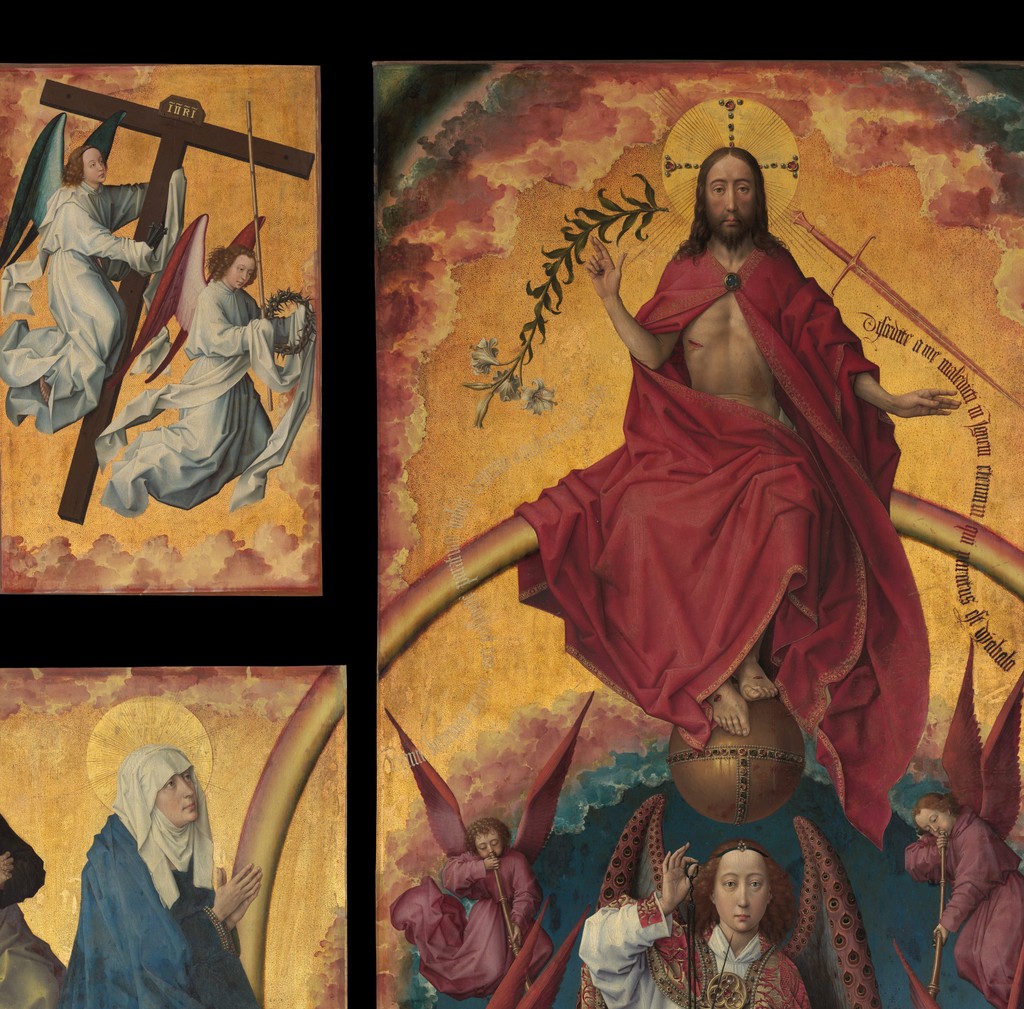
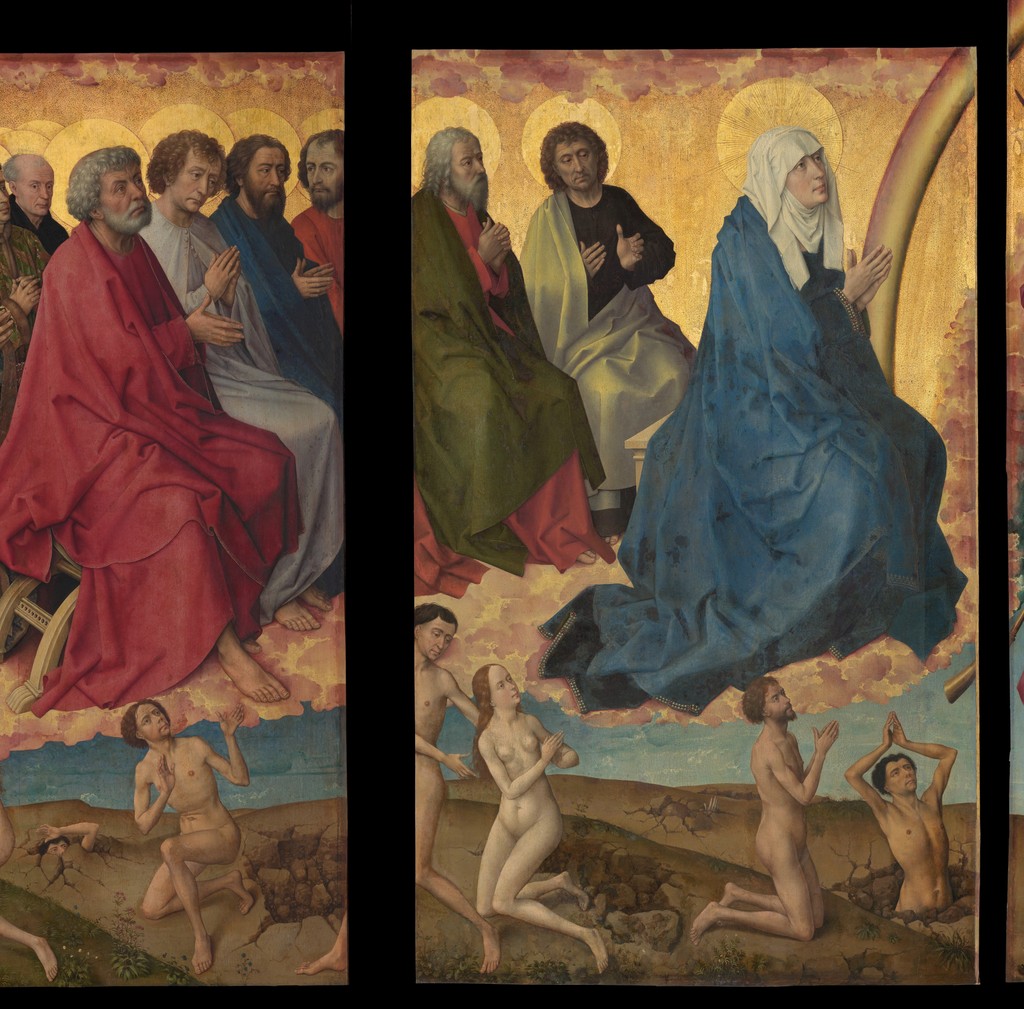
The Virgin and intercessors
The Virgin and assembled saints form a solemn court beside the central judgment.
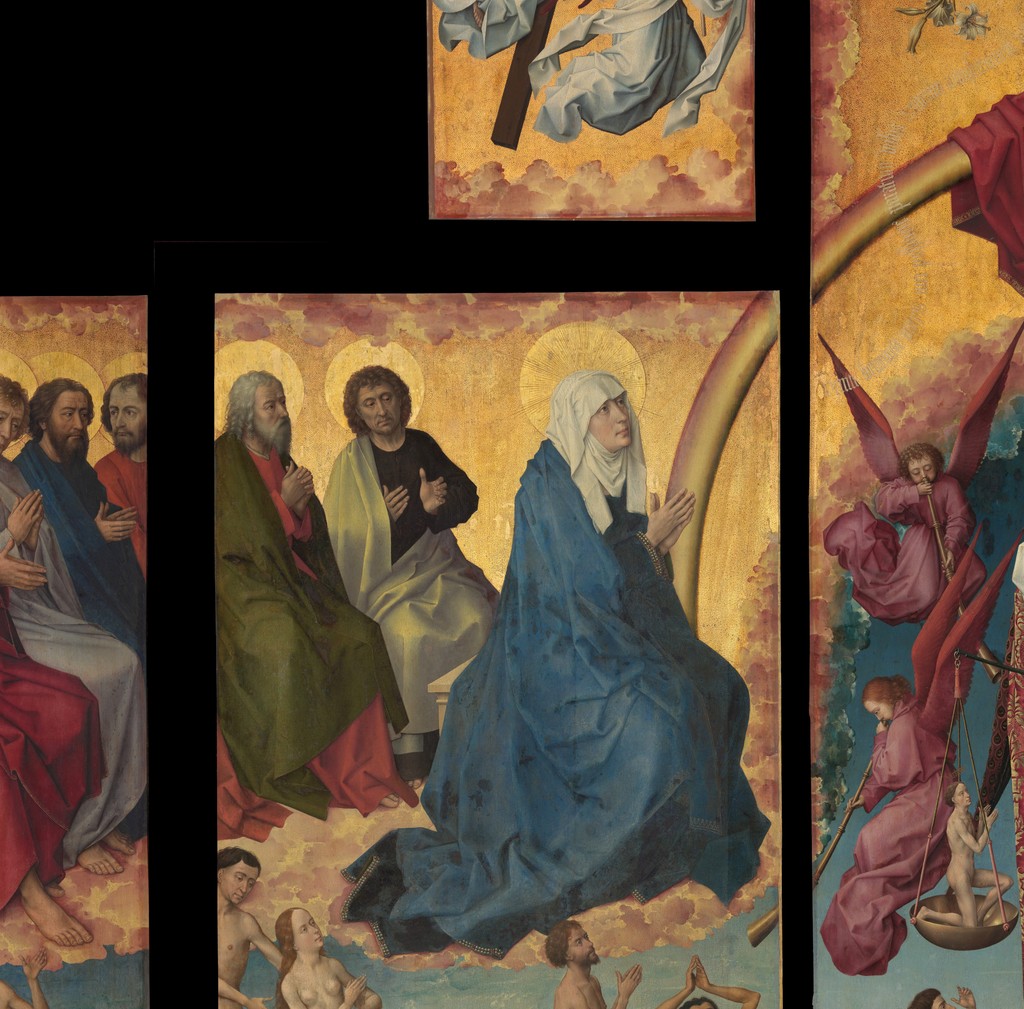
John and the blessed
John the Baptist and the blessed answer the Virgin's group across the polyptych.
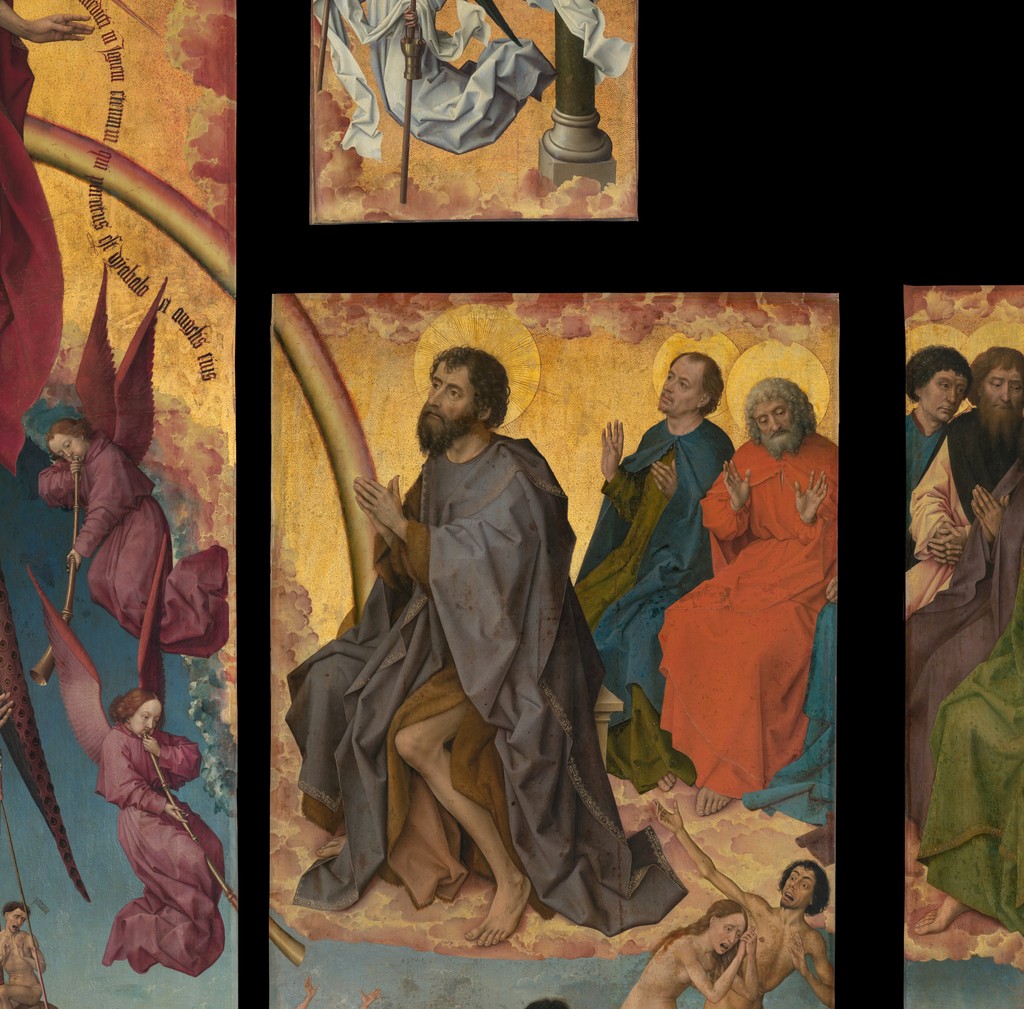
The resurrection of the dead
Small naked bodies rise from broken earth and turn toward their eternal destinations.
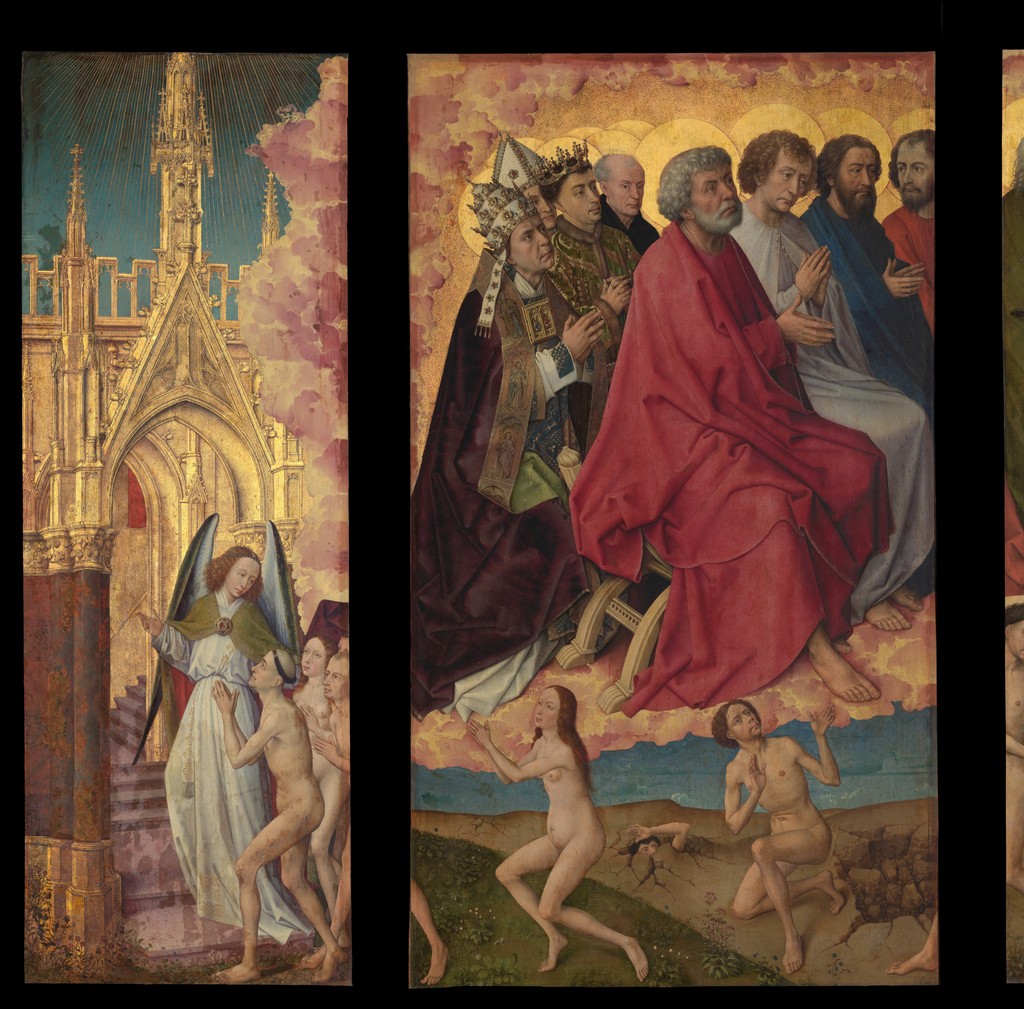
The saved entering paradise
An angel receives the saved at a luminous Gothic gateway.
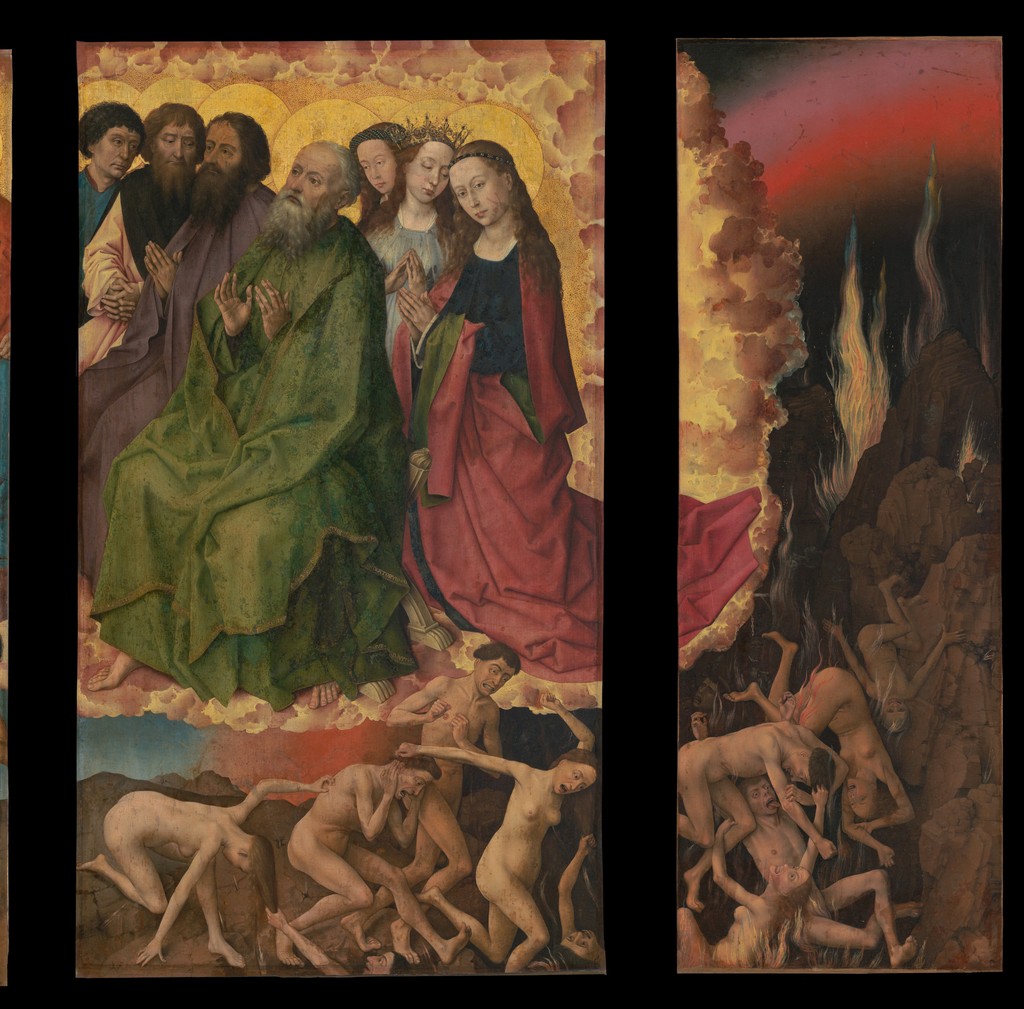
The damned driven into hell
At the far right, bodies tumble into darkness and flame without demonic escorts.
Open And Closed
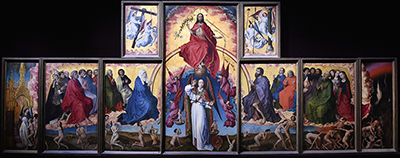
The Beaune polyptych has an open interior and a closed exterior. The open state presents the Last Judgement. Christ appears as judge, Saint Michael weighs souls, the blessed move toward salvation and the damned fall toward punishment. The exterior includes donors, saints and grisaille effects that imitate sculpture. [2]
This double structure is essential. Closed, the work belongs to remembrance, patronage and the everyday rhythm of the chapel. Open, it becomes cosmic. The hospital's founders appear within a devotional economy that also contains angels, saints, bodies rising from the dead and the final division of souls.
The two states also change the viewer's pace. The closed exterior asks for recognition: donor, saint, prayer, institutional memory. The opened interior asks for judgement: Christ, angel, scale, resurrection, heaven and hell. Rogier therefore builds time into the object. The painting can be quiet on ordinary days and overwhelming when opened for liturgical or devotional emphasis.
That alternation matters for a hospital setting. A patient did not meet the altarpiece only as a beautiful object. The work belonged to rhythms of worship, sickness, confession and care. Its opening and closing made judgement something that could be approached gradually, through ritual and memory, rather than consumed as a single spectacle.
Saint Michael And The Weighing Of Souls
At the centre of the work, Saint Michael weighs human souls. This is the visual hinge of the whole polyptych. Christ presides, but Michael enacts the sorting. In a hospital chapel, the balance is an image of judgement, but also an image of measurement, order and truth.
Rogier makes the theology physically legible. Souls are small, vulnerable and exposed. The blessed and the damned do not become anonymous masses. They remain bodies with postures, directions and feelings. The viewer can read judgement through movement: rising, turning, falling, kneeling, pleading and entering.
This physical clarity is one of Rogier's great gifts. Like the Descent from the Cross, the Beaune polyptych makes doctrine bodily. It does not merely tell the viewer that judgement will happen. It shows how bodies, expressions and gestures might register the instant when the hidden condition of the soul becomes visible.
Michael's calm is important. He stands inside a scene of extreme consequence without theatrical panic. That composure gives the image its authority. The weighing is not random violence or emotional persuasion; it is divine order made visible. Rogier often uses this kind of controlled intensity. In the Descent, grief is almost unbearable, but the composition is locked into place. At Beaune, salvation and damnation are equally dramatic, yet the centre remains measured.
The scale also creates a powerful contrast. The archangel is monumental, while the souls are fragile and exposed. This is not only a hierarchy of size. It is a hierarchy of spiritual condition. Human beings who may have appeared powerful in life become small before judgement. For a hospital founded by elite patrons, that reversal is not incidental.
Heaven, Hell And The Human Body
The Last Judgement depends on bodily resurrection. Rogier therefore makes bodies central to the image. The saved and the damned are not abstract souls floating through a diagram. They have weight, direction and vulnerability. The blessed move toward ordered welcome; the damned are pulled into confusion and fear.
This makes the altarpiece especially forceful in the Hotel-Dieu. Medieval hospital care was not separated from religious preparation. The sick body and the saved soul were part of one system of meaning. Rogier's painting faces that connection directly. It does not deny bodily suffering. It sets suffering inside a larger drama of mercy, judgement and hope.
The damned side also shows Rogier's skill at expressive compression. Terror does not need a sprawling landscape. It can be created through turning bodies, open mouths, unstable movement and the sense that figures have lost control of their own direction. The blessed side is calmer because its figures move toward order. The contrast is moral, spatial and emotional at once.
The Donors
Nicolas Rolin and Guigone de Salins were not minor patrons. Rolin was one of the most powerful officials in the Burgundian state, and Guigone remained closely associated with the life of the Hotel-Dieu. [1] Their presence in the exterior program gives the altarpiece both spiritual and social meaning.
The donors are not simply "portraits" in the modern sense. They are shown as founders who place themselves before sacred figures and before judgement. Their charity is visible, but so is their need for salvation. Rogier's art is subtle enough to hold both ideas at once. The commission asserts piety, wealth and institutional power, yet the Last Judgement refuses to let status be the final measure.
Rolin is tied to one of the great images of fifteenth-century patronage, Van Eyck's Virgin of Chancellor Rolin. Rogier's Beaune commission belongs to that same courtly and devotional culture, but it uses a very different emotional register.
Painted Sculpture And Grisaille
The closed exterior includes grisaille passages that imitate sculpture. This feature belongs to a larger Rogier vocabulary. His paintings often put bodies into shallow, stage-like spaces and make painted forms behave like sculpture. The Descent from the Cross looks like a polychrome relief activated by grief. The Beaune exterior makes the relationship between painting and sculpture explicit through its monochrome illusion. [2]
This gives the altarpiece an important place in the style-and-technique page. Rogier was not only a painter of emotion. He was a painter of thresholds: between image and object, chapel and ward, donor and saint, earthly charity and eternal judgement.
The grisaille exterior also changes how the donors are framed. They kneel in a world that feels closer to stone, memorial and monument. When the polyptych opens, colour, bodies and cosmic drama take over. Rogier uses that contrast to move from remembrance to revelation. The painting first behaves almost like an architectural furnishing, then becomes an image of the end of history.
Beaune And The Burgundian World
The Beaune commission belongs to the same Burgundian world that shaped much of Rogier's career. Nicolas Rolin served Philip the Good, and the hospital foundation connected courtly power with public charity. The work therefore helps explain why Rogier cannot be understood only through isolated masterpieces. His paintings moved through institutions, patrons, chapels, hospitals and political networks.
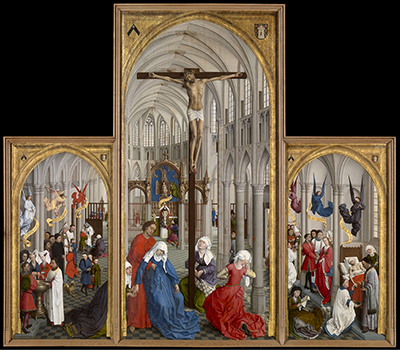
This is where Beaune strengthens the wider Rogier cluster. The Descent from the Cross shows a Leuven confraternity context. The Seven Sacraments Altarpiece connects sacramental theology with an Antwerp regional source and the Tournai/Burgundian church world. The Beaune polyptych adds hospital charity and Burgundian patronage in France. Together these works show how Rogier's emotional style served very different public and devotional settings.
The site setting also makes the work unusually teachable. Many altarpieces have lost their original liturgical environment. Beaune still lets readers connect painting, architecture, patronage and use. That does not remove every historical uncertainty, but it gives the work a rare power of place.
Why The Beaune Altarpiece Matters
It brings together the Burgundian world, a documented charitable setting, a major patron, a complex multi-panel object and one of the great late medieval subjects.
The Descent is intimate and concentrated. Beaune is institutional, theological and public. Together, they show the range of Rogier's religious art: grief at the foot of the Cross and judgement at the end of time.
It also shows Rogier thinking at the scale of an institution. The painting was not only an image for private feeling. It was bound to a hospital community, to donor memory and to the spiritual care of the sick. That combination makes the Beaune Altarpiece one of the best places to understand how Early Netherlandish painting could operate in the world: as devotion, instruction, status, consolation and warning.
FAQs
It is at the Hospices de Beaune / Hotel-Dieu in Beaune, France, the institution for which it was made. [1]
The work is connected with Nicolas Rolin and Guigone de Salins, founders of the Hotel-Dieu at Beaune. [1] [2]
The open interior shows the Last Judgement, with Christ as judge and Saint Michael weighing souls. [2]
The subject joined care of the body to care of the soul. For sick and dying viewers, the Last Judgement was not remote theology but an image of confession, hope and final accountability.
Discussion
What feels most powerful in the Beaune Altarpiece: judgement, hospital setting, donor memory, dazzling colour, or the movement between fear and hope?
Reader Insights
The hospital context changes the image. A Last Judgement in a place of illness and care would have spoken to viewers facing bodily vulnerability.
Saint Michael's weighing of souls gives the polyptych a centre of moral suspense, while Christ's authority orders the whole field.
Compare this page with the Seven Sacraments and Descent to see how Rogier builds large sacred systems around human response.
Join the Conversation
Have a thought or observation about Beaune Altarpiece / Last Judgement Polyptych? Share it below. Thoughtful responses may be added to this section as the Rogier van der Weyden cluster develops.
References
- Hotel-Dieu des Hospices de Beaune, museum page, accessed 2026-07-11. https://hoteldieu.hospices-de-beaune.com/le-musee
- Wikipedia (French), Le Jugement dernier / Beaune Altarpiece, accessed 2026-07-11. https://fr.wikipedia.org/wiki/Le_Jugement_dernier_(van_der_Weyden)
- The National Gallery, London, artist page for Rogier van der Weyden, accessed 2026-07-11. https://www.nationalgallery.org.uk/artists/rogier-van-der-weyden
- Lorne Campbell and Jan Van der Stock, eds., Rogier van der Weyden: 1400-1464. Master of Passions, Leuven, 2009.