 by Tom Gurney
Tom Gurney BSc (Hons) is an art history expert with over 20 years experience
Published on June 19, 2020 / Updated on July 30, 2026
Email: tomgurney1@gmail.com / Phone: +44 7429 011000
Rogier van der Weyden Drawings and Underdrawing: Introduction
Rogier van der Weyden is not known through a large surviving corpus of standalone drawings. That makes a simple "drawings" page risky unless it explains the evidence carefully. A better subject is Drawings and Underdrawing, because drawing matters in Rogier's art even when it survives indirectly: beneath paint, in reconstruction evidence, in copied designs and in a small number of attributed sheets. [1] [2]
This page should help readers understand process rather than promise a gallery of secure autograph drawings. In Rogier's case, drawing is often most important as planning, transfer and evidence.
At a Glance
- Main focusDrawing as design, underdrawing and reconstruction evidence
- Key examplesThe Magdalen Reading reconstruction evidence; Stockholm drawing; Louvre Head of the Virgin lead
- Related pagesThe Magdalen Reading, Style and Technique, Workshop and Influence
Contents
- Introduction
- At a Glance
- Why Drawing Matters
- The Magdalen Reading And Reconstruction
- The Louvre Head Of The Virgin
- Underdrawing Beneath Paint
- Workshop Reuse And Pattern Memory
- Drawing As A Way Of Seeing
- A Support Page With A Clear Purpose
- Why It Matters
- FAQs
- Discussion
Why Drawing Matters
Rogier's paintings look highly controlled. Their figures, gestures and draperies feel inevitable. That control did not happen by accident. It depended on design: the planning of bodies, spaces, outlines, folds and emotional correspondences before the final surface was complete.
Underdrawing helps reveal that process. Infrared and technical study can show where an artist or workshop laid out figures beneath the paint, adjusted contours or reused forms. Underdrawing is not a separate artwork. It is evidence of thinking.
Readers searching for drawings may expect a gallery of finished sheets. Rogier's case is more interesting and more difficult. The most important evidence may be hidden under paint, preserved in copies, or visible only through technical study and reconstruction.
That makes the page a bridge between the style-and-technique page and the workshop-and-influence page. Style explains what the finished paintings look like. Workshop and influence explain how forms travelled. Drawing and underdrawing sit between the two.
The Magdalen Reading And Reconstruction
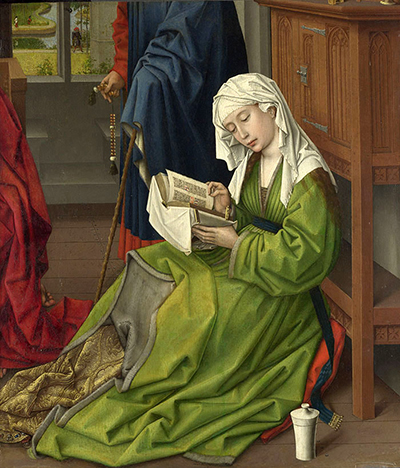
The Magdalen Reading is the best reader-friendly example. The National Gallery explains that the surviving panel is a fragment of a larger altarpiece, and that a Stockholm drawing helps reconstruct the original composition. [1] [2]
That drawing does not simply decorate the story. It changes how the painting is understood. Without it, readers might see Mary Magdalene as an isolated figure. With it, they can understand her as part of a larger sacred conversation with the Virgin, Child and saints.
The example teaches one of the most important lessons in old-master studies: evidence often survives indirectly. A lost altarpiece may be partly recovered through a fragment, a drawing, a copy, a technical study or a later record. Rogier's art is powerful partly because so much has been lost, and because the surviving evidence has to be read carefully.
The Magdalen Reading also shows why drawing is not separate from feeling. The reconstruction changes the emotional meaning of the fragment. Magdalene's absorbed reading becomes part of a larger devotional ensemble rather than a private moment detached from its setting.
The Louvre Head Of The Virgin
The Louvre-associated Head of the Virgin is useful because it introduces the problem of attributed drawings and silverpoint. [3]
Silverpoint is a demanding medium. It rewards precision and punishes hesitation. When used in the Rogier context, this example should be presented as carefully attributed material, not as casual proof of a large drawing corpus.
The value of such a sheet lies in what it suggests about preparation, figure types and close study. Even where attribution remains cautious, a drawing can help readers understand how fifteenth-century artists thought through heads, expressions and devotional types.
Underdrawing Beneath Paint
Technical study matters because it opens a hidden layer of the painting. Underdrawing can reveal changes of mind, workshop procedure, transfer methods and the planning behind a finished surface. [4]
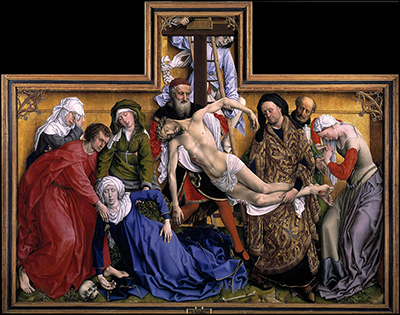
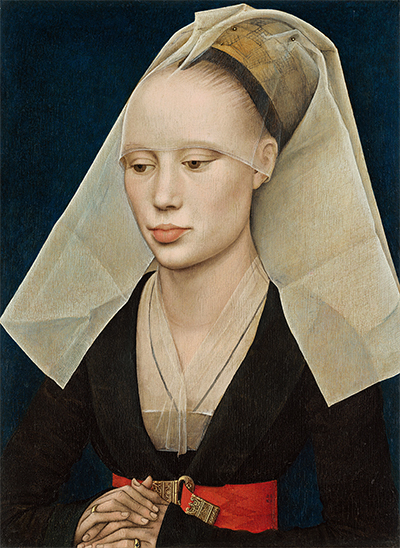
For Rogier, this is especially important because the finished paintings can look almost inevitable. The emotional force of the Descent from the Cross or the quiet concentration of Portrait of a Lady may seem effortless, but they depend on disciplined design.
Underdrawing reminds the reader that Rogier's emotion is constructed. Bodies collapse, hands fold and figures look inward because the composition has been planned to make them do so.
The point is not to drain the paintings of feeling by making them technical. It is the opposite. Technical evidence helps explain why the feeling is so powerful. Rogier's grief, tenderness and restraint are built through placement, line and revision.
This is why a drawings page belongs in the cluster even without many secure drawings on paper. It helps readers understand the hidden labour behind the visible surface.
Workshop Reuse And Pattern Memory
Drawing also matters because Rogier's workshop repeated, adapted and transformed figure types.
This does not mean every repeated figure came from a surviving drawing. It means Rogier's art operated through patterns, models, workshop memory and design transfer.
It gives readers a concrete mechanism for influence. Compositions travel because artists remember them, draw them, reverse them, copy them, adapt them and teach them. Drawing is one of the bridges between a single masterpiece and a wider visual tradition.
The page therefore links naturally to copies and reproductions after Rogier. A copy is one visible result of transmission; drawing is one of the processes that can make transmission possible.
Workshop repetition also helps explain why attribution can be difficult. If a figure type or composition was transmitted through drawings, patterns or memory, later works may preserve Rogier's invention without being painted entirely by Rogier himself. That is why this page should be read with the workshop-and-influence page.
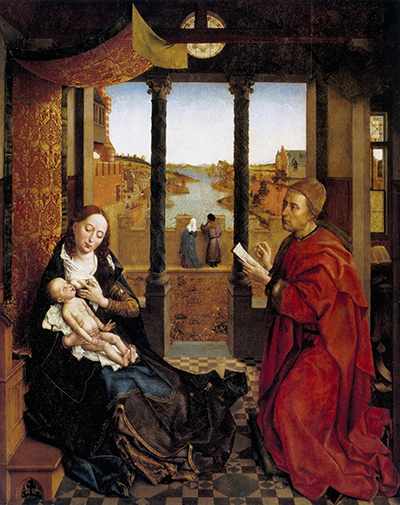
The same problem appears on pages such as Saint Luke Drawing the Virgin, Annunciation Triptych and Virgin and Child. The question is often not simply "Rogier or not Rogier?" but how design, workshop practice and later copying preserve an artistic idea.
Drawing As A Way Of Seeing
Drawing is also a way of looking. Rogier's paintings ask viewers to notice contour, gesture, posture and the relationships between bodies. These are drawing problems even when the drawing is hidden under paint.
Look at the Descent from the Cross: the parallel fall of Christ and the Virgin depends on design. Look at Portrait of a Lady: the veil, hands and triangular silhouette depend on line. Look at the Magdalen Reading: the fragment's quiet force depends on a carefully planned relation between body, book and lost surrounding figures.
The drawings page therefore helps readers look more actively at the whole cluster. It teaches them to see structure underneath emotion.
A Support Page With A Clear Purpose
This page is deliberately different from an artwork page. It should not pretend that Rogier left dozens of secure sheets for readers to browse. Its purpose is to explain how design evidence works.
That makes it useful for students and general readers. Once they understand underdrawing, reconstruction and workshop transfer, they can return to the major paintings with sharper eyes. They can see that Rogier's famous emotional clarity is also a design achievement.
The page also prevents a common misunderstanding. A thin list of alleged drawings would make Rogier look weaker than he is. A careful drawings-and-underdrawing page shows the real evidence and explains why it matters.
It also gives the cluster a place to explain why technical scholarship matters. Museum entries, infrared studies and reconstruction proposals are not specialist distractions; they are often the only way to understand how Rogier planned paintings that now appear complete and effortless.
Why It Matters
The page matters because it gives readers a more honest account of Rogier's working method. He did not leave a large secure drawing archive, but drawing remains central to understanding his paintings.
It explains underdrawing and infrared evidence, fragment reconstruction, composition planning, workshop reuse, and why attribution caution is part of serious art history. It also keeps the cluster from treating finished paintings as isolated miracles. Rogier's art was made through design, study, revision and transmission.
FAQs
No large secure corpus of standalone drawings survives.
Underdrawing is preparatory drawing beneath the paint surface. It can sometimes be studied with infrared imaging.
Because drawing also survives as underdrawing, design transfer, reconstruction evidence and workshop pattern memory.
Discussion
What can drawings and underdrawing reveal about Rogier: workshop process, design transfer, attribution problems, or the planning behind emotional clarity?
Reader Insights
Underdrawing makes Rogier's paintings feel less mysterious in a useful way: the emotional surface is built on careful planning.
Drawings and technical evidence often matter because they show where certainty ends and workshop judgement begins.
This support page helps readers understand why the cluster treats technique as evidence, not decorative background.
Join the Conversation
Have a thought or observation about Rogier van der Weyden Drawings and Underdrawing? Share it below. Thoughtful responses may be added to this section as the Rogier van der Weyden cluster develops.
References
- The National Gallery, London, The Magdalen Reading, collection record for NG654, accessed 2026-07-11. https://www.nationalgallery.org.uk/paintings/rogier-van-der-weyden-the-magdalen-reading
- Wikipedia, The Magdalen Reading and Stockholm reconstruction drawing, accessed 2026-07-11. https://en.wikipedia.org/wiki/The_Magdalen_Reading
- Wikipedia, Louvre-associated Head of the Virgin / silverpoint drawing in relation to Rogier's Madonna imagery, accessed 2026-07-11. https://en.wikipedia.org/wiki/Saint_Luke_Drawing_the_Virgin
- Lorne Campbell, "The Materials and Technique of Five Paintings by Rogier van der Weyden and his Workshop," National Gallery Technical Bulletin, 1997.