 by Tom Gurney
Tom Gurney BSc (Hons) is an art history expert with over 20 years experience
Published on June 19, 2020 / Updated on July 30, 2026
Email: tomgurney1@gmail.com / Phone: +44 7429 011000
The Magdalen Reading by Rogier van der Weyden: Introduction
Rogier van der Weyden's The Magdalen Reading is one of the most beautiful fragments in Early Netherlandish painting. It now appears as a quiet image of Saint Mary Magdalene absorbed in a book, seated on the floor in a green dress beside her pot of ointment. But the painting was once only the lower right corner of a much larger altarpiece of the Virgin and Child with saints, probably made for a church in Brussels. The fragment therefore asks the viewer to do two things at once: look closely at a complete devotional moment, and imagine the lost whole around it. [1]
The National Gallery, London dates the work to about 1435 and identifies it as oil originally on wood, later transferred to mahogany. It measures 62.2 x 54.4 cm, was bought in 1860 and has the inventory number NG654. [1] The painting is one of the strongest surviving clues to Rogier's early Brussels period, when he had recently become painter to the city and was developing the emotional geometry that would define his mature religious art.
The fragment deserves flagship support treatment rather than a minor artwork note. It connects Rogier's religious storytelling, his treatment of reading and contemplation, his workshop procedures, his reuse of figure studies, and the problem of lost and dismembered altarpieces.
At a Glance
- ArtistRogier van der Weyden
- TitleThe Magdalen Reading
- DateAbout 1435
- Medium and supportOil, originally on wood, transferred to mahogany
- Dimensions62.2 x 54.4 cm
- Current locationNational Gallery, London
- Inventory numberNG654
- AcquisitionBought, 1860
- Original contextFragment from a larger Virgin and Child with saints altarpiece, probably painted for a church in Brussels
- Key themesMary Magdalene, reading, contemplation, fragment, reconstruction, underdrawing, workshop reuse
Contents
- Introduction
- At a Glance
- What the Painting Shows
- A Fragment of a Lost Altarpiece
- Reading and Contemplation
- Space, Detail and the Window View
- Costume and the Biblical Past
- Technical Sophistication
- Workshop Practice and Reused Figures
- Provenance
- Rogier's Early Brussels Moment
- How to Look at the Painting
What the Painting Shows
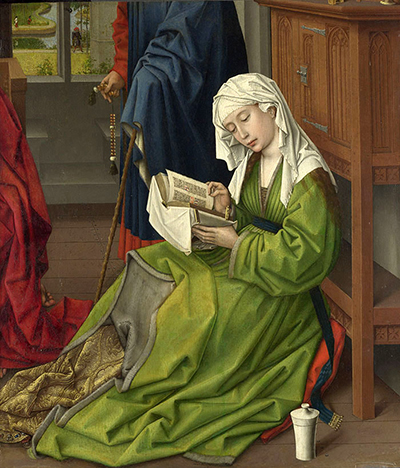
Mary Magdalene sits on the floor in a rich green dress, turned inward toward the book in her hands. Her body forms a rounded shape: head, shoulders, knees and legs curve around the act of reading. The National Gallery describes this geometric harmony as part of the way Rogier expresses feeling. [1]
The setting is a late medieval interior rather than a biblical landscape. Magdalene leans near a carved wooden cabinet and sits on a red cushion. Her dress is lined with grey fur, tightened at the waist and arranged in heavy folds around her legs. A cloth-of-gold underdress appears where the outer garment turns back. [1]
The ointment pot beside her identifies her as Mary Magdalene. In medieval tradition, the saint became associated with several Gospel stories: the woman who anointed Christ's feet, Mary of Bethany seated at Christ's feet and listening to him, and the penitent Magdalene. Rogier's image stresses the contemplative side of that tradition. She is not shown in outward drama, but in attention. [1]
The book is more than a prop. The National Gallery identifies it as probably a Bible, written in two columns with red and blue initials. It has gilded fore-edges, clasps and a white protective chemise cover. Rogier lavishes attention on the object: bindings, bookmarks and small details that reward close looking. [1]
A Fragment of a Lost Altarpiece
The most important fact about The Magdalen Reading is that it is a fragment. The cropped figures around Mary reveal this immediately. Behind her, part of a man leaning on a stick survives. At the left, another figure kneels, with only the toes and red robe visible. These are not mistakes or unfinished inventions. They are remains of a larger composition that has been cut down. [1]
The lost altarpiece probably showed the Virgin and Child with saints. The National Gallery says it was painted for a church in Brussels and may have been one of Rogier's first commissions after he settled there in 1435. A fifteenth-century sketch in the Nationalmuseum, Stockholm helps reconstruct the original arrangement. [1]
In that reconstruction, Mary Magdalene sat at the lower right. Saint Joseph, partly visible behind her in the London fragment, leaned on his stick. A youthful Saint John the Evangelist knelt to the left of the Virgin and Child, which explains the toes and red robe now visible at the fragment's left edge. Other saints, including perhaps Saint Catherine and a bishop, belonged to the larger ensemble. [1]
The heads of Saint Joseph and another female saint, perhaps Saint Catherine, survive in the Fundacao Calouste Gulbenkian in Lisbon. [1] This makes The Magdalen Reading an especially useful page for explaining how modern viewers often encounter Rogier through remnants: fragments, copies, reconstructions, workshop versions and separated panels. The work is not only a painting of reading. It is also evidence of loss.
Reading and Contemplation
Mary Magdalene's reading is the emotional centre of the fragment. She is physically present in a room, but mentally absorbed elsewhere. Rogier makes that absorption visible through the curve of her body, the downward angle of her head and the care with which her hands hold the book.
The saint's traditional identity matters here. Medieval devotion often understood Mary Magdalene as a model of repentance, love and contemplation. In this fragment, Rogier avoids sensational penitence. There is no wilderness, no skull, no dramatic tears. Instead, he shows her as a reader. Her holiness is expressed through attention.
The book also connects the viewer to the act of looking. Magdalene reads the sacred text; the viewer reads the painting. Rogier's tiny details invite a slow kind of vision, almost like turning pages. The gilded edges, coloured initials, clasps and protective cover make the book itself a sacred object within the painted world.
This is one reason the fragment still feels complete despite being cut from a larger altarpiece. The surrounding composition is lost, but Magdalene's attention is intact. Her inwardness holds the surviving corner together.
Space, Detail and the Window View
The room behind Magdalene opens to a landscape through a window. The National Gallery notes a river, people walking on the banks, an archer with a crossbow and figures whose reflection appears in the water. [1] These details show the Netherlandish pleasure in miniature observation, but they also expand the world beyond the interior.
Rogier balances near and far with great precision. The book, cushion, cabinet and ointment pot make the foreground tactile. The window landscape offers depth and worldly activity. Magdalene sits between them, physically in the room but mentally within the text.
The contrast is subtle. Outside, people move through ordinary space. Inside, Magdalene is still. The landscape does not distract from her because Rogier uses it as a counterpoint. It makes the saint's concentration more visible.
Small details also help date the painting to a culture of luxury and devotional ownership. The book is not a plain object. The dress is not a simple robe. The interior is furnished and carefully observed. Rogier's sacred scene is translated into the material language of the fifteenth-century Low Countries.
Costume and the Biblical Past
Magdalene wears fifteenth-century clothing, but the National Gallery notes that her veil is not the fashionable headdress worn by contemporary women in works such as Robert Campin's A Woman. It is more suitable to a biblical figure. [1]
This distinction matters. Rogier does not simply dress a saint as a court lady. He gives her a mixture of contemporary richness and sacred distance. The green dress and fur lining belong to the visual world of his own time, while the white veil signals that she is not an ordinary woman in a fashionable portrait.
The result is neither pure history nor pure modernisation. Like many Netherlandish devotional images, the painting brings sacred figures into a world the original viewers could recognise. The familiar room and clothing make Magdalene accessible; the veil, attribute and absorbed reading keep her distinct.
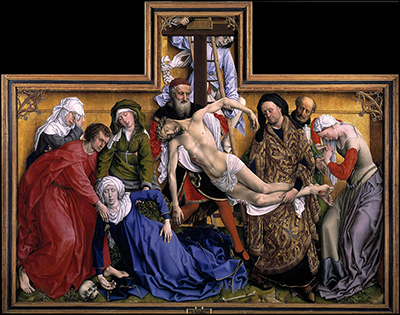
This approach links the fragment to Rogier's broader religious art. In the Descent from the Cross, sacred history is pressed into a shallow shrine-like space. In The Magdalen Reading, a saint is placed in a richly observed domestic interior. In both cases, Rogier makes devotion feel close without making it ordinary.
Technical Sophistication
The painting was originally on wood and later transferred to mahogany. The gallery also records that the background around Mary Magdalene was painted over in brown in the early nineteenth century, then removed when the picture was cleaned in 1955. [1]
Technical analysis shows no major changes between underdrawing and final paint. This suggests that the composition had been carefully worked out before painting began. The underdrawing is described as assured, bold, quick and skilful, with Mary drawn freehand with great clarity. [1]
Those details matter because they show Rogier's control. The fragment may look intimate and spontaneous, but its structure was planned. The rounded figure, the relationship between book and body, and the placement of surrounding remnants all belong to a larger design.
The paint handling is equally sophisticated. The National Gallery describes the lips as built from mixtures of vermilion, white and red lake worked wet-in-wet, while the fur edging of the dress was made by dragging wet grey tones to create texture. [1] Such details are valuable because they show how minute technique supports emotional presence.
Workshop Practice and Reused Figures
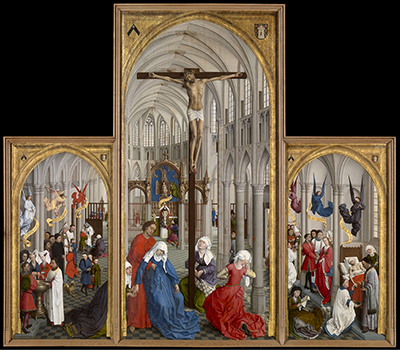
The Magdalen fragment also opens the question of Rogier's workshop. The National Gallery notes that Rogier and his assistants reused several figures from the larger composition in other paintings. Mary herself appears reversed in the Seven Sacraments Altarpiece in Antwerp. [1]
Rogier's art was not only a sequence of isolated masterpieces. It involved drawings, figure studies, workshop memory, variants and repetitions. Reuse did not mean a lack of invention. It could mean that powerful figure types were preserved, adapted and redeployed.
The Magdalen's pose is a good example. Her curved body is expressive in this fragment because it belongs to reading and contemplation. When related figure types appear elsewhere, their meaning changes with the subject, setting and scale. Rogier's workshop practice was flexible, not merely repetitive.
This makes the fragment a natural companion to the related Workshop and Influence page. It also connects to Seven Sacraments Altarpiece, because the Antwerp altarpiece is the best internal connection for the reversed Magdalen type.
Provenance
The National Gallery first traces the painting securely to an 1811 sale in Haarlem, where it appeared as lot 15 in the sale of Abraham Vermande and another collector. It was catalogued as A Woman Reading and attributed to Lucas van Leyden. It was bought in, later sold privately to the Haarlem collector Maria Hoofman, then acquired after her death by the Nieuwenhuys brothers. Edmond Beaucousin bought it at an unknown date, probably from Nieuwenhuys, and the National Gallery purchased it with the rest of the Beaucousin collection in 1860. [1]
This provenance is useful because it shows how the fragment's identity changed over time. In the early nineteenth century, it was not yet understood as the surviving corner of a Rogier altarpiece. It was catalogued as a reading woman by another artist. Modern research, reconstruction and technical study have transformed how the work is understood.
The name A Woman Reading is revealing. Detached from its lost altarpiece, the fragment could be read as a genre-like image of a woman with a book. Its sacred identity depends on iconographic details, especially the ointment pot, and on reconstructing the larger context. The painting's history is therefore a history of seeing more: from a beautiful fragment to a piece of a major devotional ensemble.
Rogier's Early Brussels Moment
The National Gallery suggests that the lost altarpiece may have been among Rogier's first commissions after he settled in Brussels in 1435. [1] This makes the fragment important for the biography page. It belongs near the moment when Rogier moved from Tournai, where he had trained with Robert Campin, into the civic and ecclesiastical world of Brussels.
The painting also helps explain why Rogier became so influential. The National Gallery's artist page describes him as internationally famed for naturalistic detail and expressive pathos, and notes that he created types for portraits and religious subjects that were repeated across the Netherlands, the Iberian peninsula and Italy. [2] The Magdalen Reading shows both qualities in small scale: naturalistic detail and a figure type strong enough to be reused.
The fragment also connects to the Descent from the Cross. The National Gallery states that the Prado Descent helps us imagine the impact of the complete altarpiece from which The Magdalen Reading came. [2] The comparison is useful because it reminds readers that the London panel is only a surviving corner of something much more ambitious.
How to Look at the Painting
Start with Magdalene's body. Follow the curve from her head down around the knees and back toward the book. The pose turns reading into a physical shape.
Then look at the book itself. Notice the columns of text, coloured initials, gilded edges, clasps and white protective cover. Rogier makes the book a devotional object, not a generic accessory.
Next, find the ointment pot beside her. This is the key iconographic detail that identifies the figure as Mary Magdalene and connects her to the Gospel traditions of anointing, repentance and love.
Then look at the edges. The cropped man with a stick and the kneeling figure's toes are reminders that this is a fragment. They are visual clues to the lost altarpiece.
Finally, look through the window. The little figures and river landscape create a world beyond the room, while Magdalene remains absorbed in her sacred reading.
Why It Matters
The Magdalen Reading matters because it turns a fragment into a major key to Rogier van der Weyden's art. It is beautiful as an image of contemplative reading, but it is also evidence: evidence for a lost Brussels altarpiece, for Rogier's early career, for his technical planning, for workshop reuse and for the vulnerability of Netherlandish panel paintings over time.
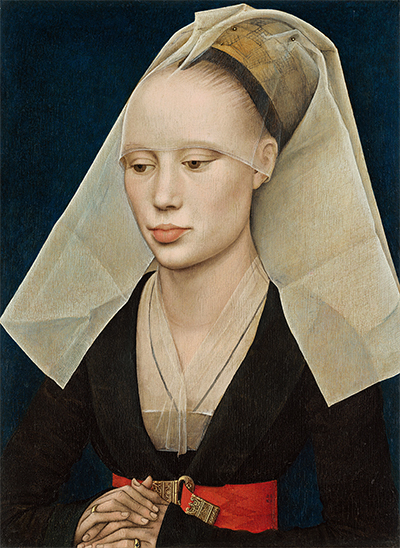
The Descent from the Cross is public, crowded and grief-stricken. Portrait of a Lady is secular, reserved and psychological. The Magdalen Reading is devotional, intimate and absorbed.
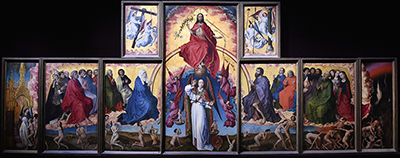
It naturally points readers to Style and Technique, Workshop and Influence, Seven Sacraments Altarpiece, Biography and Paintings.
Frequently Asked Questions
It is in the National Gallery, London, where it has the inventory number NG654. [1]
The National Gallery dates the painting to about 1435. [1]
It shows Saint Mary Magdalene seated on the floor, absorbed in reading, with her ointment pot beside her. [1]
No. It was originally the lower right corner of a larger altarpiece of the Virgin and Child with saints, probably made for a church in Brussels. [1]
The cropped figures around Magdalene, a fifteenth-century sketch in Stockholm and related surviving fragments in Lisbon help reconstruct the larger composition. [1]
The painting was originally on wood and was later transferred to mahogany, according to the National Gallery's object record. [1]
The reading emphasises her role as a figure of contemplation. Medieval tradition connected Mary Magdalene with penitence, love and attention to Christ's word. [1]
It preserves a powerful part of a lost Rogier altarpiece and gives unusually rich evidence for his early Brussels work, technical planning and workshop reuse.
Discussion
What makes the Magdalen Reading so compelling: its fragmentary survival, absorbed reading, reconstructed altarpiece, technique, or quiet devotional psychology?
Reader Insights
The painting's power partly comes from incompleteness. It asks us to imagine the lost whole without reducing the surviving fragment to evidence only.
Rogier turns reading into devotion. The saint's curved posture and absorbed face make concentration the subject of the image.
The page is one of the best technical routes in the cluster because underdrawing, surface detail and workshop reuse are all visible issues.
Join the Conversation
Have a thought or observation about The Magdalen Reading by Rogier van der Weyden? Share it below. Thoughtful responses may be added to this section as the Rogier van der Weyden cluster develops.
References
- The National Gallery, London, The Magdalen Reading, collection record for NG654, accessed 2026-07-11. https://www.nationalgallery.org.uk/paintings/rogier-van-der-weyden-the-magdalen-reading
- The National Gallery, London, artist page for Rogier van der Weyden, accessed 2026-07-11. https://www.nationalgallery.org.uk/artists/rogier-van-der-weyden
- Lorne Campbell, National Gallery Catalogues: The Fifteenth Century Netherlandish Paintings, London, 1998, cited by the National Gallery record as the source for provenance and fuller catalogue information.
- J. L. Ward, "A Proposed Reconstruction of an Altarpiece by Rogier van der Weyden," Art Bulletin, 53, no. 1, 1971, pp. 27-35, listed in the National Gallery bibliography for this object.
- Lorne Campbell, "Rogier van der Weyden and His Workshop," Proceedings of the British Academy, 84, 1994, pp. 16-20, listed in the National Gallery bibliography for this object.
- Dirk de Vos, Rogier van der Weyden: The Complete Works, Antwerp, 1999 / Harry N. Abrams, 2000, listed in the National Gallery bibliography.
- Stephan Kemperdick and Jochen Sander, The Master of Flemalle and Rogier van der Weyden, exhibition catalogue, Ostfildern-Ruit, 2008, listed in the National Gallery bibliography for this object.