 by Tom Gurney
Tom Gurney BSc (Hons) is an art history expert with over 20 years experience
Published on June 19, 2020 / Updated on July 30, 2026
Email: tomgurney1@gmail.com / Phone: +44 7429 011000
Crucifixion Triptych: Introduction
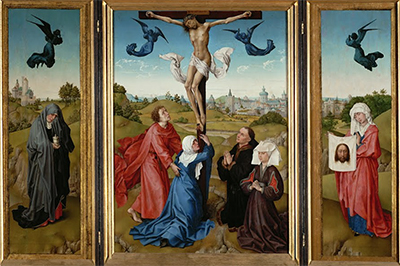
The Crucifixion Triptych in Vienna shows another solution to Rogier van der Weyden's lifelong problem: how can an image make Christ's Passion present to the viewer without losing structure? It presents Christ on the Cross in the central panel, with donors close to the sacred event and two powerful female witnesses on the wings: Mary Magdalene and Saint Veronica. [1]
The work is held by the Kunsthistorisches Museum in Vienna. It is usually dated to the 1440s, often around 1443-1445 or 1440-1445, depending on how scholars weigh dendrochronology, style and chronology. [1]
The triptych deserves a stronger place in the cluster because it sits between several major Rogier themes: Passion devotion, donor presence, female witnesses, sacred image-making and the relationship between centre and wings.
At a Glance
- ArtistRogier van der Weyden
- TitleCrucifixion Triptych
- DateUsually placed in the 1440s
- MediumOil on oak panel
- Current locationKunsthistorisches Museum, Vienna
- Common inventory leadInv. 901 in catalogue/source references
- SubjectCrucifixion with donors, Mary Magdalene and Saint Veronica
Contents
- Introduction
- At a Glance
- The Central Crucifixion
- Donors And Devotion
- Mary Magdalene And Saint Veronica
- Triptych Logic
- Sacred Images Inside The Image
- Date And Dendrochronology
- Why It Matters
- FAQs
- Discussion
- References
The Central Crucifixion
The centre panel shows the dead Christ on the Cross in a landscape. Mary collapses or clings near the foot of the Cross, supported by Saint John, while donors kneel in prayer near the right side of the scene. [1]
This donor presence is important. Rogier does not treat the Crucifixion as a remote historical event. He makes it present to the patrons, and by extension to the viewer. The image becomes a devotional encounter in which sacred history and contemporary prayer occupy the same pictorial world.
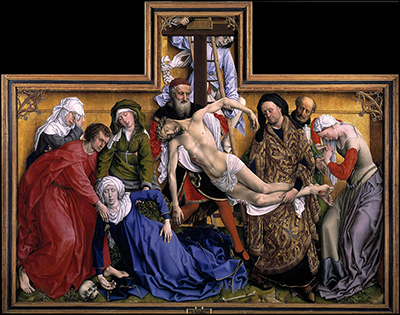
Compared with the Descent from the Cross, the Vienna triptych breathes more. The Prado painting compresses its figures into a shallow box. The Vienna work opens into landscape and wing panels, but the emotional logic remains recognizably Rogier's: grief is structured by posture, gesture and line.
The landscape also changes the feeling of the Passion. Instead of the gilded, box-like concentration of the Descent, the Crucifixion stands in a world with distance and horizon. That makes the sacred event feel both historically placed and devotionally present. Rogier can compress emotion without always compressing space.
Donors And Devotion
The donors kneel close to Christ's sacrifice, not separated in a distant frame. This arrangement is typical of fifteenth-century devotional thinking, but Rogier gives it unusual emotional force. The sacred event does not merely illustrate doctrine; it becomes something before which real people kneel.
Their presence also gives the viewer a position inside the work. The donors model prayer. They show the kind of attention the image asks from its audience. In this sense, the triptych does not only depict devotion; it teaches devotion.
This is one reason to compare the Vienna triptych with the Seven Sacraments Altarpiece. Both works bring sacred action and contemporary devotion together, though they do so differently. The Seven Sacraments page organises ritual life through church space. The Vienna triptych organises Passion response through a triptych structure and donor presence.
Mary Magdalene And Saint Veronica
The wings give the triptych much of its meaning. Mary Magdalene appears on one side with her attribute, the ointment jar. Saint Veronica appears on the other with the veil bearing Christ's face. [1]
These figures are not decorative additions. Magdalene represents compassion, penitence and bodily devotion. Veronica represents witness, image and adoration. Together, they frame the Crucifixion through two ways of responding to Christ: loving grief and reverent looking.
Magdalene links to The Magdalen Reading and the Braque Triptych. Veronica links to the wider problem of sacred images, where Rogier repeatedly asks how painted forms can carry presence, memory and devotion.
The Veronica wing is especially useful for explaining image theology. Her veil is an image within an image, a sacred likeness held before the viewer. Rogier, a painter of devotional presence, places that problem inside the triptych itself: how can a visible image carry the trace of Christ?
Triptych Logic
The work's format matters. A triptych is not simply three pictures placed together. The centre and wings create a rhythm of looking. Here the central Crucifixion is framed by saints whose attributes and emotional roles clarify how the viewer should respond.
Magdalene offers penitential love. Veronica offers the sacred image. Donors offer prayer. The triptych therefore becomes a structured field of response around Christ's death.
This is one of Rogier's strengths as an altarpiece painter. He does not merely fill panels. He assigns functions to them. Each part of the object changes how the whole is read.
Sacred Images Inside The Image
Saint Veronica's veil gives the triptych a special place in Rogier's cluster. The veil is a representation of Christ's face held within a painting of the Passion. That makes the wing a meditation on images themselves.
This theme matters for a painter working in a devotional culture where images were expected to help memory, prayer and compassion. Rogier's own painting asks the viewer to look at Christ; Veronica's veil shows a saint holding a trace of Christ's face for veneration. The triptych therefore stages a relationship between seeing, remembering and believing.
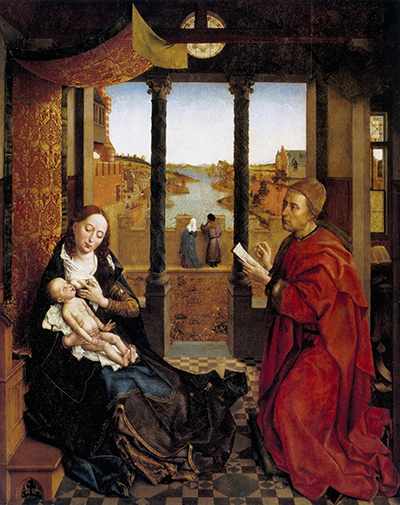
The idea connects strongly to Saint Luke Drawing the Virgin. There, an artist-saint turns sacred vision into an image. Here, Veronica presents a miraculous likeness. Together, the pages help readers understand why Rogier was not only a painter of feeling, but also a painter deeply interested in how sacred images work.
Mary Magdalene adds another side of the same problem. Her response is not about image-making but embodied feeling: penitence, grief and love. Between Magdalene and Veronica, Rogier frames the viewer's response as both emotional and visual.
The wing figures also deepen the gendered devotional language of the painting. Magdalene and Veronica are not passive bystanders. They become privileged witnesses whose attributes define two kinds of closeness to Christ: touch and image, grief and likeness. Rogier gives them the power to shape how the Crucifixion is read.
That makes the triptych valuable for readers who have already seen The Magdalen Reading. Rogier's Magdalene is not a single repeated type. She can appear as a reader, a mourner, a penitent and a witness. Across these works, the saint helps Rogier explore devotion as attention, feeling and memory.
Date And Dendrochronology
The dating of the triptych depends on technical evidence, provenance and stylistic comparison. Dendrochronology provides an early boundary for the wood, while art-historical comparison has led scholars to place the work broadly in the 1440s. [1]
A broad 1440s date is therefore more responsible than false precision. It allows the page to explain how old-master dates are constructed from different kinds of evidence.
The important point is that museum date ranges are meaningful. Wood, style, provenance and comparison all shape how old-master dates are understood.
The date also affects how the painting sits in Rogier's development. If placed in the 1440s, the triptych belongs near the period in which Rogier was consolidating the emotional and structural language that would make his Passion images so influential. It is not a late summary like the Philadelphia panels. It is a work in which triptych form, landscape, donor prayer and sacred signs are being actively organised into a coherent devotional system.
Why It Matters
The Vienna Crucifixion Triptych matters because it clarifies Rogier's range within Passion imagery. It is not the same kind of image as the Descent, the Seven Sacraments Altarpiece or the Philadelphia Crucifixion Diptych. It uses the triptych form to place donors, witnesses and sacred signs around the Cross.
It is also a strong bridge page. It sends readers toward The Magdalen Reading, the Crucifixion Diptych, the Seven Sacraments Altarpiece and the style-and-technique page. Its value is not only that it is a Passion image, but that it explains Rogier's ability to organise different kinds of devotion around one central event.
For that reason, the Vienna triptych should be read as more than a secondary Passion work. It is one of the clearest pages for understanding how Rogier joins donor prayer, saintly witness and the theology of images inside a single hinged format.
FAQs
It is in the Kunsthistorisches Museum in Vienna. [1]
The centre panel shows Christ on the Cross with mourners and donors. The wings show Mary Magdalene and Saint Veronica. [1]
No. The Vienna Crucifixion Triptych is a separate work from the Philadelphia Crucifixion Diptych.
They frame the Crucifixion through two devotional responses: compassion and sacred seeing.
Discussion
What stands out in the Crucifixion Triptych: narrative sequence, donor presence, emotional economy, or Rogier's control of sacred space?
Reader Insights
The format encourages movement between panels, making the Passion a sequence rather than a single frozen image.
Rogier often reduces distraction so gestures, faces and vertical forms carry the emotional weight.
This page belongs with the Descent, Crucifixion Diptych and Saint John Altarpiece as part of the cluster's Passion route.
Join the Conversation
Have a thought or observation about Crucifixion Triptych? Share it below. Thoughtful responses may be added to this section as the Rogier van der Weyden cluster develops.
References
- Kunsthistorisches Museum Vienna collection entry for Triptych: The Crucifixion, accessed 2026-07-11. https://www.khm.at/en/artworks/triptych-the-crucifixion-2123
- Wikipedia (German), Kreuzigungstriptychon, accessed 2026-07-11. https://de.wikipedia.org/wiki/Kreuzigungstriptychon_(Rogier_van_der_Weyden)
- Dirk de Vos, Rogier van der Weyden: The Complete Works, 2000.
- Stephan Kemperdick, Rogier van der Weyden 1399/1400-1464, 1999.