 by Tom Gurney
Tom Gurney BSc (Hons) is an art history expert with over 20 years experience
Published on June 19, 2020 / Updated on July 30, 2026
Email: tomgurney1@gmail.com / Phone: +44 7429 011000
The Descent from the Cross by Rogier van der Weyden: Introduction
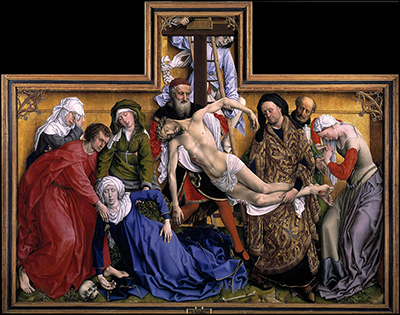
Rogier van der Weyden's The Descent from the Cross is one of the defining paintings of the Early Netherlandish Renaissance. Painted before 1443 and now in the Museo del Prado, it turns the removal of Christ's body from the cross into a scene of compressed grief, theatrical stillness and extraordinary physical precision. The figures appear almost life-sized, pressed into a shallow gilded box that resembles a carved altarpiece shrine rather than a believable landscape. That tension between painted illusion and sculptural presence is the heart of the work. Rogier makes the viewer feel that the event is both sacred history and something staged directly in front of them. [1]
The painting is not simply a Passion scene with beautiful figures. It is a carefully engineered emotional machine. Christ's body falls diagonally through the centre of the panel, while the Virgin Mary collapses below him in a matching curve. Her fainting body becomes a living echo of his dead one. Around them, mourners weep, steady, lift, bend, cling and recoil, each one given a distinct rhythm of sorrow. The result is a work that feels tightly ordered and almost unbearable at the same time.
The Prado identifies the painting as oil on panel, measuring 204.5 by 259 cm, with the inventory number P002825. Its earliest secure context is Leuven, where it was made for the chapel of the Great Crossbowmen's guild in the church of Notre-Dame-hors-les-murs. The small crossbows in the tracery help explain the commission, while an early copy dated 1443 shows that Rogier's panel must have been completed before then. [1]
At a Glance
- ArtistRogier van der Weyden
- TitleThe Descent from the Cross
- DateBefore 1443
- MediumOil on panel
- Dimensions204.5 x 259 cm
- Current locationMuseo Nacional del Prado, Madrid
- Inventory numberP002825
- Original contextChapel of the Great Crossbowmen's guild, church of Notre-Dame-hors-les-murs, Leuven
- Key themesPassion, grief, devotion, painted sculpture, guild patronage, Early Netherlandish realism
Contents
- Introduction
- At a Glance
- What the Painting Shows
- Annotated Details
- A Painted Altarpiece That Pretends to Be Sculpture
- Christ and the Virgin: Two Bodies, One Grief
- The Mourners Around Christ
- The Crossbowmen's Guild and the Original Setting
- Provenance and the Journey to Spain
- Why It Feels So Modern
- Rogier's Place in Early Netherlandish Painting
- Influence and Later Echoes
- How to Look at the Painting
What the Painting Shows
The subject is the deposition of Christ, the moment after the Crucifixion when his body is lowered from the cross for burial. The Gospel accounts describe Joseph of Arimathea receiving Christ's body and preparing it for entombment; John also mentions Nicodemus. Rogier expands that basic narrative into a crowded devotional drama. [1]
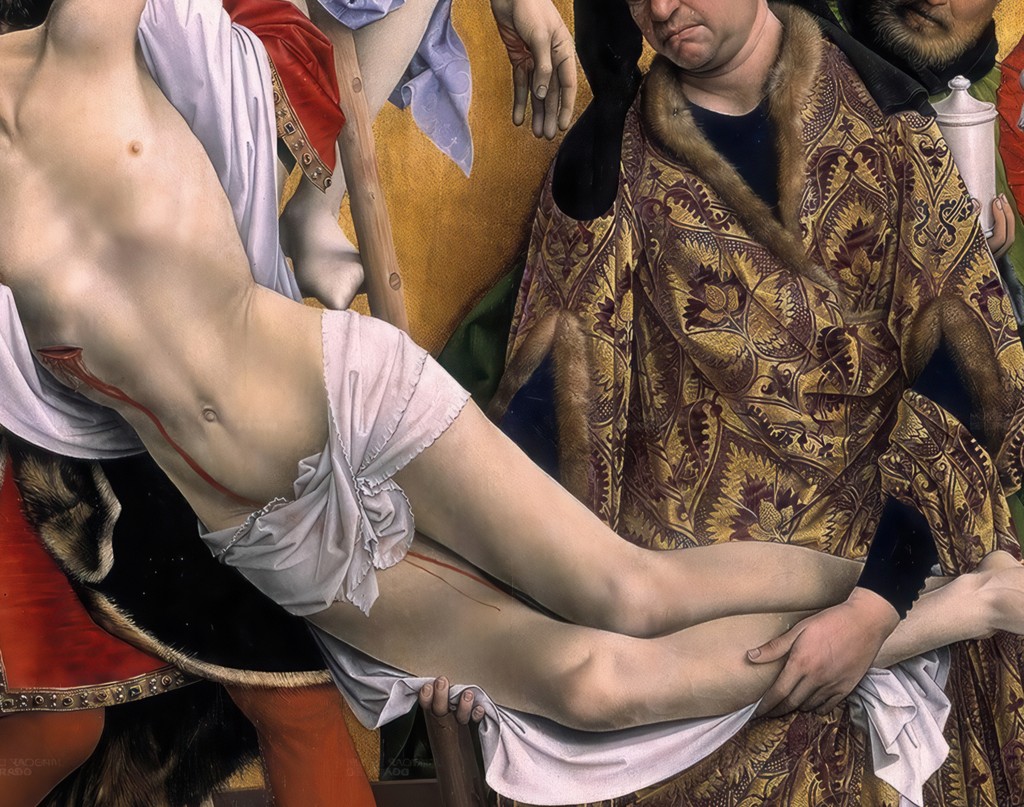
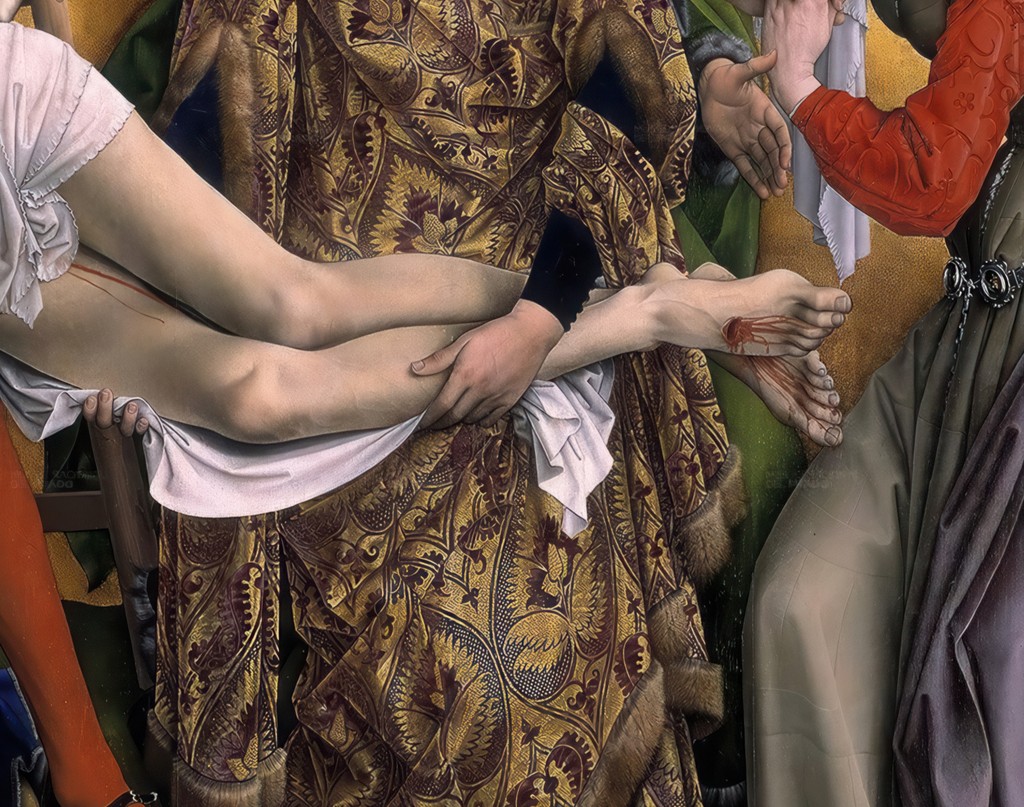
At the centre, Christ's body is supported by Joseph of Arimathea and Nicodemus. Joseph is richly dressed, and the Prado identifies him by the cloth-of-gold cape at the right of the composition. Nicodemus, shown with a white beard, helps hold the body with a white shroud, a practical and devotional detail that avoids direct contact with the corpse. A younger man on the ladder still supports Christ's arm, while another man behind Joseph holds a pot of ointment. [1]
On the right, Mary Magdalene bends forward in grief. Her body twists so sharply that the pose feels almost impossible, but the distortion is expressive rather than careless. She is not merely looking sad; she seems physically changed by the event. On the left, the Virgin Mary faints, supported by Saint John and a woman in green, probably Mary Salome. Behind them stands Mary Cleophas. Rogier gives nearly every figure some sign of weeping, tension or collapse, so that sorrow becomes the shared language of the panel. [1]
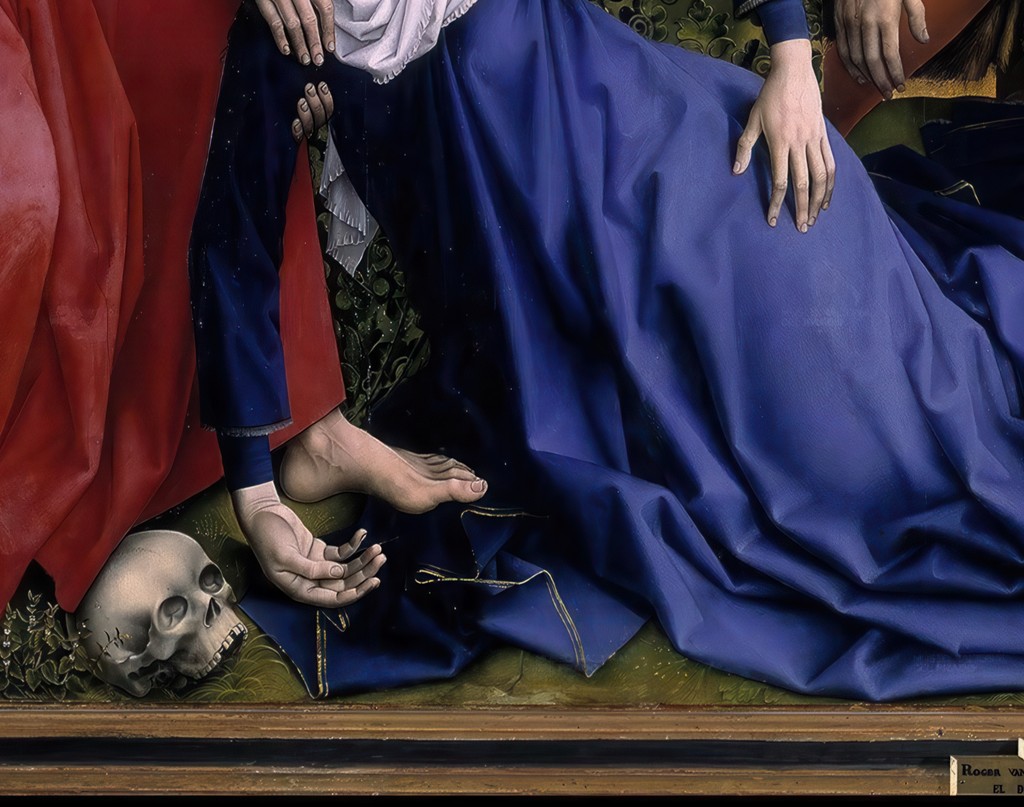
The skull and bone in the foreground refer to the traditional site of Adam's burial beneath Golgotha. This detail links the death of Christ to the fall and redemption of humankind. It also anchors the scene in a symbolic ground even though the rest of the space is anything but natural. [1]
Annotated Details from The Descent from the Cross
These numbered details show how Rogier compresses a sacred history into a shallow gilded shrine, using paired bodies, distinctive mourners, costly surfaces and practical gestures to make grief visible. [1]
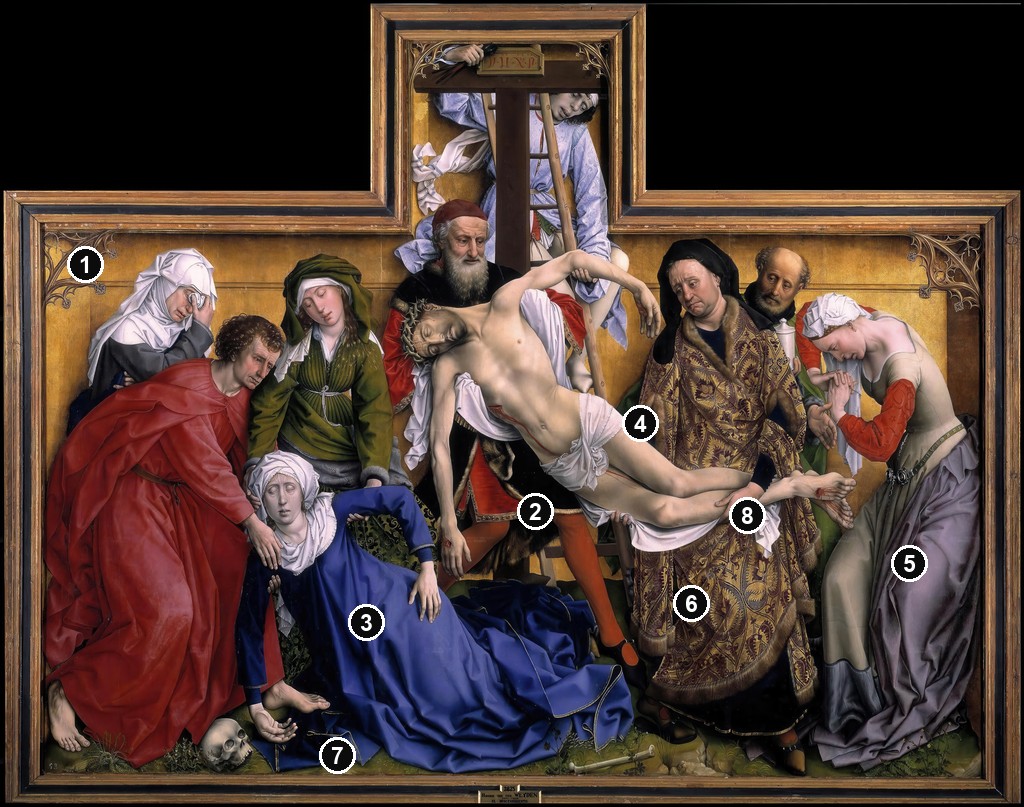
Details from THE DESCENT FROM THE CROSS
Close looking reveals how the panel's emotional force is built from composition, gesture, material and devotional symbolism.
The shallow gilded shrine
The gold ground, corner tracery and projecting upper compartment make the painted scene resemble a carved fifteenth-century altarpiece shrine. [1]
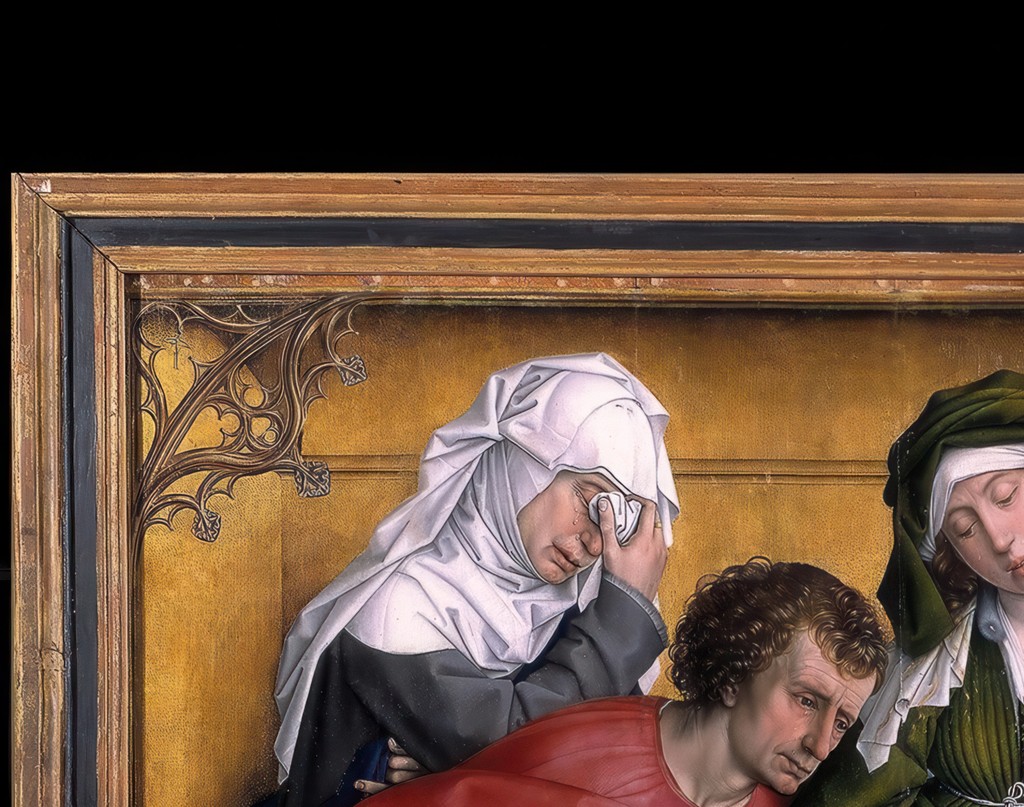
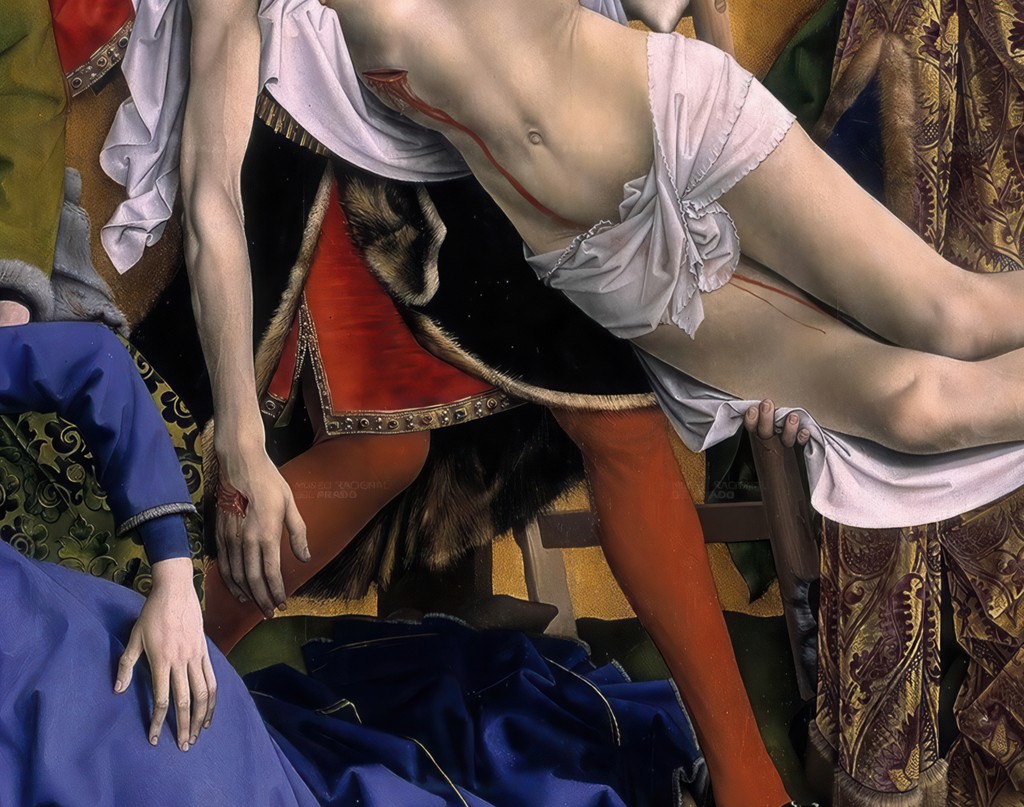
Christ and the Virgin in parallel
Christ descends in a long curve while the fainting Virgin repeats his fall below. Rogier turns compassion into the structure of the composition.
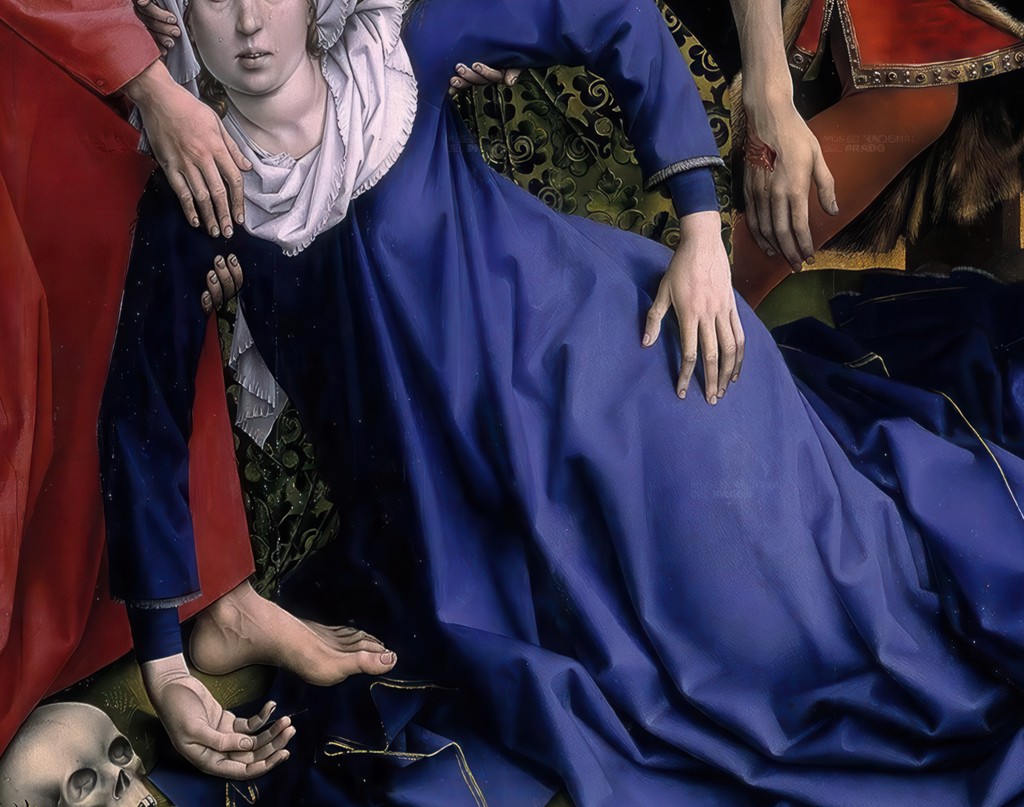
The Virgin's swoon
Mary's blue-robed body cannot remain upright. Saint John and the woman in green support her, translating spiritual grief into physical collapse. [1]
Christ's lowered body
Christ's pale body cuts diagonally across the crowded panel. The shallow space makes its weight and vulnerability press toward the viewer.
Mary Magdalene's twisting grief
At the far right, Mary Magdalene bends and twists sharply. Her compressed pose makes mourning feel bodily rather than merely facial. [1]
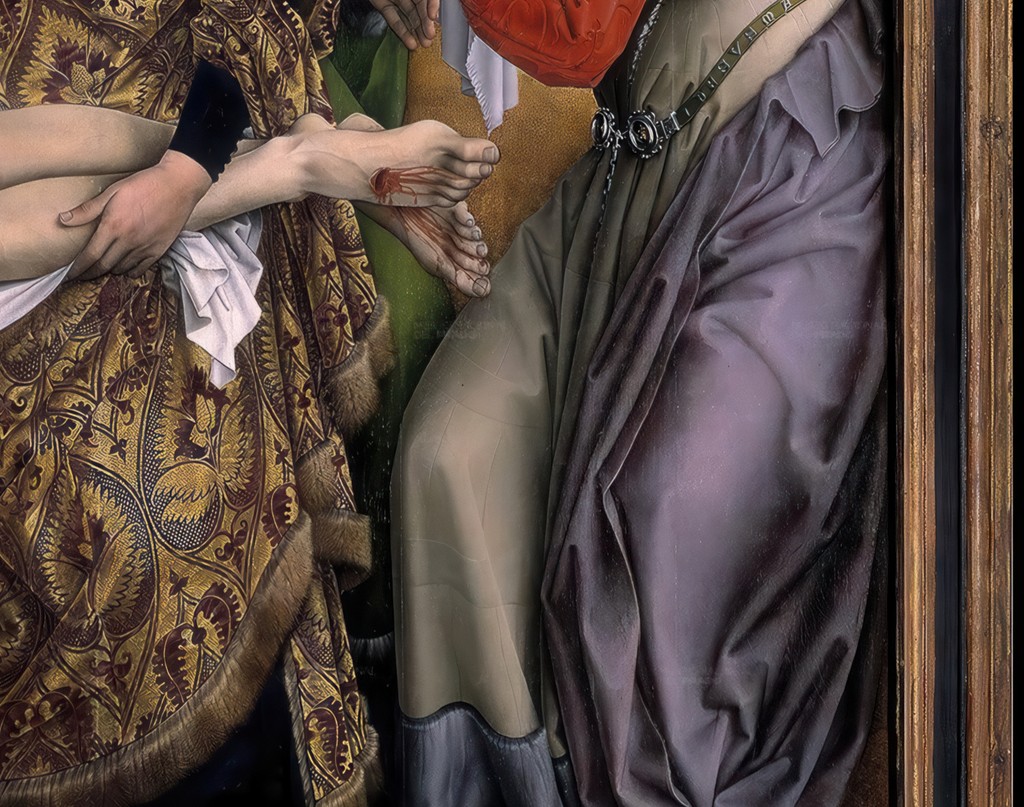
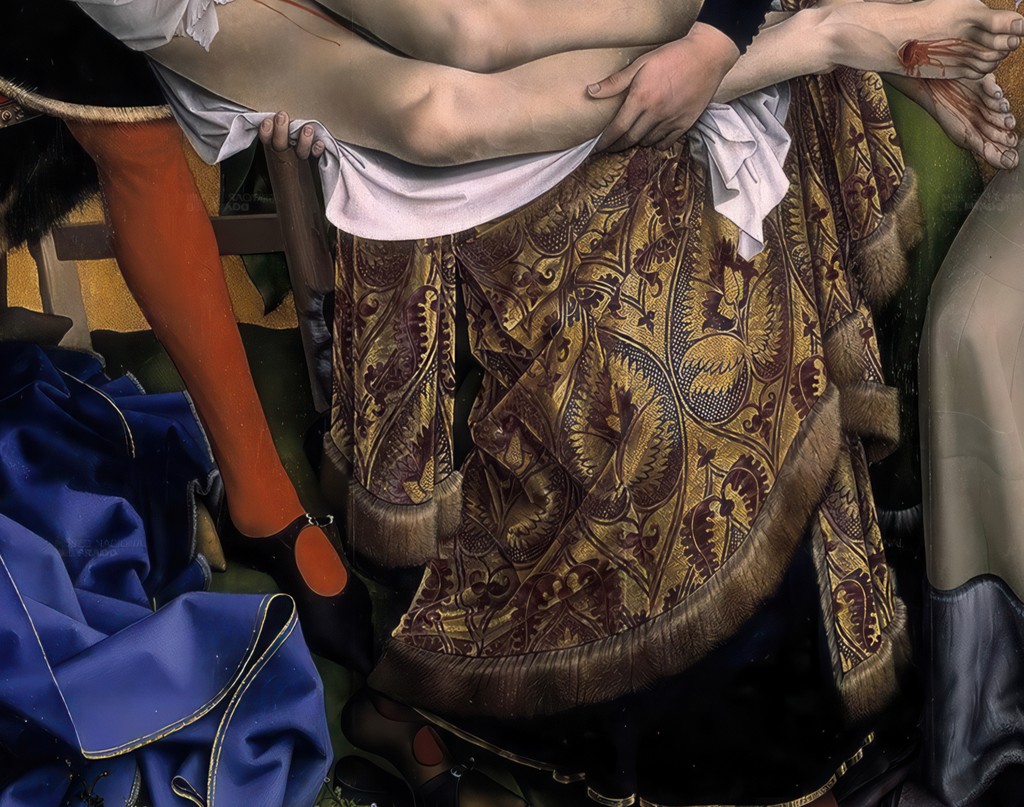
Hands, shroud and physical weight
Hands grip the white cloth, steady limbs and bear weight. These practical gestures make the sacred episode tactile and immediate.
The skull and bone at Golgotha
The skull and bone refer to the traditional burial place of Adam beneath Golgotha, linking Christ's death with humanity's fall and redemption. [1]
Joseph's cloth-of-gold mantle
The Prado identifies Joseph of Arimathea through the rich cloth-of-gold cape. Pattern and colour distinguish his solemn role in supporting Christ. [1]
A Painted Altarpiece That Pretends to Be Sculpture
One of the most striking things about The Descent from the Cross is that it does not open into a landscape or an architectural depth. The figures stand inside a shallow gold-backed structure with painted tracery in the corners and a projecting upper section. The Prado describes this as a painted evocation of a fifteenth-century sculpted altarpiece shrine, the kind of object that would have contained polychrome carved figures. [1]
This matters because Rogier is not merely painting a story. He is staging painting against sculpture. The figures are rendered with the detail and colour of living bodies, but they are pressed into a space that behaves like a carved box. Their heads, limbs and draperies overlap without much room to breathe. The shallow setting denies ordinary depth, yet the bodies have weight, volume and tactile presence. That contradiction makes the image feel immediate: the figures seem to project outward toward the worshipper rather than recede into a distant world.
Rogier returned often to the problem of how painting could imitate, compete with or absorb sculpture. In this panel, the question is not theoretical. It serves the devotional purpose of the work. A carved Passion shrine could make sacred history feel bodily and present; Rogier's painting does the same thing with colour, line, gesture and psychological intensity. The gold box removes the scene from normal time, while the carefully observed faces and hands return it to human experience.
This is why the painting has such power as an altarpiece image. It offers the viewer neither a simple narrative nor a decorative devotional object. It creates an encounter. The scene is compressed into a shrine-like space so that the viewer cannot drift away into background detail. Every visual decision pushes attention back to the bodies of Christ and Mary, and to the circle of people who respond to them.
Christ and the Virgin: Two Bodies, One Grief
The most famous compositional idea in the painting is the echo between Christ's body and the Virgin's body. Christ is lowered from the cross in a long, pale curve. Below him, Mary collapses in a similar arc. Her swoon does not compete with the Passion; it mirrors it. Rogier gives the Virgin a physical share in the suffering of her son.
This mirroring is more than a clever arrangement. It is the emotional centre of the image. Christ's death is the theological event, but Mary's grief is the human point of entry. The viewer understands the loss through the body that cannot remain upright. Her blue robe, pale face and slack hands make sorrow visible as a physical state.
The two bodies also stabilise the composition. Christ's diagonal movement might otherwise pull the whole painting downward and to the side. Mary's corresponding fall creates a second line that balances and intensifies it. Between them, grief becomes structure. Rogier organises the panel not around the cross itself, but around the answer to the cross: mourning, compassion and bodily collapse.
This compositional pairing helps explain why the painting became so influential. Later artists could borrow the subject, the figures or the emotional tone, but Rogier's deeper invention was the way he turned grief into an architectural principle. The image is ordered by feeling.
The Mourners Around Christ
Rogier's figures are not interchangeable witnesses. Each mourner has a distinct role and emotional register. Saint John holds the Virgin with urgent tenderness. The woman in green strains to help support her. Mary Magdalene at the right bends into her sorrow, her hands and body locked in a tense, angular response. Joseph of Arimathea and Nicodemus act with solemn concentration as they bear Christ's body. Even the secondary figures help thicken the atmosphere of grief.
The painting's emotional range depends on this variety. Some figures weep openly. Others control themselves enough to perform the necessary actions. The body of Christ must be lowered, wrapped and buried; devotion here includes practical labour. Rogier lets the viewer see that sacred grief is not only an inward feeling. It is also a set of gestures: holding, lifting, steadying, anointing and standing close to the dead.
The hands are especially important. They grip the shroud, support limbs, press cloth, reach toward bodies or fold into tension. In a painting where the setting is deliberately unreal, the hands return everything to lived experience. They make the scene tactile. Viewers can imagine the weight of Christ's body, the coolness of the shroud and the physical strain of the people lowering him from the cross.
The faces are equally controlled. Rogier avoids chaos. He does not fill the panel with theatrical screaming or violent movement. Instead, he gives each figure a particular degree of grief. That restraint makes the scene more painful, not less. The mourners seem trapped inside a moment that cannot be hurried.
The Crossbowmen's Guild and the Original Setting
The painting was made for the chapel of the Great Crossbowmen's guild in Leuven, and the crossbow symbols in the painted tracery point to that patronage. [1] This guild context matters. The work was not created as a free-floating museum masterpiece. It was a devotional altarpiece for a specific community, placed in a religious setting where members would have encountered it through prayer, liturgy and corporate identity.
The Crossbowmen's guild would have recognised itself in the small emblems, but Rogier did not turn the painting into a display of civic vanity. The symbols are discreet. They mark the patronage while leaving the Passion scene dominant. This balance is typical of a sophisticated devotional commission: the patron is present, but the sacred event remains the point.
Leuven also gives the work regional force. Rogier was a painter of the Burgundian Low Countries, and the panel belongs to the same cultural world as the major Netherlandish devotional images by Jan van Eyck, Robert Campin and their successors. Its later history took it to Habsburg and Spanish royal collections, but its first meaning was shaped by a Netherlandish religious and civic environment.
The earliest datable copy, the Edelheere Triptych of 1443 in Leuven, is crucial for chronology. Because that copy depends on Rogier's composition, the Prado dates the original to before 1443. [1] The copy also signals how quickly the image mattered. This was not a painting whose reputation slowly emerged only in modern art history. Its design was already being repeated in the fifteenth century.
Provenance and the Journey to Spain
The Prado records a long provenance for the painting. It originated in the chapel of Our Lady Outside the Walls at Leuven, was acquired by Mary of Hungary for the chapel of the Palace of Binche, then went to Spain, first to El Pardo and then to El Escorial. It remained connected with El Escorial until the twentieth century and entered the Prado as a deposit during the Spanish Civil War, later becoming a permanent loan from Patrimonio Nacional. [1]
This movement from Leuven to Spain is part of the painting's historical identity. It tells us how highly Netherlandish painting was valued by Habsburg and Spanish patrons. Rogier's work did not remain a local devotional object. It became a prized royal image, collected, moved and preserved across political and dynastic contexts.
The Spanish chapter also explains why the Prado is now central to the painting's scholarship and public life.
Why It Feels So Modern
For a fifteenth-century religious painting, The Descent from the Cross can feel surprisingly modern. That is not because Rogier rejects medieval devotion. On the contrary, the painting is intensely devotional. It feels modern because it concentrates emotion with such clarity. There is no atmospheric distance, no ornamental escape and almost no narrative distraction. The viewer is placed in front of a crisis of bodies.
The shallow gold space is a key reason. By denying normal depth, Rogier denies the viewer the comfort of looking "into" a picture. The scene presses outward. Christ and Mary lie almost parallel to the picture plane, and the surrounding mourners form a tight human frame. The painting is less like a window than a charged surface.
The colours help too. The blues, reds, whites, greens and golds are vivid, but they are not merely decorative. They separate the figures into legible emotional units. Mary's blue robe anchors the lower left. The red of Saint John and Nicodemus warms the centre and right. The pale body of Christ cuts through the composition with painful clarity. These colours organise grief so that the viewer reads the painting quickly and then keeps looking.
Rogier's psychological precision is another reason the image still works so powerfully. The faces are idealised but not empty. The figures belong to a sacred narrative, yet their grief is recognisably human. This combination of formal discipline and emotional access is one of the great strengths of Early Netherlandish painting.
Rogier's Place in Early Netherlandish Painting
Rogier van der Weyden, also known as Rogier de la Pasture, was born around 1399 or 1400 and died in 1464. The National Gallery of Art identifies him as Netherlandish and lists him under both names. [2] The National Gallery in London presents him as one of the great painters of the fifteenth century and notes the importance of The Descent from the Cross for understanding the impact of his lost and fragmentary altarpieces. [3]
Rogier is often discussed alongside Robert Campin and Jan van Eyck. The comparison is useful but must be handled carefully. Van Eyck is frequently associated with optical richness and luminous detail; Campin with domestic realism, strong bodies and sharply observed interiors. Rogier's special achievement lies in emotional construction. He takes the close observation and material intensity of Netherlandish painting and turns them into disciplined scenes of grief, devotion and moral pressure.
In The Descent from the Cross, this achievement appears early and fully. The painting shows an artist who understands how to make bodies convincing, but also how to make their arrangement carry theological and emotional meaning. The panel's realism is never merely descriptive. It is directed toward compassion.
It is the kind of work around which questions of style, workshop, copy and influence can be organised.
Influence and Later Echoes
The painting's influence began early, as the 1443 Leuven copy already shows. [1] Its later importance comes from the way it condensed a devotional subject into an unforgettable visual formula: Christ's body lowered from the cross, the Virgin fainting in parallel, mourners pressed into a shallow stage and grief made almost sculptural.
Those later works belong to very different artistic worlds, but the comparison is useful for readers. Rubens transforms the subject through Baroque movement, muscular force and dramatic light; Rembrandt explores it through shadow, printmaking and spiritual interiority. Rogier's version stands at the start of a powerful northern tradition of imagining the removal of Christ's body.
Together they show how Rogier builds sacred meaning through compression, gesture, emotional mirroring and the interplay between painted figures and sculptural or architectural framing.
Robert Campin belongs here as formative context, even before a local Campin page exists.
How to Look at the Painting
Start with the shape of Christ's body. Follow the diagonal from the raised arm down through the torso and legs. Then look immediately below at the Virgin. Her body repeats the same falling rhythm, but in the world of the living. This is the painting's emotional key.
Next, study the space. There is almost nowhere for the figures to go. The gold background and shallow box make the scene feel like a shrine, not an outdoor event. The crowded arrangement is deliberate. Rogier wants the viewer to feel the pressure of the moment.
Then look at the hands. They tell the story of action and grief: lifting, supporting, folding, reaching and holding cloth. The figures' hands often carry the emotional weight that their controlled faces partly restrain.
Finally, look at the small crossbows in the tracery. They are easy to miss, but they connect the painting to the Great Crossbowmen's guild. They remind us that this masterpiece was once a commissioned devotional object for a particular community in Leuven, not merely a famous picture in a modern museum.
Why It Matters
The Descent from the Cross matters because it shows Rogier van der Weyden at the point where devotional painting becomes intensely psychological without losing its sacred order. The panel is emotionally direct but formally controlled. It is dramatic without being chaotic. It is realistic in detail but deliberately unreal in space.
Its importance also lies in its usefulness for understanding Rogier's broader art. The painting introduces many of the concerns that run through his career: sculptural illusion, grieving bodies, compressed staging, powerful diagonals, carefully varied faces, theological symbolism and the ability to make sacred history feel present.
It explains why he matters, why his art needs more than a short legacy page and why the Northern Renaissance corridor can treat him as a central figure between Campin, Van Eyck, Petrus Christus, Memling, Durer, Bosch and Bruegel.
Frequently Asked Questions
It is in the Museo Nacional del Prado in Madrid, where it has the inventory number P002825. [1]
The Prado dates it to before 1443. The early Edelheere Triptych copy of 1443 is important evidence that Rogier's original had already been completed by then. [1]
The painting was made for the chapel of the Great Crossbowmen's guild in the church of Notre-Dame-hors-les-murs in Leuven. Small crossbows in the painted tracery point to that guild context. [1]
It shows the deposition of Christ from the cross, with Joseph of Arimathea, Nicodemus, the Virgin Mary, Saint John, Mary Magdalene and other mourners gathered around Christ's body. [1]
Rogier shows Mary collapsing in a pose that echoes Christ's dead body. This makes her grief central to the emotional and devotional meaning of the image. [1]
The painting is designed to resemble a carved, polychrome altarpiece shrine. The shallow gold-backed box makes the figures feel sculptural and present rather than distant. [1]
The Prado gives the dimensions as 204.5 x 259 cm. [1]
It is one of Rogier's greatest works and a defining example of Early Netherlandish devotional painting. Its intense emotional structure, sculptural illusion and influential composition make it central to understanding Rogier's art and later treatments of the Descent subject.
Discussion
Where does the Descent's emotional force come from: mirrored bodies, crowded space, guild patronage, sculptural illusion, or the controlled rhythm of grief?
Reader Insights
The parallel fall of Christ and the Virgin makes compassion visible as design. Rogier turns grief into a formal echo.
The shallow gold-backed setting behaves almost like a shrine box, pressing the figures toward the viewer rather than opening a deep world.
This is the cluster's main anchor: it should send readers outward to Beaune, Seven Sacraments, portraiture and later Passion imagery.
Join the Conversation
Have a thought or observation about The Descent from the Cross by Rogier van der Weyden? Share it below. Thoughtful responses may be added to this section as the Rogier van der Weyden cluster develops.
References
- Museo Nacional del Prado, The Descent from the Cross, collection record for P002825, accessed 2026-07-11. https://www.museodelprado.es/en/the-collection/art-work/the-descent-from-the-cross/856d822a-dd22-4425-bebd-920a1d416aa7
- National Gallery of Art, Washington, artist record for Rogier van der Weyden / Rogier de la Pasture, accessed 2026-07-11. https://www.nga.gov/collection/artist-info.1971.html
- The National Gallery, London, artist page for Rogier van der Weyden, accessed 2026-07-11. https://www.nationalgallery.org.uk/artists/rogier-van-der-weyden
- Jose Juan Perez Preciado, Fifteenth-century Netherlandish Painting at the Museo Nacional del Prado. Catalogue raisonne, Madrid, Museo Nacional del Prado, 2024, p. 316-327, no. 41, cited by the Prado collection record.
- Lorne Campbell and Jan Van der Stock, eds., Rogier van der Weyden: 1400-1464. Master of Passions, Leuven, Davidsfonds, 2009.
- Dirk de Vos, Rogier van der Weyden: The Complete Works, Harry N. Abrams, 2000.