 by Tom Gurney
Tom Gurney BSc (Hons) is an art history expert with over 20 years experience
Published on June 19, 2020 / Updated on July 30, 2026
Email: tomgurney1@gmail.com / Phone: +44 7429 011000
Virgin and Child: Introduction
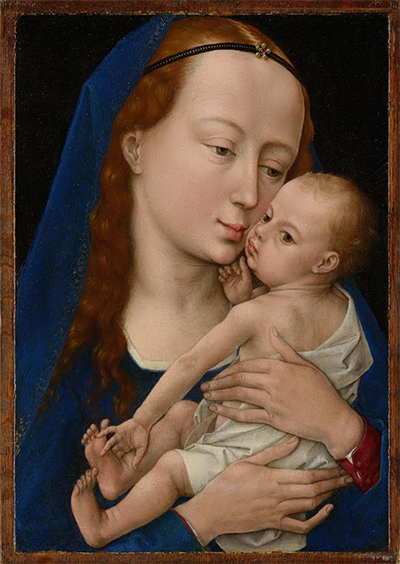
Rogier van der Weyden's Virgin and Child in Houston belongs to the intimate side of his Marian imagery. Unlike the architectural niche of the Duran Madonna or the tiny symbolic world of Virgin and Child Enthroned, this painting concentrates on the bodily tenderness between mother and child. [1]
The work is in the Museum of Fine Arts, Houston, accession 44.535, and is usually dated after 1454. Its attribution history is important: earlier scholars sometimes treated it as a replica or workshop-related version, but later studies have supported it as an autograph work by Rogier. [1]
This page should be handled as a late Madonna and attribution-history page. It is valuable not because it repeats the Duran or Thyssen pages, but because it shows a different kind of Marian closeness.
At a Glance
- ArtistRogier van der Weyden, subject to final museum wording
- TitleVirgin and Child
- DateAfter 1454
- MediumOil on oak panel
- DimensionsAbout 31.9 x 22.9 cm
- Current locationMuseum of Fine Arts, Houston
- Accession lead44.535
- SubjectHalf-length Virgin and Child
Contents
- Introduction
- At a Glance
- A Late Half-Length Madonna
- Tenderness And Control
- The Cambrai Madonna Connection
- Attribution History
- Relation To Duran Madonna And Virgin And Child Enthroned
- Late Devotion And Bodily Closeness
- Scholarship And Reassessment
- A Quiet Counterpart To The Passion Pages
- Why It Matters
- FAQs
A Late Half-Length Madonna
The painting belongs to the tradition of half-length Virgin and Child images. Mary holds the Child close, and the contact between their bodies gives the image its tenderness. [1]
This is a different emotional register from Rogier's great Passion scenes. The feeling is not grief but closeness. Yet it remains recognizably Rogier's work: the figures are controlled, the design is tight, and emotional force comes through form rather than loose sentiment.
The half-length format is important because it removes narrative distraction. The viewer does not move through a deep landscape or a complex architecture. Instead, attention falls on contact: Mary's arms, the Child's movement, the nearness of faces and the soft pressure of the embrace. The small scale would have suited concentrated looking rather than public spectacle.
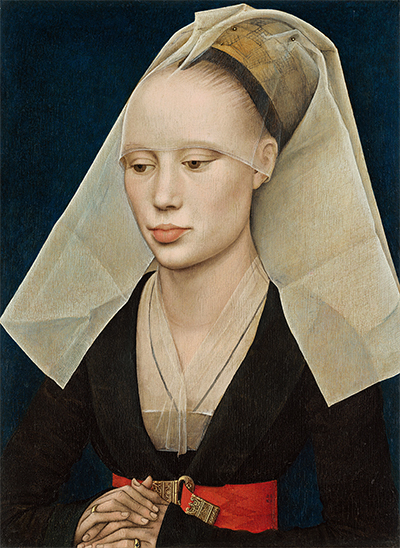
The painting therefore belongs beside Portrait of a Lady as much as beside the other Madonna images. Both works depend on close format, controlled pose and emotional compression. One turns restraint into portrait psychology; the other turns restraint into tenderness.
Tenderness And Control
Rogier rarely lets feeling become loose. Even in a mother-and-child image, the design remains disciplined. The viewer feels closeness because the figures are carefully arranged, not because the image becomes informal.
This is a crucial distinction. The painting is tender, but not sentimental. Mary's embrace, the Child's body and the shallow space work together to make intimacy feel sacred.
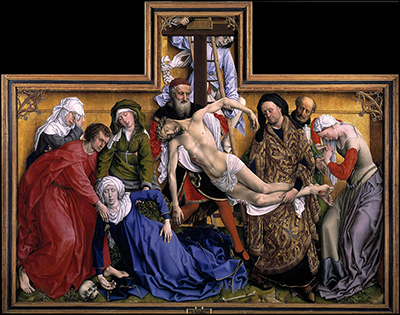
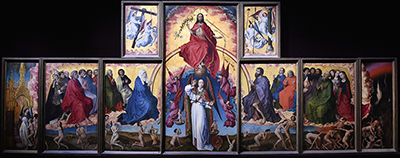
The page helps balance the cluster's emotional range. Rogier can stage grief in the Descent from the Cross, judgment in the Beaune Altarpiece, courtly identity in the portraits and quiet motherly closeness in this image. Those are different emotional registers, but they share a commitment to clarity and control.
The Cambrai Madonna Connection
The painting belongs to a broader tradition of Virgin and Child images connected with the revered Cambrai Madonna type. Rogier was from Tournai and worked in Brussels, but Cambrai was close enough to matter within the broader devotional geography of the Low Countries and northern France.
The image shows how an older icon type could be transformed through Netherlandish painting. Rather than simply repeat a model, Rogier's world could adapt it through oil technique, surface detail, emotional proximity and new forms of bodily tenderness.
This regional connection is useful for authenticity. It also belonged to local devotional geographies: Tournai, Brussels, Cambrai, Leuven, Burgundy and the wider Low Countries world. The page can therefore connect Marian devotion to geography rather than treating it as a purely generic subject.
Attribution History
The work has not always been accepted as autograph. Panofsky regarded it as an excellent replica of a Rogier design, while more recent studies have supported it as by Rogier himself. [1] [4]
Attribution is not a fixed label handed down forever. It changes as technical evidence, comparative study and scholarship develop.
The stronger approach is steady and transparent: older doubts, later reassessment, current museum wording. If the painting is accepted as autograph, it becomes one of the late keys to Rogier's Marian imagery. If it is treated more cautiously, it still helps explain how his designs circulated and how workshop or replica questions shape the surviving corpus.
This is why the page belongs with the workshop-and-influence page as well as the Madonna pages. It demonstrates how an image can be important even when its attribution history has been debated.
Relation To Duran Madonna And Virgin And Child Enthroned
The cluster now contains several Marian pages, so their differences need to be clear.
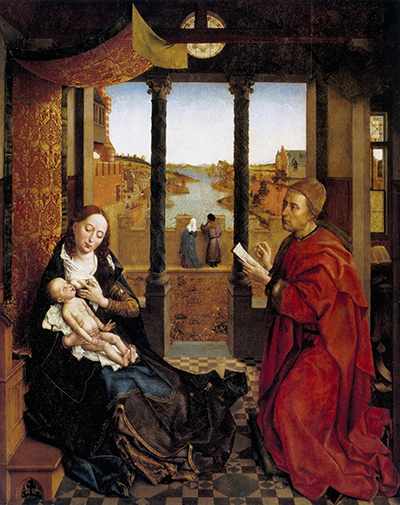
Virgin and Child Enthroned is tiny, early and architectural. The Duran Madonna is larger, sculptural and book-centred. The Houston Virgin and Child is later and more bodily, focused on embrace and tenderness.
Together, they show that Rogier did not treat the Virgin and Child as a single formula. He could make the theme architectural, sculptural, intimate, symbolic or bodily depending on format and devotional purpose.
Late Devotion And Bodily Closeness
The late date usually associated with the Houston painting matters because it shows Rogier still exploring intimate Marian imagery after the great public and courtly commissions associated with his mature career. [1]
The painting's closeness is not only emotional. It is compositional. The half-length format brings the figures toward the viewer, while the embrace concentrates attention on touch. Mary and the Child are not placed inside a grand symbolic architecture. The body-to-body relationship becomes the devotional focus.
This gives the page a role that neither the Duran Madonna nor Virgin and Child Enthroned can fill. The Duran page is about sculptural niche and book symbolism. The Thyssen page is about tiny architectural devotion and early style. The Houston page is about late tenderness and the problem of how Rogier's designs were repeated, doubted and reassessed.
Scholarship And Reassessment
The attribution history is not a side issue. It is one of the reasons the page matters. When Panofsky treated the work as a replica and later scholarship supported autograph status, the painting became a useful example of changing art-historical judgment. [1] [4]
That does not mean readers need to choose sides simplistically. The better lesson is that old-master attributions are built from evidence: style, technique, provenance, comparison, condition and scholarly argument.
The page therefore supports the wider cluster's commitment to careful attribution language. It helps readers understand why Rogier's surviving corpus includes secure masterpieces, fragments, workshop works, attributed images and debated paintings.
A Quiet Counterpart To The Passion Pages
The Houston painting gives the cluster a quiet counterweight to the Passion works. The Descent from the Cross, the Philadelphia Crucifixion Diptych and the Vienna Crucifixion Triptych all focus on suffering, witness and redemptive death. This page focuses on closeness before sacrifice.
That does not make it less theological. In Rogier's Marian imagery, tenderness often carries future knowledge. A mother holding a child can also be an image of the Incarnation, future Passion and devotional hope.
The page therefore helps readers understand Rogier's emotional range. He could make grief overwhelming, portraiture silent, and motherhood intensely close, while keeping each image formally disciplined.
It also gives the Marian route a late point of comparison. Readers can move from the early Virgin and Child Enthroned, to the sculptural Duran Madonna, to this later half-length image, and see how Rogier's treatment of the same sacred relationship changes across scale, format and attribution history.
Why It Matters
The painting matters because it adds a late, tender, half-length Madonna to the Rogier cluster while also teaching attribution caution. It helps readers see that Rogier's Marian imagery was not one-dimensional.
Its value is not only in adding another Madonna page. It clarifies the range of Rogier's Virgin and Child imagery, connects the cluster to the Cambrai icon tradition, and shows how scholarship can reassess a painting's status over time.
FAQs
It is in the Museum of Fine Arts, Houston, accession 44.535. [1]
It is usually dated after 1454. [1]
Earlier scholarship sometimes treated it as a replica of a Rogier design, but later studies have supported it as an autograph work. [1] [4]
The Cambrai Madonna was an important icon type that helped shape later Virgin and Child images in the region.
Discussion
What does the Virgin and Child page add to the cluster: Marian devotion, workshop questions, lost altarpiece context, or links to the Magdalen fragment?
Reader Insights
This page matters because surviving fragments and related images can point toward larger devotional structures that no longer exist intact.
Rogier's Virgin and Child imagery gives the cluster a quieter devotional route alongside Passion grief and portrait restraint.
The Magdalen Reading makes this page more vivid because it shows how one surviving fragment can change our sense of a lost ensemble.
Join the Conversation
Have a thought or observation about Virgin and Child? Share it below. Thoughtful responses may be added to this section as the Rogier van der Weyden cluster develops.
References
- Wikipedia, Virgin and Child, Museum of Fine Arts, Houston, accession 44.535, accessed 2026-07-11. https://en.wikipedia.org/wiki/Virgin_and_Child_(van_der_Weyden)
- Museum of Fine Arts, Houston collection entry, accessed 2026-07-11. https://www.mfah.org/
- Brigitte Dekeyzer, "The Virgin and Child in the Oeuvre of Rogier van der Weyden," in Lorne Campbell and Jan Van der Stock, eds., Rogier van der Weyden: 1400-1464. Master of Passions, 2009.
- Erwin Panofsky, Early Netherlandish Painting, 1953/1971.