 by Tom Gurney
Tom Gurney BSc (Hons) is an art history expert with over 20 years experience
Published on June 19, 2020 / Updated on July 30, 2026
Email: tomgurney1@gmail.com / Phone: +44 7429 011000
Annunciation Triptych: Introduction
The Annunciation Triptych is best introduced as a work associated with Rogier van der Weyden's workshop rather than as a securely autograph painting by Rogier himself. The Louvre records the central Annunciation panel as by the workshop of Rogier van der Weyden and the Southern Netherlandish school. [1]
The centre panel, now in the Louvre, was once part of a wider triptych whose wings are associated with Turin and the Galleria Sabauda. Even with that attribution caution, the work remains valuable for the Rogier cluster because it shows the domestic Annunciation setting, devotional stillness and workshop environment around early Netherlandish painting. [1]
This page should therefore be read as a careful workshop and split-object page. It belongs in the cluster, but it should not be presented as one of Rogier's secure autograph flagships.
At a Glance
- AttributionWorkshop of Rogier van der Weyden; Southern Netherlandish school
- TitleL'Annonciation / Annunciation Triptych centre panel
- Date15th century
- MediumOil on wood
- FormatDismembered triptych
- Centre panelAnnunciation, Louvre, Paris, INV 1982 / MR 813
- WingsVisitation and donor/clergyman panels, Turin/Galleria Sabauda source leads
Contents
- Introduction
- At a Glance
- Annotated Details
- The Centre Panel
- The Split Triptych
- Gabriel, Mary And The Interior
- Early Rogier And Domestic Space
- Attribution Caution
- Place In The Rogier Cluster
- Looking Without A Complete Object
- Links To Other Annunciation Images
- Why It Matters
- FAQs
Annotated Details from Annunciation Triptych
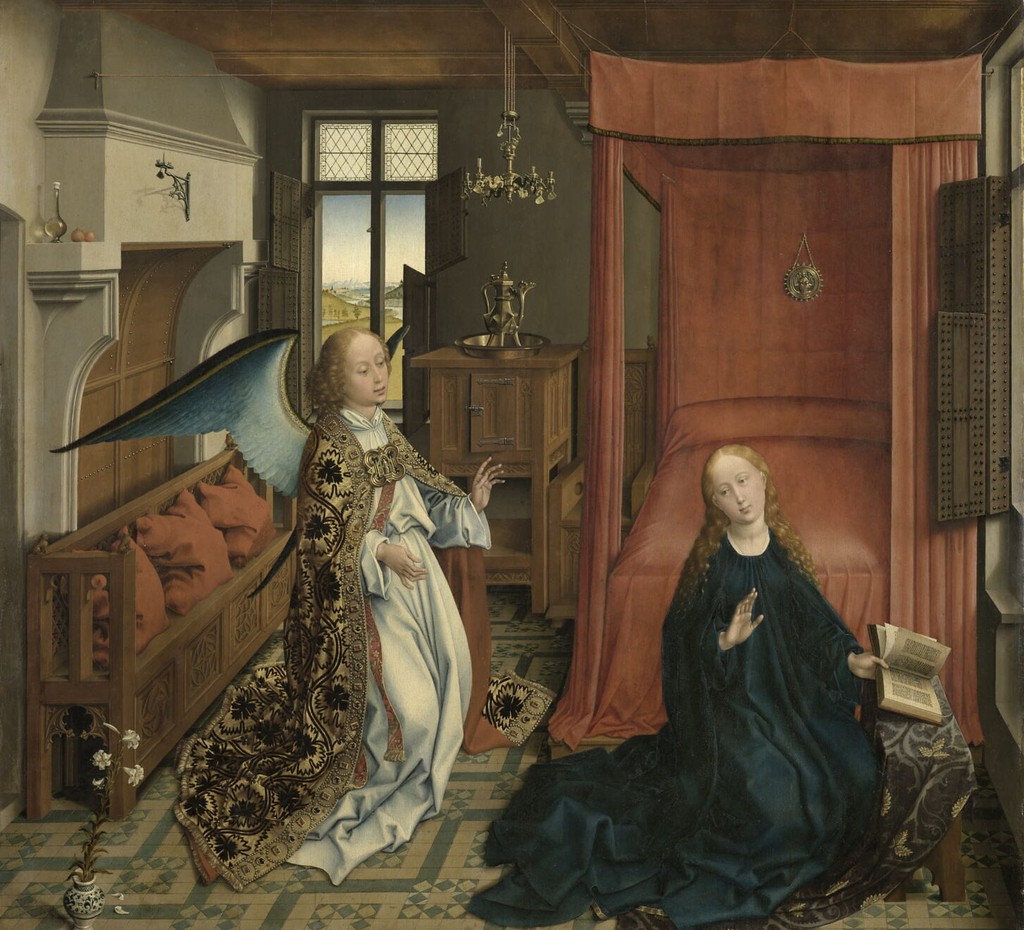
This close reading treats the Louvre centre panel as a workshop-associated image. The numbered details focus on the domestic room, the exchange between Gabriel and Mary, and the careful handling of light, architecture and devotional silence.
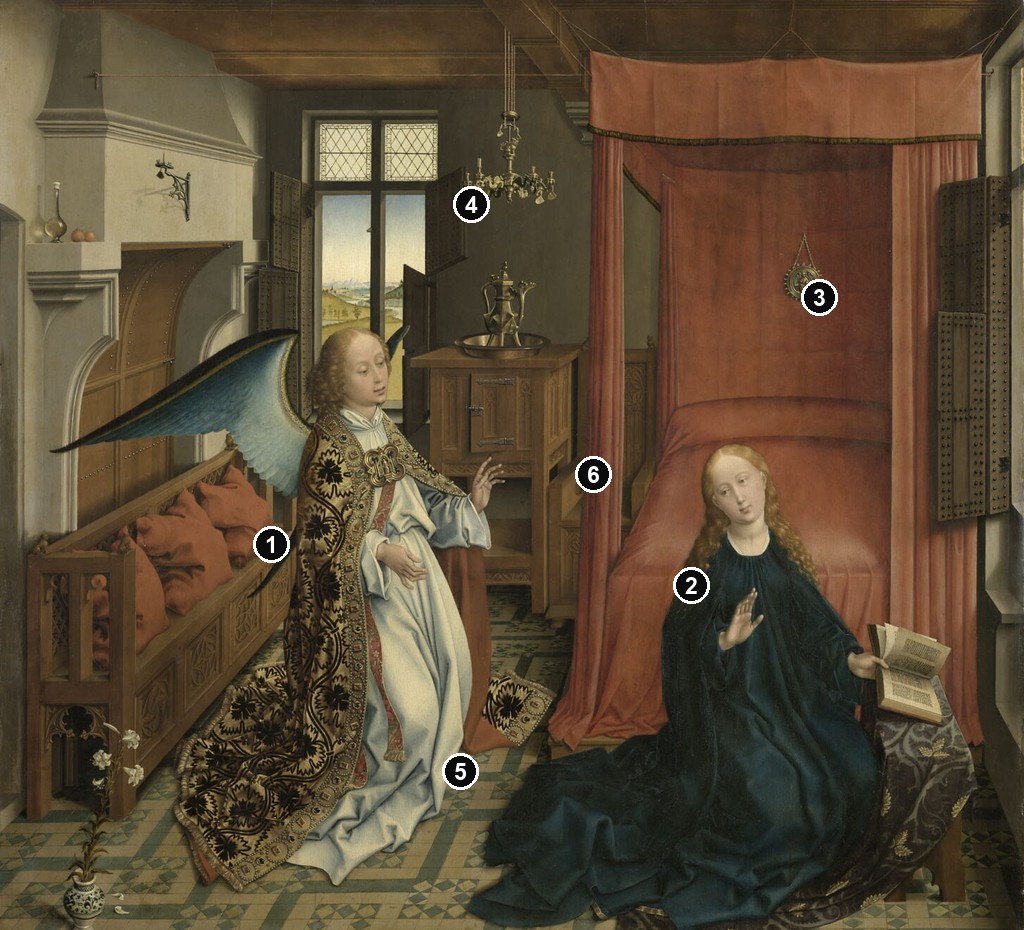
Details from ANNUNCIATION TRIPTYCH
These details help readers see why the Annunciation panel matters even when the triptych is now split between collections and must be described with attribution caution.
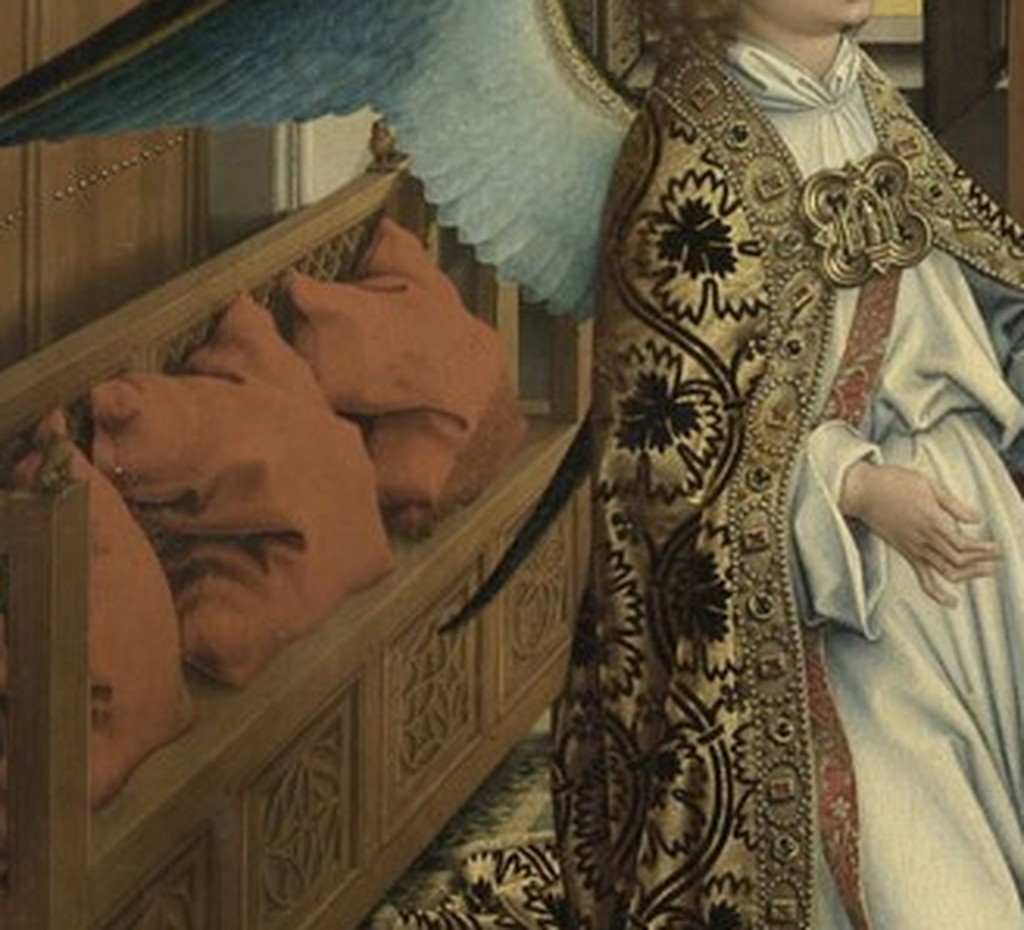
Gabriel entering the chamber
Gabriel moves into the room with a controlled gesture rather than dramatic force. The detail shows how the panel turns a sacred arrival into a poised domestic encounter.
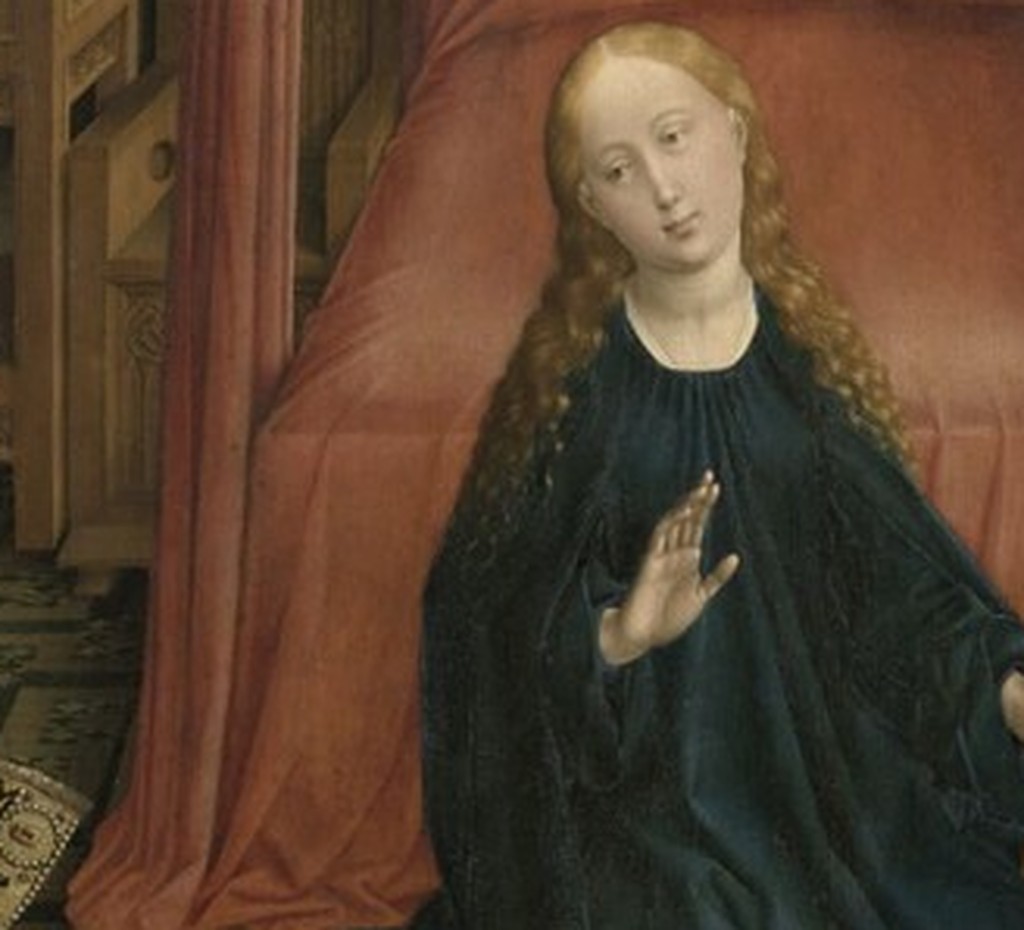
Mary at the prie-dieu
Mary's posture, book and lectern place the Annunciation inside a devotional interior. The scene depends on attention and stillness as much as narrative action.
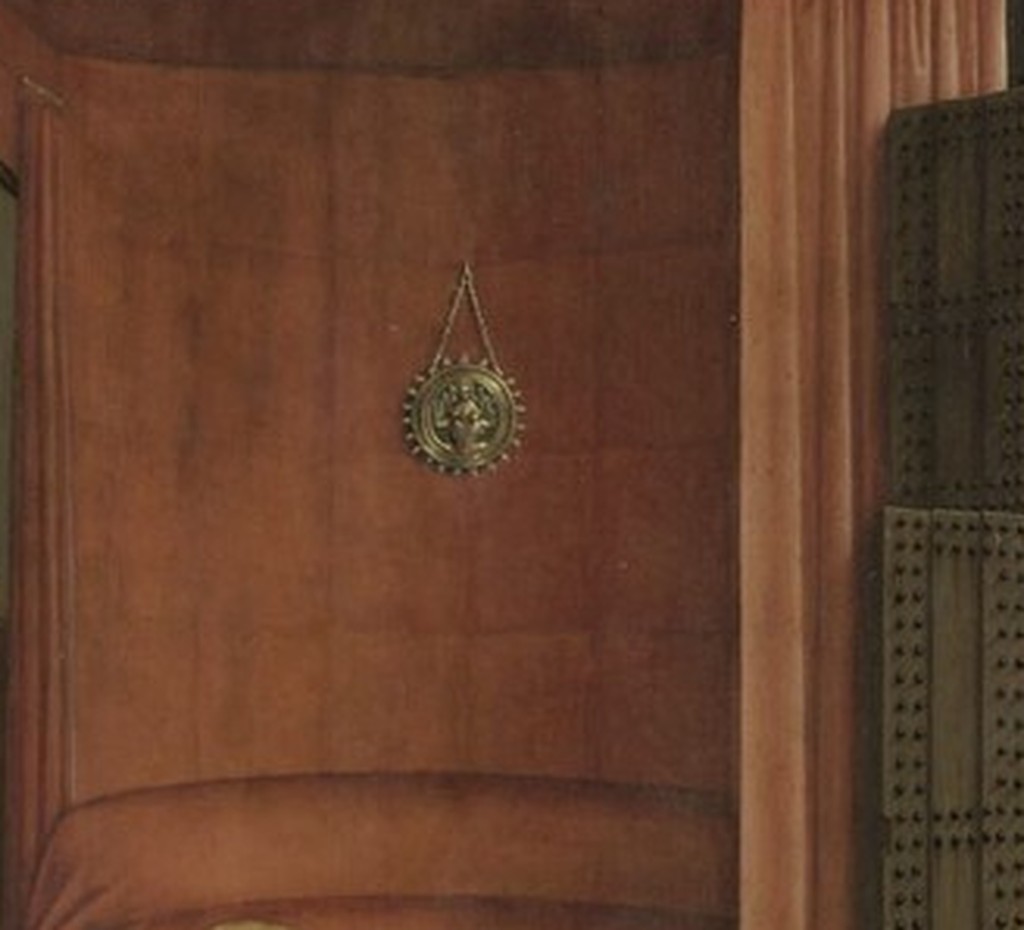
The bed and enclosed room
The bed, hangings and enclosed architecture make the event feel close and inhabitable. They also link sacred history to the visual language of Netherlandish domestic space.
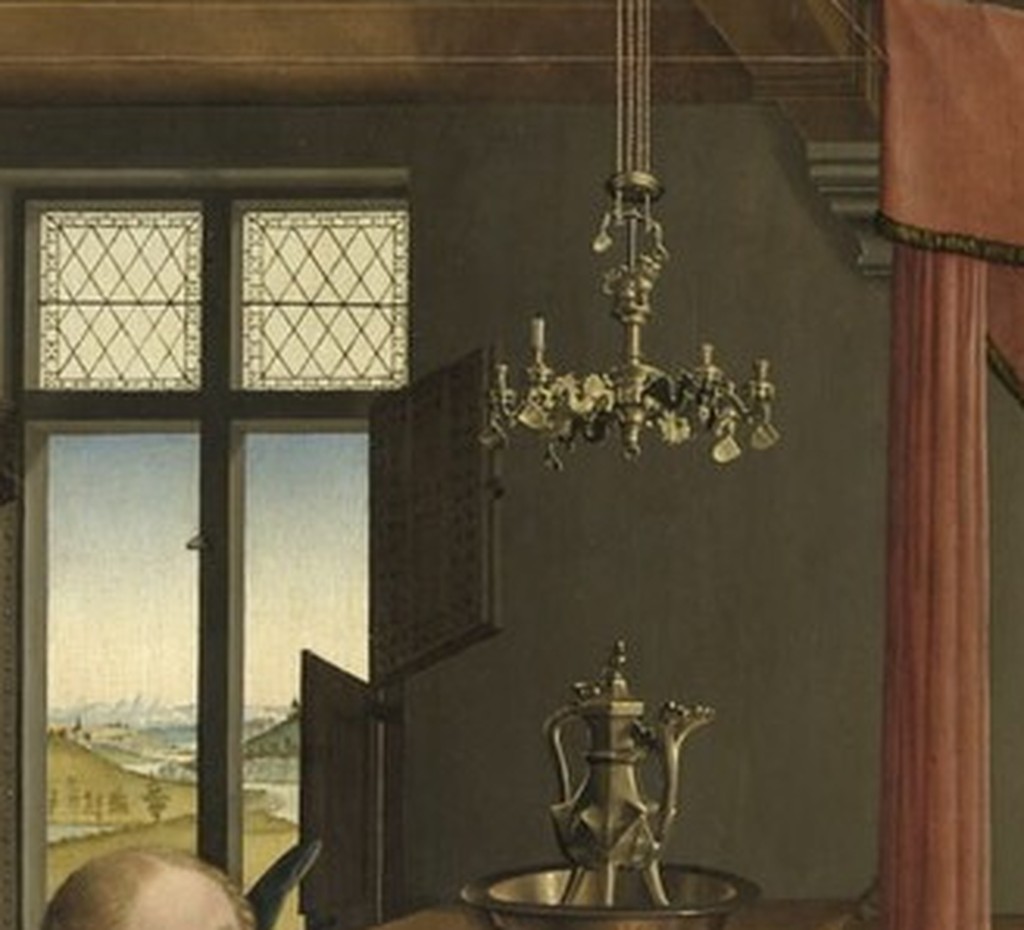
Light through the window
The window turns the room into a small theatre of light. In Annunciation imagery, such light often helps express the mystery of divine entry without breaking the room's physical order.
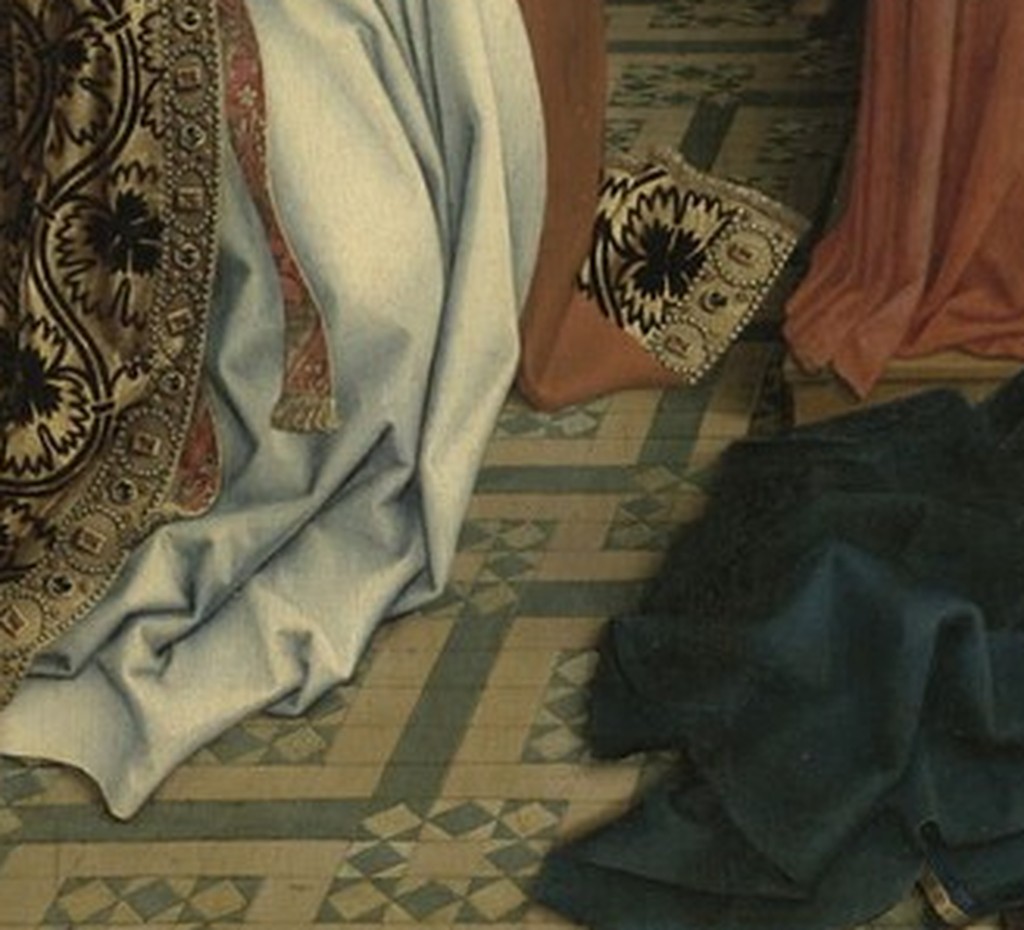
Floor tiles and recession
The tiled floor guides the eye into the space and clarifies the distance between the angel and the Virgin. Geometry quietly supports the devotional drama.
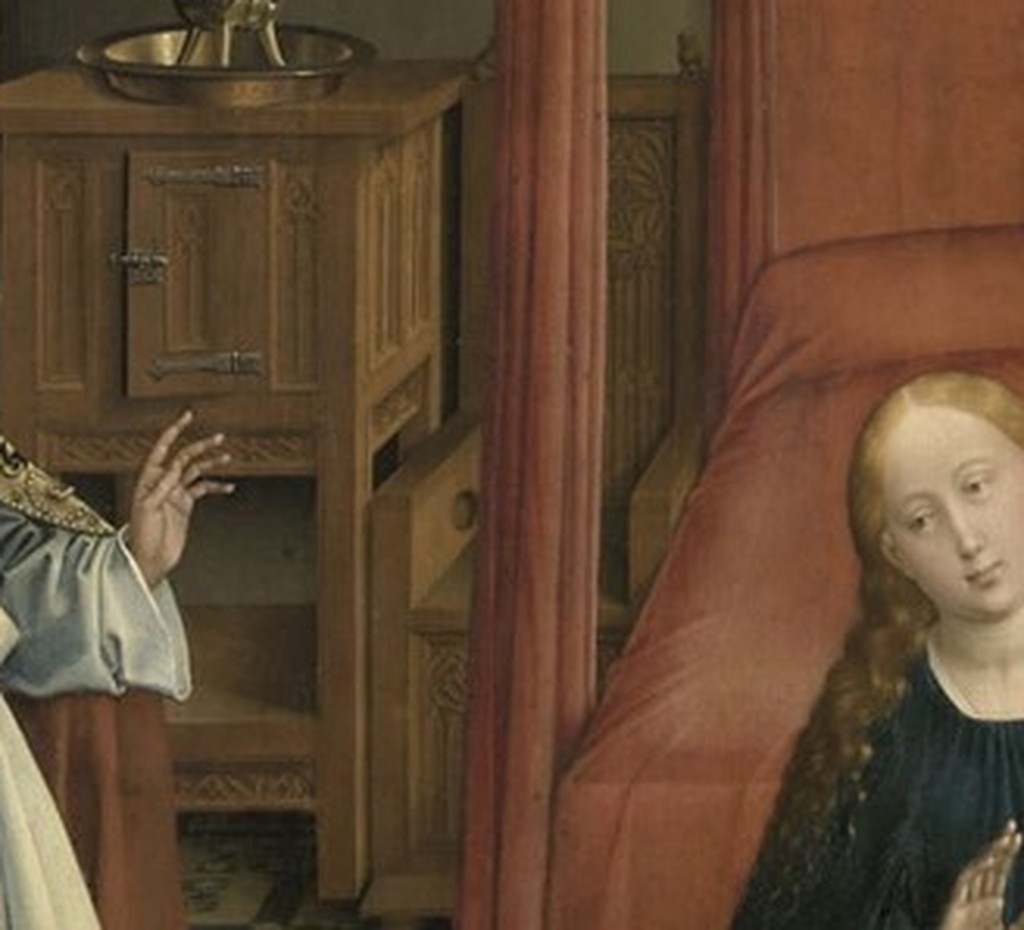
Objects of reading and prayer
Books, furniture and small household forms make the scene legible as a place of reading and prayer. The details matter because the miracle is staged through ordinary things.
The Centre Panel
The centre panel shows the Annunciation, the moment when Gabriel announces to Mary that she will bear Christ. The scene belongs to a long tradition, but the Louvre attribution means the page should speak of Rogier's workshop and artistic circle, not simply Rogier's own hand. [1]
The room matters. Early Netherlandish painters often used domestic interiors to bring sacred events close to the viewer. The Annunciation happens inside a space that feels almost reachable, but its meaning opens into the whole story of the Incarnation.
The painter does not need violent movement to create drama. Gabriel's arrival, Mary's response, the furnishing of the room and the implied movement of divine speech all carry the event. That restraint makes the triptych useful for readers who may otherwise meet Rogier's world only through grief, collapse and Passion imagery.
It is the moment before Christ's visible life, and it therefore belongs beside later pages on the Nativity, Virgin and Child images, and Passion scenes. In the wider Rogier cluster, the page helps readers understand a workshop culture of thresholds: announcement, birth, devotion, suffering, death, judgement and memory.
The Split Triptych
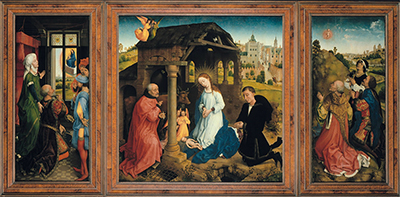
The triptych is now divided between collections. A modern viewer may encounter the Louvre panel alone, but the original logic of the work depended on centre and wings speaking together.
This split-object issue also explains why museum pages do not always reflect original objects. A single panel in Paris may have belonged to a wider devotional structure, and a wing in Turin may carry meaning that becomes clearer when reunited intellectually with the centre.
The safest interpretation is therefore careful and object-aware. The Louvre panel can be discussed in its own right, but the page should also remind readers that the original triptych was a multi-panel devotional object. That matters for Rogier's world because triptychs were designed for relationships: centre and wings, interior and exterior, open and closed, donor and sacred scene.
Gabriel, Mary And The Interior
The emotional power of an Annunciation scene often depends on the smallest shifts: Gabriel's entrance, Mary's posture, the direction of attention, the threshold between ordinary room and divine message.
In this work, the domestic interior makes the sacred event legible. Furniture, enclosed space and architectural order do not distract from the Incarnation. They make it visible inside a world the viewer can recognise.
This is a crucial Netherlandish habit. Painters in Rogier's circle could make theology feel near by placing it in rooms, chambers and city-like spaces. The sacred event is not made ordinary; the ordinary setting is made capable of receiving the sacred.
Early Rogier And Domestic Space
Rogier's later works often feel sculptural and compressed, while this Annunciation shows the kind of intimate room, light, object detail and narrative stillness that mattered in the workshop and artistic environment around him.
The comparison with Robert Campin is useful here. Campin's Annunciation interiors, especially in the Merode tradition, helped shape the Netherlandish habit of making sacred events unfold in recognisable domestic spaces. Rogier and his workshop inherit that world while moving toward clearer emotional and compositional discipline.
Van Eyck's interiors often dazzle through surfaces, light and minute observation. Works associated with Rogier's early circle tend to make interior space serve emotional ordering: how a room becomes a place where obedience, humility and divine arrival can be seen. That distinction keeps the related-artist links helpful rather than generic.
Attribution Caution
The attribution wording is part of the page's value. The Louvre does not present the centre panel simply as "Rogier van der Weyden." It records a workshop/Southern Netherlandish attribution. [1]
That distinction should remain visible. It helps readers understand the difference between secure autograph works, workshop productions, followers, copies and objects associated with Rogier's designs or artistic environment.
The page therefore belongs with the workshop-and-influence section as much as with the painting pages. It shows how Rogier's name can sit within a wider artistic ecosystem rather than only on secure masterpieces.
Place In The Rogier Cluster
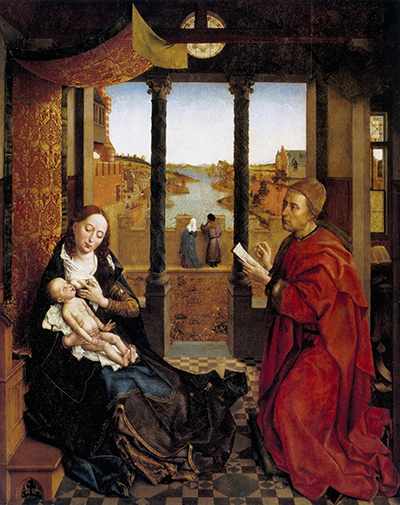
The page has a different purpose from Saint Luke Drawing the Virgin or the Saint Columba Altarpiece. Those works can carry stronger claims about Rogier's artistic identity and mature triptych design. The Annunciation Triptych is more useful as a page about workshop context, domestic sacred space and the problems created by divided objects.
It also helps readers understand the Annunciation theme across Rogier's wider circle. The subject appears in several forms: as a central event, as a wing panel, as part of a larger narrative sequence and as a devotional threshold before Christ's birth. The theme therefore links naturally to the Bladelin Altarpiece, Saint Columba Altarpiece, Duran Madonna and Virgin and Child Enthroned.
The important point is not to exaggerate the panel's certainty. Its value lies in showing how Rogier's artistic environment handled one of the most important subjects in Christian art: the moment when divine history enters a human room.
Looking Without A Complete Object
Because the triptych is divided, the modern viewer has to work with partial evidence. The Louvre panel gives the centre; the Turin wings help reconstruct the wider idea; scholarship supplies the connective tissue. That situation is common in Early Netherlandish painting, where altarpieces have often been split, cut down, restored, sold or reinterpreted.
This makes the page useful for teaching method. A viewer should not treat an isolated panel as if it tells the whole story by itself. Nor should the missing original arrangement make interpretation impossible. The responsible approach is to say what is known, what is likely and what remains dependent on reconstruction.
For Rogier, this matters because so much of the surviving corpus is fragmentary, copied, workshop-related or altered. The Annunciation Triptych gives the cluster another example of careful looking under conditions of incomplete survival.
Links To Other Annunciation Images
The page also belongs beside the Saint Columba Altarpiece and the Bladelin Altarpiece, where Annunciation imagery plays a different role inside larger devotional programs. Those comparisons show how the same subject could function as a central scene, a wing, an exterior image or part of a larger narrative sequence.
For readers, this is useful because it prevents the Annunciation from becoming a single repeated formula. Gabriel, Mary, room, threshold and divine message can be organised in many ways. Rogier's circle inherited a rich Netherlandish tradition and adapted it to different formats.
The page also links naturally to Robert Campin and Jan van Eyck. Their Annunciation interiors help explain the artistic language from which Rogier's workshop emerged, while Rogier's mature triptychs show how that inheritance could become more sculptural, restrained and emotionally ordered.
Why It Matters
The Annunciation Triptych adds a quieter devotional register to the cluster. Treated with the proper workshop attribution, it shows how architecture, gesture and the separation of panels shaped the way Rogier's artistic circle imagined the sacred event.
It also explains why the cluster must be careful with split works. A panel in the Louvre, wings in Turin and attribution language from museum records all need to be held together. That careful handling is more useful to readers than pretending the object is simpler than it is.
FAQs
The centre panel is in the Louvre, while the associated wings are connected with Turin/Galleria Sabauda source leads. [1]
It was originally conceived as a multi-panel work, but the panels are now separated between collections.
The Louvre records the central panel as workshop of Rogier van der Weyden and Southern Netherlandish school, so the page should use cautious attribution language. [1]
It shows how Rogier's workshop environment handled domestic sacred space and helps explain the artist's relationship to Campin and Van Eyck contexts.
Discussion
How does the Annunciation Triptych balance intimate devotion with the formal demands of a multi-panel altarpiece?
Reader Insights
The triptych format asks the viewer to read across thresholds, gestures and architectural divisions rather than treating each scene as isolated.
Its quietness matters. Rogier's Annunciation language is less theatrical than the Descent, but still carefully staged for close attention.
This page is a good place to ask how attribution, workshop participation and surviving evidence shape the way we describe Rogier's output.
Join the Conversation
Have a thought or observation about Annunciation Triptych? Share it below. Thoughtful responses may be added to this section as the Rogier van der Weyden cluster develops.
References
- Musée du Louvre, L'Annonciation, INV 1982 / MR 813, workshop of Rogier van der Weyden, accessed 2026-07-11. https://collections.louvre.fr/en/ark:/53355/cl010061889
- Louvre collections entry JSON for L'Annonciation, accessed 2026-07-11. https://collections.louvre.fr/ark:/53355/cl010061889.json
- Dirk de Vos, Rogier van der Weyden: The Complete Works, 2000.
- Lorne Campbell, Van der Weyden, 2004.