 by Tom Gurney
Tom Gurney BSc (Hons) is an art history expert with over 20 years experience
Published on June 19, 2020 / Updated on July 30, 2026
Email: tomgurney1@gmail.com / Phone: +44 7429 011000
Bladelin Altarpiece: Introduction
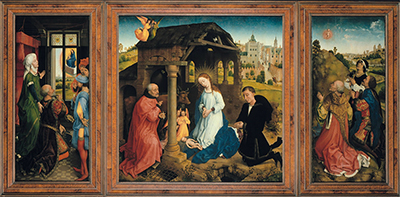
The Bladelin Altarpiece, also known as the Middelburg Altarpiece, is one of Rogier van der Weyden's richest Nativity triptychs. It places the birth of Christ at the centre, then frames that event with two scenes that show rulers and wise men recognizing the arrival of a new divine order. [1]
The painting is now in the Gemaeldegalerie, Berlin. It is usually dated around 1450 and has long been associated with Peter Bladelin, a wealthy Burgundian official and founder of Middelburg in Flanders, although the exact patronage question needs careful wording. [1]
At a Glance
- ArtistRogier van der Weyden
- TitleBladelin Altarpiece / Middelburg Altarpiece
- DateAround 1450
- MediumOil on panel
- FormatTriptych
- Current locationGemaeldegalerie, Berlin
- Inventory lead535 / SMB object 871762
- Main subjectNativity, with related scenes of recognition and kingship
Contents
- Introduction
- At a Glance
- The Centre: The Birth Of Christ
- Augustus And The Sibyl
- The Magi
- Donor And Patronage Questions
- Middelburg And Burgundian Context
- The Exterior
- Berlin And The Rogier Cluster
- How To Read The Triptych
- Why It Matters
- FAQs
The Centre: The Birth Of Christ
The central panel shows the Nativity. Mary and Joseph attend the Christ Child, while the donor kneels close to the holy event. The scene is humble in subject, but Rogier gives it the seriousness of a courtly and theological revelation.
Joseph's candle is an important motif. In Nativity imagery, a candle can suggest the fragile human response to divine light. Christ is the true light entering the world; the little flame becomes both practical object and symbol.
Rogier does not treat the Nativity as sentimental decoration. He makes it the beginning of a new order, recognized by figures across the triptych.
The central scene also depends on proximity. The donor is not pushed into a remote margin. He is close to the sacred event, yet still separate from it through posture, scale and devotion. Rogier uses this balance frequently. Donors want nearness to holiness, but the image must preserve reverence. The kneeling body becomes a visual expression of humility, memory and hope.
The Nativity setting is modest, but the triptych is not modest in ambition. The birth takes place in a world that is already being interpreted by prophecy, empire and kingship. Rogier therefore gives the viewer a child in a humble place and a theological drama stretching across history.
Augustus And The Sibyl
One wing shows the legend of Augustus and the Tiburtine Sibyl. In medieval tradition, the pagan emperor receives or is helped to interpret a vision connected with the Virgin and Child. [1]
This scene matters because it expands the meaning of the Nativity beyond Bethlehem. The birth of Christ is shown as an event that addresses imperial power. Augustus, the emblem of worldly rule, is drawn into a revelation that points beyond empire.
The scene needs a little orientation. It is not a standard Gospel episode, but part of a medieval devotional and legendary tradition around Christ's birth.
Its presence is one of the reasons the Bladelin Altarpiece should not be treated as just another Nativity. The wing frames Christ's birth as a revelation anticipated outside the immediate biblical story. Augustus stands for imperial history; the Sibyl stands for prophecy received through a non-Christian figure; the Virgin and Child vision points to a divine order that relativizes worldly power.
Rogier handles the subject with courtly intelligence. He gives the emperor and his setting visual dignity, but that dignity is redirected toward the child in the centre. The old political world is not merely rejected. It is made to recognize a higher kingship.
The Magi
The other wing shows the arrival of the Magi. Like Augustus, they represent recognition from outside the immediate Jewish and Christian narrative world. They are foreign rulers or wise men who understand that the child matters.
Together, Augustus and the Magi frame the Nativity as global. The new king is recognized by empire, prophecy and distant visitors. Rogier therefore turns the triptych into a statement about the universality of Christ's birth.
The page also sits naturally beside the Saint Columba Altarpiece, another Rogier work that includes the Adoration of the Magi. Together they show how related themes could change across format, patronage and setting.
The Magi also give Rogier an opportunity to combine devotion with luxury. Rich costume, gift-bearing and procession belong naturally to the subject, but they do not overwhelm the central idea. Their splendour is meaningful because it is submitted to the child. In that respect the wing speaks the same language as the donor portrait: status is visible, but it is placed before sacred truth.
The comparison with the Saint Columba Altarpiece is especially useful. In the Munich triptych, the Adoration forms the central panel of a sequence from the infancy of Christ. In the Bladelin Altarpiece, the Magi occupy one wing around a Nativity centre. Rogier could return to related subjects while changing their structure and emphasis.
Donor And Patronage Questions
The altarpiece has been associated with Peter Bladelin, but the identification is not a fact to state too strongly unless the evidence supports it. The German source tradition notes debate around whether the single donor figure fits Bladelin, since a paired donor representation with his wife might have been expected. [1]
This caution is not a weakness.
The attribution and patronage evidence is debated, so the page keeps the uncertainty visible without turning it into the whole subject.
The caution actually makes the work more interesting. It reminds readers that names attached to famous altarpieces often come from a mixture of documents, heraldry, later tradition, local history and visual inference. A title such as "Bladelin Altarpiece" can preserve an important association without proving every detail of the commission.
For Rogier's career, the broader point remains clear. The triptych belongs to the Burgundian social world in which wealthy officials, founders and patrons used religious images to shape memory and devotion. Whether every detail of the donor identification is secure, the painting shows how a private or semi-private devotional object could carry public ambition.
Middelburg And Burgundian Context
Rogier's career was deeply tied to the Burgundian Netherlands: Brussels, Tournai, courtly patrons, ecclesiastical figures and wealthy officials.
This is also a good place to link to Rogier's biography and workshop-and-influence page. The picture is not isolated from politics. It belongs to a network in which religious images carried memory, status, local identity and salvation hope.
Middelburg matters because it gives the painting a local identity within a wider political world. A religious image could honour a sacred subject, support a patron's memory and help define a place. The triptych's association with Bladelin and Middelburg therefore belongs to the same broad culture as the Beaune foundation: piety, status and institution-building are interwoven.
That does not mean the painting is cynical or merely political. In fifteenth-century devotional culture, patronage and salvation were often inseparable. A donor could commission a work for prayer, memory, local prestige and spiritual hope at the same time. Rogier's art is powerful because it can hold those motives without flattening them.
The Exterior
The exterior wings are associated with an Annunciation in grisaille or grey-toned imagery, probably later than the interior. [1] This requires careful wording because the exterior's dating and authorship may differ from the main triptych.
That exterior matters because it changes the object from a Nativity triptych into a more complex devotional instrument. Closed, the Annunciation prepares the viewer for the Incarnation. Open, the Nativity and its recognitions unfold. The movement from Annunciation to Nativity is theologically coherent, even if questions remain about dating and execution.
The grisaille also connects the work to Rogier's wider interest in painted sculpture. Like the exterior of the Beaune Altarpiece, the closed wings use a restrained visual language that differs from the coloured intensity of the interior. The object changes voice when it opens.
Berlin And The Rogier Cluster
The Bladelin Altarpiece is one of several major Rogier works in Berlin. Alongside the Miraflores Altarpiece and Saint John Altarpiece, it gives the cluster a strong German institutional anchor. That matters for both English readers and later German translation, because the Berlin works are not peripheral examples; they are central to how Rogier's triptych practice is understood.
The Berlin group also helps readers compare themes. Miraflores is Marian and meditative; Saint John is narrative and hagiographic; Bladelin is Nativity, prophecy and donor devotion. Together they show Rogier designing multi-panel works for different devotional problems rather than repeating one formula.
The comparison also clarifies Rogier's range. The Descent from the Cross can dominate discussion because it is so famous, but the Berlin triptychs show a different kind of achievement. They are quieter, more sequential and often more dependent on symbolic framing. They reveal Rogier as an artist of systems: sacred history organised across wings, donors positioned within devotion, and painted architecture used to shape thought.
For readers, the Bladelin Altarpiece is especially helpful because its subject is accessible. The Nativity is familiar, the Magi are familiar, and the Augustus/Sibyl wing adds something unexpected. That mix makes the painting an effective bridge from well-known Christmas imagery into the richer world of late medieval typology, prophecy and Burgundian patronage.
How To Read The Triptych
Start in the centre with the Child. The meaning of the wings depends on him. Then move to the donor, whose kneeling posture brings human devotion into the sacred event. After that, compare the two wings: one shows imperial recognition through Augustus and the Sibyl, the other shows royal or wise recognition through the Magi.
The triptych becomes clearer when seen as a chain of acknowledgement. The donor acknowledges Christ through prayer. The Magi acknowledge him through gifts. Augustus is drawn toward acknowledgement through prophetic vision. Rogier's design is therefore not three disconnected episodes, but a meditation on who recognizes the Incarnation and how.
This reading also explains why the work belongs with the Saint Columba Altarpiece. Both treat the infancy of Christ as an event that draws different worlds toward the child: kings, prophecy, donors, architecture and local devotional culture.
Why It Matters
The Bladelin Altarpiece broadens the cluster beyond the most familiar flagship works. It adds a private devotional triptych in which legend, patronage and sacred history meet.
- a major Berlin/German collection anchor
- a Nativity counterpart to Rogier's Passion-heavy pages
- Burgundian elite and Middelburg context
- a bridge to the Saint Columba Adoration page
- a strong example of how Rogier folds legend, prophecy and donor devotion into one triptych
It also balances the cluster's Passion-heavy pages. Rogier is rightly famous for grief, Crucifixion and deposition imagery, but the Bladelin Altarpiece shows him working with birth, prophecy and recognition. That range is essential. Without works like this, Rogier can look like only a painter of sorrow; with it, he becomes a painter of the whole devotional imagination.
FAQs
It is in the Gemaeldegalerie, Berlin. The official SMB object record identifies it with object 871762. [1]
The work has long been associated with Peter Bladelin and Middelburg, though the exact donor identification remains cautious. [1]
The centre shows the Nativity. The wings include the legend of Augustus and the Tiburtine Sibyl and the arrival of the Magi. [1]
Yes. It belongs naturally beside the Saint Columba Altarpiece, Miraflores Altarpiece and Saint John Altarpiece, all of which show Rogier adapting the triptych format to different devotional structures.
Discussion
How should we read the Bladelin Altarpiece: as Nativity devotion, donor statement, civic memory, or a test of Rogier's spatial invention?
Reader Insights
The donor context matters because the painting ties sacred narrative to social position, foundation memory and public identity.
Rogier uses buildings as more than scenery. Architecture frames the sacred event and helps connect earthly patronage to biblical time.
Set it beside the Saint Columba and Miraflores altarpieces to compare how different triptych structures organise devotional looking.
Join the Conversation
Have a thought or observation about Bladelin Altarpiece? Share it below. Thoughtful responses may be added to this section as the Rogier van der Weyden cluster develops.
References
- Staatliche Museen zu Berlin / Gemaeldegalerie, Middelburger-Altar / Bladelin-Altar, object 871762, accessed 2026-07-11. https://id.smb.museum/object/871762/middelburger-altar---bladelin-altar
- Wikipedia (German), Bladelin-Altar, accessed 2026-07-11. https://de.wikipedia.org/wiki/Bladelin-Altar
- The National Gallery, London, artist page for Rogier van der Weyden, accessed 2026-07-11. https://www.nationalgallery.org.uk/artists/rogier-van-der-weyden
- Dirk de Vos, Rogier van der Weyden: The Complete Works, 2000.
- Stephan Kemperdick, Rogier van der Weyden 1399/1400-1464, 1999.