 by Tom Gurney
Tom Gurney BSc (Hons) is an art history expert with over 20 years experience
Published on June 19, 2020 / Updated on July 30, 2026
Email: tomgurney1@gmail.com / Phone: +44 7429 011000
Rogier van der Weyden Style and Technique: Introduction
Rogier van der Weyden's style is built on a rare combination of emotional force and formal discipline. His paintings can feel intensely human: bodies collapse, faces weep, hands tighten, readers concentrate and sitters withdraw into thought. Yet the emotion is never loose. Rogier organises feeling through line, geometry, posture, architectural setting and carefully controlled surface detail.
The National Gallery, London describes Rogier as internationally famed for naturalistic detail and expressive pathos, and notes that his types for portraits and religious subjects were repeated widely across Europe. [1] That reputation rests on more than technical polish. Rogier found visual formulas that could be remembered, copied and adapted because they made feeling legible.
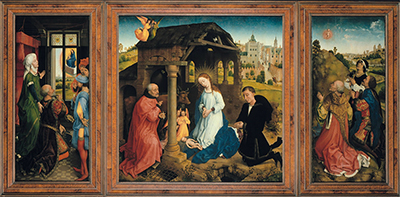
The best way to understand Rogier's method is to bring the major works together. The Descent from the Cross, The Magdalen Reading, Portrait of a Lady and the Saint Columba Altarpiece all reveal his recurring methods: sculptural staging, compressed emotion, controlled faces, eloquent hands, exact detail, planned underdrawing, workshop reuse and architecture charged with meaning.
At a Glance
- Emotional structureGrief, inwardness and devotion are organised through pose and composition
- Sculptural illusionPainted figures often behave like polychrome sculpture or relief
- GeometryCurves, diagonals and triangular forms turn feeling into order
- Hands and facesSmall gestures carry intense psychological meaning
- Oil techniqueDetailed surfaces, textiles, flesh and small objects create material presence
- UnderdrawingStrong preparatory design supports complex figure arrangements
- ArchitectureInteriors, temples and shallow boxes frame sacred meaning
- Workshop practiceFigure types, drawings and patterns were reused and adapted
Contents
- Introduction
- At a Glance
- Emotion Under Control
- Painted Sculpture and Relief
- Geometry and Composition
- Hands, Faces and Psychological Detail
- Detail and Oil Technique
- Underdrawing and Planning
- Architecture and Sacred Space
- Colour and Material Presence
- Workshop and Repetition
- How to Recognise Rogier's Style
Emotion Under Control
Rogier's art is famous for pathos, but pathos is not the same as disorder. His figures often suffer, contemplate or concentrate, yet they do so inside tightly managed compositions. The emotional impact comes from control.
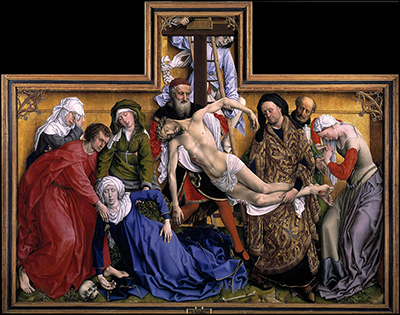
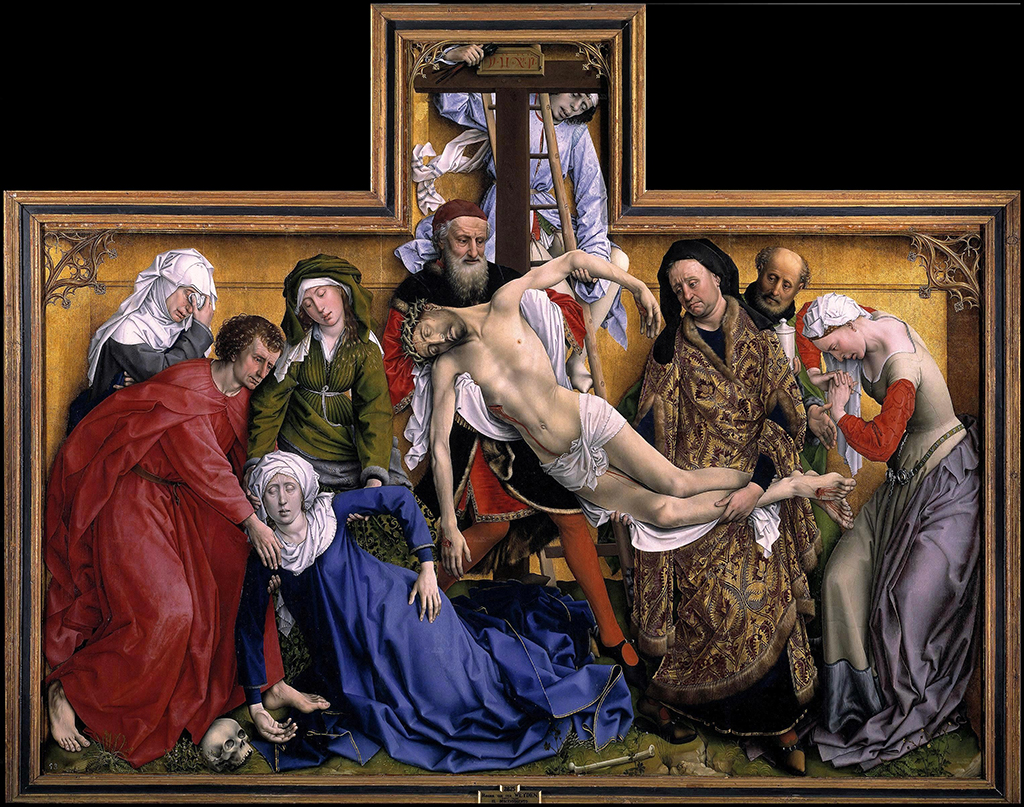
In The Descent from the Cross, the most famous example is the relationship between Christ and the Virgin. Christ's dead body falls in a long diagonal, while Mary collapses below him in a similar curve. The painting's grief is therefore not just expressed by faces. It is built into the structure of the panel. The Prado identifies the work as made before 1443 for the Great Crossbowmen's guild in Leuven and describes its shallow shrine-like space. [2]
In The Magdalen Reading, emotion becomes inward attention. Mary Magdalene's body forms a rounded shape around the book. The National Gallery specifically connects the geometry of her body with the expression of feeling. [3]
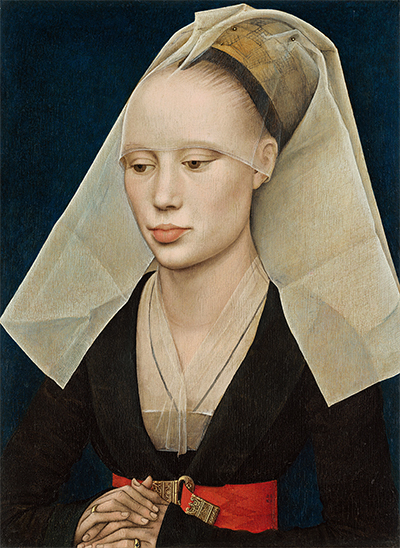
In Portrait of a Lady, the mood is quieter but no less controlled. The NGA presents the portrait as a late work of abstract elegance, where the sitter's lowered eyes, set lips and tense fingers are held inside a rigidly ordered costume and pose. [4]
Across these works, Rogier's method is consistent. He does not simply paint people feeling things. He designs feeling.
Painted Sculpture and Relief
One of Rogier's great inventions is the way painting can imitate or compete with sculpture. In The Descent from the Cross, the figures occupy a shallow gold-backed structure that resembles a carved altarpiece shrine. The Prado describes the panel as evoking a fifteenth-century sculpted altarpiece with polychrome figures. [2]
This sculptural effect changes how the viewer experiences the scene. The figures do not recede into deep landscape. They press forward. Their bodies are rounded, weighty and tactile, but the space around them is deliberately constrained. The result is closer to a painted relief than to a window into the world.
Rogier uses this effect for devotional intensity. A sculpted Passion shrine could make sacred history bodily present to a worshipper; Rogier's painted shrine does something similar through colour, contour and gesture. The viewer faces the figures almost as objects in a sacred box.
This sculptural instinct appears elsewhere too. In the Saint Columba Altarpiece, the architecture gives each scene a controlled stage. In Portrait of a Lady, the sitter's silhouette and headdress have almost carved clarity. Rogier's figures often feel made as much as seen.
Geometry and Composition
Rogier frequently uses geometry to make emotion readable. He does not rely only on narrative details. He gives feeling a shape.
The Descent from the Cross depends on diagonals and echoes. Christ's body and Mary's body form the dominant visual rhythm. Around them, the mourners create a tight human frame, pressing the viewer's attention back to the central grief. [2]
The Magdalen Reading uses a semicircular pose. Magdalene's head and legs curve around the book, making reading itself into a bodily form. The National Gallery notes this as a characteristic use of geometric harmony to express feeling. [3]
Portrait of a Lady uses triangular and vertical order. The headdress frames the face, the dress narrows downward and the clasped hands anchor the lower edge. The NGA notes how the headdress focuses attention and how the red belt sets off the hands. [4]
In each case, geometry creates pressure. It slows the viewer down and makes small details more important. Rogier's images are memorable because their emotional ideas have clear visual skeletons.
Hands, Faces and Psychological Detail
Rogier's hands are rarely neutral. They support, clasp, point, lift, grip, read, steady or mourn. They often carry emotion that the face restrains.
In the Descent, hands hold the shroud, support Christ's limbs and steady the fainting Virgin. Sacred grief becomes practical action. The mourners do not merely watch. They handle the weight of the body. [2]
In The Magdalen Reading, Magdalene's hands hold the book with absorbed care. The devotional act is quiet, but the hands make it visible. [3]
In Portrait of a Lady, the sitter's clasped fingers are one of the main clues to her inner tension. The NGA links the downcast eyes, firm lips and tense fingers to the portrait's sense of mental concentration. [4]
Faces are equally controlled. Rogier does not depend on wild expression. His faces often look grave, inward or held in check. The Pinakothek's description of the Saint Columba Altarpiece notes the seriousness of his figures and the careful treatment of human faces. [5] [6] [7]
This restraint is one reason Rogier's images remain powerful. He does not give emotion away too cheaply. He lets it build through the smallest visible signs.
Detail and Oil Technique
Rogier belongs to the Early Netherlandish culture of exact surface detail. Textiles, tears, hair, flesh, books, metalwork, fur, architecture and distant landscapes all matter. But detail in Rogier is not only decorative. It supports devotion, status and psychological meaning.
The National Gallery's notes on The Magdalen Reading are especially rich. The book has coloured initials, gilded edges, clasps and a protective chemise cover. Tiny details such as bookmarks and stitching reward close looking. [3] The same record describes the handling of Magdalene's lips with mixtures of vermilion, white and red lake, and the fur edging as wet paint dragged to create texture. [3]
In Portrait of a Lady, the NGA singles out the careful rendering of the gold filigree belt buckle and the way the red belt draws attention to the hands. [4] A small accessory becomes part of the painting's psychological design.
In the Saint Columba Altarpiece, the Pinakothek describes detailed realism joined with religious symbolism and typological meaning. [5] [6] [7] Rogier's details therefore work on multiple levels. They make the world believable, but they also point beyond themselves.
Underdrawing and Planning
Rogier's paintings can feel immediate, but they are not casual. The National Gallery records that technical analysis of The Magdalen Reading found no major changes between underdrawing and final painted version, suggesting that the composition was fully worked out in preliminary drawings. It describes the underdrawing as bold, quick and highly assured. [3]
This matters because it explains the stability of Rogier's emotional images. A pose may feel spontaneous, but it rests on planning. Magdalene's body is not simply observed; it is designed. The same is true of the Descent, where the mirrored bodies of Christ and Mary create a compositional structure too precise to be accidental.
Preparatory drawing also connects to workshop practice. If figure types were reused, reversed or adapted, drawings and pattern memory must have played an important role. The National Gallery notes that Rogier and his assistants reused several figures from the larger composition behind The Magdalen Reading, and that Mary appears reversed in the Seven Sacraments Altarpiece. [3]
Rogier's technique therefore includes both invention and transmission. He designs figures with great authority, then allows those figures to live again in related works.
Architecture and Sacred Space
Architecture in Rogier is never just background. It creates the conditions for seeing.
In The Descent from the Cross, the shallow gold box turns the Passion into a staged devotional encounter. [2] The space is artificial, but that artificiality is the point. It presses the figures toward the viewer and removes distraction.
In The Magdalen Reading, the domestic interior creates intimacy. The room, cabinet, cushion, book and window make Magdalene's contemplation feel close and material. [3]
In the Saint Columba Altarpiece, architecture links the panels. The Pinakothek notes that the Annunciation offers a view into a bourgeois bedroom, while the temple interior of the Presentation is skilfully connected with the exterior view of the central panel. [5] [6] [7]
Rogier's spaces can be shallow, domestic, ceremonial or architectural, but they are always purposeful. They guide devotion. They tell the viewer how to approach the figures.
Colour and Material Presence
Rogier's colour is often vivid, but it is rarely casual. In the Descent, blue, red, white, green and gold separate figures while binding them into a devotional whole. Mary's blue gives her visual gravity; Christ's pale body becomes the centre of grief; gold creates a sacred, object-like field. [2]
In The Magdalen Reading, the green dress, red cushion, cloth-of-gold underdress and detailed book create a rich but absorbed world. [3] Colour and material detail deepen the act of contemplation.
In Portrait of a Lady, colour is more restrained. The dark dress and green background quiet the composition, while the pale veil, face and hands carry most of the light. The red belt is a small but decisive accent. [4]
The Saint Columba Altarpiece uses colour in a more ceremonial mode, supporting the splendour of the Adoration and the solemnity of the surrounding scenes. [5] [6] [7]
Across the works, colour clarifies meaning. It guides the eye, marks status, creates emotional temperature and helps the viewer distinguish one figure's role from another.
Workshop and Repetition
Rogier's style cannot be understood only through autograph masterpieces. It also belongs to a workshop culture of assistants, patterns, copies and variants. The National Gallery's artist page explicitly raises the issue of workshop collaboration among his smaller religious works. [1]
This does not reduce Rogier's importance. It helps explain his influence. Strong figure types and compositions could be repeated because they were carefully designed. A Magdalen pose, a grieving body, a portrait formula or a devotional grouping could be adapted for new contexts.
This process needs to be visible without flattening attribution. Current museum records must control whether a work is described as by Rogier, workshop of Rogier, follower of Rogier or after Rogier. Those distinctions matter for trust.
How to Recognise Rogier's Style
Look for emotion organised by structure. Rogier often turns feeling into a strong compositional rhythm: a diagonal, a curve, a triangle, a shallow box or a repeated pose.
Look for hands. They are frequently the most expressive parts of the figure: clasped, lifting, supporting, reading or holding cloth.
Look for controlled faces. Rogier's figures often feel grave rather than theatrical. Their emotion is intense because it is held in.
Look for sculptural presence. His figures can feel like painted statues or relief figures, especially when placed in shallow spaces.
Look for detail that serves meaning. Books, buckles, veils, fur, architecture and tiny landscape elements are beautiful, but they also help define status, devotion and attention.
Why It Matters
Rogier van der Weyden's style matters because it gives Early Netherlandish painting one of its most powerful emotional languages. He joined material detail to spiritual pressure, and he made composition itself carry feeling.
A dedicated style page makes the individual artworks stronger because readers can see the pattern behind them. The Descent from the Cross, The Magdalen Reading, Portrait of a Lady and the Saint Columba Altarpiece are different in subject and scale, but they share a visual intelligence: disciplined emotion, precise surfaces and bodies arranged to make meaning.
Style also prepares readers for attribution and workshop nuance. Rogier's influence spread because his figure types were memorable and usable. Understanding style is therefore not decorative context.
Frequently Asked Questions
His style is known for emotional intensity, naturalistic detail, carefully controlled figures, expressive hands, grave faces and compositions that organise feeling through geometry. [1]
The Prado describes the painting as evoking a fifteenth-century sculpted altarpiece shrine. Rogier uses a shallow gold-backed space to make the figures feel physically present. [2]
Technical analysis of The Magdalen Reading shows assured underdrawing and no major changes between design and final painting, according to the National Gallery. [3]
Hands carry much of the emotional and devotional action. They hold books, support bodies, clasp in restraint, grip cloth and make inner feeling visible.
Workshop practice helped preserve and repeat powerful figure types. The National Gallery notes that figures from the composition behind The Magdalen Reading were reused in other works, including a reversed Magdalen in the Seven Sacraments Altarpiece. [3]
Both belong to Early Netherlandish painting, but Rogier is especially associated with emotional construction and pathos, while Van Eyck is often associated with optical richness and luminous detail. The comparison is useful, but each artist needs to be understood on his own terms.
Discussion
Which technical feature best explains Rogier's style: underdrawing, surface detail, figure geometry, colour, hands, or emotional restraint?
Reader Insights
Technique matters because Rogier's emotion is made. Underdrawing, figure placement and surface finish all serve psychological clarity.
Look repeatedly at hands and faces across the cluster. They often carry more emotional information than dramatic action alone.
This page should feed readers back into the major works with sharper eyes, especially the Descent, Portrait of a Lady and Magdalen.
Join the Conversation
Have a thought or observation about Rogier van der Weyden Style and Technique? Share it below. Thoughtful responses may be added to this section as the Rogier van der Weyden cluster develops.
References
- The National Gallery, London, artist page for Rogier van der Weyden, accessed 2026-07-11. https://www.nationalgallery.org.uk/artists/rogier-van-der-weyden
- Museo Nacional del Prado, The Descent from the Cross, collection record for P002825, accessed 2026-07-11. https://www.museodelprado.es/en/the-collection/art-work/the-descent-from-the-cross/856d822a-dd22-4425-bebd-920a1d416aa7
- The National Gallery, London, The Magdalen Reading, collection record for NG654, accessed 2026-07-11. https://www.nationalgallery.org.uk/paintings/rogier-van-der-weyden-the-magdalen-reading
- National Gallery of Art, Washington, Portrait of a Lady, collection record for 1937.1.44, accessed 2026-07-11. https://www.nga.gov/artworks/51-portrait-lady
- Sammlung Pinakothek / Bayerische Staatsgemaeldesammlungen, Columba-Altar: Verkuendigung, WAF 1190, accessed 2026-07-11. https://www.sammlung.pinakothek.de/de/artwork/A0GOlar4dp
- Sammlung Pinakothek / Bayerische Staatsgemaeldesammlungen, Columba-Altar: Anbetung der Koenige, WAF 1189, accessed 2026-07-11. https://www.sammlung.pinakothek.de/de/artwork/jWLpO7nxKY
- Sammlung Pinakothek / Bayerische Staatsgemaeldesammlungen, Columba-Altar: Darbringung im Tempel, WAF 1191, accessed 2026-07-11. https://www.sammlung.pinakothek.de/de/artwork/53470Zmx9e
- Dirk de Vos, Rogier van der Weyden: The Complete Works, Harry N. Abrams, 2000.
- Lorne Campbell and Jan Van der Stock, eds., Rogier van der Weyden: 1400-1464. Master of Passions, Leuven, Davidsfonds, 2009.