 by Tom Gurney
Tom Gurney BSc (Hons) is an art history expert with over 20 years experience
Published on June 19, 2020 / Updated on July 30, 2026
Email: tomgurney1@gmail.com / Phone: +44 7429 011000
Saint Luke Drawing the Virgin: Introduction
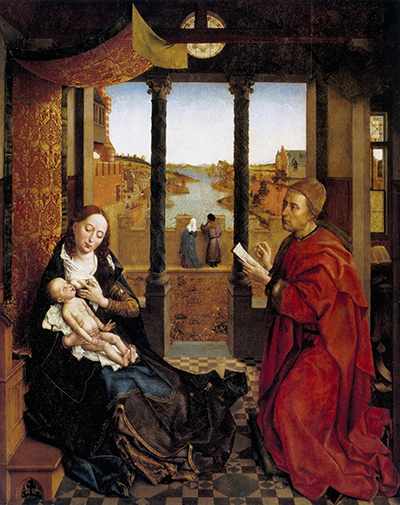
Saint Luke Drawing the Virgin is one of the most revealing images in Rogier van der Weyden's career because it turns painting itself into a sacred subject. The work shows Luke the Evangelist, traditional patron of painters, drawing the Virgin Mary as she nurses Christ. The result is devotional, but also self-aware: it asks what it means for an artist to look, record and translate holiness into an image.
The Boston panel is usually treated as the prime version of a composition that became highly influential. Related versions survive in Munich, Bruges and St Petersburg, but technical study and underdrawing evidence have helped support the importance of the Museum of Fine Arts, Boston picture. [1]
At a Glance
- ArtistRogier van der Weyden
- TitleSaint Luke Drawing the Virgin
- DateUsually dated around 1435-1440
- MediumOil and tempera on oak panel
- Dimensions137.5 x 110.8 cm
- Current locationMuseum of Fine Arts, Boston
- Accession93.153
- SubjectSaint Luke drawing the Virgin and Child
Contents
- Introduction
- At a Glance
- Luke As Artist
- A Conversation With Jan Van Eyck
- The Virgin And Child
- Space, Architecture And Landscape
- Underdrawing And The Prime Version
- Painters' Guilds And Artistic Identity
- Condition And Conservation
- Why It Matters
- FAQs
- Discussion
Luke As Artist
The subject depends on a long tradition that credited Saint Luke with making an image of the Virgin. In fifteenth-century northern Europe, Luke was also the patron saint of painters' guilds. That makes the image more than a biblical scene. It is a meditation on art's authority.
Rogier places Luke in the same pictorial world as the Virgin and Child. He is not watching a vision from a safe symbolic distance. He kneels close to the mother and child, absorbed in the act of drawing. His attention is humble, but also professional. He is a saint, a witness and a working artist.
Rogier's art repeatedly makes sacred feeling visible through precise design. In Saint Luke Drawing the Virgin, that process becomes the painting's subject.
The panel also dignifies drawing itself. Luke does not appear only as a writer of the Gospel. He is shown as someone translating sacred presence into visible form. That distinction matters in a culture where painting could be defended as a serious devotional and intellectual activity. The image is therefore partly about why pictures matter.
For Rogier, this subject was especially meaningful. His career depended on patrons, workshops, public reputation and the authority of images. By placing Luke before the Virgin and Child, Rogier places the artist's labour inside sacred history. The painter is not merely a maker of luxury goods. He can become a disciplined witness.
A Conversation With Jan Van Eyck
The composition is often discussed in relation to Jan van Eyck's Madonna of Chancellor Rolin. Both images set sacred figures in a rich interior that opens onto a landscape beyond. Both create a world in which devotion and observation coexist. [1]
But Rogier changes the logic of the scene. Van Eyck's chancellor kneels as donor before the Virgin and Child. Rogier's Luke kneels as artist before them. The viewer is no longer watching patronage alone. The viewer is watching the birth of an image.
This comparison needs care. Rogier is not simply copying Van Eyck. He is responding to a model and turning it toward another question. Where Van Eyck's picture explores donor presence, luminous detail and worldly space, Rogier's picture explores artistic making, sacred attention and emotional concentration.
The comparison also helps explain the difference between the two painters. Van Eyck's world often feels saturated with optical wonder: reflections, surfaces, distance, light and worldly specificity. Rogier uses many of the same northern tools, but he tightens them around emotional and devotional focus. In Saint Luke Drawing the Virgin, the setting is rich, but the psychological centre is the act of looking and drawing.
This makes the panel one of the best places to link Rogier with Jan van Eyck without reducing either artist. The two artists shared a visual culture, but their priorities diverged. Rogier learned from the language of precise oil painting and deep interiors, then reshaped it into a more concentrated devotional drama.
The Virgin And Child
Mary sits with the Christ Child in a domestic yet elevated space. She is intimate and monumental at the same time. The nursing motif emphasizes Christ's real infancy and Mary's bodily motherhood, while the setting lifts the scene into a world of symbolic order.
The child is not a remote emblem. He is physically present, dependent and close. Luke's drawing therefore becomes an encounter with incarnation. He is not drawing an abstract doctrine. He is drawing a mother and child whose sacred meaning comes through visible flesh.
Both paintings place a holy figure in a quiet act: reading, drawing, nursing, attending. Rogier's drama is often loud in feeling, but it can also be intensely still.
The nursing Virgin also gives the painting a strong theological core. Incarnation is not only announced; it is made visible through bodily care. The infant Christ depends on Mary, and Luke's drawing records that dependency. The sacred subject is therefore both exalted and human.
Rogier's Mary is not a distant queen set beyond ordinary life. She is placed in a carefully ordered interior, but her action is maternal. That combination of grandeur and intimacy is one of the reasons the image became so influential. It offers a Virgin who can sustain devotion, artistic theory and human tenderness at the same time.
Space, Architecture And Landscape
The setting opens from an interior toward a courtyard, river, town and distant landscape. This passage from room to world gives the painting a layered structure. The sacred event happens close to the viewer, but it is not sealed off. It belongs to a larger city and landscape.
The architecture is also a stage for looking. Luke looks at Mary. Mary and the Child occupy the centre of his attention. The viewer looks at both the sacred figures and the artist looking at them. Rogier builds a chain of seeing, and that chain is the painting's real subject.
It would help show how Rogier uses space to link intimate devotion with the wider world.
The open loggia and distant view also create a bridge between contemplation and public world. The artist kneels in a near space of devotion, but beyond him lies a city, a river and a landscape. Sacred image-making is not isolated from the world; it is made within it.
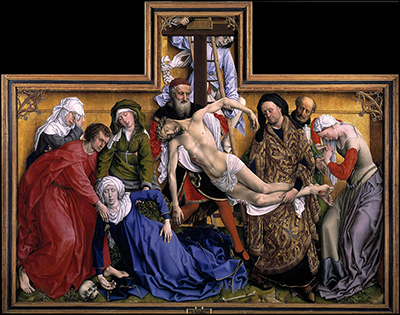
That layered space is a useful contrast with the Descent from the Cross. In the Prado painting, Rogier compresses figures into a shallow, box-like stage. In Saint Luke Drawing the Virgin, he opens the space outward. The difference shows that Rogier was not limited to one compositional formula. He could compress or expand space depending on the devotional problem.
Underdrawing And The Prime Version
The Boston version's importance partly depends on technical evidence. Scholarship has emphasized its underdrawing and reworking, which suggest a live creative process rather than a simple copy. [1] The related versions in Munich, Bruges and St Petersburg are important for reception, but the Boston panel has a special place in the history of the composition.
This evidence is useful when it remains clear and not overplayed. The key reader-friendly point is simple: the Boston painting is valued not just because it preserves a famous composition, but because its material evidence helps reveal Rogier thinking through the image.
The existence of related versions also shows how powerfully the composition travelled. A painter's invention could live beyond the original panel through copies, workshop versions and later adaptations. That is central to Rogier's artistic afterlife. Some works survive as autograph paintings; others survive as copies after lost or damaged originals; still others survive as versions that record how a successful design was reused.
For readers, the Boston panel becomes a good case study in how art history works. The question is not simply "which picture is prettiest?" Scholars compare underdrawing, changes during painting, condition, panel structure, provenance and the behaviour of related versions. Technical evidence does not replace visual judgement, but it can make visual judgement more secure.
Painters' Guilds And Artistic Identity
Because Saint Luke was the patron saint of painters, the subject had special resonance for artistic communities. A painting of Luke drawing the Virgin could function as an image of professional identity as well as devotion. It says that the artist's craft has a sacred origin and a disciplined responsibility.
That responsibility is visible in Luke's posture. He is close, but reverent. He observes, but does not intrude. He works with a tool, but the act is prayerful. Rogier uses the saint to define the ideal painter: attentive, humble, technically skilled and spiritually serious.
This is why the painting belongs near the workshop-and-influence page. Rogier's authority did not depend only on individual genius. It moved through workshop practice, guild culture, versions, drawings, underdrawings and the repeated life of compositions. Saint Luke Drawing the Virgin makes that world visible in a single sacred scene.
Condition And Conservation
The work has suffered damage and restoration, and its condition has shaped the history of its attribution. [1] That fact matters because it helps explain why old-master attributions can change over time. Paintings are not only images. They are objects that age, get cleaned, get repaired, and are reinterpreted through technical study.
This also makes Saint Luke Drawing the Virgin useful for the workshop-and-influence page. The existence of related versions and copies shows how powerful Rogier's invention became. The damaged but crucial Boston panel and the cleaner later versions together explain why art historians look at both visual quality and material evidence.
Why It Matters
It is not only a famous religious painting. It is a painting about the artist's vocation.
- Rogier's relationship with Jan van Eyck
- the Guild of Saint Luke and the status of painters
- underdrawing and prime-version debates
- the use of domestic space in Early Netherlandish painting
- the spread of Rogier's compositions through copies and versions
It also gives the cluster a crucial self-reflective work. Many Rogier pages explain what he painted: Christ's body, grieving mourners, saints, donors, portraits and altarpieces. This page explains what painting meant. It shows artistic labour as a form of sacred attention.
FAQs
The prime version is in the Museum of Fine Arts, Boston, accession 93.153. [1]
Saint Luke was traditionally believed to have made an image of the Virgin and became the patron saint of painters. Rogier uses that tradition to make the act of art-making itself devotional.
Yes. The composition is often compared with Van Eyck's Madonna of Chancellor Rolin, though Rogier transforms the donor-image structure into a scene about an artist drawing the Virgin.
Yes. Related versions are associated with Munich, Bruges and St Petersburg, but the Boston version is generally treated as the key or prime version because of its quality and technical evidence. [1]
Discussion
Why is Saint Luke Drawing the Virgin such an important page: artistic self-image, Marian devotion, workshop versions, or the link between seeing and making?
Reader Insights
The subject turns sacred vision into artistic practice, making the act of drawing part of devotional meaning.
The existence of versions and related works makes this page useful for explaining workshop practice and the movement of compositions.
It deserves strong promotion because it connects Rogier to questions of authorship, devotion and the artist's role in sacred representation.
Join the Conversation
Have a thought or observation about Saint Luke Drawing the Virgin? Share it below. Thoughtful responses may be added to this section as the Rogier van der Weyden cluster develops.
References
- Museum of Fine Arts, Boston collection entry for Saint Luke Drawing the Virgin, accession 93.153, accessed 2026-07-11. https://www.mfa.org/
- Wikipedia, Saint Luke Drawing the Virgin, accessed 2026-07-11. https://en.wikipedia.org/wiki/Saint_Luke_Drawing_the_Virgin
- The National Gallery, London, artist page for Rogier van der Weyden, accessed 2026-07-11. https://www.nationalgallery.org.uk/artists/rogier-van-der-weyden
- Carol Purtle, ed., Saint Luke Drawing the Virgin: Selected Essays in Context, Boston, Museum of Fine Arts, 1997.
- Lorne Campbell and Jan Van der Stock, eds., Rogier van der Weyden: 1400-1464. Master of Passions, Leuven, 2009.