 by Tom Gurney
Tom Gurney BSc (Hons) is an art history expert with over 20 years experience
Published on June 19, 2020 / Updated on July 30, 2026
Email: tomgurney1@gmail.com / Phone: +44 7429 011000
Prints, Copies and Reproductions after Rogier van der Weyden: Introduction
Rogier van der Weyden's influence spread not only through original paintings but through copies, adaptations and later reproductions. A page titled simply "prints" risks misleading readers, because Rogier was not known primarily as a printmaker. The better subject is how his inventions travelled after him.
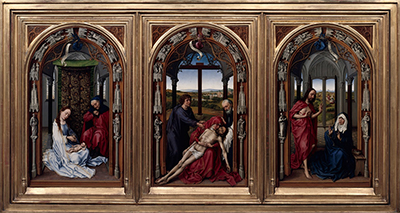
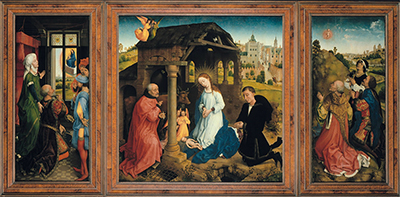
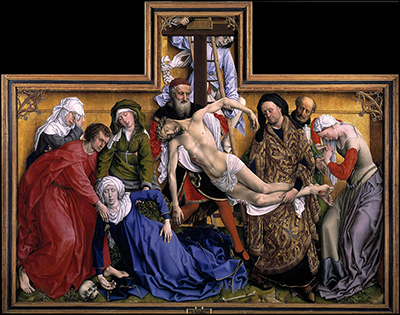
The strongest anchor is the Descent from the Cross. It was copied and adapted on a large scale, and the 1443 Edelheere Altarpiece in Leuven is one of the most important early copies. [1] [2]
At a Glance
- Main focusCopies, adaptations and reproductions after Rogier
- Key anchorThe Descent from the Cross and the Edelheere Altarpiece
- Regional anchorLeuven / Sint-Pieterskerk copy tradition
- Main cautionRogier was a painter, not primarily a printmaker
Contents
- Introduction
- At a Glance
- Copies Are Evidence
- The Edelheere Altarpiece
- Printed Dissemination
- Workshop, Memory And Repetition
- Reception Beyond The Original
- Copies And Quality
- Relation To Later Artists
- Why It Matters
- FAQs
- Discussion
Copies Are Evidence
Copies are not just weaker versions of originals. They are evidence of fame, demand and transmission. When an image is copied repeatedly, it tells us that patrons, workshops and viewers found it powerful enough to preserve and reuse.
For Rogier, the Descent from the Cross is the central case. The Prado painting's emotional structure, shallow space and mirrored collapse of Christ and Mary became one of the most influential inventions in northern painting. [2]
Some copies try to preserve a famous composition closely. Others adapt a pose, a group of mourners, a devotional idea or a figure type. Some are workshop products; others belong to later artists responding to a prestigious model. The key question is what exactly is being copied.
This distinction matters because influence is not one simple thing. A later work may copy a whole composition, borrow a figure, echo an emotional formula, reverse a design, or respond to a subject type. All of those are different kinds of relationship.
The Edelheere Altarpiece
The Edelheere Altarpiece was made in 1443 for St Peter's Church in Leuven and is an early copy after Rogier's Descent from the Cross. [1] Its date is crucial because it helps show that Rogier's original was already known and valued by that point.
Leuven was not only the original civic and religious context for the Descent commission; it also preserved a major copy tradition.
Rogier's original Descent is now in Madrid, and the Prado rightly controls the main object facts. But the painting's first life belonged to a Leuven religious and civic setting. The Edelheere copy helps reconnect the image with that local world.
This is one reason the page belongs in the Rogier cluster even if it is not about an autograph Rogier painting. Copies can preserve evidence of reception, geography and early fame. They show how quickly a composition could become authoritative.
Printed Dissemination
Later print culture helped carry Netherlandish inventions across Europe. Rogier's formulas shaped painters and printmakers, even when the transmission was indirect. Martin Schongauer and Albrecht Durer belong to the broader northern corridor in which Rogier's emotional and compositional inventions remained alive. [3]
The safer reading does not claim that every later print depends directly on Rogier. The safer argument is that copies and prints allowed northern religious imagery to circulate widely, and Rogier's inventions were among the most powerful sources available.
Those links work best as subject and reception pathways, not as a single straight line of influence. A print may share a theme, a pose or an emotional type without being a direct copy from Rogier's hand.
Workshop, Memory And Repetition
Copies also connect to workshop practice. Rogier's workshop and followers could preserve compositions, repeat figure types and adapt successful inventions for new patrons. That does not make every related work autograph, but it does show how artistic ideas travelled.
This page therefore links naturally to the Drawings and Underdrawing page. Drawing, pattern memory, workshop models and later copies all belong to the same larger question: how did Rogier's art keep moving after the first painting was made?
It also links to the workshop-and-influence page, where attribution terms such as "workshop of," "follower of," "after" and "copy after" are important. The language used for copies should be precise because it tells readers what kind of evidence they are looking at.
Reception Beyond The Original
The survival of copies changes how we understand Rogier's reputation. A painting can be influential even when viewers never saw the original. They may have known a copy, a reduced version, a print, a drawing or a composition repeated by another artist.
This is especially important for the Descent from the Cross. Its original emotional invention could travel through versions that were not identical to the Prado painting. The power of the design lay partly in its repeatability: the mirrored grief of Christ and Mary, the shallow stage, the compressed figures and the dramatic handling of hands and bodies.
The page also gives readers a way to think about lost works. Some compositions may be known only through copies or related images. In those cases, later works are not distractions from art history; they are evidence that helps reconstruct what has disappeared.
Copies And Quality
Not all copies have the same value. Some are close and early. Some are later or freer. Some preserve important information; others mainly show reputation. The page should help readers understand that copies need to be judged by date, purpose, proximity to the original, quality and documentary context.
This is why the Edelheere Altarpiece is so important. Its early date gives it unusual weight. It is not just another later echo; it is evidence that Rogier's Descent quickly became a model.
Precise language keeps the page useful. "After Rogier" is not a dismissal. It is a way of saying that the work depends on Rogier's invention while belonging to another hand, moment or context.
Relation To Later Artists
Rogier's influence did not move in a single straight line, but later northern artists worked in a visual world shaped partly by his inventions. Schongauer, Durer and later painters encountered Netherlandish devotional formulas through paintings, drawings, copies and prints. [3]
The page should therefore avoid turning every later similarity into a direct debt. The more useful point is broader: Rogier helped create a language of grief, close devotional attention and compressed sacred drama that later artists could inherit, transform or challenge.
This is why internal links to the workshop-and-influence page matter. The copies page explains the objects and mechanisms; the influence page explains the larger artistic network.
The page also helps protect readers from a common simplification. Influence is not always admiration by a named later artist. It can be practical, workshop-based, devotional, commercial or accidental. Rogier's compositions survived because they were useful to many kinds of makers and viewers.
That is why copies after Rogier deserve a serious page. They are part of the history of how images live after their first setting.
The page also gives the paintings hub a useful support route. Readers can move from the original Descent from the Cross to later copies, then back to workshop practice and drawings with a clearer sense of how a fifteenth-century composition could become a tradition.
Why It Matters
The page matters because it explains how Rogier's fame worked after the original paintings left their first settings. Copies and reproductions show demand, influence, memory and artistic transmission.
It also gives readers a more honest version of the old "prints" topic. Rogier was not primarily a printmaker, but his images entered the wider world of copied, adapted and printed devotional imagery. That is the real story.
FAQs
Rogier is known primarily as a painter, not as a printmaker.
It is an early 1443 copy after Rogier's Descent from the Cross and helps show the painting's early influence. [1]
Copies show how a composition travelled, how it was valued and how later artists encountered it.
No. Some are close copies, some are adaptations, and some belong to broader traditions shaped partly by Rogier's inventions.
Discussion
How did Rogier's compositions live on through prints, copies and reproductions, and where should we draw the line between influence and repetition?
Reader Insights
Copies and reproductions are not secondary trivia here. They explain how Rogier's image types travelled after the original context changed.
The page should avoid turning every later echo into direct influence. Some routes are strong; others are best described as reception or reuse.
This support page helps readers understand why workshop and influence matter to Rogier's reputation as much as surviving autographs do.
Join the Conversation
Have a thought or observation about Prints, Copies and Reproductions after Rogier van der Weyden? Share it below. Thoughtful responses may be added to this section as the Rogier van der Weyden cluster develops.
References
- Wikipedia, the Edelheere Altarpiece / Leuven copy after Rogier's Descent from the Cross, accessed 2026-07-11. https://en.wikipedia.org/wiki/Edelheere_Altarpiece_(Descent_from_the_cross)
- Museo Nacional del Prado, The Descent from the Cross, collection record for P002825, accessed 2026-07-11. https://www.museodelprado.es/en/the-collection/art-work/the-descent-from-the-cross/856d822a-dd22-4425-bebd-920a1d416aa7
- Wikipedia, Rogier's influence and northern print dissemination, accessed 2026-07-11. https://en.wikipedia.org/wiki/Rogier_van_der_Weyden
- Amy Powell, "The Errant Image: Rogier van der Weyden's Deposition from the Cross and its Copies," Art History, 2006.