 by Tom Gurney
Tom Gurney BSc (Hons) is an art history expert with over 20 years experience
Published on June 19, 2020 / Updated on July 30, 2026
Email: tomgurney1@gmail.com / Phone: +44 7429 011000
Rogier van der Weyden Workshop and Influence: Introduction
Rogier van der Weyden's influence was not carried by one simple route. It moved through workshop practice, drawings, copied compositions, repeated figure types, patronage networks, exported paintings, later collectors and the memory of lost works. His art was admired during his lifetime, repeated after his death and absorbed into the broader language of northern European devotional painting.
Rogier was influential not only because individual paintings were famous, but because his solutions could travel: a grieving body, a pensive sitter, a Magdalen absorbed in reading, a compressed Passion group, a donor portrait, a triptych structure.
Workshop and influence also need careful language. Some surviving works are by Rogier, some are by his workshop, some are copies, some are followers, some are fragments of lost ensembles, and some are later echoes of a subject he helped define. These distinctions are not pedantic.
At a Glance
- Workshop collaborationHelps explain uneven quality, repeated types and attribution caution
- Drawings and patternsAllowed figures and compositions to be reused or adapted
- Lost worksMajor commissions such as civic Justice scenes shaped reputation despite destruction
- Copies and fragmentsPreserve evidence for lost altarpieces and famous compositions
- Patronage networksCarried Rogier's art across the Burgundian Netherlands and beyond
- Portrait influenceShaped Netherlandish ideas of restraint, status and inwardness
- Religious influenceSpread emotional formulas for Passion, Virgin and saint imagery
- Later subject linksRubens and Rembrandt show later northern treatments of Descent themes
Contents
- Introduction
- At a Glance
- Workshop Culture
- Drawings, Patterns and Reuse
- Fragments and Reconstructions
- Portrait Types
- Religious Types and Devotional Pathos
- Patronage and Movement Across Europe
- Related Artists
- Later Descent Links: Rubens and Rembrandt
- How to Read Attribution Language
- Why It Matters
Workshop Culture
Fifteenth-century painting was rarely a purely solitary enterprise. A major master worked with assistants, drawings, patterns and delegated labour. The National Gallery's Rogier artist page notes that the uneven quality among several smaller religious works raises the question of workshop collaboration. [1]
That question is not a problem to hide. It is part of how the art was made. A workshop could prepare panels, transfer designs, paint secondary passages, repeat successful figures and produce versions for different patrons. The master's style could therefore extend beyond the master's own hand.
For Rogier, this is especially important because his figure types were powerful and memorable. A grieving Virgin, a reading Magdalen, a half-length portrait sitter or a compressed devotional group could become a model. Assistants and followers could adapt those models, while patrons could request familiar formulas.
Museum attribution language matters because each phrase carries a different level of certainty.
Drawings, Patterns and Reuse
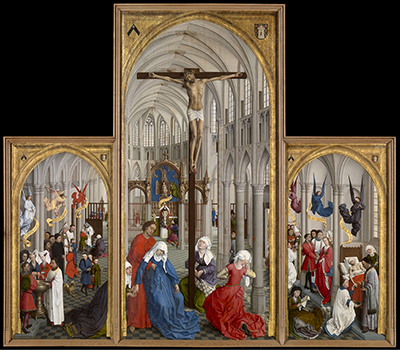
The National Gallery explains that the London fragment was once part of a larger Virgin and Child with saints altarpiece, and that a fifteenth-century sketch in Stockholm helps reconstruct the original design. It also notes that Rogier and his assistants reused several figures from that larger composition, with Mary herself appearing in reverse in the Seven Sacraments Altarpiece in Antwerp. [2]
This tells us several things. First, Rogier's compositions were planned through drawings and figure studies. Second, successful figures were not discarded after one use. Third, workshop practice could preserve a pose, reverse it, adapt it and give it new meaning.
The Magdalen type is not merely repeated as a shortcut. In London, she is a figure of contemplative reading. In the Antwerp altarpiece, her reversed presence belongs to a different theological and spatial structure. Reuse becomes interpretation.
This helps readers understand Rogier's art more generously. Workshop repetition is not necessarily mechanical. In the hands of a strong painter and workshop, it can be a way of carrying expressive forms across subjects.
Fragments and Reconstructions
Rogier's legacy is shaped by loss. Some important works were cut apart, damaged, overpainted, copied or destroyed. The surviving corpus must be read as both art and evidence.
The Magdalen Reading is the best compact example. It now functions as a complete image of Mary Magdalene reading, but it was originally only the lower right corner of a much larger altarpiece. Related fragments survive in Lisbon, and the Stockholm sketch helps reconstruct the lost whole. [2]
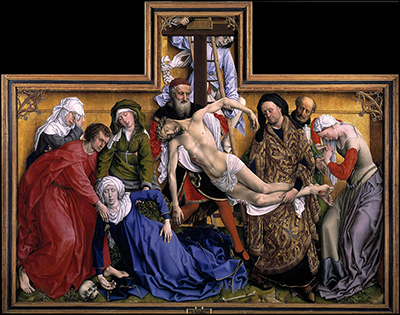
The Prado Descent from the Cross also shows how copies preserve reputation. The Prado records an early copy dated 1443, which helps establish that Rogier's original was completed before that date. [3] The copy also shows how quickly the image mattered.
Lost civic works are another part of the story. Rogier's Justice scenes for Brussels Town Hall no longer survive, but they were central to his public reputation. Printed authorities such as Dirk de Vos and Lorne Campbell remain important for these destroyed and reconstructed aspects of the career. [8] [9]
Absence is part of Rogier's history. What survives is magnificent, but it is not the whole story.
Portrait Types
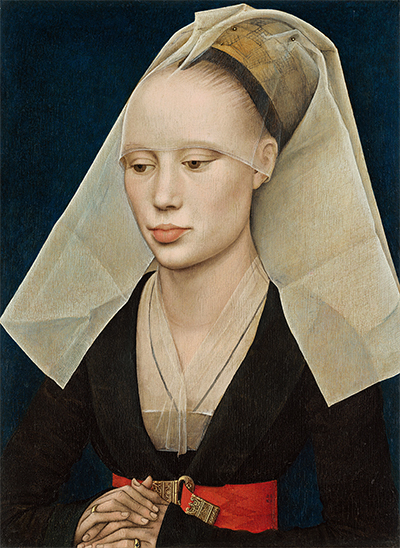
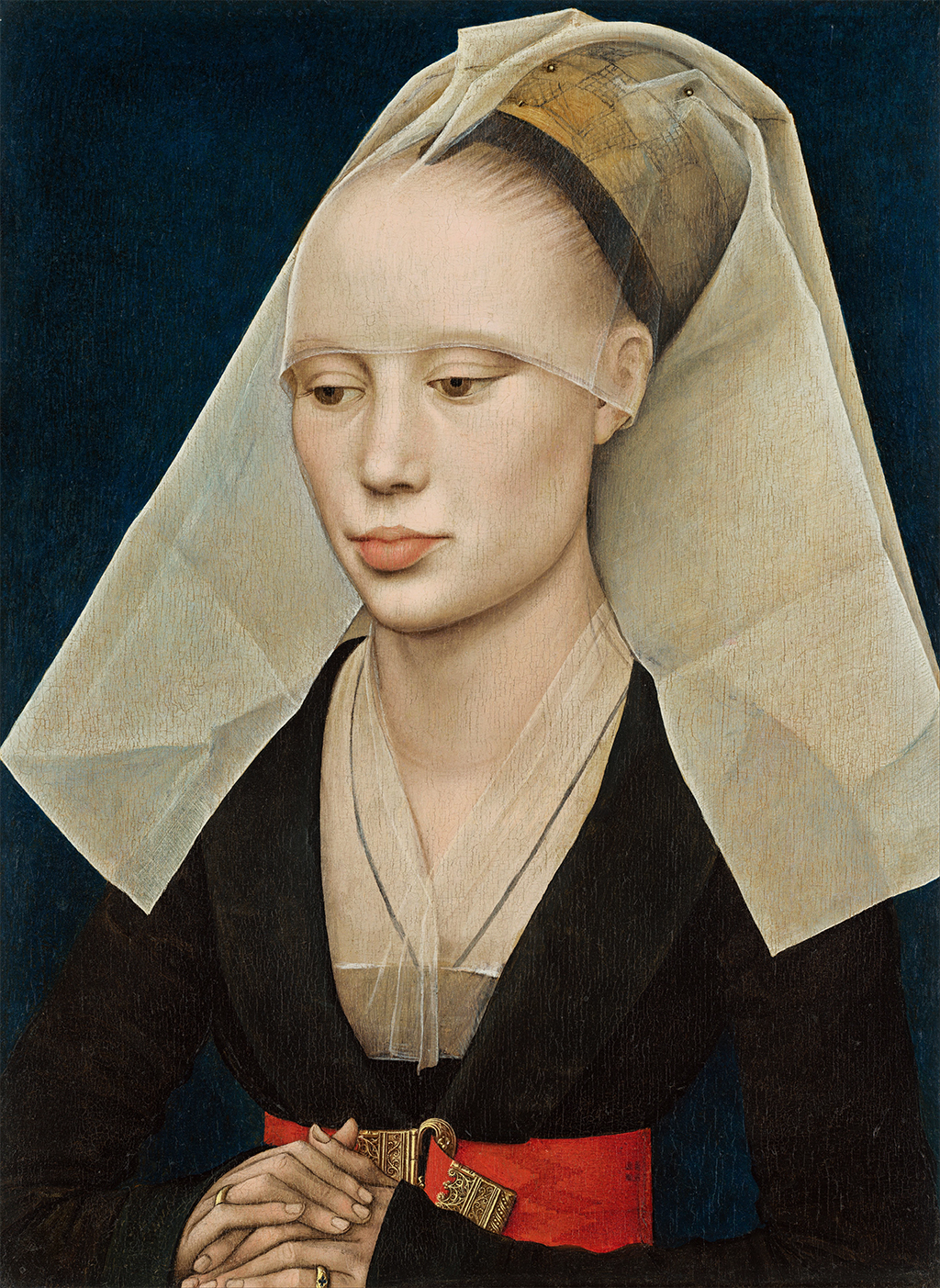
Rogier's portrait influence rests on controlled presence rather than obvious drama. Portrait of a Lady in Washington shows an unknown sitter whose lowered eyes, folded hands, veil and dark dress create a mood of inward concentration. The NGA describes the work as a late portrait of abstract elegance and notes the sitter's courtly fashion and mental intensity. [4]
This portrait language could be remembered and adapted because it is so clear. The sitter is close to the viewer but emotionally reserved. Costume signals status, but Rogier uses it to concentrate attention rather than to overwhelm the face.
His portraiture belongs to the same Early Netherlandish culture of exact surfaces, social presence and carefully staged sitters. Rogier and Petrus Christus can be connected as related figures in the portrait corridor without claiming direct dependence unless a source supports it.
They will help show how portraiture, court identity and devotional formats overlapped in Burgundian and international settings.
Religious Types and Devotional Pathos
Rogier's religious influence begins with pathos: grief made visible, disciplined and repeatable. The Descent from the Cross is the central example. The Prado records it as made for the Great Crossbowmen's guild in Leuven and describes its painted evocation of a sculpted altarpiece shrine. [3]
That painting created a powerful formula: Christ's body lowered from the cross, the Virgin fainting in a parallel curve, mourners pressed into a shallow sacred space. The idea was not only a subject. It was a structure for compassion.
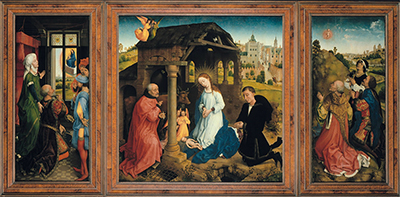
Other works created other devotional types. The Magdalen Reading gave a form to contemplative absorption. The Saint Columba Altarpiece organised scenes from Christ's early life across a coherent triptych sequence, with courtly splendour, religious symbolism and typological allusion. [5] [6] [7]
These types could be copied, adapted and reinterpreted because they were both clear and emotionally loaded. Rogier's influence worked through memorable arrangements of bodies and meanings.
Patronage and Movement Across Europe
Rogier worked in a world of mobile art and mobile reputation. The National Gallery notes that he worked for Philip the Good, foreign princes, the city and the church. [1] His images moved through the Burgundian Netherlands, Germany, Spain, France, Italy and later international collections.
The current locations of his works tell part of that story. The Descent from the Cross began in Leuven and is now in Madrid. [3] The Saint Columba Altarpiece was connected with Cologne and is now in Munich. [5] [6] [7] Portrait of a Lady passed through German aristocratic ownership and the Mellon Collection before entering the NGA. [4]
This movement is not just provenance trivia. It explains why Rogier's art mattered across regions. His paintings could serve a guild chapel, a Marian chapel, elite portrait culture, private devotion and royal collecting.
That movement is an authority signal. Regional Low Countries context remains essential, but the works' later histories justify strong source coverage from Madrid, London, Washington, Munich, Antwerp, Berlin, Vienna, Philadelphia and other holding institutions.
Related Artists
Jan van Eyck is the unavoidable comparison for Early Netherlandish painting. Rogier and Van Eyck share a world of oil technique, luminous detail and northern devotional culture, but they are not interchangeable. Van Eyck is often strongest as a comparison for optical richness and material brilliance; Rogier for emotional construction and pathos.
Robert Campin belongs in Rogier's formation, especially through the Tournai workshop context named by the National Gallery. [1] If no local Campin page exists, he can be mentioned without a link until a verified URL is available.
Petrus Christus is a useful verified internal target for portrait context and the Bruges/Netherlandish corridor. Bosch and Bruegel are later Netherlandish links, best used for broad lineage rather than direct influence. Durer can be used in reception or northern transmission context.
They belong to the later fifteenth-century Netherlandish afterlife of Rogier's formulas.
Later Descent Links: Rubens and Rembrandt
Rogier's Descent from the Cross belongs to a long northern tradition of imagining Christ's body being lowered from the cross. Later artists transformed the subject in very different ways.
Rubens's Descent from the Cross is a useful internal subject-history link because it turns the theme into Baroque movement, muscular force and dramatic action. Rembrandt's treatments offer another route, through shadow, printmaking and spiritual interiority.
These links do not mean Rubens or Rembrandt simply copied Rogier. They let the site move through a subject across centuries. Rogier's version becomes an early northern anchor for later treatments.
How to Read Attribution Language
Attribution language matters. "By Rogier van der Weyden" is not the same as "workshop of Rogier van der Weyden," "follower of Rogier van der Weyden," "after Rogier van der Weyden" or "copy after a lost original."
"By" normally means the holding institution attributes the work to Rogier himself.
"Follower of" points to an artist working in Rogier's style, usually outside direct authorship.
"After" usually means the work derives from a known or lost composition by Rogier.
Rogier's influence becomes clearer, not weaker, when the different layers are named accurately.
Why It Matters
Rogier van der Weyden's influence matters because it shows how a fifteenth-century artistic language travelled. It travelled through famous originals, but also through workshop practice, drawings, copies, fragments, patrons, collectors and later artists.
Rogier's surviving images are rarely simple. Their complexity includes lost works, cut-down fragments, workshop collaboration, repeated poses, uncertain donors and later reception. That complexity is part of Rogier's authority.
It strengthens the artwork pages by letting each one link back to a clear explanation of why Rogier's art spread and why attribution caution matters.
Frequently Asked Questions
Yes. Like other major fifteenth-century painters, Rogier worked within a workshop culture. The National Gallery notes the issue of workshop collaboration among several smaller religious works. [1]
His compositions and figure types were memorable and widely admired. Drawings, patterns, assistants and later copyists helped preserve and spread them.
The National Gallery notes that Mary Magdalene from the lost altarpiece behind The Magdalen Reading appears reversed in the Seven Sacraments Altarpiece. [2]
Not necessarily. They can show how Rogier's style spread, how patrons used familiar formulas and how the workshop translated the master's inventions into related images.
The links are useful for the subject history of the Descent from the Cross. Rogier gives an early northern anchor; Rubens and Rembrandt show later transformations of the same devotional subject.
Discussion
How should Rogier's influence be described: direct workshop practice, copied compositions, later admiration, subject traditions, or broader Netherlandish authority?
Reader Insights
Influence needs careful language. Workshop reuse, copies, followers and later subject parallels should not all be treated as the same thing.
Rogier's importance lies partly in repeatable emotional formulas that could travel through versions, patrons and later artists.
This page should be one of the cluster's main bridges to Jan van Eyck, Petrus Christus, Durer, Rubens, Rembrandt and other related artists where links exist.
Join the Conversation
Have a thought or observation about Rogier van der Weyden Workshop and Influence? Share it below. Thoughtful responses may be added to this section as the Rogier van der Weyden cluster develops.
References
- The National Gallery, London, artist page for Rogier van der Weyden, accessed 2026-07-11. https://www.nationalgallery.org.uk/artists/rogier-van-der-weyden
- The National Gallery, London, The Magdalen Reading, collection record for NG654, accessed 2026-07-11. https://www.nationalgallery.org.uk/paintings/rogier-van-der-weyden-the-magdalen-reading
- Museo Nacional del Prado, The Descent from the Cross, collection record for P002825, accessed 2026-07-11. https://www.museodelprado.es/en/the-collection/art-work/the-descent-from-the-cross/856d822a-dd22-4425-bebd-920a1d416aa7
- National Gallery of Art, Washington, Portrait of a Lady, collection record for 1937.1.44, accessed 2026-07-11. https://www.nga.gov/artworks/51-portrait-lady
- Sammlung Pinakothek / Bayerische Staatsgemaeldesammlungen, Columba-Altar: Verkuendigung, WAF 1190, accessed 2026-07-11. https://www.sammlung.pinakothek.de/de/artwork/A0GOlar4dp
- Sammlung Pinakothek / Bayerische Staatsgemaeldesammlungen, Columba-Altar: Anbetung der Koenige, WAF 1189, accessed 2026-07-11. https://www.sammlung.pinakothek.de/de/artwork/jWLpO7nxKY
- Sammlung Pinakothek / Bayerische Staatsgemaeldesammlungen, Columba-Altar: Darbringung im Tempel, WAF 1191, accessed 2026-07-11. https://www.sammlung.pinakothek.de/de/artwork/53470Zmx9e
- Dirk de Vos, Rogier van der Weyden: The Complete Works, Harry N. Abrams, 2000.
- Lorne Campbell and Jan Van der Stock, eds., Rogier van der Weyden: 1400-1464. Master of Passions, Leuven, Davidsfonds, 2009.
- John Oliver Hand, Catherine Metzger and Ron Spronk, Prayers and Portraits: Unfolding the Netherlandish Diptych, National Gallery of Art, Washington, 2006.