 by Tom Gurney
Tom Gurney BSc (Hons) is an art history expert with over 20 years experience
Published on June 19, 2020 / Updated on July 30, 2026
Email: tomgurney1@gmail.com / Phone: +44 7429 011000
Saint John Altarpiece: Introduction
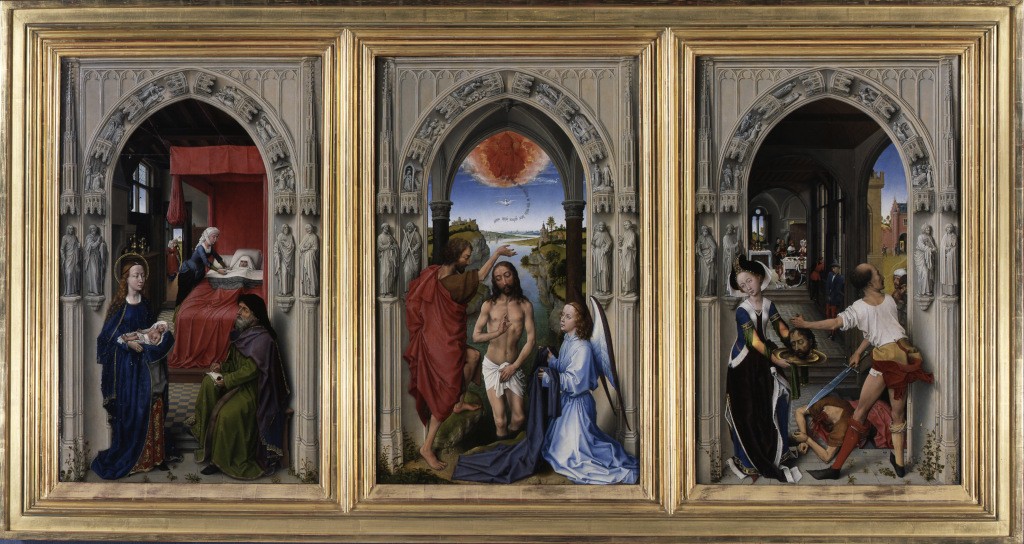
The Saint John Altarpiece is one of Rogier van der Weyden's most intellectually structured triptychs. It shows three episodes from the life of Saint John the Baptist: his birth, the Baptism of Christ and his beheading. [1]
The triptych is now in the Gemaeldegalerie, Berlin, and is usually linked in scholarship with the Miraflores Altarpiece. Both works use painted architectural frames and relief-like imagery to surround the main scenes with a larger sacred history. [1] [3]
Its importance in the Rogier cluster is clear: it is not another Passion image, and not another portrait. It shows Rogier using narrative sequence, architecture and typology to turn a saint's life into a carefully ordered devotional object.
At a Glance
- ArtistRogier van der Weyden
- TitleSaint John Altarpiece
- DateUsually around 1450-1455
- MediumOil on oak panel
- FormatThree-panel altarpiece
- Current locationGemaeldegalerie, Berlin
- Inventory lead534B in common catalogue references
- SubjectBirth, Baptism and Beheading of Saint John the Baptist
Contents
- Introduction
- At a Glance
- Three Scenes From A Saint's Life
- Painted Architecture And Relief
- The Birth And Naming Of John
- The Baptism Of Christ
- Salome And The Beheading
- Why It Matters
- FAQs
- Discussion
- References
Three Scenes From A Saint's Life
The panels present a sequence rather than a single dramatic moment. The left panel shows the birth or naming of John the Baptist. The centre panel shows Christ being baptized in the River Jordan. The right panel shows the death of John, with Salome receiving his head. [1]
This structure gives the work a narrative movement from birth to public ministry to martyrdom. Rogier does not simply illustrate episodes. He arranges them as a theological life, placing John as the forerunner of Christ and as a witness whose body becomes part of salvation history.
The three episodes also give the reader an unusually clear narrative path. Many Rogier works compress emotion into a single moment, but the Saint John Altarpiece asks the viewer to move across a life. Birth, baptism and death become a triptych of vocation: John is announced, he points to Christ, and he suffers because of his witness.
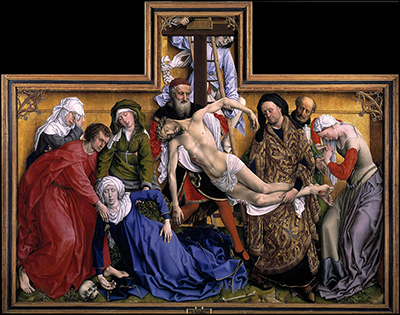
That sequence makes the work an important complement to The Descent from the Cross. The Descent is a single concentrated climax of grief. The Saint John Altarpiece is a sequence of sacred identity, in which the meaning of the saint unfolds across the panels.
Painted Architecture And Relief
Each panel is set within a painted arch or architectural frame. The surrounding relief-like imagery adds secondary scenes and scriptural resonance. [1]
This makes the altarpiece a natural companion to the Miraflores Altarpiece. In both works, painted architecture is not a decorative frame. It is part of the meaning. Rogier uses it to make the panel feel like a devotional object, a sculptural shrine and a painted narrative at once.
The painted architecture also links to the style-and-technique page. Rogier's frames can behave like theology in stone: they hold figures, organize memory and add layers of typology. A Rogier frame is rarely just a border.
This mixture of painting and sculptural illusion is one of Rogier's great achievements. The viewer is asked to read the panels as images, but also as shrine-like structures. Architecture gives the narrative authority, and the relief-like details make the whole triptych feel richer than a simple illustrated sequence.
The architectural setting also slows the viewer down. Instead of moving quickly from one episode to the next, the eye has to pass through frames, reliefs and thresholds. Rogier turns narrative into a layered act of looking. The triptych becomes a small sacred building in paint, with each panel functioning like a chapel of memory.
This helps explain why the work is so often connected with the Miraflores Altarpiece. Both paintings use architecture to make time visible. The viewer sees an event, but also the frame of meaning around that event. Rogier's painted structures give sacred history an ordered, almost liturgical rhythm.
The Birth And Naming Of John
The left panel begins the story in a domestic setting. John is born into a human household, yet the event belongs to sacred history. Rogier uses the scene to move between intimate detail and theological purpose.
The birth scene matters because it anchors the triptych in ordinary life before the drama of baptism and martyrdom. Textiles, gestures and interior space help make the sacred event legible to the viewer. As in Rogier's Virgin and Child images, domestic closeness does not reduce holiness; it makes holiness present.
This opening panel also prepares the viewer for sequence. John is not introduced as a static saint with an attribute. He is introduced through a life story, beginning with his arrival and naming.
The Baptism Of Christ
The centre panel is the theological heart of the altarpiece. John baptizes Christ, while divine presence and inscriptional elements identify the event as a revelation of Christ's sonship. [1]
This scene links naturally to the Seven Sacraments Altarpiece. Baptism is not only a narrative subject; it is the sacramental beginning of Christian life. Pairing these pages can help the reader understand how Rogier visualized ritual, water, grace and the Church.
The centre position gives the Baptism a structural authority. John's life matters because it points toward Christ. The panel therefore makes the saint's identity relational: John is important as witness, forerunner and baptizer.
The baptism scene also lets Rogier show a different kind of drama from the Passion works. There is no corpse, collapse or martyrdom in the centre panel. The drama is theological: water, blessing, revelation and recognition. Rogier makes a quiet sacramental moment carry the whole structure of the altarpiece.
Salome And The Beheading
The right panel is one of the most memorable parts of the triptych. Salome receives John's head on a platter while the violence of martyrdom enters a refined interior. [1]
Rogier's power lies in this collision. The scene is beautiful, controlled and horrifying. The body of John, the gesture of Salome and the domestic setting create a pressure similar to other Rogier works where grief or violence is forced into ordered form.
It raises questions about spectacle, courtly refinement and sacred violence. Salome's elegance does not soften the event; it sharpens the discomfort. That is a very Rogier kind of tension.
The panel also makes the triptych more than a gentle saintly biography. It ends with a severed head and a courtly interior, forcing the viewer to confront the cost of witness. The right panel's beauty is unsettling because it does not erase cruelty.
This is where the work speaks to Rogier's larger emotional language. He often refuses to separate beauty from pain. In the Descent from the Cross, beautiful colour and controlled arrangement contain grief. In the Saint John Altarpiece, courtly elegance contains violence. The viewer is made to feel the tension between form and suffering.
Why It Matters
The altarpiece gives the cluster another Berlin anchor and a different narrative structure from Rogier's Passion scenes. It links baptism, martyrdom and painted architecture, making the frame itself part of the theological argument.
It is also one of the best pages for showing Rogier's intelligence as a designer of multi-panel works. The triptych moves from birth to baptism to death, but it also moves from domestic space to divine revelation to courtly violence. Few works in the cluster make sequence, architecture and theology cooperate so clearly.
The page also strengthens the Berlin route through the Rogier cluster. Read with the Miraflores Altarpiece and Bladelin Altarpiece, it shows why the Gemaeldegalerie holdings are essential for understanding Rogier beyond the most famous Madrid and Washington works. Berlin preserves some of the clearest evidence for his mature handling of triptych structure, painted frames and devotional sequence.
For readers, the Saint John Altarpiece is therefore a navigation page as much as an artwork page. It connects baptism to the Seven Sacraments Altarpiece, martyrdom to the Passion works, and painted architecture to the style-and-technique page. It helps the cluster feel like a connected body of art rather than a set of isolated masterpieces.
It also shows why Rogier's quieter narrative works deserve the same close attention as his famous scenes of grief.
FAQs
It is in the Gemaeldegalerie, Berlin. [1]
It shows the birth of John the Baptist, the Baptism of Christ and the beheading of John. [1]
Both use a three-panel structure with painted architectural frames and relief-like imagery around the main scenes. [1] [3]
The beheading scene turns martyrdom into a controlled but emotionally charged interior drama.
Discussion
What matters most in the Saint John Altarpiece: narrative sequence, saintly identity, compact drama, or the relationship between panels?
Reader Insights
The altarpiece asks viewers to follow connected scenes rather than one central outburst of feeling.
Rogier's multi-panel works often rely on repeated structure, so small differences in gesture and setting become meaningful.
Read it near the Crucifixion Triptych and Miraflores pages to build a broader sense of Rogier's altarpiece grammar.
Join the Conversation
Have a thought or observation about Saint John Altarpiece? Share it below. Thoughtful responses may be added to this section as the Rogier van der Weyden cluster develops.
References
- Staatliche Museen zu Berlin / Gemaeldegalerie, Johannesaltar, object 866581, accessed 2026-07-11. https://id.smb.museum/object/866581/johannesaltar
- Wikipedia, Saint John Altarpiece, accessed 2026-07-11. https://en.wikipedia.org/wiki/Saint_John_Altarpiece_(van_der_Weyden)
- Barbara Lane, "Rogier's Saint John and Miraflores Altarpieces Reconsidered," The Art Bulletin, 1978.
- Victoria Reed, "Rogier van der Weyden's Saint John Triptych for Miraflores and a Reconsideration of Salome," Oud Holland, 2001/2002.