 by Tom Gurney
Tom Gurney BSc (Hons) is an art history expert with over 20 years experience
Published on June 19, 2020 / Updated on July 30, 2026
Email: tomgurney1@gmail.com / Phone: +44 7429 011000
Duran Madonna: Introduction
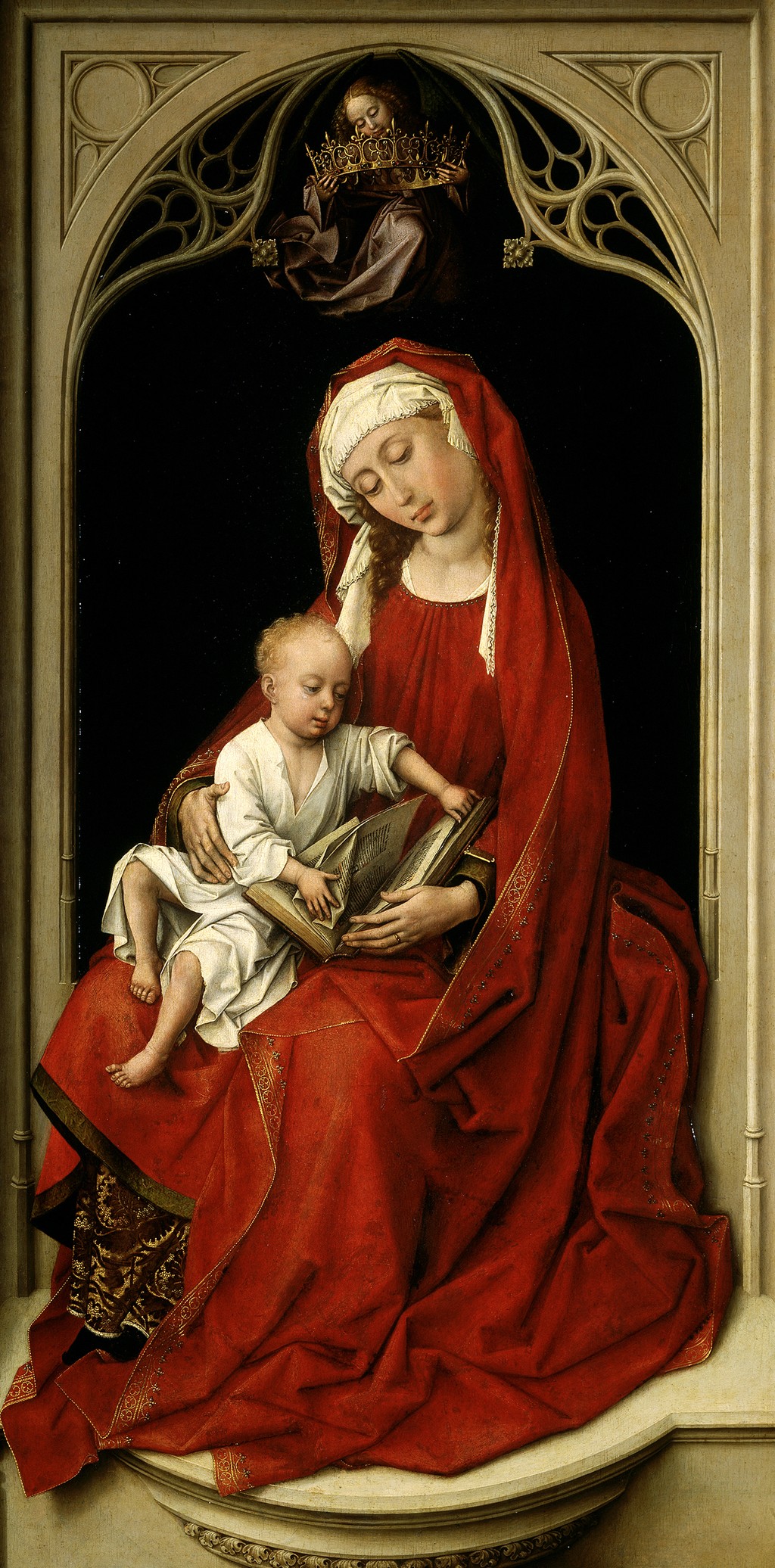
The Duran Madonna, also known as the Durán Madonna, is one of Rogier van der Weyden's most important Virgin and Child paintings because it turns a devotional subject into a sculptural illusion. Mary sits in a shallow Gothic niche, dressed in a deep red robe, while the Christ Child turns the pages of a book on her lap. [1]
The painting is in the Museo del Prado in Madrid, where it is associated with the inventory number P02722. It is usually dated around 1435-1438 and is often discussed beside the Prado Descent from the Cross and the Berlin Miraflores Altarpiece. [1]
Its importance in the cluster is that it gives Rogier's Marian imagery a major page of its own. The work is not a small footnote beside the Passion paintings. It shows how Rogier could make tenderness, sculpture, reading and foreknowledge belong to one devotional image.
At a Glance
- ArtistRogier van der Weyden
- TitleDuran Madonna / Durán Madonna
- DateUsually around 1435-1438
- MediumOil on oak panel
- DimensionsAbout 100 x 52 cm
- Current locationMuseo del Prado, Madrid
- Inventory leadP02722
- SubjectVirgin and Child in a niche
Contents
- Introduction
- At a Glance
- Mary In Red
- A Painted Sculpture
- The Book And The Child
- Van Eyck And Rogier
- Spanish Afterlife
- Why It Matters
- FAQs
- Discussion
- References
Mary In Red
Mary's red robe dominates the painting. It spreads, folds and curls around the Child, turning colour into a kind of architecture. The robe is not simply decorative. It helps build the painting's emotional enclosure.
Christ sits on Mary's lap, handling a book. Source summaries connected with the Prado tradition describe the book as an allusion to Scripture and to Christ's redemptive mission. [1] This is a subtle but central point: the Child plays with the book, but the book also points toward the Passion.
That combination of tenderness and foreknowledge is typical of Rogier. He gives the viewer a child, but also reminds the viewer that the child is already part of a larger salvific story.
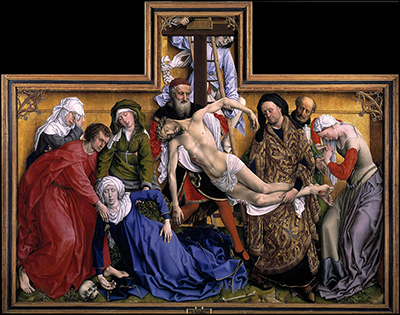
The colour relationship also matters. The red robe links the work visually to the Prado Descent, where red and white help organize grief and sacred presence. In the Duran Madonna, red becomes protective and enveloping rather than tragic, but the colour still carries emotional weight.
A Painted Sculpture
The niche makes the painting feel like a sculpture come to life. Mary and the Child are placed in a shallow architectural space with Gothic tracery and a projecting plinth. [1] Rogier pushes the figures forward so that painting seems to cross into relief.
Rogier's art repeatedly tests the boundary between painted body and sculpted object. The Prado Descent looks like a polychrome relief. The Beaune exterior uses grisaille. The Duran Madonna makes a Virgin and Child behave almost like living sculpture.
The sculptural effect is not only a clever illusion. It changes the devotional relationship. A painted figure that seems to occupy a shrine-like niche can feel more physically present to the viewer. Rogier uses that presence to make the Virgin and Child both intimate and elevated.
This is why the work belongs beside the style-and-technique page. It shows that Rogier's sculptural thinking is not restricted to Passion drama. A Marian image can also become a painted shrine, with surface, edge and architecture working together.
The niche also gives the image a controlled stillness. Mary and the Child do not sit in an open domestic room. They appear within a shaped sacred space that feels both architectural and symbolic. The shallow depth keeps the figures close to the picture plane, so the viewer encounters them almost as a devotional object rather than as figures in a distant scene.
This closeness is one reason the painting feels so different from a narrative altarpiece. Nothing has to happen outwardly. The meaning is carried by placement, touch, colour and the book. Rogier makes stillness active.
The Book And The Child
The Child's interaction with the book is one of the painting's most important details. It gives the image a quiet narrative action without turning it into a busy scene. The book can be read as Scripture, prophecy and a sign of the future Passion. [1]
The gesture also changes Mary's role. She is not only a mother holding a child. She becomes part of a devotional image in which reading, prophecy and motherhood are joined. This links the painting to The Magdalen Reading, where reading becomes a sign of absorbed devotion.
Rogier often uses books carefully. They are not generic props. They connect sight, thought, prayer and sacred history. In the Duran Madonna, the book turns an intimate mother-and-child image into a meditation on Christ's mission.
The book also creates a delicate emotional tension. The Child's action can look playful, but the viewer knows that Scripture points forward to suffering and redemption. Rogier's image therefore holds childhood and destiny together. This is not sentimental motherhood. It is tenderness under the sign of future sacrifice.
Van Eyck And Rogier
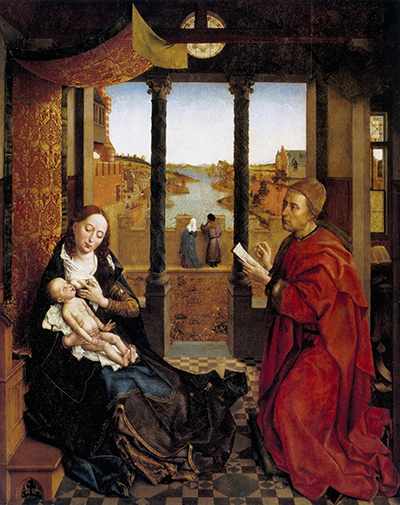
The painting is often compared with Jan van Eyck's Ince Hall Madonna and with Rogier's other early Madonnas. [1] Those comparisons are useful when they are not flattening. Van Eyck gives Rogier a model for luminous sacred presence, but Rogier transforms it through compression, sculpture-like placement and emotional directness.
The Duran Madonna is especially useful for readers who know Rogier only through grief and Passion imagery. It shows that his devotional art could be tender, quiet and physically intimate while still carrying theological weight.
Rogier's difference lies in pressure. He narrows the space, makes the niche feel shallow, and lets the figures occupy the image with sculptural force. The result is less expansive than Van Eyck, but more compressed and direct.
That directness is central to the page. Rogier does not compete with Van Eyck by making the world wider or more luminous. He makes the image more concentrated. The viewer is held close to Mary, the Child, the red robe and the book, with little room for distraction.
Spanish Afterlife
The painting later became part of Spanish collecting history. It was acquired by Pedro Fernandez-Duran in 1899 and donated to the Prado in 1930. [1]
Together, the two Madrid paintings help show how important Rogier became to Spanish collections and scholarship.
The Descent is a public, monumental Passion image; the Duran Madonna is a more contained Virgin and Child image. Together, they let the Madrid/Prado source layer support two different sides of Rogier: the architect of grief and the maker of concentrated Marian devotion.
Why It Matters
The Duran Madonna adds a sculptural kind of intimacy to the cluster. Its importance lies in the way Rogier turns the Virgin and Child into a painted object with the gravity of sculpture.
It also helps balance the cluster. Without this page, Rogier's devotional art can look dominated by Crucifixion and lamentation. With it, readers see a Marian image in which tenderness, redemptive foreknowledge, books, colour and architecture are brought into a single quiet form.
The page is also useful because it gives the Prado a second role in the cluster. The Descent from the Cross shows Rogier's public emotional drama; the Duran Madonna shows his quieter devotional intelligence. Both depend on sculptural presence, but they use that presence differently. One makes grief monumental. The other makes the Virgin and Child feel shrine-like, intimate and still.
That contrast is a good way into Rogier's range. He is not only a painter of tears and bodies. He is also a painter of reading, touch, colour and compressed sacred space.
The painting also helps connect the Marian pages to the cluster's wider theme of inward attention. The Child turns toward the book, Mary encloses him in red, and the niche holds both figures in a shallow sacred space. Nothing is dramatic in a narrative sense, but the image is full of concentration. It asks the viewer to look slowly at how touch, text and architecture create devotion.
In this sense, the Duran Madonna belongs beside The Magdalen Reading. Both works use reading or a book to suggest more than literacy. The book becomes a sign of prayer, prophecy and absorbed attention.
FAQs
It is in the Museo del Prado in Madrid. [1]
It takes its name from Pedro Fernandez-Duran, who acquired the painting in 1899 and donated it to the Prado in 1930. [1]
The book is usually understood as a reference to Scripture and to Christ's redemptive mission. [1]
It shows Rogier turning a Virgin and Child image into a sculptural, niche-like devotional object.
Discussion
How does the Duran Madonna combine tenderness, architecture, book imagery and devotional symbolism?
Reader Insights
Rogier's Madonna images often bring sacred figures close without making them casual; tenderness stays disciplined.
Books, textiles and architectural settings can carry devotional meaning while also displaying Netherlandish precision.
Read this with the Virgin and Child pages and the Magdalen to follow Rogier's interest in reading, presence and absorbed attention.
Join the Conversation
Have a thought or observation about Duran Madonna? Share it below. Thoughtful responses may be added to this section as the Rogier van der Weyden cluster develops.
References
- Museo del Prado collection entry for Virgin and Child / Duran Madonna, P02722, accessed 2026-07-11. https://www.museodelprado.es/
- Wikipedia, Duran Madonna, accessed 2026-07-11. https://en.wikipedia.org/wiki/Dur%C3%A1n_Madonna
- Lorne Campbell and Jan Van der Stock, eds., Rogier van der Weyden: 1400-1464. Master of Passions, Leuven, 2009.
- Alfred Acres, "Rogier van der Weyden's Painted Texts," Artibus et Historiae, 2000.