


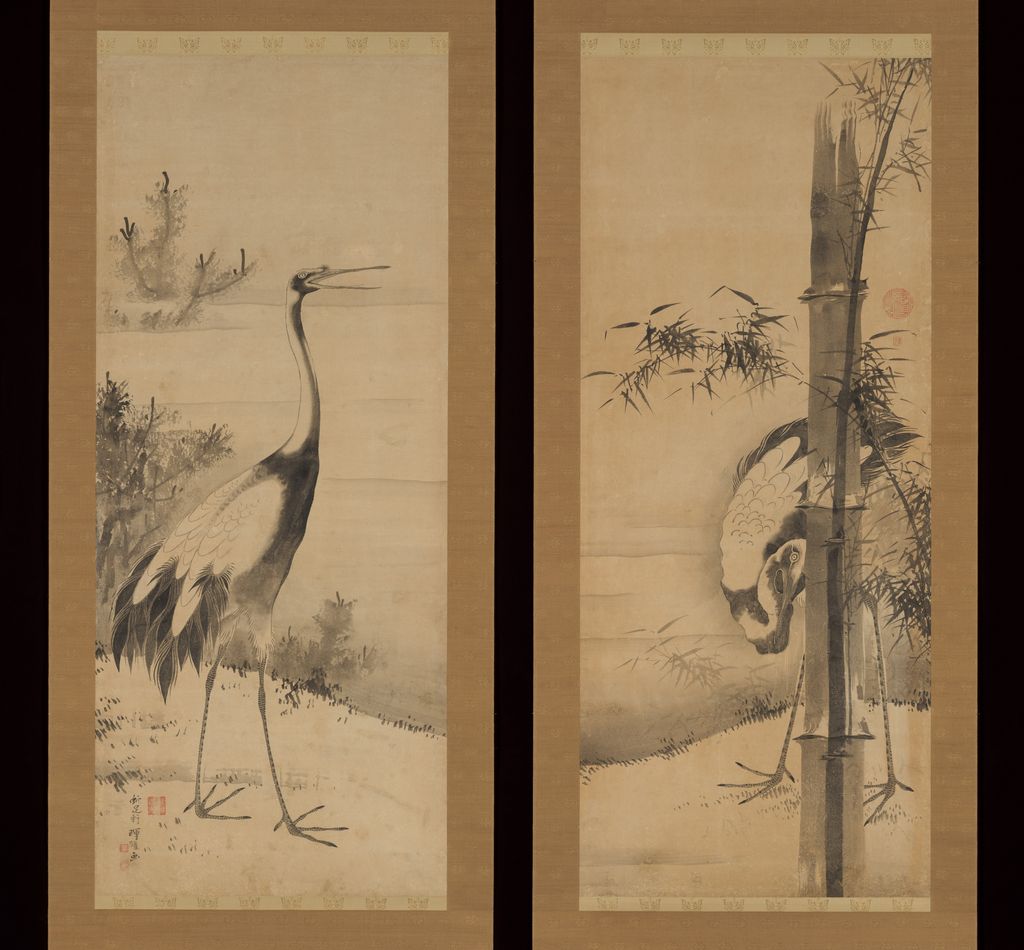
Soga Shōhaku, Cranes, pair of hanging scrolls, ca. 1760. The Metropolitan Museum of Art, 2019.420.24a,b. Museum object record.
 by Tom Gurney
Tom Gurney BSc (Hons) is an art history expert with over 20 years experience
Published on September 25, 2026 / Updated on September 25, 2026
Email: tomgurney1@gmail.com / Phone: +44 7429 011000
Soga Shōhaku: a life reconstructed from paintings and records
Soga Shōhaku (1730–1781) left paintings that can occupy a whole room, but not a day-by-day record of how he lived. The surviving evidence is uneven. Inscriptions give years and names; the backs of former sliding doors hold hints about a commission; a directory places a painter in Kyoto in 1775; a temple record establishes his death. Between those points lie journeys that scholars must reconstruct from objects, their locations and the accounts of later writers. Those different records answer different questions. Shōhaku's art is often introduced with a dramatic story about an independent eccentric. The documented life is more interesting as a working painter's movement between Kyoto, Ise and Harima, and as a series of relationships with temples, scholars, merchants and other artists. [1] [2]
His family name was Miura. Mie Prefectural Art Museum's account locates his birth in a Kyoto merchant household and records the death of his father in 1743, followed by his mother three years later. Those dates make the young man's losses unmistakable, yet they say nothing direct about his feelings or why he chose painting. The much later claim that he worked as a boy in an Ise rice shop lacks a known contemporary foundation. Nor can the suggestion that the family traded in dyeing, or had business links to Matsusaka cotton, be treated as a confirmed explanation of his first journey. It is possible to tell a clear life story without making childhood tragedy the cause of his mature brushwork. [3] [2]
Contents
- Soga Shōhaku: a life reconstructed from paintings and records
- Look closely at the two cranes
- The Miura family and a chosen artistic name
- First Ise journeys: evidence and plausible routes
- Painting rooms and moving between regions
- Scholars, monks and the working painter
- Kyoto recognition and what a directory can tell us
- Late works and the dangers of a single late style
- Death, memory and the “eccentric” image
- Books on Japanese Art
Look closely at the two cranes
Choose a number to enlarge a detail cut from a retained 300 dpi working copy of the 4313-pixel museum original. The explanations also appear below.
Explained details
The raised crane
One crane stretches its neck and beak into the gap between the scrolls. Look at the contour around its eye and the open space it faces.
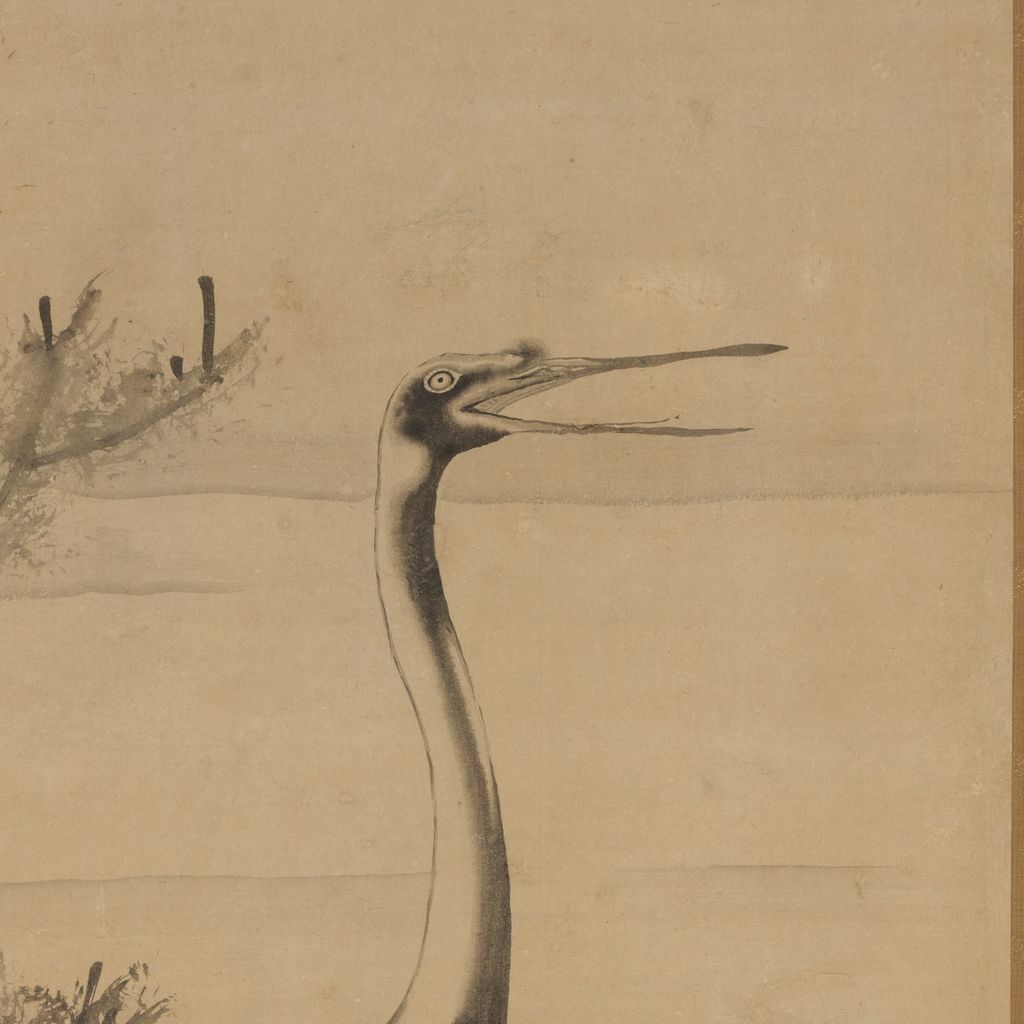
The Metropolitan Museum of Art Object record 2019.420.24a,b. Editorial crop and resize disclosed.
The crane by the bamboo
The other bird lowers its head beside the bamboo. Compare the fine marks on its feathers with the dense vertical trunk.
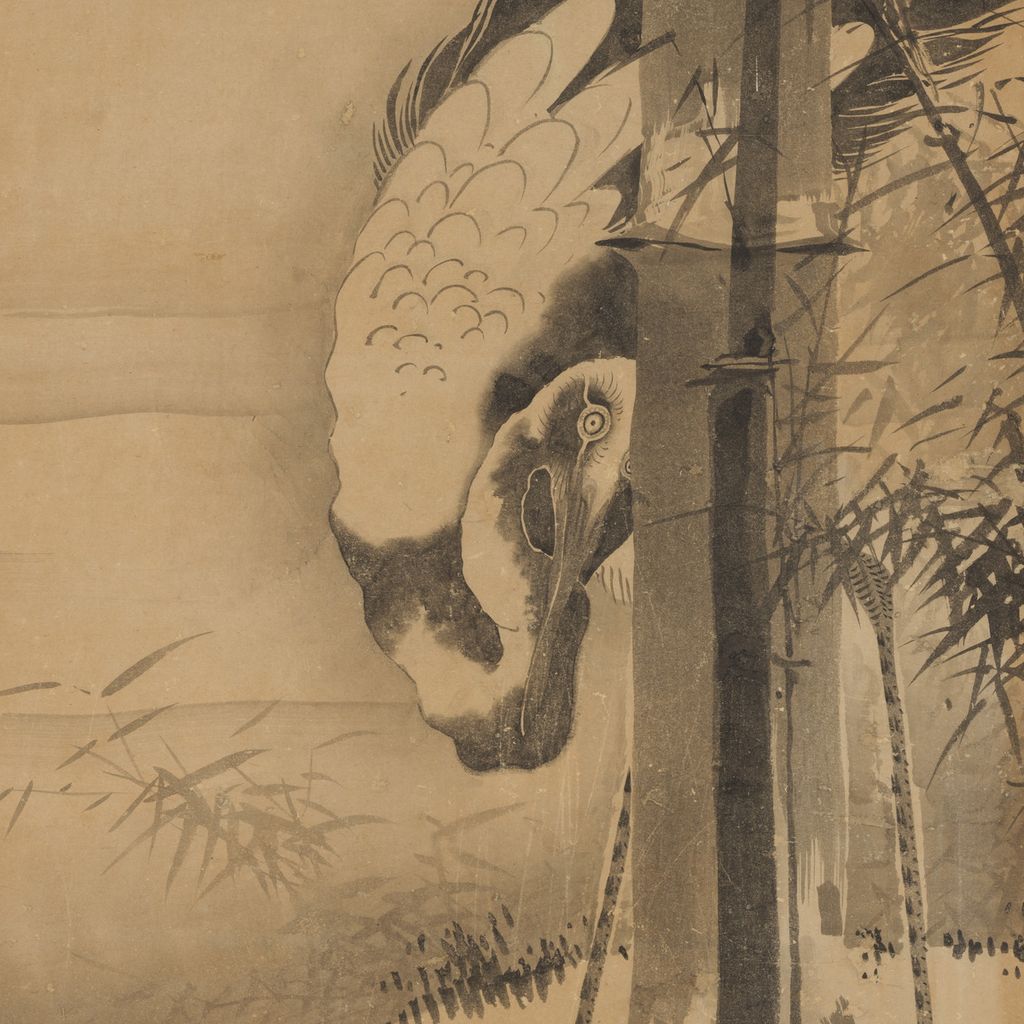
The Metropolitan Museum of Art Object record 2019.420.24a,b. Editorial crop and resize disclosed.
The Miura family and a chosen artistic name
To call himself Soga was to position his painting within a prestigious older history. On the right half of his 1760 Lin Hejing screens, the inscription claims descent from Soga Jasoku, a painter associated with late-medieval ink traditions; it also uses the name Fujiwara Teruo. That is unusually valuable biographical evidence because it is a claim Shōhaku placed on an important object while alive. But the writing proves what he asserted, not a ten-generation family tree. His actual household surname, Miura, comes from separate documentary research. Keeping the two kinds of evidence in view lets us understand the chosen name as an act of artistic identity, whether or not the genealogy could ever be independently verified. [3] [2]
At a glance
- Life1730–1781
- FamilyKyoto’s Miura merchants
- PlacesKyoto, Ise and Harima
- EvidenceInscriptions, directory, temple records
The Met's Eight Views of Ōmi offers a later-looking way to see that artistic choice, although its date cannot be used as a precise life event. The museum holds one screen of a former pair and relates its ink language to earlier Soga painters. That link supports a discussion of chosen models; it does not prove family descent any more than the 1760 inscription does. The missing companion also matters. A viewer sees four views on the surviving screen, while the work's title refers to eight across the pair. The partial surviving object cannot document Shōhaku’s visits to each viewpoint around Lake Biwa. [22]
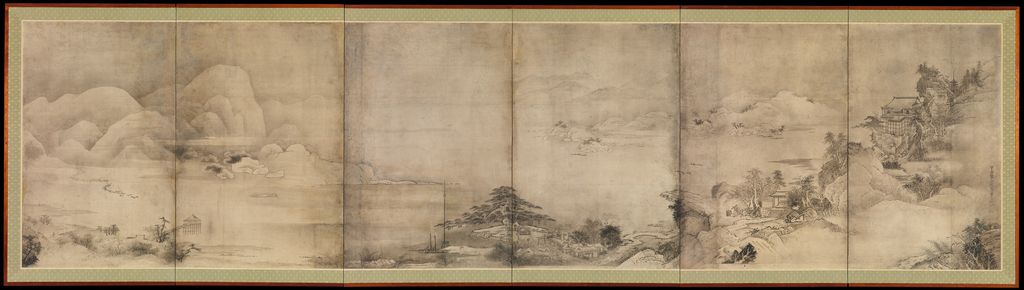
The distinction also guards against imagining that his pictures belonged unchanged to a single inherited workshop. Lin Hejing takes an old Chinese subject and opens it over two screens more than three and a half metres wide each. A large plum tree travels through the folding surface; a seemingly dispirited recluse interrupts the conventional image of a serene scholar. The date is unusually firm. Mie's object record reads the spring of the dragon year of Hōreki as 1760, and the museum calls this an early benchmark for his style. It does not tell us exactly where the screens were painted or who paid for them. Their inscriptions show a painter already using the Soga claim and making a large, sophisticated object at about thirty. [3] [4]
Takada Keisuke is often named as Shōhaku's first teacher. Tokyo Fuji Art Museum's artist introduction states the relationship confidently, while Tochigi Prefectural Museum of Fine Arts says Keisuke has sometimes been considered his teacher. The latter wording matters: no dated training contract or unbroken account of instruction is present in the material checked for this biography. Keisuke's example may have mattered to Shōhaku, and earlier Japanese writers compared the two painters. For now, a formal apprenticeship belongs among traditions about his formation, not among dated facts on a timeline. His assured drawing by 1760 tells us a great deal about skill; it does not identify every person who helped him acquire it. [5] [6]
The Met's pair of Cranes, dated approximately 1760, supplies a second view of that early competence. The birds' posture and spacing create a dialogue across two hanging scrolls; branches give each sheet a different weight. It is tempting to use such a lively pair to narrate a painter's rebellious temperament, but that would make an object do biographical work it cannot perform. The museum's “ca. 1760” is a stylistic/object date, and no inscription places the artist at a known address on the day he painted the birds. Seen alongside the dated Mie screens, however, the pair shows how rapidly one painter could move between an intimate two-scroll format and a room-scale historical subject. [7] [3]
First Ise journeys: evidence and plausible routes
Shōhaku's early regional work draws the biography away from a Kyoto-only story. In a Mie Prefectural Art Museum catalogue essay, Ichirō Mōri sets out the evidence for a Tsu-area stay around 1758–59. An earlier researcher had reported paintings bearing Shōhaku's ages as twenty-nine and thirty at local temples. The dating depends in part on those reported signatures, rather than a surviving itinerary. A second visit around 1764 is inferred in part from similarities of style, signature and seal between Matsusaka-area works and the dated age-thirty-five Immortals screens. Mie's later collection record accepts at least those two visits, while leaving the particulars of his movement open. It would be misleading to print a tidy schedule of departure and return where the evidence gives only clusters. [2] [3] [8]
What made Ise attractive to a Kyoto painter? Mōri maps works preserved in Tsu, Matsusaka, Suzuka, Yokkaichi and nearby areas, with temples, shrines and influential households among their holders. The picture of a substantial working market is stronger than a romantic image of aimless wandering. The region's roads, commercial wealth and learned circles made it possible to find customers and collaborators beyond the capital. Yet the surviving distribution of paintings is not a ledger of invoices. It establishes that works existed and were kept in particular places; it does not disclose a rate of pay, a named sponsor for every painting, or the exact path of a particular trip. [2]
Two possible channels for the first connection have been proposed. Kyoto Kōshōji, the Miura family's temple, had relationships with a Tsu temple and a local daimyo household. Another line of argument starts from a later statement that the family was involved in dyeing, and from Matsusaka's textile economy. Both might explain why Shōhaku encountered patrons there; neither has the document that would prove it. Neither proposed connection closes the gap in the record. The firmer conclusion is that regional work could be central to his livelihood, not a detour between famous Kyoto pictures. Even anecdotes about his awkward relations with some townspeople have to be set alongside the number of people who evidently valued and preserved his work. [2]
The old Ise highways explain how movement through the region was possible, but a map of a road does not record which branch Shōhaku took. Nineteenth-century photographs of a specific surviving street or temple could show a later stage in its history; they could not show the scene as he saw it a century earlier. The paintings and inscriptions remain stronger evidence of his presence than a picturesque view made long afterward. [2]
Painting rooms and moving between regions
The 1763 Dragon and Clouds now at the Museum of Fine Arts, Boston is evidence of a painter who could work on an architectural scale. The eight former sliding-door paintings stretch to roughly thirty-five feet when assembled. Their present display and mounting tell a later part of the story, not exactly what an eighteenth-century viewer saw in the original room. The year 1763 is a strong work date, but the Boston record alone should not be made into a fully documented account of who invited Shōhaku, where he lodged or how long he remained. The museum’s record documents the work and its later display while leaving the circumstances of its original commission open. [9] [10]
Around 1764, a much larger set of former doors connected with the Nagashima household in Ise allows a different kind of reconstruction. Mie studies the Seven Sages of the Bamboo Grove as eight panels once placed four and four at right angles, within an ensemble of forty-four doors. These are not simply eight interchangeable sheets. The turn of the room mattered: people crossing a threshold would meet different parts of the painted narrative. That probable setting makes the work a biographical clue about Shōhaku's professional capacity, local relationships and ability to sustain visual planning across a large interior. The circa-1764 dating is still a scholarly estimate; it should not be treated as a signed completion date for all forty-four doors. [11]
The national cultural-property Immortals pair of 1764 is another point that needs careful object identification. Its age-thirty-five inscription gives a firmer anchor than the stylistic chronology of many former doors. Several works in different collections have names that could be translated simply as “Immortals”, however. Cleveland's Eight Immortals of the Wine Cup is a separate two-screen pair based on Du Fu's poem. The Cleveland pair helps us see how Shōhaku organised lively Chinese figures across a wide support, but it cannot show what the separate 1764 pair looks like. [8] [12]
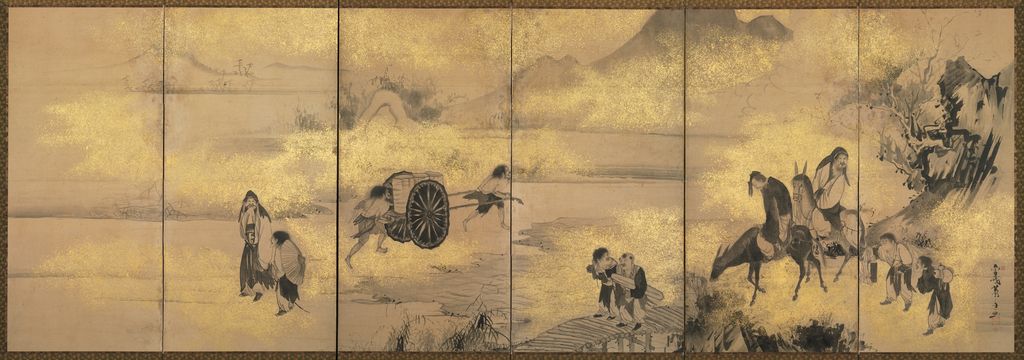
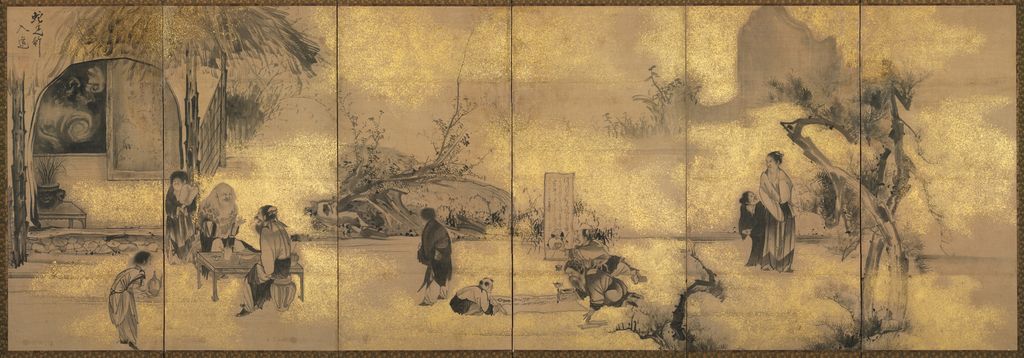
Mie's study of Peacocks and Pine, paired with Xu You and Chao Fu on former doors, proposes another journey, this time into the Takasago area of Harima around 1767. A place name on paper used behind the painting offers unusually concrete local evidence. The precise chain from paper to artist's itinerary is still interpretation. Paper may be reused, doors may move, and the current format may differ from the original installation. Nonetheless, the association broadens the picture of a painter whose working field stretched across several regions. The backing-paper clue is vivid without an unsupported claim that he stayed at one named house for a known number of weeks. [13]
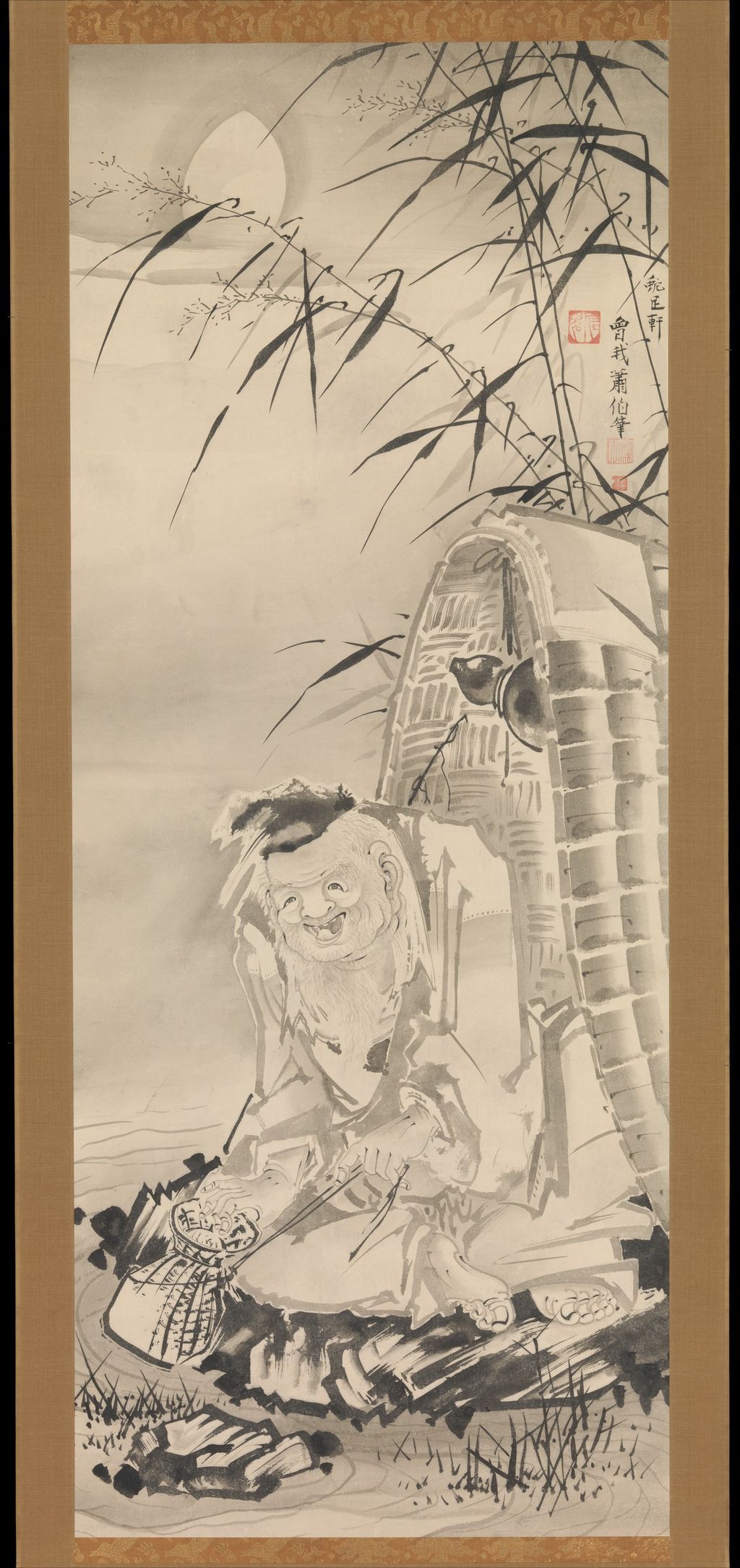
The objects also warn against making his career a simple advance from small sketches to large, spectacular screens. The early Lin Hejing is already monumental, and scrolls continued alongside doors. At the Met, Tōkaibō with a Fishing Basket is dated about 1768 using a seal that reads Soga Teruo. The small mark can bring a work into a plausible part of the chronology even when the represented subject belongs to an earlier, legendary world. It is a reminder to read the physical evidence on the picture as well as the story in it. But a seal used at a particular period is not a travel passport: the work does not in itself record whether Shōhaku painted it in Harima, Ise or Kyoto. [14]
Scholars, monks and the working painter
Networks become visible most clearly where a second person left words on Shōhaku's painting. A Daruma image carries a 1771 inscription by Okuda Sankaku, a scholar associated with the Tsu domain. Mōri notes that this may suggest another Ise stay, but the inscription only establishes the picture's and writer's connection at that date. A scholar could add words when a work reached him later; the painting could travel independently of the painter. The possible visit is worth recording as a possibility because it interrupts any over-neat account of Shōhaku leaving the region permanently after the 1760s. It is not a third journey to add confidently to a map. [2] [15]
Mōri's account of Ise also challenges the image of a solitary producer who could not form relationships. Temples preserved large door ensembles, local literati supplied inscriptions, and other painters worked in the orbit of his style. A further Tenjin painting with words by a Matsusaka temple priest is another point of contact. None of this proves that every keeper of a Shōhaku work met him face to face. Nor should later lists of “disciples” be accepted as a formal school register. The material does show a painter whose images could circulate within institutions and households sufficiently connected to commission, annotate, move and preserve them. Even deliberately strange imagery was produced inside a social and economic world. [2]
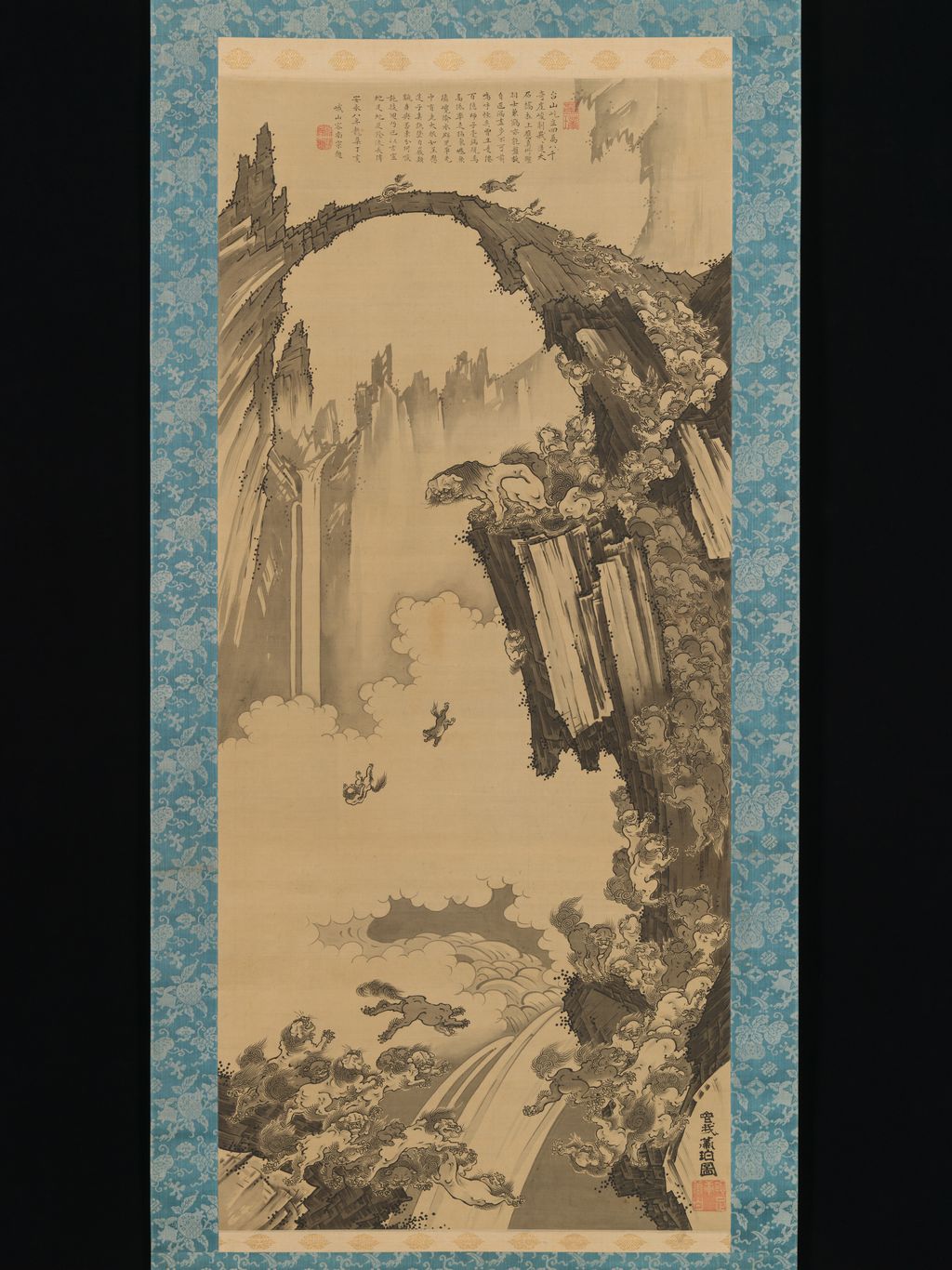
There is a useful distinction between a name written on a picture and a name assigned later in an exhibition. An inscription by Gazan Nansō accompanies the Met's Lions at the Stone Bridge of Mount Tiantai, dated 1779. The painting and poem were brought together in the artist's later years. The record supports a collaboration or at least a conjunction of painter and inscriber, but not a reconstructed conversation between them. Mie similarly names Okuda Sankaku on the earlier Daruma. These are several distinct relationships in different places and decades, not evidence of one coherent “literary circle” across Japan. It allows readers to see that religious stories, Chinese learning and painting were often experienced together. [16] [2]
Kyoto recognition and what a directory can tell us
Kyoto was a major working centre in the later part of Shōhaku's life, but the date of his settled return is less secure than a short biography might imply. Kyoto City's study of the later Jūnenji dragon-door paintings estimates a Kyoto settling around 1772. The precise year is a scholarly reconstruction, not the entry in a resident register that would allow us to say “returned in 1772” without qualification. His works and connections increasingly place him there; the absence of a complete calendar is no reason to ignore the shift. It is a reason to distinguish a broad late-career Kyoto phase from a documented move on a given day. [17] [1]
The 1775 edition of Heian jinbutsushi, a printed guide to notable Kyoto people, gives a more definite anchor. Yasuhiro Yamaguchi's study at Mie notes that Shōhaku is absent from the 1767 edition and present in the 1775 one, with a name form recorded as 曾我師寵 and a location in Upper Kyoto. The document establishes how he was publicly listed in that later edition. It does not date his first appearance in the city, the first sale to a Kyoto customer, or the exact moment he became respected. Mie points to accomplished works years before the listing, so late directory inclusion must not be used to suggest that the early painter was obscure everywhere. The gap between making ambitious work and appearing in a civic directory is itself a revealing part of professional life. [18] [19]
Yamaguchi proposes that Shōhaku may have run a small workshop in his Kyoto years. There are names of followers and pictures bearing his seals whose brushwork is not uniformly convincing as one person's work. This is a productive question for attribution, but it does not yield a secure payroll, a list of signed assistants, or a universal rule that passages of background were painted by pupils. The Met's Jurōjin, dated about 1773, gives a particularly careful object-level observation: its catalogue considers possible help in parts of the tree and rock while regarding the key figures as Shōhaku's. The value of the record is its specificity and caution. It provides a way to explain collaborative painting without turning every difference of handling into a firm second hand. [19] [20]
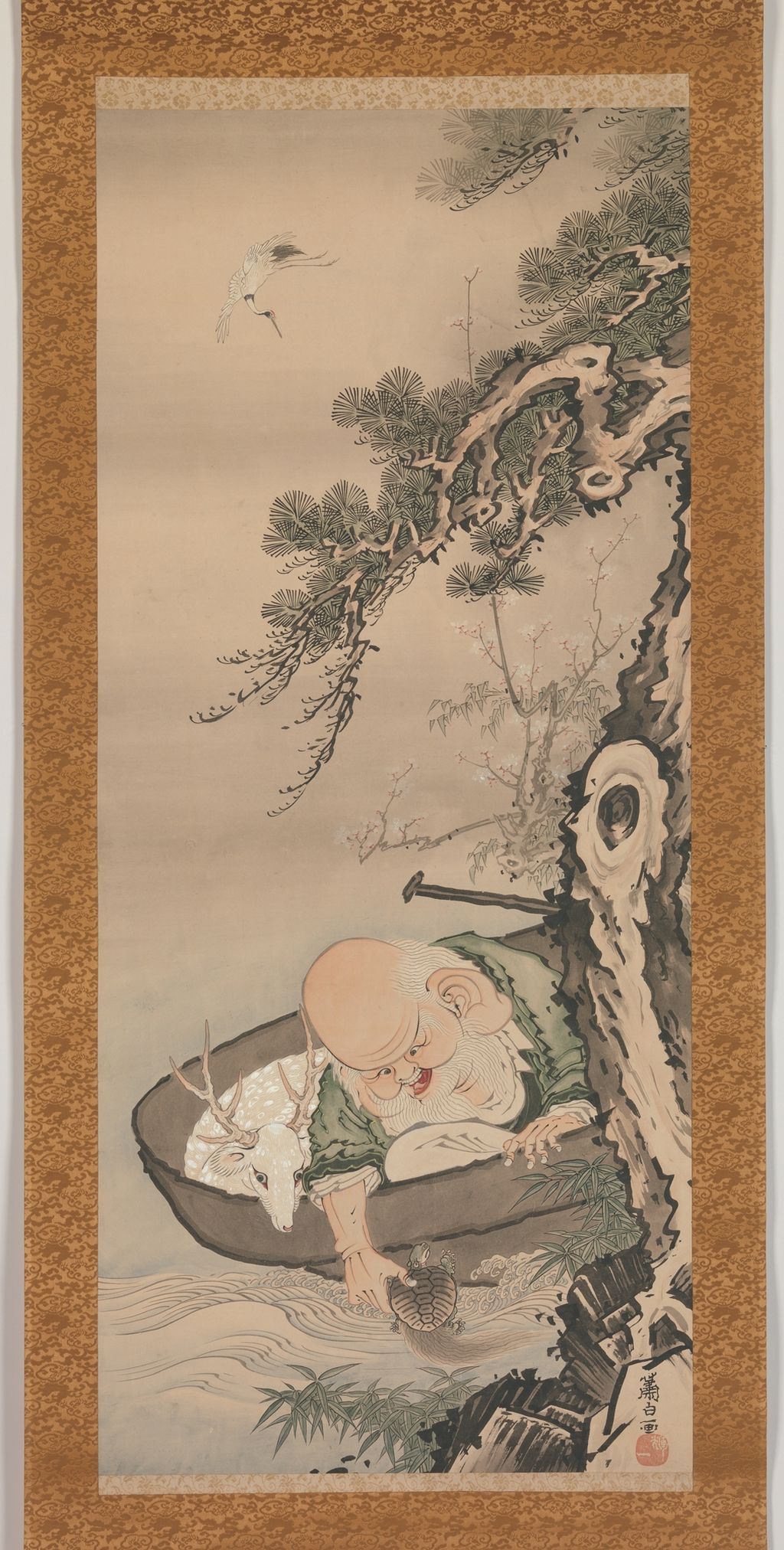
Such a workshop, if it existed, would also fit the large amount of work and range of formats associated with Shōhaku. But an appealing economic explanation cannot substitute for object-by-object testing. Dates, seals, paper, brushwork and later provenance all matter. Regional works made “in the manner of Shōhaku” after his death and outright fakes also complicate a catalogue. Mōri records the history of questionable works in Ise and Harima and warns that their dates and makers need more study. A locally preserved, Shōhaku-looking picture therefore cannot automatically be added to the itinerary of his own journeys. [2] [19]
Late works and the dangers of a single late style
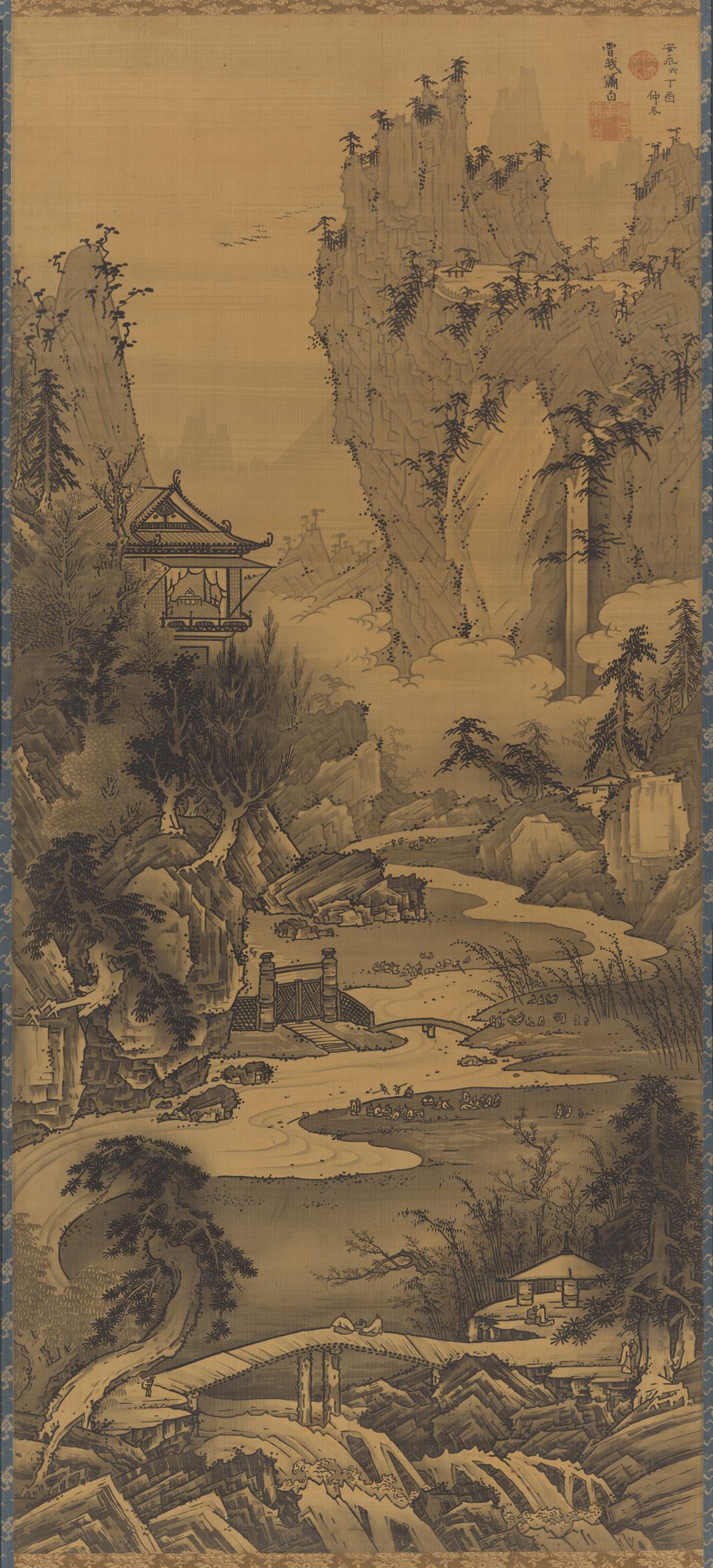
Cleveland's Orchid Pavilion Gathering is dated 1777 and returns to a learned Chinese subject. A group of participants sits and moves within a landscape, the stream carrying the picture's central social event. It is a long hanging scroll on silk rather than a door, and the change of scale alters the role of the viewer. The year places the work in Shōhaku's late career, but the subject is no sudden conversion to restrained literati interests. The 1760 Lin Hejing already showed his sustained engagement with Chinese models; the two works show how he could revisit that world across different decades and formats. Biography becomes richer when a date is used to compare continued interests as well as changes. [21] [3]
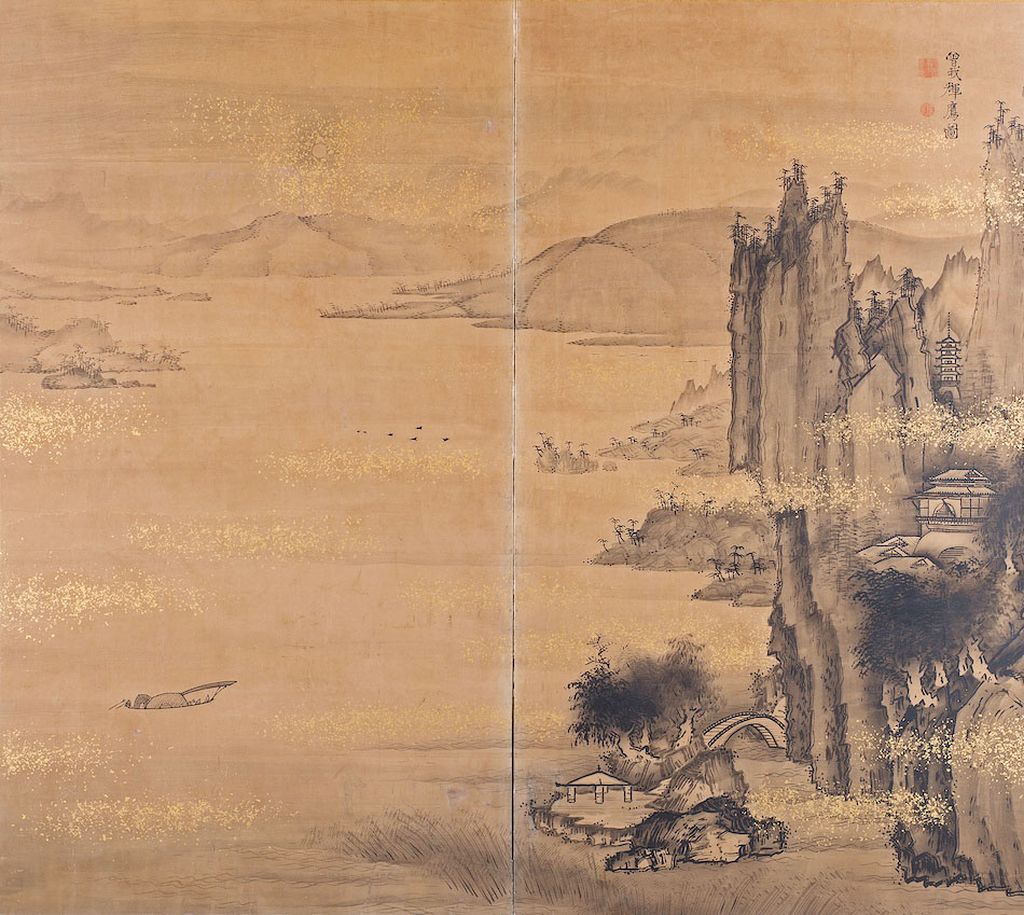
Tokyo Fuji Art Museum’s Landscape Screen provides another late-career comparison, but its date is less certain than the Cleveland scroll’s. The museum identifies a single two-panel screen and suggests a late phase through its seals; it does not supply an inscribed year. Its cliff, water and very small figures show how an artist could still use a broad folded support while painting quiet spatial recession. The contrast with Cleveland's long scroll reflects two kinds of viewing and two kinds of dating evidence. It should not be turned into a statement that Shōhaku painted both in 1777 or that he visited every landscape feature we can see in the Fuji screen. [23]
Kyoto's Jūnenji temple has a separate four-door Dragon and Clouds group, associated by a Kyoto City cultural-property report with a 1778 temple chronicle and seal evidence. Its later history is also tangled with the temple's eighteenth-century rebuilding and the 1788 fire. The report develops an account of relocation and reuse; that sequence is scholarly interpretation of surviving sources. These doors must never be merged with the 1763, eight-door Boston group because their shared subject is so memorable. A reader encountering two Dragon and Clouds titles ought to see immediately that the earlier Boston set and later Kyoto set have different dates, sizes and institutional histories. The biographical point is that a dragon theme could return in a long career, not that one great commission somehow moved intact between two temples. [17] [9]
Late chronology must also resist an automatic story of progressive wildness or progressive calm. Kyoto National Museum describes a practice spanning carefully detailed colour and broad ink, joined by remarkable drawing. The 1777 Cleveland scroll and the 1779 Met lions look very different, yet both can belong to a late, professionally established painter. The lions still stage a dramatic encounter, while the scroll asks the eye to follow an extended gathering. Neither proves that an old Shōhaku abandoned one set of interests for another. Even a museum date may be approximate, inferred from seal and style rather than inscribed. The differences between a dated work, an approximate museum date and an attribution are part of the evidence. [1] [21] [16]
Death, memory and the “eccentric” image
Shōhaku died in 1781. More specifically, the research cited by Mōri examined his grave inscription and Kōshōji temple register and established the seventh day of the first month of An'ei 10. That historical date belongs to the Japanese lunisolar calendar. Translating it silently as 7 January 1781 would give a false Gregorian precision. The temple material also anchors the Miura surname. It tells us something more reliable than many picturesque anecdotes, but not a final portrait of his state of mind. The end of a life is among the few moments here with a closely reported documentary date; the recorded date is best kept in its original calendar. [2]
After his death, stories of irregular behaviour and startling paintings helped make Shōhaku a memorable “eccentric”. Mōri discusses the local anecdotes and the later image of a man outside ordinary society, yet sets them beside substantial surviving work, patrons and companions. Yamaguchi's essay asks us to view him as a working painter too, and to consider how nineteenth-century and modern writing shaped the popular persona. The point is not to erase humour, strangeness or friction from the life. It is to ask when a story was recorded, who repeated it, and what a painting actually shows. An anecdote told decades later can be discussed as evidence of Shōhaku's reception even when it cannot certify the event it describes. [2] [19]
The dispersal of works changed that reception as well. Mōri describes the collection of Shōhaku paintings by visitors from America in the late nineteenth century. Boston's doors later became one of the most visible works for international visitors; other pictures remained in regional Japanese temples and museums. A modern exhibition can reunite them temporarily, but a reunited display is not a recovered map of every original room. Copies and contested attributions further complicate claims that a single show has assembled “the whole Shōhaku”. Local Japanese research on screens and former doors retains context that a widely reproduced isolated image can lose. [2] [9]
The painter's strongest known outline, then, is neither a set of legends nor an uninterrupted series of dated commissions. It begins in a Kyoto merchant family whose young son lost both parents. By about thirty he had the skill and self-conscious name to make ambitious screens. He sought and found regional opportunities, leaving substantial work in Ise and Harima, and was listed as a Kyoto painter by 1775. His surviving pictures and inscriptions show connections with scholars, monks and patrons, while the scale of his practice raises still-open questions about assistants and later imitators. His work survives in enough forms to let us test the image of the artist against the objects, and enough gaps remain for future research to matter. [3] [2] [19]
One final distinction shapes how these works survive. An object preserved in a collection is not always unchanged from the form Shōhaku made. A pair of screens can lose its companion, doors can be removed from a house, and a painted surface can be remounted for display. A narrow detail of each can make these different formats look deceptively alike. The surviving room commissions tell us about professional opportunities precisely because their scale and original functions are different from a scroll sold or given to one recipient. The number of surviving panels, an original door function and the date of a later remounting are separate parts of an object’s history. [9] [11]
That care also makes the evidence itself part of the reader's experience. On the 1760 Lin Hejing screens, words physically on the art support the date and show how the painter wanted to be named. On the 1775 directory page, an editor's listing tells us how a Kyoto public could find him. On the 1781 temple record, a family and religious institution kept a different kind of account. These records were made for different purposes, so they do not all answer the same question. Read together, they allow a reliable, if incomplete, account of an artist who worked across institutions and regions without asking us to choose between “eccentric genius” and “ordinary professional”. The documented paintings leave room for both invention and the practical work that sustained it. [3] [19] [2]
Frequently Asked Questions
Japanese museum records place his birth in a Kyoto merchant family named Miura. His adopted artistic name refers to an earlier Soga painting tradition; the claimed descent written on a 1760 screen is not independently proven as a family genealogy. [3]
Takada Keisuke has been proposed as his teacher, but the checked institutional accounts phrase that link with different degrees of certainty. No dated apprenticeship record is used here, so the relationship remains a tradition rather than a firm episode in the chronology. [6] [5]
The reason for his first visit has not been documented. Surviving works in temples and local households show that Ise offered a substantial market. Proposed explanations involving Kyoto temple ties or the family's possible dyeing trade are plausible but unproved. [2]
Yes. The 1763 eight-door group now in Boston and the later four-door group associated with Kyoto's Jūnenji are distinct objects. They have separate dates, dimensions and histories. [9] [17]
He died in 1781. The temple evidence cited by Mie gives the seventh day of the first month of An'ei 10 in the historical Japanese calendar. The historical day and month should not be read as a Gregorian date. [2]
Discussion
Use dated objects, inscriptions and later stories to examine what Shōhaku’s biography can establish.
Reader Insights
What can the 1760 Soga ancestry claim tell us about artistic identity?
How much can backing paper reveal about a painter’s movements?
What does the 1775 Kyoto directory establish that later anecdotes do not?
Join the Conversation
Share a documented example or reliable source below, keeping observation separate from inference.
References checked for this draft
- Kyoto National Museum, Soga Shōhaku: The Peculiar and the Beautiful.
- Ichirō Mōri, “伊勢地方と蕭白”, Mie Prefectural Art Museum exhibition catalogue.
- Mie Prefectural Art Museum, The Recluse Lin Hejing, commentary by Michida Miki.
- Mie Prefectural Art Museum, Yamaguchi Yasuhiro on Lin Hejing.
- Tokyo Fuji Art Museum, Shōhaku artist record.
- Tochigi Prefectural Museum of Fine Arts, Koizumi Ayaru and Takada Keisuke.
- Metropolitan Museum of Art, Cranes, 2019.420.24a,b.
- Agency for Cultural Affairs, 1764 Immortals pair.
- Museum of Fine Arts, Boston, Return of the Dragon.
- Tokyo National Research Institute for Cultural Properties, dated record for Dragon and Clouds.
- Mie Prefectural Art Museum, Seven Sages of the Bamboo Grove former-door study.
- Cleveland Museum of Art, Eight Immortals of the Wine Cup, first screen, 1976.11.1.
- Mie Prefectural Art Museum, Peacocks and Pine former-door study.
- Metropolitan Museum of Art, Tōkaibō with a Fishing Basket, 2015.500.9.4.
- Mie Prefectural Art Museum, 1989 exhibition checklist, Daruma, 1771.
- Metropolitan Museum of Art, Lions at the Stone Bridge of Mount Tiantai, 2015.300.216.
- Kyoto City, Jūnenji Dragon and Clouds cultural-property study.
- Yasuhiro Yamaguchi, “18世紀における地方との美術的交渉”, Mie Prefectural Art Museum.
- Yasuhiro Yamaguchi, “画師としての曾我蕭白”, Mie Prefectural Art Museum.
- Metropolitan Museum of Art, The God of Good Fortune Jurōjin, 2011.572.1.
- Cleveland Museum of Art, Orchid Pavilion Gathering, 1979.53.
- Metropolitan Museum of Art, Eight Views of Ōmi, 1994.566.
- Tokyo Fuji Art Museum, Landscape Screen, 08301.