


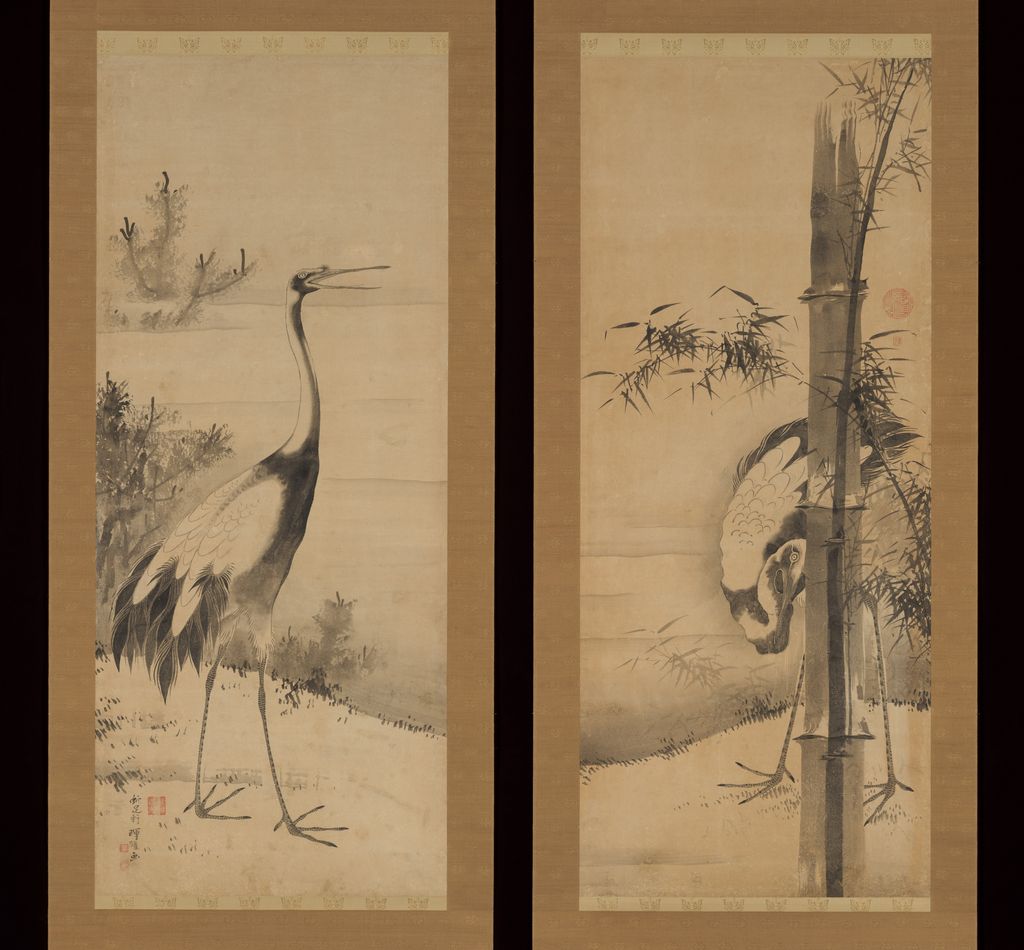
Soga Shōhaku, Cranes, pair of hanging scrolls, ca. 1760. The Metropolitan Museum of Art, 2019.420.24a,b. Museum object record.
 by Tom Gurney
Tom Gurney BSc (Hons) is an art history expert with over 20 years experience
Published on September 25, 2026 / Updated on September 25, 2026
Email: tomgurney1@gmail.com / Phone: +44 7429 011000
Soga Shōhaku: painting against easy categories
Soga Shōhaku (1730–1781) filled large folding screens with immortals, painted dragons across sliding doors, and gave individual birds the alertness of human actors. He also painted quieter landscapes where pale space, sharply drawn cliffs and a small boat make us look slowly. The name often appears as 曾我蕭白, with 曽我蕭白 in some modern catalogues. These works belong to a Kyoto-born artist who spent important working years beyond the city, notably in Ise and Harima, then returned to Kyoto. A useful introduction has to follow that variety of places and formats. Calling him an “eccentric” may point us toward his bold choices, but it does not explain how a screen was seen in a room or why a small seal helps date a scroll. [1] [2] [3]
At the Metropolitan Museum of Art, a pair of hanging scrolls brings two cranes close enough for their faces and bodies to occupy much of the viewer's field. Pine and bamboo signal a long pictorial tradition, while the birds' expressions seem almost conversational. The Met dates the pair to about 1760, not to an inscribed day. That difference matters: the painting is a strong early anchor for what Shōhaku could do, but it cannot by itself locate him on a particular journey. It makes a fitting first image precisely because its old subject and fresh sense of encounter coexist. The cranes are auspicious birds with inherited associations; their apparent personalities are a compositional decision. [4]
Contents
- Soga Shōhaku: painting against easy categories
- Look closely at the two cranes
- What is known of the painter's life
- Screens of immortals and the danger of a shared title
- Dragons that once moved with doors
- Ink that can be gentle, comic or severe
- At the Orchid Pavilion: a story made for a scroll
- Colour, ink and the surface of the work
- Other Kyoto painters and the meaning of difference
- Shōhaku's later reputation and dispersed works
- Figures of good fortune and a late lion
- How to look at a Shōhaku painting
- Books on Japanese Art
Look closely at the two cranes
Choose a number to enlarge a detail cut from a retained 300 dpi working copy of the 4313-pixel museum original. The explanations also appear below.
Explained details
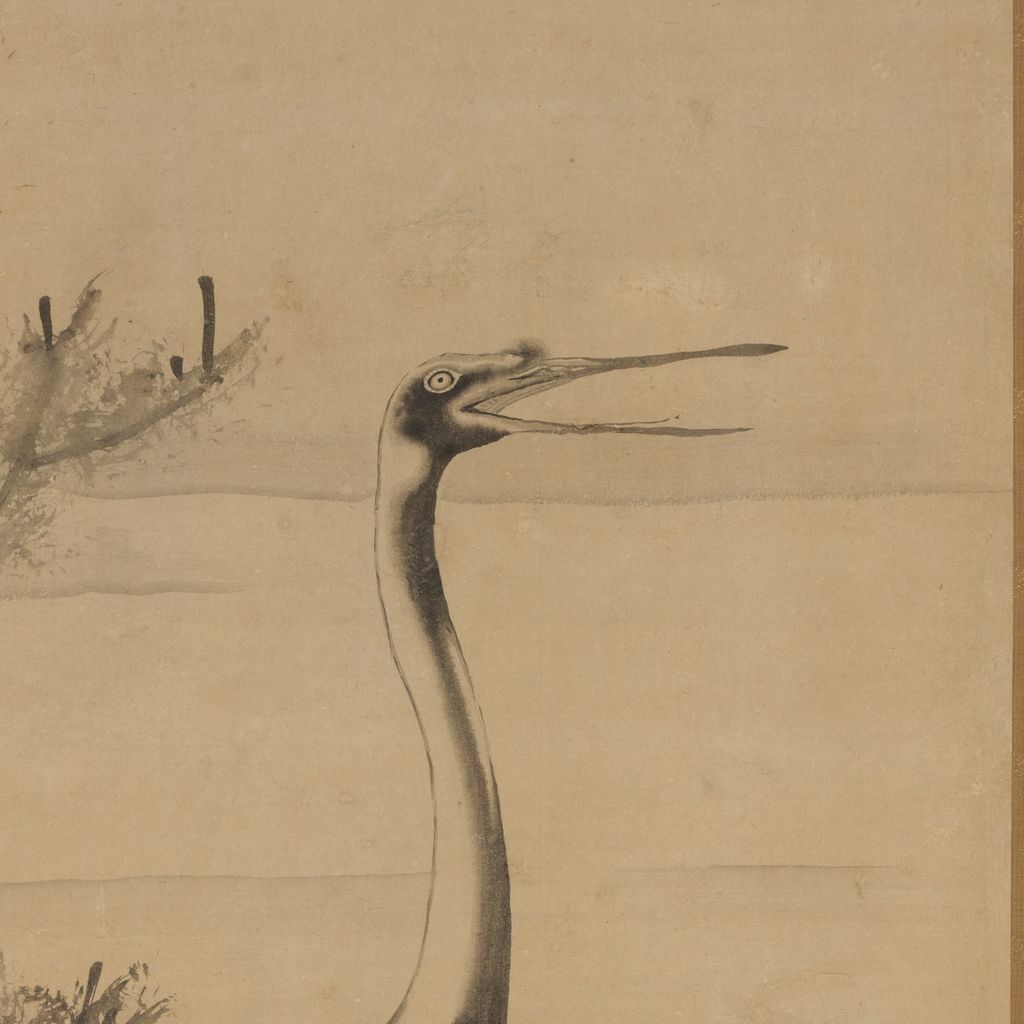
The raised crane
One crane stretches its neck and beak into the gap between the scrolls. Look at the contour around its eye and the open space it faces.
The Metropolitan Museum of Art Object record 2019.420.24a,b. Editorial crop and resize disclosed.
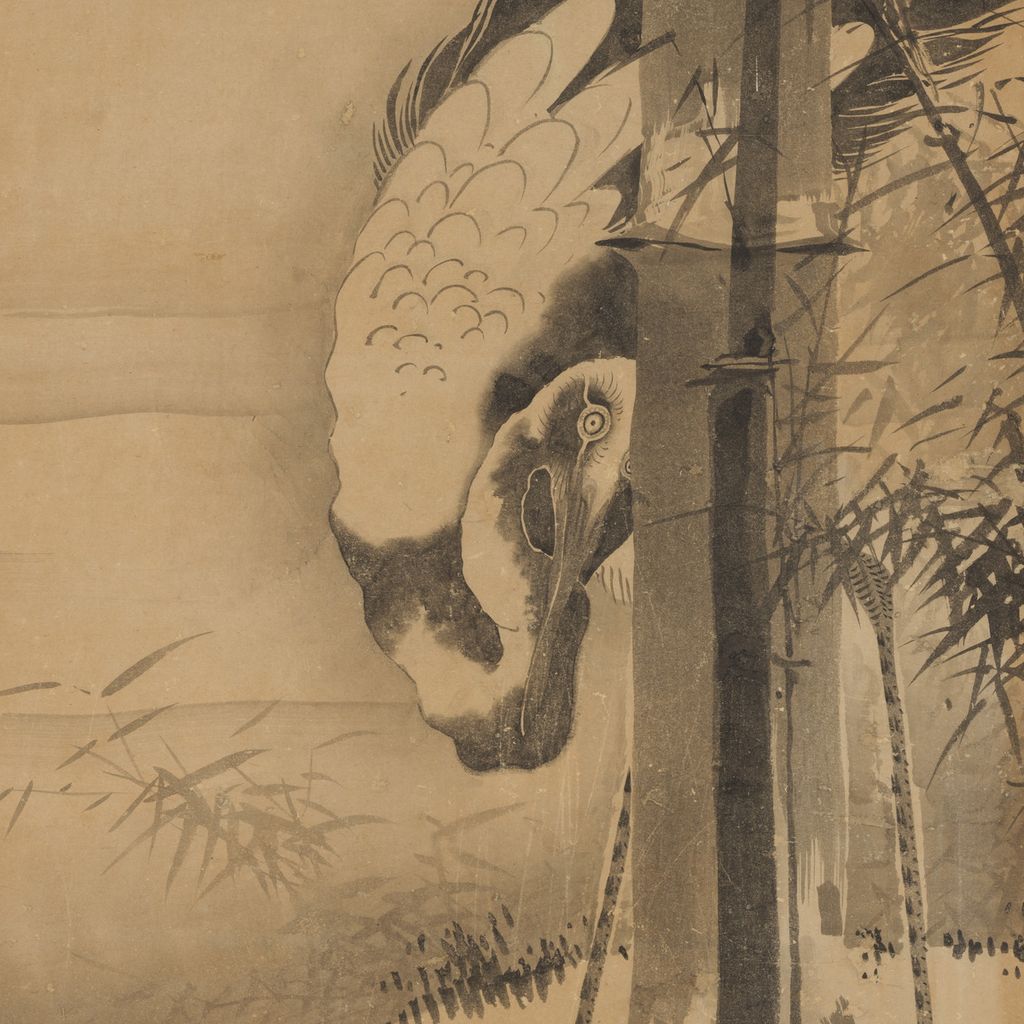
The crane by the bamboo
The other bird lowers its head beside the bamboo. Compare the fine marks on its feathers with the dense vertical trunk.
The Metropolitan Museum of Art Object record 2019.420.24a,b. Editorial crop and resize disclosed.
The pair's two sheets create a small drama across the gap between them. One bird stretches its neck upward in open space; its partner bends toward a trunk and nearby branches. The slight difference in posture makes a viewer mentally connect them, but the dividing wall space remains real. If the site's image module crops the two sheets into one narrow montage, that relation may disappear. The full photograph therefore leads, with separate views only where they let us inspect the marks around head, neck and legs. Museum records give the image dimensions of a scroll as 134 by 56 centimetres and also distinguish the larger mounted dimensions. The painted surface and its mounting should not be conflated in an annotation scale. [4]
At a glance
- Life1730–1781
- PlacesKyoto, Ise and Harima
- FormatsScreens, sliding doors and hanging scrolls
- Object careDistinguish same-titled works and later remounting
Shōhaku's chosen name can tempt a neat lineage story. Tokyo Fuji Art Museum relates it to his admiration for the older painter Soga Jasoku and describes a beginning with Takada Keisuke; it treats the possible Unkoku-school influence as an influence. The Met's Eight Views of Ōmi also reads his ink landscape as a deliberate reference to earlier Soga painters. Such references are evidence of artistic positioning, not proof that every later picture was painted in a continuously operating hereditary school. His work drew on medieval ink practice, Chinese themes and the active painting cultures of eighteenth-century Kyoto and its regions. It was recognisably his because he changed how those materials met their viewers. [2] [5]
What is known of the painter's life
The outline of Shōhaku's life is firmer than many of the colourful stories attached to his personality, yet it is far from complete. Japanese museum accounts identify a Kyoto birth in the Miura family. The name under which he later became famous was an artistic choice. His work and records connect him with Ise and Harima; he was in Kyoto in the later part of his career and died in 1781. A grave inscription and temple register studied by scholars support his original surname and date of death. They do not provide a diary of every commission or explain in his own words why he travelled. The biography page can separate each dated piece from later recollection; here the gaps keep us from arranging paintings into a convenient but unproved tale of youthful rebellion and triumphant return. [1] [2] [6]
One Japanese research essay is especially valuable on the Ise years because it tells us how the dating is constructed. Ichirō Mōri records earlier reports of signatures giving Shōhaku's ages as twenty-nine and thirty on works in the Tsu area, the basis for locating him there around 1758–59. A proposed return around 1764 rests on stylistic and seal comparisons with the dated Immortals screens and works transmitted around Matsusaka. A 1771 inscription by a Tsu scholar raises another possible visit. These are different strengths of evidence: reported ages, comparative dating and a dated text beside a painting should not be flattened into one itinerary. Mōri also says that no document yet establishes why Shōhaku first went to Ise. A temple network and a supposed family dyeing trade are plausible lines of research, not certified motives. [6]
The region was more than a picturesque stop. The former Nagashima household doors, now studied through a group of forty-four panels, show the scale of a commission made for an interior. Miki Satō's Mie Prefectural Art Museum essay associates the work with a likely 1764 visit and describes several subjects and treatments within the ensemble. Its animal names are not always settled: a creature once described as a wolf has also been read as a peculiar dog. That uncertainty is not a defect to hide. It reveals how freely Shōhaku changed natural forms and why catalogue titles cannot always answer what a viewer sees. Some passages use fine repeated lines for fur; other bodies are formed with broader washes. A regional patron could receive a coordinated environment, not just one amusing animal portrait. [7]
The doors also give a reason to resist a modern gallery habit. One displayed panel can be photographed neatly, and its subject can acquire a short English title, yet the household once experienced adjoining panels as part of movement through domestic space. Satō describes varied subjects across the forty-four, making it impossible to infer the entire programme from a single animal. A photograph of one startled creature would make an arresting thumbnail but a misleading map of the commission. If the manuscript later gains cleared images from Mie, it should reconstruct the sequence from a museum plan and identify original positions only where the evidence allows. In this artist overview, the ensemble is the example that keeps the reader aware of how much a work's setting can change its meaning. [7]
Harima was another important place, and an object can tell us more than a general statement that Shōhaku “travelled widely”. Mie Prefectural Art Museum describes four former sliding doors painted with peacocks and pine, associated with about 1767. The doors once had a different subject, the sages Xu You and Chao Fu, on their reverse. Paper used behind the paintings bore a place name near Takasago in Harima; the museum combines that physical clue with style and signatures to propose a second stay in the area. The paper is evidence about the object's material history, while the exact itinerary remains an interpretation. The peacocks are rendered in pale ink against a forceful, dark pine. That restrained choice gives a useful answer to anyone who expects Shōhaku to make every splendid bird in brilliant colour. [26]
The 1775 edition of the Heian jinbutsushi lists the painter briefly in Kyoto as 曾我師寵 上京, as Yasuhiro Yamaguchi discusses in a museum-published essay. The same essay notes that his highly accomplished works of the 1760s precede this comparatively late appearance in a Kyoto directory. It suggests followers may have worked near him, citing names with a character borrowed from the master; that remains an inference about a workshop, not a surviving payroll or studio contract. The listing gives a firmer place in the later city than most anecdotes do. It also reminds us that visibility in one printed directory is not a measure of how much was already being made elsewhere. [8]
In a separate museum essay, Yamaguchi describes encountering paintings stamped with familiar Shōhaku seals whose brushwork nevertheless seemed to come from other hands. He proposes that named followers and a small workshop may explain some of these objects. That is a more useful research question than a blanket verdict on every signed painting. The Met's Jurōjin provides a specific later case where a curator distinguishes likely master-hand figures and waves from a tree and stones that might involve assistants. Neither museum publishes a full allocation of a workshop's labour. The artist home should therefore identify the particular record and its reasoning each time it uses a qualified attribution; the biography can investigate when a studio became plausible. [27] [21]
Screens of immortals and the danger of a shared title
Shōhaku's 1764 Immortals is one of the essential works for understanding his large-scale colour. The Agency for Cultural Affairs records a pair of six-fold screens, each about 172 by 378 centimetres, designated an Important Cultural Property. A dated inscription gives his age as thirty-five; Tokyo National Research Institute for Cultural Properties transcribes it. The crowded figures do not simply illustrate an old Chinese theme. Colour, oddly shaped bodies and movement across joined panels turn the screen itself into an event. An observer must scan the whole surface, then return to individuals who press out of the group. It is a painting of scale and rhythm as much as a painting of unusual beings. [9] [10]
The date is particularly important because many surviving works are assigned a range based on seals, style or surrounding documentation. It makes the screens a fixed point for comparing works associated with the mid-1760s, including the Ise material discussed by Mōri. But a fixed point does not license a tidy claim that Shōhaku “became eccentric” that year. We do not have a complete sequence of every screen he painted before and after it. Nor should his age inscription be converted by simple subtraction into an exact birth date for every other source: the historical way of reckoning age and the modern calendar are not identical. The strongest conclusion is narrower and richer: by 1764 he could orchestrate an immense pair of colour screens in a confident and distinctive manner. [6] [9] [10]
Yet Immortals Screens is not a unique identifier. A Tokyo University of the Arts cultural-property record describes another pair also called 群仙図屏風, but its screens have only two panels each, an ink-and-gold treatment and very different dimensions. If a caption says only “Shōhaku, Immortals” and supplies a convenient search image, a reader cannot tell which work is meant. This page refers to the six-fold 1764 pair by holder, material, format and date. It will show a production image only when a file of that exact pair has suitable website rights. The similarly titled two-panel pair is a comparison, not substitute illustration. [9] [11]
Dragons that once moved with doors
The Boston Museum of Fine Arts' Dragon and Clouds dates to 1763. Its dragon extended across paintings made for eight sliding doors, a composition roughly thirty-five feet long. The museum acquired the work in 1911; the doors were later represented in four sections before restoration and a new panel presentation for the museum's 2012 exhibition. Those changes are not minor framing details. On fusuma, a dragon's body could cross seams and a viewer could meet it while moving through a room. In a modern gallery, the joined extent and the gaps are read differently. The museum's account lets us imagine both settings, while identifying which physical state a photograph shows. [12] [13]
The spectacular subject also creates a title trap. Kyoto City has documented a separate Dragon and Clouds made on four large doors for Jūnenji, associated with 1778. A temple chronicle mentions four new painted large doors; the city argues they are very likely the surviving four, comparing the painter's seals as well. It proposes how they were saved or reused around a later fire. These are careful deductions, not a signed note in the chronicle naming Shōhaku. The Boston doors and the Jūnenji doors differ in year, site, dimensions and surviving group. Any eventual close comparison must give each its own object caption. [14]
Ink that can be gentle, comic or severe
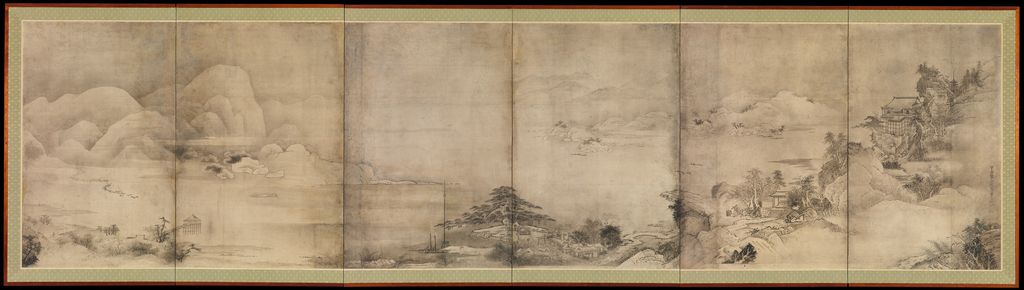
The Met's Eight Views of Ōmi shows a very different scale of looking. A six-panel screen dated about 1762–66 adapts a classical Chinese “eight views” idea to places and seasons around Lake Biwa. The Met owns the left screen of an original pair; it depicts four of the views. Ishiyamadera stands on a slope at the right edge of the present screen. Because the missing companion is not in this photograph, we cannot show all eight as if the one image completed the series. An especially useful annotated treatment would identify the temple, move to the water and then return to the uninterrupted screen, letting readers see how particular places belong to a larger visual rhythm. [5]
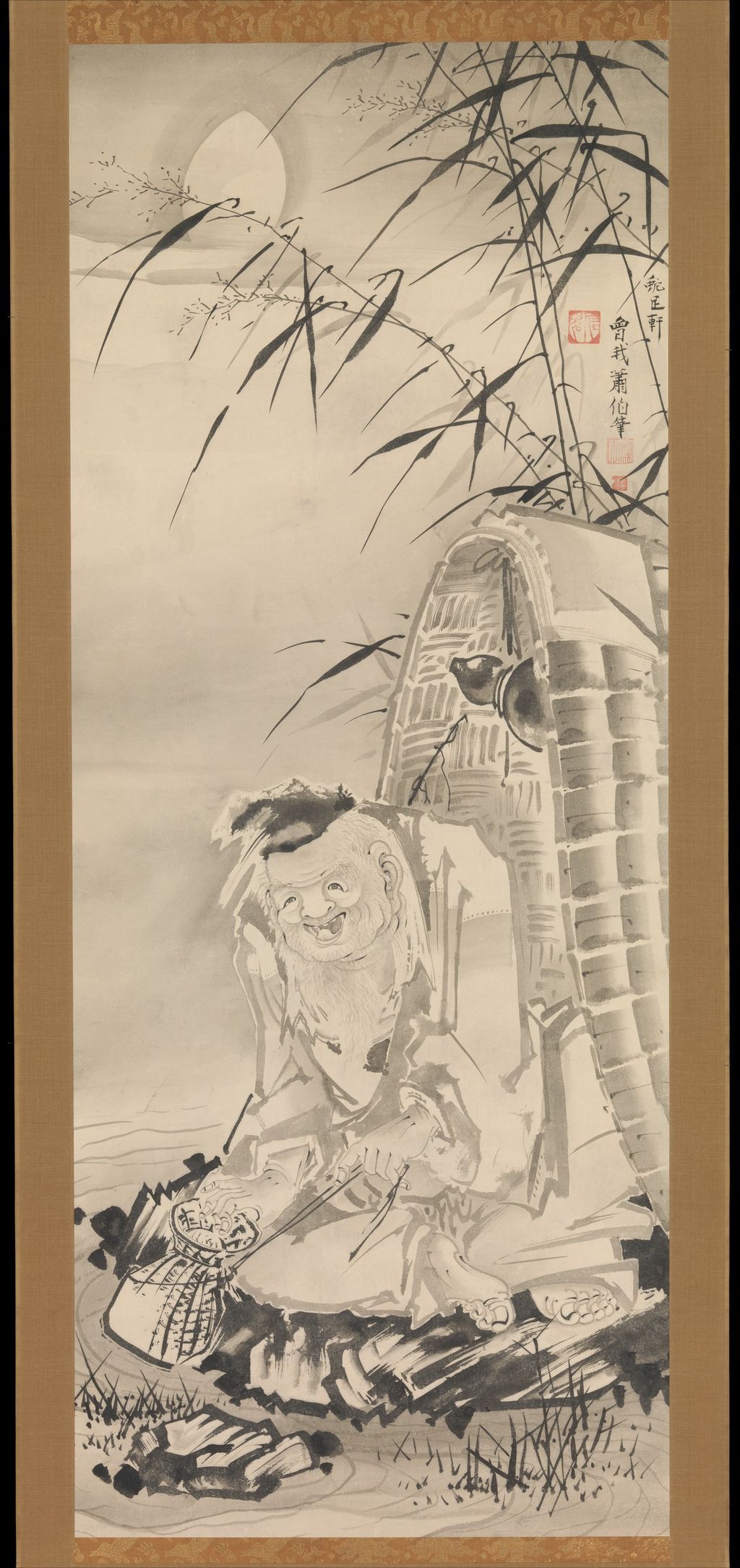
The Met's Tōkaibō with a Fishing Basket, also described in Japanese as a Taikōbō picture, turns a Chinese historical sage into a small scene of patience. Pale ink gives the seated man and lean-to their weathered presence. His cap, jug and rock receive darker touches. The Met links the subject to Jiang Ziya, whose legendary willingness to fish without bait made him exemplary as a strategist, and dates the scroll around 1768 partly from a small Soga Teruo seal. The subject is learned, but its effect is immediate: the man seems content to wait, while a basket and stream make his stillness visible. A seal can support a date without turning a circa-year into an inscribed calendar year. [16]
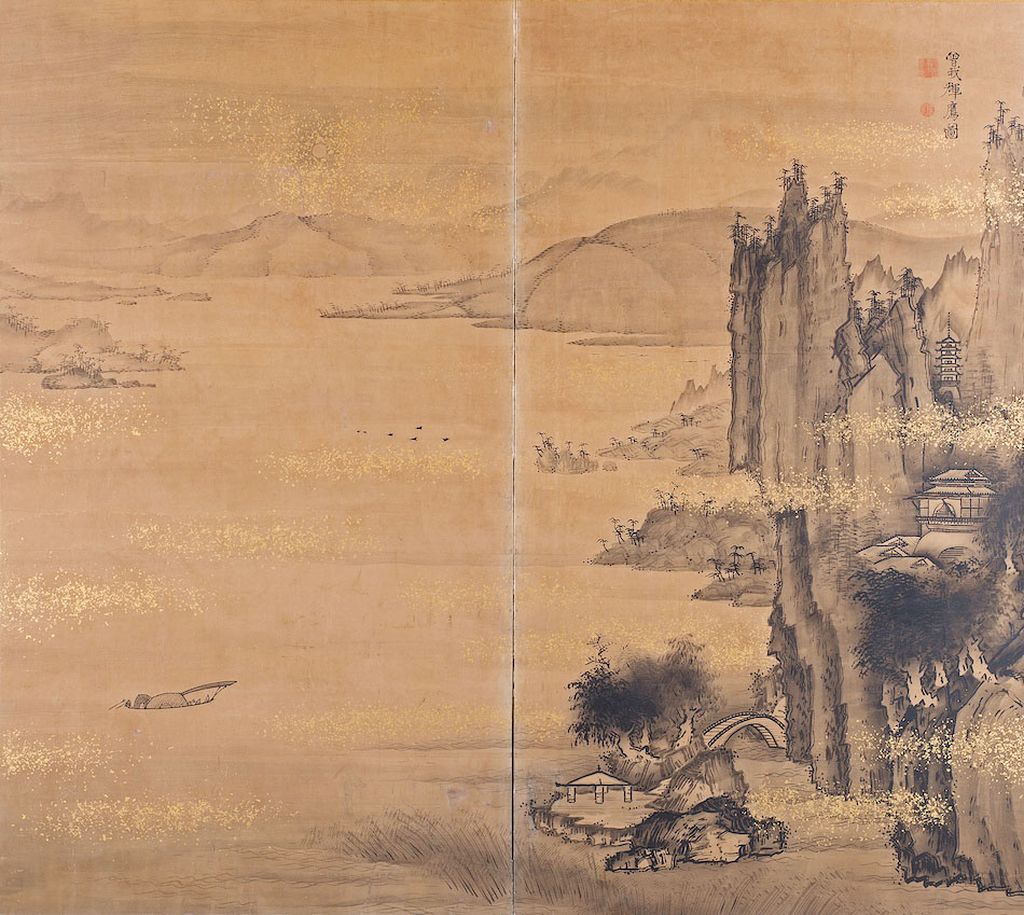
Tokyo Fuji Art Museum's Landscape Screen (山水図屏風) is a two-panel single screen that plays a more spacious game. A low boat sits at the edge of a wide, almost empty lake. High cliffs, buildings and dark vegetation draw the eye to the other side. Pale mountain ranges seem to recede behind mist; small figures make the architecture and rock feel large. The museum interprets its seals as suggesting a relatively late work, but does not assign a fixed year. This is precisely why the canvas-like whole view matters: if we crop to the dark cliff alone, we lose the quiet water that gives it distance. The museum marks its downloadable digital image CC0 and the underlying painting public domain. [17]
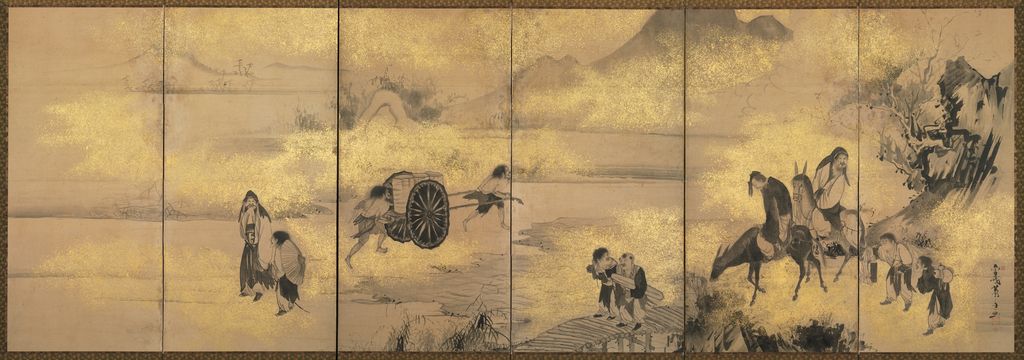
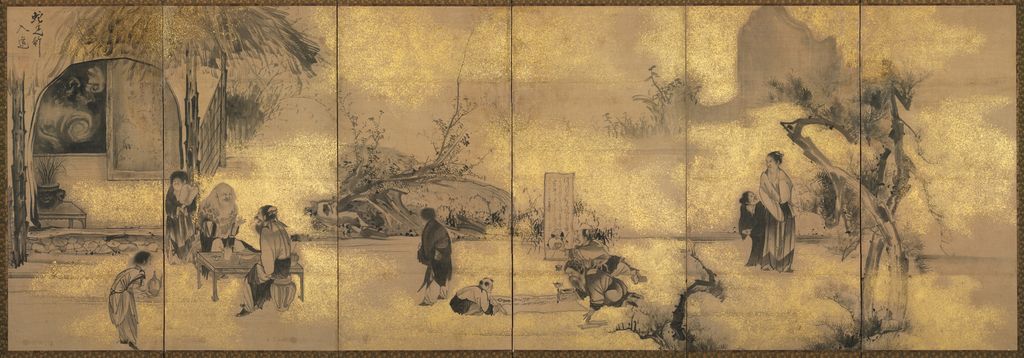
Cleveland's paired Eight Immortals of the Wine Cup screens make another Chinese source move across a very different surface. The museum links them to Du Fu's poem about eight historical men who drink and leave their official duties. Shōhaku distributes figures through mountains, bridges, buildings and gold-flecked open space. His comic expressions and groups reward close viewing, yet the screens remain a pair: Cleveland accessions 1976.11.1 and 1976.11.2 are two parts of one work set. A reader should see both in a matched layout, with the screen order and individual object numbers stated. These figures are not the Taoist Immortals of the 1764 Important Cultural Property, even though a short English title may make the groups sound alike. [18] [19]
At the Orchid Pavilion: a story made for a scroll
Another Cleveland painting, Orchid Pavilion Gathering, is dated 1777 and takes a Chinese event of AD 353 as its subject. Participants had come together to compose poetry and drink; cups floated along a stream, and a person who caught or received one was expected to make a verse. The theme carried the prestige of literary culture across centuries and countries. In Shōhaku's hanging scroll, the viewer does not need to recognise each scholar to sense the connection between buildings, gathered figures and running water. A creek descending past rock and a bridge gives the story a path through the picture. The eye travels down the vertical surface much as a cup is imagined moving along the water, an analogy suggested by the composition rather than a documented instruction from the painter. [24]
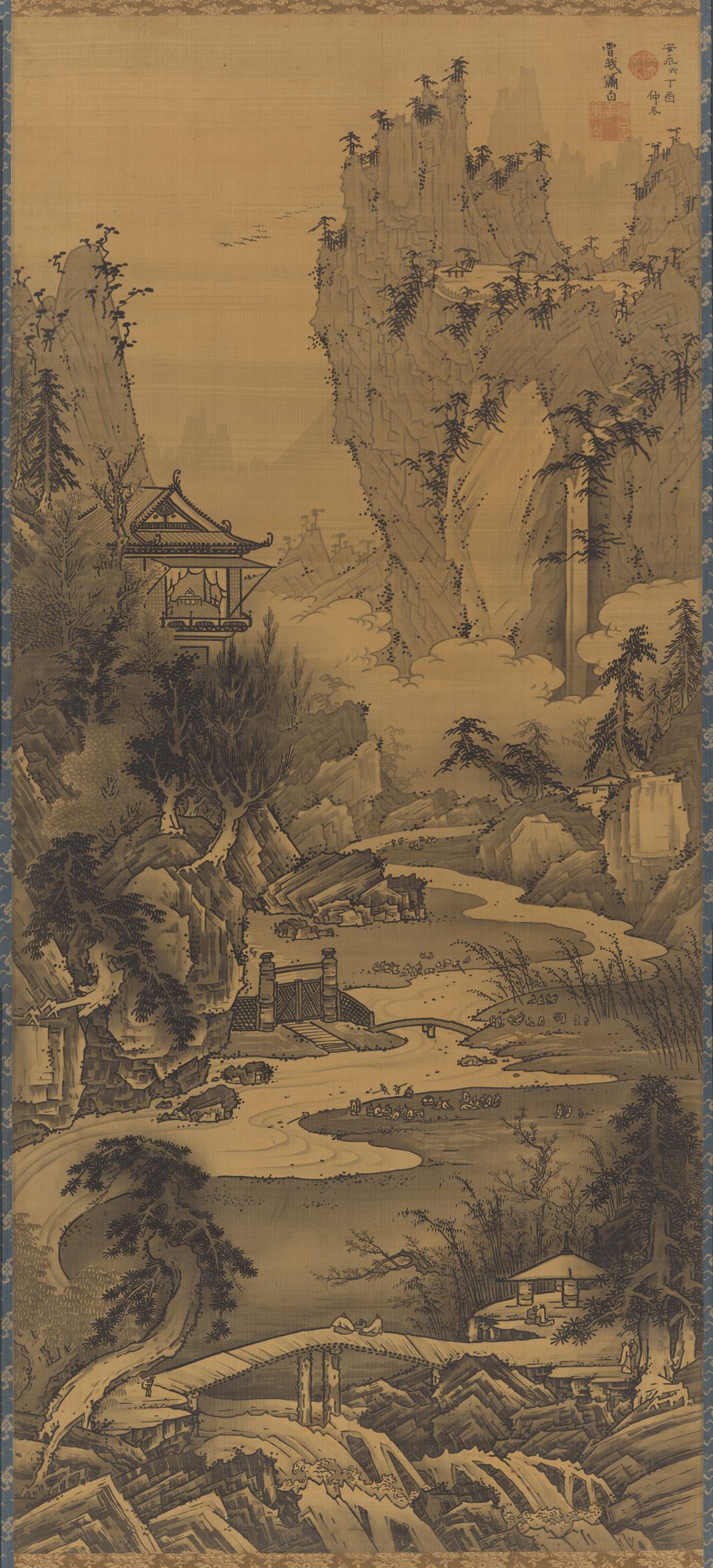
Cleveland notes that a temple in Kurume and the National Gallery of Victoria own works by Shōhaku on the same theme. That is useful evidence for a continuing subject, yet it is not permission to treat the three objects as identical versions or to reuse photographs from the other holders. This page shows the exact Cleveland scroll, accession 1979.53, and records its 1777 date. A future comparison would need the other holders' titles, dimensions, inscriptions, images and rights. The point here is narrower and more rewarding: a topic inherited from Chinese literati culture could be organised for a Japanese hanging scroll, with water and architecture controlling the way a reader experiences it. That thematic continuity also makes the Cleveland wine-cup screens less surprising. Shōhaku could return to convivial figures in more than one format without repeating the same composition. [24] [18]
Colour, ink and the surface of the work
It is tempting to describe the 1764 Immortals as Shōhaku's wild colour and the landscapes as his reflective ink. Kyoto National Museum offers a better starting point: his practice ranged from carefully detailed colour to broad and freely handled ink, joined by his ability to draw. The contrast between two works is real, but it should not become a rigid chronology or a split personality. The Met's Jurōjin uses ink and colour together; a small red mark at the mouth changes the effect of a mostly restrained scroll. The Fuji screen uses ink to build both imposing cliff and misty distance, while a few minute figures keep the giant rocks from becoming an abstract pattern. The painter did not have to choose between technical control and theatrical impact. [1] [21] [17]
Material descriptions matter here. Cleveland catalogues the Eight Immortals of the Wine Cup pair as ink and cut gold foil on paper. The flecks and gaps create a different atmosphere from the clean, pale support of the Met's ink-only Cranes. A photograph flattened to one screen width may make both look like tan rectangles; their records show different ways an original surface could catch light. Orchid Pavilion Gathering is ink on silk, not a leaf of the gold-flecked paper screen. Comparing the works should begin with what the support and material actually are, then ask how the figures move across them. “Ink painting” alone is too broad to tell a reader why the screens and the scroll feel different. [4] [18] [19] [24]
The museum descriptions also help us read distance and scale without pretending to see more than a web image can show. On the Fuji Landscape Screen, the dark cliff is concentrated on one side, while lake and low boat spread across the other. In the Met Eight Views, the folds divide four places from an original eight-view pair. On the Cleveland wine-cup screens, groups are scattered across a joined, long surface. An interface that only stacks square detail crops would make the most eye-catching faces visible but conceal Shōhaku's larger planning. The illustrated page should give each complete object its own caption and enough width to recognise its structure, using the enlargement popups to return from detail to whole. [5] [17] [18]
Other Kyoto painters and the meaning of difference
Shōhaku lived during a period rich in differing approaches to painting. The Kyushu National Museum places him in the world of eighteenth-century Kyoto painters, alongside Itō Jakuchū as an artist later often described through “eccentric” work. The Maruyama Ōkyo cluster offers another comparison, especially where direct observation and trained workshops are concerned. But the label grouping them is a modern way to organise an exhibition, not proof of a collective programme or rivalry that can be reconstructed from a similar-looking screen. To understand a difference, ask what each artist is doing to an exact subject, support and viewing setting. A crane in Shōhaku's pair meets us at nearly human scale; it need not be turned into an argument against every crane painted by another Kyoto artist. [3] [4]
The same caution applies to an old Soga name. The Met describes its Eight Views as knowingly recalling earlier Soga-school painting. That means the picture can look back while making a local view around Lake Biwa; the old precedent and regional specificity work together. An artist who borrows a name, seal habit or brush manner is not necessarily surrendering agency to the past. Nor does independence require that he invented every visual form. Satō's study of the Nagashima doors discusses the use of drawing models and motifs found in other works. The interest is how Shōhaku reassembled them into a coherent set of doors and gave particular animals unfamiliar expressions. “Original” is most useful when it points to a visible transformation, not a claim that nothing was learned or reused. [5] [7]
This matters especially when readers arrive from Hokusai or Hiroshige and expect a printed image to have stable editions and impressions. Shōhaku's principal works discussed here are paintings on paper or silk, often made for a room or an occasion and sometimes remounted long after completion. No edition number describes the Boston doors. Their present appearance reflects conservation and installation history as well as eighteenth-century paint. A screen may have a companion in another collection or a door ensemble may survive only partially. The article can make that material history legible through precise captions and a clear full-work image, helping visitors move from print culture to the different experience of painted rooms and portable scrolls. [5] [12]
Shōhaku's later reputation and dispersed works
His public image did not travel in a straight line from eighteenth-century fame to modern popularity. The late 1775 Kyoto listing offers one contemporary sign of professional recognition, but it is brief and follows significant work in Ise. Modern exhibitions have deliberately brought dispersed pieces together so viewers can see a fuller range. Kyoto National Museum's 2005 show assembled around 120 works, including pieces brought from Boston and from overseas private holdings, according to a museum-published reflection by Tamehito Reizei. That is a report on the exhibition's scope and reception, not a count of all securely autograph works. The author interpreted the appeal of unsettling beauty through the exhibition's theme; the title itself, “pleasure in defiance”, was a curatorial frame. [8] [25]
Dispersal affects this page's picture selection as well. American collections provide several clear, commercially reusable digital files, while Japanese museums and local-government studies often provide the best evidence for the original setting, title, date or regional relationships. The two kinds of evidence have different rights. The illustrated sequence of Met, Cleveland and Fuji works should never imply that only those holdings define Shōhaku's achievement. Links to the 1764 Immortals, Boston doors, Jūnenji doors and Nagashima house let readers follow major works even while their institutional photographs remain research-only. As exact licensing changes, the gallery can grow without having to rewrite its object identities. [9] [12] [14] [25]
Figures of good fortune and a late lion
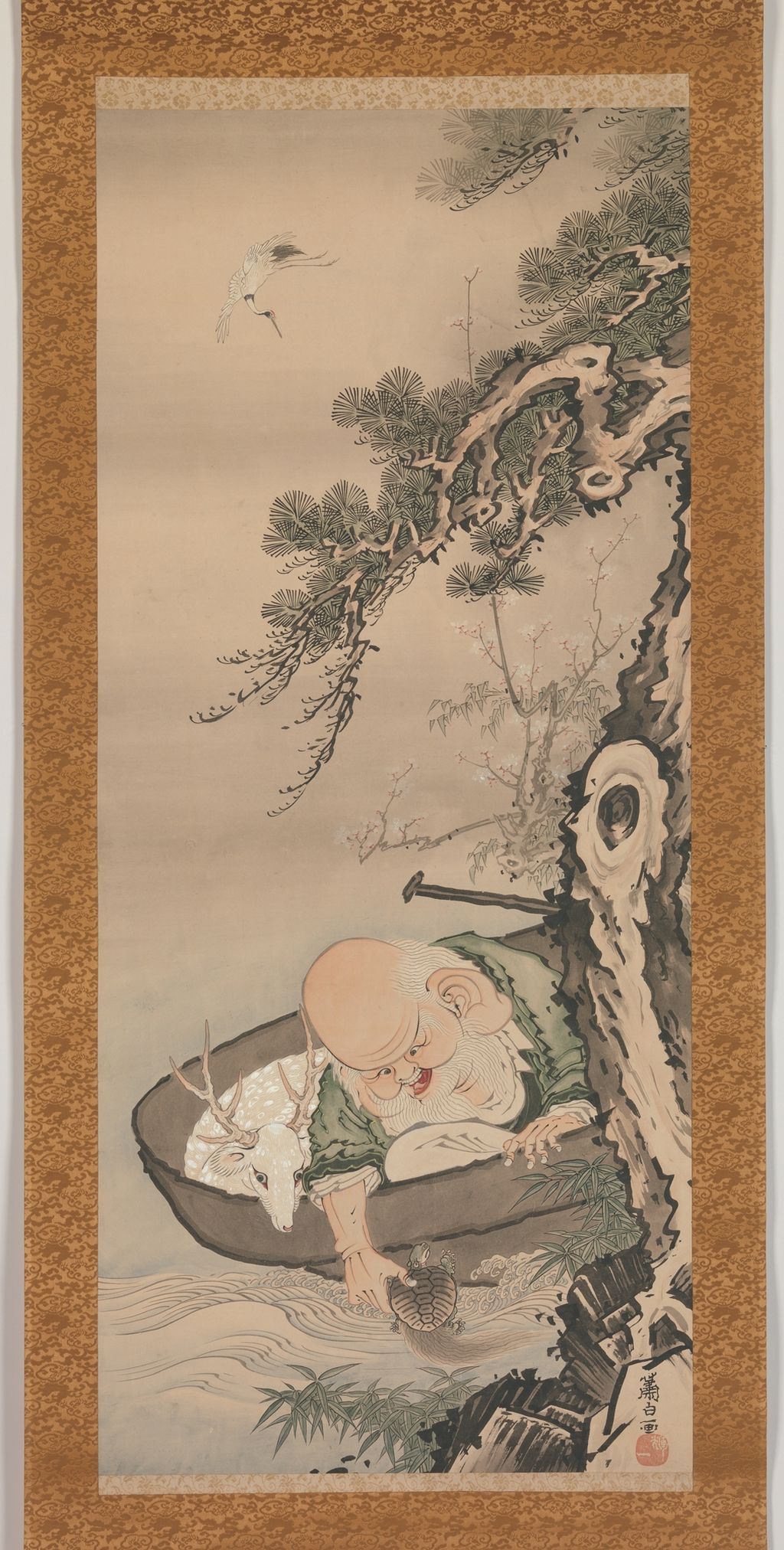
The Met's Jurōjin brings together a long-lived sage, a white deer, a crane and a turtle in one tall scroll, around 1773. Little red accents sharpen the festive tone. The museum considers the master's hand clear in the figures, deer and waves, while suggesting that other painters around him may have helped with the tree and stones. This is a better account of collaboration than a simple label declaring the whole work either “autograph” or “workshop”. It gives viewers an opportunity to compare kinds of brushwork inside one object, while admitting that stylistic judgements remain curatorial. The Kiichi seal supports its attribution among other accepted works. [21]
In a 1779 scroll at the Met, lions test a precipitous stone bridge associated with China's Mount Tiantai. The mother casts her cubs down; their ability to climb back becomes the subject of the scene. The image's theatrical violence differs from the gracious Jurōjin, yet both adapt East Asian inherited stories through startling composition. Gazan Nanso supplied the inscription on the lion scroll. Naming him matters: a painting can join another person's words without that second person becoming the painter. The date is unusually helpful so late in Shōhaku's career, but even here one object should not be asked to summarise every late work. [22]
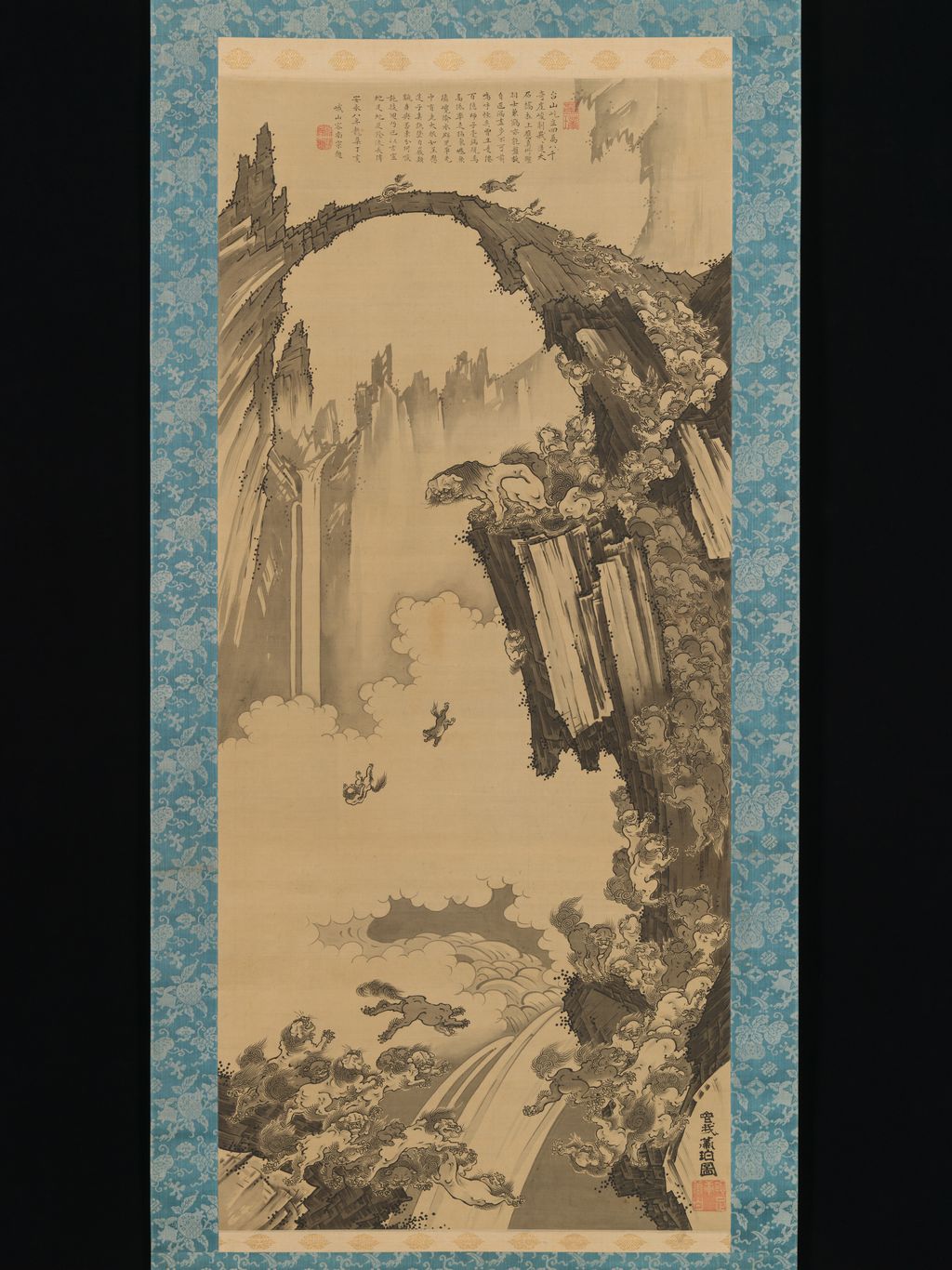
The stone bridge itself deserves attention. It is both a place in a legendary Chinese landscape and the physical obstacle that gives the cubs' action its stakes. A crop containing only a lion face might promise sensational drama, but it would erase the spatial test. In the full vertical image, rock, bridge and open fall arrange the story so that a viewer first feels where the creatures are. The inscription adds another layer of interpretation, because an eighteenth-century reader could have met image and written response together. Our enlargement should permit a close look at those components while returning to the whole scroll; it should never imply the Chinese mountain was a destination Shōhaku visited. [22]
How to look at a Shōhaku painting
Start with its format. A hanging scroll offers a single field, often unrolled for a particular viewing. A six-panel screen turns on its folds and can guide the eye along a room. Sliding doors change the architecture itself; the image may move and an adjoining door may have answered it. The Boston dragon and the former Nagashima house paintings make that architectural dimension essential. The Met Cranes and Tōkaibō ask for a more concentrated encounter. Similar ink strokes do different work at these different scales. None of those formats can be responsibly reduced to a freestanding square picture without explaining the crop or mounting history. [4] [7] [12] [16]
Next, read the object line before its familiar title. A six-fold 1764 Immortals pair differs from a two-panel art-university pair; Boston's 1763 dragon differs from Jūnenji's probable 1778 doors. Cleveland's Eight Immortals of the Wine Cup takes its title from a poem and forms one paired work across two accession records. The Met's Eight Views of Ōmi is only the left screen of an original pair. Those distinctions are not academic obstacles to pleasure. They make it possible to know whether a face, cliff or dragon in a cropped online image actually belongs to the artwork being discussed. [9] [11] [14] [18]
Finally, separate a dated inscription, an inferred date and an attribution. The 1764 Immortals inscription and Boston dragon date stand on different object evidence from “circa 1760” Cranes. Tokyo Fuji's late landscape is dated by seals and style, while the Met explicitly records that some scholars have questioned the attribution of a conservative Mountain Landscape even though its signature and seal point toward an early Shōhaku work. That disputed scroll can illuminate how scholarship works, but it should not be put in a gallery as an uncontested milestone. The question is not whether every record can be forced into certainty. It is whether the article gives readers the evidence to see the differences. [4] [9] [17] [23]
This approach makes “eccentric” a beginning rather than a verdict. Shōhaku's cranes are comic yet grounded in auspicious imagery; his screens draw on old Chinese figures and Japanese ink traditions; the Eight Views rewrites a famous landscape theme for Lake Biwa; the later lion makes a shared Buddhist and Daoist mountain story urgent. Kyoto National Museum stresses that his practice could be carefully coloured or broad and free in ink, with remarkable skill connecting the two. He changed inherited subjects because he knew them. A reader who looks past the label sees decisions about scale, address, movement and material that a personality story alone cannot hold. [1] [4] [5] [22]
Frequently Asked Questions
He was a Kyoto-born Japanese painter (1730–1781) known for screens, sliding-door paintings and hanging scrolls. Important work was made or transmitted in Ise and Harima as well as Kyoto. His best-known subjects include immortals and dragons, but ink landscapes, cranes and other figures show a much wider practice. [1] [2]
It is a later descriptive grouping for painters whose compositions or subjects surprise viewers. It was not a formal society with a fixed manifesto. Shōhaku's work also depends on older Chinese-derived themes, medieval Japanese ink practice and carefully controlled formats, so the label cannot replace an explanation of an individual picture. [1] [5]
No. The 1764 Important Cultural Property is a pair of six-panel colour screens; another 群仙図屏風 in the Tokyo University of the Arts record is a pair of two-panel ink-and-gold screens. Cleveland's Eight Immortals of the Wine Cup is another subject again, across two six-panel screens. Check the holder, format, material and date before identifying an image. [9] [11] [18]
The 1763 former sliding-door composition discussed here belongs to the Museum of Fine Arts, Boston. A high-resolution replica has been made for display in Japan. Kyoto's Jūnenji has a separate, later four-door Dragon and Clouds associated with 1778. A photograph of either doors or replica needs its own exact caption. [12] [14] [15]
The Met, Cleveland and Tokyo Fuji Art Museum provide online records for the exact works illustrated here. Physical displays rotate; their present “not on view” labels should be checked at the museum before travel. Japanese museum and cultural-property records document many further screens and doors whose online images have different reuse conditions. [4] [18] [17]
Discussion
Compare exact objects, their original formats and the evidence used to date Shōhaku’s paintings.
Reader Insights
Which details distinguish the two Immortals screen pairs?
How do the Ōmi and Fuji screens use space differently?
What changes when a former sliding-door painting is remounted for display?
Join the Conversation
Share a documented example or reliable source below, keeping observation separate from inference.
References
- Kyoto National Museum, “曾我蕭白―醜美と優美”, 2015 exhibition introduction. Checked for broad style, career and exact Japanese titles.
- Tokyo Fuji Art Museum, Soga Shōhaku artist record. Checked for Kyoto/Miura origin, early teacher, possible school influence, travels and later phase.
- Kyushu National Museum, “Fifteen Kyoto Painters” exhibition. Checked for contextual distinction between Shōhaku's forceful figures and controlled ink landscapes.
- Metropolitan Museum of Art, *Cranes*, 2019.420.24a,b. Exact pair, date, medium, title and CC0 record.
- Metropolitan Museum of Art, *Eight Views of Ōmi*, 1994.566. Exact left screen, theme, date, format and CC0 record.
- Ichirō Mōri, “伊勢地方と蕭白,” Mie Prefectural Art Museum exhibition catalogue, 1998. Full online essay read; differentiates evidence and hypotheses for Ise travel and family connections.
- Miki Satō, “曾我蕭白《旧永島家襖絵》,” Mie Prefectural Art Museum catalogue, 1998. Full online essay read for 44-panel ensemble, likely date and motif/technique disputes.
- Yasuhiro Yamaguchi, “18世紀における地方との美術的交渉,” Mie Prefectural Art Museum catalogue, 1989. Full online essay read for 1775 listing and qualified followers/workshop interpretation.
- Agency for Cultural Affairs, `紙本著色群仙図` Important Cultural Property record. Exact six-panel colour pair and status.
- Tokyo National Research Institute for Cultural Properties, 1764 *Immortals* inscription record. Date, age and dimensions.
- Agency for Cultural Affairs, Tokyo University of the Arts `群仙図屏風` record. Distinct two-panel pair.
- Museum of Fine Arts, Boston, “Return of the Dragon”, 2012–14 exhibition account. Original extent, former door format, collection and display history.
- Tokyo National Research Institute for Cultural Properties, *Dragon and Clouds* date record. 1763 inscription evidence.
- Kyoto City, Jūnenji sliding-door cultural-property investigation, pp. 8–10. Full relevant report read; four-door identity, qualified 1778 chronology, seals and temple document.
- Canon Tsuzuri Project, *Dragon and Clouds* reproduction account. Replica identity and location distinction. MFA digital images remain unlicensed for this site.
- Metropolitan Museum of Art, *Tōkaibō with a Fishing Basket*, 2015.500.9.4. Subject, circa date, seal and CC0 record.
- Tokyo Fuji Art Museum, *Landscape Screen* `山水図屏風`, 08301. Exact single-screen object, inference from seals and file-specific CC0 wording.
- Cleveland Museum of Art, *Eight Immortals of the Wine Cup*, 1976.11.1. First screen, dimensions, subject and open access.
- Cleveland Museum of Art, *Eight Immortals of the Wine Cup*, 1976.11.2. Companion screen, exact object set and open access.
- Agency for Cultural Affairs, `飲中八仙図屏風` by Kaihō Yūshō, 1602. Negative identity check; this is **not** a Shōhaku screen.
- Metropolitan Museum of Art, *The God of Good Fortune Jurōjin*, 2011.572.1. Iconography and qualified atelier observation.
- Metropolitan Museum of Art, *Lions at the Stone Bridge of Mount Tiantai*, 2015.300.216. 1779 date, story, medium and Gazan Nanso inscription.
- Metropolitan Museum of Art, *Mountain Landscape*, 36.100.66. Explicit scholarly attribution caution.
- Cleveland Museum of Art, *Orchid Pavilion Gathering*, 1979.53. 1777 hanging scroll, literary subject, comparison holdings and open-access image.
- Tamehito Reizei, “曾我蕭白展,” Kyoto National Museum newsletter essay, 2005. Checked for exhibition scale, overseas loans and contemporary reception; its evaluative language is attributed as interpretation.
- Mie Prefectural Art Museum, *Peacocks and Pine* former doors. Four panels, circa 1767, reverse-door history, Harima backing paper and ink contrast.
- Yasuhiro Yamaguchi, “画師としての曾我蕭白,” Mie Prefectural Art Museum. Full essay read for the 1775 Kyoto listing, named followers, seal/brush discrepancies and the qualified studio hypothesis.