


 by Tom Gurney
Tom Gurney BSc (Hons) is an art history expert with over 20 years experience
Published on June 19, 2020 / Updated on September 23, 2026
Email: tomgurney1@gmail.com / Phone: +44 7429 011000
A painter larger than a label
Maruyama Ōkyo (円山応挙, 1733–1795) is often introduced as the painter who made Japanese art look more like nature. That is a useful beginning, but a poor ending. In one painting a heron rests against a field of gold; in another a dragon emerges from clouds opposite a tiger; in a third, a Zen nun stands beside a broken water vessel. None is simply a specimen copied from life. Ōkyo used attentive observation alongside inherited Chinese subjects, Japanese narrative, patterned surfaces and the viewing conditions of screens and scrolls. The Kyoto National Museum describes a painter who learned from Western methods and Chinese painting while making shasei—observation or sketching—a basis for his own style. It does not say that he abandoned those other languages of painting. [1] [2]
Explore Ōkyo’s puppy paintings
Contents
- A painter larger than a label
- What did Ōkyo mean by observation?
- Stories, people and a city across the seasons
- Painting calamity and consequence
- Older landscapes through new eyes
- A screen changes with the room
- A pair of fish that marks time
- Patrons, a workshop and paintings made for buildings
- How to look—and where to go next
- Books on Japanese Art
Read Maruyama Ōkyo’s biography.
He worked in and around eighteenth-century Kyoto, where different patrons wanted paintings for different settings. A study album could keep a close record of wings, leaves or insects. A hanging scroll could isolate a person or an animal for concentrated viewing. A pair of screens spread a scene across a room, making the gaps between panels part of its rhythm. At Daijōji temple in today's Hyōgo Prefecture, Ōkyo and his pupils made paintings for rooms whose walls and doors formed an architectural whole. The artist's achievement lies partly in moving between these settings without treating them as the same pictorial problem. [3] [4]
Ōkyo at a glance
- Years1733–1795
- CentreKyoto
- FormsSketchbooks, hanging and handscrolls, screens, room paintings
- SchoolFounder of the Maruyama school; linked to Goshun and Shijō
What did Ōkyo mean by observation?
The Tokyo National Museum holds four volumes of Ōkyo's Sketchbooks (写生帖), accession A-168. Their animal, bird, insect and plant studies provide a more direct encounter with the practice behind the word shasei than an abstract label such as “realism.” One can compare the turn of a head, the overlap of feathers or the weight of a leaf before asking how any such observation might be transformed in a finished picture. The museum dates the volumes broadly through zodiac signs in the drawings, rather than giving every page a single year. That is an important limit: a study album records a body of looking, not one uninterrupted outdoor sketching session. [3]
The roll also challenges how online pages usually present a picture. A rectangular image on a screen invites a quick glance at the whole. A handscroll unfolds between the viewer's hands, so an early shore line can remain in memory when a later one appears, but not in the field of sight at the same time. A module showing a short sequence of verified details could convey that movement better than a reduced panorama. Each detail would still need to be tied to the same museum object and its position in the roll. For now the available source explains the format while our rights gate keeps its image out of the build. That gap is worth acknowledging instead of filling it with a different artist's lake scene. [8]
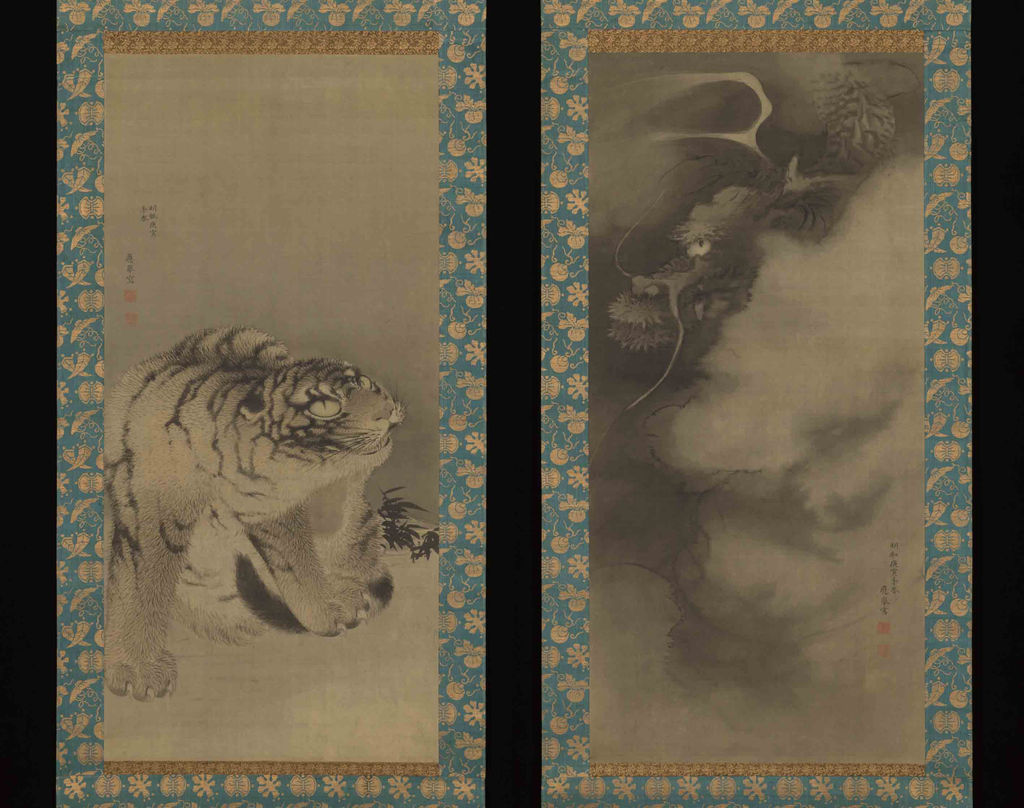
The Metropolitan Museum of Art's Dragon and Tiger of 1770 gives a sharper test of the word “realistic.” The two hanging scrolls set a dragon against a tiger. Ōkyo could observe a cat, fur, cloud or wash, but a dragon is an inherited pictorial creature, and a tiger was not an animal living in the Japanese landscape. The Met describes the dragon's emergence through layered soft washes and the tiger's carefully described fur. One half of the pair can be attentive to visible texture while the other makes weather and imagination visible. Both depend on composition and prior art as much as on observation. [9]
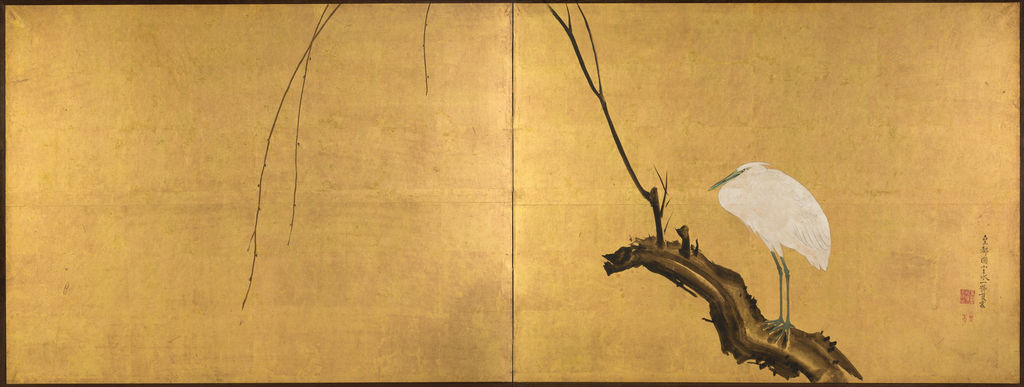
The Cleveland heron supplies a different answer. A single white bird occupies a branch against an extensive, nearly uninterrupted gold ground. The museum reads the work through a flat yamato-e mode, not a deep illusionistic space. The bird's poised body may invite close scrutiny, yet the screen also relies on asymmetry and surface. The gold changes in real light as a viewer moves; in a photograph it becomes a single flattened colour. If this were merely a test of whether Ōkyo could copy a bird, most of the screen would be difficult to explain. The empty field is what gives the creature scale, stillness and room. [7]
This makes shasei a more demanding idea than a contest of accuracy. An observed detail has to survive its move from a study sheet into a painting with a different size, material and purpose. The heron's body is legible because the branch carries its weight and the gold sets off its pale plumage; the dragon is legible because washes let it disappear as well as appear. Those are choices about attention. A museum photograph can show the main relationships, but its fixed brightness hides how the metallic background may respond to a room's changing light. For this page, the strongest annotated details would come from the original Cleveland master: a close view of the bird's head and feathers, followed by an image of the entire screen that restores the surrounding gold. The annotation should tell the reader what to inspect, then explain underneath how that inspection changes the reading of the whole. [7] [9]
Stories, people and a city across the seasons
Ōkyo's subjects also show that the studio did not live only among plants and animals. Lady Chiyono, dated 1773 in the Met's record, pictures the figure associated with a Zen awakening story. She stands with a damaged bucket or water vessel; the space around her is largely open. The point of the painting is not to identify a particular woman from life. A familiar story gives the viewer the moment to recognise, while the isolation of figure and object asks them to supply the thought. The Met attributes this hanging scroll to Ōkyo and records its medium as ink and colour on paper. A caption should identify that actual 2020.396.33 scroll, not use the picture as a generic illustration of every version of Chiyono's story. [10]
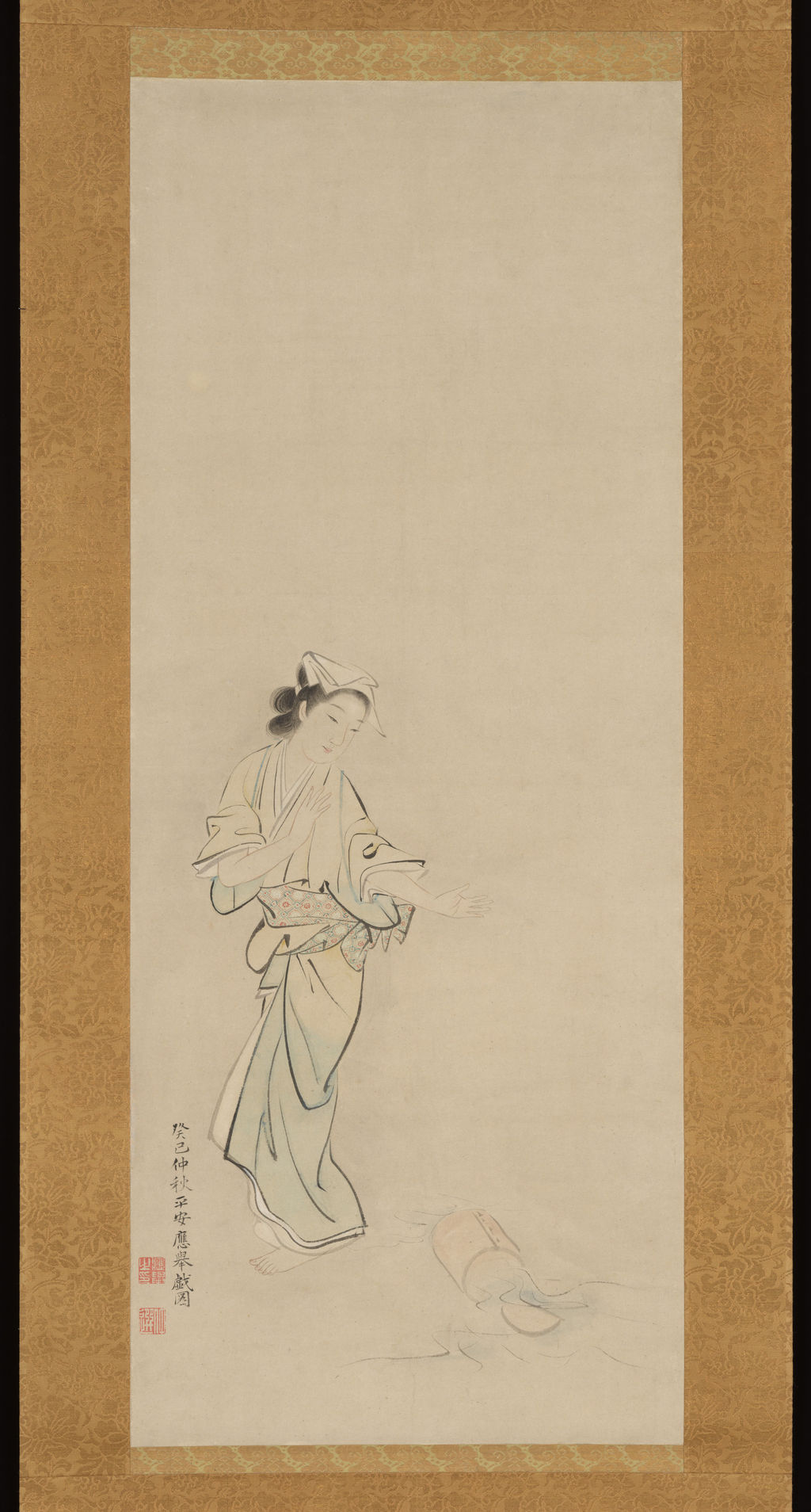
The Met's extended object essay connects the broken bucket to a reflection of the moon and Chiyono's insight into the instability of appearances. That context matters because very little action is shown. A viewer who knows the story can bring the moon, the spilling water and a verse associated with the episode to a painting that leaves much of the paper untouched. The museum points out that Ōkyo deliberately avoids the modelling and shading he could use elsewhere. Here the absence of a strongly built three-dimensional setting lets a remembered tale meet the pictured instant. This is an argument against calling one painting “advanced” because its volume is illusionistic and another “traditional” because it is spare. The same artist chose different visual means for different acts of seeing. A future Chiyono object page would need to separate the history of the medieval figure, the retelling of the Zen episode and what can actually be read from Ōkyo's 1773 scroll. [10]
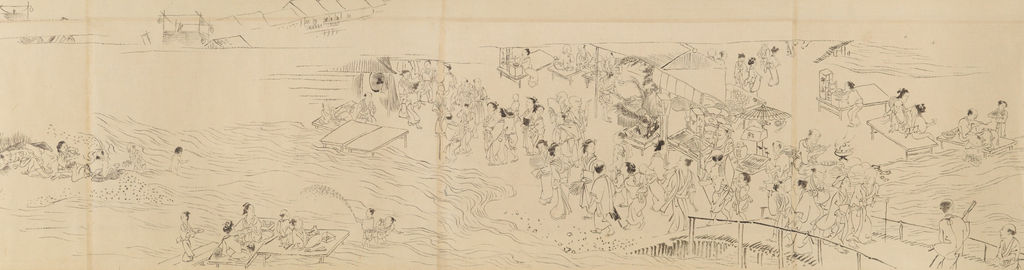
The Met's long ink handscroll Amusements in Kyoto in the Four Seasons presents a city rather than one person. The institution describes a spring cherry-blossom outing by the Hozu River, summer cooling at the Kamo River, Obon dances and preparations for New Year. These episodes are joined by the physical act of unrolling. A viewer does not see more than five metres of image at once; one gathering disappears as the next appears. The Met is careful about the object's relation to a 1777 coloured handscroll at the Tokugawa Art Museum: this ink version may be a preparatory drawing or a sketchlike copy. Neither possibility should be rewritten as certainty. Its date is given as late 1770s to early 1780s. [11]
This handscroll is a useful counterweight to a simple story about painting “from nature.” The people and festivals are socially observed, yet the seasons form a designed sequence. Place names help orient the reader, but the picture is not a photographic itinerary of one journey through Kyoto. It gathers different times and public activities into one format. When the site shows a small full-scroll image, much of its detail becomes tiny; a separate, clearly labelled detail from the same Met record can help readers inspect one scene without pretending it is another work. [11]
Painting calamity and consequence
Ōkyo's 1768 Seven Fortunes and Seven Misfortunes / 七難七福図巻 asks yet another question of observation: how do you make suffering and the consequences of action compelling to a viewer who has not witnessed the event? The Jōtenkaku Museum at Shōkoku-ji identifies the work as an important cultural property in its collection and describes three kinds of scene: natural disasters, human-caused disasters, and good fortune or long life. A single phrase such as “realistic painting” misses both the Buddhist purpose and the deliberately structured opposition between hardship and happiness. The work is a handscroll ensemble, so events were encountered in a sequence rather than simultaneously as a wall of catastrophe. [25] [26]
The original is not the same thing as every image of it now circulating. Cleveland holds an unmounted Sketch Copy of Natural Disasters dated after 1773. Its object record explicitly calls it a copy of the first of Ōkyo's three scrolls and notes marks indicating colours and other features of the original. The copy is a valuable witness to how the work was studied or transmitted. It is not an Ōkyo autograph to slip into a gallery of his paintings, even though Cleveland's image is CC0. Shōkoku-ji also discusses a preparatory drawing for an earthquake passage. A painted original, a draft and a later copy can each answer a different research question; a responsible illustrated page has to name which one the reader is seeing. [27] [28]
The subjects expose the limits of a comfortable naturalism story. How does a painter render a storm, flood or violent accident while keeping the viewer's attention on affected people? The answer cannot be inferred simply from a single frame. The sequence, scale and changes of scene carry the moral argument. The museum's 2026 Ōkyo and Jakuchū exhibition explicitly places the suffering-and-happiness scroll alongside the colour of Peacock and Peonies and the monumental Great Waterfall, suggesting the breadth of problems the artist took on. Those latter works require their own image-rights check before being reproduced. In this home page, the handscroll belongs in the account of what Ōkyo made; it should not be represented by the Cleveland copy without a clear “after Ōkyo” label. [25] [27]
Older landscapes through new eyes
Not all landscape painting in Ōkyo's career begins at a real location. The Met's Eight Views of the Xiao and Xiang Rivers takes up an established Chinese landscape theme. Eight sheets are mounted on an eight-panel folding screen, a format that asks the eye to move between distinct views while reading the folded whole. The river names point beyond Kyoto and beyond a sketchbook expedition. For a painter associated with observational novelty, such work is especially revealing: an inherited subject could remain productive if spacing, brushwork and format made it newly present to a Kyoto audience. The record identifies the Met's specific eight-sheet screen as accession 56.116. [12]
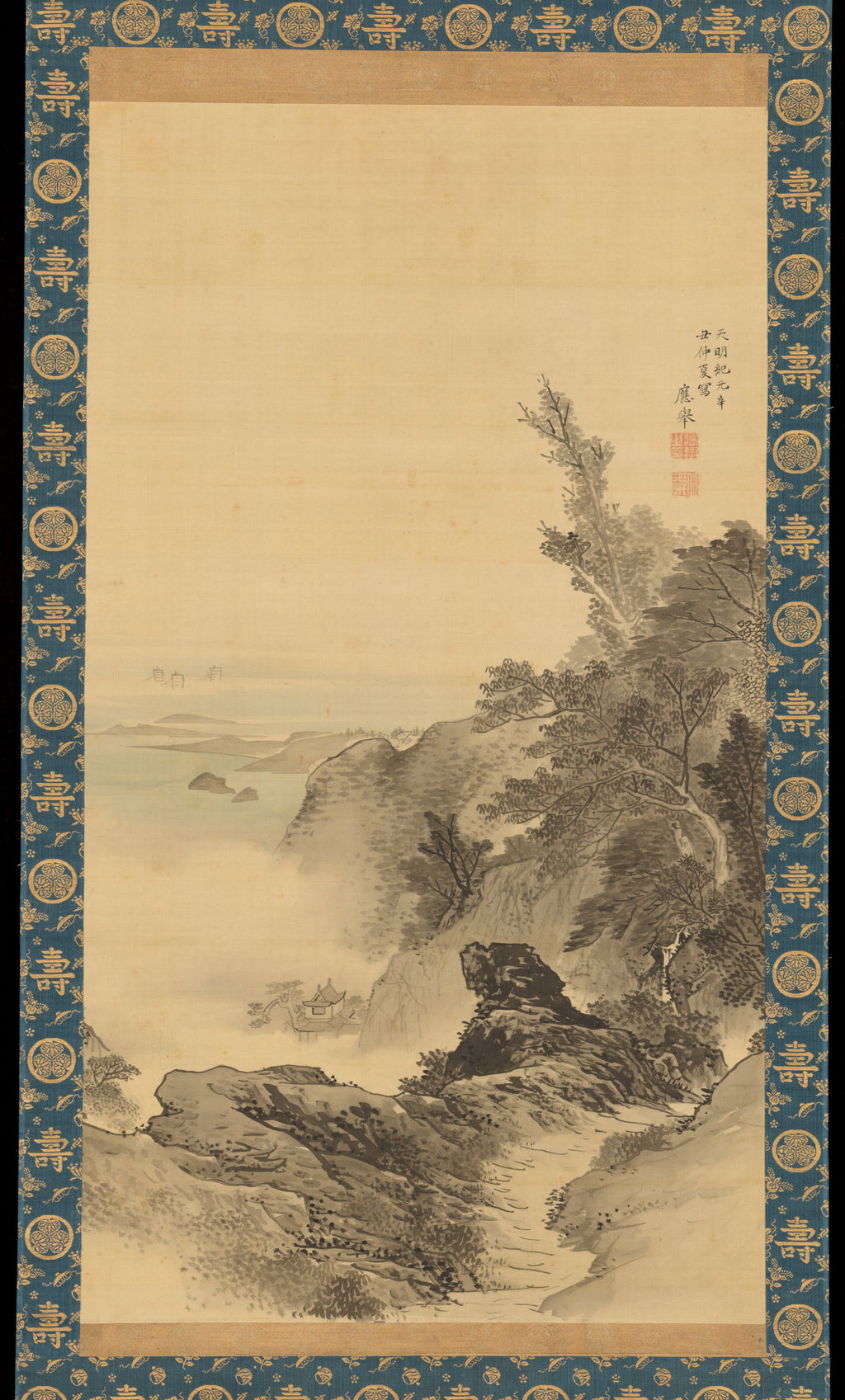
Landscape of Suzuka, a hanging scroll dated 1781, poses a different spatial question. Its rocky foreground, water, receding land and surrounding mount are not a window cut into a wall. The painted image is nested inside a physical hanging object. An English title may encourage the reader to imagine a precise topographical document, while the Met supplies a Japanese title, 円山応挙筆 鈴鹿景山水図, and catalogues the material as ink and colour on silk. The page should let readers see the relationships of ink, colour and mounted border before claiming a one-to-one match with today's terrain. The museum's accession is 2025.981.14. [13]
Together the Chinese eight-view theme, a named Japanese landscape and the Lake Biwa study roll show three different ways place can enter painting. One starts with a long-established poetic subject; another names a landscape in a finished hanging format; the third preserves a travelling sequence of observation. All can contain invented organisation. It would be too crude to sort them into “imaginary old” and “real new.” Ōkyo's practice was more exacting: what does the viewer need to recognise, and what arrangement will hold that recognition on paper or silk? [8] [12] [13]
A screen changes with the room
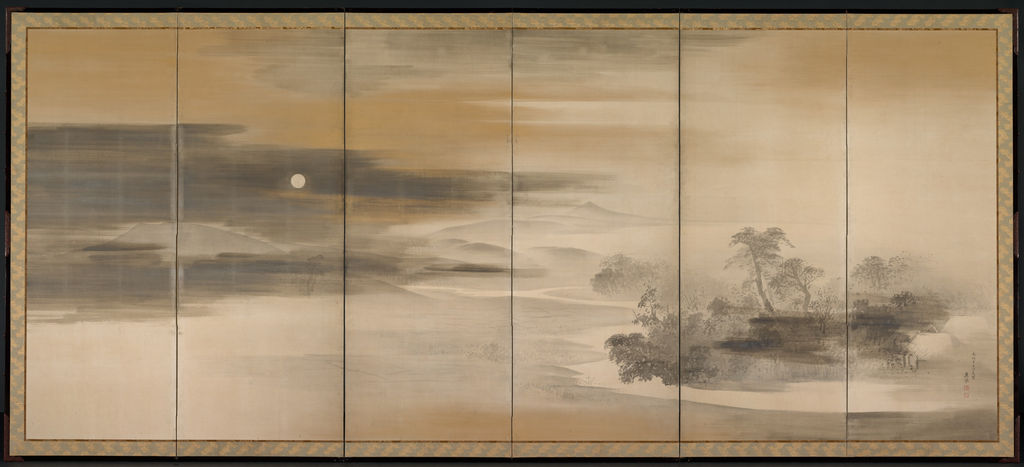
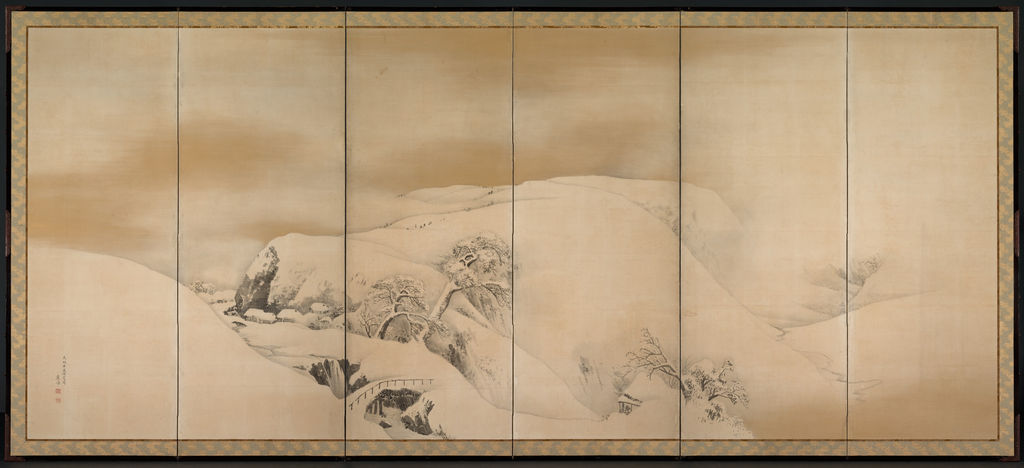
Cleveland's Summer Night; Winter Day is a pair of six-panel screens painted in 1784. The museum provides a parent accession for the pair, 1973.156, and separate entries for Summer Night (1973.156.1) and Winter Day (1973.156.2). Those child records allow two image placements here, but the captions must make the pair explicit. They were made to answer one another across seasons. Printing one alone as an isolated “Ōkyo landscape” would conceal a large part of the design. [14] [15]
The real size changes what a comparison can show. Each Cleveland screen extends about 362 centimetres across; one image in the Met's sweetfish pair is only about 37 centimetres wide, while the Kyoto handscroll runs more than five metres but is opened a portion at a time. On a responsive webpage they may all appear in the same 1024-pixel box. That equal display width is convenient for browsing yet profoundly alters the physical relationship between body and painting. An “at a glance” module should give each object's medium and dimensions, and a small scale comparison could show screen, hanging scroll and handscroll as different modes of encounter. It should not claim to replicate how an eighteenth-century room was furnished. [14] [16] [11]
In Summer Night, a pale moon, banks of shadow and inhabited land emerge through muted washes. Winter Day moves to snow, a bridge and a more open flow of landforms. The two do not simply label hot and cold with obvious colour. Their rhythms differ: one lets the eye hesitate in dusk, while the other carries it across bright reserves and snowy hills. That is a reading of the pictured pair, not a claim to know exactly how its first owner placed the screens. Folded paper changes the light that strikes gold and silver. A single digital photograph cannot reproduce the shift a viewer would see when walking between them. [14] [15]
The Mitsui Memorial Museum's Pine Trees in the Snow / 雪松図屏風 makes a still more economical winter image. The museum explains that snow on the branches is not simply an application of white pigment: exposed paper supplies the white. Ink, gold and reserved paper make a bright, cold landscape without trying to paint every snowflake. This is a work to describe from the institution's object record and exhibition writing until a separately authorised exact image can be used. The museum also says the circumstances of its creation are unclear. A familiar date-and-patron story should therefore not be repeated as a fact merely because it circulates in shorter accounts. [5] [6]
A pair of fish that marks time
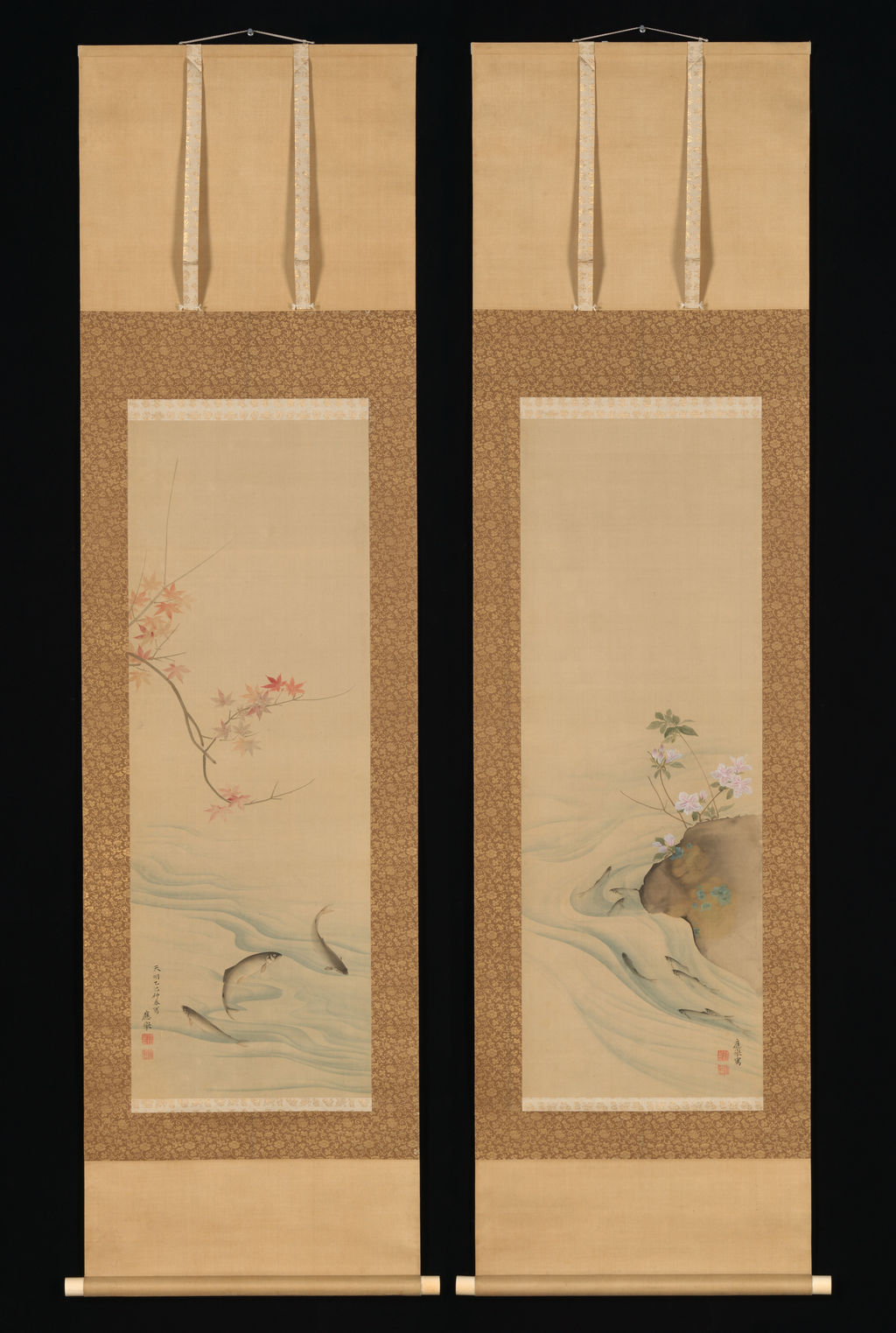
The Met's Fish in Summer and Autumn / 春秋遊魚図 is another pair of hanging scrolls, signed and dated 1785. A museum label describes young sweetfish swimming upstream on the right, while larger fish move toward the coast under autumn foliage on the left. Miyeko Murase's checked catalogue entry, printed pp. 278–280 of Bridge of Dreams, examines the pair at greater length. She relates the almost transparent modelling of the fish to the patterned blue currents and the open spaces of the picture, rather than placing naturalistic fish and decorative setting in separate categories. She also reads the pair against earlier Japanese painting practices. The date belongs to a surviving inscription, which is stronger evidence than a general career period. [16] [17]
Look at the change in direction before looking for a hidden allegory. The stream links two scrolls through movement, season and the fish's life cycle. The left and right papers are separate physical objects, yet a viewer connects them by following the current. Small details matter here: the relative number and size of the fish, flowers on one side, leaves on the other, and the areas of silk left relatively open. At normal article width those subtleties need a caption and perhaps an enlarged detail from the same accession. The primary Met file records both scrolls together. It is not evidence that every reproduction elsewhere shows this particular pair. [16] [17]
Patrons, a workshop and paintings made for buildings
A gallery of movable screens and scrolls can conceal how much Ōkyo's art depended on architecture and other people. Daijōji's temple account describes 165 painted panels attributed collectively to Ōkyo and pupils, installed as a carefully planned group of rooms. Kami town's cultural-property record likewise names the master and twelve disciples in connection with the designated ensemble. Neither source licenses a sentence claiming that Ōkyo personally painted all 165 panels. A room's doors, corners and sightlines influence how its images work; removing a panel to a museum makes conservation and close inspection possible, but changes that first experience. [4] [18]
The temple's own digital museum identifies works in individual rooms and explains how panels interact with the space. That is valuable research evidence, particularly when reconstructing a commission made by several hands. It is not, by itself, permission to put the temple's photographs into this article. The site can instead use a diagram of room positions or a labelled route out to the temple's official digital presentation, provided our diagram does not borrow restricted imagery. A future Daijōji page would need a panel-by-panel attribution and rights ledger before it could become a richly illustrated work hub. [19]
The Mitsui family's holdings reveal another kind of relationship. Mitsui Memorial Museum describes important Ōkyo material in its collection and presents Pine Trees in the Snow as a central work. Yet “Mitsui collection” is not a licence to assume that every Ōkyo picture was painted for the same family member or occasion. A securely documented patron relationship belongs to a particular record. The separation between owner, patron, commissioner and later collector is as necessary here as the separation between artist and pupil at Daijōji. [5]
The Met's Gassaku: Mount Fuji / 合作・富士山図 gives collaboration a visible object of its own. Its record names both Ōkyo and Matsumura Goshun. The title gassaku signals a joint work, and the scroll is also a place where inscriptions and other participants complicate the idea of a single author. A 2024 SOAS symposium abstract by a Met curator discusses the wider group of calligraphers and poets associated with this Mount Fuji painting. The abstract is evidence for the scholarly framing, not a substitute for a full publication of every inscription. In the article's caption and metadata, naming Ōkyo alone because one API summary field lists him first would erase the collaboration the full museum record makes clear. [20] [21]
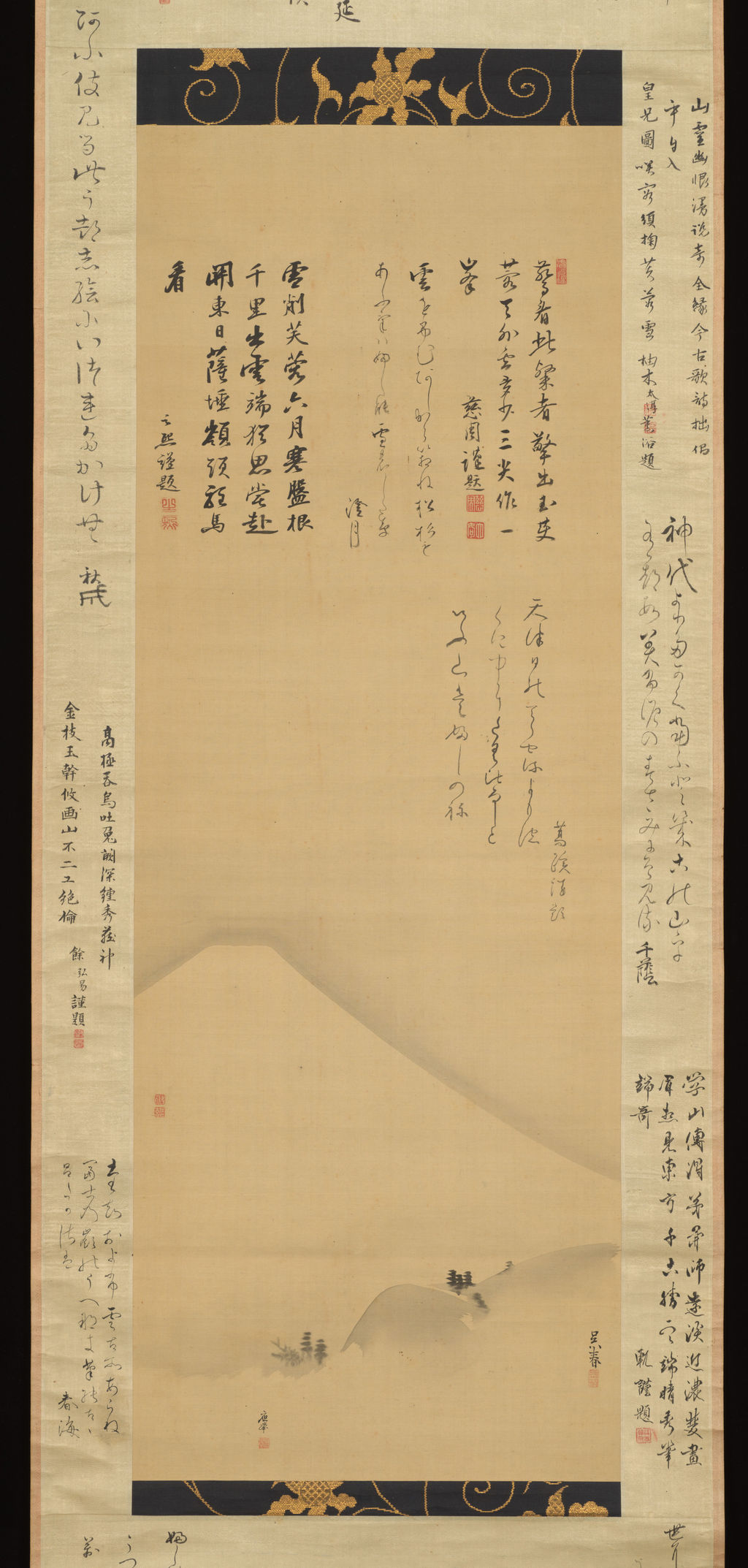
The later term “Maruyama–Shijō school” can make a network look like one continuous workshop. Japan's National Museum of Modern Art, Kyoto, describes Ōkyo as founder of the Maruyama school and Goshun as the artist who established the Shijō school after studying with him. Their linked approaches continued into modern Kyoto painting, but their names should not be merged so completely that the different lineages disappear. The joint Mount Fuji object is a better bridge between them than a blanket statement that one style replaced another. [22] [20]
The same discipline is needed for later books and paintings “after Ōkyo.” Cleveland's 1850 Ōkyo Picture Book contains woodblock-printed designs associated with him, but the museum labels it after the painter and gives an 1850 edition date, decades after his death. Its sheets are useful evidence of how later readers could encounter and circulate a style; they are not freshly discovered eighteenth-century Ōkyo drawings. Another Cleveland work, Tiger in Wind, is catalogued “after Maruyama Ōkyo.” A print or painting can be public domain and still be the wrong image for a sentence about the master's own brushwork. Our image ledger therefore records both reuse permission and exact attribution. Those checks answer separate questions. [29] [30]
This is not a fussy distinction reserved for specialists. If a reader sees a student panel, an 1850 reproduction and a late copy all captioned as “Ōkyo,” they will draw the wrong conclusions about what the artist did with ink, how his compositions changed, and what his school carried forward. The known authorship of a collaborative scroll, the collective authorship of a temple room and the after-attribution of a printed book should be visible in the page's captions. The same principle applies when two institutions use different characters for the family name: Cleveland records 丸山応挙 in several artist fields, while Kyoto institutions and the Met use 円山応挙. The variant should not be silently treated as a different painter, nor should the original object data be rewritten to hide how the holding museum catalogues it. [7] [20] [29]
How to look—and where to go next
Start a screen by looking at its actual edges. A long gold ground can be as active as its single bird. On a paired scroll, compare the two members before enlarging a detail. On a handscroll, ask what appears first and what the viewer must remember while the paper moves. At a temple, ask which room and panel a reproduced detail belongs to. These are practical ways to keep Ōkyo's many kinds of painting from collapsing into one adjective. They also help explain why the Nezu Museum once framed an exhibition as moving “beyond shasei”: the quality of looking in an Ōkyo work lies in what he selected and arranged as well as in what he saw. [23] [11] [19]
The separate Ōkyo biography should take up his documented movements, teachers, patrons, named pupils and uncertain episodes in chronological order. A future page for Pine Trees in the Snow would examine reserve, gold and conservation from the Mitsui object itself once an authorised exact image has been secured. Further pages on the sketchbooks, Daijōji rooms or sweetfish pair should be accepted only if object lists, images and sources support a distinct question for a reader. The range of these ten identified images already shows why Ōkyo deserves more than a short biography: he made observation answer to subject, material, collaboration and space. [3] [5] [17]
Frequently Asked Questions
No. Kyoto National Museum notes that surviving artist studies precede him. His importance lies in the way he developed observation into an influential painting practice and teaching network, not in a claim that nobody before him looked closely at a subject. [24] [1]
No. Pine Trees in the Snow is the Mitsui Memorial Museum's national-treasure pair of screens. Winter Day is one panelled screen from Cleveland's 1784 Summer Night; Winter Day pair, accession 1973.156.2. They offer a worthwhile comparison of winter and reserve, but one image must never be passed off as the other. [5] [15]
No. Official accounts describe an ensemble by Ōkyo and his pupils. Room and panel attributions need to be checked individually. The number 165 describes the designated set, not 165 paintings certified as his sole work. [4] [18]
Ōkyo's subjects and techniques came from more than direct views of Japan. The Met's Dragon and Tiger and Eight Views of the Xiao and Xiang Rivers make his engagement with Chinese-derived imagery visible. Observation was one resource he used to reshape such material, not a rule limiting what he could paint. [9] [12]
Discussion
Compare Ōkyo’s observations with a finished painting. What has he selected or changed?
Reader Insights
How much of the heron screen is given to the space around the bird?
How does your eye move differently through Summer Night and Winter Day?
Where can you see other participants in Gassaku: Mount Fuji?
Join the Conversation
Share a documented example or a reliable source below, keeping observation separate from inference.
References
- Kyoto National Museum, “Ōkyo at 290” / 生誕290年 円山応挙, 2024.
- Kyoto National Museum, “Ōkyo and Observational Painting” / 応挙と写生画.
- Tokyo National Museum, *Sketchbooks* / 写生帖, A-168.
- Daijōji temple, Ōkyo and the painted reception rooms.
- Mitsui Memorial Museum, *Pine Trees in the Snow* / 雪松図屏風, object record 1241.
- Mitsui Memorial Museum, *Pine Trees in the Snow and the Four Seasons* exhibition note, 2026–27.
- Cleveland Museum of Art, *Heron on a Willow Branch*, 1997.108, CC0.
- Cultural Heritage Online/Kyoto National Museum, *Sketches of Lake Biwa and the Uji River* / 琵琶湖宇治川写生図巻.
- The Met, *Dragon and Tiger* / 龍虎図, 2023.583.16a,b.
- The Met, *Lady Chiyono*, 2020.396.33.
- The Met, *Amusements in Kyoto in the Four Seasons*, 2015.300.199.
- The Met, *Eight Views of the Xiao and Xiang Rivers*, 56.116.
- The Met, *Landscape of Suzuka* / 鈴鹿景山水図, 2025.981.14.
- Cleveland Museum of Art, *Summer Night*, 1973.156.1, CC0.
- Cleveland Museum of Art, *Winter Day*, 1973.156.2, CC0.
- The Met, *Fish in Summer and Autumn* / 春秋遊魚図, 2015.300.198a,b.
- Miyeko Murase, *Bridge of Dreams: The Mary Griggs Burke Collection of Japanese Art* (Metropolitan Museum of Art, 2000), printed pp. 278–280, cat. no. 115; checked in the full museum PDF.
- Kami town, designated Daijōji painted panels / 大乗寺障壁画.
- Daijōji Maruyama-school digital museum, site and conservation overview.
- The Met, *Gassaku: Mount Fuji* / 合作・富士山図, 2023.583.17, joint Ōkyo–Goshun attribution.
- SOAS, *Creative Collaborations in Kyoto, Osaka and Beyond, 1770–1900*, symposium abstract by John T. Carpenter, 2024.
- National Museum of Modern Art, Kyoto, 2019 annual report, “Ōkyo to Modern Kyoto Painting” exhibition account.
- Nezu Museum, *Maruyama Ōkyo: Beyond Shasei*, 2016 exhibition.
- Kyoto National Museum, “Painter's Sketches” / 画家のスケッチ.
- Jōtenkaku Museum/Shōkoku-ji, “Maruyama Ōkyo and Itō Jakuchū” exhibition, 2026.
- Cultural Heritage Online, *Seven Fortunes and Seven Misfortunes* / 七難七福図, Shōkoku-ji holding.
- Cleveland Museum of Art, *Sketch Copy of Natural Disasters*, 1993.132, explicitly a later copy after Ōkyo.
- Shōkoku-ji, *Enmyō* 120, discussion of the disaster-scroll drawing and original.
- Cleveland Museum of Art, *Ōkyo Picture Book*, 1985.376, 1850 edition after Ōkyo.
- Cleveland Museum of Art, *Tiger in Wind*, 1971.232, catalogued after Ōkyo.
- National Diet Library, “Lake Biwa” in *Exploring Japanese Landmarks in Nishiki-e and Photographs*, later photographs; no file selected for production yet.