


 by Tom Gurney
Tom Gurney BSc (Hons) is an art history expert with over 20 years experience
Published on June 19, 2020 / Updated on September 23, 2026
Email: tomgurney1@gmail.com / Phone: +44 7429 011000
A life known through works and witnesses
Maruyama Ōkyo was born in 1733 and died in 1795. Between those dates he moved from a rural village in Tamba to a position at the centre of Kyoto painting. A story told only through the familiar word shasei, or sketching from observation, misses much of that movement. He learned from established painting lineages, made pictures for optical viewing, worked with a religious patron who had access to older art, and eventually organised paintings for rooms, screens and powerful households. In his later years a large group of named pupils could carry a commission across several rooms while his own name remained the one most readily remembered. [1] [2] [3]
Explore Ōkyo’s puppy paintings
Contents
Explore Ōkyo’s paintings and visual methods.
The evidence for his life is uneven. Some paintings carry dates or signatures, some contemporary lists name him in Kyoto, and the monk Yūjō kept a diary associated with their meetings. Other details, especially childhood episodes and the exact beginning of training, reach us through later accounts or pupils' recollections. Miyeko Murase's checked catalogue entry in the Metropolitan Museum of Art's Bridge of Dreams makes that mixture explicit. A biography should let a documented 1785 inscription and a reported teenage apprenticeship have different levels of certainty. It need not flatten both into a seamless story. [4] [5]
Ōkyo’s life at a glance
- Years1733–1795
- BirthplaceAnō, Tamba (today Kameoka)
- Reported teacherIshida Yūtei; exact training date unknown
- WorkScrolls, screens, sketchbooks, temple and palace painting
From Anō to Kyoto
Japanese institutional accounts place his birth in Anō, then in Tamba Province and now part of Kameoka in Kyoto Prefecture. Kyoto National Museum and Kameoka City's cultural museum agree on the locality, and Daijōji's retrospective chronology specifies 1 May 1733. Murase's English catalogue entry, however, combines “Harima” with “Tamba Province,” and the Met's sweetfish web label says Harima. Those descriptions conflict geographically with the more specific Japanese locality records. Anō in Tamba is therefore the best supported place to give readers, while the disagreement belongs in the source record rather than being silently erased. [1] [7] [3] [4]
The Daijōji chronology calls him the second son of a farming family and reports an early period as a novice at a temple, then work connected with a textile shop and a toy merchant in Kyoto. It also gives competing ages for his move to the city and for study with Ishida Yūtei. Kyoto National Museum says that he is said to have entered Yūtei's studio in his mid teens. The wording is important. It supports the broad picture of a young provincial painter learning in Kyoto; it does not establish a single year when an apprentice contract began or prove every story about the merchant's shop. Ōkyo's later fame made an origin story attractive to retell. [3] [1] [4]
Yūtei worked in the Tsurusawa line connected to Kanō painting. That apprenticeship, if described without a fixed starting date, helps explain why Ōkyo's later attention to observed creatures was never a rejection of all inherited methods. He could use brush conventions, large decorative formats and painting genres already circulating in Kyoto. The MIHO Museum artist essay and the British Museum's discussion of a pair of bird-and-flower scrolls both stress encounters with Chinese painting. The British Museum cautiously places those scrolls in Ōkyo's thirties and notes that a worn seal might even have been impressed later. They demonstrate an institutional reading of his studies, but their condition does not let us put them on a precisely dated line of early achievements. [8] [9]
Perspective pictures offer a second thread in the early career. Kyoto museum accounts and MIHO describe work on megane-e: images made for viewing through an optical device, including versions adapted from Chinese perspective pictures and scenes of Kyoto. The 2025 Mitsui Memorial Museum exhibition checklist records several individual perspective pictures and an eighteenth-century British viewing apparatus among loans to its exhibition. The presence of an apparatus in that exhibition shows how the visual format could be demonstrated; it does not prove that Ōkyo owned or used that particular instrument. Nor did learning from constructed depth make every later screen a perspective exercise. His career is more interesting because he carried different ways of making space into different formats. [1] [8] [10]
The early biography also preserves several names. MIHO lists Isshō, Kaun and Senrei among names used before the artist began signing Ōkyo in 1766. Daijōji places the adoption of that name “around” the same year. A change in signature can be checked against a particular object, but the total movement among names should not be turned into a series of dramatic personal conversions without more evidence. His earlier work deserves to be found under its own signature, and a page about any one picture needs to preserve how the holding institution reads that signature or seal. [8] [3]
Yūjō and the mid-1760s
The monk Yūjō, head of Enman-in near Lake Biwa, is central to accounts of Ōkyo's development. Daijōji dates the beginning of their close contact to around 1765; MIHO says the relationship was established by 1767. The Met catalogue refers to Yūjō's diary, Manshi, as a contemporary record of meeting the painter. A Tokyo University of the Arts exhibition checklist records twenty volumes of that diary, covering 1761 to 1773, held by Shōkoku-ji. The surviving document gives the relationship a firmer basis than a free-floating anecdote, yet without citing an examined diary passage we should not claim to know the words spoken at a particular sitting. “By the mid-1760s” is the defensible starting point for this page. [3] [8] [4] [11]
The monk's interest in pictures mattered because it brought the painter into a setting where older works could be examined. MIHO describes Ōkyo copying Chinese and Japanese images and learning from the naturalistic style associated with Shen Nanpin and from Watanabe Shikō. These are proposed lines of influence drawn by museum scholarship, not proof that one surviving animal painting is a literal copy of a named Nanpin image. Training, optical pictures and access to models help explain the range of choices visible in his work; they do not reduce a painted creature to a single borrowed technique. [8] [9]
This distinction also changes how a biography should describe “Western” influence. Perspective entered Ōkyo's working world through pictures and optical viewing practices circulating in East Asia, not through a documented tour of Europe. The same painter could set a receding street or bridge into a peepshow and then make a scroll whose empty paper carries the viewer along a river without a single vanishing point. MIHO explicitly notes his freedom from mechanical perspective in Kyoto view pictures. His experiments were responses to particular viewing situations rather than an irreversible conversion from one artistic system to another. [8] [10]
Some objects show what the period could ask of him. MIHO's discussion sets the 1765 Yodo River Banks handscroll alongside an early Pine and Snow at Tokyo National Museum. They are distinct from the far more famous national-treasure Pine Trees in the Snow in the Mitsui Memorial Museum. The similar winter titles invite an error: two different paintings must not be collapsed because both mention pines and snow. In one case a river scroll considers movement through a named landscape; in another, individual forms and brush methods matter; the Mitsui screen is a later, separate object whose commission circumstances its holder says remain unclear. [8] [12]
The three-scroll Seven Fortunes and Seven Misfortunes / 七難七福図巻 is dated 1768 and held at Shōkoku-ji. The temple's exhibition account and Japan's Cultural Heritage Online describe natural disaster, human disaster and good fortune as its interrelated subjects. Here observed gestures and bodies serve an argument about conduct and consequence. Its date supplies a secure milestone in a period when the details of patron encounters remain less exact. The work also reminds us that “naturalism” was not a subject category: a painter could use close observation for a moral and religious sequence as well as for plants or animals. [13] [14]
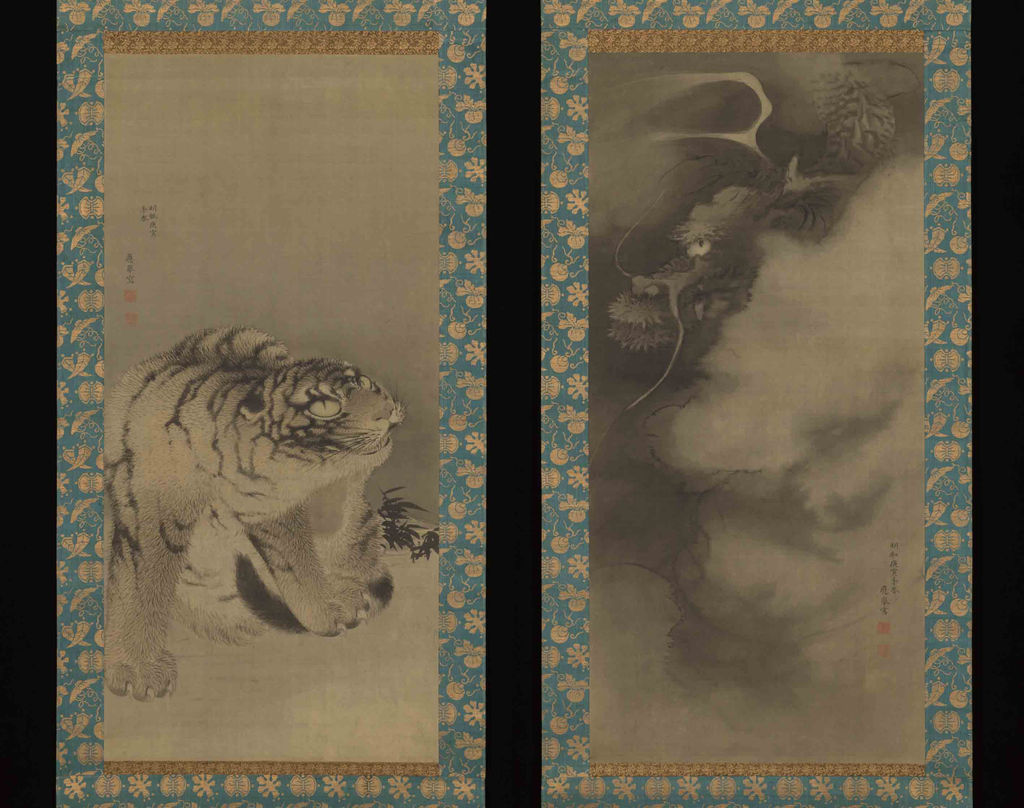
The Met's 1770 Dragon and Tiger supplies another dated anchor. A dragon cannot be studied from life, while the tiger belongs to a Chinese pictorial tradition as well as to an animal's body. A curatorial record describing the washes around the dragon and the fur of the tiger can tell us how an object works; it cannot by itself name the exact model he used. The paired scrolls make visible a painter who could bring attentive handling to an inherited subject without turning it into a specimen. [15]
Recognition in Kyoto
Ōkyo's public standing becomes easier to track through printed city records. MIHO says he appears in the 1768 Heian jinbutsu shi and another contemporary text. Daijōji's chronology places him first in the painters' section of the 1775 Heian jinbutsu shi and gives his Kyoto address at Shijō and Fuyachō. A 2024 exhibition checklist from Sekisui Museum identifies the 1768, 1775 and 1782 editions as separate printed books. This is better evidence than the loose statement that “he suddenly became famous” in one year. The recurring listings show a painter whose name could be located and ranked in Kyoto's public culture, but the position printed in one edition should not automatically be assigned to every edition. [8] [3] [16]
The 1770s show a widening set of assignments. MIHO identifies a 1771 Peonies and Peacock as a point where observed detail and a decorative surface meet; Daijōji and the Mitsui exhibition checklist name works from 1775 and 1776. The exact patron and current holding institution must be stated work by work, because a chronological list can put several quite different objects under the same familiar title. The 2025 Mitsui checklist, for instance, records a Broken-Ink Landscape dated 1765 in its own collection, a 1775 Guo Ziyi Celebration there, and works on loan with separate owners. “Shown at Mitsui” is not the same as “owned by Mitsui” or “commissioned by Mitsui.” [8] [3] [10]
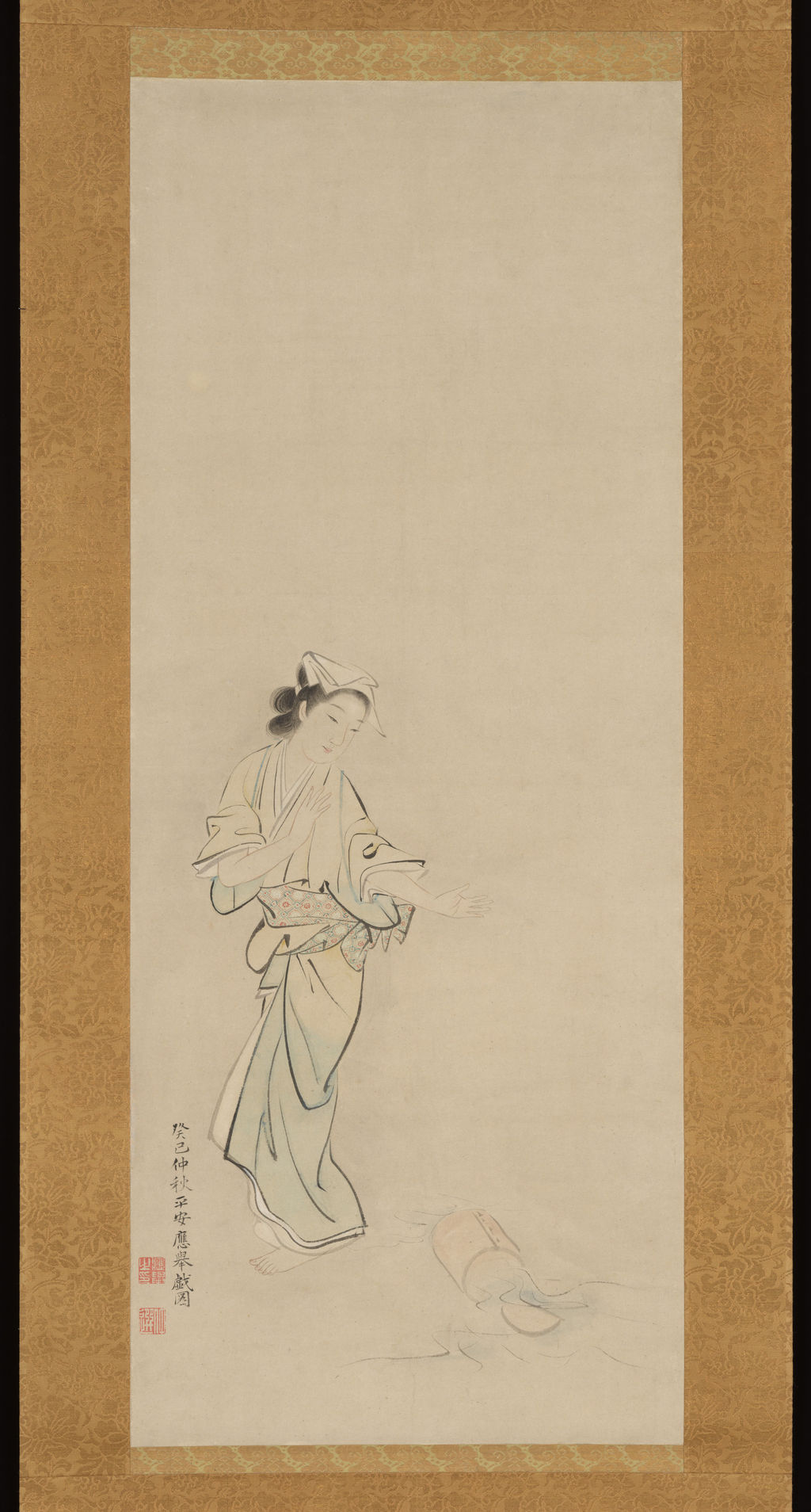
The Met's 1773 Lady Chiyono gives a different measure of reputation from a ranking list. It is a single hanging scroll, dated by the museum, whose form assumes a viewer able to recognise a Zen tale from a figure and a damaged bucket. Its restraint argues against equating Ōkyo's professional success with ever more elaborate illusion. The painting has no crowd of pupils and no architectural commission. A biography that moves too quickly from early training to huge screens would miss the choice to make a small, quiet picture at precisely the time his public standing was growing. [17]
The Tokyo National Museum's four-volume Sketchbooks / 写生帖, A-168, provide another kind of evidence. Their surviving studies make Ōkyo's disciplined attention tangible, while the museum's broad dating from zodiac indications stops us treating every leaf as a study made in a single summer. Such material connects a famous artistic method to paper he actually used, but it does not document every journey the later painter took. For the biography, the albums show continued work habits alongside the better dated public commissions. A pupil's later praise for his teacher's devotion to shasei is useful testimony; the sketchbooks provide the less rhetorical object against which it can be considered. [18] [8]
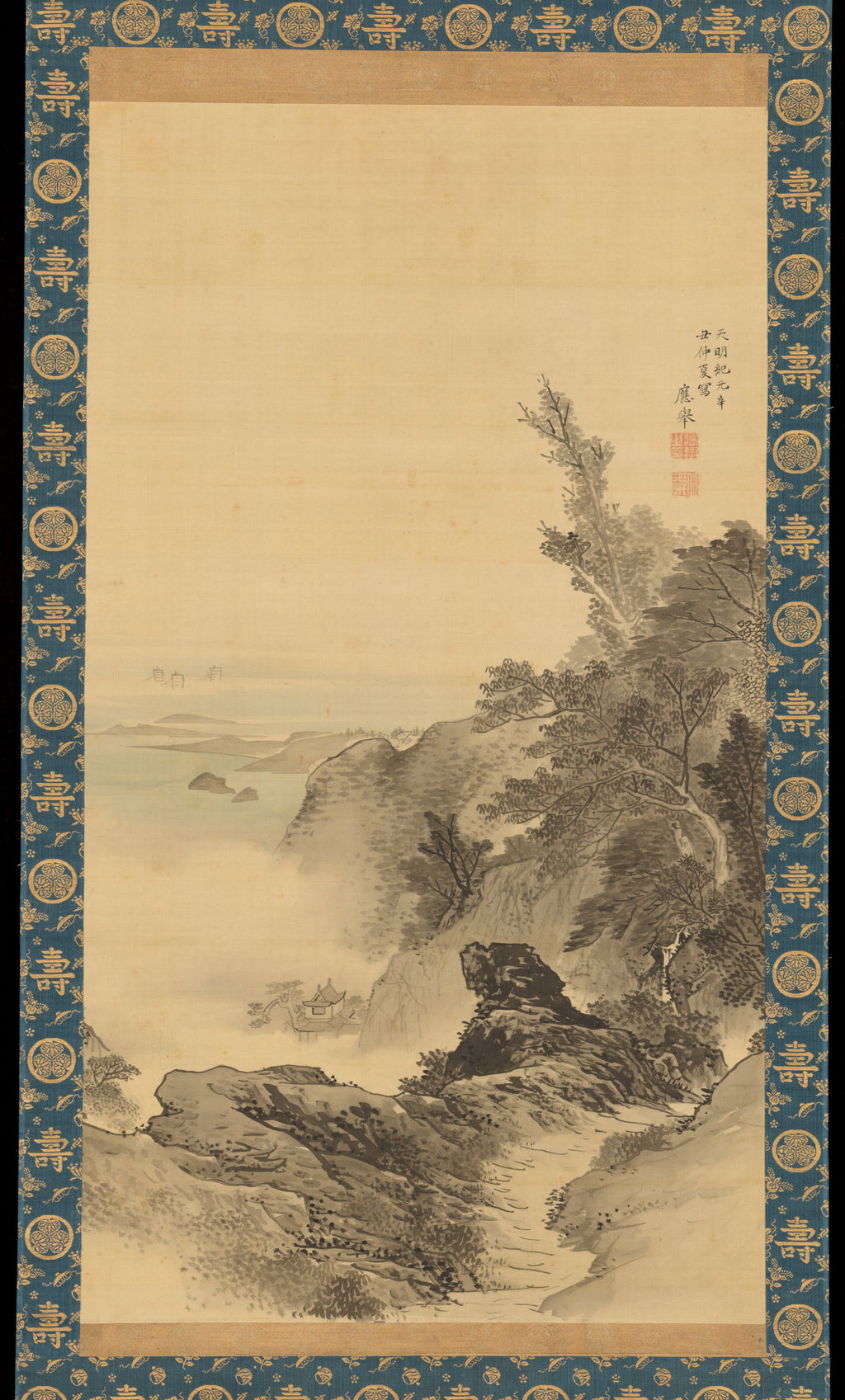
There is a difference between keeping a study and publishing a theory of nature. A sketchbook leaf might preserve a pose, an outline or a colour note that could be transformed when a commission arrived years later. It need not correspond to a finished painting we can still find. The Met's Chinese-themed Eight Views of the Xiao and Xiang Rivers and its named Japanese Landscape of Suzuka show the breadth of places and inherited subjects available to the mature artist. Neither proves that a specific TNM sketchbook leaf was carried into it. Linking a preparatory drawing to a finished object requires matching material evidence or a persuasive museum study, not a general resemblance between two landscapes. [18] [6] [33]
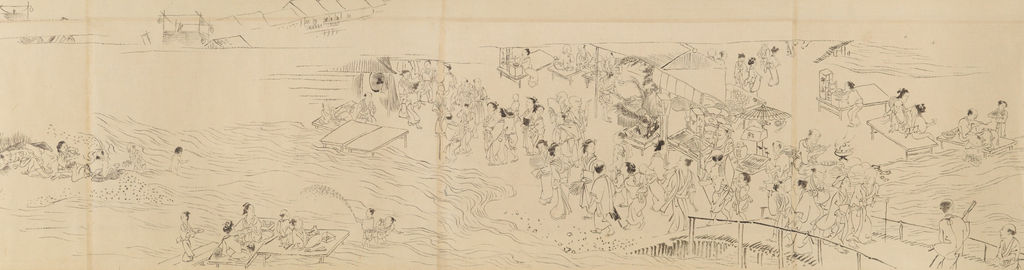
The Met's long Amusements in Kyoto in the Four Seasons, assigned to the late 1770s or early 1780s, portrays outings, cooling by the river, festival dance and New Year preparation. The museum says this ink scroll may be a study for, or a sketchlike copy of, a 1777 coloured version held by Tokugawa Art Museum. That uncertainty changes how it can be used as biographical evidence: it shows Ōkyo's involvement with a theme of Kyoto public life, but does not securely disclose which surviving version came first. A social observer could organise different seasons into one scroll without recording a literal walk through the city. [19]
Patrons, family and larger commissions
By the 1780s Ōkyo's work was visible in religious, merchant and courtly settings. The distinctions among patron, first owner and later holder still matter. Shōkoku-ji holds the disaster scrolls associated with the Enman-in patron Yūjō; Mitsui Memorial Museum holds major works connected with the merchant family; Buddhist temples and halls hold or document painted rooms. The institutions' present names are not interchangeable with an eighteenth-century commission contract. For every object, the strongest evidence is a dated inscription, a contemporary document or a holder's account that actually names the relationship. [13] [12] [20]
Daijōji's chronology says the Mitsui family offered a Daffodils / 水仙図 in memory of Mitsui Takami in 1783. The museum's 2025 checklist records a 1783 Daffodils as held by Mitsui Memorial Museum. These two institutional records together provide a specific way to discuss a merchant relationship. They do not prove that every famous Mitsui-held screen was made in the same year or for the same memorial occasion. The museum's own record for Pine Trees in the Snow gives its dimensions, technique and national-treasure status but no secure commission date; its later exhibition note expressly says the making of the screen is not well understood. The screen's fame should not draw false certainty into the biography. [3] [10] [12]
Courtly work calls for a different sort of claim. MIHO discusses Ōkyo's relationship with imperial patrons and his decorative screen painting, while Daijōji's year table says he led his group for painting connected with rebuilding the imperial palace in 1790. That is evidence for a workshop of sufficient size and reputation to meet an architectural order. It is not a roster of every painter who contributed to every palace panel. Here again a collective enterprise could become known under the senior artist's name. A future palace-specific page would need the surviving panels, inscriptions and room records before assigning individual hands. [8] [3] [2]
Such orders also affected what it meant to be a successful painter in Kyoto. A hanging scroll could pass from one owner to another, but painted doors had to fit an architectural sequence and be delivered on a building's timetable. A senior artist might set the visual programme, paint an important room and trust named associates with others. The very survival of many rooms under the general label “Maruyama school” can obscure those divisions. The biography should not use a modern museum's artist field as a substitute for a room plan, nor infer from a pupil's presence at Daijōji that the same pupil painted at the palace. The known palace participation is evidence of scale; the distribution of individual hands remains a separate question. [3] [20]
Family and pupils also become visible in the records, though not as a neat one-room household portrait. Daijōji names Ōzui as Ōkyo's son and records his painting for a room at the temple. Shimane Art Museum lists Genki, Nagasawa Rosetsu, Yamaguchi Soken, Ōzui and Oku Bunmei among painters associated with his teaching. Each name led to a different career. It is tempting to repeat the claim that Ōkyo had a thousand pupils, but Murase and the Met present that as something said, not as a verified roll of a thousand people. The documented names and their surviving works are a better basis for understanding the school's reach. [3] [2] [4]
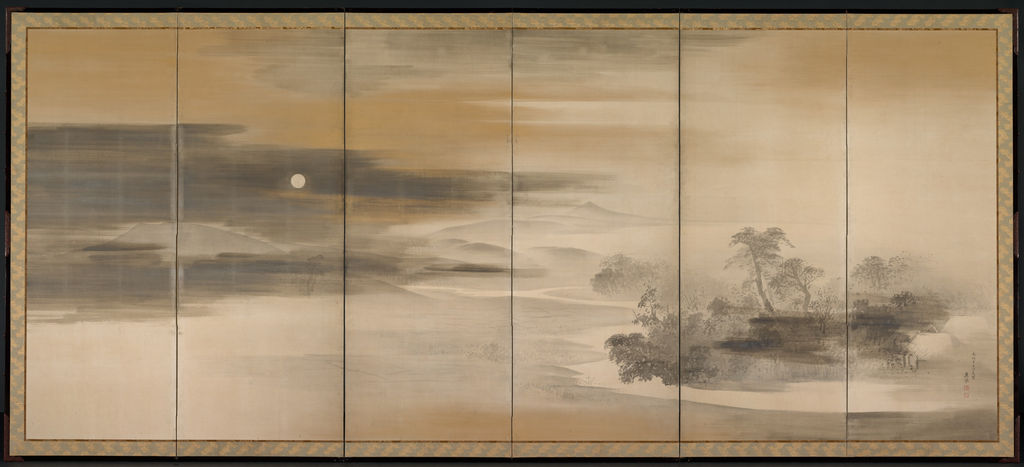
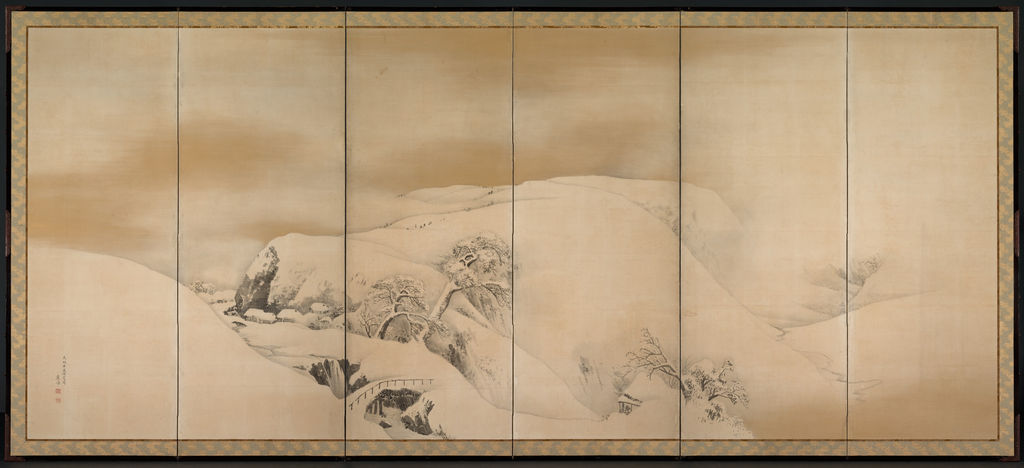
The Cleveland Museum of Art's Summer Night and Winter Day were painted in 1784 as one pair of six-panel screens. At roughly 362 centimetres across for each member, they make the move from smaller scroll to painted room scale visible, even though the original room arrangement is unknown. In the dim summer scene and the brighter winter one, season is experienced by moving between two broad surfaces. The pair can be securely attached to 1784, unlike a tempting but unproved exact date for the Mitsui snow pines. It therefore gives the biography an image of what Ōkyo was making before the largest documented late commissions. [21] [22]
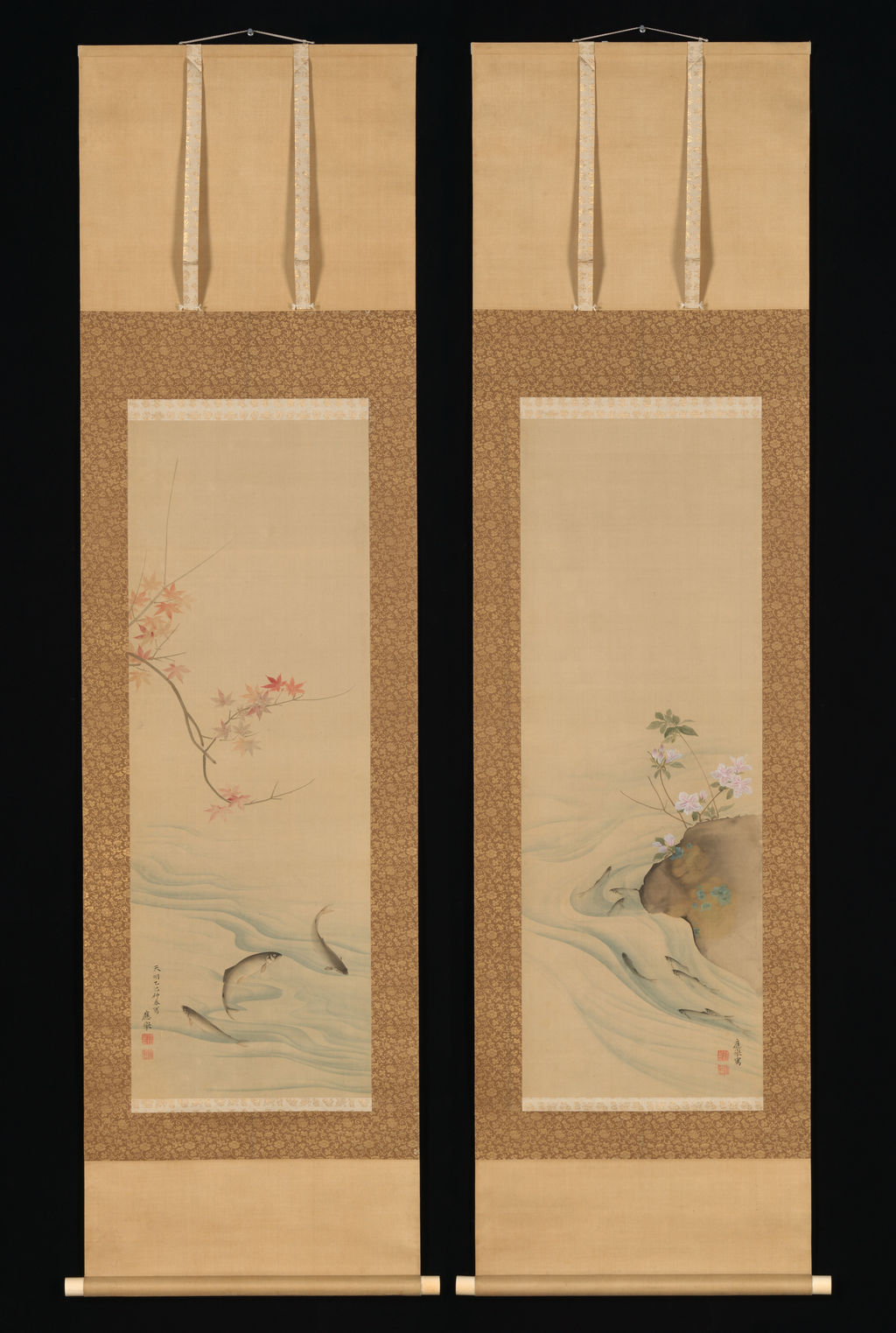
In 1785 Ōkyo signed and dated the Met's Fish in Summer and Autumn. Murase's discussion in Bridge of Dreams, printed pp. 278–280, places the young upstream sweetfish and older fish moving seaward in a wider account of life cycle, water and pictorial design. The date is carried by the object, and the pair makes an unusually strong point of reference in a lifetime often recounted through retrospective episodes. The same year Daijōji's chronology names painted rooms for a temple in Kii; that is a different commission, not a reason to label the fish scrolls as temple panels. A busy career may leave different classes of evidence side by side without connecting them. [23] [4] [3]
Daijōji, a fire and a workshop across rooms
Daijōji in present-day Hyōgo Prefecture gives the later biography a commission whose place and collaborators can be followed. The temple's chronology says its priest Mitsuei approached Ōkyo in 1787 for painted sliding doors. The same year it assigns different rooms to Ōkyo, his son Ōzui, Goshun and others. Kami town's cultural-property account describes a designated set of 165 panels by Ōkyo and twelve disciples. Those sources support a collective project planned across architecture, not an image of the master personally painting every surface. The temple's present digital museum identifies rooms and provides a way to check relationships between subject and location. [3] [20] [24]
The project's history was not a straight line from design to installation. According to the temple's chronology, a planned pine-and-peacock painting burned in Kyoto's Tenmei fire in the first month of 1788 as recorded in the old Japanese calendar, before it could be delivered. The same table places Ōkyo and Goshun living together at Kiunin after the fire and lists new work for temple rooms in the following years. A later Pine and Peacock at Daijōji should not be labelled as the piece lost in 1788 simply because the subject recurs. Fire damaged an object and altered the working situation; the chronology's wording is a basis for telling that limited story. A fuller reconstruction would require individual panel histories and any surviving temple documents. [3] [24]
The scope grew across time. Daijōji dates its reception-hall completion to 1794 and lists works associated with Ōkyo, Goshun, Rosetsu, Genki, Ōzui and other named painters into 1795. The dates given for rooms are more informative than one label saying “the 1787 commission,” because they show that the building and its paintings were developed over years. They also guard against a common error of assigning a later pupil room to the master's own hand. A visitor encounters the ensemble in a physical arrangement; the biography's images from open-access museums cannot reproduce that arrangement, so the temple's exact room names and its official virtual presentation should be linked separately. [3] [20] [24]
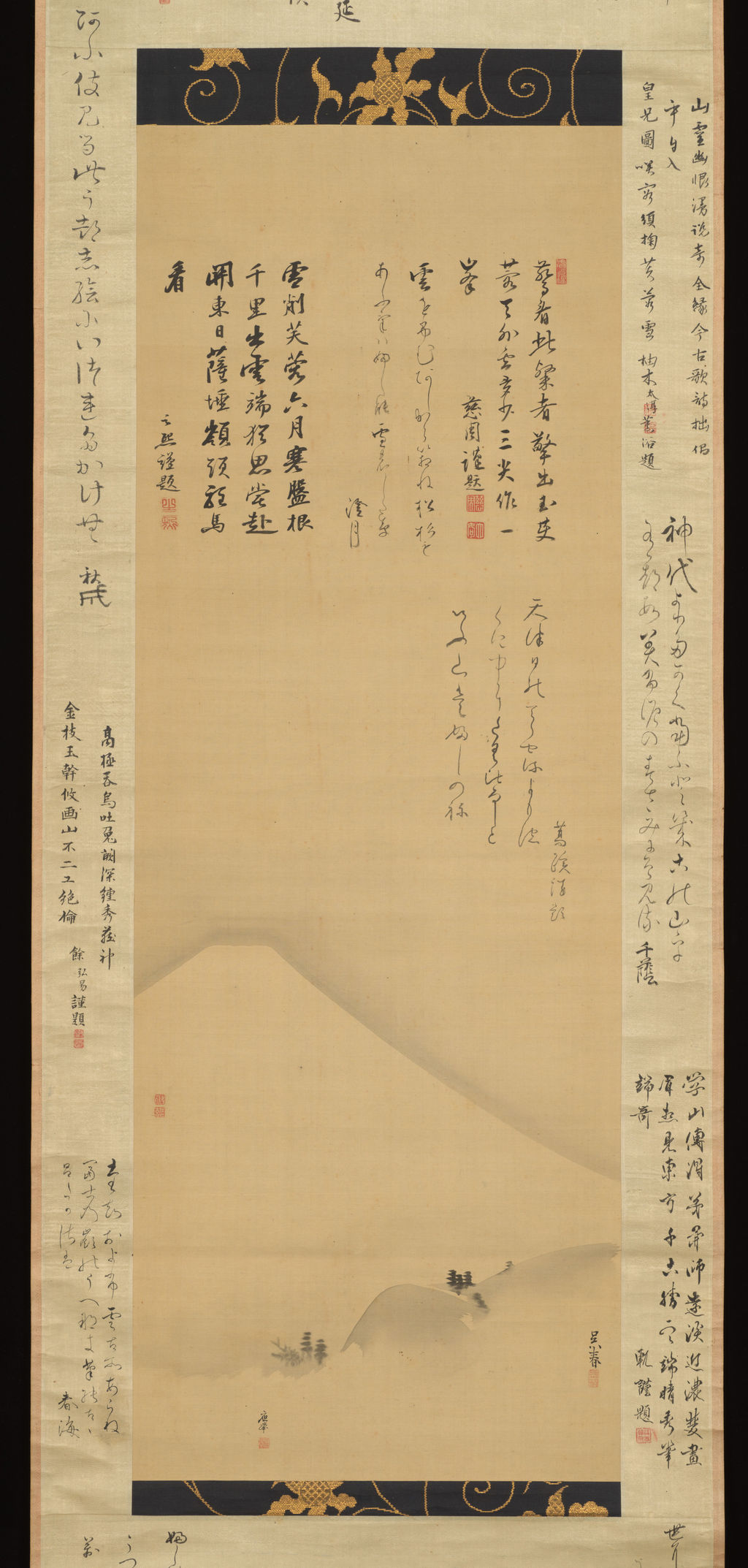
The Met's Gassaku: Mount Fuji is not a Daijōji panel, but it gives us a permitted image of collaboration between Ōkyo and Matsumura Goshun. The museum's full record attributes it to both men. A 2024 SOAS symposium abstract by a Met curator discusses the network of poets and calligraphers around the scroll. It makes sense alongside the Daijōji account because both show that an Ōkyo work could depend on more than one participant. They should not be conflated as evidence of the same commission. The surviving Fuji scroll's inscriptions and mount belong to that particular object and should stay with its caption. [25] [26]
Final years and the later school
The temple chronology places Ōkyo leading a group for the imperial-palace works in 1790 and making other late paintings into 1795. It says his health declined from around 1793 and gives his death on 17 July 1795. These dates should be presented as the temple's account unless corroborated by a closer contemporary record. His final period was evidently not empty: the Mitsui exhibition checklist has a dated 1792 Mount Fuji, while the Daijōji table names room work still under way near the end of his life. An artist's declining health does not by itself reveal which passages were drawn by him, which prepared by pupils, or how a late commission was finished. [3] [10]
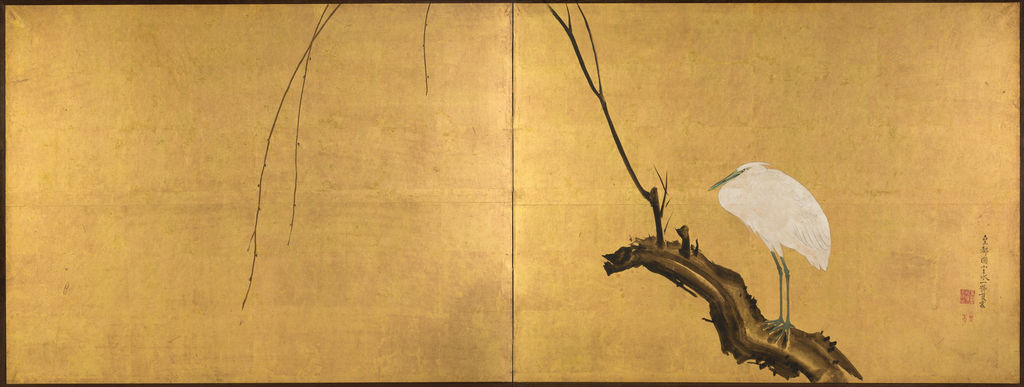
The Cleveland Museum of Art's Heron on a Willow Branch, dated broadly to the late 1700s, is a useful final look at the work without pretending to know its exact last year. A white heron holds a branch amid a large gold ground. The museum discusses the flat, yamato-e character of the space. It is a reminder that even while Ōkyo was known for studies from nature, a finished late picture could depend as much on asymmetry, surface and the surrounding room's light as on the accurate turn of a bird's neck. Its broad dating should remain broad in a biography built around chronological anchors. [27]
The Maruyama school survived through students and their own students. The National Museum of Modern Art, Kyoto, describes Ōkyo as the school's founder and Goshun as establishing the linked but distinct Shijō school after studying with him. The British Museum's 1800 copy of Yamaguchi Soken's illustrated Yamato jinbutsu gafu shows one named pupil's Kyoto genre drawing circulating in a woodblock-printed book after the master's death. The object is not an Ōkyo publication. It shows a mode of continuation: ideas passed through people, changing media and new audiences rather than through endless copies of one screen. [28] [29]
Soken's book is especially useful because it is dated after Ōkyo's death and was printed rather than painted as a unique room decoration. The British Museum identifies scenes of ordinary Kyoto and Osaka life and names the publisher. That record does not tell us Ōkyo's precise role in any one printed design—there was none to claim in 1800—but it does show how a pupil could carry an interest in people and daily settings into a medium intended for more than one purchaser. The school was therefore neither a museum label applied retroactively to identical works nor simply a set of students practising the master's bird studies. It was a network of artists who took different subjects and formats into their own careers. [29]
An 1850 Ōkyo Picture Book in Cleveland's collection is still further from the living studio. The museum catalogues it “after Maruyama Ōkyo.” It is evidence for how designs identified with his name could circulate decades later, not a cache of paintings he made in 1850. A later picture “after Ōkyo,” an eighteenth-century temple panel by a named pupil, and the joint Mount Fuji scroll tell different stories of authorship. The distinction matters to biography because otherwise the painter's lifetime expands indefinitely under his name and the careers of his followers disappear. [30] [25]
Ōkyo's reputation has remained exceptionally broad because several achievements survived together: studies, small scrolls, large screens, the histories of patrons and the lineage of a Kyoto school. None proves that he single-handedly invented sketching from life. Kyoto National Museum points to earlier painters' studies, and the Nezu Museum has presented the subject as going “beyond shasei.” Those are useful corrections to a life flattened into one innovation. The painter who came from Anō to Kyoto did not simply replace old styles with an objective eye. He learned, selected, arranged, negotiated, taught and worked with others. A biography can give those actions their proper dates where possible, and can leave a question open where the material record does. [31] [32]
Frequently Asked Questions
Japanese locality and museum records place him in Anō in Tamba Province, now Kameoka. A Met label and one sentence of an English catalogue use “Harima,” which conflicts with those more specific records; the Japanese location is the best supported current reading. [1] [7] [4]
No. Kyoto National Museum notes earlier artists' sketches. Ōkyo's influence lies in how observation shaped his paintings and teaching, not in being the first person to make a study of nature. [31]
No. The temple chronology names different painters for different rooms, and Kami town describes the designated ensemble as Ōkyo's and twelve pupils' work. [3] [20]
Discussion
Compare dated works with later accounts of Ōkyo’s life. Which events can the objects confirm?
Reader Insights
How much of the heron screen is given to the space around the bird?
How does your eye move differently through Summer Night and Winter Day?
Where can you see other participants in Gassaku: Mount Fuji?
Join the Conversation
Share a documented example or a reliable source below, keeping observation separate from inference.
References
- Kyoto National Museum, “Ōkyo at 290” / 生誕290年 円山応挙.
- Shimane Art Museum, Ōkyo artist authority.
- Daijōji Maruyama-school digital museum, Ōkyo chronology / 応挙年表.
- Miyeko Murase, Bridge of Dreams (Metropolitan Museum of Art, 2000), printed pp. 278–280, cat. no. 115; checked in the full catalogue PDF.
- Tokyo University of the Arts Art Museum, exhibition checklist, item 172, *Manshi* / 萬誌, twenty volumes, 1761–73, Shōkoku-ji holding.
- The Met, *Landscape of Suzuka* / 鈴鹿景山水図, 2025.981.14.
- Kameoka City cultural museum, local Ōkyo context.
- MIHO Museum, *Playing Turtles* / 遊亀図 and substantial Ōkyo artist essay.
- British Museum, paired bird-and-flower scrolls, 1913,0501,0.513–514.
- Mitsui Memorial Museum, 2025 Ōkyo exhibition checklist, object numbers and attributed-work distinctions.
- Tokyo University of the Arts Art Museum, *Manshi* / 萬誌 display record.
- Mitsui Memorial Museum, *Pine Trees in the Snow* / 雪松図屏風, object 1241; exhibition note on uncertain production circumstances.
- Jōtenkaku Museum/Shōkoku-ji, exhibition account of Ōkyo and Jakuchū.
- Cultural Heritage Online, *Seven Fortunes and Seven Misfortunes* / 七難七福図.
- The Met, *Dragon and Tiger*, 2023.583.16a,b.
- Sekisui Museum, 2024 exhibition checklist, separately lists the 1768, 1775 and 1782 editions of *Heian jinbutsu shi*.
- The Met, *Lady Chiyono*, 2020.396.33.
- Tokyo National Museum, *Sketchbooks* / 写生帖, A-168.
- The Met, *Amusements in Kyoto in the Four Seasons*, 2015.300.199.
- Kami town, designated Daijōji painted panels / 大乗寺障壁画.
- Cleveland Museum of Art, *Summer Night*, 1973.156.1.
- Cleveland Museum of Art, *Winter Day*, 1973.156.2.
- The Met, *Fish in Summer and Autumn*, 2015.300.198a,b.
- Daijōji Maruyama-school digital museum, room and conservation guide.
- The Met, *Gassaku: Mount Fuji*, 2023.583.17, jointly attributed to Ōkyo and Goshun.
- SOAS, 2024 symposium, John T. Carpenter abstract on *Gassaku: Mount Fuji*.
- Cleveland Museum of Art, *Heron on a Willow Branch*, 1997.108.
- National Museum of Modern Art, Kyoto, Ōkyo and modern Kyoto painting exhibition account.
- British Museum, Yamaguchi Soken, *Yamato jinbutsu gafu*, 1800 edition.
- Cleveland Museum of Art, *Ōkyo Picture Book*, 1850 edition after Ōkyo.
- Kyoto National Museum, “Painter's Sketches” / 画家のスケッチ.
- Nezu Museum, *Maruyama Ōkyo: Beyond Shasei*.
- The Met, *Eight Views of the Xiao and Xiang Rivers*, 56.116.