


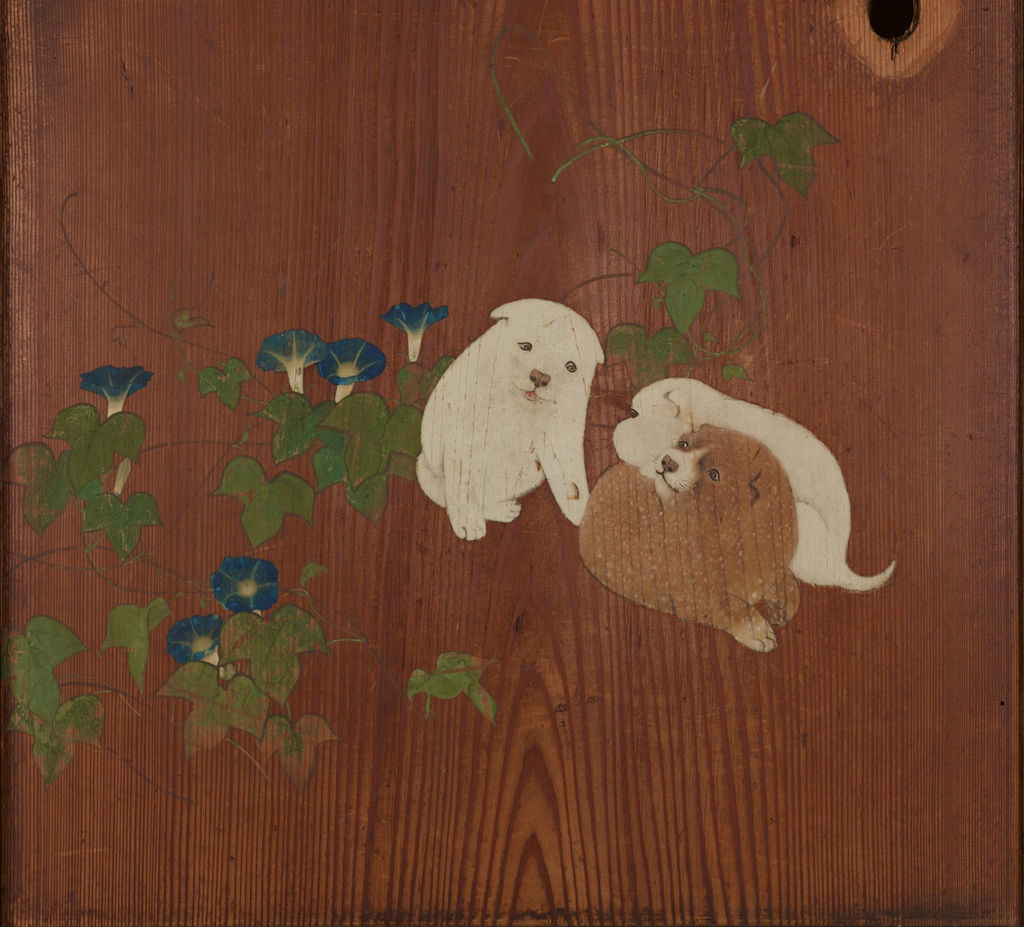
Maruyama Ōkyo, Morning Glories and Puppies, closer photograph of one of the two cedar doors. Tokyo National Museum A-12124 via ColBase; resized for this article.
 by Tom Gurney
Tom Gurney BSc (Hons) is an art history expert with over 20 years experience
Published on June 19, 2020 / Updated on September 23, 2026
Email: tomgurney1@gmail.com / Phone: +44 7429 011000
Not one painting, but a remarkable subject
The puppies are small, round and busy with one another. One sits up and lifts a paw; another tugs at a vine; a third seems to borrow a companion's back as a cushion. Their expressions invite us to read play, curiosity or sleep into a few strokes of ink and colour. Maruyama Ōkyo returned to this subject across several decades and formats. When people search for “Ōkyo's puppies”, they may mean the pair of cedar doors at Tokyo National Museum, a scroll in Minneapolis, a folding screen, or another dog painting entirely. There is no single painting with that name that can stand in for the whole group. The objects differ in date, size, material and original use, and those differences explain much of their charm. [1] [3] [4]
Four works provide a useful route through the subject. A Minneapolis hanging scroll of 1779 lets two puppies tumble across a pale field. A two-panel screen of 1781 places three against a darker, sparkling ground. In 1784, five dogs gather along the bottoms of two cedar doors, interrupted by blue morning glories. Around 1790, a Tokyo Fuji Art Museum scroll turns three puppies towards something beyond the picture. These are four accessioned works in three institutions, and their museum images are available for this page. An inscribed 1767 scroll in Fuchū and a 1778 snow scene in Tsuruga show that the sequence is broader still; their images are held back until reuse terms are established. That chronology already corrects a common assumption: the 1784 doors may be the best known, but they were not Ōkyo's first puppies. [6] [7] [3] [4] [1]
Contents
- Not one painting, but a remarkable subject
- An early dog beneath the rain
- Two puppies in a Minneapolis scroll
- A screen of three puppies, dated 1781
- Five puppies at the bottoms of two cedar doors
- Look closely at the puppies and morning glories
- A painted room, then a museum collection
- A later scroll and the continuing motif
- Observation, selection and a Kyoto school
- Where can the puppies be seen?
- Looking back across four works
- Books on Japanese Art
Ōkyo’s puppies at a glance
- ArtistMaruyama Ōkyo
- Dates1767 to c.1790
- FormsScroll, screen, cedar doors
- Key workTokyo National Museum A-12124
Minneapolis Institute of Art 74.1.136, object record. Public Domain image resized.
Minneapolis Institute of Art 2015.79.158, object record. Public Domain image resized.
Tokyo National Museum A-12124 via ColBase; resized for this article.
Tokyo Fuji Art Museum, object record. CC0 source enlarged from 950px to 1024px wide.
The impulse to call these dogs “realistic” is understandable but incomplete. Ōkyo was associated with shasei, the practice of close observation. His paintings can make a puppy's weight, a bent leg or a nose feel immediate. Yet a viewer can also see decisions about empty space, repeated shapes and where a child or adult would have met the picture. The dogs are observed animals arranged for a particular surface and audience. Looking from scroll to screen to door reveals that design as clearly as it reveals natural behaviour. Kyoto National Museum explains that drawing from life long preceded Ōkyo, but his work helped bring such looking into finished paintings with new prominence. The Minneapolis museum notes that even the broad strokes of its 1779 scroll use foreshortening to suggest solid bodies. [9] [3]
An early dog beneath the rain
The earliest firmly dated example in this group is not an image we can reproduce here. Fuchū Art Museum records an Ōkyo hanging scroll called Puppies in a Shower of Rain, or 時雨狗子図, with an inscription dating it to the summer of 1767. Its silk picture measures 99.3 by 34.8 centimetres. That is a tall and narrow support, quite different from the later Minneapolis screen. The museum's transcription of the dated signature gives a solid starting point without making this painting the absolute first dog Ōkyo ever made. A surviving dated object establishes that the subject was in his practice by 1767; it cannot tell us how many earlier drawings or paintings have been lost. [7]
The same care applies to a snowy scroll dated 1778 at Tsuruga Municipal Museum. The museum describes puppies at play and particularly notices little tracks left in the snow. Those traces make the ground part of the action: we infer movement from what is no longer under a paw. The silk scroll measures 45.2 by 64.4 centimetres. Its snow, date and holding institution make it a separate work from the 1778 Snowy Willow Puppies named in a later Mitsui exhibition list. Japanese titles containing 狗子図 can look nearly interchangeable in search results; accession, medium and owner keep the paintings from being collapsed into one invented series. [8] [14]
These early examples also caution against a neat story in which Ōkyo discovered dogs on a single visit to a temple and then repeated a successful formula. The available objects appear before, during and after the commission associated with the famous doors. They differ in their supports and likely viewing settings. We can trace a painter returning to an appealing theme; we cannot reconstruct a complete studio diary from the present collection records. Even a title shared by museums may have been supplied after a painting was made. The best starting point is the object in front of us, then the claim a museum can substantiate about it. [7] [8] [1]
Two puppies in a Minneapolis scroll
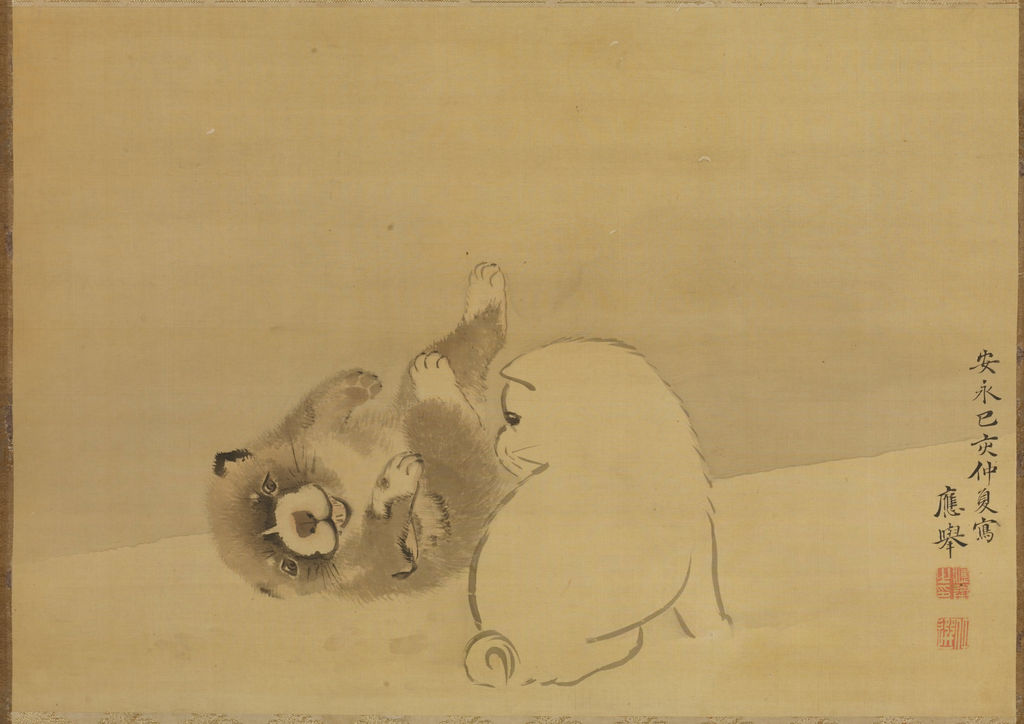
Ōkyo's Gamboling Puppies of 1779 is a hanging scroll in the Minneapolis Institute of Art, accession 74.1.136. It measures about 39.4 by 52.7 centimetres and is painted in ink and light colour on silk. In the museum image, one animal turns its belly towards us while a much lighter companion bends across the foreground. Their contact is gentle rather than a dramatic fight. The left animal's lifted legs interrupt the calm horizontal flow; the other dog's near-white body partly disappears into the pale surrounding field. What reads as effortless affection depends on a carefully chosen view of bodies that overlap and bend. The work has been described by its museum as an instance of broad brush treatment that still gives volume through foreshortening. [3]
Look at how differently the dogs are made. The darker pup has an ink-rich face and fur built through washes and marks; the pale pup can almost be read as a reserved shape against the silk. The soft boundary between body and background asks the viewer to complete the animal with the eye. In the top half, there is far more unoccupied surface than animal. The dogs therefore seem both physically present and delicately suspended in an open pictorial space. This is our visual reading of the documented museum file, not evidence that Ōkyo set them in a specific room or landscape. The museum gives no such location. It does say that his puppy portrayals were numerous, placing this pair within a practice rather than treating it as a one-off curiosity. [3]
The date matters because the scroll comes before the cedar doors. The museum's 1779 record means that the little paw, round back and expressive glance were being tested on a comparatively intimate silk surface when the doors were still in the future. Nothing in the museum record proves that a particular 1779 posture was copied onto wood five years later. Comparison is more revealing than a claim of direct transfer. In the scroll, the viewer can approach an image selected for concentrated looking; on a door, viewers would have encountered a painting while moving through a building. The same theme could work differently in each circumstance. [3] [1]
A screen of three puppies, dated 1781
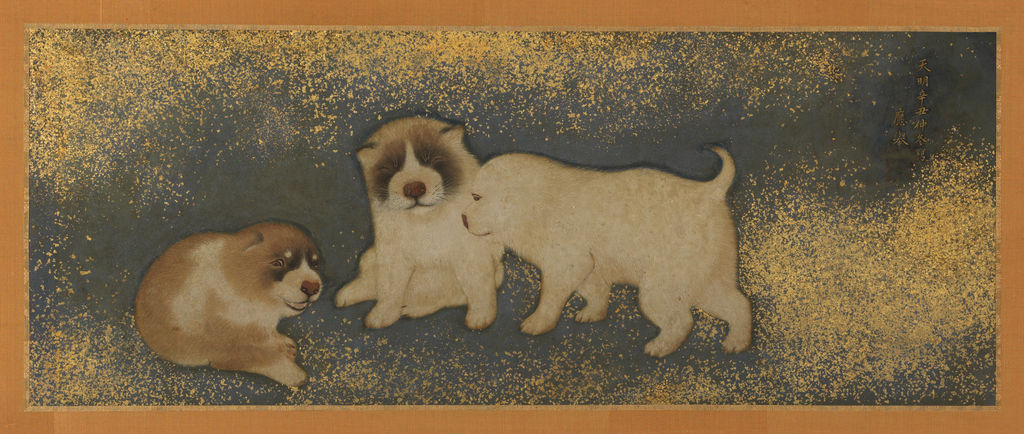
Minneapolis owns a second, separate Ōkyo puppy work: Puppies of 1781, accession 2015.79.158. It is a two-panel folding screen, or furosaki, painted in ink and colour on paper. The museum measures the painted image of each panel at 24.45 by 63.18 centimetres; together the pictured area is low and wide. Against a speckled dark ground, three dogs group themselves into a horizontal chain. One curls or sits at the left, another looks forward from near the centre, and a pale puppy crosses them at the right. Its long side-on body makes a bridge across the screen. The gold-like flecks and dark field are part of the design, not a literal claim that these pups stood under a starry sky. [4]
The format makes it especially useful to compare with the 1779 scroll. Both works draw our eyes to a small group of puppies, but they give those bodies different spaces. The scroll leaves much of its silk open and lets a single tumble occupy the lower centre. The screen fills a long, shallow band with three forms set against a decorative ground. One dog's back and tail point the eye across the panel division. The dogs may seem to share the same kind of plump bodies, yet the picture's rhythm follows the screen's width. Rather than decide which one is “more realistic,” ask how the shape of each object changes what the painter could emphasize. [3] [4]
The Smithsonian's Investigating Japan's Edo Avant Garde project uses this very screen to explore shasei. Its account notes Ōkyo's attention to a subject's appearance while seeking something of its inward life. The point is more nuanced than an easy equation between observation and accurate outline. A puppy is recognizable by anatomy and fur, but its appeal also comes from an imagined moment of attention or play. We can talk about how the painting prompts that response while distinguishing interpretation from what an archive records. The Smithsonian does not make these three dogs a portrait of identifiable pets; it treats the image as an example of a way of painting. [5]
Five puppies at the bottoms of two cedar doors
The Tokyo National Museum's Morning Glories and Puppies, 朝顔狗子図杉戸, consists of two painted cedar doors dated 1784. Each door is about 168.3 centimetres high and 81.4 wide. The pair originally belonged to the shoin of Meigen'in in Owari Province, in today's Aichi Prefecture. That building passed through later ownership and was moved to the Tokyo National Museum garden, where it is known as Ōkyokan. The painting is an architectural object, not a paper study subsequently pasted to a wall. The museum's accession A-12124 identifies both doors together. An online close view can make the little dogs fill a screen, but the full-panel photographs reveal how low they occupy the tall wooden surfaces. [1] [2]
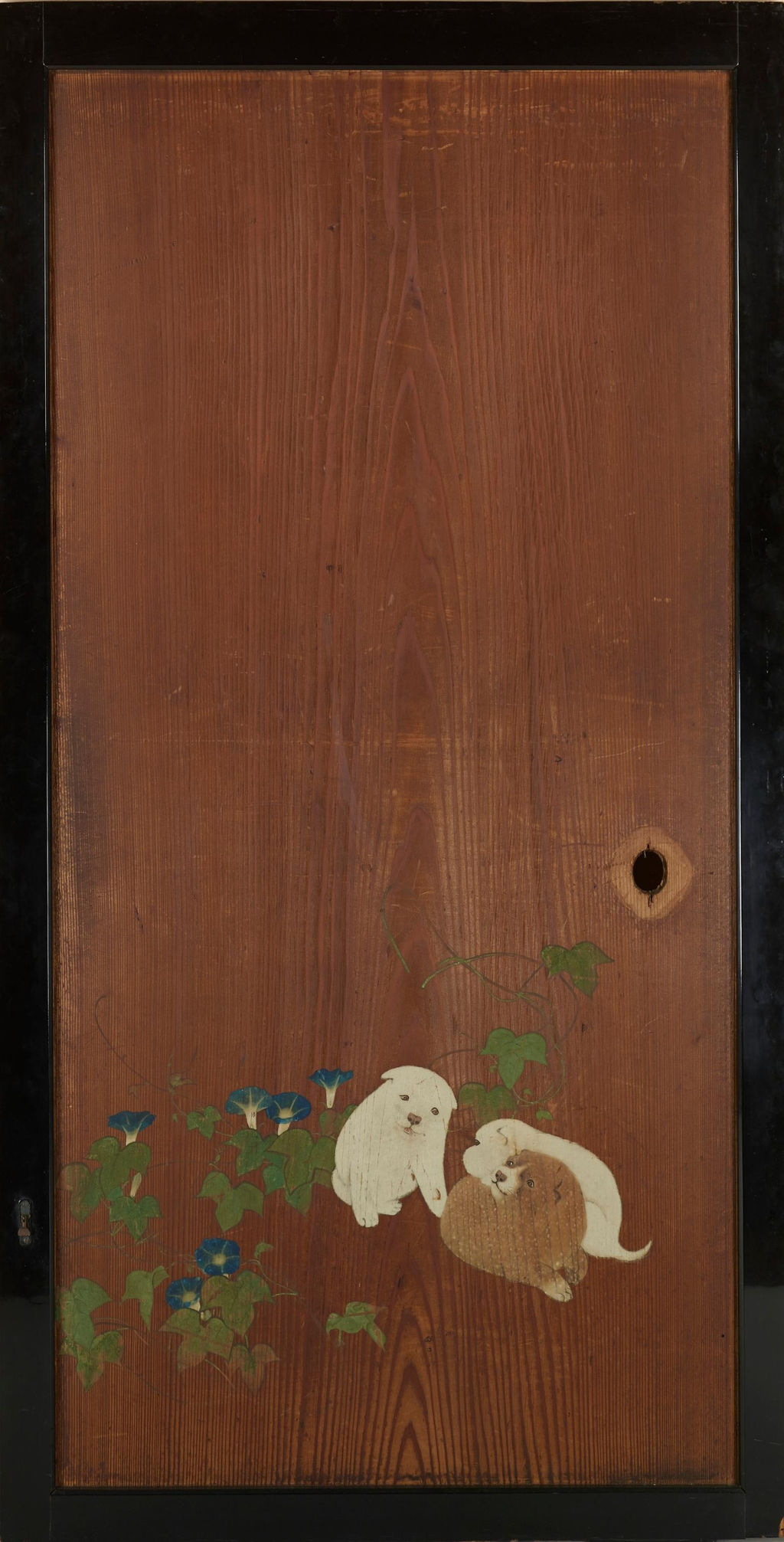
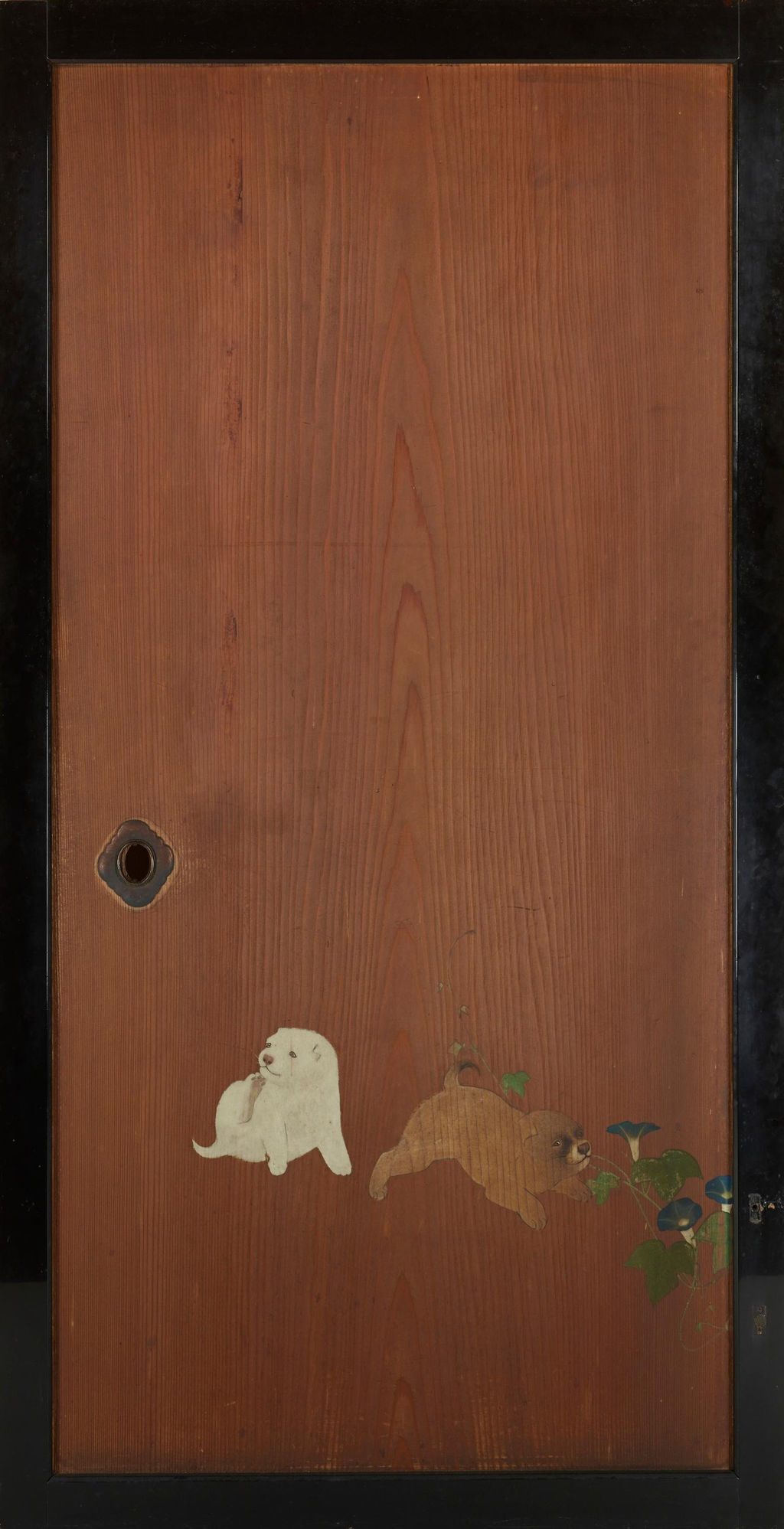
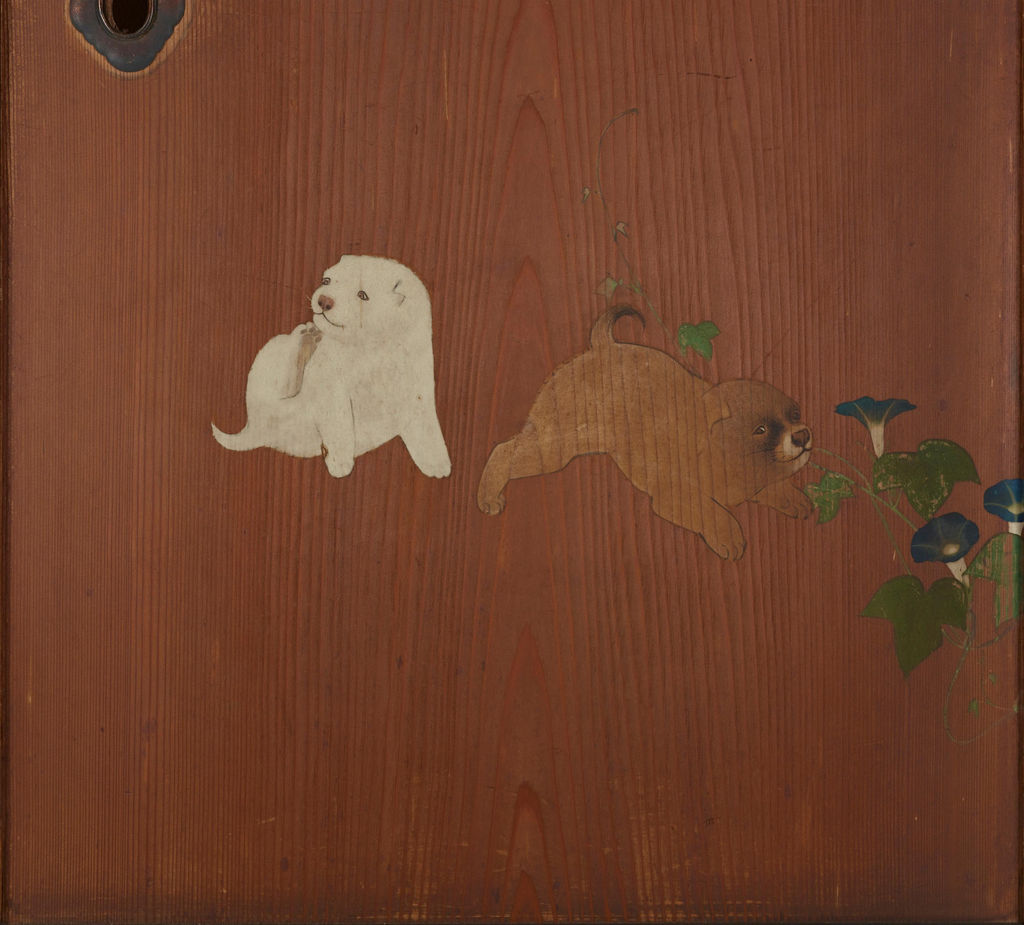
Three dogs gather on one door and two on the other. A brown pup plays with a morning-glory vine; a white pup scratches; another seems to lean or climb onto a companion. Blue flowers and green leaves trail near the animals while much of the upper cedar is unpainted. The visual balance relies on the material as much as on the dogs: a warm, grained wood ground stays visible above and around them. The Tokyo museum curator Yamashita Zen'ya notices fine strokes for the fur, carefully formed eyes and noses, and almost casually abbreviated S-shaped ears. The surface feels tangible, but it is not a uniform exercise in minute description. Detail and economy are used together. [2]
Look closely at the puppies and morning glories
Open the numbered details cropped from retained 300dpi working files of the ColBase photographs. Explanations also appear below.
Annotated image details
The three puppies huddled together
The three bodies huddle, their separate outlines overlapping.
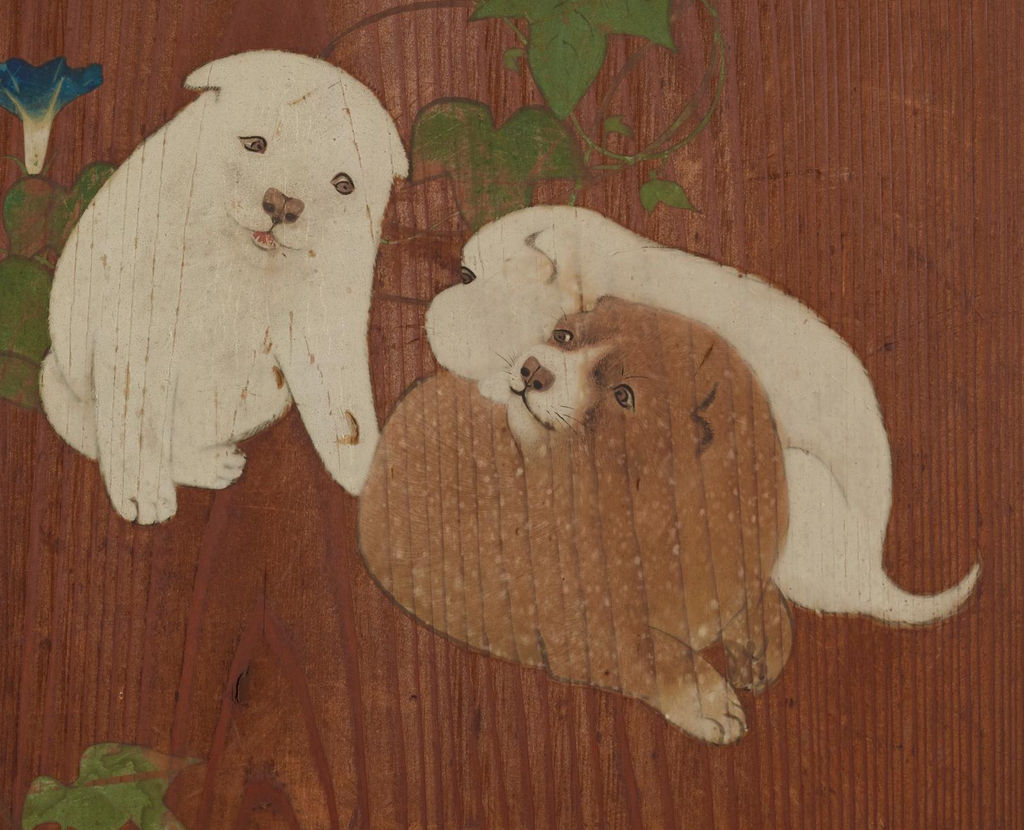
Tokyo National Museum A-12124 via ColBase; editorial crop and resize.
The white puppy lifting a paw
A lifted white paw suggests a small, passing action.
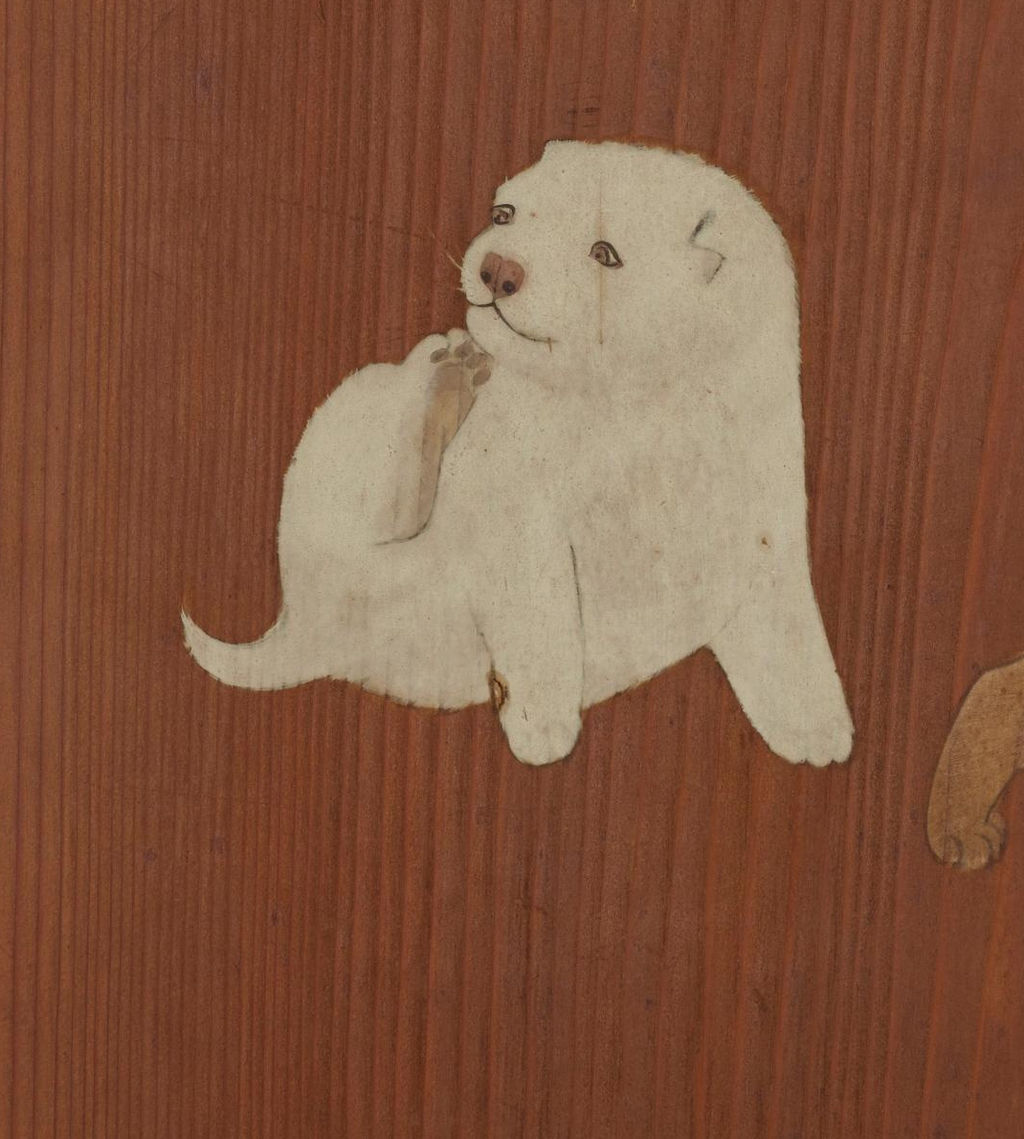
Tokyo National Museum A-12124 via ColBase; editorial crop and resize.
The brown puppy and morning-glory vine
The vine bends beside the brown puppy, binding animal and plant across the low painting field.
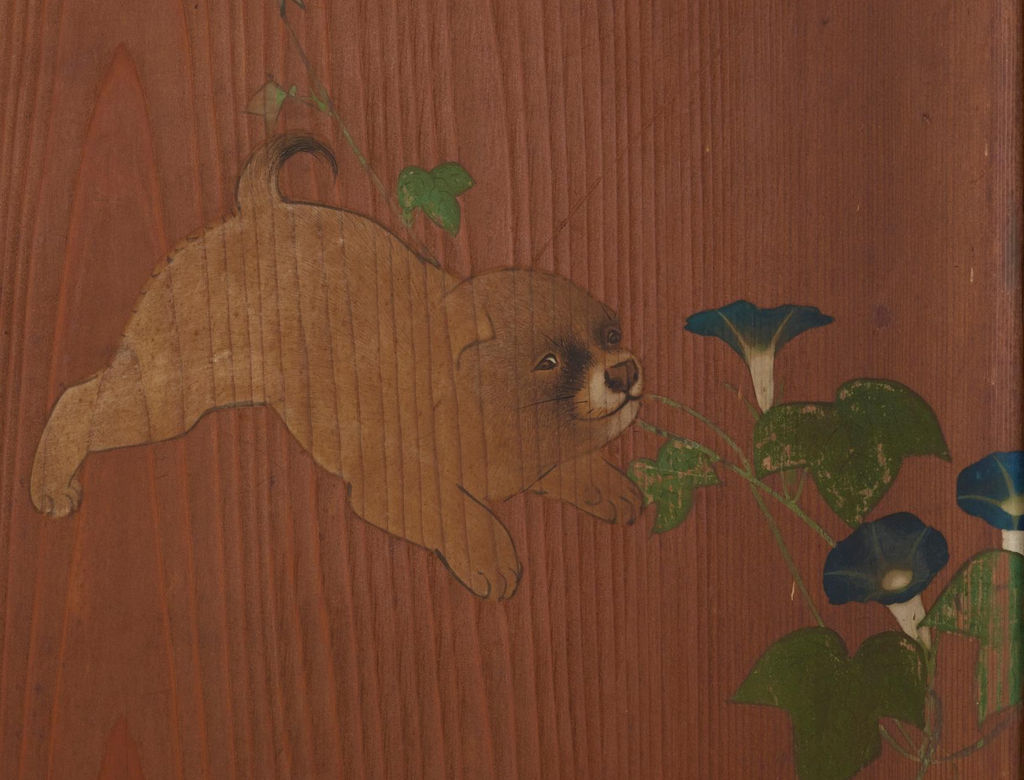
Tokyo National Museum A-12124 via ColBase; editorial crop and resize.
Blue morning glories and cedar grain beside the puppies
Blue flowers and cedar grain make colour and the architectural surface visible beside the dogs.
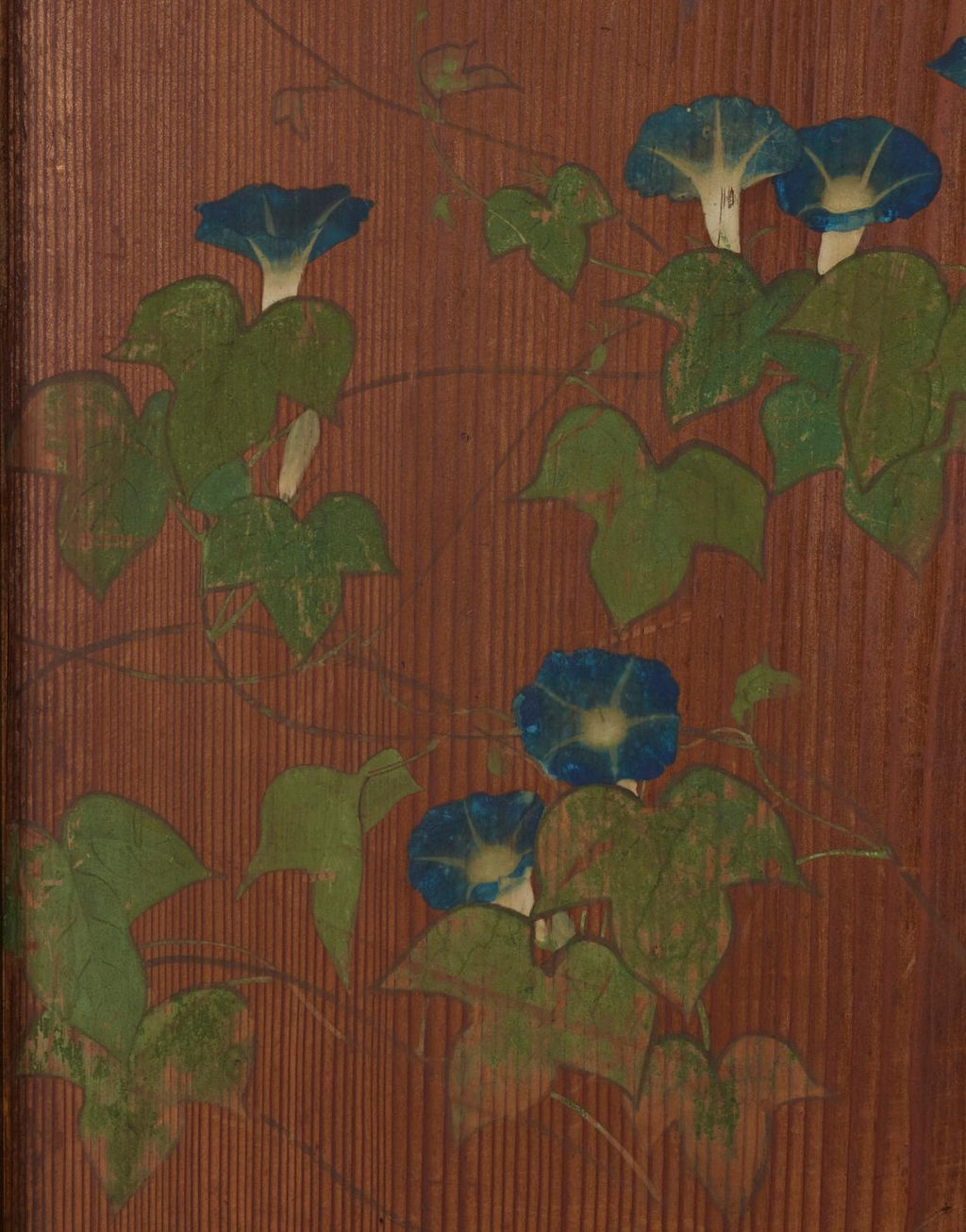
Tokyo National Museum A-12124 via ColBase; editorial crop and resize.
The nearly blank upper parts of the doors deserve as much attention as the painted lower edges. Yamashita proposes that people walking down the original corridor may have met these animals as if they were at floor level. A child might have seen them near eye height. It is a persuasive account of how their placement could operate, but it remains a curator's interpretation. The surviving object and architectural history support saying they were doors for the corridor; they do not preserve Ōkyo's own written statement of intent. The temple's tradition that he painted the work in thanks for eye treatment likewise should be told as tradition. It is part of the building's remembered history, not a documented exchange that can be narrated as certainty. [2] [1]
The doors' colours also differ from the muted scrolls. The blue morning glories stand out sharply against the cedar and green leaves. Their curved vines loosely connect the animals and lead the eye across the panels. The dogs themselves repeat rounded heads and bodies without taking identical poses. The flowers help establish scale: these are puppies low to the ground rather than heroic beasts in a landscape. Such a design can be affectionate without being careless. The details invite proximity, while the shapes and colours remain legible from farther along a corridor. Yamashita's essay offers this interplay of close paintwork, repeated curves and broad empty surface as a reason the whole composition feels so fresh. [2]
The source photographs make the door structure visible in a way cropped online reproductions often do not. There is hardware near the upper area and wood grain running behind the scene. The pictures are now preserved as collection objects; no current display date is promised in Tokyo National Museum's object record. A visitor can consult that record and the museum's current exhibition schedule, but should not assume the original puppy panels will be installed in Ōkyokan on the day of a garden visit. Distinguishing the moved building from the kept paintings answers a practical question and preserves the work's physical story. [1] [2]
A painted room, then a museum collection
The doors were part of a larger decorated interior. Tokyo National Museum's account of Ōkyokan describes a shoin built at Meigen'in in 1742, with wall and sliding-door paintings by Ōkyo and, in part, his pupil Yamamoto Shurei. One room brought pine, plum and bamboo into a group of auspicious motifs; another was linked by paintings of reeds and geese. The puppies therefore belonged to an ensemble, even though their bold blue flowers and playful bodies can now be enjoyed as a pair on their own. We cannot reconstruct every historical visitor's path through the building, but the museum's room account keeps the dogs from being treated as independent canvas pictures. The original support had a job: it separated parts of a corridor, and the painted animals met moving bodies. [18] [1]
The shoin itself travelled. According to Tokyo National Museum, Masuda Takashi, known as Don'ō, bought and moved it to his estate at Gotenyama in Shinagawa in the Meiji period; the building was given to the museum in 1933. Those changes matter because the garden structure seen now is a preserved former temple room in a new place. Its name, Ōkyokan, remembers the paintings inside it. Nothing in that story requires the actual puppy doors to have stayed permanently fitted after museum conservation practice changed. The museum explains that movable original paintings were kept in storage and shown periodically in galleries to protect them, while the building's interior could otherwise no longer communicate its earlier painted effect. That is a historical reason to distinguish architecture, original painting, photographed image and replica. [18]
In 2007 the museum announced a major project to make reproductions for Ōkyokan: 41 of roughly 50 painted surfaces were being copied, combining digital capture and printing with careful attention to tone and paper. The announcement explicitly says the cedar doors were excluded from that phase of reproduction. It also labels Morning Glories and Puppies as in storage at the time. We should not imply that a door seen in the garden was necessarily the original, or that this particular reproduction project produced a facsimile of the puppy doors. Nor should a replica elsewhere be dismissed as worthless: museum reproductions can help visitors understand a room's relationships while the vulnerable originals are protected. The crucial editorial point is honest labelling of which thing a visitor or reader is seeing. [18]
The doors' original use may also help explain the composition's unusual emptiness. When an image is mounted at the bottom of a functioning barrier, the blank wood above can serve both as physical surface and pictorial breathing room. Seen near the corridor floor, the puppies might have appeared almost at the level where actual animals would run. That is Yamashita's persuasive visual interpretation, not an instruction recovered from Ōkyo's hand. Conversely, when a digital crop isolates the painted field, the dogs become the whole image and the upper cedar disappears. Both views are useful, but they answer different questions. The full-door picture asks how the motif lived in architecture; the field photograph asks how fur, mouth, paw and vine were painted. Showing both at different moments of the article allows the reader to understand why one painting can appear so different in two museum files. [2] [1]
A later scroll and the continuing motif
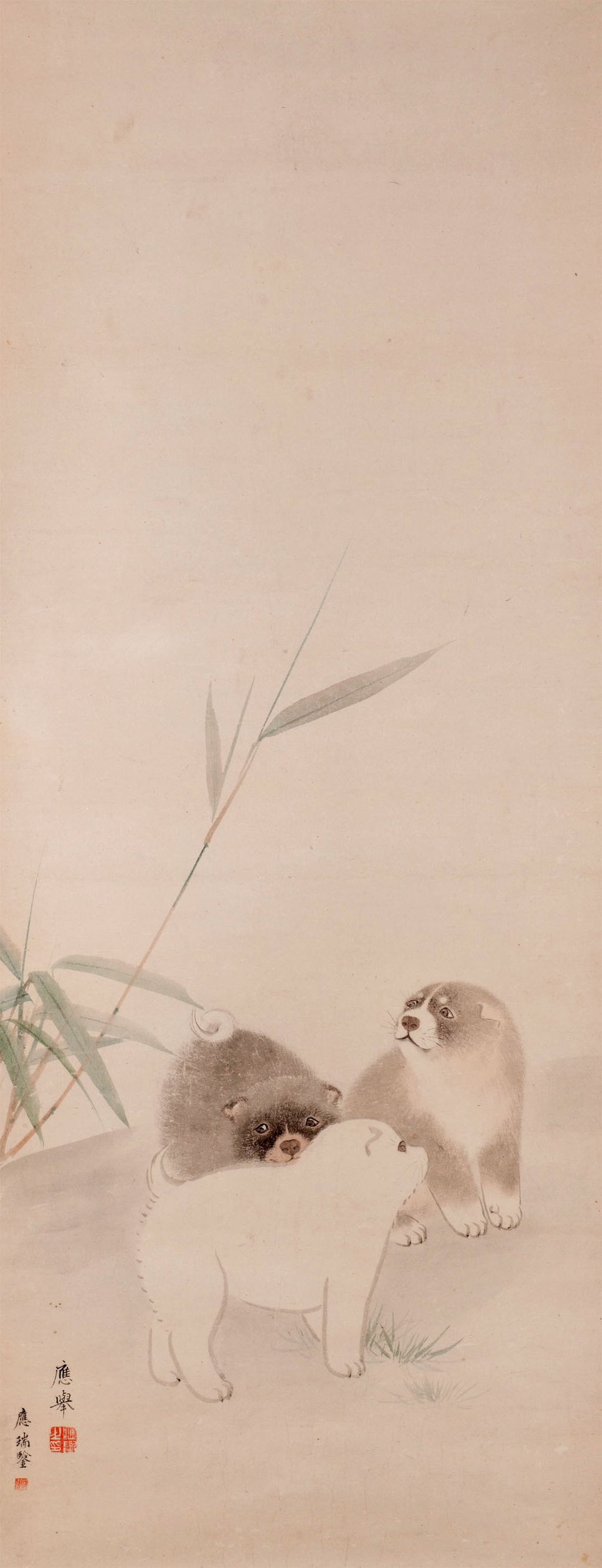
Tokyo Fuji Art Museum's Puppies, 狗子之図, is a hanging scroll of around 1790. It shows three puppies on paper in ink and colour; the painted work measures 106.5 by 41.5 centimetres. Two glance left, towards something the composition does not show, while a third occupies another part of the group. Compared with the full cedar doors, the scroll concentrates the social exchange in a much narrower field. The museum relates this work to the popularity of the 1784 Morning Glories and Puppies. That is an institutional interpretation of a later development, not evidence that the same physical animals modelled for both works. The official downloadable digital image carries a CC0 declaration. [6]
The small change of direction in a dog's gaze can make a group feel alert. Here the scroll's tall space gives the clustered puppies a quieter setting than the 1781 screen's broad dark band. The image also brings out a recurring problem in reading Ōkyo's dogs: we can sense a distinct personality in each face, but the museum does not name an individual dog. There is no need to invent one. Nor do similar white and brown coats prove a single pet's repeated portrait. Yamashita reports that researchers have imagined familiar living models because such types recur; he presents it as an idea, not a proven fact. The scroll can be moving without becoming a document of Ōkyo's household. [6] [2]
Observation, selection and a Kyoto school
Shasei is often translated as drawing or painting from life, but it did not mean copying everything the eye sees in equal detail. Kyoto National Museum notes a history of observed plant and animal studies before Ōkyo. What changed was the standing of observation within a finished image. His dogs have weight and recognizable gesture, yet their surroundings can be reduced to a few plants, snow, a decorative ground or bare wood. The contrast between careful fur and shorthand ears on the cedar doors is especially clear. A studio trained to look closely could still use conventions, compositional rhythm and selective omission. The works reward us most when “natural” and “artful” are allowed to coexist. [9] [2]
Why choose puppies rather than the more imposing animals that might announce a patron's power? Both MIHO Museum's account of Ōkyo and the Tokyo National Museum curator describe his attention to very young dogs as an unusual subject in the painting of his time. That statement should not be turned into the absolute claim that nobody in Japan had ever depicted a puppy. What is distinctive in the examples here is the sustained focus on puppies as the principal action. There is no warrior or hunting party for them to accompany. On the scroll, their exchange is enough; on the cedar doors, play near a vine can carry a picture across a working architectural surface. The apparently modest subject made room for an art of everyday gesture that viewers could recognise without knowing a literary story. [19] [2]
Their appeal is also a matter of age and scale, rather than just rounded outlines. The morning glory on the doors lets the viewer compare a familiar flower and leaf with the small bodies beside them. A pup that scratches itself, clambers over another or noses a tendril behaves briefly and imperfectly: these are not formal poses of an adult animal trained to stand still. Ōkyo can bring the viewer close by painting a muzzle carefully and by leaving enough surrounding space for each action to be read. Yet the painting never supplies the dogs' names, breed records or exact day of observation. To say “this looks like something a puppy does” is an act of looking; to claim “this particular puppy belonged to the painter” would require a document the museum does not offer. [2]
The recurrence of white and brown types is especially interesting without becoming proof of portraiture. In the 1781 screen the white dog stretches across its companions. On the cedar doors white and brown forms alternate, making a five-dog scene readable from some distance. In the Tokyo Fuji scroll, their glances collect around an event beyond the frame. Comparing coat colour is a good way to follow how Ōkyo arranges groups, but it should not erase differences in date, medium or ownership. The same visible type can be a chosen pictorial resource, a real model, or both; these records do not let us select one answer with confidence. That uncertainty is productive because it returns attention to what each work actually shows. [4] [1] [6]
The Tokyo Fuji museum links Ōkyo's small-animal paintings to sketch scrolls made around 1771 that studied forms from more than one angle. Kyoto National Museum holds a sketch scroll associated with Ōkyo and Goshun. Such records show a culture of close study, but neither identifies a preparatory sheet for a particular dog on a particular door. We should therefore avoid drawing a straight line from a named sketch to a named finished puppy when the archive does not. Research on Ōkyo and Watanabe Shikō also shows that seemingly direct claims about copying and influence can be reconsidered as new evidence appears. That is a useful reminder that shasei was an artistic practice within a network of paintings, patrons and pupils, not a magic label that explains every object by itself. [6] [10] [17]
Ōkyo's students carried puppy subjects onward. Daijōji Temple records a willow-and-puppies scroll by the master from autumn 1789 and describes the popularity of his dogs. Yet a similar image in the Museum of the Imperial Collections, Morning Glories and Puppies dated 1792, is assigned to his pupil Yamaguchi Soken. The name of the artist matters as much as the motif. A copy or school painting can be valuable evidence of influence without becoming another Ōkyo autograph. This page should let the viewer enjoy the family resemblance while keeping the labels separate. The British Museum's later puppy netsuke, made by Kaigyokusai Masatsugu, offers a still later echo: its curator compares the plump miniature carving with Ōkyo's dogs, but the object is a Meiji-period sculpture, not a painting by Ōkyo or a documented copy of one. [11] [12] [13]
Where can the puppies be seen?
Collection ownership and an exhibition are not the same thing. As checked on 25 September 2026, Tokyo National Museum's A-12124 entry says no display is scheduled; both of the Minneapolis puppy records say “Not on View.” The Tokyo Fuji page records its ownership and past loan exhibitions, but its old exhibition dates do not establish a current display. These status lines can change, so a visitor should follow each linked museum record and its live display calendar immediately before travelling. The picture files on this page allow close study even when the original is resting in storage. The TNM object's two doors should not be assumed to stand in the moved Ōkyokan building simply because they once furnished its corridor. [1] [3] [4] [6]
There are other securely recorded dog paintings to look for. Fuchū has the dated 1767 rain scroll; Tsuruga records a 1778 snow scene; Daijōji has the 1789 willow scroll. Mitsui Memorial Museum's 2025 exhibition list named yet more snow and willow works, but that show has ended and its list says objects with no museum named were from private collections. It would mislead a traveller to turn an old exhibition list into a current gallery guide. For an art lover, the useful distinction is simple: a collection record tells where a work belongs; a current exhibition notice tells whether it is available to see now. [7] [8] [11] [14]
Looking back across four works
The four illustrated works show a painter adapting an observed subject to different settings. The 1779 scroll lets two bodies tumble in pale space. The 1781 screen sets three puppies across a decorative horizontal field. The 1784 cedar doors place five low in a corridor composition, where wood grain and morning glories matter as much as the animals. The c.1790 scroll pulls three expressions into a tall, quiet image. None should be treated as an impression, edition or enlarged detail of another. Their materials and formats are part of their meaning. [3] [4] [1] [6]
What persists is the invitation to look at a living gesture. A paw is lifted, a body folds, one dog turns towards another. Ōkyo could observe those movements and then make viewers notice them through placement, omission, colour and scale. His puppies are not merely illustrations of the word shasei or evidence of a private fondness for pets. They are paintings and painted objects that think through what an animal's brief movement can do on silk, paper and cedar. Return from the detail crops to the entire doors or screen and the point becomes clear: the appealing face is only one part of a carefully organized encounter. [2] [3] [5]
Frequently Asked Questions
No. Museum records identify separate scrolls, a folding screen and the two 1784 cedar doors. The four illustrated examples on this page have different dates, materials and accessions. [3] [4] [1] [6]
Tokyo National Museum's Morning Glories and Puppies, A-12124, is a particularly familiar example. It is a pair of cedar doors from the former Meigen'in building, dated 1784, with five puppies and blue flowers. Fame does not make it the only puppy work. [1] [2]
That is not established. A Tokyo museum curator notes that some researchers have imagined familiar living models because similar white and brown types recur. The museum does not present a surviving record naming pets or identifying a particular dog. [2]
Tokyo National Museum owns them as A-12124. Its collection entry, checked on 25 September 2026, says that display plans are undecided. The Ōkyokan building in the museum garden was moved from the former temple, but a visit to that building does not guarantee the original painted doors are on view. [1] [2]
Discussion
Compare the scrolls, screen and cedar doors. Where does a small puppy gesture change the space around it?
Reader Insights
How would the low placement have looked in a corridor?
Compare a paw or muzzle with the placement of the group.
Which details distinguish the similarly titled scroll and screen?
Join the Conversation
Share a documented example or a reliable source below, keeping observation separate from inference.
References
- ColBase, Tokyo National Museum, Morning Glories and Puppies / 朝顔狗子図杉戸, A-12124, exact object metadata and image files; see also TNM display record.
- Yamashita Zen'ya, “Ōkyo's puppies,” Tokyo National Museum curator essay, 16 July 2015; physical setting, visual details and explicitly speculative readings.
- Minneapolis Institute of Art, Gamboling Puppies, 74.1.136, 1779; official object data.
- Minneapolis Institute of Art, Puppies, 2015.79.158, 1781; official object data.
- Smithsonian National Museum of Asian Art, Investigating Japan's Edo Avant Garde, Puppies, on Mia 2015.79.158 and shasei.
- Tokyo Fuji Art Museum, Puppies / 狗子之図, c.1790, object page, museum interpretation and individual CC0 image terms.
- Fuchū Art Museum, 時雨狗子図 / Puppies in a Shower of Rain, catalogue 1151, 1767.
- Tsuruga Municipal Museum, 狗子図 / Puppies, ID 33, 1778.
- Kyoto National Museum, Ōkyo and shasei painting, institutional explanation of observation and its historical context.
- Kyoto National Museum, 写生図巻 / Sketch Scroll, A甲551, object record; no direct preparatory link to puppy works is claimed.
- Daijōji Temple, 柳下狗子図 / Puppies beneath a Willow, 1789; research-only image.
- Museum of the Imperial Collections, 朝顔狗子図 by Yamaguchi Soken, 1792, distinct pupil's work.
- British Museum, puppy netsuke by Kaigyokusai Masatsugu, HG.561; later reception comparison only.
- Mitsui Memorial Museum, 2025 Ōkyo exhibition object list; additional dog paintings and ownership key, not a current display guide.
- Chūō Kōron Bijutsu Shuppan, Sasaki Jōhei and Sasaki Masako, Maruyama Ōkyo Research, 1996; verified bibliographic lead, not quoted.
- Nezu Museum, Maruyama Ōkyo: Beyond Shasei, 2016 retrospective; accompanying catalogue record, not quoted from unread text.
- Kato Hiroko, research grant summary on shasei, Ōkyo and the Maruyama school; note on reconsidering an older direct-copying account.
- Tokyo National Museum, Ōkyokan wall-painting reproduction project, February 2007, five-page official report; original storage, room context, 1933 move and the exclusion of cedar doors from that reproduction phase.
- MIHO Museum, 仔犬図 / Puppies by Maruyama Ōkyo, institutional object account and discussion of the puppy subject; image rights not cleared for reproduction.