 by Tom Gurney
Tom Gurney BSc (Hons) is an art history expert with over 20 years experience
Published on June 19, 2020 / Page Updated on November 5, 2026
Email: tomgurney1@gmail.com / Phone: +44 7429 011000
Introduction
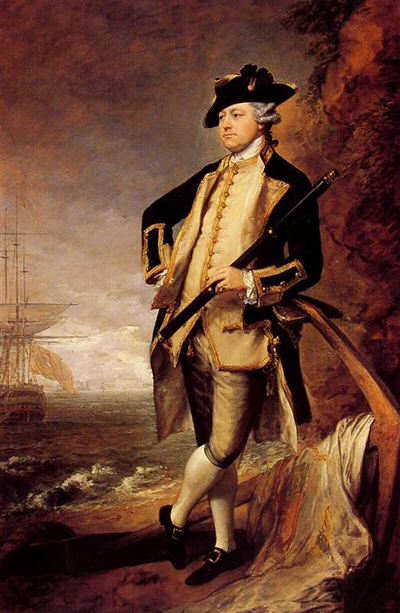
Thomas Gainsborough's full-length portrait of Augustus Hervey is a naval image that refuses to become only a naval image. The National Trust title identifies him as a commodore, an honourable younger son, a later vice-admiral and the later 3rd Earl of Bristol, and that wording is worth preserving because it holds together the sitter's service rank, family status and later title.[1] The work is in the National Trust collection at Ickworth, Suffolk, inventory NT 851720.[1]
The National Trust dates the painting to 1767-1768, records it as oil on canvas, gives the measurements as 2320 × 1525 mm, and identifies Bath as the place of origin.[1] The record also notes exhibition at the Society of Artists.[1] These object facts place the portrait in Gainsborough's Bath period, when he was building a highly fashionable practice among visitors, aristocrats and ambitious sitters. Hervey is shown in naval uniform, but the painting's social intelligence lies in how uniform, gentlemanly ease, maritime memory and Bath portraiture all meet in one image.
The sitter stands by the sea, turned left, with telescope, anchor, Spanish ensign, cliff, ship and distant Havana reference around him.[1] The iconography is military and imperial, but the manner is poised. Gainsborough does not turn Hervey into a rough sea officer. He turns him into a gentleman whose naval distinction can be worn, displayed and made elegant. That tension gives the portrait its particular character.
At a Glance
- ArtistThomas Gainsborough
- National Trust titleCommodore the Hon. Augustus Hervey, later Vice-Admiral, and 3rd Earl of Bristol [1]
- Date1767–1768 [1]
- MediumOil on canvas [1]
- Dimensions2320 × 1525 mm [1]
- Current holderNational Trust, Ickworth, Suffolk [1]
- InventoryNT 851720 [1]
- Place of originBath [1]
- Portrait typeFull-length naval portrait with retrospective Havana imagery
- ExploreBiography; The Blue Boy; Mr and Mrs Andrews; Paintings; Portraits
Contents
- Introduction
- The National Trust Object
- Uniform and Gentlemanly Ease
- Havana, Anchor and Ensign
- Bath and the Business of Portraiture
- Hervey Without Drowning the Painting
- The Print After the Painting
- Composition and Looking
- Why the Portrait Matters
The National Trust Object
The National Trust record controls the basic identity. The painting is by Thomas Gainsborough RA, represents Augustus Hervey, and belongs to Ickworth.[1] Its large scale immediately matters. At more than two metres high, this is not an intimate bust or a small family likeness. It is a public full-length portrait designed to make rank, career and presence visible.
The date, 1767-1768, is just as important.[1] Hervey's active sea career had already passed its climactic point. The portrait looks back to achievement, especially to the 1762 action at Havana, rather than presenting an officer in the middle of service. The National Trust describes the picture as retrospective in that sense: the setting and props allude to what Hervey saw as a distinguished moment in his career.[1]
The place of origin, Bath, sharpens the reading.[1] Gainsborough's House explains that Gainsborough moved to Bath in 1759 and began attracting more cosmopolitan and aristocratic clientele, while still combining portrait and landscape interests in inventive ways.[2] Hervey's portrait belongs to that social environment. The seaside props may point toward naval fame, but the painting was made in the orbit of a spa town, not aboard ship.
This makes the portrait a performance of remembered service. Hervey appears in uniform and stands beside naval symbols, yet the image is polished for display among people who understood rank, fashion and social visibility. His body is arranged for spectators, not for command. The result is a portrait about how a naval career could become a gentleman's image.
Uniform and Gentlemanly Ease
The National Trust description emphasises the sitter's naval uniform: a dark blue coat with gold braid, cream waistcoat with gilt buttons, crossed legs, telescope, anchor and Spanish ensign.[1] The Frick Collection's exhibition account also draws attention to the uniform, fob, sword and ring as details through which Gainsborough conveys profession, rank and wealth.[3] Those details make the sitter legible, but they also refine him.
Uniform is a social language. It tells the viewer that Hervey belongs to the navy, but it also lets him appear controlled, ornamented and authoritative. The gold braid catches status as much as service. The telescope and anchor identify maritime command, but they are arranged as portrait props. Even the captured ensign becomes part of a composed display.
The National Trust observes that, despite the uniform, setting and props, the sitter remains first and foremost a gentleman.[1] That is the key to the work. Hervey does not look submerged in professional labour. He looks at ease beside the signs of it. He wears naval identity as a form of aristocratic self-presentation.
This is not a weakness in the portrait. It is the point. Gainsborough was especially skilled at making sitters appear natural while carefully constructing their public selves. Hervey's crossed legs, resting arm and calm bearing prevent the image from becoming stiff martial theatre. The portrait turns service into poise.
That poise also distinguishes Gainsborough from a more emphatically heroic mode. Joshua Reynolds could make military and naval portraiture grand, moral and public in a different way. Gainsborough's Hervey is less monumental than stylish. The scale is large, but the feeling is still one of fluent social ease.
Havana, Anchor and Ensign
The portrait's maritime references are specific. The National Trust connects the distant fort to the taking of Moro Castle at Havana in 1762, during the Seven Years' War, and identifies the ship as likely Hervey's command, the Dragon, a 74-gun vessel.[1] Royal Museums Greenwich, in its record for a later print after the portrait, also describes the sitter standing by a cliff, leaning on an anchor draped with a captured Spanish ensign, with the Dragon and the bombardment of Morro Castle in the distance.[4]
These details give the portrait historical force. The anchor is not a generic emblem alone. The ensign points to Spanish defeat. The ship and distant action place Hervey within imperial conflict. Gainsborough therefore gives the sitter a setting in which career, nation and personal distinction can be read together.
Yet the painting keeps those elements subordinate to the sitter's presentation. The ship is distant. The fort is distant. The captured flag lies as an emblem near the body. The eye returns to Hervey: his posture, uniform, face, hands and controlled elegance. War becomes the background of identity rather than a scene of action.
This is a delicate form of commemoration. Hervey had taken part in the Havana campaign and had the honour of carrying news back to Britain; the National Trust also notes that he captured a French frigate on the way.[1] Such facts support the portrait's iconography, but Gainsborough does not paint a battle. He paints a man who wishes his battle-connected distinction to be recognised.
That difference matters. A battle painting would ask for movement, danger and collective action. This portrait asks for standing, bearing and memory. The naval story is condensed into objects: telescope, anchor, flag, ship and fort. Hervey's body becomes the point at which history is turned into status.
Bath and the Business of Portraiture
The Bath setting is more than logistical background. The Frick notes that Hervey suffered from gout and travelled to Bath, where he met Gainsborough.[3] Gainsborough, meanwhile, had positioned himself advantageously in the spa town's social life. Gainsborough's House states that Bath brought him a more cosmopolitan and aristocratic clientele after 1759.[2] The portrait therefore belongs to a culture in which health, leisure, society and portrait commission could overlap.
Bath was a place to be seen. Visitors came for treatment, sociability, music, dancing, conversation and display. A portrait made there could serve as a record of rank, but also as a product of that social theatre. Hervey's naval uniform looks toward sea service; the polished treatment looks toward Bath society.
This doubleness is one of the portrait's strongest features. Hervey's identity is built from naval distinction, aristocratic lineage, fashionable presentation and social availability. The painting does not choose only one. It allows the sitter to appear both officer and gentleman, veteran and man of fashion, active career-maker and later titled aristocrat.
Rosenthal's Paul Mellon Centre study is useful as a broader frame because it treats Gainsborough's art within the commercial and social world of eighteenth-century British looking.[5] Hervey's portrait fits that world exactly. It is not simply a private likeness. It is a professional object made to convert a sitter's public identity into paint.
The portrait also shows how Gainsborough could adapt to male status images. In other works, fashion might mean silk, ribbons, hair, jewels or theatrical dress. Here it means uniform, braid, sword, telescope, anchor and controlled bearing. The materials differ, but the mechanism is related: identity becomes visible through costume, accessory and painterly surface.
Hervey Without Drowning the Painting
Augustus Hervey's biography is colourful enough to distract from the portrait. The National Trust record mentions his naval career, diaries, marriage scandal involving Elizabeth Chudleigh, relationships, inheritance issues and the complex descent of the painting.[1] The Frick also notes his family's reputation for flamboyant behaviour and the public scandal around Chudleigh.[3] These details belong to the sitter's world, but they should not take control of the interpretation.
The painting itself is more disciplined than the biography. It gives no chaotic scandal. It gives poise. That contrast matters. Gainsborough presents Hervey as the sitter wished to be seen: naval, wealthy, dignified, accomplished and socially commanding. Portraiture often works this way. It does not merely reveal a life; it edits one.
The National Trust's account helps explain why this edit was desirable. Hervey had been an active officer, entered the navy young, ended sea service as captain of the Centurion in 1763, served as a Lord of the Admiralty from 1771 to 1775, and became Vice-Admiral of the Blue in 1778.[1] Those career facts were strong material for display. The portrait chooses them over the messier private narrative.
Even the later title in the National Trust wording has to be handled carefully. Hervey was not born the 3rd Earl of Bristol. The title came later. The institutional title preserves that sequence by using “later Vice-Admiral, and 3rd Earl of Bristol.”[1] That phrasing prevents confusion: the picture shows a man whose image looks back to naval success and forward through later rank and inheritance.
The name Hervey also carries family status. He was a younger son who had to make a career, as the National Trust notes.[1] The portrait therefore joins birth and achievement. Aristocratic origin mattered, but naval service gave Hervey a public identity of his own. Gainsborough's painting turns that earned identity into a form of elegance.
The Print After the Painting
Royal Museums Greenwich holds a later print titled Augustus John, 3rd Earl of Bristol, connected to Charles Algernon Tomkins and Gainsborough.[4] Its record describes it as an aquatint in the National Maritime Museum's Caird Collection, not currently on display, and identifies it as made after Gainsborough's oil painting.[4] This print is not the main object, but it is a useful afterlife witness.
The print shows that Gainsborough's composition could be translated into a maritime visual record. RMG's description repeats the key elements: captain's undress uniform, hat, telescope, anchor, Spanish ensign, the Dragon, commodore's broad pennant and the view toward Morro Castle.[4] The oil painting's identity was therefore strong enough to survive in another medium as a recognisable naval image.
At the same time, the print changes the work's function. A full-length oil at Ickworth operates as a grand family and collection object. A print can circulate more broadly, carrying the sitter's image into a different public sphere. The naval iconography becomes easier to read as historical record, even though its origin is a portrait designed for elite display.
This afterlife also helps protect the interpretation from treating the portrait as only aristocratic costume. The maritime details were not incidental. They were important enough to structure a later naval print record. Hervey's naval identity was part of the picture's public legibility.
Still, the painting remains more complex than the print can suggest. In the oil, Gainsborough's handling of scale, surface, colour and bodily ease does work that a reproductive object cannot fully replace. The print confirms iconography; the painting creates presence.
Composition and Looking
The first thing to notice is the full-length stance. Hervey's body is arranged to occupy the large canvas with confidence. The crossed legs and leaning pose soften the martial setting. Instead of squarely confronting the viewer as a commander, he appears at ease, as if the props of service belong naturally around him.
Then look at the telescope. It is an emblem of command and sight, but also a device that makes the hand meaningful. Hervey holds not a weapon but an instrument of looking. That suits the portrait's retrospective character. He is not fighting; he is associated with vision, navigation and command memory.
The anchor is equally important. It grounds the body and allows the Spanish ensign to enter the composition. It is heavy, rusty and maritime, but in portrait terms it functions like furniture: something to lean upon, a support for posture and meaning. Gainsborough turns an object of shipboard labour into an aristocratic prop.
The distant ship and fort extend the portrait's geography. Without them, the image would remain a uniformed man by the sea. With them, the scene points toward Havana and the Seven Years' War. The painting's space therefore runs from foreground body to distant military memory. Hervey stands between emblem and history.
The face should not be overlooked. In a portrait so rich with uniform and props, the viewer can easily read the accessories first. But Gainsborough's challenge was to make the sitter remain alive amid all that symbolism. The National Trust's observation that Hervey remains first and foremost the gentleman points back to the face and bearing.[1] The sitter's social identity is carried by expression as much as by costume.
Why the Portrait Matters
The Hervey portrait matters because it expands the idea of what Gainsborough's Bath portraiture could do. It is not a rustic scene, not a musician portrait, not a domestic conversation piece and not a blue-and-silk society image. It is a naval full-length that still behaves like a Gainsborough: elegant, socially alert, pictorially fluent and slightly resistant to hard heroic formula.
It also matters because it shows the painter negotiating male public identity. Hervey needed to be seen as noble, naval, accomplished and fashionable. Gainsborough gives him all of that, but without making the image crude propaganda. The portrait's power lies in the balance between service and ease.
The object facts reinforce that importance. A large oil painting, made in Bath around 1767-1768, exhibited at the Society of Artists, now at Ickworth, and later echoed through print culture, has a strong place in Gainsborough's portrait world.[1][4] It links the spa-town studio to aristocratic naval memory and to the visual culture of British imperial war.
It also reminds us that title discipline matters. The sitter should be called Hervey and Bristol, not by distorted inherited wording. The National Trust title is long because the life was sequential: honourable younger son, commodore, later vice-admiral, later earl.[1] The length protects the history.
The portrait's final interest is its refusal to choose between action and display. Hervey's sea career is present, but the sea is calm enough for portraiture. The captured ensign is present, but arranged decoratively. The ship and fort are present, but distant. Gainsborough turns naval violence into gentlemanly memory. That transformation is not accidental. It is the work's whole social drama.
The image is therefore most revealing when read at two speeds. At first glance it is a splendid naval full-length. More slowly, it becomes a Bath portrait about how public achievement is dressed for a room, a family collection and a future reputation.
Frequently Asked Questions
Discussion
How does Gainsborough turn naval achievement into gentlemanly display?
Reader Insights
Where does rank remain visible while the crossed stance softens martial formality?
How do anchor, ensign, ship and fort convert past action into portrait symbols?
How does a spa-town portrait balance officer, aristocrat and fashionable sitter?
Join the Conversation
Share your reading below.
References
- National Trust Collections, “Thomas Gainsborough, Commodore the Hon. Augustus Hervey, later Vice-Admiral, and 3rd Earl of Bristol (1724-1779),” NT 851720. View source.
- Gainsborough's House, “About Thomas Gainsborough.” View source.
- The Frick Collection, “Captain Augustus John Hervey, Later 3rd Earl of Bristol,” in Gainsborough: The Fashion of Portraiture. View source.
- Royal Museums Greenwich, “Augustus John, 3rd Earl of Bristol,” object PAF3443. View source.
- Michael Rosenthal, The Art of Thomas Gainsborough: "A Little Business for the Eye" (New Haven and London: Yale University Press for the Paul Mellon Centre for Studies in British Art, 1999). Publication record.