 by Tom Gurney
Tom Gurney BSc (Hons) is an art history expert with over 20 years experience
Published on June 19, 2020 / Page Updated on November 5, 2026
Email: tomgurney1@gmail.com / Phone: +44 7429 011000
Introduction
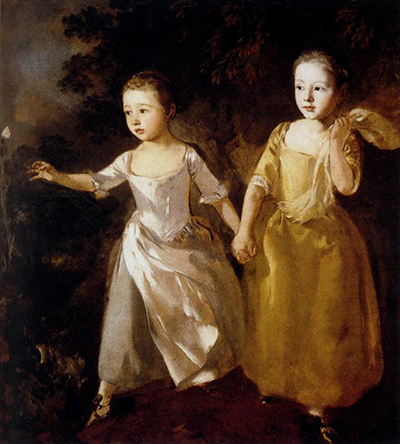
Thomas Gainsborough's The Painter's Daughters chasing a Butterfly is one of the most tender and unsettling images in his work. Two little girls run hand in hand through a dark wood, intent on a butterfly that has paused on a thistle. The children are Mary and Margaret Gainsborough, the artist's daughters by Margaret Burr. The scene looks immediate, affectionate and free, yet it is also unfinished, technically revealing and charged with the knowledge that childhood is fragile.
The National Gallery, London gives the full title as The Painter's Daughters chasing a Butterfly, probably about 1756. It is oil on canvas, 113.5 by 105 centimetres, inventory number NG1811, and entered the collection through the Henry Vaughan Bequest in 1900.[1] The painting is probably the earliest of at least six double portraits Gainsborough made of his daughters between about 1756 and 1770.[1] That sequence matters because this is not an isolated family likeness. It is the beginning of a repeated artistic problem: how to paint his children together as bodies in motion, linked by touch, feeling and experiment.
The picture should be read with warmth, but not with soft focus. It is affectionate, but not merely sweet. It is a childhood image, but not innocent of anxiety. It is a portrait, but it behaves partly like a landscape and partly like the later world of fancy pictures. Gainsborough used the freedom of painting his own children to attempt something unusually bold for him at this early stage: two full-length, nearly life-sized figures in action, moving through open air rather than sitting decorously for a conventional likeness.[2]
This combination gives the painting its special place in the Gainsborough cluster. It is not a grand public portrait, yet it tests a problem that would matter across his career: how to make figures feel alive in a landscape without making the landscape mere scenery. The girls are larger and more animated than the small figures in many early outdoor portraits, but the wood is not passive. It surrounds them, darkens the mood and makes the chase feel both natural and strange.
At a Glance
- ArtistThomas Gainsborough
- Dateabout 1756 [1]
- MediumOil on canvas [1]
- Dimensions113.5 × 105 cm [1]
- CollectionNational Gallery, NG1811 [1]
- SittersMary and Margaret Gainsborough [1]
- StatusUnfinished, with exposed ground and experimental handling [1][2]
- MotifsButterfly and thistle [1][2]
- ProvenancePresented by Charles Fairfax Murray in 1900, from the John Sheepshanks Vaughan bequest [1]
- ExploreFancy pictures; Landscapes; Paintings; Portraits
Contents
- Introduction
- Mary and Margaret Gainsborough
- The Chase and the Dark Wood
- Butterfly, Childhood and Fragility
- An Unfinished and Experimental Portrait
- Scale, Movement and Boldness
- Ipswich, Hingeston and Early Provenance
- Among the Daughter Portraits
- Family Feeling Without Sentimentality
- Why the Painting Matters
Mary and Margaret Gainsborough
The two girls are Mary and Margaret, Gainsborough's only daughters to survive infancy.[1] The National Gallery records that Mary was baptised on 3 February 1750 and Margaret on 22 August 1751, both born while Gainsborough was living and working in Sudbury, Suffolk.[1] Judy Egerton's catalogue entry notes that baptismal evidence corrected earlier assumptions about the sisters' ages, making it likely that there was only about eighteen months between them.[2]
That age correction is important for dating the painting. The National Gallery places it probably about 1756, when Mary seems around six and Margaret around four or five.[1][2] Egerton argues that the picture was likely painted in Ipswich, where Gainsborough lived from 1752 to 1759, before the family moved to Bath.[2] This makes the work part of the Ipswich years rather than the later Bath period of fashionable portrait success.
The family context should not swallow the painting. Mary and Margaret later had difficult lives, and the catalogue records later information about Mary's mental illness, Margaret's unmarried life and the sisters' continued companionship.[1][2] Those facts belong to the longer family story, but they should not be pushed backward too strongly into the image of two young children chasing a butterfly. The painting is poignant enough without making every gesture prophetic.
What matters in the picture itself is the girls' shared movement. They run hand in hand. Margaret reaches forward; Mary holds her apron as if it might catch the butterfly.[1] They are separate children, each with a distinct role in the chase, but they are physically joined. Gainsborough repeatedly returned to that joinedness in later double portraits of his daughters, showing them linked by hands, arms or protective embrace.[1][2]
That joinedness should be understood visually as well as emotionally. The clasped hands form the hinge of the composition. Margaret's reach pulls the group outward toward the thistle, while Mary's gathered apron pulls the eye back into the mass of yellow dress and moving fabric. The sisters' contact therefore does more than communicate affection. It gives the painting its structure, binding two moving bodies into one action.
The Chase and the Dark Wood
The action is simple. Margaret and Mary pursue a cabbage white butterfly, which has landed momentarily on a tall thistle.[1] Margaret stretches out her hand toward it, while Mary gathers her muslin apron like a net.[1] The moment is suspended between success and disappearance. The butterfly is close enough to tempt them and fragile enough to vanish.
The dark woodland gives the chase its emotional pressure. The National Gallery describes the wood as dark and sombre, and that darkness changes the meaning of the children's play.[1] A brighter setting might make the scene purely charming. Here the girls' movement takes place in a shadowed environment, so childhood energy is set against a world that feels larger, deeper and less secure.
The thistle is equally important. Egerton notes that the tall flowering thistle may have been based on a study from nature, consistent with Gainsborough's habit of drawing from observed forms, although no exact matching study is known.[2] The plant is not merely a perch for the butterfly. Its height, prickliness and vertical presence make the children's reaching more dramatic. Margaret's hand moves toward beauty, but also toward a plant that can hurt.
This is why the scene should not be reduced to a pretty anecdote. The chase is visually delightful, but the painting's mood is more complex. A white butterfly, a dark wood, a thistle, running children and an unfinished surface combine to make childhood feel vivid and exposed. Gainsborough gives the moment enough immediacy to seem alive, and enough shadow to keep it from becoming simple illustration.
Butterfly, Childhood and Fragility
The National Gallery suggests that the attempt to catch the elusive butterfly may be intended to evoke the fleeting nature of childhood and the fragility of children's lives.[1] The wording matters: may be intended. The butterfly is not a single fixed allegory with only one meaning. It can suggest transience without turning the painting into a moral diagram.
Egerton's catalogue entry sharpens the butterfly's strangeness. It identifies the insect as a large female cabbage white, one of the commonest native English butterflies, and notes that its wings are shown drooping and folded in a way that means it could not actually fly away.[2] That observation makes the apparent chase more unsettling. The girls appear to pursue living flight, but the butterfly may already be immobilised.
This does not mean that the picture becomes grim. Gainsborough's art often depends on holding charm and unease together. The girls' movement is full of life; the butterfly image raises the question of life's brevity. The thistle is naturalistic; it also gives the scene a sharper emotional edge. The dark wood is a landscape; it also acts almost like a boundary between childhood play and a more uncertain world.
The symbolic reading is strongest when it remains open. Childhood may be fleeting. Children may be vulnerable. The butterfly may stand for beauty, capture, mortality, attention or the unreachable object of play. Gainsborough does not need to settle the meaning. The painting works because it lets the viewer feel the chase before explaining it.
The cabbage white also keeps the symbolism close to ordinary nature. It is not an exotic creature imported to make an elaborate emblem. It is a familiar English butterfly, linked to gardens, fields and the children's immediate world.[2] That commonness matters. Gainsborough can suggest mortality and passing childhood through something small and everyday, not through a grand allegorical prop. The emotional pressure emerges from the ordinary thing made suddenly precious.
An Unfinished and Experimental Portrait
The work is unfinished, and that unfinished state is part of its modern power.[1] The National Gallery notes that the girls' faces are highly finished, while other areas remain loose and expressive.[1] The pinkish-brown ground shows through Margaret's dress, apron and outstretched foot, and thick white strokes suggest fabric moving in sunlight.[1] These visible layers make the painting feel unusually close to the act of making.
Egerton's technical notes give the material basis for that effect. The ground is pinkish brown, made from lead white, chalk and orange ochre.[2] Mary’s dress includes Naples yellow, and the light green of Margaret's underskirt contains white tinted with Prussian blue and black pigment.[2] Such details matter because they show that the painting's freshness is not a vague impression. It comes from specific materials, exposed preparation and uneven finish.
The unfinished condition also reveals Gainsborough's priorities. He has brought the faces far enough to hold likeness and emotional focus, but left other passages more open. This contrast between finish and looseness lets the children appear both present and moving. Their identities are secured in the faces; their energy is released in the sketchier fabric and limbs.
The catalogue stresses that painting his own children gave Gainsborough freedom to experiment with handling paint.[2] That freedom is visible across the surface. He did not have to satisfy a paying sitter's demand for polished likeness or social presentation. He could test scale, movement, open-air figure painting and a more expressive relation between body and brushwork.
The technical detail also changes how the unfinished areas should be judged. The exposed ground is not merely absence; it becomes part of the colour and motion of the picture. The white strokes on fabric do not fully describe cloth in a polished academic manner, but they make sunlight and movement legible. The loose paint is therefore not failure to finish in a simple sense. It is part of the painting's vitality, even if the work was never brought to a conventional completion.
Mary's yellow dress is another example. Egerton's technical notes identify strong Naples yellow in the brighter passages.[2] The colour helps Mary hold her place in the dark setting, and it gives the children's movement a flash of warmth against the sombre wood. Margaret's more exposed and less finished passages work differently, allowing the preparation beneath to pulse through the surface. The sisters are linked by action, but their painted treatment is varied.
Scale, Movement and Boldness
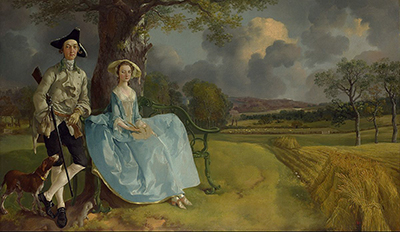
Before this painting, Gainsborough had probably not attempted anything so ambitious as two full-length, nearly life-sized figures.[1][2] Earlier outdoor figures in works such as Mr and Mrs Andrews are smaller and more decorous by comparison.[1][2] Here, Mary and Margaret are larger, bolder and more naturally animated. Their bodies do not simply stand in a landscape. They break into motion.
That motion is central to the painting's originality. The girls lean and reach, their joined hands pulling the composition into a diagonal rhythm. Margaret's outstretched arm carries the eye toward the butterfly. Mary's apron creates another moving shape, both garment and imagined net. The action is physically slight, but pictorially large.
The painting also changes the relation between portrait and landscape. The children are unmistakably the subject, yet the surrounding wood determines the mood. They are not displayed against a neutral ground. They run through a landscape that is dark, dense and emotionally active. This is one reason the picture looks ahead to Gainsborough's later ability to make figures and settings breathe together.
The boldness is not only technical. It is emotional. Gainsborough treats his daughters as children in action rather than as miniature adults arranged for family pride. Their gestures are urgent, absorbed and unguarded. The portrait values animation over decorum. That decision gives the picture its extraordinary freshness.
This decision also separates the painting from a conventional eighteenth-century child portrait. Many child portraits charm through costume, composure or family status. Gainsborough instead gives the children a task. They want the butterfly. Their attention is directed away from the viewer and toward the small white object that has caught their eye. That outward focus lets the painting feel observed rather than staged for social approval, even though it is carefully composed.
Ipswich, Hingeston and Early Provenance
The likely Ipswich setting gives the painting a social frame. Egerton records that Gainsborough's rented house in Ipswich had a garden adjoining the larger house occupied by the Revd Robert Hingeston, Master of Ipswich School.[2] Hingeston and his wife sat to Gainsborough around 1756-1759, and Hingeston was a friend of the artist.[2] The daughters may therefore have been familiar presences in a shared neighbourhood world.
The National Gallery provenance records Hingeston as the first known owner, unless the painting was given to him by Gainsborough; otherwise he probably bought it at Gainsborough's sale before the artist left Ipswich in October 1759.[1] Egerton explains that Gainsborough advertised household goods, pictures and landscape drawings for sale before moving to Bath, and that Hingeston may have acquired the daughters' portrait then.[2]
This moment before the move to Bath is important. Gainsborough was leaving the narrower Ipswich world for the more ambitious portrait market of Bath, where he would attract richer and more fashionable patrons.[4] The butterfly painting, if it remained with Hingeston, belongs to the threshold between those worlds. It looks backward to a familiar Ipswich garden neighbourhood and forward to the more confident figure painting of the later career.
This history is touching because it suggests that the painting may have passed first to someone who knew the children. It was not necessarily made for the market in the ordinary way, nor was it a formal commission. It may have entered Hingeston's possession as a gift or as part of the practical dispersal before the family's move. Either way, its earliest known context is intimate and local.
The Hingeston connection also helps explain why the painting could remain informal. If its first owner knew Gainsborough and had seen the children nearby, the picture did not need to perform the same social work as a commissioned family portrait for strangers. It could preserve an intimate image of children in motion, perhaps valued because the girls were recognisable and because the moment felt so alive.
The later provenance is clear enough to trace the work into public life. After the Hingeston family, it passed through Owen Roe of Ipswich and Henry Vaughan, who bequeathed it to the National Gallery in 1900.[1] A private image of the artist's daughters, perhaps first seen by neighbours and friends, became a national collection work. That movement from family intimacy to public significance is part of its modern identity.
Among the Daughter Portraits
The National Gallery states that Gainsborough painted at least six double portraits of Mary and Margaret, along with separate portraits, between about 1756 and 1770.[1] Egerton lists the known double portraits and treats The Painter's Daughters chasing a Butterfly as the earliest of the sequence.[2] This matters because the painting begins a sustained family theme rather than closing one.
In later works, the sisters appear with a cat, as gleaners, with flowers, as students of drawing, and in a final double portrait probably from the mid-1770s.[2] The exact order of some middle works remains uncertain, but the larger pattern is clear: Gainsborough repeatedly explored the emotional and pictorial relation between the two sisters. He returned to their closeness in different costumes, settings and stages of growth.
The National Gallery article on Gainsborough's daughters emphasises that family portraits gave the artist a kind of freedom unavailable in most commissioned work.[3] He knew the people he was painting intimately, and he could attend to moods, gestures and expressions without the same social obligations imposed by patrons.[3] In the butterfly picture, that freedom appears as movement, informality and open handling.
The later daughter portraits also prevent a single reading of Mary and Margaret. They were not only children chasing a butterfly. They could be shown with a cat, as rural gleaners, in imagined artistic training, or as older sisters whose closeness had become a more complicated form of companionship.[2][3] The butterfly painting is the beginning of that pictorial biography, but it should not be made to contain the whole of it. Its proper force lies in the first encounter: two young bodies, joined by the hand, running into an image of desire and danger.
At the same time, the painting should not be made to carry the whole family saga. It is enough to recognise the sequence and the affection. The later portraits, Mary’s later marriage and illness, Margaret's care for her sister, and the sisters' adult lives are relevant context, but the butterfly painting remains an image of two small children in the mid-1750s. Its strength comes from that early moment.
Family Feeling Without Sentimentality
Gainsborough's affection for his daughters is evident, but sentimentality would flatten the picture. The girls are not presented as decorative emblems of innocence. They are active, impulsive and vulnerable. Their joined hands express closeness, but also dependence. Their chase is playful, but the dark wood and the butterfly's fragility introduce unease.
The National Gallery article states that surviving letters confirm Gainsborough's affection for his children, especially when they were away at school after leaving Bath in 1764.[3] That later evidence supports a picture of a devoted father, but it should not replace looking. In the painting itself, affection is not declared; it is built through gesture, scale, attention and freedom of handling.
The unfinished surface also helps prevent sentimentality. A polished, finished family portrait might have made the children safer and more ornamental. Here, the exposed ground and loose brushwork keep the image alive and unresolved. The children seem caught in a moment that the painting itself has not fully fixed.
That unresolved quality suits the subject. Childhood is moving, not settled. The butterfly is momentary. The girls are growing. Gainsborough's unfinished painting becomes a material echo of the life it depicts: vivid, incomplete, and impossible to hold still for long.
Why the Painting Matters
The Painter's Daughters chasing a Butterfly matters because it joins intimacy, experiment and symbolic openness. It is a family portrait, but it is also a technical experiment in scale, movement and loose handling. It is a childhood image, but it resists easy sweetness. It is an unfinished work, but that condition helps explain its freshness rather than diminishing it.
It also matters because it reveals what Gainsborough could do when freed from the decorum of commissioned portraiture. Gainsborough's House describes his early love of landscape and his later habit of combining landscape and portraiture in inventive ways.[4] This picture makes that combination personal. The landscape is not background alone; it is the emotional climate through which the children run.
Rosenthal's Paul Mellon Centre study frames Gainsborough's career as varied, commercially pressured and visually inventive.[5] The butterfly picture fits that broader career because it shows the artist working outside the usual transaction of patron portraiture while still developing skills that would matter across his art: animation, touch, figure movement, landscape mood and the conversion of private subject into public visual pleasure.
Above all, the painting matters because it remains open. The butterfly may suggest fleeting childhood; the dark wood may suggest danger beyond play; the unfinished paint may reveal experiment; the sisters' hands may express affection, mutual dependence or both. Gainsborough does not close these possibilities. He gives us a chase that never quite ends, a butterfly that cannot be safely possessed, and two children whose moment of life remains moving because it is so beautifully unsecured.
Frequently Asked Questions
Discussion
What gives this unfinished family portrait its emotional force?
Reader Insights
How does the sisters’ movement make their relationship legible?
Does the small target make childhood seem more vivid or more fragile?
Where does visible process intensify rather than diminish the painting?
Join the Conversation
Share your reading below.
References
- National Gallery, London, “Thomas Gainsborough, The Painter's Daughters chasing a Butterfly.” View source.
- Judy Egerton, “The Painter's Daughters chasing a Butterfly,” in National Gallery Catalogues: The British Paintings (London: National Gallery Company and Yale University Press, 2000), National Gallery, London. View source.
- National Gallery, London, “Gainsborough's daughters.” View source.
- Gainsborough's House, “About Thomas Gainsborough.” View source.
- Michael Rosenthal, The Art of Thomas Gainsborough: "A Little Business for the Eye" (New Haven and London: Yale University Press for the Paul Mellon Centre for Studies in British Art, 1999). Publication record.