 by Tom Gurney
Tom Gurney BSc (Hons) is an art history expert with over 20 years experience
Published on June 19, 2020 / Updated on November 6, 2026
Email: tomgurney1@gmail.com / Phone: +44 7429 011000
Christ in the House of Martha and Mary by Vermeer
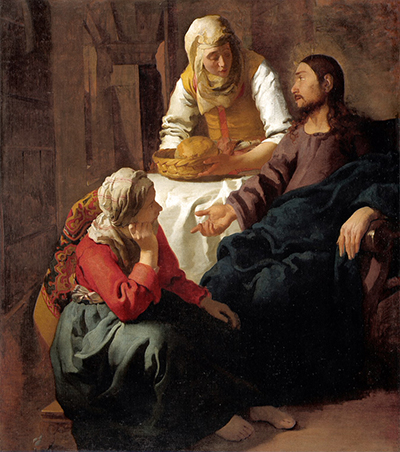
Christ in the House of Martha and Mary shows Johannes Vermeer working on an unusually large scale and with an explicitly biblical subject. Three figures occupy a substantial interior: Christ sits beside a table, Martha stands behind it with food, and Mary listens at his feet. Their relationship is carried by a small number of gestures, concentrated areas of colour and the different directions of their attention.
The National Galleries of Scotland identifies the painting as an oil on canvas of about 1654–55, measuring 158.5 by 141.5 centimetres, accession NG 1670. It is Vermeer's largest surviving painting. Its broad treatment and ambitious subject offer a valuable counterpoint to the smaller domestic interiors for which he later became famous. [1]
At a Glance
- CollectionNational Galleries of Scotland, NG 1670
- Dateabout 1654–55
- SubjectLuke 10:38–42
Works in context
Contents
The encounter in Saint Luke's Gospel
The subject comes from Luke 10:38–42. Martha welcomes Christ into her home and occupies herself with the work of hospitality. Mary sits and listens to his teaching. When Martha asks that her sister help, Christ responds by defending Mary's choice to listen. The story contrasts two forms of attention without denying that the domestic work is real.
Vermeer makes that contrast intelligible through bodies and objects. Martha's standing position connects her with the table and the provision of food. Mary's lower, seated position brings her close to Christ as a listener. Christ's gesture establishes the relationship between the sisters as the central issue of the encounter.
The painting does not need to show a great variety of servants or household tasks to convey Martha's activity. A few carefully chosen elements are enough. This concentration allows the figures to carry the narrative, while the viewer's attention moves between their faces and hands rather than becoming dispersed through an elaborate interior.
A triangular exchange
The three figures create a stable but active arrangement. Each belongs to a different height within the composition, and the eye moves between them along the lines of arms, shoulders and glances. The table helps connect their separate positions while keeping the relationship between standing and seated bodies clear.
Christ's hand is particularly important. Set against a lighter area, it remains visible even when the picture is viewed as a broad arrangement of tones. It connects speech with gesture: the mouth need not be dramatically open for the viewer to understand that he is responding to Martha and directing attention towards Mary.
Mary's posture produces a different kind of activity. Listening has no obvious movement comparable to carrying food or raising a hand, yet Vermeer gives it bodily form. Her position near the ground makes her appear receptive without turning her into a passive ornament. She is one of the three participants who determine the painting's shape.
Light, cloth and ordinary things
The tablecloth is one of the composition's most effective devices. Its brightness creates a field against which hands and objects can be distinguished. The folds also prevent the light area from becoming a flat interruption. The fabric has weight, changes direction and belongs to the same physical space as the figures.
Bread gives the scene an ordinary material presence. Its inclusion makes Martha's hospitality visible, while its light and colour offer a smaller point of concentration within the larger design. A viewer can recognise the particularity of an object without losing the central human exchange.
These passages are useful when comparing the painting with Vermeer's later work. His mature interiors often depend on an exact relationship between a figure, a table and a few objects. Here that problem is already present, though addressed through larger figures and broader painting. The continuity lies in pictorial relationships, not in an identical surface finish.
An early ambition in history painting
In seventeenth-century artistic theory, history painting encompassed subjects drawn from scripture, classical literature and history. It required the painter to choose a narrative moment and make the actions and emotions of its participants understandable. This painting shows Vermeer engaging with that ambitious category early in his career.
The National Galleries' interpretation relates its handling of light and figures to the Utrecht painters who had absorbed Caravaggio's influence. That is a discussion of pictorial affinities, not proof that Vermeer travelled to Italy or studied in a named master's workshop. Those further claims would require documentary evidence. [1]
The early religious subject also belongs beside Diana and her Nymphs and the dated Procuress in an account of Vermeer's development. The Metropolitan Museum's study of The Milkmaid reproduces the Edinburgh canvas within this early group. The comparison helps establish the range of subjects and formats from which his later practice emerged. [2]
Patronage and the limits of what is known
The painting's size and subject suggest a particular commission rather than an incidental studio exercise. The precise original destination, however, has not been established. A Catholic patron or religious setting has been proposed in connection with Vermeer's family circumstances, but a proposed context should not become an identified commission without a supporting record.
This uncertainty is meaningful. A large religious painting could be made for different kinds of private or communal setting. Its biblical subject alone does not identify the room in which it first hung, the person who paid for it or the denominational experience of every viewer who encountered it.
The safest interpretation begins with the object itself and the documented facts of Vermeer's early career. Its scale demonstrates ambition. Its subject requires an informed account of scripture. Its surviving history leaves parts of its original social setting open. Those conclusions can stand together.
Rediscovery and attribution
The painting was not always recognised as a Vermeer. The National Galleries' account describes the discovery of the signature during cleaning in 1901 and the subsequent recognition of the work as part of his small surviving output. It entered the Scottish collection in 1927 through a gift by the sons of William Allan Coats in memory of their father. [1]
The history of attribution helps explain why early works can challenge an artist's familiar reputation. If Vermeer is defined only by small, meticulous interiors, a large biblical canvas can initially seem difficult to accommodate. The object broadens that definition by showing a younger painter working through other pictorial possibilities.
It also encourages a careful use of the word awkward. Differences from the later paintings should first be described: a broader touch, a larger figure, a stronger contrast or a more compressed spatial relation. An assessment becomes useful when it explains those differences rather than merely measuring the early work against a later ideal.
A painting about attention
The story's argument remains visible in the way Vermeer asks us to look. Food and fabric reward material observation, while the exchange between Christ and the sisters requires attention to gesture and listening. The painting thus gives physical form to the problem it represents: how a person directs attention among the demands of the immediate world.
Its importance is not limited to its place at the beginning of Vermeer's career. It demonstrates how a biblical narrative can be concentrated into a few bodies and ordinary objects. The scene has enough breadth to sustain a public religious subject and enough restraint to anticipate the quiet human encounters of his later art.
Artworks and records
Selected documented works and records relevant to this article; this is not a complete catalogue.
| Name | Date | Record |
|---|---|---|
| Christ in the House of Martha and Mary | about 1654–55 | Painting |
| Diana and her Nymphs | about 1653–54 | Painting |
Discussion
Share a reading of the figures, materials or relationships discussed in this article.
Reader Insights
Which detail most affects your reading?
Which comparison would you like to explore further?
Join the Conversation
Share a detail, comparison or question about Christ in the House of Martha and Mary by Vermeer below.
References
- National Galleries of Scotland, Christ in the House of Martha and Mary, NG 1670, object record and John Leighton collection essay. View source.
- Walter Liedtke, The Milkmaid by Johannes Vermeer, Metropolitan Museum of Art, 2009, early-work comparisons. View source.
- Saint Luke, Gospel, chapter 10, verses 38–42, narrative source.
- Mauritshuis, Diana and her Nymphs, 406. View source.